Canadian politics are sexist. What are men going to do about it? 

Worth reflecting and acting upon:

A 2016 survey of 55 female parliamentarians from 39 countries found that 44.4 per cent had received threats of death, rape, beatings or abduction, and 65.5 per cent said they had “often” been subjected to humiliating sexist remarks from male colleagues. And, of course, we all know what happened toHillary.

Good ideas have been floated to address this hostility towards female politicians: last week, the Alberta Council of Women’s Shelters created the Lift Her Upcampaign to challenge sexist bullying; and Notley believes we should be encouraging more women to enter politics. In the U.S., women are already responding to the 2016 presidential election by pursuing their own runs for office: since November, more than 4,500 of them have signed up for She Should Run, a new organization that trains women for public life. 

But a quick and simple solution is unlikely. The threats and harassment are bound to get worse before they get better. And what’s more: This isn’t women’s problem to fix. This one is up to men. Because men—and it is almost entirely men who’ve been targeting female politicians—are reacting to a very real change. As Don Braid wrote in the Calgary Herald, “Alberta has become a kind of social laboratory, unique in North America, to test whether a near-majority of women in a government caucus makes a change in style and substance. The verdict is already in—they do, as shown both by Notley’s conciliatory style and the NDP’s advancement of women and minorities.”

There are some men who find this progress very, very threatening. For them, the advancement of women, people of colour and LGBT people in politics and other arenas feels like a personal attack. It feels like what has been rightfully and unquestionably theirs for so long is now being stolen away.

American author and academic Michael Kimmel calls this “aggrieved entitlement.” In his book, Angry White Men, which came out in 2013 but seems even more relevant now, Kimmel surveys the growing rage among neo-Nazis, gamers, right wing talk radio hosts and men’s rights activists who define their masculinity and manhood in terms of dominance and power and who believe in their “God-given right” to rule the world.

Female politicians from the right, left and middle have been attacked. Those who identify as feminists have been harassed as well as those who don’t. Their haters simply don’t like that these women are smarter, more powerful and more successful than they are. Given the narrow way they define their manhood, it’s emasculating.

To put it in terms those guys will understand, what they really don’t like is that these women have bigger balls than they do. (Because whether or not you agree with the politics of these women, you have to recognize the guts and perseverance and hard work it takes to run for office.)

Men who believe in equality need to champion the idea of women in power and, more significantly, they need to model for other men that they are respectful of and comfortable with female leaders and female bosses. Michael Kimmel suggests we might start to address white male rage by creating a new definition of masculinity doesn’t depend upon male supremacy, but instead embraces egalitarianism and a true meritocracy.

It turns out that inclusion and social equality are good for white guys, too. Men in marriages where the responsibility for domestic chores and financial support are more evenly shared report higher levels of happiness and less depression. And societies that care for the rights and well-being of all their citizens tend to be the ones that provide a social safety net to protect those, including white men, who have lost jobs or feel disempowered.

Over the last several decades, women have redefined their roles, moving into fields that were previously off-limits, like politics. Now it’s up to men—white, straight men in particular—to redefine theirs. What does it mean to be a man when it’s no longer just a man’s world?
For racialized communities, electoral reform is about more than voting | Toronto Star

While Avvy gets the numbers wrong – there are 47 visible minority MPs, not 46  (14 percent), close to the 15 percent of visible minorities who are also Canadian citizens and who can vote, her broader point on the need for better representation would benefit for more attention to the declining naturalization rate, and how that disproportionately affects visible minorities, and hence participation in elections (see Citizenship Applications: Third Quarter Continues to Show Decline).

Moreover, while it is legitimate to criticize the specific choices of which  visible minorities made it into Cabinet (four Canadian Sikhs, one Afghan Canadian), a broader look at senior political positions (parliamentary secretaries etc) and Senate appointments presents a more nuanced picture (see my Government appointments and diversity).

My focus is more on the declining naturalization rate given the longer term impact on social inclusion/cohesion and representation:

When the 46 so-called “visible-minority” MPs were elected to the Canadian Parliament in the 2015 election, some media called it a “watershed” moment in our history and a victory for Canada’s multiculturalism. In reality, out of a total of 338 seats, the politicians from different communities of colour represent just over 13 per cent of Parliament, while about 19 per cent of Canada’s population is made up of people of colour, with the largest three groups being South Asian, Chinese and black, who together made up 61 per cent of all communities of colour. When Trudeau named his cabinet, one that he described as looking like Canada, not one Chinese or black made it to his short list.

Today, tens of thousands permanent residents of Canada are denied the right to vote because of the strict naturalization law, not to mention the 200,000 or immigrants with precarious status who have lived and worked in Canada for years, in some cases decades, without ever given a chance to regularize their status.

As Canadians ponder which electoral system will be best for our democracy, considerations should be given for the following two questions:

  • Which electoral system will be best able to engage the marginalized communities, including racialized communities and new Canadians, in order to ensure their full participation in the democratic process.
  • Regardless of which system is chosen, what can we do to make our political bodies more fully reflect the makeup of Canada?

On both questions, the special committee report fell short. While the Report did make some passing references to the need to increase representation of “visible minorities,” no specific recommendation — or an attempt to come up with one — was made to address this issue.

This is in contrast with the committee’s treatment of some of the other under-represented groups, or groups that are not as engaged in the political process as they should, such as indigenous peoples, students, youth, people with disabilities, and women, where there were specific sections in the report devoted to analyzing how to increase their democratic purification, and in the case of indigenous people and women, their political representation. But even then, the committee did not offer any concrete solutions for these critical challenges.

The government has since been hosting its own online consultation to gather public opinion. Apart from offering no public education or information about the electoral reform process or the various possible options, the questions posted on Mydemocracy.ca are replete with false dichotomy.

Canadians are asked a number of “either-or” questions, as if the choices presented are mutually exclusive. One question assumes, for instance, a system that requires greater collaboration among parties would be less accountable. Another asks Canadians to choose between improving representation of under-represented groups and greater political accountability.

While there is no perfect system, there is no reason why we cannot aspire to design a system that is inclusive, accountable, and above all, responsive to all Canadians.

Source: For racialized communities, electoral reform is about more than voting | Toronto Star

More people should engage in politics so ‘no party gets to run against Muslim Canadians,’ Justin Trudeau says

Pitch perfect:

Galloway asked the prime minister for his reaction to the proposal to screen immigrants for “anti-Canadian values” put forward by federal Conservative leadership candidate Kellie Leitch.

Trudeau did not address Leitch by name. He said he told a group of Muslim-Canadians during a recent meeting that he was happy to have them as supporters. However, he said he suggested they encourage family members and friends to also get involved in politics, whether on behalf of the Liberals or another party that aligns with their values.

Media placeholder

“The other two political parties have leadership races on now. I’d like to see more Canadians of diverse backgrounds engaging with parties that line up with their convictions and ideologies to make sure that no party gets to run against Muslim Canadians or any other group of Canadians and demonize them,” Trudeau said.

“And I think the way we do that is getting involved in the whole breadth of the political spectrum in Canada. I’m happy when people decide they are more aligned with me and my party, but they should also think about being active and aligned with parties that disagree with me on certain issues.”

Galloway also asked the prime minister about how his policy, which has brought more than 35,000 Syrian refugees to Canada in just over a year, contrasts with that of U.S. president-elect Donald Trump and some politicians across Europe, who advocate for a more closed approach on refugees.

“I’m not going to answer whys,” he said. “I’m just going to continue to point out the facts that the way Canada is benefiting from welcoming in people who are so deeply committed to living up to the opportunity given to them.”

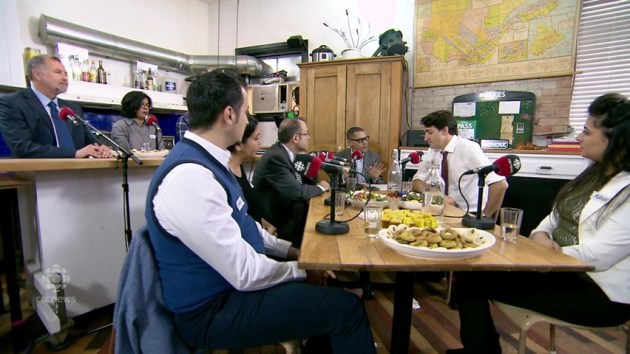
He added, “I challenge any one of those governments or those citizens to sit down around a table like this and break bread and not be afraid of the other.”

Source: More people should engage in politics so ‘no party gets to run against Muslim Canadians,’ Justin Trudeau says – CBC.ca | Metro Morning

Donald Trump could happen in Canada. It’s already begun. – Macleans.ca

Some good analysis and questions regarding the resilience of Canadian politics to Trump-style politics, focussing on the ugliness in the Alberta PC leadership campaign and the Leitch/Blaney campaign approaches.

Starting with Charlie Gillis:

The question, say experts, is whether support for such ideas could galvanize into a Trump-style movement. Ice-breakers like Blaney and Leitch are exploiting the same rural-urban cultural divide that Trump did in the U.S., acknowledges Clark Banack, a Brock University political scientist who studies populist movements. But the kind of anti-elitist discontent that moves votes is seldom seen in Canada outside the West, Banack notes, and when it arises elsewhere, it tends to be short-lived. “We have sporadic examples of people emerging for a short time around a specific issue,” he says, citing Rob Ford’s rise to the Toronto mayoralty on the strength of working-class, suburban anger. “But overall, Canadian political culture is less susceptible to populism than American political culture.”

Another mitigating factor: the relative absence in Canada of a dispossessed working class in a mood to punish its leaders. David Green, a professor at the University of British Columbia’s Vancouver School of Economics, believes Trump’s support base of white men with no college degree would be hard to replicate in this country because the commodities boom sustained Canada’s blue-collar workers, even as the financial crisis crushed the dreams of their counterparts in other countries. Between 2003 and 2015, he notes in a forthcoming paper, mean hourly wages for Americans with a high school education or less fell by six per cent; for the same demographic in Canada, they climbed eight per cent. The effect, he says, was to slow the growth of the economic gap that has fed voter rage in the U.S., the U.K. and parts of Europe. Last year, our top 10 per cent of earners made 8.6 times on average what the bottom 10 per cent pulled in—a ratio that, while high, falls beneath the OECD average and far below the U.S. ratio of 19 to one.

But all that could change, Green warns, if oil prices remain low—especially if the housing market weakens at the same time. The country’s residential construction boom, he notes, has maintained job centres around the country’s large cities, putting more than a few displaced oil patch employees to work. “What do you do with that set of less-than-university-educated guys—the demographic that switched over to Trump?” Green asks. “That’s a potentially worrying connection.”

More so, agrees Banack, if you have a high-minded central government that overlooks their misfortune while pursuing its own pre-occupations. Running against Ottawa, he notes, is a time-tested stratagem for populist movements in Canada, and these days, few national governments are more closely identified with the globalist program of trade, labour mobility and climate-change action than Justin Trudeau’s Liberals. Something like Trudeau’s promised national carbon tax, which will be felt keenly in the West, could be enough to trigger a populist insurgency in Alberta, he says, though it’s safe to assume the federal Conservative party would do everything it could to stop such a movement, given the outcome of the Reform party experiment: “Another vote split, and you could forget about a Conservative federal government for another 10 or 15 years.”

Maybe, but experienced political players are no longer sure economic logic and conventional political calculus are in force. Carter, the Alberta strategist, notes that the online communities where so-called “alt-right” voters congregate—Facebook groups, or conspiracy-fuelled sites like Infowars—don’t traffic in that sort of information. In its place: a strain of fanaticism typified by the onslaught that ran Jansen off the PC stage, which Carter believes is sure to spread. “I don’t know if it’s Trump or social media or just belief that they’re correct that gives a sense of permission,” he says. “But this is not normal.”

Gary Mason in the Globe picks up similar themes:

The Premier and her party are now sitting at 14 per cent in the polls. The party receiving the most support in recent public opinion surveys is the Progressive Conservatives, the same entity Mr. Kenney plans to destroy if he wins the leadership. He wants to build a new political organization that Wildrose members will feel comfortable joining as part of an overarching bid to unify conservative forces in the province.

Either way, Alberta seems to be preparing to make an ideological course correction.

There’s little doubt the rise of Donald Trump has emboldened many in the province. One of those would appear to be Derek Fildebrandt, a Wildrose MLA and one of the most powerful conservative voices in Alberta.

He has little patience for the likes of Ms. Jansen and others complaining about online trolls and provocateurs. “Hypersensitive, politically correct, victim-as-virtue culture is creating a leadership class of wimps,” he wrote in a tweet that could have been sent out by The Donald himself. “People are sick of it.”

After Mr. Trump was elected, Mr. Fildebrandt tweeted: “The biggest lesson that we should learn from the election of Trump: smug, condescending political correctness will spark a backlash.”

I’m not sure what is happening in Alberta, but on almost any level it’s not good. Trump-style politics could well be making its way north of the border. At the end of the day, however, society gets the politicians it deserves.

Source: Not so progressive: Trump-style politics seep into Alberta

ICYMI: China trip may help Trudeau win Chinese-Canadian votes

Good and interesting analysis regarding the differences among Chinese Canadians voting patterns and the efforts by the Liberals and Conservatives to attract their votes. For the breakdown of major voting groups in the 33 ridings where visible minorities are in the majority, see 2015 Election Top 33 ridings more than 50 % visible minorities):

As Justin Trudeau tries to build economic ties during his first state visit to China, he may also be helping himself a little with a political goal back home: breaking through with the country’s largest immigrant group.

Among the very few disappointments for Mr. Trudeau’s campaign team, in last year’s election, was how their party fared with Chinese-Canadians. Liberal candidates did as well or better with just about every other demographic as they could reasonably hope; this was one with which they struggled, and the Conservatives retained strength, more than they anticipated.

Markham-Unionville, with the highest concentration of Chinese-Canadian voters of any riding nationally, was one of the very few Greater Toronto Area seats where the Liberals failed to top the Tories – and, according to members of Mr. Trudeau’s inner circle, the only seat in the country they wrongly expected to win.

 The one other riding where more than half of eligible voters are of Chinese descent, the Vancouver-area Richmond Centre, also proved beyond their grasp; narrower-than-expected margins in a few ridings they did win, notably in Toronto’s inner-suburb of Scarborough, suggested a pattern.

It’s one the Liberals need to break, as the country’s largest immigrant population – 1.5 million and growing – could yet be the difference in a close election.

But there are no shortcuts, in the form of goodwill from foreign trips or anything else, to breaking through. Based on conversations with party organizers who have worked on the ground in Chinese communities, the reality is more an array of complex factors that the Liberals will have to work hard to change.

Underscoring the nuance is a key distinction between families who came from Hong Kong, mostly through to the 1980s, and those who have come from mainland China in the past couple of decades. The general consensus is that the Liberals tended to do better with the former and the Conservatives with the latter in last year’s vote.

While that may have helped the Liberals at least significantly narrow the gap from 2011 in a riding like Richmond Centre, where many of the Chinese-Canadian voters have Hong Kong roots, it’s of little consolation since even there those voters are increasingly being overwhelmed by waves of mainland emigrants.

The Liberals’ election postmortems seemed to leave them with all sorts of explanations for why they’ve struggled with the newer arrivals.

The most popular of those explanations, among Mr. Trudeau’s top officials, is social conservatism. The Conservatives made a concerted effort to convince immigrant voters (not just Chinese-Canadians) that the Liberals would allow the sale of marijuana to children; in Ontario, the Liberals also had to contend with controversy around their provincial cousins’ sex-education changes.

While such concerns may have gotten traction among evangelicals with Hong Kong roots, Liberals say they especially heard about them from mainlanders new enough to Canada to be worried about the radicalism of a party they had not seen much (if at all) in power.

Those issues may have penetrated partly because the Tories out-advertised the Liberals in Chinese-Canadian media. And Conservative-friendly ownership of leading outlets such as Fairchild TV and the Sing Tao Daily newspaper helped the Tories get more positive earned media than the Liberals in primary news sources for many relative newcomers – if not as it related to hot-button social issues, then in how the leaders and their agendas were generally presented.

That ties into a whole bunch of other explanations floating around. The Liberals’ polling, according to a source familiar with it, suggested former mainlanders were receptive to what some other Canadians saw as Stephen Harper’s authoritarian streak, considering him a much stronger leader than Mr. Trudeau.

A veteran organizer in the Chinese community suggested economic conservatism was borne of relatively affluent recent arrivals being concerned about their assets’ safety from government intrusion. Just as earlier waves of immigrants had a positive association with the Liberals because that party was in power when they got here, more recent ones might have felt that way about the Tories.

Merely having won government may help the Liberals with that last factor, and some of the others besides. They can set to rest some of the more extravagant fears about their social liberalism by not legislating like radicals. Mr. Trudeau will seem stronger just by virtue of his office.

A trip like this week’s is a prime opportunity to forge better relations with Mandarin media outlets, while also getting copious coverage in them. (Although it also runs the risk of alienating some of their supporters who came here from Hong Kong, and are wary of Canada’s government cozying up to the Middle Kingdom.)

But there is also an underlying reality that belies quick fixes, and will test the Liberals’ commitment to their “hope and hard work” mantra to winning over voters.

Source: China trip may help Trudeau win Chinese-Canadian votes – The Globe and Mail

Why the ‘barbaric cultural practices’ debate won’t go away: Delacourt

One of the better commentaries on Kellie Leith’s “barbaric cultural practices” repeat performance:

The good news for Kellie Leitch — and she might need some right now — is that many Canadians believe this country needs young, female political leaders.

The bad news is that most Conservatives — the people who make up the party Leitch wants to lead — do not share that view.

These findings come from new research by Abacus Data. By sheer happenstance, Abacus and the Leitch leadership campaign were out in the field in late August, doing some survey work that touched on Canadian values. The two surveys dovetail in some fascinating ways.

The Leitch survey asked, controversially, whether respondents would support screening immigrants for “anti-Canadian values.” This was quite the surprise coming from the MP for Simcoe-Grey, once the federal labour minister, who only months ago was apologetically backtracking for her role in the infamous “barbaric cultural practices” tip line proposal of the 2015 election campaign.

Now, we seem to be back in the middle of a debate we thought had been settled in the last election. Maybe it wasn’t.

The Abacus survey sounded people out on the traits and values they’re seeking in political leaders. Leitch and her supporters no doubt will be heartened to hear that 54 per cent of respondents to the Abacus poll said they would prefer a woman leader. Moreover, a whopping 65 per cent — nearly two-thirds — said they would rather have someone under 50 years of age. Leitch, 46, comfortably meets both criteria.

The problem for Leitch, however, is that her own fellow Conservatives aren’t as enthusiastic about young female leaders. Almost 60 per cent of Conservative respondents to the Abacus poll said that if they had their choice between someone over 50 and someone under 50 to lead a political party, they’d select the older candidate. Only 13 per cent said they would prefer a younger, female leader.

Those results are even more striking when compared to the views of Liberal and NDP supporters who participated in the Abacus poll. Nearly 70 per cent of Liberals and 77 per cent of NDP supporters said they’d opt for a woman leader given a choice between a man and a woman of equal qualifications.

The obvious conclusion, then, is that Leitch is running for the wrong party. Then again, she might have trouble selling Liberal or NDP voters on the idea of screening immigrants for potential anti-Canadian values.

Even some folks in her own party (her leadership rivals, anyway) are balking. Michael Chong called it “dog-whistle politics.” Maxime Bernier, taking a more practical approach, called it an “unworkable” idea.

open quote 761b1bClearly, Leitch’s campaign believes this issue taps into a rich vein of support, at least in Conservative circles. Which could explain why Bernier called the idea ‘unworkable’ rather than, say, ‘egregious.’

Abacus conducted its poll online in late August, asking 2,010 Canadians of voting age all kinds of questions about their ideal political leaders. When they got around to the subject of leadership qualities, the results turned out to be highly interesting.

The top two traits? “Understanding different parts of the world” and “thinking about what’s right for the next generation.” Respondents also placed a high value on leaders who “think a lot about the future of the world”, are “open-minded about different lifestyles” and “care about the poor.”

Buried in the list, however, is a possible rationale for Leitch’s controversial survey question.

Only 18 per cent of the respondents to the Abacus poll said that a leader must embrace the idea that “immigration is good for Canada.” Understanding different parts of the world is one thing, apparently, while welcoming them here is another matter entirely.

Nick Kouvalis, Leitch’s campaign manager, has said that the survey was based on what the campaign had been hearing out on the road over the summer. Kouvalis, for those who may have forgotten, has not been shy in the past about courting controversy with provocative survey questions. His firm, Campaign Research, was scolded by the Commons Speaker several years ago for polling Montreal residents about Irwin Cotler’s allegedly imminent resignation. (Cotler, then the MP for Mount Royal, protested in the Commons that the survey breached his parliamentary privileges, though he did eventually step down before the last election.)

Kouvalis, let’s also remember, was one of the early backers and staffers for former Toronto mayor Rob Ford (he was also one of the first to walk away when things started to go crazy in Fordland). Kouvalis was on John Tory’s team in the last mayoralty election in Toronto and helped B.C. Premier Christy Clark pull off an unexpected victory in 2013.

On Twitter, Kouvalis has been predicting that all the leadership candidates eventually will perform some “world-class gymnastics” to embrace Leitch’s views on screening immigrants for anti-Canadian values. Clearly, her campaign manager believes this issue taps into a rich vein of support, at least in Conservative circles. Which could explain why Bernier called the idea “unworkable” rather than, say, “egregious.”

Among the other admirable leadership qualities cited by respondents to that Abacus poll were the ability to “ask for help when you need it,” to “seek advice from smart people everywhere” and to “apologize when you make a mistake.”

One can’t help but notice that Leitch hasn’t apologized for this survey question — perhaps on the advice she needed from people she considers smart.

“Oftentimes, debating and discussing these complex policies requires tough conversations — conversations that go well beyond media sound bites and simplified labels,” Leitch wrote in an emailed statement after the controversy.

“I am committed to having these conversations, to debating theses issues, and I invite Canadians to give their feedback.”

So, like it or not, immigration may become a hot-button issue in the Conservative leadership race. Consider this an early warning — especially for those complacent Canadians who say that Donald Trump’s rhetoric on immigration couldn’t possibly work here.

The people in Leitch’s Conservative party may not be the biggest fans of female leaders under 50, but this particular candidate could be giving them the campaign’s sleeper issue. In other words, the debate about “barbaric cultural practices” didn’t die in 2015; it’s simply been slumbering, waiting for an opening.

Source: Why the ‘barbaric cultural practices’ debate won’t go away

Liberal, Moderate or Conservative? See How Facebook Labels You – The New York Times

Not surprising that Facebook is doing this kind of analysis. Does not appear to work for Canadian political leanings when I checked my profile (no “Canadian politics” tab):

You may think you are discreet about your political views. But Facebook, the world’s largest social media network, has come up with its own determination of your political leanings, based on your activity on the site.

And now, it is easy to find out how Facebook has categorized you — as very liberal or very conservative, or somewhere in between.

Try this (it works best on your desktop computer):

Go to facebook.com/ads/preferences on your browser. (You may have to log in to Facebook first.)

That will bring you to a page with your ad preferences. Under the “Interests” header, click the “Lifestyle and Culture” tab.

Then look for a box titled “US Politics.” In parentheses, it will describe how Facebook has categorized you, such as liberal, moderate or conservative.

(If the “US Politics” box does not show up, click the “See more” button under the grid of boxes.)

Facebook makes a deduction about your political views based on the pages that you like — or on your political preference, if you stated one, on your profile page. If you like the page for Hillary Clinton, Facebook might categorize you as a liberal.

Even if you do not like any candidates’ pages, if most of the people who like the same pages that you do — such as Ben and Jerry’s ice cream — identify as liberal, then Facebook might classify you as one, too.

Facebook has long been collecting information on its users, but it recently revamped the ad preferences page, making it easier to view.

The information is valuable. Advertisers, including many political campaigns, pay Facebook to show their ads to specific demographic groups. The labels Facebook assigns to its users help campaigns more precisely target a particular audience.

For instance, Donald J. Trump’s presidential campaign has paid for its ads to be shown to those who Facebook has labeled politically moderate.

Campaigns can also use the groupings to show different messages to different supporters. They may want to show an ad to their hard-core supporters, for example, that is unlike an ad targeted at people just tuning in to the election.

It is not clear how aggressively Facebook is gathering political information on users outside the United States. The social network has 1.7 billion active users, including about 204 million in the United States.

Political outlook is just one of the attributes Facebook compiles on its users. Many of the others are directly commercial: whether you like television comedy shows, video games or Nascar.

To learn more about how political campaigns are targeting voters on social media, The New York Times is collecting Facebook ads from our readers with a project called AdTrack. You can take part by visiting nytimes.comand searching for “Send us the political ads.”

Source: Liberal, Moderate or Conservative? See How Facebook Labels You – The New York Times

Can Jason Kenney throw a rope around Alberta’s unruly Right? Delacourt

Good column by Susan Delacourt on Kenney’ s move to Alberta politics and his many strengths, with a nice shout out to my books:

One of the events obliged panelists to give quick answers to provocative questions posed by the audience. “Who’s the best cabinet minister in Ottawa right now?” someone asked. I didn’t even have to pause for thought: “Jason Kenney,” I said. Many others on stage and in the audience shared that view.

It wasn’t just his reputation for hard work, although that certainly was a factor. Kenney was everywhere in the old Conservative government, building his clout on the political front (with those cultural communities and others) but also on the policy front. I was told once that Kenney had a representative at every meeting in Ottawa, keeping tabs on all kinds of decision-making processes, even those beyond his ministerial brief.

open quote 761b1bKenney does have strong views (no one’s going to mistake him for a Red Tory) but the caricatures ignore his practical side. And party mergers need practical politicians.

For a sense of what kind of minister Kenney was, I tend to urge people to take a look at books published by Andrew Griffith, a former director general in Kenney’s old department of Multiculturalism. Griffith has written revealingly of a public service coming to grips with a minister who had definite ideas about how to blend policy and politics, evidence and anecdote.

And where many ministers hewed to the PMO diktat and avoided contact with the media, Kenney was eminently approachable. I don’t think he ever said no when I asked him for comment on one thing or another. (Though he hasn’t replied to a message I sent him today as I was writing this article.)

For years he held annual Christmas parties at which reporters were not only welcome, but positively encouraged. The reward for attending was getting to hear Kenney tell funny, behind-the-scenes stories about the Harper government — nothing headline-making, just anecdotes that presented his political workplace as a little less stuffy and aloof.

And it was never hard to find opposition MPs during the Harper years willing to say that Kenney (along with John Baird) was one of the more co-operative ministers in cabinet, willing to occasionally drop the hyper-partisan posture that characterized so much of that government’s style.

This version of Jason Kenney is at odds, naturally, with the caricature painted by his critics — of a rigid, even scary, ideologue. Kenney does have strong views (no one’s going to mistake him for a Red Tory) but the caricatures ignore this high-energy politician’s practical side.

And party mergers need practical politicians. Harper was a pragmatist when he set about uniting the old federal PC party with the Canadian Alliance back in 2003.

Still, I will concede that I’m finding it hard to square the more nuanced Kenney I saw with the politician who tweeted out his support for the Brexit vote a couple of weeks ago. Given that much of Brexit’s support came from hostility towards immigrants, it seemed odd, to say the least, to see a former immigration minister — a courter of cultural communities — on that side of the question.

Interim Conservative Leader Rona Ambrose, I noticed, also seemed at a loss to explain the support for Brexit from the likes of Kenney and Tony Clement in an interview last weekend on CBC’s The House — suggesting vaguely that it might have something to do with friendships they’ve forged abroad.

Perhaps it was just Kenney keeping things interesting, blurring the tidy lines of the boxes people want to throw around him. If he is going to seek the leadership of the Alberta PCs, that in itself is a bit of a surprise; many people expected to see him seek the leadership of the federal Conservatives.

It may not be a good sign for those federal Conservatives that Kenney sees his future elsewhere right now. He became pretty adept — as his old boss would attest — at figuring out where there was room for growth in the conservative movement.

Could he pull off a merger in Alberta? I wouldn’t put it past him. Kenney has developed a knack for doing — and being — the unexpected.

Source: Can Jason Kenney throw a rope around Alberta’s unruly Right?

Because it’s 2015 … Implementing Diversity and Inclusion – My latest ebook

because-its-2015_pdf__page_1_of_59_Over the past months, as many of you know, I have been doing a series of articles on the 2015 election, Cabinet and other senior appointments, along with baseline data for the public service, Governor in Council and judicial appointments by which to measure the government’s implementation of its diversity and inclusion commitments.

I have integrated and updated these in mini-book form, available as a free download from:

iPad/Mac version (iBooks)

Windows version (PDF)

I hope you find this compilation and the reference data it provides of interest and use.

The description is below.


——————-

Because it’s 2015 … Implementing Diversity and Inclusion

Canada’s 2015 election provided a sharp contrast between the social cohesion focus of the Conservative party and its use of identity politics, and the Liberal party’s emphasis on diversity and inclusion. This was not only reflected in policy and language but in candidate recruitment, with the Liberals having the largest number of visible minority candidates, although Conservative and NDP numbers also increased.

The overall voting shift to the Liberals was particularly strong among new Canadian voters, reflecting a mix of the overall shift to the Liberals in this election, perceived anti-immigrant bias and identity politics, and lack of support for Conservative restrictive citizenship and immigration policies.

In power, the Liberals implemented their diversity and inclusion commitment through the establishment of a Cabinet Committee on Diversity and Inclusion, Cabinet and Parliamentary Secretary appointments, Ministerial mandate letters and initial Senate appointments. They also set expectations for other senior appointments.

This short book provides data and related analysis with respect to the election results, political representation and leadership positions, and establishes the 2016 baseline for senior public servants, Governor in Council and judicial appointments by which to judge the Government’s implementation.

With over 40 charts and tables, Because it’s 2015 … is an invaluable reference for those interested in Canadian politics and diversity. iPad optimized.

Table of Contents

  1. Introduction
  2. Political Institutions
  3. Public Service Impact
  4. Governor in Council Appointments
  5. Judicial Diversity
  6. Concluding Observations

Tories unfairly targeted Muslims during election, supporter tells convention

Jenni Byrne still in denial mode?

A Muslim Conservative supporter took to the floor of the federal Tory convention in Vancouver to accuse her party of unfairly targeting Muslims during the failed 2015 election campaign.

Urz Heer, who hails from the riding of Brampton South in the Toronto area, told Conservative Party executive director Dustin van Vugt that the party made her feel like an outsider.

The Tories came under fire during the 2015 campaign for vowing to ban people from wearing the niqab head covering during citizenship swearing-in ceremonies and for pledging to consider barring public servants from donning the same garb at work.

 “This party worked actively and aggressively against my people,” Ms. Heer said as some fellow Conservatives disputed what she was saying.

“It did,” she said. “It didn’t differentiate who Muslims were versus the enemy.”

She said Conservative tactics spurred Muslims to vote against the Tories in the election, Ms. Heer said.

“For the first time I felt like I didn’t belong here and this was my country,” the Conservative delegate said.

Former Conservative campaign manager Jenni Byrne, also attending the Vancouver party convention, defended the campaign’s conduct. The Tories also promised late in the campaign to set up a tip line so Canadians could report allegations of “barbaric cultural practices.”

Ms. Byrne noted that Mr. Harper’s announcement in early October last year that his government would consider a ban on niqabs in the public service followed a court decision on the headgear.

A day before the Conservative Leader’s statement, the Federal Court of Appeal had rejected the Tory government’s request that its ruling on the unlawfulness of barring the garb from citizenship ceremonies be put on hold while it sought leave to take the matter to the Supreme Court.

“In terms of the barbaric cultural practices or the niqab debate, the campaign had absolutely no choice but to speak on it, the [former] prime minister had choice but to speak because there was a court ruling midway through the campaign. It wasn’t that it was a campaign choice. It was: we had to react to a court case,” Ms. Byrne said.

Source: Tories unfairly targeted Muslims during election, supporter tells convention – The Globe and Mail