Beaudry: Au-delà des chiffres sur le français et les étudiants étrangers

Useful reminder that Quebec francisation policies are harder for PhD students:

Les étudiants étrangers font la manchette : on leur attribue divers maux de notre société, du déclin du français à la crise du logement. Mais plutôt qu’alimenter la guerre de chiffres que se livre différentes factions en matière d’immigration, ce texte relatera plutôt une belle histoire de volonté et de résilience.

En matière de francisation, la réalité des études supérieures contraste avec celle des études de premier cycle. À l’instar de plusieurs universités en Europe et ailleurs, la pression pour donner les cours et faire la recherche en anglais est très forte.

Bien que ce ne soit pas la mission de nos universités de franciser les étudiants allophones, rendre plus flexibles nos programmes d’études supérieures pour leur permettre de suivre de vrais cours de francisation est nécessaire, puisqu’avantageux pour tous. Mais cela prend du temps et de l’argent. Faire son doctorat et suivre des cours de francisation en même temps relève du parcours du combattant.

À Polytechnique, comme dans beaucoup d’autres institutions, le doctorat à temps partiel n’existe pas : il faut franchir à vive allure toutes les étapes dans les temps impartis. Si nous voulons contribuer à l’intégration des personnes étudiantes que nous accueillons et formons, nous devons repenser ces premières années des programmes d’études supérieures.

Ce temps supplémentaire exerce aussi une pression énorme sur les fonds de recherche des universitaires qui appuient ces personnes pendant une plus longue période d’études.

À Polytechnique, j’enseigne en français. Un de mes étudiants de doctorat dont le français se résumait à « bonjour » s’inquiétait de ne pas pouvoir suivre les cours et bien comprendre la matière. Pour les cours du trimestre d’hiver 2022, nous nous sommes donc tournés vers la technologie pour pallier son manque de compréhension du français. Il a installé une application sur son téléphone cellulaire qui traduit de façon simultanée la langue parlée. Une des oreillettes était placée sur mon bureau (elle servait alors de micro) et il avait l’autre dans l’oreille (où étaient diffusées mes paroles traduites en anglais). Le texte traduit en anglais défilait aussi sur son téléphone, avec un petit délai différent de celui de la voix en anglais. Ce n’était pas parfait, mais il estime que 60 % de la traduction était compréhensible et correcte. En plus de cet équipement mal synchronisé, il a traduit en anglais tous les documents et présentations de ses cours du trimestre.

À l’été 2022, je lui ai demandé pourquoi il n’était jamais disponible avant 14 h. J’ai déjà eu des étudiants lève-tard et des oiseaux de nuit, mais si tard, je trouvais cela curieux. Il m’a avoué candidement et un peu honteux que depuis novembre 2021, il était inscrit à temps plein aux cours de francisation pour les personnes immigrantes et qu’il devait être en classe de 8 h à 13 h, et ce, tous les jours de la semaine.

Me voyant bouche bée, il m’a expliqué que, pour comprendre la réalité des personnes immigrantes au Québec, de façon à bien cerner cette dimension de son sujet de recherche, il devait se mettre dans leurs souliers. Il faut dire que sa thèse porte sur le rôle de l’immigration qualifiée et des étudiants étrangers sur la collaboration internationale en science, technologie et innovation.

Depuis le début de ma carrière de professeure, certains de mes étudiants ont bien suivi quelques cours de français ici et là au cours de leurs études — avec des résultats très mitigés, pour être honnête. Mais personne ne s’était encore prêté à cet exercice intense en plus de ses études doctorales.

Nous avons dû planifier l’examen doctoral et la présentation de sa proposition de thèse, qu’il a réussi avec brio, entre deux modules de cours de francisation. Avec la permission de son école de francisation, il faisait une pause pour reprendre lors du prochain module (dont la durée est d’environ huit semaines). Au moment où j’écris ces lignes, il ne lui reste que deux modules de cours de francisation à terminer, mais toute mon équipe de recherche l’encourage, converse avec lui en français et est fière de ses progrès.

S’astreindre chaque jour à cinq heures de cours de français, en plus des devoirs à faire le soir, des présentations orales à préparer, sans compter les cours de la scolarité doctorale, les travaux et les articles à lire en préparation de la proposition de thèse, représente une tâche titanesque.

Serez-vous surpris d’apprendre que cet étudiant a non seulement réussi avec succès son examen doctoral et présenté sa proposition de thèse, mais qu’il a aussi remporté l’une des prestigieuses bourses Vanier que le Canada offre à des étudiants exceptionnels et déterminés ? Félicitations, Amirali !

Plutôt qu’être un handicap pour les universités francophones, ce début un peu plus lent des études doctorales devrait être considéré comme un avantage qui rend nos diplômés plus attrayants dans un milieu très compétitif. Autant nos étudiants et futurs diplômés, leur famille, leur société d’accueil et les universités francophones en bénéficient.

Donnons-nous les moyens de remplir cette mission sociétale correctement.

Source: Au-delà des chiffres sur le français et les étudiants étrangers
Sweden: Academics protest against ‘fatal’ changes to Aliens Act

Seems counterproductive to make it harder for highly-skilled PhDs to transition to permanent residency:

Changes to the Aliens Act in Sweden, which impose onerous self-sufficiency requirements on international doctoral students and researchers and require them to leave the country to apply for Swedish residence permits for family members – even those born in Sweden – have been denounced by academic stakeholders.

The legislation was enacted after a heated discussion in parliament in June 2021.

Online magazine Universitetsläraren has identified several researchers that have had to travel as far afield as Asia to apply for visas to travel with their families to neighbouring countries such as Denmark or Germany. “With the COVID situation the travel can be very lengthy,” said researchers who did not want to disclose their identity.

Disruption

Erik Kvist, who is international coordinator at Lund University, said he and colleagues have been involved in similar cases where families have been uprooted from their work in Sweden to travel abroad, a process that can create problems at their workplaces and disrupts their lives.

Kvist said that in these cases the parents of the children are in Sweden on a valid residence permit. 

“The expulsion [out of the country] of a lone baby [without a permit] would be morally unacceptable, lead to great personal suffering and I am questioning how his can be related to the UN Convention on the Rights of the Child and the right to private and family life according to the European Convention on Human Rights,” Kvist said.

“The contention that one should make an application before the newborn baby came to Sweden is an unjust demand when the child is born in Sweden,” he said.

According to the press officer for the Swedish Migration Agency, Annica Dahlqvist, no exemptions to the rules will be offered.

Pil Maria Saugmann, Swedish National Union of Students (SFS) representative and chairperson of the Doctoral Students’ Committee at SFS, told University World News that roughly 20% of doctoral students in Sweden are affected by the new legislation. “But it is maybe also important to mention that the issue digs deeper and affects post-docs and other early career researchers as well,” she said.

The legislation’s impact goes beyond having to travel outside the country to apply for permit applications.

Financial self-sufficiency

Since 2014, international doctoral students have been able to secure permanent residency after four years of doctoral studies. However, last year’s changes – introduced without a transition period – also make it necessary for international students and researchers to show they are financially self-sufficient, in other words, have a job, for a period of time, a period interpreted by the Swedish Migration Agency to be at least 18 months.

petition by the Swedish Association of University Teachers and Researchers (SULF), the Swedish National Union of Students’ Doctoral Students’ Committee (SFS-DK) and trade union Fackförbundet ST calling for a reversal of the legislation, notes that doctoral students and other early career researchers are very rarely offered such long-term contracts, whether employed by universities, private companies or the state. 

At the same time, those who hold a PhD degree are rarely unemployed and, if they are unemployed, it is usually only for a short time. 

“While the demand for their skills and expertise is high, their chances of being given a long-term contract are low during the first few years after graduation. The new permanent residency rules will create additional hurdles in their pursuit of long-term career development in Sweden. Hence, the new rules will also create a lose-lose situation for Sweden as a knowledge-based nation,” the petition, signed by almost 5,000 people, states.

‘Fatal consequences’

Adding her voice to criticisms of the legislation, Astrid Söderbergh Widding, president of Stockholm University, wrote in her blog on 23 September 2021 that the consequences of changes in the Aliens Act “risk becoming fatal for international doctoral students and junior researchers” and “threaten Sweden’s position as a prominent knowledge nation”.

She said the Swedish Migration Agency’s insistence on fixed-term employment for at least 18 months meant that doctoral students “can no longer count on completing their doctoral education in Sweden under reasonable conditions, while those with a newly earned doctor’s degree no longer have the opportunity to secure a multi-year post-doc or equivalent with the help of ‘bridge funding’ after the completion of their PhD”.

She called on parliament to introduce an exemption for doctoral students and junior researchers from the requirement to be financially self-sufficient in the narrow sense defined by the agency, saying: “All of Sweden’s higher education institutions agree.”

Speaking to University World News on behalf of the European Migration Network, migration expert Bernd Parusel said that for some time the main focus of migration policy in Sweden has been to limit the immigration of people seeking asylum and their family members. 

“It seems that this restrictive approach in Swedish migration policy has spilled over and affected other groups as well, even those that Sweden wants to attract and retain,” he said.

The call for changes to the new legislation continues, with the establishment of a Facebook page, “Intl PhD students in Sweden call for changes in permanent residency law”, which has so far attracted 2,300 members. 

SULF is also keeping the issue alive by arranging webinars on the topic and has set up a webpage hosting question-and-answer sessions and other information.

Source: Academics protest against ‘fatal’ changes to Aliens Act

Immigrants With PhDs: Difficult Transitions, Marginal Advantages – New Canadian Media – NCM

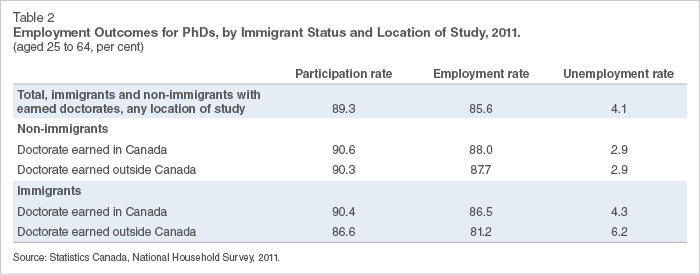
PhDs and EmploymentInteresting comparison on outcomes for immigrants and non-immigrants with PhDs, including country where PhD granted. Nice evidence-based approach to analysis:

Immigrants are less likely than non-immigrants to have studied in a country whose credentials are easily recognized and trusted by Canadian employers. While immigrants who earned their doctorates in the United States had an unemployment rate of only 3 per cent—in line with the unemployment rate of non-immigrants with doctorates—less than a quarter earned their doctorates from the United States. Immigrants who earned their doctorates in countries other than the U.S. or U.K. experience much higher rates of unemployment.

But location of study explains only part of the difference. Regardless of where they earn their PhDs, immigrants face a range of employment barriers, including less-developed employment networks, language barriers, and racism. Immigrants with PhDs fare much better than immigrants without PhDs, but they face difficult transitions, achieve only a slim advantage over non-immigrants with lower education, and continue to lag well behind their non-immigrant peers with PhDs.

Understanding and addressing the many barriers to immigrant PhDs is critical to ensuring that both they and Canada’s economy and society as a whole can benefit from the advanced education and skills they have obtained. The ongoing work of The Conference Board of Canada’s Centre for Skills and Post-Secondary Education and National Immigration Centre explores various dimensions of the challenges facing immigrants—those with and without PhDs. It will shed light on changes that might be required as to how immigrant PhDs are educated and trained in Canada, as well as how immigrants are selected and integrated into the Canadian economy and society more generally. Watch for future commentaries and reports from both centres in 2015.

Immigrants With PhDs:  Transitions, Marginal Advantages – New Canadian Media – NCM.