Irwin Cotler: Canada needs to fundamentally rethink its approach to the Israel-Palestine conflict

Missed opportunity in not addressing the blockage by the current Israeli government over many years and the need for political renewal on the Israeli side and reduced political influence by religious hardliners and extremists, although I agree on how the debate reflects poorly on parliamentarians:

The debate, amendment and passing of the NDP motion on Palestine on March 18 was a perfect representation of the current state of discourse on the Israeli-Palestinian conflict in Canada today: chaotic, toxic, reactive and polarized; grounded in disinformation and misrepresentations; and performative rather than productive.

From a procedural standpoint, the motion made a mockery of the parliamentary process. After hours of polarized debate, it was amended significantly. These amendments were presented with mere minutes to spare, leading to parliamentarians raising concerns about the lack of debate on the substantially changed motion. Notably, the amendments were initially tabled without any French translation, characterizing the chaotic and ad-hoc nature of the process.

The substance of the debate was similarly flawed. Members of Parliament speaking in favour of the motion consistently relied on statistics provided by the Gaza Health Ministry — an arm of Hamas, a listed terrorist group in Canada. Even the text of the motion itself relies on these flawed statistics. Sadly, this is emblematic of the preponderance of disinformation and misrepresentations in current Canadian discussions on Israel and the Palestinian territories.

The ultimate result — the adoption of a watered-down motion that served primarily to inflame sectarian tensions and incentivize the anti-democratic behaviours of a domestic mob — is representative of Canada’s unproductive, performative and harmful approach to this issue.

It is clear that Canada needs a new framework for the Israeli-Palestinian conflict — one that is coherent, principled, fact-based and characterized by long-term strategic thinking; one that promotes both coexistence in Canada and peace in the Middle East.

This new framework should encompass four dimensions: (1) it must be informed by, and anchored in, the global context; (2) it must contribute to a new regional reality; (3) it must centre on justice and accountability in Israel and the Palestinian territories; and (4) it must involve responsible leadership here at home.

The first dimension is necessary because the global context plays a substantial role in shaping the conflict and our perceptions of it. We are in the midst of a new global struggle between liberal democracies and authoritarian regimes that are seeking to undermine liberal democracies and dismantle the rules-based international order.

The new authoritarian “axis of evil” — led by Iran, Russia and China — is using the Israeli-Palestinian conflict as a powerful tool to further their destabilizing agenda. They are spreading Hamas propaganda and disinformation, co-opting international institutions, weaponizing international law and directly funding, arming and supporting Hamas and other terrorist groups.

This facilitates their efforts to weaken and divide liberal democracies, undermine international norms and distract the West from their ongoing crimes — including the Russian invasion of Ukraine, the Uyghur genocide in China and the horrific repression of Iranian women.

This authoritarian destabilization campaign is aided by pervasive, systemic, global antisemitism, which has been used by autocrats to further their repressive ends for centuries. Antisemitism is responsible for Israel being held to higher levels of scrutiny than any other country, and enables hatred of, and lies about, Israel to spread with unparalleled ease. Canada’s new policy framework on the Israeli-Palestinian conflict must both account for, and actively counter, these harmful global factors.

The second dimension is that discourse and policy on Israel and the Palestinian territories must both acknowledge and support the new regional reality in the Middle East. The Abraham Accords provide new opportunities for working towards peace. Canada should encourage these new and potential allies to play a key role in regional peace-building.

As part of this, Arab countries must take greater responsibility for supporting and aiding the Palestinian people, rather than simply criticizing Israel. They should provide funding, humanitarian aid and other forms of assistance to Gaza and the West Bank. Arab countries should also be held accountable for their cynical treatment of Palestinians within their own countries, keeping them stateless and dispossessed as a political tool against Israel.

Crucially, Canada must also work with its regional partners to counter the malign influence of Iran and its proxies — the greatest enemies of peace in the Middle East — which are currently instigating a multi-front war against Israel, an asymmetrical dynamic that is noticeably absent from Canadian discourse.

The third dimension is the most important: ensuring justice and accountability for actors on the ground in Israel and the Palestinian territories. The status quo — for international institutions, governments, the media, human rights organizations and grassroots activists — is to hold Israel to an inequitably high threshold of accountability, while allowing the Palestinian leadership to shirk accountability altogether.

While it is true that democracies can be expected to demonstrate greater adherence to international laws and norms, it is an inversion of justice to impose stringent accountability on the lesser rule-breaker, and minimal accountability on the greater rule-breaker. Basic principles of fundamental justice demand the precise opposite — graver crimes and more persistent rule-breaking must result in greater sanctions and more accountability.

In addition to being unjust, the status quo creates perverse incentive structures that facilitate a continuous cycle of hatred and violence. Although, like any other state, Israel must be held accountable for any violations of international law, it is demonized and attacked no matter what it does, which contributes to its threat perception and domestic support for leaders who are obstacles to peace.

Hamas is able to garner global sympathy no matter how abhorrent its crimes, thus enabling its continued criminality, which culminated in the heinous mass atrocities of Oct. 7. Furthermore, Hamas is incentivized to ensure maximum Palestinian casualties and suffering, because it knows that all the blame will be placed on Israel.

This informs and emboldens Hamas’s comprehensive strategy of using its own citizens as human shields, including by placing its headquarters, weapons arsenals and rocket launchers under hospitals, next to mosques and in schools.

To bring justice and accountability, Canada must dedicate vastly more resources and energy towards holding Hamas, other Palestinian terrorist groups and the Palestinian Authority accountable for their contraventions of international law, their role in the continuation and deepening of the conflict, and their repression of their own citizens.

For Hamas, this requires more than lip-service condemnations. It requires pressure to be put on its allies in Qatar, Iran, South Africa and elsewhere; the mobilization of international legal mechanisms to put Hamas, rather than Israel, in the docket of the accused; and combating the spread of Hamas propaganda and disinformation on social media and in the mainstream media.

For the Palestinian Authority, accountability means refusing to accept its continued corruption and refusing to ignore the fact that its leader is in the 19th year of his four-year term and frequently engages in antisemitic incitement and Holocaust denial.

Accountability means ensuring that terrorism is not incentivized through the PA’s infamous “pay-for-slay” program. Accountability means the media shining a light on how Hamas and the Palestinian Authority repress their own citizens. Accountability also means putting strict conditions on funding for organizations such as UNRWA, which was not only complicit in the Oct. 7 crimes against humanity, but has indoctrinated children with hate and helped to keep Palestinians stateless for decades.

The fourth and final dimension is that of responsible leadership here at home. Responsible leadership means actively combating hatred and incitement rather than merely condemning it. A simple way for policymakers, pundits, the media and activists alike to embody responsible leadership on this charged and complicated issue is by always “starting with the endpoint.”

Hopefully, Canadians broadly agree that the ideal endpoint is: (a) peaceful coexistence in Canada, characterized by lowering tensions, reducing hate and polarization, and bridging communities; and (b) peace in the Middle East, characterized by a two-state solution, with mutual acknowledgement of each other’s legitimacy — two democratic states for two peoples.

When making statements or taking policy actions, responsible leadership means stopping to consider whether those statements or actions will bring us closer to that endpoint, or move us further away from it. Divisive and polarizing motions, such as the NDP’s opposition motion, fail this test by creating greater rifts between Canadians and perpetuating the perverse incentives that feed the cycle of hatred and violence in the Middle East.

Source: Irwin Cotler: Canada needs to fundamentally rethink its approach to the Israel-Palestine conflict

Macron Suffers Surprise Setback Over Immigration in France

Of note (another country having difficulties passing immigration legislation):

President Emmanuel Macron of France suffered an unexpected setback on Monday as lawmakers brought his government’s immigration overhaul bill to a screeching halt, casting fresh doubts on his ability to get key legislation through Parliament.

The bill, which tries to strike a balance between cracking down on illegal immigration and extending work opportunities for migrants with needed skills, had been in the making for over a year. The government struggled to find a mix of measures that would pass muster in the lower house, the National Assembly, where Mr. Macron’s centrist party and its allies do not hold an absolute majority.

But those hopes were dashed on Monday when the lower house passed a motion to reject the bill without further discussion. The motion by the Green party, one of several left-wing opposition groups in Parliament, received 270 votes in favor and 265 against. Parliamentary debate that was expected to begin Monday and last two weeks was immediately cut short.

Immigration has long been a fixation of French politics. The bill would be the 29th immigration and asylum law in four decades in France, a country that is often described by politicians and commentators, particularly on the right, as fending off an out-of-control influx of migrants.

The rejection was a particularly stinging blow for Gérald Darmanin, Mr. Macron’s tough-talking interior minister, who had staked a lot of political capital on getting the bill passed without resorting to a constitutional tool known as the 49.3. The government used that tool, which allows certain bills to be passed without a vote, earlier this year to ram through Mr. Macron’s unpopular pension reform, a method that was ultimately successful but bruising.

Marine Le Pen, the far-right leader, said after the vote that Mr. Macron’s centrist alliance had “forgotten” how to govern without the 49.3.

Source: Macron Suffers Surprise Setback Over Immigration in France

The U.K. a role model for political diversity

A more compete survey can be found here: https://commonslibrary.parliament.uk/research-briefings/sn01156/.

While the UK is far ahead of Canada in terms of political leaders, less so in terms of MPs: 10 percent visible minorities compared to about 16 percent in Canada:

History shows us that governments that are representative of all their people are often better run and more meritocratic. Representative governments tend to implement more inclusive policies while at the same time elevating a diverse set of role models. These leaders bring more creative insights to the policy-making table that can lead to alternative solutions and thus make decisions that better serve everyone.

While Canadian governments have been getting more diverse in their representation over the past few years, unlike in Britain, the top jobs in Canadian politics have largely eluded the grasp of racialized and new Canadians.

As India and Pakistan gained their independence just over 75 years ago, the stage was set for a rapid wind down of the British Empire over the next two decades. Britain benefited from its post-colonial relationships by attracting waves of African, Asian and Caribbean immigrants as a postwar labour shortage forced it to look beyond its shores in order attract the workers needed to keep its economy running. This migration changed the face of cities like London, Manchester and Glasgow during the latter half of the 20th century.

Yet it was not all milk and honey for these newcomers. On arrival, many often faced racism and discrimination, which was not officially outlawed in Britain until 1965. While the struggle against systemic discrimination continues, there is no doubt that at least when it comes to political representation, the descendants of these post colonial migrants have made their mark on British society in a big way.

Today, arguably the top three political jobs in the U.K., that of British prime minister, Scottish first minister and Lord mayor of London, are held by Rishi Sunak, Humza Yousaf and Sadiq Khan respectively. Their grandparents lived under British Colonial rule in South Asia.

More importantly, they each hail from different parties across the ideological spectrum and they all rose to political heights without facing significant backlash from a British society that appears to have moved beyond seeing race as a determining factor in selecting its leaders. Across the Irish Sea, Leo Varadkar, whose father was born in Bombay (Mumbai), has twice served as prime minister of the Republic of Ireland since 2017.

So, how do we Canadians fare in comparison to our cousins in the British Isles?

Despite our overt commitment to multiculturalism and the fact that Statistics Canada projects racialized Canadians will make up between 38 to 43 per cent of the Canadian population by 2041, Canada has never had a person of colour serve as a first minister, apart from Ujjal Dosanjh’s very brief stint as premier of British Columbia more than 20 years ago.

Source: The U.K. a role model for political diversity

Australia: ‘Be less of a white boys’ club’: How to address Parliament’s lack of diversity

Of note (Canadian Parliament and Senate are much more diverse than Australia):

“Stale, pale and male” has become a shorthand for the lack of diversity of all kinds across society’s institutions. Parliament has not escaped its accusations and even federal politicians have levelled the tag at it.

Labor frequently pats itself on the back for achieving near-gender parity in its caucus room but this week it has been beset by criticism it has not done enough to address other types of diversity.

The decision to parachute senator Kristina Keneally into the safe lower house seat of Fowler, in Sydney’s west, at the expense of local, young, Vietnamese lawyer Tu Le has led to calls for diversity quotas and divisions over “token” multiculturalism.

But it’s not only Labor’s politicians who are overwhelmingly white.

Out of the 226 men and women who make up Federal Parliament, 23 were born overseas but only five in non-European countries to parents who weren’t Australian. Another 52 have parents who were born overseas, overwhelmingly in the UK.

Contrast this with the general population. Just under half of all Australians were either born overseas or their parents were. Nearly three times more people in the wider Australian community were born overseas than their parliamentary representatives.

However, Parliament this week hit a milestone of proportionate representation of Indigenous people. There are now seven Indigenous members after the Greens’ newest senator Dorinda Cox, a Yamatji-Noongar woman, replaced Rachel Siewert.

Tim Soutphommasane, a professor at the University of Sydney and a former race discrimination commissioner, says Parliament “fails dismally” on cultural diversity.

“It doesn’t look remotely like today’s multicultural Australia. It might make some uncomfortable, but our political class looks like it’s stuck in the White Australia era,” he says.

“If you don’t have cultural diversity in our politics, you don’t have a politics that’s representative. That’s a pretty basic problem.”

Dr Blair Williams from the Global Institute for Women’s Leadership at ANU says while an exact representation of the community isn’t possible, “it just needs to be a bit more focused on being less of a white boys’ club from a certain background”.

There has been a strong focus for some time now on increasing the number of women elected, but Williams says there also should have been thought put into improving cultural diversity. She’d also like to see more young people, people with disabilities and those from different class backgrounds.

The problem is self-perpetuating, says Race Discrimination Commissioner Chin Tan. If people don’t see anyone like them in Parliament, they’re less likely to get involved in the political process.

“The lack of diverse and inclusive parliaments means certain groups are poorly represented and their interests are not well spoken for,” he says.

“Even aside from the importance of involving diverse voices in the legislative process, Parliament provides a tremendous platform for engaging in public debate. We have often seen that when politicians from diverse backgrounds enter Parliament, they achieve great outcomes by focusing attention on issues that might otherwise be overlooked.”

Soutphommasane points to the agitation in some quarters for abolishing section 18C of the Race Discrimination Act, which protects against hate speech, saying the lack of diversity can contribute to a distorted political debate.

“A monochrome political class will have some blind spots,” he says.

The question of how to fix the problem is not easy, nor will it happen quickly. Those who advocate a quota arrangement point to Labor’s gains in gender diversity.

It has taken the party more than 30 years from its first quota to reach equal representation. Former cabinet minister and deputy leader Jenny Macklin says quotas are still contested and there continues to be male resistance.

Emily’s List, an organisation that backs progressive women running for Parliament, published a paper in 2019 that recommended Labor introduce “tandem quotas” for women and cultural diversity with different targets for safe seats, marginal seats and the party executive.

Williams says these types of tandem quotas benefit culturally diverse women but are less good for “majority men and majority women”. An alternative could be a kind of reverse quota.

“So you only have a certain amount of white men in Parliament and when you hit that number, then you have to diversify,” Williams says.

“If you do look at other styles of quotas, like the tandem quotas … you do run the risk of having, say, 30 per cent of people preselected who are women and culturally diverse, that still means that the other 70 per cent can be white men.”

Labor MP Peter Khalil, whose parents migrated from Egypt to Australia in the 1970s, said this week MPs with diverse backgrounds “should not be token or just be making up the numbers”. Rather, parties had to show a real commitment.

His colleague Anne Aly, who was herself born in Egypt, also called on her party to do more than just pay lip service to multiculturalism.

Other MPs also called for action, with Ed Husic saying Labor had to do a stocktake of its membership and have a serious conversation about how to reflect the community, and senator Jenny McAllister saying it was time for “bold actions”.

But not everyone thinks quotas are the answer.

Osmond Chiu, an ALP member and research fellow at the Per Capita think tank, says the party needs to work out the extent of its problem with diversity before it can address it.

Any talk of quotas to improve cultural diversity or candidates “is putting the cart before the horse” when change throughout the whole party organisation is needed.

“A lot of the focus has been on Fowler because it’s symptomatic, it symbolises this wider systemic problem that exists, that Australia has become a much more diverse country … but our institutions, such as Parliament, haven’t really kept up,” he says.

Liberal MP Dave Sharma says there’s no doubt all parties including his own have to more actively recruit people with different backgrounds instead of continuing the “pretty laissez-faire attitude” they have now.

Since his election – replacing Labor’s Lisa Singh as the only person of Indian heritage in Parliament – he has often heard from people in the Indian Australian community asking how they can become involved in politics.

He doesn’t believe in quotas but points to the work of the Conservatives in the UK to transform from a “very stuffy, traditional party” to the more diverse outfit after the party machinery actively sought “people from outside the usual breeding grounds of politics”.

It is as much as smart politics as the right thing to do.

“People are much more inclined to vote and support for, empathise with or have a connection with people that have a similar life experience,” Sharma says.

“That doesn’t just mean ethnically, it can be religiously, it can be professionally, it can be if you’ve got a disability, all those sorts of things … help your political brand strength.”

Tan says this is why parties must look beyond candidate preselection and make sure there are people from diverse backgrounds welcomed and involved at grassroots and administrative levels too.

“Parties stand to gain from this by broadening their base, widening their gaze, and attracting the additional talents that exist within diverse communities,” he says.

“I think this would in turn lead to more diverse candidates being preselected.”

Changing the face of Parliament will require hard calls from political leaders, Soutphommasane says.

“You can’t conjure up more diversity in your parliamentary ranks simply by saying you like multiculturalism. Or by saying that it’ll come next election.”

Source: ‘Be less of a white boys’ club’: How to address Parliament’s lack of diversity

Make way! Creating space for change in Canadian politics

Former MP Caesar-Chavannes and Alex Marland make the case. IMO, a bit unrealistic in terms of solutions and no guarantees that increased diversity will necessarily reduce partisanship and “team player” conformity, or result in greater diversity of thought.

But an important reflection none the less:

There are many ways politicians and bureaucrats can show leadership in response to calls to democratize Canadian politics. Specifically, there are a lot of things men can do, particularly heterosexual white men.

As the largest demographic in Parliament, they can lead the way by stepping back or stepping aside, in order to create meaningful opportunities to engage more women, Indigenous, Black and marginalized peoples. 

Let’s face it, if we are to transform the culture of Canadian political institutions, we must take immediate, deliberate and intentional action.

As co-authors, one of us is the only Black woman MP who served in the 42nd Parliament (2015-19) and is a champion of diversity, equity and inclusivity. The other has interviewed more than 100 Canadian politicians and political staff for a book about party discipline. We met as part of that research, and share a deep concern about the need for the political elite to make room for diverse voices in the House of Commons.

Representation matters

When interacting with politicians, it becomes clear that at different points in their careers they approach politics with distinct philosophies about representation

Some elected officials take a principled stand on big picture issues. Some believe that voters trust them to figure things out, while others feel a duty to follow the wishes of constituents. Far too many Canadian politicians are guided by loyalty to their political party and leader, whereas some are motivated to champion the concerns of people who share similar identities or similar experiences.

Prioritizing the composition of legislatures and looking at public policy through the lens of gender, Indigeneity, race or other identity characteristic is sometimes known as “descriptive representation,” a term coined by American political scientist Hanna Pitkin in her landmark book The Concept of Representation. In it, Pitkin dissects what the contested concept of representation means. She makes a compelling argument that a democratic legislature must be a forum to hear from a diversity of people’s voices. This is important because otherwise these voices are excluded from political debate and from public policy decision-making.

But in what tangible ways can diversity improve democracy?

Identity and intersectionality

Diversity is necessary for citizens to see themselves represented. Since 1867, and before, generations of white, land-owning men were the beacon of political leadership. Since the Second World War, they have increasingly toed the party line, as have others, recruited into a political system that values conformity over diversity. In today’s world, it is important to remember that we are each the product of a variety of different identities that intersect to make us who we are. For some, their different identities add layers of oppression in politics.

Studies have argued that descriptive representation can fundamentally support the principles of democracy. This extends beyond reshaping the composition of legislatures: listening and receiving input from diverse voices can result in better governance and better policy. A good example is research showing that women leaders have been rated significantly more positively than men during the COVID-19 pandemic. In particular, women are thought to have exhibited better interpersonal skills in managing the crisis. 

Listening to marginalized voices is needed to help shape Parliamentary decisions. Deliberations around medical assistance in dying legislation (Bill C-7) would have benefited from improved listening to disability groups and racialized communities.

Diversify legislatures

More diverse legislatures can transform Canadian politics in a profound way: challenging the dogma of party discipline that keeps politics organized but corrodes representation. In Ottawa and the provinces, political parties have an iron grip over politicians, and group conformity is expected. 

Why is it normal in Canada that a politician jeopardizes their parliamentary career by taking a public stand different from the party leader? Don’t we want politicians who feel that they can speak truth to power? Homogeneity in party politics might work for partisans, but does it work for constituents? Even MPs become frustrated with democratic institutions when they are reduced to robots, encouraged to vote along party lines and repeat talking points.

Electing a broader array of Canadians can help break down party silos and soften polarization. In workplaces, more heterogeneity can stir internal conflict and rattle group norms. But injecting different perspectives also enriches the ability of a group to come up with creative and innovative solutions. The same is true in politics. 

The more diverse the voices that occupy seats in legislatures, the more political parties can benefit from better policy which, in turn, benefits the public. Sadly, there is little evidence that partisans are open to listening to people willing to rebuff the “team player” mentality that dominates Canadian Parliament. A good way to help change that is to change who is being elected.

This can include white men not seeking re-election in order to create space for others, encouraging people to run for political office, and also helping the newest members thrive when they get there. 

Taking proactive steps toward fewer white men in politics in order to create an opening for others has worked in British Columbia. In 2011, the B.C. NDP introduced a radical policy that when a male legislator vacates a seat, the party must nominate a woman, racialized person or someone from other underrepresented groups in Canadian politics. 

In the 2020 provincial election, the B.C. NDP won a majority of seats, and for the first time in Canadian history a governing party’s caucus has more women than men, as well as more people of colour serving than any B.C. caucus ever elected before. Diversity in Premier John Horgan’s caucus meant that he had more choices to assemble a diverse cabinet. The party’s policy of affirmative action has translated into meaningful, profound change in both the legislative and executive branches of government. Bold action like this is needed to achieve the ideals of descriptive representation.

Ensuring democracy thrives

The principles of diversity, equity and inclusivity are important, and taking action so that Canadian politics are not dominated by one segment of society is necessary to democratize our institutions. Regardless of party affiliation, or political ideology, the urgency of now demands that those with power choose to challenge the status quo. 

To ensure democracy thrives in Canada, politicians need to listen to the voices of those who are often on the margins of our political ecosystem and act accordingly. Gaining knowledge is a necessary first step, and men in positions of authority can help create a thriving democratic landscape by opening opportunities to people who are different than them. 

A good place to start is for men to listen.

Celina Caesar-Chavannes, Queen’s University, Ontario; Alex Marland, Memorial University of Newfoundland

Source: https://theconversationcanada.cmail19.com/t/r-l-tlvurhk-kyldjlthkt-b/

Tohti and Burton: Canada must respond to China’s harrowing genocide

More on the oppression Uyghurs and the need for more forceful policy responses:
As the world somberly marked UN Genocide Commemoration Day this week, Canadians still await their own government’s action after a parliamentary panel found that China’s persecution of Uyghurs is now the largest mass detention of a people in concentration camps since the Holocaust.Last summer, the House of Commons Subcommittee on International Human Rightsheld a series of emergency meetings on the plight of the Uyghur population in China, in response to growing reports of forced labour, forced sterilization and population control.

The subcommittee received briefs and testimony from 23 Canadian and international witnesses, who detailed atrocities in China’s flourishing campaign to eradicate Uyghur culture and identity by engaging two million people in forced labour and mental torture.

The subcommittee heard that in the prison camps, Uyghurs are required to speak only Mandarin Chinese and are denied their human right to practise their religion. Women and girls often face sexual abuse and rape by their captors. The situation for their children consigned to orphanages is one of complete assimilation into Han Chinese language and culture, combined with the desperation of having no information on the fate of their parents.

Family abroad, meantime, have no means to communicate with anyone in the Uyghur regions. The stress on Canadian Uyghurs of not knowing if family members are alive is enormous, and they are subject to menacing threats by Chinese agents in Canada who intimidate them from speaking out on what’s going on. These threats sometimes precede the sudden death of family members in the camps. There was also extensive evidence given of sterilization of Uyghur women and forced marriage to Han Chinese men.

The subcommittee’s report to Parliament this Fall found that China’s policies toward Uyghurs and other Turkic Muslims are worse than imagined. It concurred with testimony by former human rights lawyer and Canadian justice minister Irwin Cotler, who called the Uyghur situation “a classic case study of such war crimes, crimes against humanity and, as I and others have mentioned, acts that are constitutive of genocide.”

Cotler and others implored the Canadian government to take various measures including working with allies and multilateral organizations to condemn China’s use of concentration camps, extending sanctuary for Uyghur refugees trapped in third countries, and refusing to import products of Uyghur forced labour.

The subcommittee is urging the federal government to impose Sergei Magnitsky Actsanctions on all Chinese government officials culpable for perpetrating human rights abuses, and notes that if the international community does not condemn China’s campaign in Xinjiang province, a precedent will be set and such atrocities will be adopted by other regimes.

Besides Wednesday having been Genocide Commemoration Day, Dec. 9 was also the 72nd anniversary of the Genocide Convention, the first human rights treaty adopted by the United Nations General Assembly. The Convention signifies the international community’s commitment to “never again” and establishes a duty for states to prevent and punish the crime of genocide.

But as the months go by, it becomes increasingly apparent the Canadian government will ignore the findings and recommendations of its own parliamentary subcommittee. The federal government will not expel any Chinese diplomats overseeing the harassment of people in Canada, instead advising Uyghur Canadians to contact local police if they are subject to threats. And evidently Beijing has sufficient influence in Canada to put a stop to any talk of Magnitsky sanctions against complicit Communist officials, some of whom have real estate here and children enrolled in Canadian schools.

In the end, it all seems to be about racism and the critical position of Uyghur territory for China’s global “Belt and Road” infrastructure campaign. As Uyghurs call for self-rule in an independent East Turkestan principality, China evidently believes it can solve that problem through its cultural extermination efforts.

The subcommittee’s report aptly quotes Nobel Peace laureate Elie Wiesel: “Silence in the face of evil ends up being complicity with evil itself.” It is time Canada stopped standing idly by and showed some legitimacy for our purported commitment to the rules-based international order.

Mehmet Tohti is Executive Director at Uyghur Rights Advocacy Project. Charles Burton is a senior fellow at the Macdonald-Laurier Institute in Ottawa, and non-resident senior fellow of the European Values Center for Security Policy in Prague. He is a former professor of political science at Brock University, and served as a diplomat at Canada’s Embassy in Beijing.

Source: Tohti and Burton: Canada must respond to China’s harrowing genocide

Parliament should label Uyghur persecution as genocide to foster global support against China’s human rights abuses, says former Liberal justice minister

Needed debate and action:

Parliamentarians heard from activists during hours-long committee meetings last week who were calling for the Chinese government’s oppression of Uyghur Muslims to be acknowledged as genocide, and a former justice minister says Parliament is uniquely positioned to have a “distinguishable role” in condemning Beijing’s alleged behaviour to build an international partnership to counter China’s bullying.

The House Subcommittee on International Human Rights heard from more than 20 witnesses over 14 hours on July 20 and July 21 about the persecution of the Uyghurs. Many said the mistreatment and abuse of Uyghurs was tantamount to genocide and called for Canada to take a stand.

“Genocide obliges us all—internationally, domestically, governments, Parliaments, civil societies—and here the Canadian Parliament has a distinguishable role to call out genocide,” said Irwin Cotler, a former Liberal justice minister and now founding chair of the Raoul Wallenberg Centre for Human Rights. He told The Hill Times that Parliament has set a precedent of playing a leading role in calling out human rights abuses and acts of genocide.

“I think it’s very important that governments act in concert, that Parliaments act in concert, as well as civil society acting in concert in calling out China,” said Mr. Cotler, who was a Liberal MP from 1999 to 2015. “If we want to protect the rules-based international order—and justice for the victims in China and accountability for the violators—we’re going to have to do so in concert governmentally and in Parliament.”

“Canada can play a leading role in this,” he said, citing the work that Parliamentarians have previously done raising the issue of genocide prevention, and raising awareness of the Rohingya genocide, among other targeted mass killings.

“China has been assaulting the rules-based international order and committing these international crimes with impunity thus far,” Mr. Cotler said. “They’ve been able to do so with impunity because they have been leveraging their economic and political power, and targeting countries one by one if those countries dare stand up to them.”

“What is needed now is an inter-governmental alliance, an alliance of democracies, so China doesn’t leverage its power and bully countries one by one.”

Some witnesses told the subcommittee that it is necessary for Canada to place sanctions on top Chinese Communist Party officials in Xinjiang where there are reports of mass detentions and forced sterilization of the Uyghur population.

The Associated Press reported on a systematic program to reduce the Muslim population in China, with the government enacting population control measures, which included IUDs and sterilization.

Adrian Zenz, a senior fellow in China studies at the Victims of Communism Memorial Foundation, told the subcommittee that in 2018, 80 per cent of new IUDs in China were placed in Xinjiang, which only makes up 1.8 per cent of China’s population.

The Chinese government has long held that human rights abuses aren’t taking place in Xinjiang and have called the alleged detention facilities “vocational education and training centres” that are being used to combat terrorism.

University of Ottawa international law professor Errol Mendes, who appeared virtually before the subcommittee, said Canada should apply Magnitsky sanctions on the “chief planners of the detention.” He said that should be Xinjiang regional government chairman Shohrat Zakir and Xinjiang Communist Party Secretary Chen Quanguo, a member of the politburo.

Prof. Mendes told The Hill Times that imposing sanctions would prove that Canada is not staying silent and is upholding its commitment as a party to the United Nations Genocide Convention.

He added that the sanctions will “probably not” have tangible results in the short run. In spite of that, Prof. Mendes said when countries have “sufficient proof” that a genocide is taking place, “they must act.”

Magnitsky sanctions have already been applied on Chinese Communist Party officials in Xinjiang by the U.S., including on Mr. Chen.

Prof. Mendes said other levers can also be used, such as stopping companies from purchasing products in their supply lines from Xinjiang, which have reportedly been through forced labour.

He said that a motion of Parliament labelling the actions of the Chinese government as acts of genocide might not have impact for Beijing.

“Sending a direct signal to one of the main politburo members sends a message to President Xi [Jinping],” Prof. Mendes said.

Mr. Cotler said a parliamentary condemnation of the Chinese government’s mistreatment should include sanctions as well.

“Under the Genocide Convention, there is an obligation to act pursuant to that determination and an obligation to hold a country—that is engaged in acts that constitute genocide—accountable,” he said.

It is the responsibility of Canada and the international community to bring justice to the victims and hold criminals accountable, Mr. Cotler said.

University of Ottawa professor John Packer, director of the Human Rights Research and Education Centre, said that it is clear that China has been committing genocide based on the Genocide Convention.

According to the convention, an act of genocide is taking place if any of the five conditions are met: killing members of a group; causing “serious bodily harm or mental harm” to member of a group; intentionally “inflicting on the group conditions of life calculated to bring about its physical destruction in whole or in part”; “imposing measures intended to prevent births within the group”; and “forcibly transferring children of the group to another group.”

Prof. Packer said it looks “quite clear” that there have been breaches of the convention, adding that “it is very difficult not to draw the negative inference that this is purposeful state policy.”

“That would mean that it is genocide,” he said. “This is not by accident.”

“If China really believes this is all mistaken, they should be entirely open to exposing to international scrutiny what is going on,” he said, adding that if there is a dispute, the convention states it should be referred to the International Court of Justice.

Prof. Packer also noted a party to the Genocide Convention has a duty to prevent acts of genocide.

“If we see something happening and we are silent then there are fundamental issues about how seriously we consider this fundamental norm of international relations,” he said.

“Where such cases [of genocide] are quite clear in terms of international exposure, such as the Rohingya, such as the Uyghurs, it strikes me as extraordinary that we would demure—that we would shuffle our feet and look the other way,” Prof. Packer said.

He added that a motion of Parliament acknowledging a genocide is taking place would set a “very big international symbol.”

Conservative MP Garnett Genuis (Sherwood Park-Fort Saskatchewan, Alta.), his party’s critic of Canada-China relations, said the subcommittee heard “clear-cut” evidence of genocide.

“We should recognize that the Chinese state is guilty of genocide in Xinjiang,” he said, adding that Canada should respond with Magnitsky sanctions and by addressing the possible complicity of investment in Chinese companies that are involved in the oppression in Xinjiang, as well as imported products that are produced through forced labour.

“All of that flows from recognition” that a genocide has taken place, Mr. Genuis said, adding that both the Canadian government and the House of Commons should make that acknowledgement.

Echoing Mr. Cotler, he said there is a need for principled multilateralism of likeminded countries that follow their own obligations in concert with each other.

“What we’ve seen from the government is occasional words but no actions,” Mr. Genuis said. “The government has acknowledged the issue of abuses of human rights involving Uyghurs. They have not used the word ‘genocide,’ they have not used the words ‘crimes against humanity.’ In other words, they haven’t used words that carry international legal significance.”

In a brief to the International Human Rights Subcommittee, Global Affairs noted that Canada is “deeply concerned” about human rights abuses against Uyghurs by Chinese officials.

Canada is urging that Beijing release “Uyghurs and other Muslims who have been detained arbitrarily—based on their ethnicity and religion.”

“Publicly and privately, in multilateral fora as well as in bilateral dialogues, Canada has consistently called the Chinese government to address repression in Xinjiang,” the brief notes.

Mr. Genuis said the government hasn’t addressed the issue in areas that have “legal weight.”

NDP MP Heather McPherson (Edmonton Strathcona, Alta.), her party’s representative on the International Human Rights Subcommittee, said the committee will release a statement on the meetings in early August.

“I think what we pretty universally agreed upon is that there needs to be more done,” she said. “We need to take a stronger stance to ensure that we are protecting human rights around the world. It doesn’t matter where it happens, the rule of law and the protection of human rights is vital.”

Ms. McPherson wouldn’t say whether the subcommittee meetings will lead to a recognition by Parliament that acts of genocide have taken place.

“I will say that the testimony that we heard—the very credible witnesses that we heard from, the survivors that we heard from—there’s pretty strong proof and testimony that there have been acts of genocide perpetrated against the Uyghur people,” she said.

She added that it is vital to figure out a strategy to re-engage on the world stage to jointly address China’s human rights record.

“We’re not ever going to want to do this alone. … We’re never going to want to take giant steps by ourselves. I think we want to work with our multilateral partners and we want to work with our likeminded allies and use those tools at our disposal to put some pressure on China to come back to the side of international law, to come back to the side of protection of human rights.”

Source: Parliament should label Uyghur persecution as genocide to foster global support against China’s human rights abuses, says former Liberal justice minister

You don’t stop a virus by bleeding democracy

Why is it that governments, no matter their political stripe, cannot resist the temptation to over-reach and reduce oversight, whether with respect to bloated omnibus budget bills or during the current COVID-19 pandemic?

And while the federal Conservatives, supported by the NDP, correctly forced the Liberals to back down given a minority government, in Alberta, there is no such check on the UCP government as this Globe editorial details.

Even more shameful than the attempted federal Liberal element given the UCP’s majority and its disregard for parliament (ironic, given that Premier Kenney was an effective parliamentarian at the federal level).

Hopefully, the same conservative-leaning pundits that rightly condemned the Liberal attempted power grab will also call out the Alberta UCP power grab (the first one to do so, John Carpay: Alberta’s Bill 10 is an affront to the rule of law):

Three weeks ago, the Trudeau government tried to use the cover of the coronavirus crisis to give itself unchecked powers once enjoyed by 17th-century European monarchs.

Prime Minister Justin Trudeau had recalled the House of Commons on March 23 to debate and pass emergency measures to shore up the economy and help Canadians who were losing their jobs.

The opposition were willing to back the minority government’s economic measures, but once they saw the draft bill, they realized the Liberals had something more in mind.

Along with tens of billions of dollars in aid for Canadians in need, the bailout legislation also included clauses that would have given the government the power to raise or lower taxes, and to spend money, without going through Parliament. These extraordinary powers were to last until Dec. 31, 2021.

The opposition, along with many in the media, this page included, were having none of it. By the end of the day on March 23, the government relented. It removed the offending clauses, the opposition offered its backing and, the next day, the bill became law.

Team Trudeau has not explained its attempted end run around democracy, probably because it can’t. There is never any reason to usurp Parliament’s critical role as overseer of government and keeper of the public purse. Every Canadian government, provincial or federal, should get that.

And yet, barely a week later, it happened again.

In Alberta, the United Conservative Party of Premier Jason Kenney used its overwhelming majority to push through a bill on April 2 that gives cabinet ministers unilateral power to write and enact new laws in public health emergencies, with zero oversight by the provincial legislature.

Under Bill 10, the only requirement for enacting a new law is that the relevant minister “is satisfied that doing so is in the public interest.” The only limit on that power is that a new offence cannot be applied retroactively.

It is utterly wrong for democratic governments to seek unilateral powers under the cover of an emergency. It is also unnecessary. There is no justification for it – especially not the one that says governments need to move quickly in a crisis.

Alberta passed Bill 10 in less than 48 hours; the Trudeau government, having secured the support of the opposition, passed its original bailout measures in the same short period. Last weekend, it took less than a day for Parliament to adopt a wage subsidy package. The government shared the legislation with the opposition in advance and made changes to ensure it would pass.

Giving legislators the chance to study, debate and vote on bills doesn’t result in unacceptable delays – if anything, as shown time and again, it improves legislation. More importantly, the transparency and accountability that comes from having to pass a bill through Parliament is the foundation of our system of government.

The Liberals and the opposition parties are now arguing about how often the House of Commons should sit during the remainder of the crisis, and whether sessions should be held in person with a skeleton crew of members, or with all MPs, via teleconferencing.

However it does so, Parliament must sit. Committees, too. And Question Period must happen, so that the government remains answerable to the House and to Canadians. That holds in Ottawa and in each of the provinces. It goes for both minority and majority governments.

Under no circumstances should any government see this emergency as an excuse to sideline the elected representatives of the people.

Thanks to their daily crisis briefings, government leaders are dominating the news coverage. Opposition voices have been sidelined, but they must be given their due in order for our democracy to function properly. That happens best in Parliament.

This crisis is demanding a lot of Canadians. They are self-isolating at home with their families. Many have lost their jobs, or are watching their businesses teeter on the precipice.

They will be able to decide for themselves whether federal and provincial opposition parties have helped the situation, or simply been a partisan nuisance. But Canadians must not come out the other end of this only to discover that their institutions and rights have been compromised by governments that grabbed for powers they were not entitled to.

Source:    You don’t stop a virus by bleeding democracy Editorial <img src=”https://www.theglobeandmail.com/resizer/p5aED50QGxv9DJSWx6332Wy7vT0=/163×0:4746×3055/600×0/filters:quality(80)/arc-anglerfish-tgam-prod-tgam.s3.amazonaws.com/public/5D7WOGR7DNNH3AJ33H42OZMKTU.jpg” alt=””>     

House of Commons becoming more reflective of diverse population

My latest in Policy Options:

How well does Canada integrate immigrants and visible minorities into political life? While the barriers to entering political life are significant, as the Samara Centre for Democracy study on nomination processes has shown, the recent election is cause for hope.

This article is based on an analysis of the 2019 election I undertook, using a dataset developed together with the Hill Times, Samara, and McGill University political scientist Jerome Black. We drew on a mix of official party biographies, media articles, social media, and name and photo analysis (we did not include Indigenous candidates and MPs). We also compared the 2019 results with those for the 2015 election and with visible minority representation in other countries’ legislatures. Our results show that in 2019 in Canada the visible minority composition of MPs elected is reasonably representative of the immigrant and visible minority populations in the country as a whole.

….

Source: House of Commons becoming more reflective of diverse population

Australia’s new parliament is no more multicultural than the last one

Dramatic contrast with Canadian numbers: 56 foreign-born (44 MPs, 12 Senators, 2017), and currently 48 MPs who are visible minority:

Politicians often say Australia is the most successful multicultural country in the world – but it would seem the country’s growing diversity is failing to make its mark in the corridors of power.

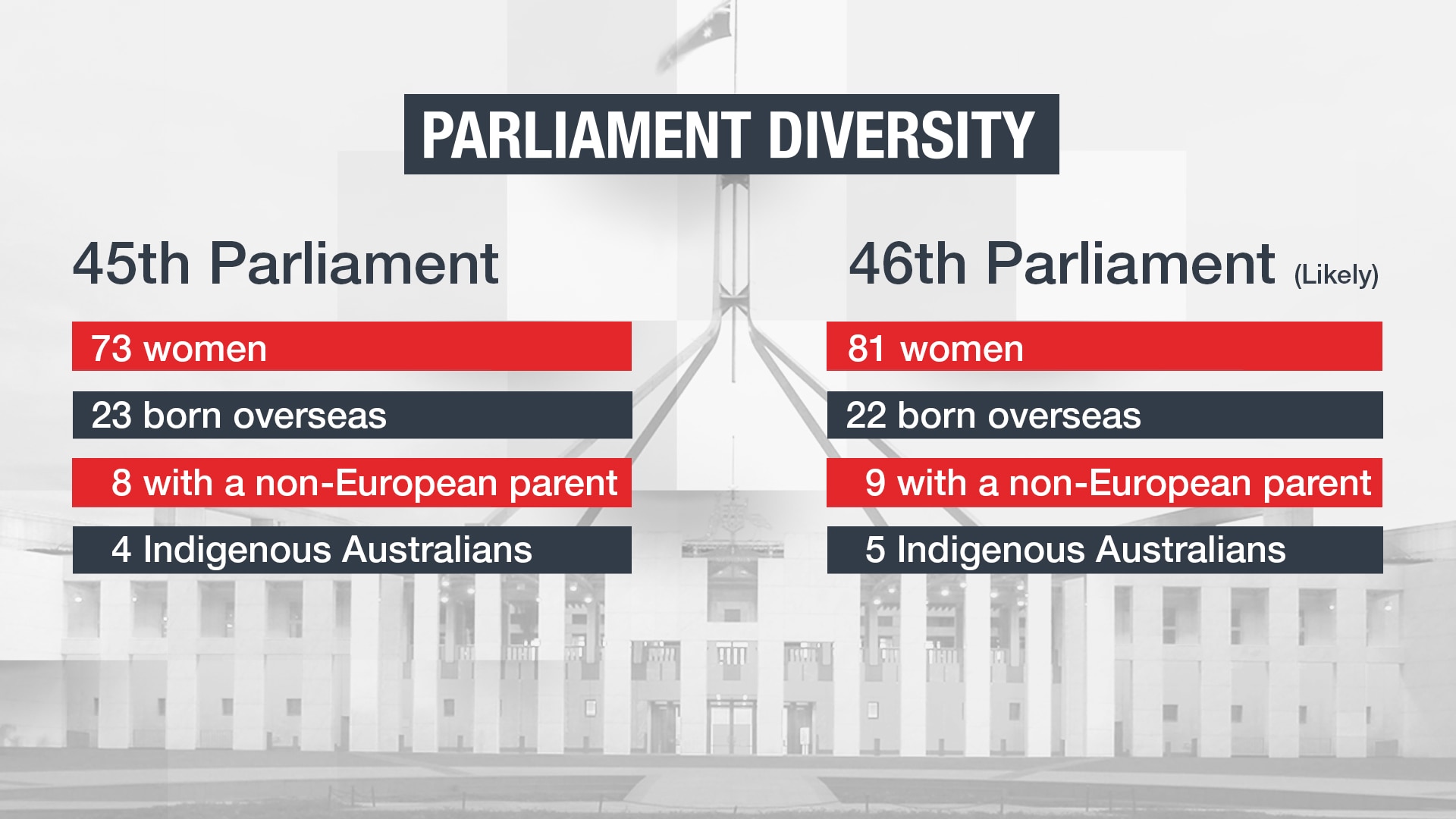
The newly elected 46th parliament will likely have little more cultural diversity than the previous one, according to figures compiled by the Parliamentary Library and SBS News.

The number of MPs born overseas in the new parliament is down from 23 in the previous parliament, to 22, across the House of Representatives and Senate. While the number of MPs with one or more parent from a non-European background rose slightly, from eight in the previous parliament to nine in the new one.

45th Parliament versus the 46th Parliament

SBS News (source Parliamentary Library and SBS News)

Some of the notable exiting MPs include the Liberal’s Tony Abbott, born in England and Lucy Gichuhi, born in Kenya. As well as Labor’s Lisa Singh whose parents were born in Fiji.

Some of the newly elected MPs from diverse backgrounds include Liberal’s Dave Sharma, born in Canada to an Indian father; the Green’s Mehreen Faruqi, born in Pakistan; and the Liberal’s Gladys Liu, born in Hong Kong, who as of Tuesday was on track to pick up the closely fought Victorian seat of Chisholm.

According to the 2016 census 28.5 per cent of Australians were born overseas. While the United Kingdom remains the largest country of origin within that, China and India are in second and third place respectively.

UTS sociology professor Andrew Jakubowicz said he wasn’t surprised parliamentary diversity hasn’t grown in the new parliament.

“Parliament is essentially a white club, it is essentially a white boys club … The dynamic of change which is sweeping through the Australian community more widely is very apparent at the state level, but the federal level it seems to have been squeezed out,” he told SBS News.

The figures on multiculturalism for the 45th Parliament come from the Parliamentary Library and were accurate as of April 2019.

Data for the new parliament is compared with the previous figures and available public biography information of all new incoming MPs on their official websites.

Parliament is essentially a white boys club.

– ANDREW JAKUBOWICZ, ACADEMIC

SBS News has reached out to both the Labor and Liberal parties to confirm the birthplace of several new members who haven’t mention their place of birth on their official websites.

The analysis is also based on the likely results, with some Senate and Lower House results still not finalised on Tuesday, following Saturday’s election win for the Coalition.

Where there has been change, is in the number of women who will take their place in parliament, with at least 81 women having confirmed to have won seats in the Senate or the House of Representatives.

This is compared to 73 female MPs in the previous parliament. There are 227 seats across both houses of parliament.

The number of Indigenous Australians in parliament will also likely increase from four to five with the return of Tasmanian Senator Jacqui Lambie.

During her first stint in Parliament, Ms Lambie used her maiden speech in 2014 to reveal her family connection to Tasmania’s Indigenous population.

According to an Essential Research poll commissioned for SBS News prior to the election, 71 per cent of Australians believed the country would benefit from a greater representation of under-represented groups in parliament.

Of those who agreed with the sentiment, 46 per cent said they would like to see more women in parliament, 32 per cent said more Indigenous Australians and 17 per cent said more Australians born overseas should be in parliament.

Professor Jakubowicz said he believed the Section 44 controversies and dual-citizenship concerns may be a barrier for multicultural Australians who are thinking about getting into politics.

“I think people from ethnically diverse communities who might want to make a run might be fairly intimidated by the sorts of hoops needed to jump through,” he said.

He also added that until the major parties change their internal processes and begin pre-selecting diverse candidates in winnable seats, little would change.

“The idea is that the parliament represents the range of the Australian people … that isn’t happening,” he said.

Source: Australia’s new parliament is no more multicultural than the last one