Liberals set tighter rules for coming leadership race amid foreign interference concerns

Finally reading the room! One can argue about the age but the party has done the necessary in limiting participation to citizens and Permanent Residents:

The Liberals will pick a new leader to replace Prime Minister Justin Trudeau on March 9 under tighter new rules meant to address concerns about potential foreign interference.

Trudeau’s successor will take the reigns of the party just weeks before parliament is set to resume on Mar. 24. The government is almost certain to face a non-confidence vote which would trigger a spring election.

The Liberal Party board decided it will restrict voting rights in the leadership race to permanent residents and Canadian citizens in contrast to its wide-open approach which previously allowed non-Canadians to vote.

“Protecting the integrity of our democratic process, while still engaging as many people as possible, is one of the Liberal Party of Canada’s top priorities,” the party said in a release. 

The party retained rules that allow minors as young as 14 to become registered Liberals and to cast a vote.

To be a registered Liberal, an individual must simply “support the purposes of the party,” not be a member of any other federal party and not have declared to be a candidate for any other federal party.

Source: Liberals set tighter rules for coming leadership race amid foreign interference concerns

Immigration department received intelligence about huge rise in clandestine U.S.-Canada border crossings last year

Good questions regarding senior official and minister awareness:

Intelligence experts within Canada’s border agency informed the federal immigration department last December about a big rise in illegal crossings of the Canada-U.S. border, including into the States, which raises questions about why action to curb it was not taken earlier.

An intelligence document sent to senior Immigration, Refugees and Citizenship Canada officials, says smugglers were moving people across the border in both directions, with some foreign nationals flying into Canada at major airports and swiftly slipping across the border into the United States.

The Canada Border Services Agency’s intelligence analysis says clandestine entries have led to thousands of refugee claims, mostly in the Greater Toronto Area.

The document says “the Southbound movement into the United States (US) has grown significantly since 2022″ adding that “the majority of individuals who attempt to cross southbound illegally arrive by air, mainly at Montreal Trudeau International Airport and Toronto Pearson International Airport and move quickly.”

It found that “the vast majority were very likely in Canada for less than 6 months of which a large portion were in Canada for less than 3 weeks.”

Ministers have insisted in recent weeks, amid heightened tensions between U.S. president-elect Donald Trump and Ottawa over illegal immigration into the U.S., that Canada’s borders are secure.

But the emergence of the detailed analysis by the CBSA’s Intelligence and Investigations Directorate raises questions about whether ministers were ignorant of the extent of people smuggling into the U.S. from Canada, and in the other direction….

Source: Immigration department received intelligence about huge rise in clandestine U.S.-Canada border crossings last year

Misleading Canadians: The Flawed Assumption Behind the Government’s Planned Reduction in Temporary Residents

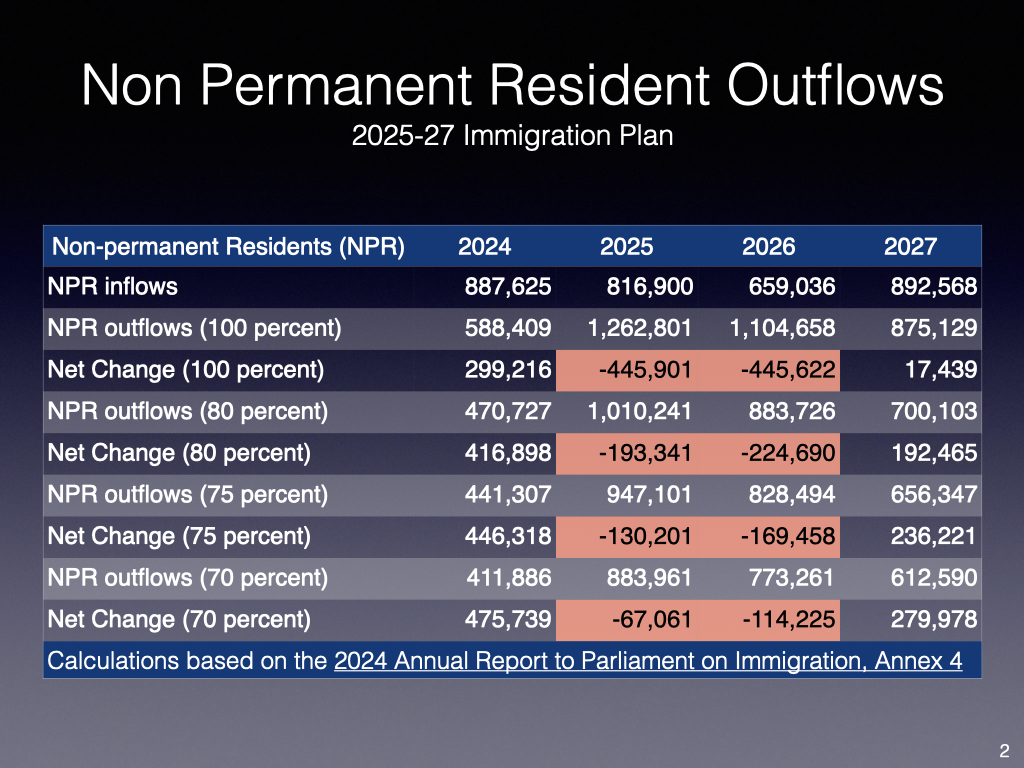
This analysis was prompted by questions regarding the projected numbers of departures with no methodology mentioned, and the suspicion, subsequently confirmed, that it was based on the false assumption that all temporary residents would leave upon expiry of their visa

When IRCC released its annual immigration plan last month, eyebrows were raised over the plan’s prediction of large outflows of temporary residents upon expiry of their visas. The Parliamentary Budget Office noted that “there is significant risk to the demographic projection presented in the Government’s new immigration plan—particularly to the projected outflow of non-permanent residents.” The plan included a table covering projected outflows without indicating the methodology and assumptions behind the table. Subsequently, IRCC has confirmed that the calculations assumed that all temporary residents would leave when their visa expired, save for those who transitioned to permanent residency.

This assumption is just wrong as many temporary residents may well remain in Canada and appears aimed at misleading the public. For illustrative purposes, I revised the plan table to include four assumptions: 100 percent of temporary residents leave (the plan’s assumption), and three alternatives where 80, 75 and 70 percent leave. Should 60 percent or less leave, there would not be any net reduction in the temporary resident population.

The overly precise nature of the numbers—down to individual persons—highlights that the government adapted a purely mathematical approach in its estimates. In the case of permanent resident levels, the government more sensibly uses ranges rather than precise numbers which reflect more accurately operational realities. While politically difficult to admit that some non permanent residents will remain, by not doing so the government attracts more scepticism regarding its plans.

Moreover, as Canada does not track outflows systematically, we will not have accurate data on how many actually leave. The government should explore coordination of flight and CBSA data to obtain better anonymized information on outflows and those who overstay their visa.

The Prime Minister has stated that “Between the amount of people coming and going, we’ll effectively pause population growth for the next two years, then from 2027 onwards, it will balance out and slowly start increasing again at a sustainable pace.” However, this is based on the false assumption that all temporary residents will leave when their visa expires. Unfortunately, as we will not know how many people will stay versus how many people will leave, it will not be possible to verify the extent of errors and estimates.

In short, while inclusion of temporary residents in the annual immigration plan is both overdue and welcome, a more serious approach is needed that better reflects the reality and challenges.

Immigrants Didn’t Steal the Election After All

Yet another myth questioned:

Among the rampant absurdities about immigration that spread from both the obscure and prominent corners of the Internet, the idea that the Biden administration was “importing” voters from abroad to help Kamala Harris win was simultaneously the silliest and the most common. Setting aside the conspiracy theories, the 2024 election provides the best evidence to date that Republicans can compete when immigration is high.

For reasons I can’t appreciate, many Republicans act as if they cannot do well if there are many immigrants in the electorate. Vice President-elect JD Vance saidrecently that immigration would permanently tilt the balance of power in favor of the Democrats. He said this even as his running mate was poised to make historic gains among Hispanic voters, many of whom are immigrants or children of immigrants. Regardless, the historical evidence shows that GOP performance improves with more immigration, so there are no data behind Vance’s fears.

The immigrant share isn’t associated with a stronger performance of either party in presidential elections. But there is a relationship between stronger Republican performance and a larger immigrant share of the US population. The Democrats controlled both houses of Congress for 83 percent of the years from 1935 to 1994 when the immigrant share of the US population was below 10 percent. Since 1995, Democrats have not controlled either house of Congress 53 percent of the time.

Republicans have performed much better during the high immigration periods of US history. Why? Not only do new populations assimilate, but the more Democrats compete and cater to the votes of naturalized citizens, the more US-born voters drift toward Republicans. An additional factor is that the immigrant share has been high when the unionized share of the labor force has been low, possibly because immigrants undermine unionization

Unions were historically the base of the Democratic Party until recently. Any benefit from naturalized citizens did not outweigh losses among the unionized population.

Does this mean that Democrats needed to be even more anti-immigrant to win? That was Kamala Harris’s assessment of the situation. But my view is that her (and Biden’s) immigration gambit backfired. Polls show that from 2019 to 2023 the share of voters saying immigration should be decreased grew just 6 points. Even though illegal immigration fell sharply in 2024, the share of Americans saying that immigration should be restricted suddenly jumped 14 points in June 2024.

Here’s what happened: Harris and Biden endorsed a bill to “shut the border” in 2024, which they reiterated as their position repeatedly before finally acting unilaterally to ban asylum in June 2024. It’s no surprise that when the heads of both parties endorse immigration restrictions, more people move toward that position. We have seen similar swings on other issues, like trade, when the head of a party (Trump) suddenly endorses a different view. Rather than neutralizing Trump’s immigration attacks, Harris’s flip validated them.

Source: Immigrants Didn’t Steal the Election After All

Selected commentary on Government’s reversal of immigration policies

The plan, apart from the numbers and the addition of targets for temporary residents, also had high level discussion of impacts on housing, healthcare and education, as I argued for in my December 2022 article Has immigration become a third rail in Canadian politics?

Major and overdue reversal, one that allows for a more serious discussion regarding immigration policies and priorities without accusations of xenophobia or racism (although see that some activists have already gone there).

Some selected commentary, mix of serious and agenda driven, no doubt more will follow.

Advocates:

A Dark Day for Canada: CILA Condemns Immigration Levels Plan 2025-2027: As an example of this, the federal government’s decision to aggressively increase permanent resident levels in 2021 during a challenging pandemic operating environment created a cascading effect on permanent and temporary resident programs which are still placing immense pressure on the immigration system today and will continue to do so over the foreseeable future. Another example was to allow international students to work full-time while class was in session. This change added to the growing number of foreign students coming to Canada, primarily to seek employment opportunities rather than academic pursuits. Consulting widely with stakeholders would give IRCC the information it needs to plan for the long-term and make policy decisions that are sustainable.  

While we are unable to change the past, it is incumbent on IRCC to learn from its recent shortcomings and ensure it hosts genuine stakeholder consultations moving forward so that immigration levels planning and other major policy decisions consider various viewpoints and we can proactively and effectively manage a healthier immigration system. 

OCASI: Immigration Levels Plan leaves behind refugees, families and people without status: We are deeply concerned that the government continues to incorrectly tie immigration numbers to housing pressures. Scapegoating immigrants for the lack of affordable housing is disgraceful, and will only increase anti-immigrant sentiment from politicians and the public. We expect better from the government and leaders of all political parties. 

These cuts also contradict the government’s acknowledgement that immigration is essential to Canada’s economic success and growth, and that 100% of Canada’s labour market growth comes from immigration. We call on the government to provide greater clarity on how the new levels plan is expected to resolve the public concerns it claims to address.

Canada betrays refugees – CCR Statement on 2025 Levels Announcement: In a shameful abdication of responsibility, the Canadian government has massively reduced its commitment to offer protection to those fleeing persecution and danger in the world, and all but ensured that refugees in Canada will remain separated from their spouses and children for years to come. The CCR condemns today’s announcement and calls on the government to reverse this dangerous course.

Media commentary

Clark: The day Justin Trudeau (sort of) admitted a mistake on immigration: The U-turn is unusual for governments, and out of character for this one. But it had become a political necessity to tell Canadians the Liberals are changing course. Mr. Trudeau even admitted he made a mistake. Or sort of.

Keller: The Trudeau government wants to restore the immigration consensus that it broke: Good news: Canada’s immigration consensus is back. Better news: It’s being restored by the people who broke it.

That means immigration is not going to become a divisive, polarizing and potentially explosive issue in the next federal election. Unlike our peers in Europe and the United States, we’re not going to have a radical left versus radical right brawl over the issue.

Why not? Because Prime Minister Justin Trudeau’s government has come to its senses on this issue. It’s been moving in that direction for the last year and a half, and as of this week, it’s close to fully there.

Phillips | Don’t be fooled into thinking Canadians have soured on immigration — the truth is remarkable
Canadians, by a significant majority, still believe in the value of immigration and they aren’t scapegoating immigrants for their problems, which compared to what’s happening in other countries is quite remarkable. Apparently, not even massive screw-ups in the immigration system can change that. Be grateful.

John Ivison: Red flags all over Trudeau’s flawed plan to curb runaway immigration: The new immigration plan says that 62 per cent of permanent resident admissions will come from the economic class next year, up from 58 per cent in 2024.

But that might simply reflect the adoption of a proposal circulating in the Immigration Department that would create a new economic class of permanent residents for people with high-school education or less, who would otherwise not pass the Comprehensive Ranking point-system that has served Canada so well when it comes to selecting the best and brightest.

The fear among some economists is that this might apply the brakes to a situation that is out of control but risk derailing the whole locomotive by undermining the skills-based system and lowering the standard of permanent resident that Canada accepts.

SUN EDITORIAL: Reducing immigration necessary, not racist: We aren’t going to fault Prime Minister Justin Trudeau for admitting his high immigration policies were a mistake that contributed to today’s affordability crisis, including high housing costs.

We do fault him for his government’s false depiction of Canadians who were raising these concerns long before he did, as racists.

Jesse Kline: Toronto Star paints a skewed picture of Trudeau’s immigration cuts: The bigger problem is that Keung’s story ran in the news section, where reporters have traditionally been expected to provide unbiased accounts of the day’s events. Although Keung is a veteran of the Star’s newsroom, the issue of reporters blurring the line between news and opinion is becoming increasingly common — particularly among young journalists fresh out of university, where many professors now see it as their duty to train activists, rather than extol the virtues of objective journalism.

This influx of woke young journalists has fundamentally changed the culture of many newsrooms, even ones as storied as the New York Times, as its former opinion editor, James Bennet, lamented in a lengthy feature published in The Economist last December. Bennet noted that when he began working at the paper as a reporter in 1991, he started from the bottom and was taught to aspire to “journalistic neutrality and open-mindedness.” In 2006, he left to become editor-in-chief of The Atlantic, where he started to “see some effects of the new campus politics.” [Ironically, the NP increasingly resorts to anti-woke younger columnists.]

Academic

Worswick: As Canada cuts immigration numbers, we must also better select immigrants
The reduction in the immigration and temporary-resident targets can be seen as sound economic policy so long as we as a country maintain our historical focus on selecting economic immigrants who are likely to have high earnings in the Canadian labour market. This focus has played no small part in maintaining our pro-immigration consensus, which can continue under a properly designed set of immigration policies.

Various (Star selection)

Canada’s major changes to immigration targets met with widespread criticism: Diana Palmerin-Velasco, a director of the Canadian Chamber of Commerce, said the business community understands the need for a sustainable immigration system but is concerned about the plan’s implications on the labour market.

“It seems that the government might be overreacting,” she said. “It’s not just 100,000 fewer permanent residents. We are also expecting to see 400,000 fewer temporary residents. We are talking about 500,000 people.”

Scotiabank economist Rebekah Young said the drastic cuts to both permanent and temporary immigration are going to have a near-term macro impact on the economy, and there will be trade-offs.

“They are a source of labour supply and they provide economic activity through the workforce, but they also consume,” said Young. “We’re likely left with lower GDP, but not necessarily a stronger trajectory for the growth outlook.”

Dan Kelly, president of the Canadian Federation of Independent Business, said the cuts are troubling to employers and small businesses.

“A restaurant owner who can’t find a cook ready and willing to work in their community will not have work for the Canadians who may work in the front of the house,” he said. “We need to rethink many of these recent changes and be ready to turn the dial back up.” 

The cuts mean migrants will be forced to remain temporary or become undocumented, and pushed further into exploitative jobs and conditions, said Syed Hussan of the Migrant Rights Network.

The Canadian Immigration Lawyers Association called the pullback a “dark day” for Canada, warning of economic, fiscal and social damage.

“We still have an aging population, low birth rate, and pressing economic and fiscal pressures,” said Barbara Jo Caruso, its co-president. “Canada’s fundamental need for immigration has not changed.”

Diana Gallego, president of the Canadian Council for Refugees, said behind the numbers slashed from the humanitarian component of the levels are 14,000 real people struggling under persecution or in conflict zones around the world.

Business

Statement by Century Initiative in Response to Federal Government’s 2025-2027 Immigration Levels Plan: “Cutting immigration targets is the ultimate hammer solution to a problem far more complex than a few loose nails. This decision projects panic and instability at a time when the country needs clarity and foresight. Canada’s reputation as a stable, welcoming environment for business and talent is now at risk.” — Lisa Lalande, CEO, Century Initiative 

CFIB statement on the latest immigration cuts: These decisions hold huge implications for small business owners, Canadian workers as well as permanent immigrants and temporary workers. A restaurant owner who can’t find a cook ready and willing to work in their community will not have work for the Canadians who may work in the front of the house. We need to rethink many of these recent changes and be ready to turn the dial back up whenever and wherever needed.

Size of Ottawa’s cuts to immigration targets takes business by surprise: Since the reduction is likely to take place when the economy is becoming less inflationary and interest rates decline, this could inspire “existing Canadians to ramp up their spending,” said James Orlando, director of economics at Toronto-Dominion Bank, instead of depending upon newcomers.

Bank of Montreal economist Robert Kavcic in a note on Thursday said that while the government’s decision will reduce demand, the narrative that slower population growth is bad for the economy needs to be dispelled.

He said gross domestic product per capita, which measures the total production of goods and services during a certain period divided by the total population, has fallen in seven of the eight quarters since the second quarter of 2022.

Canada’s immigration pullback may impact economic growth, BoC governor says: “If population growth comes down faster than we have assumed, headline GDP growth will be lower,” Macklem said in response to a question on how the immigration curbs would impact the bank’s forecasts.

If household spending recovers more quickly due to continued cut in interest rates, economic growth could also be higher, he said, while addressing reporters virtually from Washington.

Other

Peter Csillag: Bigger numbers, fewer safeguards, and no accountability—How to fix Canada’s foreign worker program woes: The government’s signal this week that it is willing to not only entertain but actually implement restrictions on its broader immigration agenda is welcome, but far too little, too late. While the high-profile announcement of cuts to the number of permanent residents allowed into Canada is much needed, broader problems persist, particularly with the TFW program. It will be up to the next government to solve them.

Liberals to reduce immigration levels by 135K over two-year period: Sergio Karas, a specialist in immigration law agrees, he told True North that while this reduction is necessary given the housing crisis and the current state of the economy, he still believes that number should be further reduced. 

“As usual, the Trudeau government is doing it wrong,” said Karas. 

“The total number should be reduced to the 2015 levels of approximately 300,000 because the federal government inflated the number exponentially in the last nine years, but more important are the categories where the reduction should be applied. Not all applicants have the same ability to adapt, job security, language skills, and expertise required to ensure economic growth.”

Government announcement

The 2025–2027 Immigration Levels Plan is expected to result in a marginal population decline of 0.2% in both 2025 and 2026 before returning to a population growth of 0.8% in 2027. These forecasts account for today’s announcement of reduced targets across multiple immigration streams over the next two years, as well as expected temporary resident outflows resulting from the 5% target, natural population loss and other factors.

With this year’s levels plan, we have listened to Canadians. We are reducing our permanent resident targets. Compared to last year’s plan, we are:

  • reducing from 500,000 permanent residents to 395,000 in 2025
  • reducing from 500,000 permanent residents to 380,000 in 2026
  • setting a target of 365,000 permanent residents in 2027

The Levels Plan also supports efforts to reduce temporary resident volumes to 5% of Canada’s population by the end of 2026. Given temporary resident reduction measures announced in September and this past year, Canada’s temporary population will decrease over the next few years as significantly more temporary residents will transition to being permanent residents or leave Canada compared to new ones arriving.

Specifically, compared to each previous year, we will see Canada’s temporary population decline by

  • 445,901 in 2025
  • 445,662 in 2026
  • a modest increase of 17,439 in 2027

These reductions are the result of a series of changes over the past year, including a cap on international students and tightened eligibility requirements for temporary foreign workers, implemented to decrease volumes and strengthen the integrity and quality of our temporary resident programs. The changes are designed with long-term economic goals in mind to make sure that we continue to attract the best and the brightest.

These changes will help provinces, territories and stakeholders align their capacities and allow the population to grow at a sustainable pace as we encourage institutions to do their part in better welcoming newcomers.

Other measures from the 2025-2027 Immigration Levels Plan include the following:

  • Transitioning more temporary residents who are already in Canada as students and workers to permanent residents
    Representing more than 40% of overall permanent resident admissions in 2025, these residents are skilled, educated and integrated into Canadian society. They will continue to support the workforce and economy without placing additional demands on our social services because they are already established, with housing and employment.
  • Focusing on long-term economic growth and key labour market sectors, such as health and trades
    Permanent resident admissions in the economic class will reach 61.7% of total admissions by 2027.
  • Strengthening Francophone communities outside Quebec and supporting their economic prosperity
    Of the overall permanent resident admission targets, Francophone immigration will represent
    • 8.5% in 2025
    • 9.5% in 2026
    • 10% in 2027

Through this plan, we are using our existing programs so that everyone—including newcomers—has access to the well-paying jobs, affordable homes and social services they need to thrive in our beautiful country.

Source: Government of Canada reduces immigration


Canadians increasingly divided on immigration, government research shows

Confirms other surveys. Karas is editorialized by adding DEI concerns to the mix as no such question was asked in the survey (https://publications.gc.ca/collections/collection_2024/ircc/Ci4-183-1-2024-eng.pdf):

Canadians are becoming increasingly divided on the federal government’s current immigration targets, with over a third now saying we’re taking in “too many” people from other countries.

The Department of Immigration requested polling agency Ipsos conduct a national survey on its current immigration quotas. 

“Many participants felt that the targets set for the next three years, which were presented to them, were too high,” reads the survey. “They could not fathom how cities, that are already receiving high volumes of immigrants and where infrastructure is already under great strain, could accommodate the proposed targets.”

The survey cost $295,428 and included 3,000 people canvassed with two surveys and 14 focus groups.

When asked if they thought that immigration has a positive effect on their city or town, just over half, 55% agreed, while 22% said the effect has been negative. 

The results were similar when broken down provincially, with 58% saying that the immigration has had a positive effect on their province, compared to 24% who disagreed. 

Asked if immigration had a net “negative effect” on their province, 41% of Ontarians surveyed said yes, while a third of Prince Edward Islanders, 33%, and 27% of Albertans saw immigration as a net negative.

Only 48% of respondents felt that the current targets were “about the right number,” while a little over a third, 35%, said it was ‘too many.’ 

Another small cohort of 12% said that “too few” immigrants are coming to Canada. 

The “too many” sentiment was felt highest in Alberta at 52%, followed closely by Nova Scotia and Ontario at 51% and 49%, respectively.

On the national level, 63% said immigration has a positive effect and 23% said it’s negative. 

This shows the erosion of a long-held immigration consensus in Canada, one expert says.

“For the first time in recent history, support for immigration has eroded steadily amongst the public,” immigration lawyer Sergio Karas told True North.

“There are a multiplicity of reasons why this is happening. Still, the main issues are the cost of living, housing, competition for good jobs, and the general perception that the recent cohorts of immigrants do not contribute to the economy in the same way that previous generations have.”

The immigration department said the “broad sentiment” indicates support for immigration generally but with the caveat of “not right now” or “how are we going to make this work?”

Participants also expressed “strong appeals for reducing the barriers that prevent experienced newcomers from practicing in their fields of expertise,” citing nurses, teachers and skilled labourers as necessary examples. 

However, “reactions to prioritizing those with business skills were more mixed.” 

On the issue of family and immigration, respondents generally agreed on “setting a higher target for sponsoring spouses and partners, who are likely to be working-age, and a lower target for sponsoring parents and grandparents, who might put a strain on the healthcare system rather than contribute to the economy.”

Several participants suggested expediting immigration applications for healthier parents and grandparents over “frailer ones.”

“There is also resentment, especially from immigrants who have been in Canada for many years, that the current crop of newcomers is far more interested in receiving government benefits, and that their language and work skills are not up to par,” said Karas. “This seems to be especially acute about the large number of refugees that Canada has admitted.”

According to the department’s data, few participants believed that Canada was doing the “right thing” by providing asylum to large numbers of refugees. 

While some respondents recognized the “need to assist,” they were also concerned about Canada’s ability to “realistically support population growth given the current strains on public infrastructure.”

Karas said that a further reason for Canadians’ shifting opinion of immigration is the notion that the government is “admitting anyone” without properly vetting them for their skills, language ability and security. 

“While this is not always true, the public is sensitive to how immigrants from non-Western countries are changing the face of Canada,” said Karas. 

“The public concern is that the changes are too rapid and too deep and that immigrants should do more to adapt to existing customs, rather than the public being obligated to adapt to them. Current policies of  Equity, Diversity, and Inclusion have exacerbated that perception as organizations show a preference for EDI hires rather than using a merit system.”

Source: Canadians increasingly divided on immigration, government research shows

Trudeau says temporary immigration needs to be brought ‘under control’

Better late than never (who let it get out of control?) One of the bigger policy and program fails of this government, one than is damaging the overall consensus in favour of immigration:

Prime Minister Justin Trudeau says the government wants to rein in the number of temporary immigrants coming to the country, saying the situation needs to be brought “under control.”

“Whether it’s temporary foreign workers or whether it’s international students in particular, that have grown at a rate far beyond what Canada has been able to absorb,” Trudeau said at a housing announcement in Dartmouth, N.S.

“To give an example, in 2017, two per cent of Canada’s population was made up of temporary immigrants. Now we’re at 7.5 per cent of our population comprised of temporary immigrants. That’s something we need to get back under control.”

The prime minister then said that this is driving mental health challenges for international students and that more businesses are relying on temporary foreign workers, driving down wages in some sectors.

“We want to get those numbers down. It’s a responsible approach to immigration that continues on our permanent residents, as we have, but also hold the line a little more on the temporary immigration that has caused so much pressure in our communities,” Trudeau concluded.

Immigration Minister Marc Miller said on March 21 Ottawa would set targets for temporary residents allowed into Canada to ensure “sustainable” growth in the number of temporary residents entering the nation. Over the next three years, Miller said the goal is to reduce the amount of temporary residents to five per cent of Canada’s population.

For permanent residents, Canada has a target of 485,000 new immigrants, increasing to 500,000 in both 2025 and 2026.

In their last immigration plan update, the government said there are plans to “recalibrate” the number of temporary admissions to Canada in order to ensure the system is sustainable.

In January, Miller announced a cap on student visa admissions to Canada at 360,000 permits, a 35 per cent decrease from 2023.

Source: Trudeau says temporary immigration needs to be brought ‘under control’

Zachary Paikin: Canada’s leaders must take the dangers of diaspora politics seriously

From my time in the foreign service years ago, virtually all governments have struggle to define the national interest beyond the general, and have struggled with diaspora politics to varying degrees, whether in terms of response to humanitarian disasters and conflicts (e.g., measures for Ukrainians compared to other countries) or “imported conflicts” like the current Israel-Hamas one.

Valid to argue for focusing on what brings us together. But beyond general bromides, and process suggestions for a national dialogue on core national interests, it is unclear how such a process would have a meaningful impact given a fragmented media and social media landscape, not to the political incentives for community targeting. And as the Liberal government has found out with respect to Israel-Gaza, extremely difficult to have clear and consistent messaging and actions:

A massive spike in antisemitic incidents across the country following Hamas’ gruesome October 7th attacks has shocked many Canadians. But these events are only the latest example of how diaspora politics are increasingly putting our national cohesion and international engagement at risk.

The disorder we have witnessed in Canadian cities in recent months, which just this weekend succeeded in shutting down an event between two G7 leaders at the Art Gallery of Ontario, comes on the heels of a major break in Canada-India relations following the killing of Sikh nationalist Hardeep Singh Nijjar, as well as the fiasco surrounding the invitation of former Waffen SS member Yaroslav Hunka to Parliament.

The implication seems clear: An increasingly multipolar international order—one featuring assertive new powers and competing global interests—risks fracturing our diverse society and rendering our foreign policy impotent. To avoid this outcome, we need to do two things. 

First, our leaders need to repurpose our public discourse about multiculturalism toward highlighting the ties that bind Canadians together, rather than focusing on the ways in which we are diverse and different from one another. 

Continual intimidation, harassment, and violence against Jewish businesses, neighbourhoods, and community institutions since October 7th has been unnerving and dangerous. I certainly never thought I would live to see the Avenue/Wilson intersection in Toronto—where I spent the first five years of my life—labelled a “Zionist-infested area,” nor to witness a crowd outside the Montreal Holocaust Museum earlier this week cheer as those inside the building were called “rats.”

The face of Canada has changed considerably since multiculturalism was first adopted more than a half-century ago. One day after introducing the policy in Parliament in October 1971, Prime Minister Pierre Trudeau’s maiden speech to outline his vision of a multicultural Canada was made to the Ukrainian Canadian Congress.

Ten years later, in 1981, Jews still outnumbered Muslims nearly four-to-one in the Toronto Census Metropolitan Area (CMA). Yet as of the 2021 census, Muslims accounted for more than 10 percent of the Toronto CMA, now outnumbering Jews by roughly the same four-to-one margin.

Multiculturalism is a unique Canadian success story. And it remains one of the most important assets we have to grow the foundations of our national power and prosperity in an increasingly post-Western international order. But the dramatic change in the demographic composition of Canada over the past four decades means that our population has become subject to a wider range of pressures and ideas. If we fail to pair our growing diversity with a common narrative, then we risk seeing Canadians pitted against one another—as indeed is already occurring—and the whole multicultural edifice being brought down in the process.

Leaders from all parties need to get behind a unifying message, rooted in the founding wisdom of our constitutional order: Canada stands for peace, order, and good government. That means that acts of intimidation and harassment will not be tolerated. But it also means we cannot allow conflicts in distant lands to divide us and shape who we are as Canadians.

This domestic message will resonate even more strongly if accompanied by an adjustment in the way we conduct our foreign policy. Research I have conducted for the Institute for Peace & Diplomacy shows how our political class has difficulty articulating a common idea of Canada’s national interests, beyond platitudes such as outdated conceptions of our “role in the world” as a “middle power” or our desire to be “seen to be a good ally.”

Unable to focus resources and attention on clearly defined core interests, our leaders all too often gear their statements toward domestic audiences for political gain. The current Israel-Hamas war is a case in point: given that Canada’s ability to influence the conflict is negligible, foreign policy statements are used to satisfy demands from this or that constituency. Diversity management takes the place of diplomacy.

A new discourse focused on what does or does not constitute a core national interest would encourage ethnocultural communities to think about foreign policy not as Jewish, Muslim, Sikh, or Ukrainian Canadians, but rather simply as Canadians. Owing to Canada’s location on the map, challenges in the Arctic, Asia, and Europe must rank far ahead of the Middle East when it comes to allocating limited resources in the pursuit of our interests.

By the same token, we should oppose antisemitism not just as Jewish Canadians, but because it offends who we are as Canadians: a civilized country based on peace, order, and good government for all. With a multipolar world exerting growing pressure on our multicultural tapestry, our leaders should focus less on moral posturing toward a conflict over which they have little influence and more on what kind of society we want to build here at home.

Dr. Zachary Paikin (@zpaikin) is a senior fellow with the Institute for Peace & Diplomacy, a Canadian foreign policy think tank.

Source: Zachary Paikin: Canada’s leaders must take the dangers of diaspora politics seriously