Task force rejects calls for special employment status for Jewish, Muslim public servants

Of note. Curious that the report mentioned the Muslim Federal Employees Network (MFEN) but not that of the Jewish Public Service Network (JPSN). Conscious or inadvertent? I made a submission that was not listed, perhaps being deemed not a”comprehensive written submissions.” (Link: https://multiculturalmeanderings.wordpress.com/wp-admin/post.php?post=56715&action=edit). 

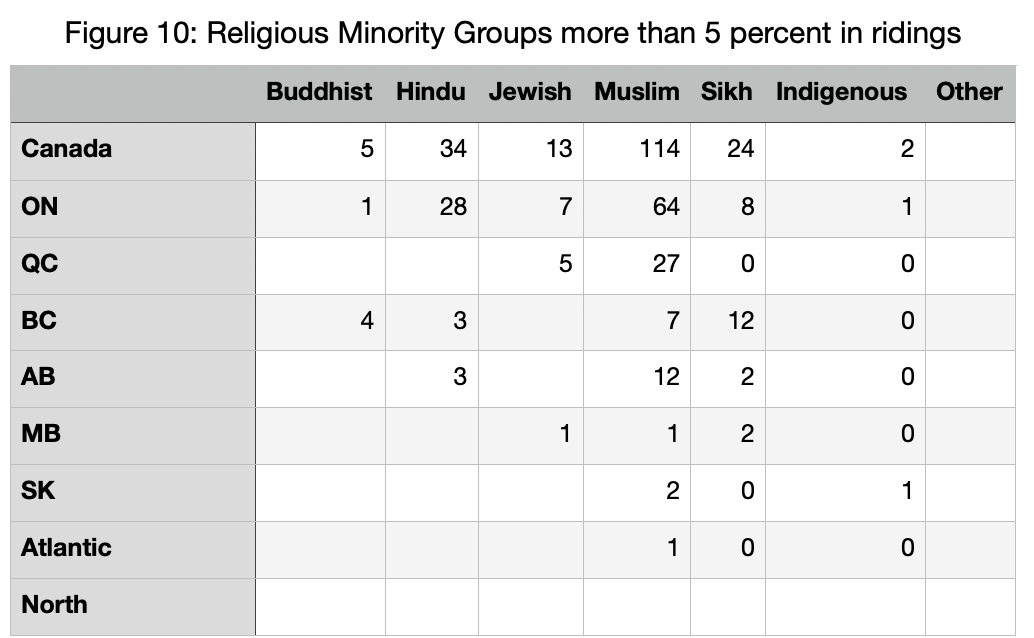
That being said, inclusion of religious minorities would prove a challenge and require religious self-identification and analysis would require deep intersectionality to be meaningful. Census data provides some insights but haven’t had time yet to analyze 2021 data:

Months before the eruption of the Israel-Hamas war ramped up ethnic and religious tensions in many Canadian communities, a government task force rejected requests to recognize Muslim and Jewish public servants as separate groups facing systemic workplace barriers, CBC News has learned.

Muslim and Jewish public servants asked to be designated as employment equity groups under the Employment Equity Act nearly two years ago in submissions to the task force, set up by Employment and Social Development Canada.

CBC News obtained the Muslim Federal Employees Network (MFEN) submission through an access to information request, and the one from the Jewish Public Service Network (JPSN) by asking for a copy.

“The inclusion of religious minorities would provide obligations on behalf of the employer toward removing barriers to religious minorities in the public service, so that they may bring their whole selves to work, including Jews,” says the JPSN’s submission, which also asked that Jews be identified both as an ethno-cultural group and as a religious group under the law.

“Discrimination and socio-economic barriers continue to exist for Canadian Muslims. These barriers will not disappear without intervention,” said the MFEN’s submission. “We recommend that Muslims are added to the Employment Equity Act as a designated employment equity group.”

The Employment Equity Act (EEA) was introduced in 1986 to knock down employment barriers facing four marginalized groups: women, Indigenous people, people with disabilities and members of visible minorities.

The legislation requires that federally regulated employers with more than 100 employees use data collection and proactive hiring to ensure that these groups are not under-represented in their workforces. No designated employment equity groups have been added to the EEA since its creation.

The MFEN and JPSN submissions were prepared in spring 2022, long before the latest deadly conflict erupted between Israel and Hamas in October of last year.

Labour Minister Seamus O’Regan shared the task force’s findings with the media last December, after his office initially received them in April 2023.

The task force said it decided “not to recommend the creation of a separate category for some or all religious minorities at this time,” but encouraged further study.

Jewish, Muslim employees report discrimination

In its submission, the JPSN cited Statistics Canada figures showing Jews were the group most often targeted by hate crimes between 2017 and 2019.

It quoted a B’nai Brith Canada audit in 2021 that reported a “733 per cent increase of violent anti-Semitic incidents.”

In its submission, the JPSN presented anonymous testimony from Jewish public servants. One Jewish employee said they were told they “really bring new meaning to Jews having a lot of money,” after mentioning their background. Several Jewish employees also said they have been called “cheap.”

The submission cited workplace barriers too, such as important meetings being scheduled on religious holidays, excluding observant Jews, or “managers scrutinizing and questioning the validity of leave requests for Jewish holidays.”

The Muslim Federal Employees Network, meanwhile, pointed out that the EEA’s protection for visible minorities won’t protect Muslims.

“There are non-racialized Muslims such as Eastern European Bosniaks, Indigenous Muslims and white converts,” it said in its submission. “In some cases, it may not be possible to determine if someone is Muslim without them disclosing it first. For example, not all Muslim women wear a hijab.”

The MFEN said Muslim federal employees face various forms of Islamophobia. In its submission, it cited reports of Muslim women being subjected to comments “about their ability to do their federal public jobs because they wear a hijab,” and of Muslim men “who are seen to be terrorists and perpetrators of violence.”

It said Muslim federal employees have sometimes struggled to obtain security clearances “because of biases around their countries of origin or their names.”

In its report, the task force did not mention the JPSN’s request, although it cited the MFEN report and two other submissions from the Canadian Council of Muslim Women and the Sikh Public Service Network.

The task force recommended designating 2SLGBTQI+ and Black workers as employment equity groups. It said it had been told by the minister’s office to consider adding those two groups, which allowed it to obtain targeted funding for community consultations.

“In contrast, despite our extensive consultations, we did not receive representations from many of the concerned groups in the broad population beyond the federal public service who wanted us to consider adding religious minorities,” the task force said.

Final decisions on adding more groups to the legislation will be made by O’Regan.

In a statement, O’Regan’s office said it might consider further changes to the EEA.

“These initial commitments are only our first steps in our work to transform Canada’s approach to employment equity,” it said.

The statement said O’Regan “will continue to engage affected communities, including religious minority communities.”

The office said it looks forward to tabling new government legislation but did not offer a timeline.

It said it’s also working to arrange meetings between O’Regan and Amira Elghawaby, the federal government’s special representative on combating Islamophobia, and Deborah Lyons, special envoy on Holocaust remembrance and combating antisemitism.

Source: Task force rejects calls for special employment status for Jewish, Muslim public servants

Phillips: How Muslim voters are exerting their growing political influence

Another number: Canadian Jews from more than 5 percent of the population in 13 ridings compared to Canadian Muslims forming more that 5 percent in 114 ridings:

But the Trudeau government surely didn’t need much encouragement to move in that direction, and it didn’t necessarily have to do with geopolitical calculations. You only have to look at changing demographics in this country and their far-reaching political implications.

This can be touchy territory, so let’s specify a couple of things upfront.

There’s nothing wrong with any community, including Muslims, organizing to maximize their political impact. That’s as Canadian as butter tarts. Virtually every group has done it — from the English and Irish to francophone Quebecers, Ukrainians, Italians, Sikhs, you name it.

And ethnic voting doesn’t explain everything about this or any issue. You don’t have to be Muslim to be appalled at the death toll in Gaza, no more than you have to be Jewish to be sickened by the massacre of Israeli civilians on Oct. 7.

But in this case, there’s no ignoring the increase in Muslim voters. A few numbers: the 2001 census showed there were 579,000 Muslims in this country (or 1.95 per cent of the population). The most recent census, in 2021, put that number at 1.77 million (4.9 per cent).

That’s a dramatic rise. By contrast, Muslims are only an estimated 1.1 per cent of the U.S. population, meaning their relative demographic weight in Canada is almost five times as large.

Another relevant comparison: in 2001, Canada’s Jewish population was put at 330,000. The 2021 census measured it at 335,000 — virtually the same. So while the country’s Jewish population flatlined, its Muslim population tripled….

But no party can ignore the new reality. Demographics, they say, are destiny. And right now they’re showing Muslim voters must be taken seriously.

Andrew Phillips is a Toronto-based staff columnist for the Star’s Opinion page. Reach him via email: aphillips@thestar.ca

Source: How Muslim voters are exerting their growing political influence

‘It’s a new party’: How Conservatives try to rebuild trust among Muslim communities

Of note. Repeat of the Bricker-Ibbitson and Jason Kenney arguments, but targeted towards a group traditionally less inclined to vote Conservative. But opportunistic given the controversies among some members of religious groups regarding LGBTQ+ and gender issues in the school system:

When Pierre Poilievre pitches the Conservative party to Muslim Canadians, he talks about “faith, family and freedom.”

For months he has been pointing out what he sees as their overlapping values during visits to mosques, at community celebrations, with businesses and in conversations with ethnic media outlets.

It’s part of an effort to grow the party’s presence, particularly in larger cities that are home to many racialized Canadians whose support for the Conservatives plummeted during the final months of Stephen Harper’s government and his divisive 2015 campaign.

Poilievre has also fine-tuned his message to appeal to growing concerns from some parents, echoed by several prominent Muslim organizations, about what their children are learning about LGBTQ+ issues in schools.

He is gaining some traction with his acknowledgment of such worries, but whether he will take action through party policy remains unclear, given his firm view that education is a provincial matter.

Some also wonder what he would do to address the Islamophobia that many feel his party exacerbated the last time it was in power. “This is where we have that sort of cautious optimism,” said Nawaz Tahir, a lawyer who chairs Hikma, an advocacy group for Muslims in southwestern Ontario. Tahir met Poilievre with other community leaders this summer.

“While it might be resonating in the short term, there are long-term questions about whether or not people will continue to listen, or latch on, in the absence of some concrete policy proposals.”

Poilievre has chosen to walk a careful path on the issue of “parental rights.” The term, which speaks to the desire by parents to make decisions regarding their children, has been popularized by people with wide-ranging concerns about efforts to make schools more inclusive for LGBTQ+ students, such as by raising Pride flags or including discussion of sexual orientation and gender identity in the curriculum.

New Brunswick and Saskatchewan now require parental permission for transgender and nonbinary students to use different names or pronouns at school. Court challenges have ensued, with teachers’ unions and provincial child advocates saying the policies put vulnerable students at risk.

The Conservative leader has said that Prime Minister Justin Trudeau should “butt out” of the issue and “let parents raise kids,” but otherwise Poilievre has stayed mum on how he might respond.

At last month’s policy convention in Quebec City, Conservative party members voted overwhelmingly in favour of a policy change to prohibit minors experiencing gender dysphoria from receiving “life-altering” pharmaceutical or surgical treatment.

A video posted online shows that Poilievre said during a Punjabi media event in Surrey, B.C., several days later that he was “taking some time to study that policy to come to the right solution.”

He said the party would have to consider “jurisdictions,” in the sense of “which level of government is responsible for it” — but ultimately, “I will be making my position clear.”

Poilievre’s office did not respond to a question about whether he has come to any conclusions.

His office was also silent in July when a photo circulated online that showed Conservative finance critic and Calgary MP Jasraj Singh Hallan with two men who wore T-shirts that read “leave our kids alone.” The shirts featured an image of stylized figures beneath an umbrella shielding them from the rainbow of colours associated with LGBTQ+ Pride flags.

One of the men in the photo, Mahmoud Mourra, a Muslim father of five, has for months been protesting school policies and activities that acknowledge students’ sexual orientation and gender identity.

As he and thousands of others took to the streets in recent countrywide demonstrations against “gender ideology” in schools on Sept. 20, Trudeau posted on X, the platform previously known as Twitter, that “transphobia, homophobia, and biphobia have no place in this country.”

Poilievre’s office, meanwhile, instructed MPs to keep quiet.

Two days later, Poilievre also posted on X, accusing Trudeau of “demonizing concerned parents” with his statement about the protests.

The Muslim Association of Canada also condemned Trudeau’s remarks, saying Muslim parents who participated in protests showed up “to be heard, not to sow division.” The organization said it feared Muslim kids would face “increased bullying and harassment” at school —a statement Poilievre and many of his MPs shared online.

Dalia Mohamed, who leads public affairs at the Canadian chapter of the Islamic Society of North America, said her organization has heard from parents who worry their children face pushback when opting out of certain lessons or activities related to LGBTQ+ issues.

“What they’re seeing more and more is that their kids are facing repercussions,” she said.

An audio recording surfaced online in June alleged to be an Edmonton school teacher chastising a Muslim student about missing class to avoid Pride events. The unidentified teacher says respect for differences “goes two ways,” adding that if the student thinks same-sex marriage should not be legal, then he “can’t be Canadian” and does not “belong here.”

The National Council of Canadian Muslims called it “deeply Islamophobic, inappropriate and harassing behaviour.” The school board said it was dealing with the issue.

Tahir, with Hikma, said it comes down to respecting religious freedom, adding that it is “not part of our faith teaching” to hate the LGBTQ+ community. “We condemn that,” he said.

Tahir said he and other community leaders told Poilievre the Conservatives have an opportunity to regain the support of Muslim Canadians.

He argued that the “vast majority” of Muslims voted for Brian Mulroney’s Progressive Conservatives in the 1980s and early ’90s.

“There was a lot of alignment on a number of issues. And that seems to have gone by the wayside,” he said.

Still, while there is frustration that the governing Liberals have failed to take enough action against Islamophobia,including within its own government agencies, Poilievre faces an uphill battle against long memories.

“He was around the table during the Harper years when there were some things that happened that were not well received by the Muslim community,” said Tahir.

In 2011, then-immigration minister Jason Kenney brought in a rule requiring Muslim women to remove face coverings, such as niqabs, when swearing the oath during citizenship ceremonies. During the 2015 federal election campaign, the Conservatives asked the Supreme Court to hear a request to appeal a court decision to overturn that policy, and Harper mused about extending it to all public servants. The Conservatives also promised to create a tip line to enforce a law against “barbaric cultural practices,” which they said at the time included forced marriages.

Eight years later, Conservatives are still apologizing.

“Mistakes were made. No doubt about that,” Conservative MP Garnett Genuis said in August of the 2015 campaign at a Greater Toronto Area breakfast meeting with members of the Pakistani community.

“There’s rebuilding of trust,” he said in a video shared online. “And I understand people saying, ‘Well, we’re not sure yet because of some of the things that happened in the past.'”

He described a “deep fundamental connection” between the Conservative party and the wider Muslim community. He said a “renaissance” of that relationship is underway.

“We’re trying to reach out to the community and tell them, ‘It’s a new party, that was eight years ago,'” Conservative Sen. Salma Ataullahjan said at the same event. Her office did not respond to a request for comment.

In a written statement, Genuis said the party’s message around lower prices, affordable housing and safer communities is “resonating with Canadians of all walks of life.

So is its defence of “faith, family and freedom,” he added.

Poilievre addressed the criticism of the Conservatives’ unsuccessful 2015 campaign during last year’s leadership race. Rival candidate Patrick Brown, who at the time was counting on heavy support from Muslim communities, accused Poilievre of having never “publicly stood against” the divisive policies, such as a “niqab ban.” Poilievre pushed back by noting the policy was limited to swearing the citizenship oath.

Since winning the leadership, Poilievre has travelled extensively to meet with immigrant and racialized communities that Conservatives had long ago credited with delivering them a majority victory in 2011.

Historically, the party has believed that many in these groups tend to be more religiously conservative, that they will prioritize public safety and that they are looking for policies, such as lower taxes, that can help them gain an economic foothold in Canada.

Tahir said Poilievre was told during his meeting this summer that if he comes back with concrete plans to address Islamophobia, there would be “a strong willingness” from the community to vote Conservative.

In 2017, Poilievre voted alongside other Conservative MPs against a motion from a Liberal MP to condemn Islamophobia, citing concerns it could infringe on free speech.

During Ramadan this spring, Poilievre said in an interview with Canada One TV that he believes the country must “combat bad speech with good speech, not with censorship, but with good speech.”

He also spoke of bolstering a security fund for mosques and talked about combating Islamophobia through a stronger criminal justice response, part of a broader push by the Conservatives for tough-on-crime policies.

Earlier this year, Poilievre addressed long-standing allegations that the Canada Revenue Agency is discriminating against Muslim charities.

The agency “has been abusing our Muslim charities and the immigration system has been discriminating against our Muslim immigrants,” he said in a video shared by the Muslim Association of Canada.

The National Security and Intelligence Review Agency announced in March it would be investigating allegations of bias and Islamophobia at the CRA.

Saleha Khan said she believes Poilievre is using the debate around LGBTQ+ issues in schools to his advantage. She also worries the surrounding rhetoric could ultimately bring more harm to the community.

The London, Ont., woman and nearly 700 other people, many of whom are members of the Muslim Canadian community,have asked in an open letter that their leaders “help separate fact from fiction” by speaking out about misinformation they see fuelling a lot of the discourse, placing both Muslim and LGBTQ+ students at risk, as well as those who identify as both.

She said the debate is “gut-wrenching” and risks making life even more dangerous for average Muslim families and their children, who already experience Islamophobia and live their life under high alert.

“We will become the poster children for transphobia and homophobia when we are not the poster children for homophobia and transphobia.”

In the Ramadan interview with Canada One TV, Poilievre acknowledged that his party has done a lousy job of fostering better ties.

He pledged to be different.

“I’m coming here with my hand extended in a spirit of friendship,” he said. “It’s not the duty of the Muslim community to come to us. It’s our duty to come to you.”

Source: ‘It’s a new party’: How Conservatives try to rebuild trust among Muslim communities

Islam and the issue of parental rights

Of interest:

There’s a religion angle to pretty much every news event that happens these days. That’s one of the reasons why the Free Press continues to report about religion, even when most other daily papers in Canada have given it up.

This includes the 1 Million March for Children, which found thousands of Canadians rallying against what they see as inappropriate teaching about gender and sexuality in schools.

As it turns out, the key person behind the March was Kamel El-Cheikh, an Ottawa businessperson whose parents emigrated from Lebanon. El-Cheikh identifies as Muslim. His children attend a private Islamic school.

I watched a couple of interviews with him on conservative media to learn more about how his faith might be influencing his views on this topic.

In those interviews, El-Cheikh indicated he’d been watching this issue for a decade or more. He became active after a student was suspended from a Catholic school in Renfrew, Ont., last November for organizing a student walkout to protest biological males from accessing a women’s washroom.

That incident led him to explore what he called “the indoctrination” and “compulsion” that goes on in schools over sexual orientation and gender.

As a Muslim, he said, he wants to be kind and respect other views. But, he added, “when compulsion came into the country, that’s when we said it was getting out of hand.”

When asked if Canadian Muslims are being influenced on this issue by far-right Christian groups in the U.S., El-Cheikh said no. That notion, he said, was “disrespectful” and “demeaning” to Muslims in Canada, suggesting they are “gullible and naïve” and that they need Americans to tell “us what to think.”

And yet, while not using any of the far-right Christian nationalist rhetoric that is common in the U.S., El-Cheikh did use terms familiar to that movement — things like “the fabric of Canada is changing,” that we need to “get back to what Canada stood for,” and that he wants it to be “one nation under God.”

El-Cheikh spoke highly of diversity in Canada. But, he added, “diversity doesn’t just mean your sexual orientation. It also means straight families, that’s diversity too, Muslim and Christian.”

He emphasized he wasn’t opposed to adults deciding about their sexual orientation, noting he has had gay bosses and employees. “Who am I to judge?” he asked. “If you want to be gay or a drag queen, go ahead. The problem is if it involves kids.”

He also opposes things like being told to accept gender neutral pronouns, things that he said infringe on his beliefs. Doing so, he said, “is forbidden in my faith.”

El-Cheikh acknowledged that Christian groups have been active in this area for some time, and that Canadian Muslims “are late to the dance.” Muslims, he said, were “silent, we didn’t want to be rude or offend.” That silence, he added, was “taken for weakness.”

But now it has come to the point where “we had to say something about what is happening today,” he said, adding Muslims in Canada are “going to be active at all levels” on this issue as school trustees and in “every organization that involves our children.”

He disputed the notion, promoted by some Canadian Muslims, that Islam is not in conflict with homosexuality. That idea, he said, is “blasphemy.” Islam, he said, “is opposed” to homosexuality. “You can’t practise the faith and do that.”

At no point did El-Cheikh claim to represent any official Muslim group. Two Islamic organizations, the Muslim Association of Canada and the Canadian Council of Imams, did issue a joint statement saying they were not involved in the organization of or endorsed the marches.

They did add, however, that “Canada is regrettably moving in a direction where advocates of sexual and gender ethics contrary to Islamic faith are going beyond their limits by imposing their worldview on our children.”

Muslims aren’t the only religious group involved in this issue; Christian organizations like Canada Family Action and Action4Canada also are calling for enhanced parental rights and the elimination of gender and sexuality education in schools.

What to take away from this?

First, although El-Cheikh identifies as a Muslim, he doesn’t represent all Muslims in Canada — just as someone who is Christian who takes a strong stand on an issue doesn’t represent all members of that faith.

Second, it appears that people from religions other than Christianity are exercising their rights to express themselves about this issue. This likely won’t be the last time we hear from some Muslims about this.

Finally, the march and this issue has brought together right-wing Christians and Muslims in a single cause — who saw that coming? These two groups ordinarily don’t mix. I wonder where that might go in the future?

But one thing you can count on; the Free Press will continue to monitor it.

Source: Islam and the issue of parental rights – Winnipeg Free Press – Winnipeg Free Press

Siddiqui: Despite decades of adversity, Muslims have become an integral part of the West

Interesting and relevant reflections:

Last week marked the 22nd anniversary of the Sept. 11 attacks when nearly 3,000 innocent people were killed by 19 Muslim terrorists. In the ensuing American-led war on terror waged overtly and covertly in more than 80 countries, nearly 900,000 Muslims have been killed and at least 37 million have been displaced, according to Brown University’s Cost of War Project.

We also know about the parallel cultural warfare on Muslims. The Green Scare turned out to be worse than the Red Scare of the 1950s – it has had a bigger footprint, lasted longer and affected, besides the Muslim world, Muslim minorities across the West, estimated at more than 30 million.

What we know little or nothing about is this:

Muslims in the West are emerging as an integral part of the mainstream, despite or because of the heavy odds they’ve encountered.

This is particularly true of Canada’s 1.8 million Muslims and the estimated 3.5 million Muslims in the United States, that hotbed of Islamophobia.

Muslims are assuming prominent roles in a range of fields, from politics to business to culture to sports

Not only is this good news for this beleaguered minority but also our democracies, which, despite bouts of abominable bigotry, do provide the legal and political mechanisms for victims to reassert their rights, eventually.

Post-9/11, Muslims became defensive: “I am a Muslim but not a bin Laden Muslim,” “ … not a fundamentalist Muslim,” “ … not a Wahhabi Muslim,” but rather, “a moderate Muslim,” or “a Sufi Muslim.” Not that many knew who or what a Sufi was, only that the designation signalled you were Muslim Lite and unlikely to blow up planes and buildings.

But as Islamophobia intensified, many Muslims gravitated to their faith. Their ethnic, linguistic, racial, cultural, nationalist and doctrinal affiliations began to take a back seat to their pan-Islamic identity. Or, pan-Muslim identity, in the case of the non-observant.

While 48 per cent of Canadian Muslims consider their ethnic or cultural identity as important, more than 80 per cent cite being Muslim and being Canadian as markers of their identity.

Muslim and Canadian. Muslim and American. Muslim and British.

It used to be that demonized minorities in North America kept their heads down and played down their identities. During and after the Second World War, for example, Mennonites in southern Ontario nearly disappeared from the census. But Muslims announced themselves in the 2011 and 2021 censuses when the decennial religion question was asked.

Mosques are overflowing, in part due to increased immigration but not just because of it. Politicians were the first to sniff this out and troll for votes there. On the Friday sabbath, most mosques are holding two or three services. In Ramadan, the late-evening prayers when the entire Quran is recited in the month, congregations are spilling into corridors, classrooms, gyms – in an orderly Canadian manner.

An unprecedented number of women in Canada – and the United States, Britain and parts of Europe – are wearing the hijab. Most were born or bred in the West, and the first in their families to do so, often defying parents. They’ve marched proudly and fearlessly into the front lines of battling both religious and gender discrimination. They are also carving out new paths: Playing hockey and basketball, acing postsecondary education, and being professors, doctors, lawyers, engineers, entrepreneurs, business partners, authors, TV producers, news anchors and stand-up comedians. In my books, they are the real Muslim heroes of the post-9/11 period.

Even the Halal industry is booming, said to be worth around $1.5-billion in Canada alone.

Ismaili Muslims, followers of the Aga Khan, are beginning to fast in Ramadan, and perform the annual hajj pilgrimage in Saudi Arabia. Given that such obligations had long been left to individual choices among the Ismailis, the new trend by their young denotes strong ecumenical solidarity.

This increase in faith activity may spook those who consider religion incompatible with secularism. On the contrary, freedom of religion, including the right to public assertion of it, is a bedrock principle of liberal democracy. So long as a faith practice is within the law, we have little or no reason to panic. Indeed, it can lead to ethical behaviour and a more humane society. Sikh gurdwaras, for example, serve Sikhs and non-Sikhs alike at their langar, free mass feeding, as they did during the COVID-19 pandemic. Churches routinely house refugee claimants.

Mosque-based food banks are feeding people of all faiths and no faith, and mosques are raising funds for neighbourhood public schools and hospitals. The Toronto-based International Development and Relief Foundation – founded in 1984 by a pious Niagara Falls physician, Fuad Sahin – provides humanitarian aid and development programs without discrimination in Canada and abroad. The Aga Khan Foundation Canada is partnering with the federal government to deliver development programs abroad.

All this represents a remarkably swift evolution for a relatively recent immigrant group, especially the Ismailis. Refugees from East Africa in the 1970s, they’ve shown themselves to be highly organized, self-reliant and successful – a model minority within a minority. Former prime minister Jean Chrétien told me during the 1990s recession that what his hometown of Shawinigan, Que., needed was “a dozen Ismaili entrepreneurs.”

Muslim advocacy groups helped turn the politically docile Muslims into a formidable voting bloc. In the 2015 election, nearly 80 per cent of Canadians Muslims voted, according to the group The Canadian Muslim Vote. Nationally, they voted 65 per cent for the Liberals, 10 per cent for the NDP and just 2 per cent for the Conservatives. In the 2021 election, 28 Muslim candidates ran and 12 won. Four have been ministers: Maryam Monsef (a refugee from Afghanistan), Ahmed Hussen (a refugee from Somalia), Omar Alghabra (an immigrant of Syrian descent), and my Toronto area MP Arif Virani (a refugee from Uganda), now Canada’s first Muslim minister of justice. Naheed Nenshi of Calgary was the first Muslim mayor of a large North American city, and Ausma Malik is the first hijab-wearing councillor in Toronto, indeed Canada.

In the United States, 57 Muslims were elected in the 2020 national and state elections. Keith Ellison, the first Muslim elected to the House of Representatives, took his oath of office in 2007 on a copy of the Quran owned by president Thomas Jefferson who, unlike contemporary American politicians, wanted to better understand Muslims. Mr. Ellison has been followed by three others: representatives Andre Carson, Rashida Tlaib and the hijab wearing Ilhan Omar.

In Britain, which has been slower in integrating minorities, there were 55 Muslim candidates in the 2019 general election and 19 were elected. Two were named Conservative ministers – Sajid Javid and Nadhim Zahawi. In Scotland, Humza Yousaf became First Minister earlier this year, the first Muslim to lead a major U.K. party, and the first Muslim to lead a democratic Western European nation. His wife, Nadia El-Nakla, is a councillor in the City of Dundee, the first member of any minority elected there.

The mayor of London since 2016 has been Sadiq Khan. Earlier as a Labour MP, he voted against his own government’s draconian anti-terrorism legislation in 2006, fearing it might snare innocent Muslims. In 2009, he was sworn in as a member of the Privy Council at Buckingham Palace on the Quran. Upon discovering that the palace had none, he left his copy there.

It’s not just politics.

Goldy Hyder is the first Muslim chief executive of the Business Council of Canada, which represents the heads of Canada’s 150 leading businesses. Toronto lawyer Walied Soliman, Canadian chair of Norton Rose Fulbright, has also served as its global chair.

Authors include M.G. Vassanji, Canada’s first two-time winner of the Giller Prize for fiction; Uzma Jalaluddin; Kamal Al-Solaylee; and Omar Mouallem. Rappers K’naan and Belly. TV anchors Omar Sachedina, Farah Nasser and Ginella Massa; broadcaster Adnan Virk. There’s hockey star Nazem Kadri and the wrestler Sami Zayn. Comedian Ali Hassan and Zarqa Nawaz, producer of the CBC sitcom Little Mosque on the Prairie, which drew a record audience of 2.1 million when it premiered in 2007.

We are familiar with American entertainers Hasan Minhaj, Mahershala Ali, and Aziz Ansari; the writers Fareed Zakaria, Reza Aslan, and Ayad Akhtar, who is also the president of PEN America; the painter Salman Toor and his partner, singer Ali Sethi, whose song Pasoori, Punjabi for conflict, has exceeded 500 million views and was the most searched song in 2022, according to Google Trends.

Muslims have traditionally divided the world into Dar al-Islamand Dar al-Harb, the dominion of Islam and the dominion that barred the free practise of Islam. Canadian Muslims speak of Canada as Dar al-Amn, an abode of peace – sans Quebec.

The province has been aping France and certain European jurisdictions in banning the hijab and the niqab (and the turban and the kippa) in public service, on pain of the wearers losing their jobs. France recently also banned the abaya in state schools, the long dress worn by some Arab women. The discrimination is rationalized in the rubric of laïcité, secularism – oblivious to the irony that while the Taliban and the ayatollahs tell women what to wear, these guardians of secularism order women what not to. The urge to control women is the same. Quebec recently banned religious activity (i.e. prayers) in schools, which disproportionally affects Muslim students. China has banned beards in Muslim Xinjiang in the name of curbing “extremism.” We are left to argue only about the degree of the control and the punishments for disobedience.

Quebec also shares another unfortunate trait with France and other parts of Europe. The only Muslims it grants prominent roles in government and the public sector are those who attack fellow Muslims, especially the observant. No dissident voices are allowed to disturb the certitudes of anti-religious secularism.

Happily, in English Canada, Muslim-baiting no longer pays political dividends. Stephen Harper found that out in the 2015 election when Canadians decided that his Barbaric Cultural Practices Act was one dog whistle too many.

Today, no Islamophobic party can win a national election, nor a xenophobic one.

Yet, as we know, Canada has not been immune from Islamophobia.

Six worshippers were massacred in Quebec City in 2017. A caretaker at a Toronto mosque was murdered in 2020. A family of four was mowed down in London in 2021; the trial of the accused is taking place as I write this.

Muslims face hostility – including, shamefully, by the right-wing mainstream media. They suffer high unemployment and underemployment. Hijab-wearing women are still harassed, spat upon, pushed, shoved and kicked in public spaces, pointing to yet another irony: The West thinks that Islam and Muslims mistreat women, yet it is Muslim women in the West who are the biggest victims of discrimination by liberals and louts alike.

Ottawa has appointed a Special Representative on Combatting Islamophobia, Amira Elghawaby, a hijab-wearing human-rights activist. Her role is akin to that of the Special Envoy on Preserving Holocaust Remembrance and Combatting Anti-Semitism. This is appropriate, given that Islamophobia is the new antisemitism.

Through these tough times, as during others through the ages, Muslims have been sustained by a resiliency born of sabr, patience/perseverance, enjoined by the Quran and the Prophet Muhammad. Even the non-observant have it in their DNA. One common refrain among Muslims is that as bad as they’ve had it here, they are blessed, compared with the plight of many Muslims and non-Muslims around the world.

Overcoming adversity, succeeding as a minority, and integrating into the larger society have had two significant beneficial side effects for Muslims:

1) Going or gone is the notion that Muslim states “back home,” or at least the influential ones, would come to the rescue of Muslims here. Or that the Organization of Islamic Co-operation, the Jeddah-based, 56-member umbrella organization of the world’s 1.8 billion Muslims, would.

2) Old-world interdenominational rivalries are dissipating. All strands of Islam co-exist here: There are no Orange Day-like parades, with one set of Muslims needling the other.

All these transformational changes speak to a greater truth: Democracy is the best polity for Muslims, as it is for peoples of other faiths and no faith, so long as it treats all groups fairly.

This is not an exclusively secular idea. It was enunciated with stunning clarity by Islamic clerics back in the 1930s in colonial British India. Its strongest proponent was Husain Ahmed Madani, rector of a highly regarded orthodox madrassah in Deoband, north of Delhi. I’ve been reading about him while tracing my family history in those precincts.

He was a steadfast supporter of Mahatma Gandhi’s joint Hindu-Muslim struggle for independence from the British. He opposed dividing India into a majority-Muslim Pakistan and Hindu-majority India, and would ask: Whose Islam would prevail in Pakistan? Given the range of theological diversity among Muslims, only an authoritarian government could impose the kind of Islam it opted for. He was making the case for Muslims to stay in the democratic framework of postcolonial India. His prescience is being proven over and over in the West, especially Canada.

Haroon Siddiqui is editorial page editor emeritus of the Toronto Star and a senior fellow at Massey College. His latest book is My Name is Not Harry: A Memoir.
Source: Despite decades of adversity, Muslims have become an integral part of the West

Muslims opposed to LGBTQ curricula for their kids aren’t bigots

A justification from the Dean of an Islamic Centre to provide some context to Canadian and American protests and highlighting an alignment among the religious right across religions. Ingenuous to argue that it is not political given today’s environment:

We are witnessing a unique and welcome phenomenon: Muslims in the West are at the forefront of a social movement that transcends any one faith or ethnicity. For those following the news, protests led by parents have erupted across the United States and Canada against school boards that wish to teach schoolchildren content about the acceptability of LGBTQ lifestyles.

While parents of all ethnicities and religions are involved, Muslim parents have been playing a central role in all of these cases, both as organisers and protesters, and their highly visible presence is creating waves on social media.

It is understandable for parents to be concerned. In Maryland, for example, a school district has approved books that discuss homosexuality and transgenderism as normal realities for children as young as three years old. This is state-sponsored ideological indoctrination of toddlers who can barely form complete sentences, much less think critically.

Parents have a God-given duty and legal right to provide moral instruction and guidance to their children. This includes the right of parents and their children to reject ideologies that contravene their beliefs.

Yet, supposedly secular institutions like public schools are now dictating that students must accept and affirm LGBTQ ideology, at times with the threat that if they refuse to do so, they “do not belong” in their country, as one teacher in Edmonton, Canada, recently said to a Muslim student.

As Muslims, we refuse to be coerced into believing something our faith categorically condemns. This is not a political stance. It is a moral principle.

recent statement I helped draft, titled “Navigating Differences: Clarifying Sexual and Gender Ethics in Islam”, has been signed and endorsed by more than 300 Islamic scholars and preachers across North America. In this document, we explicitly and clearly lay out the non-negotiable, normative Islamic position on sexuality and gender ethics.

We believe this statement will allow Muslim parents, educators, students and professionals to establish their right to hold their religious views without fear of legal reprisal. All too often, those who wish to live in accordance with mainstream, family-based morality are accused of being bigoted and “homophobic” if they refuse to endorse LGBTQ events. Many suffer social repercussions for holding such beliefs.

Worse still, children are expected to attend events in which drag shows and other actions deemed immoral by many people of faith are showcased.

This statement seeks to be a reference point to demonstrate to school boards and employers why Muslims must preferably be excused from activities that contradict our religious ideals.

The statement is explicitly non-partisan and states that the signatories are “committed to working with individuals of all religious and political affiliations to protect the constitutional right of faith communities to live according to their religious convictions and to uphold justice for all”.

Despite such clear declarations of non-partisanship and though the protesters, from Maryland to Ottawa, have insisted they are asserting moral agency rather than political allegiance, certain groups insist on turning this into a partisan issue.

Those who have committed themselves to a left-wing liberal ideology (including some progressive Muslims) are outraged and ashamed of anything short of the full affirmation and acceptance of all LGBTQ demands. They point to our own experience of oppression as a Muslim minority and say we should thus show reciprocity to other marginalised groups, even as LGBTQ advocates often refuse to show the same sensitivity on issues we hold sacred.

The fact that conservative media outlets have provided a platform for Muslim parents to share their grievances is supposedly conclusive proof that these protesters, and all of us who oppose the teaching of the LGBTQ agenda in schools, are aligning themselves with the far-right, including white supremacists. That is simply not the case.

To be sure, the sudden friendliness of politically-conservative groups and media outlets towards Muslims is indeed tempting some in the community to rush to forge new alliances with the political right after previously flirting with the left. They are making a mistake. Again.

Muslims across North America should firmly root their moral values in their faith, not in a specific political ideology. To understand why this distinction is so critical, we ought to heed a lesson from our recent past.

In the immediate aftermath of 9/11, Islam in North America faced an existential crisis. Muslims were widely portrayed as the enemy. Scholars were deported. Bearded Muslim men and hijabi women were harassed, randomly questioned and detained at airports. Many worshippers avoided praying in masjids and some Muslims even changed their first names. The reality of Muslims in North America in the first decade of this century was one of fear, anxiety and extreme alienation.

The open hostility of the North American political right towards Islam and Muslims sharply contrasted with the comparatively sympathetic left. As a matter of pragmatic political (and in some cases, literal) survival, Muslims flocked to the liberal political parties of Canada and the United States. These left-wing institutions gave Muslims the best chance to survive against anti-Muslim forces largely represented by the conservative right. But embracing the left meant accepting an entire package of causes, some of which aligned ideologically with Islamic ethics (such as combatting racism), while others did not (such as the legalisation of certain drugs).

Many Muslims began approaching politics not as a tool but as an ideology. They felt motivated to resolve the cognitive dissonance between their political commitments and their religious beliefs, even if it meant radically reinterpreting the faith to allow for such accommodation.

Some progressives who identified with Islam began claiming, for the first time in our 14 centuries of scholarship, that the Quran has been misunderstood and that in its correct interpretation, it endorses alternative sexual lifestyles and sanctions same-sex marriages.

To be clear, Islamic law differentiates between a desire, which is in itself not sinful, and the deed, which could be a sin. Those struggling with same-sex desires but wishing to abide by Islamic law are our full brethren in faith and deserve all the love and rights of believers. They stand in contrast to those who flout Islamic law and take pride in disobedience. Muslim politicians and influencers, in particular, should be careful not to make religious claims on behalf of our faith.

In an authentic narration, Prophet Muhammad (peace be upon him) says: “believer is not bitten from the same hole twice”. Muslims who are rightly indignant about the moral decay sweeping our society in the name of inclusivity ought to be cautious not to be a pendulum that swings from one extreme to another.

Our politics is not our ideology and our ideology is neither left nor right. Our ideology is centred in our unshakeable faith, grounded in our immutable creed, and firmly rooted in the timeless words of God and the teachings of His final Messenger. We are a “Middle Nation” and, as the Quran says (2:143), our role is to be moral exemplars for mankind.

Yasir Qadhi Dean of The Islamic Seminary of America and Resident Scholar of East Plano Islamic Center

Source: Muslims opposed to LGBTQ curricula for their kids aren’t bigots

Rahim Mohamed: Unhinged teacher tells Muslim to support Pride or ‘you can’t be Canadian’

Of note. Teacher went to far with her “you don’t belong (in Canada)!” but most other points were valid. And it is equally valid to point out the lack of consistency in reasonable accommodation arguments:

Administrators were thrust into full damage control mode on Tuesday when an audio recording of an in-class scolding of a Muslim pupil, attributed to a teacher at North Edmonton’s Londonderry Junior High, was leaked to social media.

In the recording, shared on Twitter by the London (U.K.)-based 5Pillars news, the teacher could be heard berating a student, identified as “Mansour”, for allegedly skipping class to avoid ‘Pride Month’ activities:

“You are out to lunch if you think it’s acceptable to not show up because (of) Pride activities going on at school,” the speaker admonished. “But meanwhile, (your LGBT+ classmates), they’re here when we did Ramadan… and they’re showing respect for in the class for your religion…”

“It goes two ways! If you want to be respected for you are… then you better give it back to people who are different from you.”

The speaker then references new anti-gay legislation in Uganda, a country where over eight-in-10 citizens identify as Christian: “In Uganda, literally, if they think you’re gay, they will execute you.” (Uganda’s just-passed Anti-Homosexuality Bill imposes the death penalty for so-called “aggravated” homosexual acts, such as gay sex with an underage partner or infecting a partner with HIV).

“If you believe that kind of thing, then you don’t belong (in Canada)!”

She went on to suggest that those who don’t agree with certain laws in Canada don’t belong in this country.

“We believe that people can marry whomever they want. That is in law. And if you don’t think that should be the law, you can’t be Canadian. You don’t belong here.”

(As of Wednesday morning, the recording had garnered over 100,000 views on Twitter).

5Pillars also shared a letter, dated (Saturday,) June 3, 2023, purportedly written by the school’s principal Ed Charpentier: “Many of you may have heard an audio recording of a teacher at Londonderry School circulating on social media channels,” reads the letter. “I want to emphasize that the views expressed by the teacher do not reflect the values of acceptance, inclusion and belonging that are so strong at Londonderry School.” (a phone number given at the bottom of the letter leads to the school’s central directory). The letter’s date suggests that the incident took place sometime last week.

Edmonton Public Schools added the following on Tuesday in an email to members of the media: “(We are) aware of the audio recording of a teacher at Londonderry School circulating on social media channels. The school and Division are taking steps to address the situation. Due to the Division’s legislated privacy obligations, we are not able to provide any further information.”

While the teacher was clearly out of line, the recording nevertheless reflects a religious tension that’s playing out across Canada over increasingly elaborate in-school Pride celebrations. Evidence is starting to mount that Muslim students are “opting-out” en masse from Pride-related activities — going so far as to skip school on designated Pride days.

London, Ont. (a city where nearly 10 per cent of residents identify as Muslim) has been hit by a wave of absences on school days dedicated to LGBT visibility. Just last month, nearly one-third of students enrolled at London’s largest elementary school stayed home as the district commemorated the International Day against Homophobia, Biphobia and Transphobia. (As the National Post’s Tristin Hopper reported, a majority of students absent that day appeared to be from Muslim families). At least six other schools in the London-area reported higher than usual absences that day. A similar mass absence broke out three months earlier, when the elementary school marked “Rainbow Day”.

A subsequent public statement from the London Council of Imams (LCI) read, “When it comes to activities related to ‘Pride Month’… parents play an integral role in the education of their children and are critical to empowering them to remain steadfast on their faith and beliefs. For this reason, the LCI is not in the position to direct parents on whether to choose to have your child(ren) to attend or be absent from school.” The statement advised parents to “use their discretion” to determine whether to send their children to school on days that included Pride-related activities and programming.

While Pride-related absenteeism among Muslim students has been documented most extensively in London-area schools, the leaked recording from Edmonton indicates that this issue is beginning to crop up in other Canadian cities with large Muslim populations (Edmonton is home to nearly 100,000 Muslims).

Interestingly, the brewing tensions over Muslim students declining to partake in in-class Pride activities recall the “reasonable accommodation” debates of yesteryear — only with the ideological roles reversed. The same progressives who once breathlessly defended the right of Muslim women to don Niqabs in voting booths (and, famously, at citizenship ceremonies) are now claiming that celebrating Pride Month is a sine qua non of being Canadian: “If you don’t believe that, then you don’t belong here!”

Even as they publicly condemned the teacher’s words, it would be unsurprising if many leaders in Edmonton’s ultra-progressive public school system were quietly nodding their heads in agreement with this statement.

Once again, Canada’s Muslim community finds itself at the centre of an ideologically charged debate over Canadian values. This time around, the absolutists are wearing rainbow-coloured clothing.

Source: Rahim Mohamed: Unhinged teacher tells Muslim to support Pride or ‘you can’t be Canadian’

Daphne Bramham: Muslims and Sikhs of Indian descent want Canada to do more to protect them

Of note:

Like Canadians of Chinese, Uyghur, Tibetan, Russian and Iranian descent, organizations representing the Indian diaspora say their members have been subject to foreign intimidation and have seen evidence of India attempting to interfere in elections here.

They’re urging Canada to set up a foreign agents registry and add India to the list of governments exerting undue influence here.

“Canada’s racialized communities are simultaneously some of the most targeted — and vulnerable — for foreign interference, intimidation and harassment in pursuit of securing the policy objectives of foreign states,” says a March report released by the B.C. Gurdwaras Council and the Ontario Gurdwaras Committee.

That’s echoed in a joint report by the National Council of Canadian Muslims and the World Sikh Organization of Canada, also released in March.

While the reports are aimed at raising awareness, they also underscore just how complicated the issues of foreign interference and diaspora politics are.

The World Sikh Organization has been linked to the Sikh separatist movement. As recently as 2018, “Sikh extremism” was mentioned in the Canadian Security Intelligence Service annual assessment of domestic terror threats. The reference to Sikh extremism was later removed because it “unintentionally maligned certain communities.”

During Prime Minister Justin Trudeau’s visit to India in 2018, concerns were repeatedly raised about Sikh separatists in Canada, and included the four Sikhs in his cabinet.

It’s a link so deeply embedded in the Indian consciousness that after a father was stabbed to death outside a Vancouver Starbucks last week and Inderdeep Singh Gosal was arrested, a Delhi-based journalist tweeted — without evidence — that it was “a shocking murder by a Khalistani radical.” Other Indian media websites posted similar descriptions.

The two March reports blame the continued stereotyping of Sikhs and Muslims on Prime Minister Narendra Modi’s Hindu-first policies and its attempt to spread its message to the Hindu diaspora through a network of organizations aligned with the ruling Bharatiya Janata Party.

Since the Bharatiya Janata Party came to power in 2014, human rights groups have raised concerns about the erosion of civil rights, arbitrary detention of activists, journalists and critics, and the use of counterterrorism laws to silence dissent.

In 2022, Amnesty International reported that the Indian government “selectively and viciously cracked down on religious minorities, and explicit advocacy of hatred by political leaders and public officials towards them was commonplace and went unpunished.”

It noted that “punitive demolitions of Muslim family homes and businesses were carried out with impunity.” Peaceful protests were treated as a threat to public order, and minority and marginalized communities continued to face violence and entrenched discrimination.

The joint Muslim and Sikh report alleges the Indian government — through its diplomats and an expanding network of aligned organizations — is attempting to spread the message through “bold and often public stereotyping of Muslims and Sikhs as anti-Indian, anti-Canadian, and Hindu-phobic terrorists working to discredit the BJP’s reputation and accomplishments across the world.”

The gurdwaras report echoes that concern, alleging that Indian diplomats and intelligence agencies are trying to “persuade Canadian policymakers to criminalize and prosecute Sikh political advocacy in Canada under the guise of ‘countering extremism.’”

Among the evidence cited of Indian government interference is a CSIS document filed in a 2018 immigration case. Global News reported in 2020 that CSIS said the Indian citizen, an editor known only by his initials, was involved in espionage.

It said he attempted to sway politicians into supporting Indian government interests following more than two dozen meetings in Canada with agents from India’s two main intelligence branches.

Since 2014, the joint Sikh and Muslim report says, there has been a rapid expansion of both the radical Hindu nationalist network called the Rashtriya Swayamsevak Sangh and the Overseas Friends of the Bharatiya Janata Party, which is listed on the American’s registry of foreign agents.

In 2018, the Canadian Overseas Friends of the Bharatiya Janata Party and its chapters in B.C., Alberta, Manitoba and Ontario changed their name to Canada India Global Forum.

According to the forum’s website, its mission is to “utilize the Indo-Canadian diaspora in Canada to help promote and strengthen the economic, bicultural and political ties.”

The Rashtriya Swayamsevak Sangh played a key role in Modi’s party winning successive majorities in 2014 and 2019. Quotes from its founders and early leaders citing Nazi Germany as an inspiration are included in the report. It warns that the Indian government’s nationalist policies pit Hindus against other religious minorities and that message is being exported here.

It also says that the “sectarian, discriminatory, and often hateful antipathy toward those framed by RSS and Hindutva ideology as enemies … pose a direct threat to Muslim and Sikh communities, as well as to the social fabric of Canada.”

It singles out Hindu Swayamsevak Sangh as part of the Rashtriya Swayamsevak Sangh’s Canadian network, noting that photos on the group’s Facebook page include images of some of the Rashtriya Swayamsevak Sangh’s earliest leaders “often strewn with flowers.”

Hindu Swayamsevak Sangh is a tax-exempt charity with 25 Canadian chapters or shakhas including some operating out of public schools in Ontario.

According to the its website, it encourages “maintaining Hindu cultural identity in harmony with the larger community” through structured programs of regular athletic and academic activities that develop leadership skills “emphasizing values such as self-discipline, self-confidence and a spirit of selfless service for humanity.”

Coincident to foreign interference in Canada widely discussed last month, hundreds of people gathered in Vancouver outside the Indian consulate and rallied in Prince George to protest mass arrests, internet and mobile phone shutdowns in Punjab as police hunt for activist Amritpal Singh.

Singh has been described as the leader of a renewed Sikh separatist movement and is being sought by police for attempted murder, obstruction of law enforcement and creating disharmony.

If this is a harbinger of rising Sikh separatist sentiment in Canada, Canada will have to respond, adding a further complication to the knotty problem of protecting Canadians from foreign interference, while also ensuring all citizens’ right to speak freely and be free from discrimination.

Source: Daphne Bramham: Muslims and Sikhs of Indian descent want Canada to do more to protect them

Le «Québec bashing» pour faire avancer l’agenda islamiste

Of note:

Je suis arrivée du Maroc en 2005 accompagnée de mes deux jeunes garçons de un et trois ans. Je ne me sauvais pas d’une situation de violence particulièrement grave, mais d’un état de dépendance et de soumission assez banal pour une femme dans une culture arabo-musulmane.

Cela n’a pas été facile de redémarrer une vie de mère de famille monoparentale dans un nouveau pays, mais le Québec a été pour moi une destination de rêve, et je suis reconnaissante de l’accueil dont j’ai bénéficié. J’ai toujours trouvé injustes les accusations de racisme et d’islamophobie dont les Québécois sont la cible. Je me sens plus respectée au Québec que je ne l’étais dans mon pays d’origine. C’est ici que je me suis sentie citoyenne à part entière, libre de mener ma vie comme je l’entendais, sans jugement, et j’ai le sentiment d’avoir bénéficié de l’égalité des chances.

On parle beaucoup d’islamophobie, mais on ne parle jamais de la pression communautaire qui pèse sur les ressortissants des pays arabes pour les forcer à se conformer à des normes culturelles et religieuses et les empêcher de s’intégrer dans leur pays d’accueil. Mon expérience récente dans le milieu associatif montre à quel point il est difficile de faire émerger un islam humaniste au Québec, et comment les accusations de racisme et d’islamophobie contre les Québécois sont utilisées pour faire avancer des objectifs islamistes.

J’avais envie de m’investir dans le milieu associatif pour aider d’autres ressortissants de pays musulmans, surtout les jeunes, à s’en sortir. Je voyais le danger de la radicalisation et l’influence que certains prédicateurs ont sur les jeunes ici même, à Montréal. Mon neveu de 25 ans habitant à Laval, plein de talent et de joie de vivre, artiste peintre, parolier, bon joueur de soccer, est soudain tombé entre les griffes du radicalisme. Du jour au lendemain, il a arrêté ses études, ses activités artistiques et le sport, pour se consacrer à la religion. J’avais tellement envie de crier fort : laissez les enfants vivre sans influence religieuse, arrêtez de les endoctriner.

Dès que j’en ai eu la possibilité, j’ai donc décidé de m’investir dans la société civile. Le passage à Montréal d’un penseur égyptien prônant une approche humaniste de l’islam m’en a donné l’occasion. Autour de ce penseur, la possibilité de créer une association de citoyens de culture arabo-musulmane favorables à la laïcité s’est présentée. Dans le cadre de cette nouvelle association, nous avons commencé à organiser des activités culturelles et des rencontres virtuelles avec des membres dans différentes villes du Canada et des États-Unis.

Arme aux mains des intégristes

Cependant, une personne très connue dans le milieu associatif et très influente dans une certaine communauté musulmane de Montréal prenait de plus en plus de place dans la direction de l’association. Le temps accordé aux personnes non pratiquantes, athées ou favorables à la laïcité diminuait au bénéfice de nouvelles personnes qu’il invitait, ayant des idées plus proches d’un islam radical. Lorsque je lui en parlais, il m’expliquait qu’il était important d’écouter ces personnes pour les amener un jour à changer d’idées.

Je n’étais pas convaincue par ses arguments, mais étant donné sa notoriété et son expérience associative de plus de trente ans, j’acceptais. Cependant, plus le temps passait, plus des personnes défendant l’islam politique se joignaient à l’association qui, rappelons-le, avait été créée justement pour faire face aux idées de l’islam politique.

À chaque occasion qui se présentait — rencontres en personne, virtuelles ou téléphoniques —, ce monsieur trouvait le moyen de décrire le Québec comme une province raciste et islamophobe. Il utilisait toutes les tribunes pour diaboliser le Québec. Lorsque j’intervenais pour parler de mon expérience positive au Québec, il ridiculisait mes propos et expliquait que si j’étais bien accueillie, c’était en raison de mes positions « anti-islam ».

Ma position en faveur de la loi 21 est ce qui m’a valu le plus de moqueries de sa part. Il insinuait que je voulais plaire aux Québécois et que je n’étais qu’un instrument entre leurs mains. Lors de la nomination d’Amira Elghawaby comme représentante canadienne à la lutte contre l’islamophobie, il fit des pressions sur moi pour que je ne puisse pas exprimer mon avis contre sa nomination.

C’est à la suite de la dernière rencontre que j’ai décidé de quitter l’association. Parmi les intervenants, il y avait une maman syrienne qui racontait son expérience douloureuse en nous montrant la photo de sa fille dans la vingtaine tuée par Daech [groupe État islamique]. Lorsque la réunion fut terminée, ce monsieur réagit violemment en interdisant la diffusion d’une vidéo présentant nos interventions et déclara que la maman n’aurait pas dû qualifier Daech d’organisation terroriste.

L’association dont j’avais été membre fondatrice n’avait plus rien d’humaniste ni de laïque.

Je ne sais pas quel sera le mandat de la représentante canadienne à la lutte contre l’islamophobie, mais je sais que ce concept est une arme aux mains des intégristes pour faire avancer leurs objectifs politico-religieux et pour creuser un fossé entre les musulmans et les autres. Il y a de quoi s’inquiéter.

Source: Le «Québec bashing» pour faire avancer l’agenda islamiste

Diversity Initiatives Are Failing the U.S. Muslim Community

Interesting new term for me, “crisis diversity:”

Over the past decade, the Muslim community has become included in diversity initiatives in the United States. Hollywood is finally producing shows that feature Muslim characters, such as Hulu’s Ramy, Netflix’s Mo, and Disney+’s Ms. Marvel. Universities are adjusting dining hall hours to accommodate Muslim students who fast during Ramadan, and they are increasing the number of reflection spaces on campus to facilitate Muslim ritual prayer. Nike launched its Pro Hijab, a headscarf for Muslim women athletes, and Olympic medalist Ibtihaj Muhammad became its model. Muhammad also served as the inspiration for the first Muslim Barbie doll.

These initiatives enhance our sense of belonging as Muslims in the U.S.—but they are not enough to actually challenge Islamophobia.

How did Muslims come to be included in diversity plans in the U.S.? My research shows that this happened in the wake of crises, or moments that made it clear that Islamophobia was a problem. Diversity initiatives born out of crisis can produce important social change, but responding to a momentary flare up as opposed to longstanding structural inequality limits the extent of possible change. Social change requires addressing the root of the problem primarily located in a history of U.S. foreign policies that dehumanize Muslims.

Islamophobia, itself, is far from new. Scholars trace forms of it as far back as the 7th century, with the emergence of Islam as a religion. But the term found new popularity in the late 20th century. Many point to the 1997 report published by the Runnymede Trust in the UK as the first influential use of the word Islamophobia, since it was the first to highlight it as a social problem. But the term did not enter the U.S. lexicon until about a decade after 9/11.

Muslims have long been constructed as threats to U.S. national security, but this intensified after 9/11. Think of the USA PATRIOT Act, Special Registration, U.S.-led wars in Afghanistan and Iraq, and the Abu Ghraib prison scandal as prime examples of this.

But in the 2010’s, as the nation grappled with a history of racism and inequality, a new rubric of “diversity, equity, and inclusion” created an opening for Muslims to be seen as a beleaguered minority. Muslims became included in conceptions of diversity and social justice through a series of crises, such as the 2010 “ground zero mosque” controversy, the establishment of the Islamophobia Industry, and Donald Trump’s 2015 announcement to ban Muslims from entering the U.S.

These moments led to widespread recognition that Muslims are demonized and targets of individual hate and repressive state policies. This phenomenon is a prime example of crisis diversity—where a precipitating event leads to the recognition of racism or discrimination and an ensuing flurry of concerted action.

Crisis diversity produces a domino effect of responses: The general public becomes aware of a long-standing problem (Islamophobia); people of that particular identity group (Muslims and experts on Islam) are called upon to urgently educate the public and advise leaders on how to make changes; media conglomerates, corporations, universities, and other organizations respond by issuing statements or embarking on new diversity initiatives. The crisis moment then passes, and little attention is paid to the issue until the next crisis emerges, restarting the cycle.

Crisis diversity is not solely a response to Islamophobia. One need only look at how the police killing of George Floyd in the spring of 2020 led to nationwide protests, reigniting public debate about police brutality and putting anti-Black racism firmly on the agenda of the criminal justice system, as well as universities and a wide array of corporations and industries. That same year, the football team the Washington Redskins was finally renamed the Washington Commanders after decades of refusing to change the name, despite protests from American Indian communities. NASCAR finally banned use of the Confederate flag, and Quaker Oats finally retired its brand based on the Aunt Jemima racial stereotype. At the same time, the number of Black people killed by police has not decreased.

In similar, yet distinct ways, Islamophobia is discovered anew each time an instance of it manages to capture public attention. How much social change is accomplished through these crises-responses is varied and debatable.

For Muslims, crisis gave us Mo and Ms. Marvel. It gave us prayer rooms on college campuses. It gave us Rashida Tlaib and Ilhan Omar, the first Muslim women in Congress. These progress markers are an important start; however, the crisis-response approach is limiting. While Hollywood sticks it to Trump by finally including Muslims in roles that have nothing to do with terrorism, it does so without acknowledging how the industry itself has demonized Muslims for over a century.

Perpetrators of hate crimes against Muslims are given life sentences, without addressing how the same criminal justice system subjects Muslims to surveillance, deportation, and detention, that fuel hate crime violence. Racial and religious stereotypes are also used to criminalize Muslim men. Prosecutors used Adnan Syed’s identity as Pakistani and Muslim to argue that his religion and culture influenced him to murder his 18-year-old girlfriend, Hae Min Lee, and be prone to violence. In Sept. 2022, after spending over two decades of a life-in-prison sentence for murder, robbery, kidnapping, and false imprisonment, the charges were dropped, and Syed was released.

Crisis diversity focuses our attention on only the most overt, public, and often seemingly sudden expressions of racism, obscuring its longevity and reach well beyond crisis moments. In doing so, it obscures the enduring causes of Islamophobia, rooted in national security policies that demonize Muslims.

Real change requires understanding and approaching the problem as part of longstanding practices that will not evaporate with quick fixes during momentary crises. It requires a paradigm shift in our understanding of the problem and its magnitude. If leaders in Hollywood, corporations, universities, and the government consistently considered the long history of inequality in the U.S. when devising solutions (rather than responding to a momentary crisis), a more just and inclusive future would be possible.

Alsultany is an Associate Professor of American Studies and Ethnicity at USC’s Dornsife College and the author of Broken: The Failed Promise of Muslim Inclusion

Source: Diversity Initiatives Are Failing the U.S. Muslim Community