Why Muslims are proud Canadians: Adams and Bullock 

www_environicsinstitute_org_uploads_institute-projects_survey_20of_20muslims_20in_20canada_202016_20-_20final_20report_pdfWell worth reading the report in its entirety. The finding that the younger generation demonstrates greater religiosity, within the general context of integration, is of particular interest (same-sex relationships appear to be area of greatest divergence):

Our survey found that young Muslims are often more religious than their immigrant parents. For many, their religious identity is becoming more important to them – not less. At the same time, Canadian-born Muslims are now among the most likely to believe their community wants both integration and to remain distinct, suggesting the development of a unique “Canadian Muslim identity.” More than 90 per cent of young Muslims believe that “other cultures have a lot to teach us; contact is enriching.” Canada promises freedom of religion and young Muslims appear ready to take up this constitutional offer.

Interestingly, while religious practice and identity remain salient, other values change. A big one is patriarchy. In Muslim households, as in most other Canadian families, gender roles are becoming more equal. In our 2006 survey, 70 per cent of Muslims strongly agreed “that taking care of home and kids is as much a man’s job as a woman’s.” In 2016, that number is up to 76 per cent. Among those born in Canada, more than eight in 10 reject the notion that the “father in the family must be the master in his own house,” signalling value convergence over time between many in the younger Muslim community and the broader Canadian society.

Modernization and secularization evolve in different ways in different countries as majorities and minorities interact; groups can fight each other, or they can accommodate. Canada has the aspirational ideology of multiculturalism, as well as the policy framework that goes by the same name. Neither inoculates against discrimination or injustice, but if we look at public attitudes, citizenship acquisition among immigrants and minority representation in our legislatures, it seems that ours may be the worst system in the world, except for all the others.

Muslims report positive feelings toward Canada and non-Muslim Canadians are more likely to have positive impressions of Islam than negative ones. As well, the more Canadians report encountering Muslims in daily life, the more positive their impressions: familiarity breeds good feeling, not contempt.

These findings may explain why we see so little conflict between Muslims and other Canadians; when such conflict does erupt (as when a hijab-wearing woman in Toronto was harassed last fall), public figures are unanimous in their condemnation. The data may also help to explain why Canadians, in sharp contrast to Americans, have been so supportive of accepting Syrian refugees by our government and through private sponsorships.

These numbers are the big picture against which the news of the day unfolds. They offer an empirical grounding against which individual incidents – stories of harmony or harassment – can be judged as typical or unusual and they serve as a useful corrective to inflammatory anecdotes and stereotypes.

Whatever the headlines of the day, the deeper story is that Muslims are proud to be Canadian and they appreciate the same things about Canada that other Canadians do.

Source: Why Muslims are proud Canadians – The Globe and Mail

Some of the better analysis of the study to date:

A third of Canadian Muslims say they’ve experienced discrimination (Nicholas Keung)

Muslim Canadians are different — but not that different: Neil Macdonald

ICYMI – Islam, Europe and Belgium: Belgium’s dilemmas over Islam are common to Europe | The Economist

Hobson’s choice:

The problem of which partners to choose for co-operation (and how to avoid killing them with kindness) is especially acute in Belgium, which has a tradition, reflecting its Catholic heritage, of offering generous state help to religious institutions—above all, religious education. As explained in a recent article by Caroline Sagesser, of the Free University of Brussels, the Belgian state officially recognised Islam as one of the country’s religions, eligible for help, back in 1974. Ever since it has been trying to find a reliable Muslim body that can help certify mosques and schools (as deserving of official help) and is also genuinely representative of the community.

Only in 2007 did an “Executive of Belgian Muslims” start playing that role effectively, and it has been paralysed by internal quarrels, or by quarrels with the government, quite a lot of the time since then. The government’s need for a Muslim partner has grown more acute in the past couple of years since young zealots, mostly of Moroccan origin, began leaving for Syria. It recently earmarked €3.3m ($3.8m) to pay the salaries for 80 new imams; it still needs advice on where to find suitably moderate recipients of that money. (As of now, the country has around 300 imams, of whom about 160 are on the state payroll.)

The Executive has in recent weeks undergone some internal upheavals. An imam who had been president since March 2014, and complained that he was being undermined and threatened by hardline conservatives, stood down in favour of one who enjoys the formal backing of Belgium’s Moroccan community. The new president, Salah Echallaoui, has been serving as head of an association of Moroccans in Belgium which is also supported by the Moroccan state. In a sense, the Belgian and Moroccan governments are now co-managing Belgian Islam; that marks a big change from the Executive’s earlier days, when it was boycotted by Moroccans. Mr Echallaoui has been much in the news in recent days, condemning the terrorist attacks and insisting they had nothing whatever to do with the true message of Islam.

The emergence, and the government’s acceptance, of a leader with official Moroccan backing reflects a wider European trend. A decade ago, the talk in many countries was of fostering a “European Islam” which would put down local roots and gradually reduce the influence of migrant-sending countries like Algeria, Turkey and Morocco. But in the current situation, European governments are concluding that they need all the help they can get in keeping extremism under control; and if the governments of other countries can assist, so much the better. The Belgian government used to compete with Turkey’s religious affairs directorate, the diyanet, for influence over Muslim newcomers; more recently it has welcomed the diyanet‘s help in preparing imams to work in Europe. The situation in other European countries with Turkish minorities has shifted in a similar way.

Another strong Muslim institution in Belgium, much heard in condemnation of the terrorist attacks, is the Ligue des Musulmans de Belgique (League of Muslims of Belgium) which in recent years has organised a high-profile exhibition of all things Islamic in Brussels. But the government is under international pressure to keep it at arm’s length. The United Arab Emirates, as part of its broader campaign against the global Muslim Brotherhood, has denounced the League as a “terrorist” organisation under Brotherhood influence. The League rejects that allegation, calling itself a peaceful organisation of mainly Moroccan-born Belgians which has no connection with Egypt (the homeland of the Brotherhood) or the Gulf. But the government keeps a careful eye on the speakers invited to the exhibition and it has banned at least one.

The problem is that any Muslim who wields enough clout to be a useful partner to the government is probably getting backing from somewhere, be it the governments of Morocco or Turkey, the Brotherhood or some other international network. And whenever the government starts grooming its own favourite Muslims, whose distinguishing feature is impeccable moderation, they can rapidly come to be seen as stooges by their own community. Many European countries, including Britain, face just that dilemma. But governments will keep trying to find the right partners because they feel they have no choice.

Source: Islam, Europe and Belgium: Belgium’s dilemmas over Islam are common to Europe | The Economist

A French Minister Has Compared Muslim Women to ‘American Negroes’ | TIME

No wonder France has integration problems:

She has apologized for her choice of words, but stands by her general observation.

France’s Minister for Women’s Rights has found herself in hot water after comparing Muslim women who wear their faith’s traditional garments to “American negroes” who supported slavery.

Laurence Rossignol, the government minister, made the remark during a French television interview on Wednesday. She was condemning retailers like H&M and Dolce & Gabbana for their decision to sell product lines designed for Muslim women, saying these firms were “promoting the confinement of women’s bodies,” France 24 reported.

The interviewer noted that some Muslim women in fact choose to wear articles of clothing like burqas and hijabs.

“Of course there are women who choose it,” Rossignol replied. “There were American negroes who were in favor of slavery.”

Rossignol has since expressed remorse for her choice of words, calling it an “error of language” and insisting that she would only use the word negro in the context of slavery, but otherwise she is standing by her observation. She is now the target of a social-media backlash. As of early Thursday morning, a Change.com petition demanding that Rossignol face “sanctions” for her language had received more than 15,800 signatures.

Source: A French Minister Has Compared Muslim Women to ‘American Negroes’ | TIME

US election 2016: What does ‘Islam’ think of America? – BBC News

Useful summary of what some of the polling data indicates:

The Pew Research Centre, which surveys global attitudes, said anti-Americanism was strong around the word around the time of the US invasion of Iraq.

However, currently there is little evidence of profound anti-American sentiment except for in a handful of countries, it says.

Bruce Stokes, director of global economic attitudes at Pew, says sentiment towards the US varies widely between Muslim-majority countries.

“We tend to see more negative sentiment among Muslims in the Middle East, such as those from Egypt and Jordan,” he says.

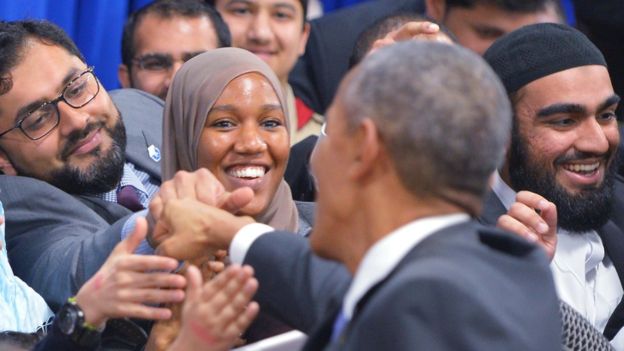
Barack Obama meeting American MuslimsImage copyrightGetty Image
“But Muslims outside the Middle East generally have a more positive outlook,” he adds.

In Indonesia, the world’s most populous Muslim country, 62% of people hold a favourable opinion of the US, Pew’s latest data suggests.

That figure rises to 80% in Senegal, a country which is over 90% Muslim. Mr Stokes points out that this is a stronger approval rate than Germany.

“Attitudes have also been changing over time. We’ve seen a gradual rise in positive sentiment since President Barack Obama came to power,” Mr Stokes says.

“Even in the Palestinian Territories, where sentiment is 70% unfavourable, that’s an improvement on 82% in Barack Obama’s first year.”

The BBC World Service commissioned its own poll of global attitudes in 24 countries in 2014.

Among other things, it asked respondents if they thought the US “had a mainly positive or mainly negative influence in the world”.

Pakistanis generally held the worst view of the US, with 61% saying the US had a negative influence.

But both China and Germany were not far behind, scoring 59% and 57% respectively.

Turkey, almost 98% Muslim, was split between 36% positive, 36% negative and 28% neutral.

Source: US election 2016: What does ‘Islam’ think of America? – BBC News

Obama to Turnbull on Indonesia, Islam and the Saudis: ‘It’s complicated’

Always interesting to have a more inside account of these discussions, highlighting awareness in this case:

A revealing series of interviews with US President Barack Obama has given insight into a private discussion he had with Australian Prime Minister Malcolm Turnbull.

The 20,000-word feature published in The Atlantic magazine also relies on interviews with Mr Obama’s former Secretary of State Hillary Clinton, her successor John Kerry, Israeli Prime Minister Benjamin Netanyahu, other world leaders and key White House insiders.

It details part of a meeting between Mr Obama and Mr Turnbull during November’s APEC summit in Manila.

The president, according to The Atlantic, described to Mr Turnbull how he had watched Indonesia gradually move from a relaxed, multi-faceted Islam to a more fundamentalist, unforgiving interpretation with large numbers of Indonesian women adopting the hijab Muslim head covering.

“Why, Turnbull asked, was this happening?” the author of the feature, Jeffrey Goldberg, wrote.

Mr Obama told the prime minister the Saudis and other Gulf Arabs have funnelled money and large numbers of imams and teachers into Indonesia and in the 1990s the Saudis heavily funded Wahhabist madrassas, seminaries that teach the fundamentalist version of Islam favoured by the Saudi ruling family, according to The Atlantic.

Mr Obama also told Mr Turnbull Islam in Indonesia was much more Arab in orientation than it was when he lived there.

“Aren’t the Saudis your friends?,” Mr Turnbull reportedly asked Mr Obama.

Mr Obama smiled and said: “It’s complicated”.

Source: Obama to Turnbull on Indonesia, Islam and the Saudis: ‘It’s complicated’

Donald Trump’s success a ‘wake-up call’ for Michigan’s Muslims

Does not bode well:

On Thursday, Muslim leaders in this Detroit suburb were saying that members of their community still felt safer here than they would in just about any other place in their country.

….The source of considerable angst and reflection was this past Tuesday’s Michigan presidential primary. In one of the most Muslim-heavy states in the country, Republican front-runner Donald Trump – a candidate so overtly playing to Islamophobia that he pronounced during a CNN interview this week that “Islam hates us” – cruised to victory with about 37 per cent of the Republican vote. And in Dearborn itself, where nearly half the city’s roughly 100,000 residents are Arab-American and many country- or state-wide Muslim or Arabic organizations are based, Mr. Trump’s percentage was a couple of points higher than that.

Unsurprisingly, most of his votes came from the half of Dearborn that’s not really a Muslim capital at all. While the vast majority of residents on the east side of town are of Arabic descent – with roots primarily in Lebanon, Syria, Yemen and the Palestinian territories – the west side is primarily white. Of the 3,153 Dearbornians who voted for Mr. Trump, only about 500 live on the east side. (Christian Arabs, a small population here, may account for a few of those.)

But until recently, Dearborn seemed to be a success story of Muslims integrating into a city with a history of segregation, and a state that has seen more than its share of racial strife. Many have opened businesses on the west side, some have even moved there, and they are increasingly engaged civically, including on the city’s council. The town has attracted its share of attention from cranks: Right-wing bloggers have long propagated various bogus conspiracy theories, including that the city is under Sharia law, and the likes of Koran-burning Florida pastor Terry Jones occasionally show up seeing attention. But even following the attacks of Sept. 11, 2011, there wasn’t the degree of backlash for which many of its immigrant families braced themselves.

Now, with thousands of people with whom they co-exist either embracing Mr. Trump’s Muslim-bashing or proving willing to overlook it, Muslim residents have been given a reality check about how they’re perceived – and how much Mr. Trump has helped bring to the fore something ugly that was lurking below the surface.

“I think what is most troubling about this election cycle is that in Michigan, you would assume there is a certain familiarity with Muslims,” says Rana Elmir, who grew up in Dearborn and is now deputy director of the American Civil Liberties Union of Michigan. “And I don’t think what you’re seeing in those results reflects that familiarity and trust.”

Source: Donald Trump’s success a ‘wake-up call’ for Michigan’s Muslims – The Globe and Mail

ICYMI: The Interview: Crime author Ausma Zehanat Khan’s unique lens on Islam

Worth reading, have selected the quote below on the contrast between Canada and the USA:

Q: Do you wear a headscarf?

A: I don’t. No one can visibly identify me as a Muslim woman until the moment that I choose to identify myself, so there is a certain level of protection with that—which is not to say that everybody that I encounter is filled with anti-Muslim hatred, just that there are certain situations where you are aware of it. When I’m in Toronto, and I’m out in public with friends, or my husband, I dress any way I want. Sometimes, as when I’ve just been praying, I will still have my scarf on, and I’ll go out and never think twice about it. I don’t feel the pressure of looks or judgment.

But there have been many, many times here where I’ve felt that; that we’re attracting notice. So we’re careful. We don’t talk about issues in public, certainly not when we’re going to the airport. [laughs] We’re careful about what kind of books we have in public. When I want to pray inside my house, I draw my blinds. Those kinds of small accommodations are because you realize that people have heard negative things about Muslims and associate all Muslims with jihadists, and they’re wary and suspicious of them. And I’ve heard about Islamophobic incidents and attacks, so I’m wary and suspicious of other people, so it’s mutually reinforcing—even when I’m sure the majority of people don’t have those attitudes, just as the vast majority of Muslims are not jihadists. It’s a really sad state of affairs.

Source: The Interview: Crime author Ausma Zehanat Khan’s unique lens on Islam

Azeezah Kanji: Counterpoint: While on the topic of Muslims, here are a few other numbers to note

Kanji effectively rebuts Barbara Kay’s early piece stoking fear of Muslims (Barbara Kay : Most Muslims aren’t jihadists, of course. But some of them are), providing context to the numbers Kay uses and comparisons to attitudes within other religious groups:

In order to cast her net of suspicion beyond the small number of Muslims actually involved in violent activity, Kay cites data regarding the percentage of Muslims around the world who “hold beliefs in retrograde cultural practices that cannot co-exist in harmony with Western civilization.” These beliefs include a minority of Muslims’ endorsement for capital punishment for apostasy, adultery, and homosexuality: opinions which are certainly disturbing, and are vigorously opposed by Muslim activists in those countries. But the Pew study Kay relies on does not suggest that Muslims are trying to impose these beliefs in “the West” (on the contrary, available research indicates the opposite) — so on what basis is the threat to Western civilization construed?

Indeed, when it comes to attitudes deleterious to “harmony,” surveys suggest that Kay should be directing her gaze elsewhere. American Muslims are more likely to oppose attacks on civilians (which Barbara Kay defines as “terrorism”) than any other major religious group polled in the United States. And while Kay claims that “support for terrorism is high in Islamic countries” (where, according to Pew, support for such attacks ranges from 1 per cent to 40 per cent), a 2011 Gallup poll question on whether it is ever appropriate for a military to target civilians reveals it is proportionately far higher among Christian Americans (58 per cent) and Jewish Americans (52 per cent). Curiously, Kay references the numbers on Muslim support for “terrorism” but is silent on the non-Muslim statistics.

Kay’s tunnel-vision perspective leaves out more than half the picture. In addition to her selective use of statistics, Kay also makes unsubstantiated accusations about Muslims’ use of the legal system and “political/institutional membership” to advance some nefarious but unspecified agenda — recalling the fomentation of moral panics about other minority groups in other periods of history. Exaggerated narratives about the “disease of radical Islam” have been debunked by government dataacademic analyses, and expert commentary. The fact that they still have any purchase reveals the perturbing resistance of stereotypes to reality.

Source: Azeezah Kanji: Counterpoint: While on the topic of Muslims, here are a few other numbers to note | National Post

Italy creating ‘Italian Islam’ by making new religion in line with ‘Christian tradition’

While the focus on integration is welcome, it appears to be one-way with the obligations only on Italian Muslims and not also on the ‘mainstream’ in facilitating integration, or a more inter-faith or multi-group approach:

Italy is setting up a council of “Italian Islam” that claims to be bringing the religion into compliance with the country’s “Christian and humanist tradition”.

The reason for the controversial creation was not made clear in a statement by interior minister Angelino Alfano, although he did say provinces “concerned with immigration” would be involved.

Announcing the move on Tuesday, he said the Council of Relations with Italian Islam would be an advisory body aiming at furthering integration.

“The Council will be responsible for providing opinions and making proposals on issues concerning the integration of people of Islamic culture and religion in Italy,” Mr Alfano said.

“Respect and co-operation between cultural and religious identities in Italy must constitute the basis for a dialogue that enriches democracy, promoting the aims of peace, social cohesion and unity, and that fosters a community of those who…intend to contribute to the peaceful development and prosperity of our country, in full compliance with our laws and our Christian and humanist tradition.”

The Interior Ministry said Islamic leaders, experts and professors would be working towards “the formation of an Italian Islam”.

Source: Italy creating ‘Italian Islam’ by making new religion in line with ‘Christian tradition’ | Europe | News | The Independent

Dolce & Gabbana Debuts New Collection for Muslim Women – The Atlantic

Fashion and business responding to clients, reminding us that the choice of hijab can signal the degree of religiosity and the balance between faith and the desire to be stylish:

Given these high stakes, it’s perhaps no surprise that designers and retailers at both the high and low end of the fashion spectrum have been quietly courting customers there for years. DKNY, Oscar de la Renta, Tommy Hilfiger, Mango, and Monique Lhuillier have produced capsule collections sold only in the Middle East, generally around Ramadan. The e-tailers Moda Operandi and Net-A-Porteroffer carefully curated “Ramadan Edits,” including Badgley Mischka caftans, Etro tunics, and Diane von Furstenberg maxi dresses. The fast-fashion purveyors Uniqlo and H&M have featured hijab-wearing models in their ads. And, around 2009 or so, savvy retailers and fashion bloggers devised a category of “modest” fashion, with the euphemism neatly encompassing the sartorial needs of Muslims, Mormons, Orthodox Jews, and fundamentalist Christians alike.

The fashion industry has always catered to lucrative emerging markets, whether in China, Japan, or Brazil, enlisting local celebrity spokespeople, creating exclusive new products, and even revamping sizing to fit new customers. Last year, Dolce & Gabbana designed a capsule collection for the Mexican market, inspired by native tiles and embroideries. But Muslims are more diverse, geographically and culturally—what sells in Kuwait won’t necessarily sell in Kuala Lumpur, or Kalamazoo, for that matter.

Dolce & Gabbana’s new collection prompts many questions about the practical relationship between Western fashion and religion. After all, the very things the industry celebrates—materialism, vanity, sensuality—are anathema to many faiths. Add capitalism to the mix, and inclusiveness can risk looking like crass exploitation (just remember the cash-strapped couturiers scrambling for petrodollars in the 1970s).

The link between Western fashion and Islam has been particularly vexed. Look no further than 2008, when the preppy chain store Abercrombie & Fitch denied employment to a hijab-wearing job applicant in California because she didn’t fit their “Look Policy.” (The Supreme Court ruled against Abercrombie last year in a discrimination suit.) Or consider how hijab wearers have suffered not only prejudice but also a series of violent physical attacks, in the U.S. and abroad. Long a symbol of style and personal expression as much as religious devotion, the hijab is increasingly being cast off in favor of “safer” hats and turbans—or taken up as a political weapon by non-Muslims. Dolce & Gabbana’s announcement comes at a critical time, making the statement that Western fashion and Islam can make for an aesthetically compatible and socially productive union: yielding beautiful garments and helping in some small way to chip away at the marginalization of Islam in countries like the U.S.the U.K.and France.

In her 2015 book Muslim Fashion: Contemporary Style Cultures, the London College of Fashion professor Reina Lewis argues that Muslim fashion has been “underrepresented in the style media” while being “overrepresented in the news media” because of two related presumptions: “that fashion is a Western experience and that Muslims are not part of the West.” That’s no longer the case. Far from being the mark of the anti-fashion outsider, hijabs and abayas have become part of the Western fashion mainstream, virtually overnight. From here on in, they’ll be vulnerable to the same trends, knockoffs, and inflated price tags as any other article of Western clothing, but on the plus side, perhaps a new generation of Muslim fashionistas can now see themselves better reflected in an industry they admire.

Source: Dolce & Gabbana Debuts New Collection for Muslim Women – The Atlantic