Terry Glavin: There are more crucial issues than the colour of Vancouver’s council

I agree more with Tolley (see Lack of council diversity puts municipalities at risk) than Glavin here (perhaps not surprisingly). The thought experiment I often use is how would I feel if I could not see myself reflected in political leadership and institutions? Would I be comfortable or not? Could I completely divorce feelings about my identity from the more intellectual choices in public policy? And could the abysmally low turn-out be tied to lack of representation or not?

And the other question to ask, where Terry has a point, would more diverse municipal councils address more or less effectively the issues facing the municipalities? In general, more diverse voices ensure better consideration of different perspectives, but not automatically so:

You might think it would be bad enough to show up again this year near the top of Demographia’s listings of cities with the least affordable housing markets in the world, and a rental vacancy rate of less than one per cent, and to have been reduced to ground zero of Canada’s fentanyl crisis, with a worldwide reputation as the epicentre of a global money-laundering system run by organized crime networks in China.

You might also think it is a bit disturbing that Vancouverites are apparently so dispirited by all this, and perhaps even convinced beyond doubt that there is nothing that can be done about any of it, that voter turnout in Vancouver’s recent civic election was about 40 per cent.

On the bright side, it’s a good thing that mayor Gregor “Happy Planet” Robertson and his Vision Vancouver team, after having presided over Vancouver’s transformation from Lotusland’s Metropolis to a seedy gangland paradise of drug-money laundering and shady real estate swindles, is now in history’s dustbin. On the downside, Robertson’s successor, Kennedy Stewart, won the race for the mayor’s office backed by only about 12 per cent of the city’s eligible voters.

Vancouver mayor-elect Kennedy Stewart celebrates with his wife, Dr. Jeanette Ashe, after addressing supporters in Vancouver on Oct. 21, 2018.

Whatever might be said about all that, the post-election thing to get worked up about, judging by reports in the Toronto Star, the local CBC news, various city webzines and the Twitter hashtag #councilsowhite, is the noticeably pale complexion of the new city council members, save one. Pete Fry. His Trinidad-born mother is the Vancouver Liberal fixture Hedy Fry, the long-serving MP for Vancouver-Centre.

To be fair, the statistical dearth of successful non-white candidates is something worth noticing, and even worrying about. Perhaps not so fervently as Globe and Mail Vancouver reporter Sunny Dhillon did, mind you. Owing to his bureau chief’s decision that the historic surfeit of women on Vancouver’s new city council was perhaps more newsworthy than the colour factor, Dhillon quit this week, quite publicly. Eight of the Vancouver’s 10 council members, as of the Oct. 20 elections, are women. This is, after all, quite a big deal.

The whiteness of recently elected municipal councils is being noticed right across Canada at the moment, though, and so it was helpful that the Institute for Research on Public Policy published a brief paper in its Policy Options journal this week, under the headline: “Elections in some of Canada’s most diverse cities still produced extremely homogenous councils. This threatens the legitimacy of their decisions.”

But just hold on a minute. If voters engage in a civic election, and the ethnic or racial diversity of the winners, in the aggregate, does not end up replicating the ethnic or racial diversity of the people who voted them into office, isn’t it a bit of a stretch to say the result “threatens the legitimacy of their decisions”?

Not a stretch at all, according to the article’s author, Erin Tolley. An assistant professor at the University of Toronto and “co-investigator” with the Canadian Municipal Election Study, a project of the Social Sciences and Humanities Research Council of Canada, Tolley writes: “All else being equal, we know that voters gravitate toward candidates with whom they share an ethnic or racial background.”

Maybe so. But “all things being equal” is a rather basket-sized caveat, and in any case, the examples she cites — recent elections in Vancouver, Mississauga, Ont., and Toronto — could be held up as evidence against her claim just as easily as Tolley cites them as evidence in favour of it. Voters in Vancouver, Mississauga and Toronto do not appear to have followed the pattern of ethnic gravitational pull at all.

British Columbia NDP MLA Leonard Krog is recorded as a reporter interviews him while awaiting the municipal election results for Nanaimo, B.C., on Oct. 20, 2018. Krog was elected mayor.

In Mississauga, 57 per cent of the voters identify as members of a “visible minority” but only one “racialized” councillor got elected. In a city where slightly more than half the people identify as members of “visible minority” groups, Toronto’s 25-member city council can boast only four people of colour. Statistics Canada’s recent data shows the same sort of ratio for Vancouver — slightly more than half of Vancouverites identify as members of “visible minority” groups.

So what’s with all the white people on city councils?

It’s a question worth asking, and although the answers are likely to differ from city to city, Tolley’s remedial prescription, an interim measure consisting of diversity and inclusion advisory committees to provide councils with advice about ethno-cultural relations and diversity, is perfectly reasonable, so far as it goes. An approach like that might also give “racialized” participants some public exposure, access to networks and degrees of civic exposure “that might serve them well if they choose to enter electoral politics,” Tolley writes.

But isn’t this just a bureaucratic solution in search of a problem? Does the ubiquity of white people in civic politics really mean “many voices are excluded from the decision-making process,” and that this state of affairs “puts municipalities at risk”?

In Vancouver, Kennedy Stewart, backed by Metro Vancouver’s labour unions, won the race for the mayor’s office only by squeaking past the Non-Partisan Association’s Ken Sim, who happens to be Chinese-Canadian. The result was 49,812 votes to Sim’s 48,828. Sim can hardly complain that he wasn’t taken seriously, so I asked three unsuccessful Vancouver civic candidates, people of colour, all with the outside-chance upstart ProVancouver slate, what they thought about all the fuss about whiteness.

Women cross the street at the intersection of East Pender Street and Gore Avenue in Vancouver on Dec. 5, 2016.

ProVancouver council candidate Rohana Rezel, born in Sri Lanka, had to put up with some nasty and widely publicized online racist harassment. “People from all ethnic communities came and rallied around me every time somebody tried to attack me. There was nothing that made me less privileged than other candidates, based on my ethnic background,” he said. “I just don’t buy the argument that white people just vote for white candidates.”

Rezel’s running mate, Raza Mirza, a Punjabi Muslim, said: “I just don’t understand this obsession with the idea that overall, council must look like the overall general population.” ProVancouver mayoral candidate David Chen, whose background is Taiwanese: “You have to be careful with that, or you’re going to risk forcing bad people into the system.”

All three said there are far bigger “process” issues that require attention. Like the abysmally low voter turnout. And Vancouver’s antiquated at-large voting system.

Source: Terry Glavin: There are more crucial issues than the colour of Vancouver’s council
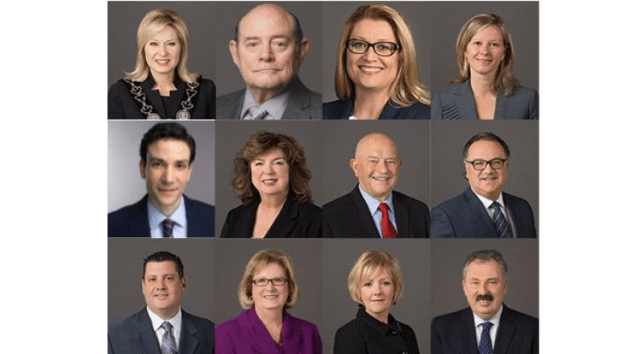
Mississauga’s population is 57% visible minorities. So why does its city council look like this?

In general, diversity is significantly greater at the federal and provincial levels than municipal.

I look forward to comparing the results of the upcoming Toronto election: thanks to the (disruptive) change to electoral boundaries, it will be possible to compare federal, provincial and municipal results given identical boundaries:

According to the 2016 census, 57 per cent of Mississauga, Ont., residents identified as visible minorities. However, not one of them was elected to the city’s 11 council seats in 2014. (Mississauga)

As a rookie politician taking on an incumbent city councillor, Safeeya Faruqui is already staring down long odds in the upcoming Mississauga, Ont., municipal election.

But if the 24-year-old succeeds in her bid for Ward 4 on Oct. 22, she’ll have made history too — becoming the first woman of colour elected to city council in the mostly suburban city west of Toronto.

“That would be another glass ceiling broken,” Faruqui told CBC Toronto at her campaign office. “We need to make sure that all voices are being heard to create the best society that we can.”

Faruqui’s campaign is bringing new attention to the glaring disparity between the general population in southern Ontario’s Peel Region and the makeup of its city councils.

According to the 2016 census, 57 per cent of Mississauga residents identified as visible minorities. However, not one of them was elected to the city’s 11 council seats in 2014.

In neighbouring Brampton, where 73 per cent of residents identify as visible minorities, just one of the city’s 10 councillors is a person of colour.

Neither city has ever had a non-white mayor.

Why it matters

Faruqui says lack of diversity on council has resulted in some policy decisions that don’t fully account for the city’s diverse population.

“The decisions aren’t reflecting everybody,” she said.

Gurpreet Singh Dhillon, the lone visible minority on Brampton’s council, points to an ongoing struggle in the city to build a shade shelter for seniors to explain why diversity can be helpful.

He said older residents in his community have been seeking to recreate the tradition of gathering and socializing under a large willow tree, which began in India, with an artificial shade as a replacement.

Singh, 38, said the project has been stalled because some elected officials and city staff did not understand the request, since they were not familiar with the tradition.

“It’s really important that we have people in our staffing, and our council who understand,” he said. After serving one term as a city councillor, Singh is now running as the regional councillor for Wards 9 and 10.

“It’s even more important going forward that we do have a council that does reflect the community,” he added.

There are also concerns that the lack of accurate representation has also stalled civic engagement and created distrust in local governments among visible minority communities.

“Our community has not been doing a good enough job to remedy that,” said Faruqui, who added that “real, frank, open discussions” are needed to restore faith in local politics.

If elected, Dhillon says he will advocate for the creation of a diversity officer at Brampton city hall, who would review everything passed by city council to ensure no minority communities — whether by ethnicity, gender, age or sexual orientation — are negatively affected.

He said similar initiatives have been successful in other cities around the world.

‘Overwhelming but… exciting’

During her first term in office, Mississauga Mayor Bonnie Crombie, who is running for re-election, helped introduce a diversity and inclusion advisory committee. The group provides strategic advice to council in an effort to better serve the city’s diverse population.

Still, Crombie said she would welcome more variety among the city’s elected officials.

“It would be wonderful if we could have a very diverse council that reflects the diversity that is our city,” Crombie told CBC Toronto.

As to why so few visible minorities have been elected, Crombie pointed to a slew of long-serving incumbent councillors, who are notoriously difficult to unseat in municipal elections.

“Some of them have been in office a long period of time,” she said. “And the city has changed over the years.”

Due to a death and a retirement, two of the city’s council seats will be open races this election. She said that has opened up an opportunity for a number of “wonderful diverse candidates” running this fall.​

Faruqui, however, is competing against incumbent John Kovac.

“Going through this for the first time, not really having any role models who look like me doing this, it’s something that is overwhelming but also very exciting,” she said.

Source: Mississauga’s population is 57% visible minorities. So why does its city council look like this?

Des minorités visibles invisibles [municipal elections]

Common to many municipalities in Quebec and elsewhere. Provincial and federal representation generally stronger:

Avec aussi peu d’élus se disant issus de minorités visibles et ethniques, la diversité ne se reflète pas à Montréal, encore moins au Québec. Pourquoi la métropole, si cosmopolite, peine-t-elle encore à attirer des immigrés ? Le Devoir a rencontré trois élus montréalais qui en ont long à dire sur le sujet.

On les appelle les minorités visibles, mais elles sont pourtant presque invisibles dans le lot d’élus au Québec. Le ministère des Affaires municipales et de l’Occupation du territoire ne tient même pas de données statistiques là-dessus, selon ce qu’a appris Le Devoir. À Montréal, sur 103 élus, il y en a désormais 21 qui représentent cette diversité — minorités visibles (6), minorités ethniques (14) et handicapés (1) —, soit 5 de plus qu’aux dernières élections.

On ne fracasse aucun record ici, croit Nathalie Pierre-Antoine, une élue montréalaise d’origine haïtienne. Elle croyait pourtant que la métropole, qui compte 34 % de minorités visibles, allait faire mieux. « On est quand même en 2017 », dit celle qui a été élue pour un second mandat dans l’arrondissement de Rivière-des-Prairies–Pointe-aux-Trembles pour l’Équipe Denis Coderre.

Ce n’est pourtant pas parce que les électeurs ne sont pas prêts, croit-elle. « La preuve, je suis élue », a-t-elle lancé en riant, citant les exemples de Cathy Wong, d’Abdelhaq Sari, de Marie-Josée Parent, qui se dit d’origine autochtone.

Oui, c’est possible

Immigré du Maroc à l’âge d’un an, Younes Boukala, élu conseiller d’arrondissement à Lachine pour Projet Montréal, s’est dit la même chose. Pour le Québécois de 22 ans, musulman et d’origine berbère marocaine, la seule façon de changer les choses était de plonger lui-même. « Les gens me disaient : “Tu as juste 22 ans et tu te présentes ?” Et moi, je leur disais : “Mais ça prend quoi pour se présenter ? Plein de diplômes et un certain âge ?” Il faut juste oser. »

Sur le Plateau Mont-Royal, les habitants du district De Lorimier ont également accueilli à bras ouverts Josefina Bianco, élue pour Projet Montréal comme conseillère d’arrondissement. « Ça ne fait même pas deux ans que je suis Canadienne et j’ai été élue », s’est réjouie la jeune mère italo-argentine, qui vit au Québec depuis sept ans.

Lors de son porte-à-porte, les habitants du quartier n’ont pas manqué de souligner son petit accent espagnol chantant et lui posaient des questions sur ses origines et ses motivations. « Mais j’ai toujours eu un accueil magnifique », dit-elle, consciente que les choses n’auraient peut-être pas été aussi simples dans un autre arrondissement. « La réponse était positive, que ce soit des femmes immigrantes, qui étaient très fières, ou des Québécois. 

Discrimination positive ?

Mais alors, pourquoi si peu de diversité ? D’emblée, il n’y a pas lieu de jeter la pierre aux partis, qui ont fait de grands efforts de recrutement, constate Mme Pierre-Antoine. N’empêche : sur 298 candidats qui se présentaient cette année, 43 (14 %) ont dit appartenir à une minorité visible, ce qui est loin des 34 % de minorités visibles recensées dans la métropole. Toutefois, en tenant compte de ceux qui se déclarent « minorité ethnique » (43 personnes également), ils ont été au total 86 candidats issus de la diversité à se présenter aux élections de dimanche dernier. Sur ce plan, avec 23 % de minorités visibles dans son équipe, Projet Montréal a fait un peu mieux qu’Équipe Denis Coderre, qui n’en avait que 19 %.

Faut-il obliger les partis à la discrimination positive ? « Il faudrait peut-être une formule pour qu’on soit mieux représentés dans les candidatures, mais le choix final appartient aux électeurs », soutient Mme Bianco. Elle préfère croire en l’émulation et en une « vraie » mobilisation citoyenne. Mme Pierre-Antoine est du même avis. « Il y a du pour et du contre concernant les quotas, et c’est vrai que c’est quand on oblige que les choses finissent par arriver plus concrètement. Mais personnellement, je crois qu’il est toujours mieux de sensibiliser avant. »

Intéresser les immigrants

Pour avoir plus de candidats et d’élus issus de la diversité, encore faudrait-il qu’ils aient un intérêt se présenter. « Comme nouvel arrivant, avant de s’impliquer dans la vie politique, on est “en mode” subsistance. On cherche à se loger, se nourrir, à travailler ; l’implication politique n’est pas une priorité », rappelle Mme Bianco, qui a une formation en travail social. « Il y a aussi des immigrants qui viennent de pays aux histoires politiques très difficiles. Pour croire à nouveau en la politique, ça peut leur prendre du temps », ajoute-t-elle, évoquant le passé dictatorial peu reluisant de son pays d’origine.

Avec sa monarchie, le Maroc n’a pas non plus une grande tradition démocratique, souligne Younes Boukala. « Là-bas, on ne se pose pas de questions. C’est le roi qui décide », dit-il. Il a parfois senti une désillusion de la politique de certains de ses concitoyens de Lachine. « Des [personnes issues de] minorités ethniques me disaient “tu vas être un vendu toi aussi” », raconte-t-il. Il leur répondait aussitôt : « Je veux juste vous dire une chose, ce serait quoi mon intérêt à aller en politique à 22 ans ? Mes parents ont beaucoup souffert pour que je puisse réussir et je veux donner cette même chance de réussite aux autres », se rappelle-t-il. « Neuf fois sur dix, leur approche changeait. »

Voter sans citoyenneté

Et si on l’enlevait l’exigence de citoyenneté pour encourager les gens à aller voter au municipal ? N’y aurait-il pas plus de nouveaux arrivants et de gens d’origines diverses en politique active ? La chose mérite qu’on se penche dessus, lance Josefina Bianco. « Il faudrait voir de façon précise avec quel statut on autoriserait le vote, mais c’est vrai que pour quelqu’un qui vit ici, qui paye ses taxes dans la ville, qui a des enfants à l’école et contribue à son quartier, pourquoi pas ? Ça enracinerait davantage les gens. » Younes Boukala abonde dans le même sens. Après tout, les statistiques montrent que plus un individu commence à voter à un jeune âge, plus les chances sont grandes qu’il revote et s’intéresse à la politique. « Et on aurait au moins une chance de diminuer le faible taux de participation au municipal. »

via Des minorités visibles invisibles | Le Devoir

Let non-citizens vote in municipal elections: Editorial | Toronto Star

I don’t agree with The Star’s position.

Citizenship take-up should be encouraged and municipal voting for non-citizens may result in less incentive to become citizens. I have never seen any convincing evidence that municipal voting for Permanent Residents will significantly increase voter participation and visible minority representation.

The revisions to the Citizenship Act along with previous changes, making it harder for some visible minorities to become citizens, and with an overall decline in citizenship uptake, do however weaken the case against allowing non-citizen municipal voting:

Toronto Mayor John Tory doesn’t want people who aren’t Canadian citizens to vote in municipal elections. It’s a reasonable stand, but he should change his mind.

We did.

In 2005 the Star was firmly opposed to giving non-citizens the right to cast a municipal ballot, arguing that this was a well-intentioned proposal that would unfortunately dilute the privilege of citizenship.

Tory expressed similar sentiments this past week at a Ryerson City Building Institute forum organized to explore ways of bridging urban divides. Giving non-citizens the vote was suggested as a way to open up the democratic process and help more visible minority candidates win elected office.

Mississauga Mayor Bonnie Crombie and Ajax Mayor Steve Parish welcomed the idea. But the Star’s David Rider reports that Tory expressed reservations, including doubt that this change could actually boost the diversity of municipal councils.

As far as getting more minority people elected, the reform is at least worth a try. Not much else has worked so far. But even beyond that, change is a matter of fairness. On this ground alone, the right to vote in municipal elections should be extended to all permanent residents — citizens and non-citizens alike.

It’s estimated that more than a quarter-million newcomers live, work and play in Toronto. They volunteer in support of local causes, send their children to local schools, pay local taxes, and support local businesses. Yet they’re barred from the ballot box, denying them a say in how this city is run, because they’re not Canadian citizens.

At least 40 other countries allow non-citizens to vote at the municipal level, and it’s time Toronto did too. The province would need to amend the Municipal Elections Act to bring this about and it would be a big help if Toronto’s mayor were a firm advocate of change.

Citizenship would remain a privilege associated with voting in federal and provincial elections. This would still be something special. It makes sense to set a lower requirement for voting at the municipal level, where the issues aren’t national security or foreign policy concerns but more mundane matters such as garbage collection, water bills, transit fares and whether the Gardiner Expressway is torn down.

Non-citizens have become a vital component of Canada’s largest city, helping to make it one of the most diverse places in the world. These people should no longer be written off on Election Day.

Let non-citizens vote in municipal elections: Editorial | Toronto Star.

Toronto election is missing a racial equity perspective | Toronto Star

The activist perspective on the upcoming Toronto municipal elections:

What’s more, we need leaders who are willing and able to put racial equity at the core of their campaign. This would mean, among other things, supporting employment equity at the city level and having a concrete plan for implementation; committing to inclusionary zoning and the expansion of affordable housing development; embracing the collection, analysis and use of disaggregated data by the city for all of its programs and services, including Toronto Police Services; and pushing for the extension of the municipal franchise to all city residents regardless of their immigration status.

It would indeed be a sorry state of affairs if Torontonians were to cast their ballots on Oct. 27 based solely on which candidate has the fewest skeletons in her or his closet.

As the most diverse city in North America, Toronto desperately needs a leader who can demonstrate true understanding and commitment to the city’s motto, “Diversity Our Strength,” with a plan to promote respect for equality, including an economic platform that is equitable, inclusive and sustainable.

Toronto election is missing a racial equity perspective | Toronto Star.