Rempel Garner: For youth, AI is making immigration cuts even more urgent.

Will be interesting to see if the annual levels plans makes any reference to expected impacts of AI. Valid concerns and need for further thinking about appropriate policy responses, shorter and longer-term:

…So at writing, the only consensus on what skills will make someone employable in a five to ten year period, particularly in white collar jobs, are advanced critical thinking and problem solving ability acquired through decades of senior level managerial and product creation experience. So the question for anyone without those skills – read, youth – is, how can someone acquire those skills if AI is taking away entry level research and writing jobs? And how can they do that while competing with hundreds of thousands of non-permanent foreign workers?

While many parts of that question may remain without clear answers (e.g. whether current public investments in existing modalities of education make sense), there are some that are much more obvious. Where Canadian employers do have a need for entry level labour, those jobs should not be filled by non-Canadians unless under extremely exceptional circumstances, so that Canadian youth can gain skills needed to survive in a labour market where they’re competing against AI for work.

And translating that principle into action means that the Liberal government must (contrary to Coyne’s column) immediately and massively curtail the allowance of temporary foreign labour to continue to suppress Canadian wages and remove opportunity from Canadian youth. It’s clear that they haven’t given the topic much thought. Even their most recent Liberal platform only focused on reskilling mid-career workers, not the fact that AI will likely stymie new entrants to the labour market from ever getting to the mid-career point to begin with. While older Liberals may be assuming that the kids will be alright because they grew up with technology, data suggests AI will disrupt the labour market faster and more profoundly than even offshoring manufacturing did. Given that context, immediately weaning Canadian businesses off their over-reliance on cheap foreign labour seems like a no brainer.

But on that front, Canada’s federal immigration policy, particularly its annual intake targets, fails to account for the anticipated labor market disruptions driven by artificial intelligence. This oversight may have arisen because many of those setting these targets have had the luxury of honing their skills over decades in an economic landscape where life was far more affordable than it is today. Or, because it’s easier to listen to the spin from lobbyists who argue that they have the right to cheap foreign labour than to the concerns of millions of jobless Canadian youth. Nevertheless, the strategy of allowing Canadian youth to languish in this hyper-rapidly evolving and disruptive job market, while admitting hundreds of thousands of temporary low-skilled workers and issuing work permits to an equal number of bogus asylum claimants, demands an urgent and profound rethink.

Indifference to this issue, at best, will likely suppress wages and opportunities as the economy transitions to an AI integrated modality. At worst, it may bring widespread AI precipitated hyper-unemployment to an already unaffordable country, and all the negative social impacts associated with the same: debt, crime, and despair.

So the Liberals can either immediately push their absurdly wide open immigration gates to a much more closed position while they grapple with this labour market disruption out on behalf of Canadians, or pray that Canadians forgive them for failing to do so.

Source: For youth, AI is making immigration cuts even more urgent.

Rempel Garner: 50K+ jobs to foreign workers in Q1. Why?

Interesting list of which companies and organizations, and for which occupations, had approved LMIAs (Rempel Garner neglects to mention Kenney’s earlier mistake and rhetoric regarding expanded access for Temporary Foreign Workers but his correction was both quick and efficient).

The chart below shows the overall shift to lower skilled occupations, particularly a greater shift to the lowest skill levels, with some correction in the latter half of 2024:

The Q1 List of Shame

To illustrate the dysfunction, consider these (few) examples (there are many, many more, and I encourage you to look through the list yourself):

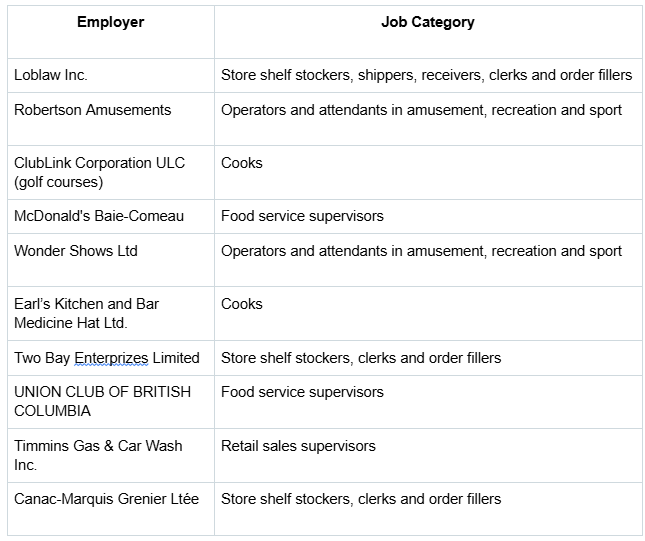
Companies and public sector entities that got approved to hire entry-level and food services labour:

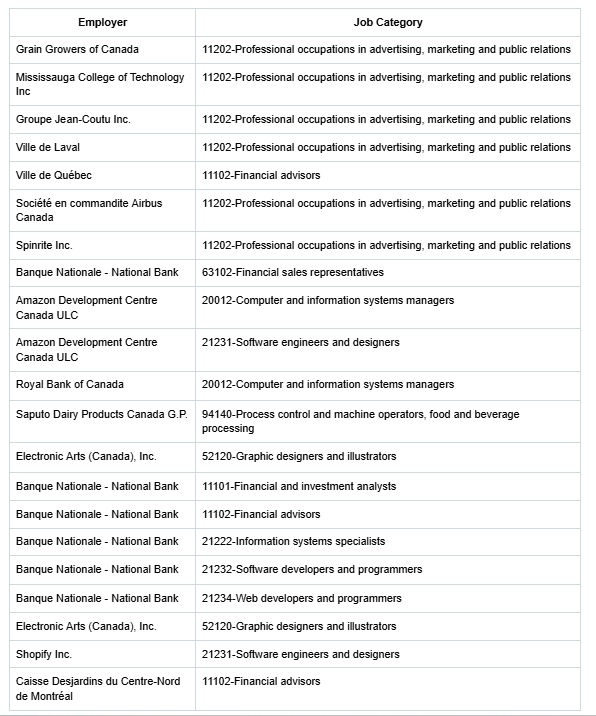
Companies and public sector entities that got approved to hire white collar jobs with TFWs (my personal favourite here is the Grain Growers of Canada(a lobby group) receiving a positive LMIA decision for a communications position….come on guys, for real??):

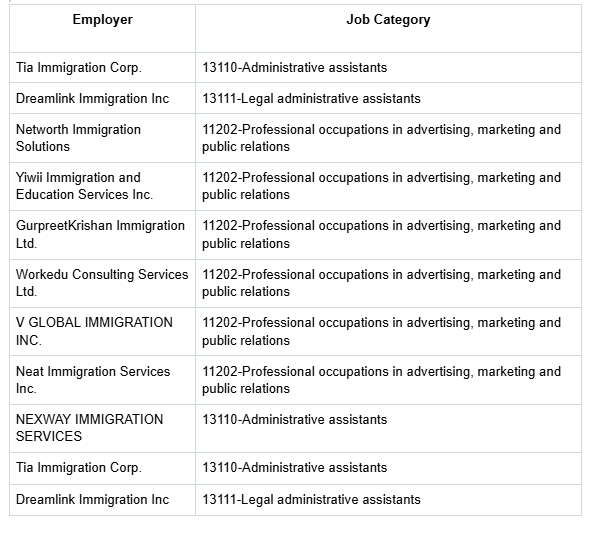
Immigration consulting firms that often help companies get approved for TFWs got approved for TWFs too:

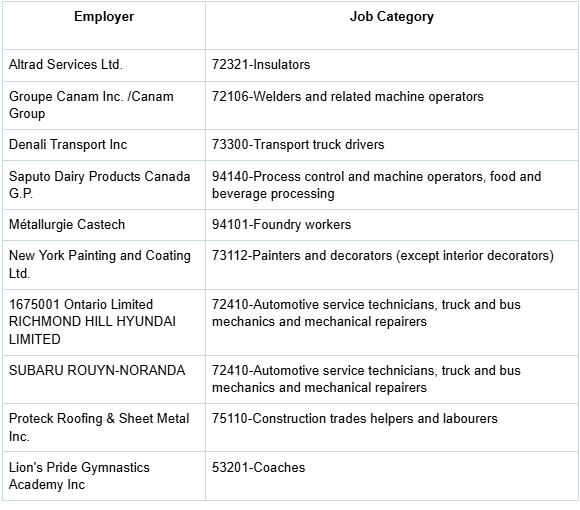
Companies that got approval to fill trades jobs with TFWs:

The arguments that many companies most commonly use to justify their use of the TFW program (particularly the low-skilled stream) are that:

  • Canadians don’t want to do the work
  • That only a foreigner could do the job, or
  • That government benefit programs often prevent people from taking jobs. 

In many cases, these arguments wouldn’t pass the smell test for an ordinary Canadian, so they shouldn’t for the Liberal government either.

In reality, outside of a very few regions where unemployment levels significantly defy the current national rate of 6.9%, and in certain segments of the seasonal agricultural industry, many of these jobs can and should go to available Canadians. And, there won’t be change unless the Liberals stop buying into bunk arguments for temporary foreign labour and find ways to reform the program, or, as the case may be, incent Canadians to work. Wages that aren’t suppressed by an open floodgate of low skilled temporary foreign labour would probably be a good place to start.

Ironically, on that front, all the Liberals had to do upon taking office in 2015 was not bend to the will of powerful corporate lobbyists clamouring for the reversals of program changes made by the former Harper Conservative government. I was in cabinet at the time and remember the gnashing of teeth and wailing from employers that were accused of seriously abusing the program.

Nonetheless and to his credit, Jason Kenney, as Minister of Employment and Social Development, introduced major reforms to the TFW program and LMIA process in 2013 and 2014. In 2013, key changes included requiring employers to pay temporary foreign workers at prevailing wages, introducing processing fees for LMIA applications, extending job advertising periods to recruit Canadians first, and adding scrutiny on outsourcing impacts. The 2014 overhaul was more comprehensive: it imposed a 10% cap on low-wage foreign workers per worksite (phased in from higher limits), barred low-wage hires in regions with unemployment above 6%, limited low-wage worker stays to two years, introduced moratoriums in sectors like food services, boosted inspections and fines for violations, and split the TFW program from the International Mobility Program to reduce overall reliance on foreign labor, leading to an 80% drop in low-skilled approvals.

Source: 50K+ jobs to foreign workers in Q1. Why?

Thousands of foreigners’ criminal convictions forgiven by Ottawa over 11-year span, raising transparency concerns

Rempel Garner and Kurland correct to call for more transparency:

More than 17,500 foreigners have had their criminal convictions forgiven by the Immigration Department over the past 11 years, removing a bar to coming to Canada, federal government figures show. The disclosure has raised transparency concerns about the type of offences they committed.

Foreigners are, in general, inadmissible to Canada if they have been convicted of an act that is considered a criminal offence in this country. But Immigration, Refugees and Citizenship Canada (IRCC) has the power to grant an exception if five years have elapsed since a person was convicted or finished a sentence. 

Government figures show that in the 11 years up to and including 2024, 17,600 people convicted of criminal offences abroad were considered “rehabilitated” by IRCC. This meant they were able to apply to enter Canada, including through work and study visas, as permanent residents or visitors. 

IRCC has not, however, released a breakdown of the kind of criminal offences that were forgiven. It said in a statement to The Globe and Mail that the Immigration Minister would be involved in decisions relating to the most serious offences. …

Source: Thousands of foreigners’ criminal convictions forgiven by Ottawa over 11-year span, raising transparency concerns

Critic calls out border bill’s proposed new cabinet powers on immigration

As expected. Suspect that the over-reach of the Bill with respect to civil liberties will over shadow concerns of immigration and refugee advocates:

An NDP critic says a provision in the federal government’s border security bill that would give cabinet the power to cancel immigration documents looks like an attempt to “mimic” measures deployed by the Trump administration in the U.S.

“It seems to me … this piece of legislation is Canada’s attempt to mimic some of those measures that the United States is adopting. I actually never thought that this day would come where Canada would go down that road,” B.C. NDP MP Jenny Kwan told The Canadian Press.

“However, it is here, and meanwhile the government is saying, ‘Don’t worry, trust us.’”

Public Safety Minister Gary Anandasangaree said that the immigration minister would only be able to exercise the power to cancel, suspend or alter immigration documents in an “emergency” and after being granted the authority through an order-in-council.

“The tools are in place to ensure the minister of immigration has additional tools to ensure that in a modern era, for example, whether it’s a pandemic or issues around cybersecurity, she will have the tools to make those decisions,” Anandasangaree said during debate on the bill Thursday.

Conservative immigration critic Michelle Rempel Garner said the legislation contains several “poison pills” that threaten people’s civil liberties. 

This includes the ability for Canadian Security Intelligence Service and police to access customer information from online service providers in certain circumstances.

“The government has not shown Canadians any specific situation, any specific evidence or circumstance in granular detail about why we should be giving up our civil liberties to a government that unlawfully used the Emergencies Act,” Rempel Garner said during Thursday’s debate.

This is in reference to to a 2024 Federal Court ruling that found the government’s use of the Emergencies Act was unreasonable to breakup the 2022 “Freedom Convoy” protests against COVID-19 public health measures.

The government has appealed this ruling. 

Bloc Québécois MP Claude DeBellefeuille said that her party plans to support the bill at second reading so it can be studied by the public safety committee.

Speaking in French, she said the bill needs to be examined closely because it looks to give new powers to government ministers, law enforcement and even Canada Post.

Immigration Minister Lena Diab said Wednesday the legislation is designed to address “one-off” situations like a pandemic or some other “exceptional circumstance.”

“I think people, Canadians should feel safe that we are putting in all these safeguards, but again, as I said, it’s all part of protecting our country and protecting our system that we value and protecting people that come here because we want to ensure that they are successful as well,” Diab said.

Bill C-2 also proposes giving the immigration minister the power to pause the acceptance of new immigration applications and cancel or pause processing of the current inventory of applications in the event of an emergency.

Julia Sande, a human rights lawyer with Amnesty International Canada, said immigration applicants could lose a lot of money because the legislation doesn’t oblige the government to refund affected people.

“People give up their entire lives, in some cases, their life savings or their family’s life savings. People go into debt just to be able to come here,” she said. “And so to have the government be able to pull the rug out from under wide groups of people is concerning.”

Kwan said the proposed new powers are problematic because cabinet decisions are made in secret and there’s no firm definition of an “emergency” in the legislation.

“I don’t accept that the Liberals say, ‘Don’t worry, we’re the good guys, so trust us.’ I’m sorry, that is just not acceptable,” she said, adding there’s no way to know what a future government might do with this power.

The text of the legislation says that if the minister “is of the opinion that it is in the public interest to do so,” they may trigger the power to cancel, suspend or alter immigration documents through a cabinet order.

“They’re saying in an emergency, but that’s not what’s written. They said if they’re in the opinion that it’s in the public interest … that could really be anything,” Sande said.

“In the fall, we saw migrants and refugees being scapegoated for the housing crisis. And so, you know, what’s in the public interest?”

Last year, then-immigration minister Marc Miller said plans to reduce the number of permanent and temporary visas issued would help stabilize the housing market.

U.S. President Donald Trump has used national security as justification for a host of immigration measures that involve detaining and deporting people, including university students who have condemned the war in Gaza.

Sande said the proposed bill “attacks” the right to seek asylum by making it harder for migrants to make a claim if they are entering Canada from the U.S., or have been in the country for more than a year.

“They’re talking about fentanyl, they’re talking about guns and then all of a sudden they’re attacking the right to asylum,” Sande said.

“They are completely different things and it’s difficult for civil society, for experts to respond when there’s so many things going on.”

Source: Critic calls out border bill’s proposed new cabinet powers on immigration

Rempel Garner: Canada’s immigration system needs massive, wholesale reform. 

Gives a strong sense of where the Conservative opposition will likely focus on immigration. Mainly overall levels and program integrity. Focus is on the impact on housing and healthcare for immigrants and non-immigrants alike, not values. She is right in stating the need for “wholesale reform” (or at least major reform) but silent on the need for some form of commission to lay out issues and options. Some of her assertions are excessively partisan or exaggerated but the issues are real.

And of course, is coy on what the right level of immigration would be, back to the last year of the Harper government, less or more:

…I am presently convinced that nothing short of wholesale reform of the entire system, starting with the process by which the federal government sets and counts immigration levels, will fix the mess the Liberals have created. With millions of people currently in Canada with temporary permits about to expire, the government must urgently entirely rethink the criteria by which people are allowed to stay and enter the country – and then consistently enforce the same. Overall immigration levels need to be drastically reduced and the problem of millions of people with no legal reason to be in Canada must be addressed head on, for there to be any future hope of program or system reform.

Having only been officially on the job for a couple of days, I will consult with stakeholders and our newly expanded Conservative caucus and appointed Shadow Ministers on how they feel we should hold the government to account on this issue. Immigration policy affects all of their communities and files, and not necessarily in a homogenous way. However, what I will be pitching to them as a starting point are the following principles – which the Conservative Party has already generally established as our macro-level position on immigration.

As a first principle, the government must be forced to take action on something that they’ve already acknowledged, that present overall immigration levels must be massively and immediately curtailed. What is the correct number to allow you to enter the country, you ask? Whereas academics and special interest groups have recently often the loudest voices on that front, the reality is that the lived experience of millions of Canadians have been ignored. And many of those Canadians, grappling with job losses, soaring housing costs, and lengthy healthcare wait times, believe the ideal immigration number is far less than what it is now, zero—or even negative. It falls to the Liberal government to justify any figure they propose by first validating these concerns – which have been long ignored – and addressing the systemic strains exacerbated by high immigration. Every parliamentarian must hold the government accountable on this front, demanding decisive action and transparent data.

As a second principle, the Liberals must be made to acknowledge that the immigration system is so strained that simple tweaks are insufficient and sidestep the core issue: Canada’s capacity to absorb newcomers successfully. Fraud, abuse, and massive backlogs now plague everyimmigration stream, with the unifying problem being unchecked inflow coupled with countless people living in the country without legal status. Without significantly reducing overall immigration, massively tightening temporary resident permit criteria, and promptly removing those with no legal right to remain, the pressure on the system will simply shift elsewhere—such as illegal border crossings leading to work permits or temporary residents with expired permits claiming asylum. The bureaucratic dysfunction underpinning Canada’s immigration system cannot be resolved while piling on more entrants, while unscrupulous actors manipulate the system, visa standards stay lax, asylum backlogs grow, and deportations are delayed.

Finally, parliamentarians must to have the courage to address head-on the uncomfortable questions that underpin both of these principles (of which there are many and will be the topic of future columns), while remaining compassionate. Every policy decision made on this file has a human face and story – for newcomers and long-standing Canadian citizens alike. So, the Liberals must be made to rethink the criteria and circumstances in which we will allow people into the country, but also when we won’t, and then held to account to strictly enforce those rules. Only then can our systems and processes make sound and expedited decisions on when to allow or deny someone entry, remove them, and prevent profiteers from profiting from failure.

Solving these challenges is integral to virtually every other area of government policy – from the economy to health care, housing, and more.

Failure is not an option. So giddyup, back in the immigration saddle again.

Source: Canada’s immigration system needs massive, wholesale reform.

Michelle Rempel Garner: They’re really sorry, but your parents won’t be able to come to your wedding

Of interest by Conservative MP Rempel Garner. Most media coverage of backlogs has focussed on permanent residents, work permits and citizenship rather than visitor visas but this is as important given the impact on families and tourism. 74 percent as of this October.

Somewhat surprising in that visitor visas are a leading program in using AI and other tools to improve and streamline processing.

My take on this and related processing delays and backlogs is somewhat different from hers. I would place more blame on the political level for recklessly focussing on increasing numbers across all programs without sufficiently considering the ability to deliver (whatever happened to Deliverology?). The COVID excuse is past its best before date:

Two of my best friends got married in early October. It would have been a perfect day except for one thing — a glaring family absence.

Despite applying for something called a temporary resident visa (TRV) over four months before their wedding date, the parents of one of the grooms were unable to travel to Canada for the wedding. Their absence was due to a massive backlog in the Canadian government’s review process of this routine piece of paperwork.

For the uninitiated, a TRV is a document issued by the federal government that allows a person to enter Canada as a visitor, student or worker. If you hold a Canadian passport and have travelled to another country, you most likely never have had to apply for a visa, because many countries grant visa-free entry to Canadians.

The same isn’t true for many foreign nationals who want to enter Canada, including several countries that have large diaspora populations in Canada. The TRV application review process is supposed to be thorough, but fast. It’s designed to screen applicants for things like if they pose a security risk to the country, if they have sufficient financial resources to support themselves during their stay in Canada, and if they have enough permanent ties to their home country to ensure they return to it.

Years ago, this process would only take a few weeks, at most, to complete. Now, as with my friend’s parents, it’s taking months at best. As of the end of September 2022, there were nearly a million outstanding applications for a TRV in the processing backlog, with roughly 75 per cent of new applicationstaking longer than the service standard to process. 

The problems this backlog has created are big ones, and they have a far-reaching impact. 

TRV processing delays have had a critical negative impact on several industries, and create a drag on our economy. At a time when Canada is facing an enormous labour shortage, workers may forego coming to Canada due to the uncertainty the backlog has created. International students that could provide talent and expertise to Canada are choosing to go elsewhere. Families, even spouses, that want to be reunited with loved ones have lost a clear line of sight on if and when they’ll be able to do so. 

The backlog is also raising concerns about equity issues. Desperate applicants will attempt to get the Minister of Immigration to directly intervene. Immigration lawyers are sometimes retained in hopes of finding some way to speed up the process. This raises the question — why should application processing be determinant upon access to money and influence? 

When attempting to explain the cause of the backlog, the federal government points to global pandemic restrictions, an increase in the number of applications, limited resources, and the complexity of processing visas.

For many, these reasons don’t hold water. The backlog was rapidly growing before the pandemic started. And in recent years the federal government has dramatically increased spending on the department in charge of processing TRVs. Despite this, processing wait times have grown and remained high. Other countries with similar economic profiles and demand for visas to Canada have managed to keep their backlogs comparatively low.

The real reasons for the backlog go deeper than resourcing.

Civil society groups have raised numerous valid inequities in the TRV processing system that may add to the backlog, including how applications from certain countries have longer wait times than others. Requirements for approval change often and are not well communicated to applicants, leaving many confused and uncertain about their eligibility. This increases the likelihood of submitting incomplete applications, which creates more administrative burden for the government. 

And the actual criteria used to approve or reject an applicant is pretty opaque. Many applicants are denied visas despite meeting all of the listed requirements, so they re-apply, putting more burden on the system.

From where I sit, a big part of the reason for the backlog lies in the Liberal government treating the immigration ministry like the armpit of their cabinet. Successive Liberal immigration ministers have been allowed to throw money at the problem without seeing meaningful results and without suffering demotion from their role. To get movement on the backlog, the minister must ensure that recalcitrant senior bureaucrats aren’t incentivized to find excuses for why the problem can’t be fixed. Their continued collective employment should be contingent upon doing the opposite. 

Nor should the government be tempted to sacrifice the integrity of the process to process more applications. Thorough diligence is still needed. Nor should standard service timelines be raised to manage expectations instead of application volume. For the hundreds of millions of dollars Canadian taxpayers have spent on this system, we should get a visa processing system that is fair, rigorous, and fast — not the debacle the federal government is currently presiding over.

My friend’s parents’ TRV was approved five months after they applied; one month after the wedding. Their frustrating journey to come to Canada has become the rule, not the exception. 

For the countless Canadians who, due to the backlog, will be separated from loved ones this holiday season, and for the thousands of businesses that are without workers, that rule has brought shame to our country. We ought to be embarrassed. 

Source: Michelle Rempel Garner: They’re really sorry, but your parents won’t be able to come to your wedding

Canada: Indian-origin ex-minister ‘sorry’ for backing proposed anti-Muslim bill [Uppal]

Following Rempel Garner, another former minister reflects in the South Asian press:

A former Canadian minister of Indian origin has publicly apologised for having supported in the past a proposed bill that would have banned Muslim women in the country from wearing the niqab, a face-covering veil, while taking their citizenship oath.

Conservative Party MP Tim Uppal, a Sikh, was the minister of state for multiculturalism in the government of then PM Stephen Harper in 2015 when he had backed the controversial bill.

His apology has come at a time when terror charges have been slapped on Nathaniel Veltman, a 20-year-old who had mowed down four members of a Muslim family in the city of Hamilton in Ontario on June 6 in an act of Islamophobia.

Uppal is currently an MP from Edmonton Mill Woods.

Uppal’s mea culpa has come following the attack. In a Facebook post, he said he was the spokesperson for the proposed bill in 2015, but after his party was defeated in that year’s general election by the Justin Trudeau-led Liberals, he spoke with Canadians outside the “partisan political bubble” and realised “how this ban and other campaign announcements during the 2015 election alienated Muslim Canadians and contributed to the growing problem of Islamaphobia”.

He posted, “When it came to these policies, I should have used my seat at the table to push against divisiveness that promoted the notion of the other. I regret not being a stronger voice and sincerely apologise for my role.”

Referring to the Hamilton attack, he said it has been “a devastating week for many. We are mourning as a nation for a family that was so brutally attacked and destroyed by a terrorist”.

The apology came as a federal prosecutor imposed terror charges on Veltman, who drove his truck over the family when they had been out for an evening walk. The charges were upgraded on Monday.

Source: Canada: Indian-origin ex-minister ‘sorry’ for backing proposed anti-Muslim bill