Citizenship minister’s office declines to clarify “hijab” reference

Canadian_Multiculturalism_Integrated_Book_DraftAs noted by John Geddes, Minister Alexander surely knows the difference between a hijab and niqab (mainly worn in Gulf Arab countries) and the burqa (worn in Afghanistan where he lived and worked).

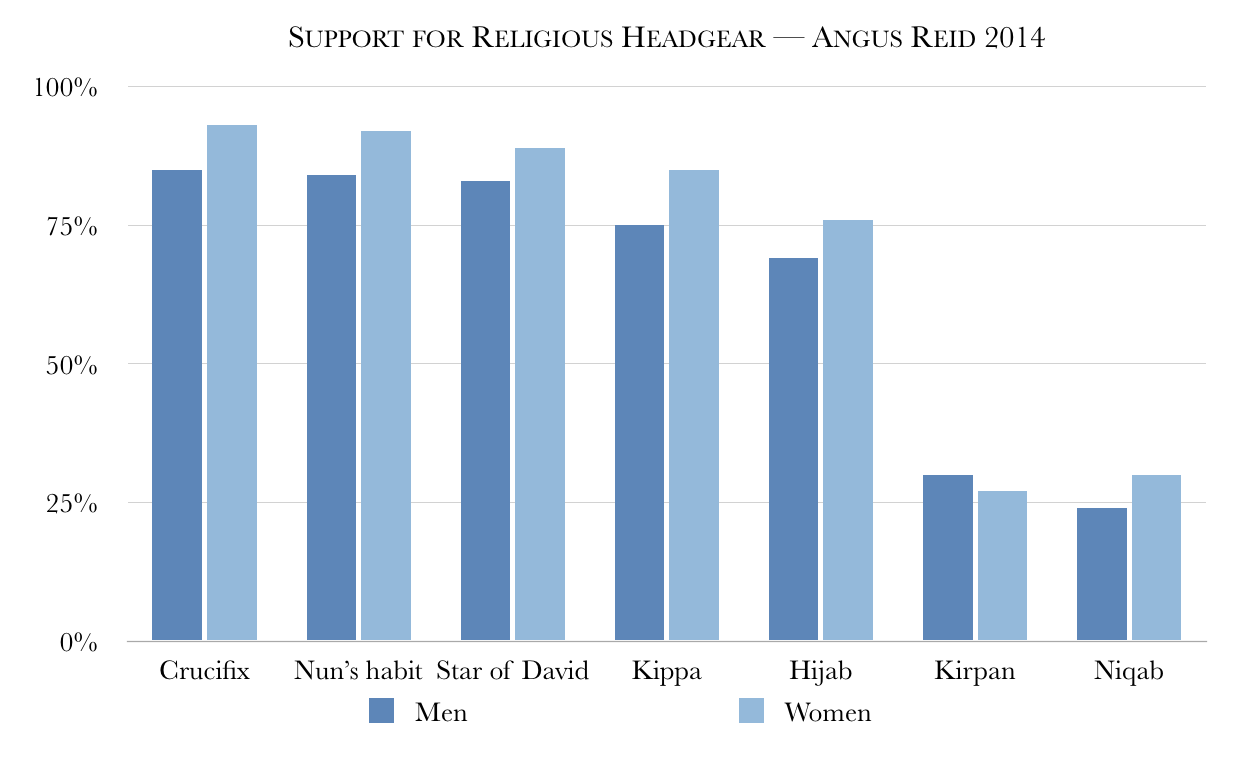
As the above chart shows, Canadians clearly make a distinction between the hijab and the niqab, with the former supported by three-quarters of Canadians, the latter only one-quarter.

Is this part of an emerging Quebec strategy to play on xenophobia? Part of the strategy to play the values card? From another Minister, I might assume an inadvertent slip of the tongue.

And sad to see, after Minister Kenney and the Government, were so strong in their opposition to the PQ’s proposed Charter of Quebec Values:

Based on today’s evidence, you would have been wrong. News that the Conservatives sent out a fundraising email on the topic led to a question from Liberal MP Chrystia Freeland in the House. She focused specifically on how the Tory email mentioned that the government was appealing a judge’s ruling “allowing people to wear the hijab while taking the oath.”

The odd thing about that phrase, which Freeland zeroed in on, is that the word “hijab,” at least in Canada, almost always refers to a Muslim woman’s head scarf that covers only the hair, unlike the “niqab,” which also covers much of the face. Directing her question at Citizenship Minister Chris Alexander, a former diplomat who served in Muslim countries, including Afghanistan, Freeland said, “Surely the minister, of all people, ought to know the difference between a niqab and a hijab.”

But Alexander defended his terminology. He alluded to his experiences “living in a majority Muslim country where the hijab has been used to cover the face of women, just as the niqab and just as the burka has been used under the terrible influence of the Taliban, and other obscure entities, in places like Afghanistan and Pakistan.”

I took that to suggest the government might mean to allow the hijab during the citizenship oath, so long as it wasn’t somehow used to cover the face. To be certain I understood properly, I emailed Alexander’s office for a clarification. The first response said Alexander was referring to “the actual covering of the face during the oath.” Just to be certain, I followed up by asking if, in that case, the hijab would be permitted, if it didn’t cover the face.

Instead of answering that question directly, Alexander’s office forwarded me this statement: “As the Prime Minister said, it is offensive that someone would hide their identity at the very moment where they are committing to join the Canadian family. We are opposed to anything that hides someone’s face when reciting the Oath of Citizenship. We believe the oath should be taken freely, openly and proudly for everyone to hear.”

I don’t think that directly answers my question about the hijab. In fact, I remain puzzled about why Alexander injected such a precise term as “hijab” at all into this already fraught debate. Having used it, though, he should now explain in plain language exactly how he means to be understood.

I assume he means it in a different way than Defence Minister Jason Kenney did, back when he was citizenship minister in 2013, and the Quebec Charter of Values debate was roiling, and he tweeted: ”A child is no less Canadian because she or he wears a kippa, turban, cross, or hijab to school.”

Citizenship minister’s office declines to clarify “hijab” reference.

Niqab appeal by Ottawa is questioned over motivation

CIC Minister Alexander trying up to come up with a convincing rationale for the niqab ban bit mixing up the niqab at citizenship ceremonies with domestic violence issues (which are not, needless to say, unique to niqabi women) is clumsy.

PM is more convincing when he spoke about the symbolism of “joining the Canadian family,” as niqab signals separation, not integration, in a way that other religious symbols (hijab, kippa, kirpan) do not:

Citizenship and Immigration Minister Chris Alexander, who was named as the respondent in Ishaq’s case, said Friday that people need to be identified and need to “commit to the oath.”

“We also are a government, and I think a people, that is concerned about protecting women from violence, protecting women from human smuggling, protecting women from barbaric practices like polygamy, genital mutilation, honour killings,” Alexander said.

“I worry when some of those defending the idea of keeping a woman behind a niqab in a citizenship ceremony are also those who say that we don’t need these protections for women from violence and from abuse. It’s something we’re all passionate about in Canada, there is no place for violence against women or any domestic violence in this country.”

Alexander said not showing your face is not a requirement of Islam and the “vast majority” of Muslim groups have said the 2011 law in question is fair and does not violate their freedom of religion.

Amira Elghawaby, human rights coordinator at the National Council of Canadian Muslims, said many Muslims and Canadians disagree with the idea of the niqab, but if it’s someone’s sincere religious belief, the right to wear one is a legal matter protected under the Charter of Rights and Freedoms.

New Canadians take the oath of citizenship at a ceremony in Dartmouth, N.S. in 2014. A Federal Court ruling that women who wear a niqab do not have to remove it to take the oath is being appealed by the federal government. (Andrew Vaughan/The Canadian Press)

“Our opinions about these things really are irrelevant, what’s important is what it means to be Canadian and what it means to have freedom of religion and consciousness in this country,” she said.

“I think that unanimously, people who understand our Charter of Rights understand that this is a right that should be protected. She is not harming anyone by deciding to keep her niqab on … and whether I agree in it or not, I do not have the right to tell her to remove it because the law does not support that and the constitution does not support that.”

NCCM forgets that freedom of religion, like other fundamental freedoms, is not absolute.

Niqab appeal by Ottawa is questioned over motivation – Politics – CBC News.

The muted reaction of other political parties:

Federal opposition parties trod carefully Friday on the issue of whether a Toronto Muslim woman should be allowed to wear a niqab while taking the oath of citizenship.

NDP multiculturalism critic Andrew Cash said the Conservative government was conflating matters of security and ceremony by appealing a court decision permitting the woman to wear the facial covering.

“It’s unfortunate that in matters of ceremonial issues, Conservatives are willing to play partisan politics to simply ratchet things up to win votes,” Mr. Cash said.

Liberal immigration critic John McCallum said that the matter is before the courts. And party spokesman Cameron Ahmad said that “the responsibility to present the case falls on the government.”

Neither party would say outright whether it backed Zunera Ishaq’s bid to keep her face covered during the swearing-in portion of the ceremony.

Federal opposition parties tread carefully on issue of niqabs during citizenship oath

Canada vows to accept 13,000 more refugees from Syria and Iraq

Good commitment – finally, now the challenge will be in implementation:

Canada has already accepted 20,000 Iraqis and since mid-2013 has brought 1,060 Syrian refugees to Canada. Total approvals for resettled Syrian refugees now exceed 1,275, with thousands more applications still being processed. This number doesn’t include the many more Syrians who’ve been accepted as refugees after making “inland claims” from within Canada.

The government also announced another $90-million in humanitarian assistance for people affected by the intensifying violence in both Iraq and Syria, home to a long-running civil war as well as battles between Islamic jihadis and government forces. The assistance will be distributed via UN agencies, the Red Cross and aid groups.

Mr. Alexander said the 10,000 new Syrian refugees will be resettled in Canada through both government and private-organization sponsorship. He said he expects roughly 60 per cent will be supported by private sponsors such as church groups and 40 per cent through government arrangements – “roughly the same proportions we’ve always had.”

Refugee sponsor groups said it will be a huge task to help 6,000, or 60 per cent of Syrian refugees, settle in Canada over 36 months. This is on top of the 3,000 additional Iraqi refugees Canada is now accepting.

Some said they hadn’t been officially informed of the proportion that private sponsors are expected to shoulder.

“Over three years, it will be probably on the edge of possible,” Alexandra Kotyk, director of sponsorship at AURA, a charitable organization representing the Anglican Diocese of Toronto and the Toronto Conference of the United Church of Canada.

I have less of an issue than some critics on the issue of need and possible preference given to Christian refugees, as it is hard to argue that Christians, and other minorities, are not likely at more risk than others.

Canada vows to accept 13,000 more refugees from Syria and Iraq – The Globe and Mail.

457 Syrian refugees resettled in Canada, but pledge was for 1,300

Sharp contrast between the Minister’s statements and the reality. Other countries (e.g., Sweden, with over 30,000) have done much better.

Not exactly inspiring and in keeping with best of the Canadian tradition (e.g. the Vietnamese boat people):

The document says that as of Nov. 13, 457 Syrian refugees have landed in Canada. That number includes 163 refugees sponsored by private groups and 294 sponsored by the government.

Alexander has repeatedly said more than 1,150 Syrians “have received Canada’s protection” in response to questions both inside and outside the House of Commons.

Groups working with refugees in Canada have said that figure is misleading as it likely includes Syrians who have arrived in Canada on their own and claimed asylum.

They have urged Alexander to do more to increase the number of refugees being resettled in Canada. So far, the government has only committed to 1,300 by the end of 2014.

That promise was made in July 2013 by Jason Kenney, who was then the immigration minister. Refugee sponsorship groups have warned for months the promise would be difficult to keep, given delays that already existed in processing applications.

The newly released document says the first privately sponsored refugee to land in Canada under the government’s promise only arrived in March of this year.   Another figure though, suggests there is a large number of Syrians who want to come to Canada as refugees.  It states that the immigration department received 2,343 applications for privately sponsored refugees from October 2013 to September 2014.

“It is important to note that the scale and scope of the Syrian refugee crisis will not be solved by resettlement alone,” the document said, echoing statements made by Alexander.

457 Syrian refugees resettled in Canada, but pledge was for 1,300 – Politics – CBC News.

Chris Alexander’s rocky journey from Kabul to cabinet | Toronto Star

A largely sympathetic portrait of Minister Alexander, balanced with supporters and critics (Konrad Yakabuski’s earlier portrait was sharper in tone Chris Alexander balances his portfolio and power):

But even the brightest and most independent minds must work within the party system in Parliament. “The best ministers are always independent of spirit,” says [ Former PM Joe] Clark. “That doesn’t mean they take on their party or their leader regularly in public debate. I think it’s a characteristic of really any strong minister I’ve encountered and I think Chris brings that capacity to the table.”

Alexander’s response to the question about whether his independent spirit chafes under the parliamentary and party system is deliberate. “We go into caucus, into cabinet, and not everyone agrees. And no one who has been part of a team expects their vision or their priorities to prevail. But this is a strong team because we do work together; we do support each other and we have moved a huge number of issues forward, especially in the area of immigration.

“I have to say there is nothing more satisfying than to be part of Canada’s democracy . . . I think this is the best government we’ve had in Canadian history. And I’m proud to be part of it.

”So does Alexander think he’s reached political superstardom?

“I will leave it to others . . . Voters get the chance to do that every four years.”

Listening to his more inclusive language at the recent Canadian Race Relations Foundation symposium was an interesting contrast to some of his more churlish language when defending government positions (e.g., refugee claimant healthcare coverage, Syrian refugees).

Chris Alexander’s rocky journey from Kabul to cabinet | Toronto Star.

Minister knew Canada wouldn’t meet Syrian refugee commitment

Caught out. At best, misleading the House and Canadians.

Four days later [March 25, 2014], C.I.C. officials told Alexander in a briefing note that the government “will not meet its Syrian private sponsorship commitment by the end of 2014” because “it takes time for private sponsors to organize and raise the funds to welcome a refugee to Canada.”

Highlighting the point, officials provided Alexander an update on June 10 that showed just 58 private sponsorship applications had been approved since January.

The update, which did not say how many, if any, had actually arrived in Canada, was provided the day before Alexander hung up on CBC’s As It Happens when he was being asked about the government’s response to the Syrian refugee crisis.

The minister later said he hung up because he was late getting to question period. But the incident prompted suspicions the government was lagging in its promise to resettle 1,300 Syrian refugees.

Alexander had repeatedly said more than 1,150 Syrians had received “Canada’s protection,” a figure he also cited in the House of Commons throughout the spring.

However, the documents show that number refers to all Syrian refugees accepted since 2011, including 942 who had travelled to Canada on their own before applying for asylum in the country.

Only 219 had actually been resettled from overseas, of which 93 had arrived in 2014 and would count toward the commitment to take in 1,300.

Liberal immigration critic John McCallum says the fact the Conservative government won’t meet its own “pathetically, ridiculously small” commitment demonstrates it has no real interest in accepting Syrians into Canada.

“They don’t care,” he said Friday. “It’s not a priority. If they cared, they could get the United Nations and people out in the field to give them huge numbers. There’s no shortage of needy people out there.”

NDP immigration critic Lysane Blanchette-Lamothe said the documents could explain why Alexander has been extremely evasive when asked to provide concrete numbers about how many Syrian refugees have arrived in Canada as part of its commitment to the UN.

“I would be very ashamed if I was the minister and I wasn’t able to fulfil such a small commitment in that massive crisis,” she said. “There’s nothing to be proud of in how the government has answered the international call.”

Always safer to stick to the truth, provide an explanation for some of the difficulties, rather than being ‘clever’ and  evasive. Eventually, the truth will come out.

Minister knew Canada wouldn’t meet Syrian refugee commitment | Ottawa Citizen.

More refugee claimants get 2nd chance with new appeal process

Interesting:

Under the old system of judicial review, only about seven per cent of rejected claimants were granted leave to appeal their cases to the Federal Court. That means the number of people who are now getting a chance at an appeal has nearly tripled.

“They’re doing a better job, a much better job than the previous federal court process,” said Peter Showler, professor emeritus at the University of Ottawa and a former chair of the Immigration and Refugee Board. “[But] that’s because that process was so drastically limited.”

Under the old system, the standard for overturning a decision was too narrow, Showler argued. Federal Court judges could only consider whether the decision reached by the refugee board was “reasonable” in law. That filter, he said, prevented many legitimate claims from being reviewed.

“One way of seeing it is the Refugee Appeal Division is certainly doing a better job of identifying mistakes than the federal court,” he said.

“Another way of seeing this is we’ve had 10 years of lack of justice in this country where claimants were incorrectly refused and we did not catch those mistakes.”

CBC News asked officials in Immigration Minister Chris Alexanders office to comment on the new figures. His office did not immediately respond.

But other experts say that while the numbers are encouraging, there are still far too many restrictions on who gets to appeal their case.

Refugee lawyer Lorne Waldman noted that claimants from so-called safe countries like Hungary and Mexico are barred from appealing their cases, as are claimants who arrive and lodge a refugee claim at the U.S. border.

The Government could tout this as evidence that refugee reform both tightened the system and made it more fair than the previous Federal Court process.

But that might undermine their overall anti-fraud and misrepresentation messaging.

More refugee claimants get 2nd chance with new appeal process – Politics – CBC News.

Conservative ‘barbaric practices’ bill panders to fear of immigrants: Walkom

Tom Walkom on the Government’s pandering to its base:

As justification for his bill, Alexander cited the case of Mohammad Shafia, an Afghan immigrant who, along with his wife and son, killed three of his daughters and the girls’ stepmother.

What the minister didn’t point out is that all three killers received the maximum sentence — life in prison.

“The apparent reason behind these cold-blooded, shameful murders was that the four completely innocent victims offended your completely twisted concept of honour . . . that has absolutely no placed in any civilized society,” the judge said at sentencing.

Not much leniency there.

In another case cited by Alexander this week, it’s hard to know what the judge will say. The alleged wife-killer has not yet gone to trial.

This inconvenient fact didn’t stop the minister from publicly declaring the recent immigrant from Afghanistan guilty of an honour killing. It’s the second time this year that Alexander has preemptively convicted this particular man. The first was in a March speech for Toronto’s Canadian Club.

It is true that Canada does not tolerate practices more common in other countries. Americans who want to come to Canada must give up their handguns. Chinese billionaires, if they wish to settle here, may have only one spouse apiece. Murdering wives and daughters — for any reason — is just not on.

But laws in these areas already exist. With the exceptions noted above, Alexander’s bill does not add anything helpful. In the guise of protecting women it takes potshots at Muslim immigrants. Its motives are crassly political.

Perhaps the title of the bill could be changed from “Zero Tolerance for Barbaric Cultural Practices Act” to “Craven Pandering to the Conservative Base and anti-Muslim Sentiment.”

Conservative ‘barbaric practices’ bill panders to fear of immigrants: Walkom | Toronto Star.

Feds brace for backlash against new immigration rules (against polygamy, forced marriages)

Apart from the silly and pandering name (Zero Tolerance for Barbaric Cultural Practices Act), and whether in its application it will make much of a difference, or provide effective new powers, hard to disagree with the overall intent and principles behind the Bill.

After all, the case mentioned by Alexander, the Shafia murders (Shafia jury finds all guilty of 1st-degree murder), were successfully prosecuted under existing laws:

The bill would amend the Immigration and Refugee Protection Act, making permanent residents or temporary residents inadmissible if they practice polygamy in Canada.

The bill would also amend the Civil Marriage Act to ban marriage for anyone under the age of 16.

It also changes the Criminal Code to impose a maximum five-year prison term on anyone who “celebrates, aids or participates” in a marriage rite or ceremony knowing that one of the persons is being married against their will, or is not of legal age.

Alexander noted the case of an Afghan immigrant accused of stabbing his wife to death last year, apparently because he felt dishonoured by her independence.

He cited another case in which an Afghan-Canadian man, his second wife and their son were convicted of first-degree murder in the deaths of his three teenaged daughters and his first wife — also because he felt they were bringing dishonour on the family by dating or dressing in ways he found offensive.

“Honour-based killings are nothing more than murders,” Alexander said.“We will be working through this bill to make sure that such killings are considered the murders that we know them to be. There is absolutely no room for ambiguity.”

But I don’t buy the argument that countries like the UAE are likely to protest. Most immigrants from the Gulf are guest workers, not citizens, and given their own restrictions and the bad publicity, unlikely to be an issue.

Better reporting on how these measures would be implemented and enforced would be more useful.

Feds brace for backlash against new immigration rules.

More substantive reporting here:

But some immigration lawyers are questioning the need for the new legislation, saying they are aware of few cases of polygamy among immigrants to Canada and don’t see early and forced marriage as a pervasive concern.

Immigration lawyer Joel Sandaluk said the polygamy portion of the bill was particularly puzzling because the practice is already illegal in Canada. He said the legislation seems to be aimed at individuals who were married in another country before arriving in Canada, but added that he believes their numbers are relatively few.

After practising immigration law in Canada for 15 years, he said he’s never come across the issue. “It’s just something that’s completely outside of my experience as an immigration lawyer,” he said.

Mr. Sandaluk said he also wasn’t aware of a particular concern with the ability to prosecute forced marriages, and pointed to the language of the announcement and the term “barbaric cultural practices” as evidence that the government is targeting a specific subset of the population.

“What the government I think is doing is sending a political message with this legislation,” he said. “And I think this is better considered posturing rather than policy.”

Experts question use of bill banning immigrants in polygamous marriages

Refugee health care temporarily restored in most categories

Government partial compliance with the refugee claimant health care coverage:

“We are doing this because the court has ordered us to do it. We respect that decision while not agreeing with it,” Immigration Minister Chris Alexander said following question period on Tuesday.

The government had until the end of today to review a 2012 policy the Federal Court deemed unconstitutional, “cruel and unusual” last July.

The government had asked for a stay until an appeal is heard, but that request was rejected on Friday. A date for the appeal has not been set.

“Under the temporary measures, most beneficiaries are eligible to receive coverage for hospital, medical and laboratory services, including pre- and post-natal care as well as laboratory and diagnostic services,” the government said in a notice posted on the website of the Department of Citizenship and Immigration over an hour after the minister spoke.

Children under 19 years of age will receive full coverage, while pregnant women will be covered for all but supplemental health benefits.

Supplemental benefits include “limited dental and vision care, prosthetics and devices to assist mobility, home care and long-term care, psychological counselling provided by a registered clinical psychologist, and post-arrival health assessments.”

However, refugee claimants in seven of the 12 categories included in the governments chart will not be covered for drugs or supplemental health coverage.

….The Canadian Association of Refugee Lawyers, one of the groups that took the government to court over the changes the Conservatives brought in back in 2012, says the temporary plan does not comply with the Federal Court ruling.

“The government is still being punitive, they’re being selective and the court told them to reinstate all benefits,” said Peter Showler, co-chair of the refugee lawyers’ group and a former chair of the Immigration and Refugee Board of Canada. He is also an expert in refugee law at the University of Ottawa.

Showler was critical of the government’s decision to deprive certain refugee claimants of coverage for prescription medications.

“They are not in compliance with the decision based on the information that the government put out on its website today.”

Refugee health care temporarily restored in most categories – Politics – CBC News.

And the link to the table outlining what is covered and what is not:

Text of the government’s temporary plan for refugee health care