Globe editorial: Why to drop a bad idea on immigration

Appears dropped may be actually dropped. Money line “we want it in writing.” Regional effects vary, may be more negative impact in rural Canada compared to need to reduce in urban centres:

…Canada’s immigration system is on the mend today because of belated reforms introduced in the dying months of the Trudeau government, and due to further fixes under the Liberals’ current reincarnation. 

Ottawa is now trying to reduce the number of temporary residents in Canada, from 7.1 per cent of the total population to 5 per cent by the end of 2026.

The country is also at a historic crossroads as it tries to shake up its economy in order to be less reliant on the United States. A big part of that will involve improving Canada’s productivity, which in turn means businesses need to become more efficient. Letting them continue to rely on low-wage, low-skill labour when the unemployment rate is 6.9 per cent would be self-defeating. 

The fact that Ottawa is not moving ahead with its low-skilled pathway into the country means it may have seen the light. But we want it in writing.

Source: Why to drop a bad idea on immigration

Ottawa yet to launch program announced last year that would grant permanent residency to low-wage workers

Second thoughts?

More than a year after announcing a new immigration stream that would have granted permanent residency to low-wage workers already in Canada, the federal government has yet to move ahead on formally launching the program – suggesting that Ottawa could be backing away from the plan altogether. 

The plan targeting low-wage workers was informally announced in April 2024, through the Canada Gazette. Consultations were set to begin last year on amending immigration laws to admit a “new permanent economic class of workers in TEER 4 and TEER 5 jobs.” 

But the program was not included in July’s version of Immigration, Refugees and Citizenship Canada’s forward regulatory plan, which details coming changes to federal immigration rules and programs over the next three years. 

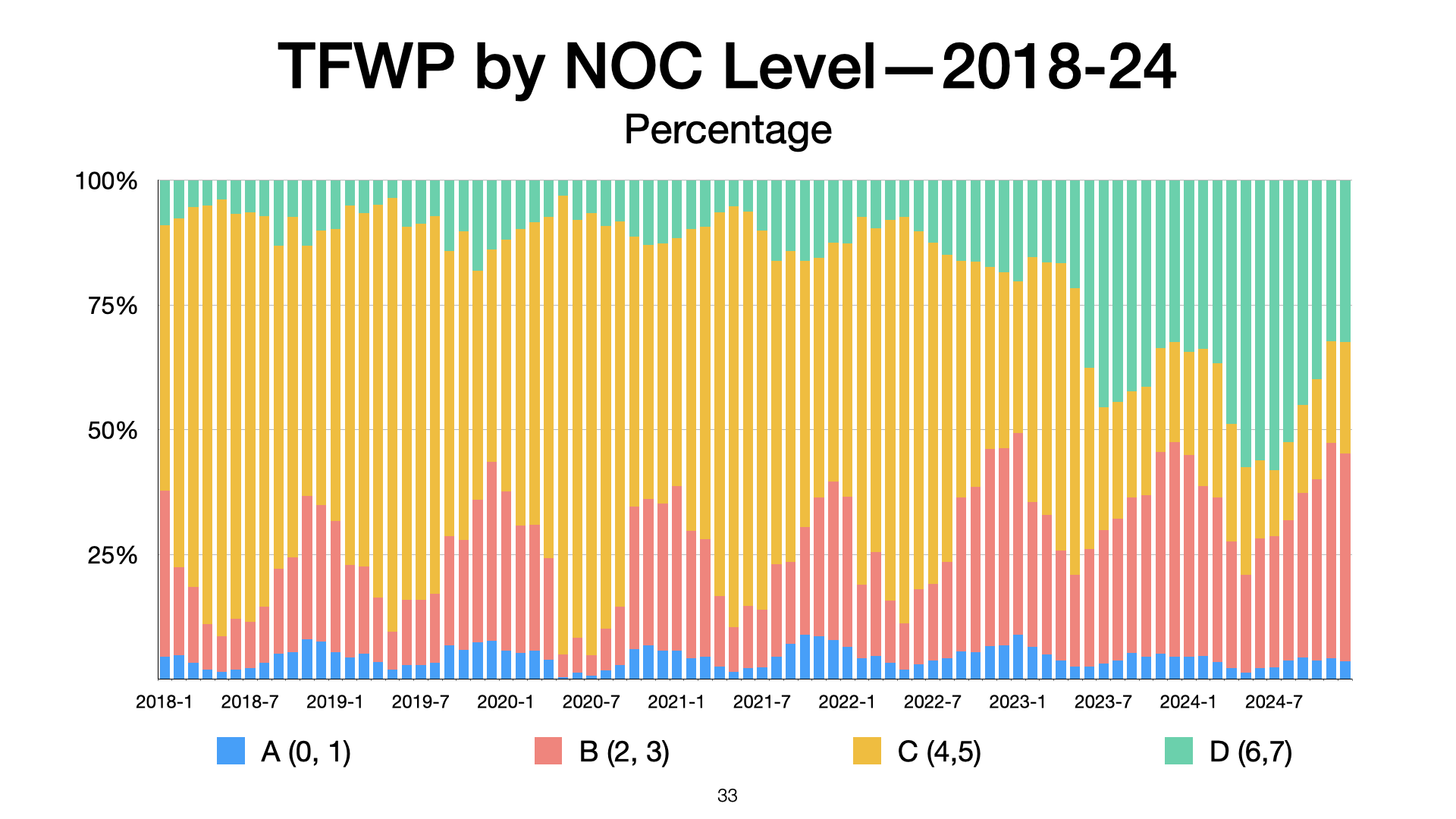
Training, Education, Experience and Responsibilities, or TEER, is a job categorization system used by the government for immigration purposes. TEER 4 and TEER 5 workers usually have either a high-school diploma or no formal education at all, and examples of their occupations include delivery service drivers, caregivers, food production and retail workers. 

IRCC spokesperson Sofica Lukianenko said in a late July e-mail to The Globe and Mail that the department will “continue to examine the role of immigration in meeting labour market needs at TEER 4 and 5 occupations.” …

Scrapping an immigration program that would grant PR to low-wage workers would be a wise move if the government’s larger goal is to increase gross domestic product per capita through prioritizing higher-skilled immigrants, argues Mikal Skuterud, a professor of labour economics at the University of Waterloo. 

Prof. Skuterud was highly critical of the TEER 4 and TEER 5 pathway plan when it was announced last year, telling The Globe at the time that it would suppress wages and undermine public support for immigration. He said Ottawa intended to launch the program to hedge against the growing problem of visa overstayers, as offering foreign workers currently in Canada a direct path to PR en masse would reduce both temporary resident and undocumented populations. …

Source: Ottawa yet to launch program announced last year that would grant permanent residency to low-wage workers

Canada increasingly dependent on low-wage migrant workers, says report

Confirmation what many have been noting (chart below highlights shift before more recent reversal_:

The share of native-born Canadians in the labour force has dropped nearly 10 percentage points since 2006, according to a new Bank of Canada report documenting how the country’s economy is becoming increasingly reliant on low-wage migrant workers.

“Not only has Canada experienced an unprecedented surge in immigration, but the composition of recent newcomers has been markedly different than in the past,” reads a discussion paper published May 9 by the bank’s Economic Analysis Department.

The paper found that, driven largely by a surge in temporary migration, the average Canadian immigrant has now become younger, lower-skilled and more likely to hail from poorer regions such as India, sub-Saharan Africa or the Middle East.

They’re also paid less. Particularly among Canada’s surging ranks of temporary migrant workers, wages have “reduced significantly relative to Canadian-born workers,” reads the paper.

Since 2015, “the average nominal wage gap between temporary and Canadian-born workers has more than doubled,” it read.

The authors calculated that the average migrant worker in Canada is now paid more than one fifth (22.6 per cent) less than a comparable Canadian-born worker. Prior to 2014, that gap was only 9.5 per cent.

The paper, entitled The Shift in Canadian Immigration Composition and its Effect on Wages, is one of the most definitive official documents as to the massive surge of migrant workers brought to Canada in the immediate wake of the COVID-19 pandemic.

Starting in 2022, Canada began accepting more than one million newcomers per year, mostly in “non-permanent” categories of immigrants ranging from international students, who are among those admitted under the international mobility program, to temporary foreign workers.

The Bank of Canada document shows that this wasn’t just unprecedented for Canada, but it went well beyond the pale of any comparable advanced economy.

Between 2019 and 2023, Canada charted population growth of more than six per cent. This was triple the rate seen in the United States, and double the rate seen in Switzerland, the only other developed economy analyzed by the paper whose demographic shift came anywhere close to those of Canada’s….

Source: Canada increasingly dependent on low-wage migrant workers, says report

ICYMI: Concerns mount over new federal immigration policy that would grant permanent residency to low-wage workers 

Valid concerns:

Economists and policy experts are expressing growing concern over a potential new federal immigration program that would immediately grant permanent residency to temporary residents who are in low-wage jobs.

The program, if launched, would target people who already have Canadian work experience in what Ottawa classifies as TEER 4 and TEER 5 occupations – delivery service drivers, caregivers, food production workers and retail staff, to name a few.

TEER stands for Training, Education, Experience and Responsibilities, and it is a job categorization system the government uses for immigration purposes. TEER 4 and TEER 5 workers typically have a high school diploma or little or no formal education at all.

….This is perhaps exactly why Ottawa is thinking of introducing a new path to permanent residency for low-wage workers, Prof. Skuterud and Toronto immigration lawyer Ravi Jain both say.

“The easiest way to deal with this problem is to create a new pathway to permanent residence,” Prof. Skuterud said. “But it’s not smart policy. It will more likely suppress wages and undermine public support for immigration.”

Source: Concerns mount over new federal immigration policy that would grant permanent residency to low-wage workers

Ottawa agrees to pause low-wage stream of Montreal temporary foreign worker program – with several exceptions 

Exceptions are reasonable. The degree to which these restrictions are enforceable, or are enforced, remains to be seen. But, as some Quebec commentators have noted, major step in giving Quebec a larger say with respect to Temporary Foreign Workers:

Ottawa has approved a Quebec request to impose a six-month pause on new applications to the low-wage stream of the temporary foreign worker program in Montreal, with exemptions for several sectors.

Employment Minister Randy Boissonnault announced the decision on Tuesday, saying the pause will not apply to the construction, agriculture, food-processing, education and social-services sectors.

Quebec Premier François Legault said the six-month pause would only apply to about 3,500 workers filling low-wage jobs on the Island of Montreal. During a Tuesday news conference, Mr. Legault presented this as a first step and acknowledged that it represents only a small fraction of Quebec’s temporary residents….

Source: Ottawa agrees to pause low-wage stream of Montreal temporary foreign worker program – with several exceptions

Keller: Canada is about to lose more than 100,000 farming jobs. That’s great economic news

More on innovation, productivity and immigration:

….Back in 1891, it would have called for a large (and mostly poorly paid) work force. Progress since then has been remarkable, spurred by massive investments in labour-saving farming equipment and technology. The Conference Board study predicts more of the same.

All of which should be a reminder that labour shortages and rising wages have economic benefits. Yes, benefits. They are the mother of business innovation and investment, because they force businesses to chase ever greater labour productivity. Particularly when it comes to low-wage jobs, a tight labour market and upward pressure on pay should be the goal of government policy.

However, Canadian businesses in recent years persuaded Ottawa that, no matter the state of the economy or the level of unemployment, they can’t fill hundreds of thousands of low-wage jobs. But these alleged labour shortages are mostly just businesses facing the pressure to compete for workers by raising wages.

Those pressures have been alleviated by allowing businesses to recruit an effectively unlimited number of temporary foreign workers, at the lowest legal wage, or less. Absent that low-wage release valve, businesses would have to innovate and invest more in new technologies to use less labour, and get more out of each hour of (increasingly expensive) labour.

That’s how we raise productivity. That’s how we grow the economy….

Source: Canada is about to lose more than 100,000 farming jobs. That’s great economic news

Paradkar: Dear immigrants: Coming to Canada? Here’s what you’re really in for

While a bit overboard, all too accurate given the various changes to ease business restrictions on temporary worker permits and limits on employment time for international students:

Hello, new immigrants. Most of you are likely coming to Canada in search of a better life and better opportunities than in the lands you leave behind. The good news is that many of you will find a job. Some of you will even be well-paid. But more than a few will find your dreams of stability and comfort seriously challenged.

For those who take on the vast majority of jobs Ontario is looking to fill — in restaurants and in bars, in truck transportation, construction, nursing homes — you’ll first have to survive the savageries of capitalism and xenophobia.

As Canada opens its doors to half a million immigrants annually — about half of whom will land in Ontario — we say welcome, today’s newcomers. But do you know what you’re in for?

Canada has historically benefitted from immigration. Many immigrants, particularly higher skilled ones, have also benefitted by coming here. But this round of gate-opening reveals the truth about Canada’s economic immigration policy. It’s designed in the interest of a stronger economy, which serves, first and foremost, not the majority of immigrants, who will be channelled into unskilled, often temporary jobs, but those at the top.

What Canada wants, but is not saying out loud, is a servant class; a vast army of workers prepared to accept the low-paid jobs no one else wants. And given how the economy is structured along with our poor preparedness to receive these newcomers, it’s clear we want to keep them in that position.

The current immigration push continues a centuries-old tradition of worker exploitation in the Americas. When European settler attempts to enslave Indigenous populations failed for various reasons, indentured servants arrived in the 1600s to care for the vast lands the earliest settlers had got, bought or stole.

Then came chattel slavery, itself created because the elite capitalists realized free labour by commodifying humans kidnapped from afar was more profitable than cheap wage labour.

When, some 200 years later, Britain abolished slavery in most of its colonies in the 1830s, this continent experienced a “labour shortage,” like the one today. That led to Britain importing indentured or bonded labour from colonies such as India, particularly on its plantation islands.

Then, as today, “labour shortage” didn’t mean there was a lack of human bodies to do jobs that build societies. Nor did it mean there was a lack of skills to do them. Then, as today, it meant something about the shifting dynamics of demand and supply.

A higher demand for labour shifts power toward workers, who agitate for better wages and working conditions. Flooding the market with a supply of workers swings that shift in power back to the owning class.

Today’s immigration push comes with baked-in economic disenfranchisement. Temporary work in precarious jobs leaves workers vulnerable to abusive working conditions.

Much like the West Indian Domestic Scheme of the 1950s and ’60s, when Canada sought Black Caribbeans to be domestic workers, the floodgates are opening today through initiatives such as the Temporary Youth Worker Program and the Federal Skilled Trades program, and via colleges and universities, which are taking increasing numbers of international students.

According to Statistics Canada, a vast majority of Ontario’s job vacancies right now — 60 per cent — require a high school graduation or less, many needing less than one year of experience.

The Federal Skilled Trades program doesn’t require candidates to have secondary education but it will prioritize those with a certificate or diploma or degree. That means many economic migrants will be overqualified for the jobs being asked of them, but they will come, perhaps hoping they’re at least getting a foot in the door.

Once in, however, these immigrants will have been slotted into the jobs Canadians won’t do for the wages being offered.

The overt racists and xenophobes also grease the wheels of this exploitative system.

If employers see labour as robotic capital-making units, xenophobes, easily made insecure by “outsiders,” keep immigrants bracing for attacks on their very existence, leaving them grateful for the crumbs, told their deplorable circumstances are a result of their not working hard enough or their supposed inferiority.

The economy is structurally built to see full employment — everyone having a job — as a problem.

A seventh straight month of job gains and near-record-low unemployment of five per cent is leading economists to predict that the Bank of Canada might well raise already high interest rates in coming months to “cool the economy” and inflation.

In this way of thinking, rising wages for, say, an average grocery worker in Canada, who earned $18.97 per hour in 2022 is a threat to the economy. But grocery magnate Galen Weston earning $5,679 an hour is not.

This thinking is why employers freely blamed programs such as Canada Emergency Response Benefit — that offered about $500 a week to those who lost income due to COVID — for “spoiling” workers.

Far better to call a person earning $500 a week, and not wanting to work for less than that bare minimum, lazy than pay them higher wages.

Perhaps the new immigrants coming in to rescue our economy, including those who have to remain jobless in service of this country, might be thanked in other ways? Maybe they’ll be housed relatively easily? Not have to worry about finding good schools for their children? Or have a safety net should they fall ill?

No such luck. Provincial parsimoniousness has already extended to defunding education, defunding health care and not building enough or affordable houses on land already earmarked for homes.

Politicians and their owning class friends are eyeing for-profit education and for-profit health care once the current systems are squeezed to the point of hopelessness. Large developers, quite coincidentally, bought precisely those thousands of acres of environmentally sensitive and protected Greenbelt land that Ontario’s premier opened up to build housing.

Yes, developers will need construction workers willing to work for less than a decent wage, if they hope to pad their profits. Instability in foreign lands fostering desperation can be a wonderful boon.The very rich benefit mightily from boosted immigration in other ways, too. More people means more consumers and buying food is non-negotiable. Ka-ching, that sound of cascading coins, is an inadequate metaphor to capture the surge in sums of money for people like Weston, whose family’s net worth is about $8 billion US.

We — as a nation — either need to be better prepared to receive newcomers or, failing that, be honest and say: Welcome, newcomers — welcome to your new life of multi-dimensional suffering.
Source: Dear immigrants: Coming to Canada? Here’s what you’re really in for