Su | From sunny ways to stormy days: navigating Canada’s immigration debate

Interesting convergence in position between Su, from York University, and Poilievre, the former stating “…policies should be developed in accordance with Canada’s housing, health care and education capacities and potential,” the latter stating he would “tie the country’s population growth rate to a level that’s below the number of new homes built, and would also consider such factors as access to health-care and jobs:”

….As Canada prepares for new leadership, there is an opportunity to foster a more nuanced and productive dialogue on immigration. We can have hard and honest conversations about immigration without the racism, the hate and the punching down.

Political candidates should develop clear and consistent long-term immigration policies that balance economic needs with social cohesion. These policies should be developed in accordance with Canada’s housing, health care and education capacities and potential. Candidates should also commit to promoting the positive impacts of diversity and multiculturalism on Canadian society and economy to improve social cohesion.

By confronting our immigration identity crisis head-on, political leaders can help shape a more inclusive and prosperous future for all Canadians that stay true to our core values. Immigration has built Canada, so let’s move beyond divisive politics and work toward a unified vision that embraces Canada’s multicultural heritage while addressing the legitimate concerns of voters.

Source: Opinion | From sunny ways to stormy days: navigating Canada’s immigration debate


Alicia Planincic: The provinces are losing ground to federal priorities in immigration 

Useful observation and analysis. It would benefit, however, from further analysis comparing PNP and federal economic outcomes:

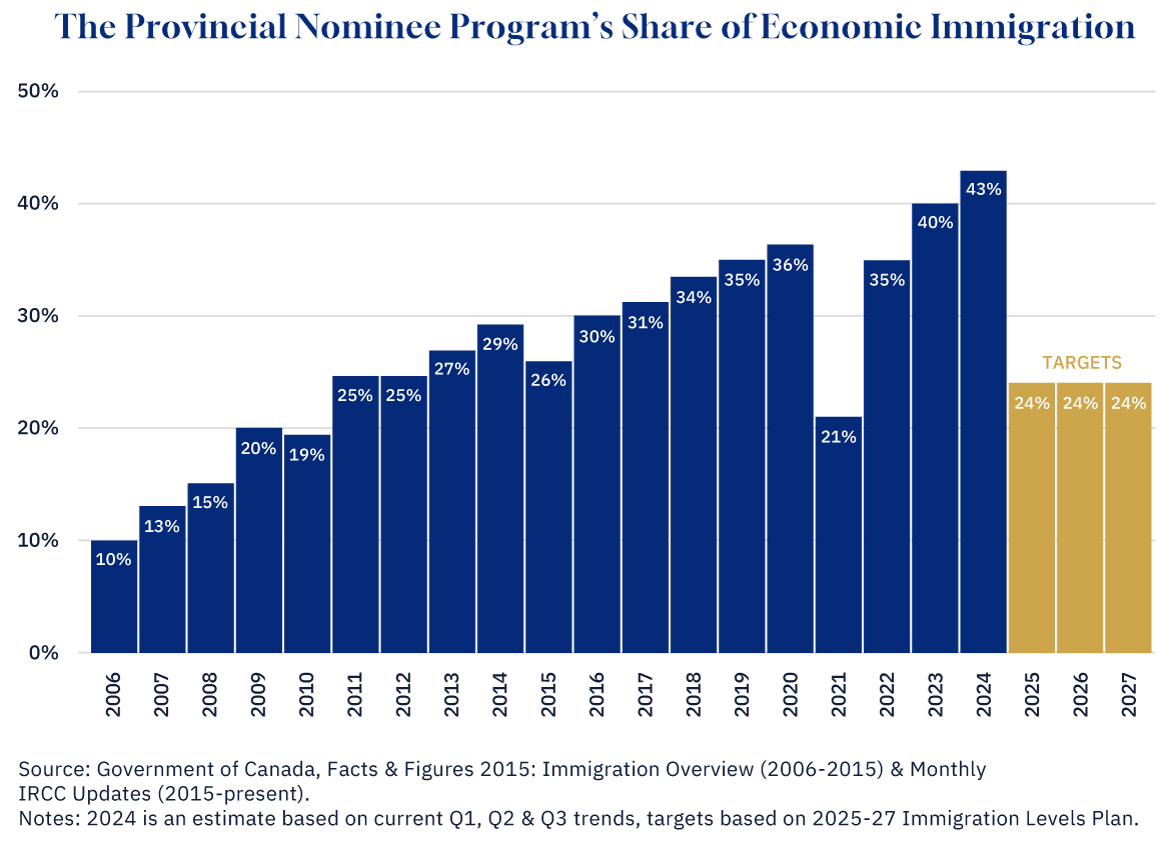
A couple of months ago, the federal government made a big announcement that they were decreasing targets for immigration pretty substantially. Though there was a lot of talk about the topline numbers and what it means for the economy, what was overlooked at that time was that cuts to immigration came primarily at the expense of a single program: the Provincial Nominee Program (the “PNP”)—what represents the provinces’ role in selecting economic immigrants.

What’s important about the PNP is that it’s designed to distribute immigrants more widely across Canada (especially beyond the country’s biggest cities) and give the provinces the ability to meet local labour market needs. And, though it’s not perfect, it’s pretty effective at both.

Just how big of a hit did the program take? Pretty big.

Graphic credit: Janice Nelson. 

While total immigration was reduced by around 100,000 new permanent residents (annually), the PNP was reduced by 65,000. To put this into perspective, the PNP is just a single program within the broader “class” of economic immigration but cuts to the PNP dwarfed cuts made to the other two main classes of immigration combined (i.e., family-related immigration and refugees).

At the same time, federally-focused economic programs did not see any major cuts. In fact, their numbers grew slightly. The result of all this is that the province’s role in economic immigration, which had been steadily growing for years, is set to collapse from over 40 percent of total economic immigration down to just 24 percent.

It’s worth noting that the PNP is also losing ground to another federal priority: French-speaking immigration outside of Quebec. In fact, French language proficiency has become a key factor in selecting economic immigrants federally. Though the target for French-speaking immigration was cut marginally this year, numbers have nearly doubled over the last couple of years, with the latest target at 30,000 (compared to 55,000 for the PNP).

In other words, the current plan to decrease immigration is not just an across-the-board cut that will hit all parts of Canada equally. It comes with regional consequences, as provincial priorities lose out to federal ones.

Source: Alicia Planincic: The provinces are losing ground to federal priorities in immigration 


Kelly McParland: Of the long list of Liberal blunders, immigration takes the cake

Reasonable assessment:

Canada stands out amid the fray, however. For decades, Canadians expressed a pride approaching smugness in the high levels of support for ever-rising immigration quotas and the civility of the welcome offered newcomers. There was widespread agreement that immigration brought with it growth, energy, new ideas, broad experience and an array of benefits in food, music, style, the arts and other cultural attractions.

No more. The Trudeau government now sees electoral advantage  — or more likely necessity — in hot-footing it to the front of the deportation parade, as if it weren’t responsible for the policies that produced the parade in the first place. In a sharp reversal of previous positions,  Immigration Minister Marc Miller proclaimed last week in Vancouver that whatever it was Ottawa thought its border policies were achieving was no longer operative.

“It’s clear that the age of unlimited supply of cheap foreign labour is over, and I think that is a good thing,” he announced.

“Bringing the numbers down, I think, is very important to making sure that we aren’t simply chasing short-term gain for a lot of long-term pain.”

Short-term gain is precisely what the Liberal approach to immigration has been all about. Annual admissions have almost doubled since 2015. The government saw it as a way to secure reliable votes from grateful newcomers, provide abundant low-wage labour, fill schools with foreign students paying high tuitions, and support Liberals’ eagerness to portray themselves as caring, tolerant and good-hearted.

Instead, the rise in population is blamed for a housing crisis, college campuses have become puppy mills for overcharged students, tens of thousands of newcomers have seen their hopes of a permanent new life in Canada dashed, and Canada’s international reputation has been badly sullied. The number of students seeking asylum has grown from about 1,800 in 2018 to more than 12,500 in 2023. In the first nine months of this year, there had already been almost 14,000 requests. More than 1.2 million people granted temporary residency are being told to leave by next year in what would be an unprecedented outflow. The backlog in refugee claims has reached 260,000, creating a lineup so lengthy it allows claimants to spend additional years in the country awaiting their hearing.

A big problem with well-meaning, but ill-considered, social programs is that they bring the aim itself into disrepute when they go wrong. Eight years ago, when Justin Trudeau was keen on differentiating his views from a bellicose new U.S. president named Trump, he fired off a message obviously intended to reflect Canada’s superior righteousness.

“To those fleeing persecution, terror & war, Canadians will welcome you, regardless of your faith,” he tweeted.

The day after Trump was voted back into the White House this month, all that had changed.

“Canadians quite rightly believe that it needs to be a decision of Canada and Canadians who comes to our country and who doesn’t,” asserted Deputy Prime Minister Chrystia Freeland.

“That is something that’s really important, it’s fundamental.”

Source: Kelly McParland: Of the long list of Liberal blunders, immigration takes the cake

PBO: Impact of the 2025-2027 Immigration Levels Plan on Canada’s Housing Gap 

Good assessment, particularly with projected outflows of temporary residents. Key findings:

  • Assuming that the population evolves in line with the Government’s projection, we estimate that the 2025-2027 Immigration Levels Plan will reduce Canada’s housing gap in 2030 by 534,000 units (45 per cent). After accounting for the Government’s new immigration plan, we estimate Canada’s housing gap in 2030 to be 658,000 units.
  • Combined with our updated baseline outlook of 1.7 million net housing completions, closing the housing gap in Canada would require a total of 2.3 million housing completions by 2030, which would translate into 390,000 total units completed annually, on average, over 2025 to 2030.
  • We judge that there is significant risk to the demographic projection presented in the Government’s new immigration plan—particularly to the projected outflow of non-permanent residents. Our estimated reductions in household formation and the housing gap are uncertain and likely represent upper-bound estimates.

On October 24, the Government released its 2025-2027 Immigration Levels Plan (ILP), which included permanent resident targets and, for the first time, temporary resident targets for international students and temporary foreign workers. For permanent residents, the plan highlights a decrease in permanent resident admissions from 464,265 in 2024 to 395,000 in 2025, 380,000 in 2026 and 365,000 in 2027. For non-permanent residents (NPRs), the plan presents arrival targets set with the goal of reducing the number of NPRs to 5 per cent of Canada’s population by the end of 2026.

Given the immigration targets announced in this plan, the Government projects that the Canadian population will decline by 0.2 per cent in both 2025 and 2026, before returning to population growth of 0.8 per cent in 2027. If the population evolves as the Government projects, it will be the first time Canada experiences an annual decline in its population. Although the ILP projects fewer permanent resident admissions and fewer NPR arrivals, the projected decline in the population will be driven by large outflows of NPRs. Excluding individuals who will transition to permanent residency, the plan assumes that 2.8 million temporary residents will leave the country over the next 3 years—equivalent to 93 per cent of the current NPR population….

Source: Impact of the 2025-2027 Immigration Levels Plan on Canada’s Housing Gap

Esses: Canada’s immigration strategy: How reduced targets can preserve positive attitudes

More wishful thinking than based on evidence and public opinion research. Striking her focus on Permanent Residents only, with no mention of temporary residents, which have grown the most. Perhaps she is trying to provide a case for pro-immigration academics and the like that there is a silver lining in the cuts. But control or management needs to be demonstrated in implementation, which Miller has started to do:

….In announcing the new targets for immigration levels, Immigration Minister Marc Miller said “Canadians want the federal government to better manage the immigration system.” By managing immigration, Miller suggests that the integrity of the immigration system will be preserved. 

These statements, paired with reduced immigration targets, may help restore Canadians’ sense of control over immigration. This, in turn, could prevent the potential cycle of perceived lack of control, negative attitudes toward immigrants and poor immigrant integration.

We recommend that public leaders continue to show that Canadians have control over immigration. At the same time, it is important for them to highlight the benefits of immigration for Canada. They should also express favourable views of all classes of immigrants, whether they are coming to work, join family in Canada or come as refugees. 

Expressing these views can help restore Canadians’ positive attitudes, as seen during the Syrian refugee crisis. In 2015, newly elected Prime Minister Justin Trudeau shared positive messages about Syrian refugees. This messaging, amplified by the media, made Canadians more open to the arrival of Syrian refugees. It also promoted more positive attitudes toward refugees in general

Reducing immigration levels could reinforce the blame placed on immigrants for current societal problems. However, it also provides an opportunity to promote more positive views. Political leaders can shift the focus away from negative views by emphasizing Canada’s control over immigration and the importance of immigrants to the country’s future. Business leaders are already proclaiming this importance and can contribute to the promotion of positive attitudes toward immigrants and immigration. 

By emphasizing both control and the benefits of immigration, leaders can preserve positive attitudes toward immigrants. They can also maintain support for the immigration system, ensuring it continues to meet Canada’s evolving needs. This approach can help build a welcoming society that values and recognizes immigrants as essential to Canada’s future.

Source: Canada’s immigration strategy: How reduced targets can preserve positive attitudes

Lavoie: U.S. election’s greatest fallout: a new immigration challenge for Canada

Bit light on practical advice. But of course our immigration strategy needs to be broader than a numbers game yet not be disconnected from the numbers:

…Democratic institutions governing people with diverse cultures on an equal footing is a relatively new phenomenon. We are living a great experiment, and racial, religious and cultural tensions observed in many countries suggest it will not be an easy ride. The different cultures of immigrants test and challenge our own institutions and culture, making us uncomfortable. But research shows it is possible for very different people to build trust with time. If rich countries like ours fail with this experiment, the future of the global order will be rather bleak.

Ultimately, the solution to slowing the flow of migration and truly helping people is for Canada, the U.S. and other wealthy countries to contribute to the global effort to limit climate change and reduce global inequalities. Research from the recent winners of the Nobel Prize for economics suggests that helping poorer countries develop better institutions is the best way to reduce these inequalities. The disastrous experiences in Iraq and Afghanistan show how bad we are at this. More international research and co-operation are needed.

Unfortunately, the results of Tuesday’s election will not stop the U.S. from moving toward more nationalistic policies. This is a call for Canada to stand up. Our immigration strategy should be broader than just a numbers game.

Source: U.S. election’s greatest fallout: a new immigration challenge for Canada

Québec met sur pause deux importants programmes d’immigration

Of note:

Pour juguler la hausse fulgurante du nombre d’immigrants venant s’installer au Québec, le gouvernement de François Legault s’apprête à imposer un moratoire temporaire sur deux des principales voies d’accès vers la résidence permanente.

Cette décision, d’abord rapportée par La Presse et Radio-Canada, sera présentée dans le détail aux médias jeudi. En procédant ainsi, le gouvernement souhaite respecter les cibles qu’il avait fixées en novembre dernier dans sa planification pluriannuelle de l’immigration.

Concrètement, Québec cessera de délivrer des certificats de sélection du Québec (CSQ) — le document nécessaire pour immigrer de façon permanente — aux immigrants destinés au Programme régulier des travailleurs qualifiés, le principal véhicule d’immigration économique au Québec. Dans sa dernière planification, le gouvernement prévoyait d’accueillir en 2024 environ 30 000 immigrants économiques, dont 25 000 dans le cadre de ce programme.

Il mettra aussi un frein temporaire à l’admission « en continu » d’immigrants de la catégorie « diplômés » du Programme de l’expérience québécoise (PEQ). Québec avait projeté en accueillir autour de 6500 cette année.

Cela aura pour conséquence de mettre fin pour quelques mois à la sélection d’une bonne part des immigrants permanents en provenance de l’étranger. Le ministre québécois de l’Immigration, Jean-François Roberge, espère ainsi réduire la liste des détenteurs de CSQ toujours en attente d’une résidence permanente.

Sa cible pour l’année 2025 reste globalement inchangée.

Le gel annoncé par le gouvernement caquiste ne touche pas les immigrants de la catégorie de la réunification familiale, ni ceux des catégories humanitaires, comme les réfugiés. Les autres programmes d’immigration économique, moins importants, et les autres volets du PEQ ne sont pas touchés par le moratoire….

Source: Québec met sur pause deux importants programmes d’immigration

To curb the meteoric increase in the number of immigrants coming to Quebec, François Legault’s government is preparing to impose a temporary moratorium on two of the main access routes to permanent residence.

This decision, first reported by La Presse and Radio-Canada, will be presented in detail to the media on Thursday. By doing so, the government wishes to respect the targets it set last November in its multi-year immigration planning.

Specifically, Quebec will stop issuing Quebec selection certificates (CSQ) — the document necessary to immigrate permanently — to immigrants destined for the Regular Skilled Worker Program, the main vehicle of economic immigration in Quebec. In its latest planning, the government planned to welcome approximately 30,000 economic immigrants in 2024, including 25,000 under this program.

It will also put a temporary brake on the “continuous” admission of immigrants in the “graduates” category of the Quebec Experience Program (PQE). Quebec had projected to welcome around 6,500 this year.

This will result in ending the selection of a large part of permanent immigrants from abroad for a few months. Quebec’s Minister of Immigration, Jean-François Roberge, hopes to reduce the list of CSQ holders still waiting for a permanent residence.

Its target for 2025 remains broadly unchanged.

The freeze announced by the Caquist government does not affect immigrants in the family reunification category, nor those in the humanitarian categories, such as refugees. Other, less important economic immigration programs and other components of the PEQ are not affected by the moratorium….

Le PQ veut réduire de 60% le nombre d’étudiants étrangers

A noter:

La « réduction substantielle » de l’immigration permanente et temporaire souhaitée par le Parti québécois (PQ) doit aussi s’opérer dans les cégeps et les universités, estime son chef, Paul St-Pierre Plamondon, qui proposera la semaine prochaine de réduire de 60 % le nombre d’étudiants étrangers au Québec.

Dans un document promis depuis un an et demi, qui se veut une « réplique » aux politiques migratoires de Justin Trudeau et de François Legault, le PQ s’engagera lundi à diminuer radicalement la taille du bassin d’étudiants internationaux pour revenir aux niveaux observés au milieu des années 2010, avant l’arrivée au pouvoir de la Coalition avenir Québec (CAQ).

La cible de « PSPP » : atteindre un total de 50 000 détenteurs de permis d’études à la fin d’un éventuel premier mandat. Cette diminution contribuerait à couper de moitié le nombre de résidents non permanents en territoire québécois, qui a presque atteint cette année le chiffre des 600 000.

« On a assisté au cours des dernières années à une augmentation qu’on peut qualifier de fulgurante du nombre d’étudiants étrangers sur le territoire québécois », a constaté le chef péquiste en entrevue avec Le Devoir, vendredi. Sous le gouvernement Legault seulement, ce chiffre a grimpé d’environ 70 000 en 2018 à 123 000 au troisième trimestre de 2024….

Source: Le PQ veut réduire de 60% le nombre d’étudiants étrangers

The “substantial reduction” of permanent and temporary immigration desired by the Parti Québécois (PQ) must also be carried out in CEGEPs and universities, says its leader, Paul St-Pierre Plamondon, who will propose next week to reduce the number of foreign students in Quebec by 60%.

In a document promised for a year and a half, which aims to be a “replica” to the migration policies of Justin Trudeau and François Legault, the PQ will commit on Monday to radically reduce the size of the international student pool to return to the levels observed in the mid-2010s, before the arrival to power of the Coalition avenir Québec (CAQ).

The target of “PSPP”: to reach a total of 50,000 study permit holders at the end of a possible first term. This decrease would help to cut in half the number of non-permanent residents in Quebec territory, which almost reached the figure of 600,000 this year.

“Over the past few years, we have seen a meteoric increase in the number of foreign students in Quebec territory,” said the Péquista chef in an interview with Le Devoir on Friday. Under the Legault government alone, this figure rose from about 70,000 in 2018 to 123,000 in the third quarter of 2024….

Don Wright: Will Trudeau make it impossible for Eby to succeed?

Valid arguments:

It is three-and-a-half months since David Eby took the reins of power in B.C. There is no denying the energy and ambition he has brought to the role. Announcement after announcement has rolled out of the Premier’s Office since December 8 across a broad spectrum of initiatives in health care, housing, energy, infrastructure, increases in affordability tax credits and family benefits, and many, many more.

This column isn’t going to analyze the pluses and minuses of this ambition. Instead, I will argue that Premier Eby’s success on the big questions that will ultimately determine his political success may well be largely out of his control.

The most recent polling in B.C. shows that the most important issues are housing affordability, inflation/rising interest rates, and health care. Inflation and rising interest rates are overwhelmingly determined by federal monetary and fiscal policy, so largely outside the control of Premier Eby.  What about the other two big issues – health care and housing affordability?  While these two areas look to be within the domain of the provincial government, B.C.’s success in addressing the public’s concerns here will be largely hostage to the federal government’s immigration policy.  Let me explain.

Since it came to office, the current federal government has increased the level of immigration into Canada significantly.  Most of the attention has been focused on the increase in new permanent residents.  Last year, 438,000 people were granted permanent resident status, a 60% increase over 2015.  The federal government plans to raise this to 500,000 by 2025.

What receives less attention is another category of people coming to Canada – “non-permanent residents.”  This category includes Temporary Foreign Workers, International Students, and the International Mobility Program, which provides multi-year permits to live and work in Canada.  This category has been growing as well.  In fact, this category has been growing at a faster rate than permanent residents.  Last year there was a net increase of 608,000 in non-permanent residents. 

So, in total, the federal immigration policy resulted in an additional 1.045 million people coming to Canada – far and away the largest number of newcomers to Canada in one year ever.  Last year 160,000 of the 1.045 million came to B.C.

The rationale for these unprecedented numbers is that Canada has a “worker shortage.”  This rationale is almost entirely fallacious, but that is a subject for another column.  Let’s focus here on what this means to Premier Eby.

What is the basic problem in health care?  An inability to meet the public’s demands for medical services.  One million British Columbians don’t have a family doctor.  Waiting lists to get to see specialists and to get necessary surgery continue to get longer.  No doubt part of the problem is a result of the Covid pandemic.  But that rationalization is buying less and less forbearance by the public as we get further and further away from those dire days in 2020 and 2021.

The federal government’s prescription for this?  A rapid increase in the number of people who will need services from our health care system!

A story is spun is that the government will use the higher immigration numbers to bring in more health care professionals.  But this would only work if the proportion of qualified doctors, nurses and allied health workers in the more than one million new Canadians is significantly larger than the existing proportion of those professionals in the current Canadian population, and that they could get licenced immediately to practice in Canada.  Neither of these conditions will be met. 

The net result of this?  Premier Eby is going to have even more difficulty in delivering improved health care accessibility to British Columbians.

And then there is housing.  Almost all of the narrative around the shortage of affordable housing focuses on the supply side.  If only we could force municipalities to make permitting easier and faster, and to zone more density, our housing affordability would be solved.  The fact is, we build a lot of homes in B.C.  In Greater Vancouver – ground zero in our housing affordability problem – 365,000 homes were built in the 20 years between 2001 and 2021.  And there has been ample densification, as a walk through any of the redeveloped neighbourhoods in Vancouver shows. 

But supply is only half of the equation. Demand matters too.  And as quickly as we have built new homes, the population in our major urban centres rises as well. 

The Federal Government’s prescription for this?  Ramp up immigration numbers!

Again, a story is spun that this will actually increase housing supply because we are going to bring in more trades workers to build the houses we need.  Suffice it to say there are some pretty heroic assumptions here.  It is not going to work.

Of the 160,000 new British Columbians last year, more than 95% settled in the Lower Mainland, Southern Vancouver Island, and the Okanagan – where affordable housing was already acutely unavailable.

The net result?  Premier Eby is going to have even more difficulty in delivering more affordable housing.

This is all good for one group of British Columbians – those that are fortunate enough to already own a home.  So, thank you, Mr. Trudeau for making me wealthier and my fellow boomers wealthier. 

But if I were Premier Eby, I don’t think I would be quite as grateful.

Don Wright was the former deputy minister to the B.C. Premier, Cabinet Secretary and former head of the B.C. Public Service until late 2020. He now is senior counsel at Global Public Affairs.

Source: Don Wright: Will Trudeau make it impossible for Eby to succeed?

Où sont passées les clés de notre système d’immigration ?

Good article in La Presse (translation below):

Aujourd’hui, le Canada perd la face sur la scène internationale.

La mécanique qui permet aux employeurs canadiens de faire venir des travailleurs étrangers à bas salaire crée un « terreau fertile » pour l’esclavage contemporain, déplorait le rapporteur spécial l’ONU, Tomoya Obokata, cette semaine1.

Le constat est dur. Mais il ne révèle qu’une partie du problème. En fait, le Canada a perdu le contrôle de l’immigration temporaire.

Au fil des ans, Ottawa comme Québec ont laissé émerger un système d’immigration à deux vitesses, dans la plus grande hypocrisie.

Devant les projecteurs, Québec impose des plafonds chiffrés et des critères précis pour l’immigration permanente. « En prendre moins, mais en prendre soin », clamait la Coalition avenir Québec (CAQ) quand elle a été élue pour la première fois. 

Mais en coulisses, le gouvernement laisse entrer sans compter les résidents non permanents qui ont été trois fois plus nombreux à arriver au Québec (174 000) que les permanents (52 800), en 2023.

Devant les micros, Québec fait grand cas de l’augmentation des demandeurs d’asile. Il est vrai que la province fait plus que sa part et on se réjouit de voir Ottawa réfléchir à un plan pour mieux répartir l’effort à travers le pays. Mais Québec se garde bien de dire que la croissance dans les autres catégories de résidents non permanents (étudiants, travailleurs temporaires) a été encore plus forte (+44 %) que celle des demandeurs d’asile (+37 %) depuis un an.

Cela fait l’affaire des cégeps et universités sous-financés par l’État, qui ont trouvé là un filon pour regarnir leurs coffres et maintenir en vie des programmes en manque d’étudiants locaux. Cela fait aussi le bonheur des employeurs, qui veulent des bras pour accomplir des tâches ingrates au salaire minimum.

Mais pour l’ensemble de la société, c’est contre-productif.

Qu’à cela ne tienne, Québec et Ottawa ont accordé une série d’assouplissements, sans considérer leur effet cumulatif, qui a fait exploser l’immigration temporaire depuis 2015.

Ils ont en quelque sorte donné les clés de notre système d’immigration aux établissements d’enseignement et aux employeurs qui déterminent le nombre et le profil des étrangers qui arrivent chez nous, selon leurs besoins à eux.

Cela a fait dévier le système d’immigration de son objectif d’attirer des travailleurs qualifiés. Et c’est ainsi qu’on se retrouve avec un niveau de vie à la baisse, comme en témoigne le PIB par habitant, qui descend depuis plusieurs trimestres.

Le ministre fédéral de l’Immigration essaie maintenant de remettre le dentifrice dans le tube. En mars, Marc Miller a annoncé son intention de réduire d’environ 20 %, d’ici trois ans, le nombre d’immigrants temporaires qui atteint 2,8 millions au Canada.

Ce ne sera pas simple.

Va-t-on leur montrer la porte ? Il y a un risque que les non-résidents qui perdent leur permis restent au Canada quand même, sans papiers, un statut qui peut mener à des abus encore pires. Et cela ne réduirait pas le nombre d’étrangers sur le sol canadien… à moins de mettre en place un système de déportation à l’américaine. Franchement, ça ne serait pas chic.

Va-t-on leur accorder la résidence permanente en vrac ? Cela ferait en sorte que des immigrants temporaires qui n’ont pas le meilleur profil passeraient devant les candidats plus qualifiés. Pas fort. 

Remarquez, on pourrait aussi relever les plafonds d’immigration permanente pour leur faire de la place. Mais dans ce cas, on ne réduirait pas réellement la croissance de la population.

On le voit, il n’y a pas de solution magique pour diminuer rapidement le nombre de non-résidants déjà au Canada.

Voilà pourquoi il est crucial d’agir en amont, en resserrant les critères d’immigration temporaire.

Auparavant, les demandes d’immigration permanente étaient acheminées de l’étranger. Quand les immigrants étaient acceptés au Canada, ils entraient par la grande porte, avec des services structurés. 

Désormais, les étudiants et les travailleurs arrivent avec un statut temporaire, dans l’espoir de rester à long terme. On ne peut plus continuer avec ce système à deux étapes qui crée des frustrations et des goulots d’étranglement.

Il est crucial de mieux arrimer les immigrations temporaire et permanente, qui sont des vases communicants.

Il est aussi nécessaire de sevrer graduellement les employeurs de la main-d’œuvre étrangère à bas coût, une solution de dernier recours. C’est une chose de recruter des travailleurs saisonniers dans le secteur agricole. C’en est une autre quand le secteur manufacturier, la restauration ou le commerce de détail pourvoient avec des immigrants temporaires… des postes permanents.

Le recours trop facile à la main-d’œuvre bon marché peut avoir l’effet pervers de freiner les investissements en technologie et en machinerie qui permettraient d’améliorer la productivité du Québec, souligne un rapport de l’Institut du Québec2.

Il est temps de donner un bon tour de vis à l’immigration temporaire.

Québec, qui a favorisé abondamment le recours aux immigrants à bas salaire, a le devoir de présenter une vision d’ensemble, claire et logique. Il ne suffit pas d’attendre les mesures d’Ottawa pour ensuite crier à la victime en réclamant les pleins pouvoirs.

Source: Où sont passées les clés de notre système d’immigration ?

Today, Canada is losing face on the international scene.

The mechanism that allows Canadian employers to bring in low-wage foreign workers creates a “fertile breeding ground” for contemporary slavery, lamented the UN Special Rapporteur, Tomoya Obokata, this week1.

The observation is hard. But it only reveals part of the problem. In fact, Canada has lost control of temporary immigration.

Over the years, both Ottawa and Quebec City have allowed a two-speed immigration system to emerge, in the greatest hypocrisy.

In the spotlight, Quebec City imposes numerical ceilings and precise criteria for permanent immigration. “Take less, but take care of it,” said the Coalition avenir Québec (CAQ) when it was first elected.

But behind the scenes, the government lets in without counting non-permanent residents who were three times more likely to arrive in Quebec (174,000) than permanent residents (52,800), in 2023.

In front of the microphones, Quebec City makes a big case for the increase in asylum seekers. It is true that the province is doing more than its part and we are delighted to see Ottawa thinking about a plan to better distribute the effort across the country. But Quebec is careful not to say that growth in other categories of non-permanent residents (students, temporary workers) has been even stronger (+44%) than that of asylum seekers (+37%) over the past year.

This is the case of CEgeps and universities underfunded by the state, who have found there a vein to replenish their chests and keep programs alive in need of local students. It also makes employers happy, who want arms to perform ungrateful tasks at the minimum wage.

But for society as a whole, it is counterproductive.

Never mind, Quebec and Ottawa have granted a series of relaxations, without considering their cumulative effect, which has exploded temporary immigration since 2015.

They have somehow given the keys to our immigration system to educational institutions and employers who determine the number and profile of foreigners who arrive with us, according to their needs.

This has diverted the immigration system from its objective of attracting skilled workers. And this is how we find ourselves with a declining standard of living, as evidenced by GDP per capita, which has been falling for several quarters.

The Federal Minister of Immigration is now trying to put the toothpaste back in the tube. In March, Marc Miller announced his intention to reduce by about 20%, within three years, the number of temporary immigrants to reach 2.8 million in Canada.

It won’t be easy.

Will we show them the door? There is a risk that non-residents who lose their license will still remain in Canada, without papers, a status that can lead to even worse abuses. And this would not reduce the number of foreigners on Canadian soil… unless an American-style deportation system is set up. Frankly, it wouldn’t be chic.

Will they be granted permanent residence in bulk? This would ensure that temporary immigrants who do not have the best profile would pass in front of more qualified candidates. Not strong.

Note, we could also raise the permanent immigration ceilings to make room for them. But in this case, population growth would not really be reduced.

As we can see, there is no magic solution to quickly reduce the number of non-residents already in Canada.

This is why it is crucial to act upstream, tightening the criteria for temporary immigration.

Previously, permanent immigration applications were sent from abroad. When immigrants were accepted into Canada, they entered through the big door, with structured services.

From now on, students and workers arrive with a temporary status, in the hope of staying in the long term. We can no longer continue with this two-step system that creates frustrations and bottlenecks.

It is crucial to better stick up temporary and permanent immigration, which are communicating vessels.

It is also necessary to gradually wean employers of low-cost foreign labor, a solution of last resort. It is one thing to recruit seasonal workers in the agricultural sector. It is another when the manufacturing sector, catering or retail supply temporary immigrants… permanent positions.

The too easy use of cheap labor can have the perverse effect of slowing down investments in technology and machinery that would improve Quebec’s productivity, says a report from the Institut du Québec2.

It’s time to give a good turn of the screw to temporary immigration.

Quebec, which has widely favored the use of low-wage immigrants, has a duty to present an overall, clear and logical vision. It is not enough to wait for Ottawa’s measures and then shout to the victim by demanding full powers.