Interesting how identity changes over generations, not atypical for many with immigrant ancestry:
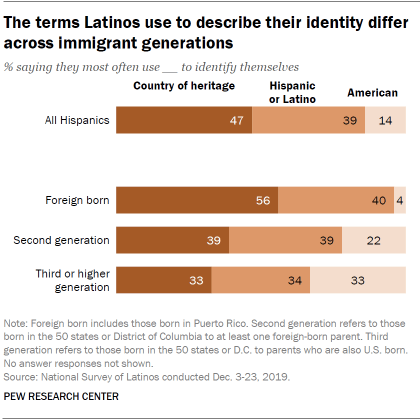
The terms Hispanics in the United States use to describe themselves can provide a direct look at how they view their identity and how the strength of immigrant ties influences the ways they see themselves. About half of Hispanic adults say they most often describe themselves by their family’s country of origin or heritage, using terms such as Mexican, Cuban, Puerto Rican or Salvadoran, while another 39% most often describe themselves as “Hispanic” or “Latino,” the pan-ethnic terms used most often to describe this group in the U.S.
Meanwhile, 14% say they most often call themselves American, according to a national Pew Research Center survey of Hispanic adults conducted in December 2019.
The use of these terms varies across immigrant generations and reflects their diverse experiences. More than half (56%) of foreign-born Latinos most often use the name of their origin country to describe themselves, a share that falls to 39% among the U.S.-born adult children of immigrant parents (i.e., the second generation) and 33% among third- or higher-generation Latinos.
How we did this
Meanwhile, the share who say they most often use the term “American” to describe themselves rises from 4% among immigrant Latinos to 22% among the second generation and 33% among third- or higher-generation Latinos. (Only 3% of Hispanic adults use the recent gender-neutral pan-ethnic term Latinx to describe themselves. In general, the more traditional terms Hispanic or Latino are preferred to Latinx to refer to the ethnic group.)
The U.S. Hispanic population reached 60.6 million in 2019. About one-third (36%) of Hispanics are immigrants, according to a Pew Research Center analysis of U.S. Census Bureau data. Another third of Hispanics are second generation (34%) – they are U.S. born with at least one immigrant parent. The remaining 30% of Hispanics belong to the third or higher generations, that is, they are U.S. born to U.S.-born parents.
The December 2019 survey also finds U.S. Hispanics are divided on how much of a common identity they share with other Americans, though views vary widely by immigrant generation. About half (53%) consider themselves to be a typical American, while 44% say they are very different from a typical American. By contrast, only 37% of immigrant Hispanics consider themselves a typical American. This share rises to 67% among second-generation Hispanics and to 79% among third-or-higher-generation Hispanics – views that partially reflect their birth in the U.S. and their experiences as lifelong residents of this country.
Speaking Spanish seen as a key part of Hispanic identity
What it means to be Hispanic can vary across the group. Hispanics most often say speaking Spanish is an essential part of what being Hispanic means to them, with 45% saying so. Other top elements considered to be part of Hispanic identity include having both parents of Hispanic ancestry (32%) and socializing with other Hispanics (29%). Meanwhile, about a quarter say having a Spanish last name (26%) or participating in or attending Hispanic cultural celebrations (24%) are an essential part of Hispanic identity. Lower shares say being Catholic (16%) is an essential part of Hispanic identity. (A declining share of U.S. Hispanic adults say they are Catholic.) Just 9% say wearing attire that represents their Hispanic origin is essential to Hispanic identity.
The importance of most of these elements to Hispanic identity decreases across generations. For example, 54% of foreign-born Hispanics say speaking Spanish is an essential part of what being Hispanic means to them, compared with 44% of second-generation Hispanics and 20% of third- or higher-generation Hispanics.
Most Latinos feel at least somewhat connected to a broader Hispanic community in the U.S.
For U.S. Latinos, the question of identity is complex due to the group’s diverse cultural traditions and countries of origin. Asked to choose between two statements, Latinos say their group has many different cultures rather than one common culture by more than three-to-one (77% vs. 21%). There are virtually no differences on this question by immigrant generation among Latinos.
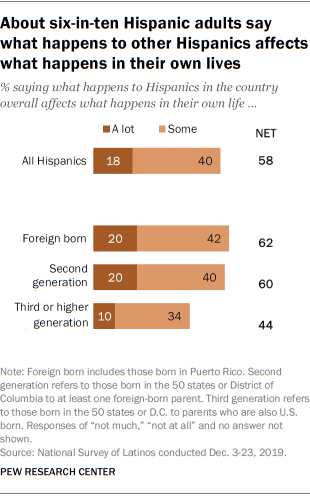
Few Hispanics report a strong sense of connectedness with other Hispanics, with only 18% saying what happens to other Hispanics in the U.S. impacts them a lot and another 40% saying it impacts them some. Immigrant Hispanics (62%) are as likely as those in the second generation (60%) to express a sense of linked fate with other Hispanics. This share decreases to 44% among the third or higher generation.
The Pew Research Center’s national survey of Latinos queried more than 3,000 respondents about the term Latinx, and I spoke with their director of global migration and demography research, Mark Hugo Lopez, about their findings. Our conversation has been condensed and edited for clarity.
In Pew’s latest survey of Latinx adults living in the United States, you found that only three percent self-identify as Latinx. What’s being used instead?
What we found is that “Hispanic” is preferred by far. Then, Latino, and finally, as you noted, a very small share say that they prefer Latinx. But there’s another important finding in the report, which is about awareness of the term. Latinx is a relatively new umbrella term on the scene. It’s been around for about 20 years, but it’s only recently — in the last five or six years— really begun to be used widely in the news media, in pop culture and by corporations. Universities have been using it for a while, but only about a quarter of people in this population say they’ve actually heard the term. So the term is relatively unknown to the population it’s meant to describe.
You say it’s been around for 20 years. That’s longer than I thought. Where did it originate?
There’s actually been Google searches all the way back to 2004, the beginning of Google Trends’ search data. However, in the ’90s, there were a lot of changes at universities. For example – Chicano studies programs were renamed Chicana/o studies, to better represent the experiences of both men and women, to be gender inclusive.
As people were searching for a way to be inclusive, Latinx emerged sometime in the late’ 90s. That’s the earliest reference that I found as we were doing this study. But it did start to rise in use, especially after the Pulse nightclub shooting. Latinx is a term that is gender inclusive and inclusive of LGBT adults. That’s where you started to see it in headlines and in news coverage. And that may have led to more Google searches. There have been other events, like when Elizabeth Warren used it. But we saw the highest level of searches in June of 2020, more than we’ve ever seen relative to the past, so we’re actually at a high point right now. But just because there are more Google searches, that doesn’t mean that’s the term people want to use to describe themselves.
So, who are the 3% your survey says self-identify as Latinx?
It is young people, people ages 18 to 29 who are most likely to be aware of the term. Forty-two percent of them, for example, say that they’ve heard the term Latinx. Interestingly, only seven percent of that group actually use the term to describe themselves. Another group that uses it more than others are college-educated people. U.S.-born English speakers are also more likely to use it.
And interestingly, the one group that uses it the most is young Hispanic women ages 18 to 29. About 14 percent of Hispanic women say that they use the term to describe themselves. That’s almost one in seven people, and that’s one of the highest shares of use that we see among the data that we collected.
We’ve done stories on the Code Switch podcast about the birth of the pan-ethnic label to refer to people in the U.S. who trace their roots to Latin America. And we know how hard-won those labels were, whether it’s Hispanic or Latino. But, based on your research, people would still rather identify based on country of origin, not based on these broad umbrella terms.
That’s right. We found over the years, over 15 years of surveys, that when it comes to the labels that people want to use to describe themselves, more often than not, they prefer their country of origin. That’s true particularly of immigrants, but it’s also true even of U.S.-born Hispanics or Latinos who are the children of U.S.-born parents. Into the third generation, oftentimes the most common term used references the country of origin, like Mexican, Dominican, Cuban or Puerto Rican. And that’s something that’s been pretty strong over the years.
In your research over the last two decades, specifically on this issue, do you feel like the adoption of pan-ethnic labels is becoming more popular?
That’s a really great question, because there are a number of demographic trends underway that are impacting the way in which this population that we’re talking about sees itself. About a quarter of all newlyweds who are Latino have a spouse who’s non-Latino. And that’s been true for about 30 years. But, an inflow of new immigrants during the 1980s, ’90s and into the 2000s softened the impact of that of intermarriage in terms of identity. But now it’s US births that are the biggest source of growth of the Latino population.
What does this mean in terms of self-identification? You’ll find that, for example, among immigrants, nearly 90% will say they’re Hispanic. Among U.S.-born children of immigrant parents of this heritage, you’ll also find about 90%will self-identify as Hispanic. But by the third generation that falls to about 75%. And then by the fourth generation, only half of them self-identify as Hispanic.
So what happens to the identity and self-identifying with this group over the course of several decades with high rates of intermarriage and without a new inflow of immigrants? What would that mean for this population in terms of how they identify?
What pan-ethnic label do you use? I heard you say Hispanic and Latino a lot.
The Pew Research Center uses them interchangeably in our reports, as does the U.S. Census Bureau. For me personally, it varies depending on where I’m at, because it does matter who asks. For example, I might say I’m Hispanic in a certain part of the country. I’m here in Southern California right now, here I tend to use Chicano, because my dad had been in the Chicano movement in the ’60s and ’70s locally, and so it was important to identify as such. And when I travel abroad, for example, I might actually say that I’m American because most people in Europe, for example, may not be aware of the distinctions between Hispanic, Latino, etc. And if I am in other parts of the country, I might use Latino. It depends how I feel that day. I think that’s really important here, what people use can change depending on the circumstances, who’s asking and how and where they are.




 Multicultural Meanderings