Good calling out of the hypocrisy of the anti-woke when it comes to their betrayal of liberal beliefs in the age of authoritarian Trump and his policies:
…While Quillette’s liberal editorial mission has never really changed, executing it became more complicated during the COVID pandemic—especially once vaccinesbecame available. When heated and pressurised under lockdown, the same sort of free-thinking scepticism that fuels heterodox political thought, it turns out, can readily blur into conspiracism and junk science. A prominent example is Bret Weinstein, the one-time Quillette academic darling who began telling Americans that COVID vaccines had, according to one “credible estimate,” caused “something like 17 million deaths globally.” (In fact, the figure represents a passable ballpark estimate of the number of lives that such vaccines have saved.)
Even in ultra-progressive Canada, where this sort of conspiracism is less common, I’ve seen a number of prominent anti-wokesters go down similar rabbit holes. And though it’s been years since the pandemic ended, not all of them have found their way back to the surface.
Following a recent speech I gave to a free-thinking Toronto crowd, the organiser felt moved to explain to attendees that it was important to hear “diverse views.” This was a diplomatic reference to my (poorly received) observation that many self-described heterodox intellectuals who cheer on my opposition to trans-activist pseudoscience will also insist (falsely) that COVID vaccines don’t work and (also falsely) that anthropogenic global warming is a myth. Science isn’t a buffet where you get to pick and choose what proven truths to accept, I told them. Few in the crowd looked convinced.
Another major schism within our liberal movement has centred on Donald Trump and conservative populism more generally. Trump’s second presidency, in particular, has accelerated the ongoing process by which critics of progressive illiberalism have been self-organising into two separate camps—(1) one that continues to oppose illiberalism of all flavours (that’s us), and (2) another that’s just fine with authoritarian political creeds, so long as the authoritarians come from the conservative side of the aisle.
If the goal is to get rid of DEI and throw men off women’s college sports teams, members of this latter Trump-friendly faction reason, why bother with the hard intellectual slog of staging “heterodox” academic conferences and writing long essays about Martin Luther King Jr., Areopagitica, and the nature of human sexual biology? Just elect a strongman who tells university presidents and athletic directors what to do, on pain of losing their government cash. Problem solved.
…While the University of Austin is just one institution, it serves as a bellwether of the whole anti-woke project more generally—having been conceived as a sort of model liberal project by some of the leading lights of this movement. Its board of trustees includes historian Niall Ferguson and journalist Bari Weiss, while the board of advisors boasts Eric Kaufmann, economists Glenn Loury and Tyler Cowen, and famed evolutionary biologist Richard Dawkins. Harvard professor Steven Pinker was also an early advisor; as was social scientist Jonathan Haidt (a founder of the staunchly liberal-minded Heterodox Academy)—though both have since departed. Every one of these people has been featured by Quillette at one time or another, either as author or podcast guest. It says a lot about the stormy seas that liberals now face that even a once-impeccably liberal organisation such as this can begin listing to starboard just four years out of the shipyard.
I find these developments not just politically disturbing, but also personally disappointing. Not so long ago, I imagined that the coalition of plucky liberal gadflies that began countering illiberal progressivism at around the time I began working for Quillette could be sustained indefinitely—and perhaps even solidify into a durable movement that would become my long-term political home. (I’ve never had one, and it would be nice if I finally did.) But that’s now been exposed as an exercise in wishful thinking.
O’Sullivan’s Law and Quillette’s Law (I promise that’s the last time I’ll use the phrase) both describe ideologically centrifugal forces—driving people away, in opposite directions, from the liberal democratic baseline that I’d always taken for granted as the natural resting point for mainstream intellectual life. Battling against illiberalism from both sides at the same time can feel like a lonely and hopeless intellectual project. But absent the emergence of some third law that will deliver me from my labours, I see no principled alternative.
Valid question regarding lack of investigation and follow-up. Wouldn’t go as far as Kay calling it a “sacred myth”:
….No one has any idea what underground banalities gave rise to those 215 soil dislocations, because the Tk’emlúps te Secwépemc First Nation, as the Indigenous community in question is officially known, has refused to show anyone all of the data; and has now gone silent on the issue, after having pocketed more than $12-million CAD from the federal government, about $8-million of which was supposed to have been directed toward researching those supposed graves. The few reporters who’ve dared ask for more evidence have been denounced by activists as ghouls, and instructed that such inquiries represent a new form of colonial trauma.
The registered on-reserve population of the Tk’emlúps te Secwépemc First Nation comprises just 543 people. So the federal outlay works out to about $22,000 per person—enough to employ literally the entire community for many months to investigate graves that supposedly lie in precisely identified locations just a few feet from the earth’s surface.
But after four years, not a single grave has been found in Kamloops. It’s impossible to disprove the idea that one or more graves might be found at some point in the future. But the idea that there are 215 of them, much less that they contain murdered children, has become a grim farce.
Yet it is a very strange kind of farce, insofar as almost no public figure in Canada has had the courage to candidly revisit the apocalyptic pronouncements made during the initial unmarked-graves social panic of 2021.
During that period, the idea of these 215 little Indigenous martyrs being killed off by the priests and nuns who ran the Kamloops Indian Residential School became a sacred myth. And no one in the Canadian political and media establishment has any idea how to stand down from this myth now that it’s been debunked. Most members of polite society have simply stopped talking about it, apparently in hopes that the issue will fade into obscurity with the passage of time….
Does appear to be a waste of time compared to more practical training with respect to indigenous health and needs of Indigenous patients:
Last month, I received a tip from a nursing student at University of Alberta who’d been required to take a course called Indigenous Health in Canada. It’s a “worthwhile subject,” my correspondent (correctly) noted, “but it won’t surprise you to learn [that the course consists of] four months of self-flagellation led by a white woman. One of our assignments, worth 30 percent, is a land acknowledgement, and instructions include to ‘commit to concrete actions to disrupt settler colonialism’… This feels like a religious ritual to me.”
Canadian universities are now full of courses like this—which are supposed to teach students about Indigenous issues, but instead consist of little more than ideologically programmed call-and-response sessions. As I wrote on social media, this University of Alberta course offers a particularly appalling specimen of the genre, especially in regard to the instructor’s use of repetitive academic jargon, and the explicit blurring of boundaries between legitimate academic instruction and cultish struggle session.
Students are instructed, for instance, to “commit to concrete actions that disrupt the perpetuation of settler colonialism and articulate pathways that embrace decolonial futures,” and are asked to probe their consciences for actions that “perpetuate settler colonial futurity.” In the land-acknowledgement exercise, students pledge to engage in the act of “reclaiming history” through “nurturing…relationships within the living realities of Indigenous sovereignties.”
My source had no idea what any of this nonsense meant. It seems unlikely the professor knew either. And University of Alberta is not an outlier: For years now, whole legions of Canadian university students across the country have been required to robotically mumble similarly fatuous platitudes as a condition of graduation. It’s effectively become Canada’s national liturgy….
Suspect that one of the first things the public service will need to cut is DEI training given Conservative MP views, considerable commentary on excesses as per the example below, and virtually cost-free politically, with some minor cost savings. The last sentence is particularly graphic:
…It is, then, exquisite timing that, at the same time Transport Canada is moving toward the announcement of high-speed rail, its senior leadership at the deputy minister level is staging a farce around mandated sessions on Indigenous reconciliation, as chronicled on the social media site X.com by journalist Jonathan Kay and confirmed by a contact who works in the department.
To cut a long story short, the planned sessions on reconciliation didn’t go according to plan when some of the public servants began challenging the outside speaker’s materials. Now there is sustained effort at a senior level to ensure the orthodoxy is respected/enforced, with the threat of punishment for those who challenged said orthodoxy. The beatings at TC will clearly continue until morale improves.
Which brings it back to focus. There is already a day when the public service has time off to reflect/learn about this worthy subject matter. Why not offer the programming then and let people get on with their actual jobs? Especially when the message from the taxpayer is to do exactly that.
Two contrasting views on the right, starting with Kay:
…If legislators at work are to be governed by a rule that forbids political symbols, then that category should be defined narrowly — which means permitting any symbol, such as a keffiyeh, whose use doesn’t necessarily convey a political meaning. In a liberal society, it is much more important to guard against false positives than false negatives when defining classes of banned expression. And Jama’s antics shouldn’t be seized upon as an excuse to err in an illiberal direction.
One reason I’m wary of any kind of keffiyeh ban is that we’re just coming out of a period of progressive social panic in Canada, during which even the mildest articulation of conservative viewpoints, or display of traditional Canadian symbols, was denounced as a “dog whistle” for white supremacy or some such. (To take one particularly ludicrous example: Recall that in 2022, an “anti-racist” group got a six-figure grant from Justin Trudeau’s government so it could author a report denouncing the Red Ensign flag — Canada’s national symbol until about 60 years ago — as a coded endorsement of white supremacism.) We’re all sick of this type of phobic mindset being displayed on the left, and I’m wary of conservatives copying the worst habits of their enemies now that the cultural tide is starting to turn.
One of those bad habits is catastrophizing. When I first mentioned on social media that I thought Jama should get her way on the keffiyeh issue, I got a chorus of pushback to the effect that she was channelling antisemitism — because what else except Jew-hatred would motivate anyone to take up the keffiyeh in the shadow of 10/7? To allow her to continue dressing in this way, the claim goes, is to make Jews across Ontario feel unsafe.
But I doubt that Jama is any kind of true bigot (even if the stridency of her anti-Israeli statements raises the possibility). What seems more likely is that she’s one of those serial activists whose focus will flit from cause to cause over the years, based on what’s in the news and what brings out the cameras. Once Gaza cools down and other conflicts take centre stage, who knows? We may see Sarah Jama in a turban, or a Ukrainian vyshyvanka, or perhaps even some kind of fez.
Whatever adornments Jama chooses, the best course is to simply ignore them, and leave it to Hamilton Centre voters to assess her wardrobe choices in the next election.
…The legislature holds a unique place in our polity and should aspire to more. While it should serve as the forum for political disagreement and debate, it should not itself be seen as partisan. And it should elevate our public discourse, instead of becoming yet another force that reduces nuanced topics to signs, pins, stickers, and placards.
Opposing the keffiyeh for its alleged bad meaning naturally draws out the battle over that meaning, and invites another battle over the freedom of expression. It also invites future fights about the meaning of every other symbol that MPPs will hereinafter try to bring into the legislature. Is the Ukraine pin a good or bad symbol? The Black Lives Matter badge? What about the MAGA hat? Open this door just a little and we will be mired in a thousand battles about a thousand causes, logos, and signs.
The solution, then, is not to engage in a futile line-drawing exercise which will leave many stakeholders unhappy much of the time. Instead, it is to maintain the existing nearly blanket ban on political symbols. (I say “nearly blanket” because symbols like the Remembrance Day poppy are now permitted at Queen’s Park. But even that required a special exemption.) The ban avoids the problem altogether, allowing our core deliberative body to remain a place for reason above passion.
We will likely never agree on the precise meaning of the keffiyeh (though we should at least strive to be honest in its interpretation; something the “it’s just a cultural symbol” crowd is not doing.)
But we should agree that some corners of our society should be reserved for deliberation and debate instead of cheap appeals to emotion and tribalism. What better place for that than Queen’s Park?
Of note, an egregious example of DEI training run amok and a cautionary tale regarding engaging American DEI consultants:
In late April, 2021, a Diversity, Equity, and Inclusion (DEI) trainer named Kike Ojo-Thompson presented a lecture to senior Toronto public-school administrators, instructing them on the virulent racism that (Ojo-Thompson believes) afflicts Canadian society. Canada, she said, is a bastion of “white supremacy and colonialism,” in which the horrors unleashed by capitalism and sexism regularly lay waste to the lives of non-white and female Canadians.
Anyone who lives in Canada knows this to be a preposterous claim. But in the wake of the George Floyd protests, which opportunistic DEI entrepreneurs in Canada treated as a gold rush, such lies have been treated as unfalsifiable. The same is true of the (equally preposterous) claim that Canada’s experience with anti-black racism directly mirrors that of the United States. And so it was expected that Ojo-Thompson’s audience would simply nod politely and keep their mouths shut until her jeremiad had concluded.
But one audience member refused to submit: Richard Bilkszto, a long-time principal at the Toronto District School Board who’d also once taught at an inner-city school in upstate New York. Having worked on both sides of the Canada-U.S. border, he told Ojo-Thompson that her generalizations about the two countries seemed misguided; and that denouncing Canada in such a vicious manner would do “an incredible disservice to our learners.”
Bilkszto’s descriptions of Ojo-Thompson’s presentation (a recording of which was verified by at least one Canadian journalist) suggest that she is indeed quite ignorant of both American and Canadian history. Her claim that Canada’s monarchist tradition marks it as more racist than the United States is particularly absurd, given that the British outlawed slavery decades before both Canada’s creation and the U.S. Civil War.
National Post columnist Jamie Sarkonak describes what happened after Bilkszto began speaking up:
“Ojo-Thompson is described to have reacted with vitriol: ‘We are here to talk about anti-Black racism, but you in your whiteness think that you can tell me what’s really going on for Black people?’ Bilkszto replied that racism is very real, and that there’s plenty of room for improvement—but that the facts still show Canada is a fairer place. Another KOJO training facilitator [KOJO Institute is the name of Ojo-Thompson’s company] jumped in, telling Bilkszto that ‘if you want to be an apologist for the U.S. or Canada, this is really not the forum for that.’ Ojo-Thompson concluded the exchange by telling the class that ‘your job in this work as white people is to believe’—not to question—claims of racism.”
This is not a unique story. I have reported for Quillette on other instances in which audience members have been smacked down for raising their voices when confronted with this kind of diatribe. It is part of the pattern of hypocrisy that surrounds the DEI industry more generally: While these consciousness-raising sessions are typically conducted on the conceit of teaching participants to be “brave” and ”disruptive,” the well-paid corporate trainers who lead them often demand a climate of craven subservience.
Ojo-Thompson didn’t confine herself to rebuking Bilkszto in that moment. She also allegedly attacked Bilkszto in a subsequent lecture as exemplifying the forces of white supremacist “resistance.” In Ojo-Thompson’s view, her original treatment of Bilkszto had presented everyone with a valuable template for how they should respond when “accosted by white supremacy.”
For his part, Bilkszto responded by suing the Toronto District School Board (TDSB) for harassment. He also sought a TDSB investigation of Ojo-Thompson’s actions, which the school board refused to conduct. But Ontario’s Workplace Safety and Insurance Board (WSIB) took the incident more seriously, determining that Bilkszto was owed seven weeks of lost pay due to the mental stress he’d endured.
The WSIB judgment, later obtained by the National Post, concluded that Ojo-Thompson’s behaviour “was abusive, egregious and vexatious, and rises to the level of workplace harassment and bullying,” and that she’d intended to “cause reputational damage and to ‘make an example’” of Bilkszto.
I spoke with Bilkszto several times over the last two years, and he would often email me stories about other Canadians who’d been targeted as heretics. He took a leading role in a group of Toronto educators looking to address the problem of ideological extremism, and brought me in once as a guest speaker in late 2021.
Although Bilkszto and I never met (this was still the COVID era, when almost every meet-up was done over Zoom), we quickly bonded over our shared principles, both of us being traditional urban liberals who’d become concerned by the social-justice fanaticism that now suffused the TDSB.
Yet nothing in my own experience allowed me to fully comprehend the pain that Bilkszto was experiencing. A political progressive who’d devoted more than two decades of his life to the TDSB, Bilkszto never fully recovered from being falsely smeared as a supporter of white supremacy in front of his peers.
This month, Bilkszto, aged 60, committed suicide. I don’t know if he left a note. But according to his family, his suicide related to the false accusations of racism he’d endured in April 2021.
Bilkszto was particularly devastated by the fact that some of his TDSB bosses, whom he’d naively expected to defend him (or at least have the courtesy to say nothing at all), eagerly piled on with the public shaming meted out by their external DEI consultant.
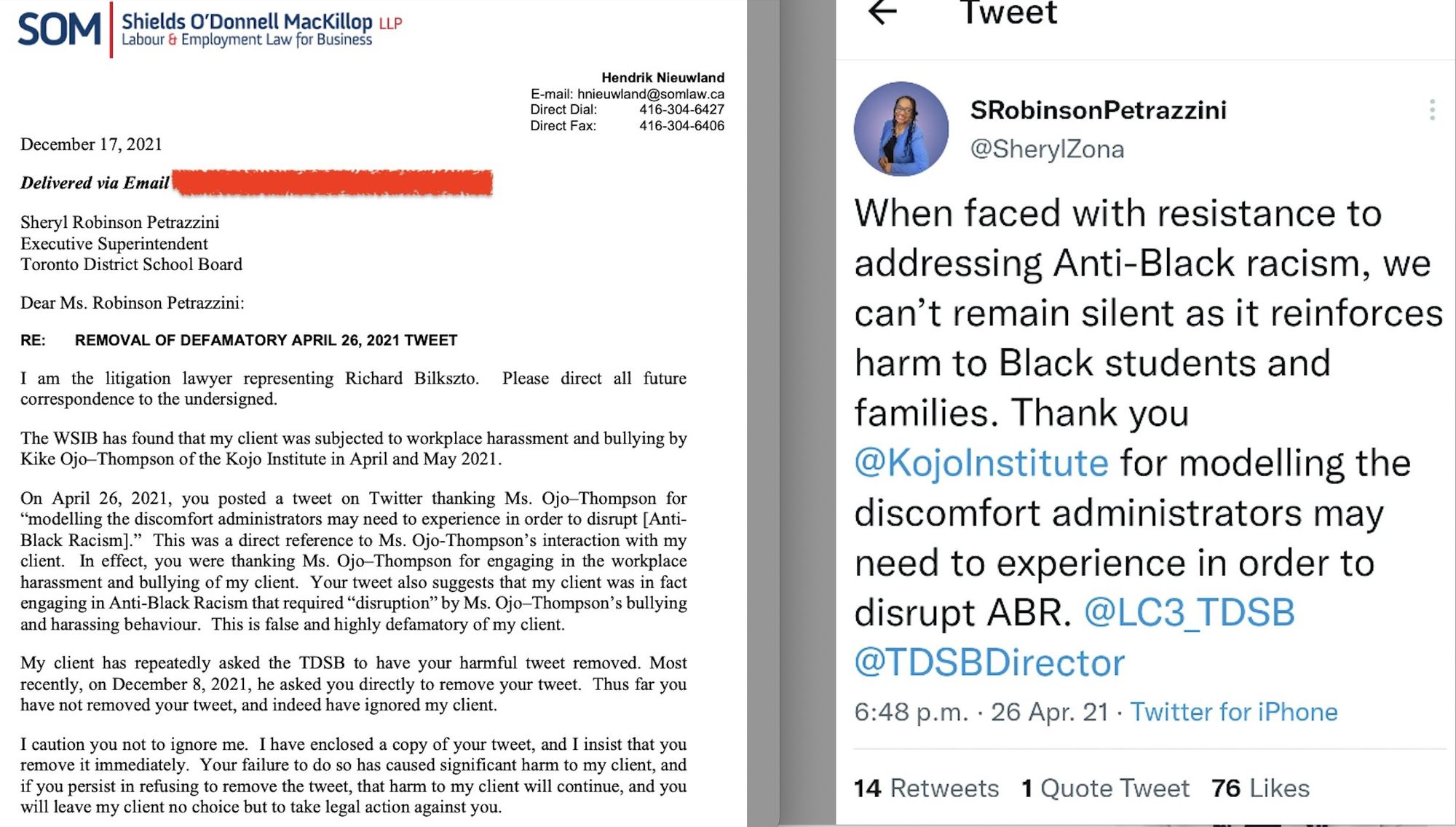
On Twitter, Sheryl Robinson Petrazzini, then the TDSB’s Executive Superintendent, thanked Ojo-Thompson and her KOJO colleague for “modelling the discomfort [that] administrators”—i.e., Bilkszto—“may need to experience in order to disrupt ABR [anti-Black racism].”
For good measure, Robinson Petrazzini also suggested that Bilkszto (whom she did not name, but was the obvious subject of her Tweet) was allied with the forces of “resistance” to anti-racism, and so was abetting “harm to Black students and families.”
Bilkszto personally asked Robinson Petrazzini to delete the Tweet. She did so only eight months later, and only after receiving a letter from Bilkszto’s lawyer warning her that she’d be sued unless she did so.
According to Bilkszto, his other bosses also refused to support him, instead attacking him for his “male white privilege.” And yet, once Bilkszto filed a lawsuit against the TDSB, seeking $785,000 damages for the emotional and reputational harm he’d endured, those same administrators now began claiming that it was Ojo-Thompson who’d gone rogue.
While they’d been perfectly happy to throw Bilkszto under the bus when the stakes were confined to emotional “discomfort,” the TDSB suddenly decided to sue Ojo-Thompson for negligence and breach of contract, demanding that she effectively indemnify the school board for any payout that might become due to Bilkszto. (The TDSB later claimed that it planned to discontinue this suit. But Sakornak reported that it was still a going concern as of June 6.)
I live in Toronto, where my own children have all passed through TDSB schools. Their experience has been a positive one, and I’m happy with the education they’ve received, notwithstanding the sometimes excessive pedagogical focus on race and genderwang. In fact, I have come to sympathize with the teachers—most of them smart hard-working people who find themselves being pressured by their own unions and administrators to adopt militant social-justice postures in their classrooms.
In some school boards, moreover, professional advancement is limited to those who explicitly embrace “anti-racist, high anti-oppressive” leadership principles. So while social-justice puritans comprise a small minority at most schools, they are able to exert disproportionate power in their bid to censure, humiliate, or even oust colleagues, such as Bilkszto, who speak up for the silent majority. In some cases, these ideological enforcers work closely with local race activists and their media allies, so as to harass or censor educators and parents accused of wrongthink.
While the work of anti-racism careerists such as Ojo-Thompson and TDSB Director of Education Colleen Russell-Rawlins is often justified as a righteous crusade against the forces of privilege, it would be difficult to find a more privileged clique of professionals in the field of Canadian public education.
Prior to getting her $300K-per-year TDSB gig, for instance, Russell-Rawlins served as the anti-racism czar at the (even more dysfunctional) neighboring Peel District School Board. Since coming to the TDSB, she’s presided over a series of embarrassing scandals, including an aborted student census that was discovered to be full of overt social-justice propaganda, a revamping of specialty schooling that was found to have been based on a plagiarized research report, and the cancellation of a speaking event by a Nobel-winning ISIS survivor on the grounds that it might be seen as Islamophobic. She’s blithely sailed through all of this without suffering any career repercussions.
The same is true of Robinson Petrazzini, the former $200K/year TDSB superintendent who went on Twitter to spike the football when Bilkszto was humiliated by Ojo-Thompson. Shortly after Bilkszto lawyered up, Robinson Petrazzini became Director of Education at the neighbouring Hamilton-Wentworth District School Board.
As for Ojo-Thompson, she continues to be feted by numerous Canadian organizations and media outlets. In 2022, she served on the board of directors of Parents of Black Children, a Toronto-area lobby group that’s made a name for itself largely by urging school boards to implement the same anti-racism instructional modules that constitute Ojo-Thompson’s own stock-in-trade. (Her partner Rohan served until recently as Workplace Equity Manager with the Peel District School Board, and the two would appear together on stage to talk about “the Impact of Systemic Racism on K-12 Workplace Well-Being.”) The market for the sort of militant anti-racist diatribes that Ojo-Thompson peddles seems inexhaustible within Canada’s corner offices, and I seriously doubt whether even the negative attention resulting from Bilkszto’s death will dent her income.
And in any case, she’s been through this before—for this was not the first time that Ojo-Thompson has encountered “resistance”: A 2021 diversity training session that she delivered to councilors of Sarnia, a small Ontario city on the shores of Lake Huron, reportedly sparked a revolt among some audience members, causing Ojo-Thompson to quit that gig in a huff.
“The undisputed, uncorrected, and unabated hostility demonstrated by some members of Council toward our Principal Consultant Kike Ojo-Thompson was wholly inappropriate,” declaimed the KOJO Institute’s director of client services, Craig Peters. “There were things that were said in that meeting—that we won’t divulge—that led us to believe that it wasn’t in the organization’s best interest to continue.”
When contacted by The Sarnia Journal, Ojo-Thompson added that the comments she’d heard had made her feel unsafe.
“Safety isn’t always physical,” said Ojo-Thompson. “There is emotional and mental harm that can be done.”
No doubt, Richard Bilkszto (1963-2023) would agree.
An interesting account of police training, the social work side of policing, and an equally important discussion of the rush to apply a simple race lens rather than a more comprehensive look at the evidence and issues involved.
While it is necessary and legitimate to question police practices, both systemic and particular, and while any death related to policing is a human tragedy, one should neither assume that all incidents involving the police are racist or that none of them are:
A few years ago, when I did ride-alongs with Toronto-area police officers, I saw how much of their job involves dealing with mental-health and addiction issues. Most of the incidents these officers responded to were rooted in a troubled household, and the protagonists typically were well-known to the arriving officers: an autistic adult son whose outbursts overwhelmed aging parents, a wife fearful of an alcoholic husband, an agitated elderly man who’d become convinced his neighbours were spying on him through his devices. Most of these incidents required therapists as much as (or more than) police officers. But since the threat of violence hovered over all of them, at least in theory, it was the police who got the call. As I wrote at the time, the officers mostly played the role of social workers with a badge.
The stereotype of police as violent, poorly trained hotheads is sometimes borne out on YouTube, which now functions as a highlight reel for every bad apple wearing a uniform. But the reality—at least in Canada, where I live—is that new officers are typically post-secondary graduates who spend a lot of their time in training sessions. In 2016, I sat in on one such session at a police headquarters facility west of Toronto, where officers attend seminars conducted by experts from within the community, and then go through elaborate small-group role-playing scenarios led by a trained corps of actors who specialize in mimicking various crisis states. As I reported in a magazine article, the facility features a mock-up house with different rooms, so officers can perform their exercises in realistic domestic environments. When each role-playing scenario was completed, the officers were critiqued and interviewed in front of the entire group. Then the actor herself would give her impressions about how the officers’ behaviour made her feel.
I thought about all this following the real-life case of Regis Korchinski-Paquet, the 29-year-old black woman who fell to her death from a Toronto apartment balcony in May while seeking to evade police officers. During one role-playing session I observed four years ago, an actor seeking to evade officers under similar circumstances ran into a bathroom and locked the door. For five minutes, the officers awkwardly tried to coax her out, meeting with eventual success. In the analysis segment that followed, the supervising officer explained that it once was common practice for officers in such situations to simply bash open the door. But this kind of technique fell out of fashion years ago, since it led to unnecessary trauma and risk (for the officers as much as the bathroom occupant).
Some of the other acted exercises I observed included a paranoid schizophrenic crouching under a kitchen table, babbling fearfully as officers tried to soothe him, and a homeless woman who threatened to hurt herself with a knife if officers approached. While holding them at bay from her perch on a living-room sofa, the actress recited a backstory: She had nothing to live for because child services had taken away her kid, her only reason for hope. When she finally put away the knife, the officers walked forward to escort her away—at which point the supervisor ended the exercise and admonished them: “Yes, she put away that knife,” he said. “But how do you know that’s the only weapon she’s got? When you focus on the object, you forget about the person.”
There was also a memorable exercise involving a male actor who was threatening to jump from a window—which presents another grim point of analogy to the Korchinski-Paquet case. It is a mark of this man’s acting skill that, years after I watched his morbid star turn, I still remember the details of his narrative: He was a musician, suffering from depression, who was stuck pursuing a dead-end part-time position with a local orchestra.
Critically, he wasn’t the only actor who was part of this particular exercise. An older woman played the role of his mother, who was screaming non-stop as the officers arrived. Two pairs of officers did the exercise in succession, and their approaches were very different. The first pair—two men who’d recently joined the force—both approached the man and took turns imploring him to step down from the window. But they could barely make themselves heard over the screaming of the actor playing the mother role. Then came the second pair of officers, middle-aged women who’d apparently worked together on the beat. One of the women spoke to the man, while the other officer gently guided the mother off into another room. This was correct practice, the instructor said: You can’t make any progress if you’re just going to become bystanders to an ongoing drama. In many cases, you need to separate the family members before you can help them.
It’s the same principle I saw (and wrote about) when I observed two veteran officers show up at the (very real) home of a young couple who’d been fighting. The man, plainly troubled in all sorts of ways, had punched a hole in the wall, and the woman was frightened. One of the first things that happened upon our arrival was that the female officer—Constable Jaime Peach, who still serves on the Peel Police—took the man downstairs and interviewed him in the lobby. The other officer, Winston Fullinfaw (who was promoted to Staff Sergeant around the time I rode with him), interviewed the woman and learned about her complicated family situation. Had there been more adults in the household, it’s possible that more officers would have been dispatched: When it comes to complicated domestic disputes, sometimes there is no substitute for manpower. A beleaguered lone officer sometimes may become more prone to violence, since he is more likely to lose control of a situation and feel threatened.
This is something we should think about amid claims that society would be more peaceful if we simply got rid of the police, or starved it of funding. We should also think about how such police forces would respond to funding cuts. Training programs would be one of the first things to face the chopping block. Would that make anyone safer?
On May 27, the last day of Korchinski-Paquet’s life, a half-dozen Toronto Police Service officers and an EMS worker responded to a call from her family members, who’d told a 911 operator that there was a fight in their 24th-storey apartment. Because Ontario’s independent Special Investigations Unit (SIU) now has released its report on Korchinski-Paquet’s death, based on camera footage and numerous interviews, we know what happened next. As the Toronto Sun accurately reportedback in early June, Korchinski-Paquet asked to take a bathroom break before accompanying the officers downtown for mental-health treatment. She then barricaded a door, went onto her balcony, and slipped while trying to step onto another balcony, falling 24 floors to her death. Initial reports from family—which suggested that officers had murdered the woman by deliberately pushing her off the balcony—were completely false.
To state the obvious, the death of Korchinski-Paquet is a tragedy. And it would have compounded the tragedy to learn that her death was a racist act of homicide. One might therefore imagine that it would provide Torontonians with at least some meager solace to learn that their police force had acquitted itself without fault, and in a way that reflected the progressive, non-violent methods that are taught in training programs. But in the aftermath of the death of George Floyd and the riots that followed, it has become a common claim among progressive media and politicians that Canada is every bit as racist as the United States. And in the absence of actual recent Canadian scenes of horror on par with the killing of Floyd, the case of Korchinski-Paquet has been cited as a substitute.
The Toronto Star, which never misses a chance to hustle racism claims to its readers, has run features with titles such as “Regis Korchinski-Paquet’s death and anti-Black violence in policing,” informing us “how systemic racism and anti-Black violence continues to play a huge role in Canada.” In a Star op-ed published in early June, opinion writer Noa Mendelsohn Aviv explicitly rejected the proposition that “in order to comment on Regis’s death, we must wait for the result of the Special Investigation Unit’s investigation because we do not yet have the facts and need to ascertain the truth.” (Even when the SIU report came out, the Star could not bear to abandon its anti-police posture, and so now is impugning the credibility of the SIU.) A Maclean’s writer described Korchinski-Paquet’s death as evidence that “Black lives” are “expendable.” The SIU investigation shows nothing of the kind, even if I doubt we will see any retractions.
Perhaps the most appalling response—because it comes from someone who purports to be seeking the job of Canadian prime minister—was from Jagmeet Singh, leader of Canada’s progressive New Democratic Party (NDP). On August 26, after the SIU released its report, Singh blithely claimed that Regis Korchinski-Paquet “died because of police intervention. She needed help and her life was taken instead. The SIU’s decision brings no justice to the family and it won’t prevent this from happening again.” Singh offered no theory as to why the SIU report was wrong, but simply delivered a flat-out blood libel against the officers who’d tried to help Korchinski-Paquet on May 27 (and who are likely traumatized by what happened, as any normal person would be). To repeat: This isn’t some college activist or aggrieved family member. It is the leader of a national Canadian political party who holds the balance of power in Canada’s minority Parliament.
Singh is in some ways a special case, because his NDP, having strayed so far from the unionized blue-collar base on which it was founded, now has been reduced to little more than a social-media outpost catering to college hashtaggers. For weeks, in 2017, he spouted conspiracist nonsense about the 1985 bombing of Air India Flight 182, the worst terrorist attack in Canadian history. More recently, he casually denounced the Royal Canadian Mounted Police as a gang of bigots, and then was ejected from Parliament when he accused a fellow Parliamentarian of being racist because he didn’t go along with Singh’s slur. But though comprising an extreme example, Singh is hardly alone. Indeed, the presumption that all police are, by their nature, contaminated by racist malignancy, has become a casually recited starting point in debates about crime and policing.
In regard to the actual goal of reforming police methods—which is the thing that Singh and everyone else pretends to care about—it’s worth taking stock of the damage wrought by this irresponsible approach. About one Torontonian dies every year during encounters with police, this in a city of three-million people. That’s about one tenth the average annual tally for Minneapolis, a city that is one seventh the size of Toronto. One might think that a 70-fold difference in per-capita police-involved deaths might be seen as statistically significant, and be reasonably attributed to the massive investments in training and professionalism that I have personally witnessed in Canadian constabularies. If best practices in Toronto spread to American cities, lives truly could be saved. But instead, progressives such as Singh are far more interested in polluting Twitter with lazy lies and protest applause lines that erase any distinction between policing methods.
Information about the death of Korchinski-Paquet may be found on the web site of Ontario’s SIU. And if there are lessons to be gleaned about how to better respond to potentially violent family crises, our leaders should implement them. But so far, police critics seem far more interested in exploiting this poor woman’s death to advance their own ideological bona fides and defame innocent police officers than with preventing future tragedies.
Some of the more interesting commentary on both sides of the issue (I favour the critics on this one):
Starting with Jon Kay:
…….Discussing the number of people killed in a genocide has an inherently dehumanizing effect on individual victims. But numbers matter, since the term “genocide” becomes completely meaningless if is used as a catch-all to describe all forms of homicide that afflict disadvantaged groups. The government of Canada recognizes five genocides—corresponding to Armenia, Rwanda, Ukraine, Bosnia and the Nazi Holocaust. The average fatality count for these genocides was about three million. The total number of Canadian MMIWG killed over the last half century is about one thousandth that number.
A finding of genocide does not require the discovery of concentration camps and gas chambers: As with the Armenian and Ukrainian genocides, one may infer genocidal intent based on policies that inflicted deadly conditions on men, women and children by intentionally destroying their property and livelihoods, or casting them out into the wilderness to die by exposure, starvation or pogroms. This is in fact how many real historical genocides against Indigenous peoples were perpetrated. But that has no relevance to the manner by which MMIWG are dying in 2019—which is not by pogrom or rampaging militia, but by the same ordinarily horrible way that most homicide victims meet their end: domestic violence and street crime. Nor is there statistical evidence to suggest that Canadian constabularies as a whole don’t take these crimes seriously—though there are individual cases in which police have acted disgracefully. “In 2014, a higher proportion of homicides of Aboriginal victims were solved by police compared with non-Aboriginal victims (85 percent versus 71 percent),” the government reportedin 2015.
The homicide rate for Aboriginal females in Canada, measured in 2014, was 4.82 per 100,000 population. This is about 30 percent less than the homicide rate for the entire U.S. population (6.2). So the statistical implication of this week’s report from the National Inquiry into Missing and Murdered Indigenous Women and Girls (to cite the body’s full name) is that the entire United States exists in a daily state of permanent genocide.
Of course, one could attempt to prove the existence of such an ongoing U.S. genocide by claiming—truthfully—that the higher rates of black homicide are connected to the American legacy of slavery and other genocidal practices. But if this sort of historical analysis is invoked as a means to justify the use of the term genocide, then literally every killing known to humankind can be swallowed up by the word, since no human being exists in isolation from the past. And that is just one of the many bizarre corollaries that emerge from this inaccurate use of language: Since about 70 percent of MMIWG are killed by Indigenous men, the effect of this week’s declaration is to present Canada’s Indigenous peoples as genocidaires of themselves.
Despite this, many Canadians seem anxious to embrace the report, as it affirms the simple narrative that the challenges faced by Canada’s Indigenous peoples are largely the result of white racism, and so can be solved if Canadians simply awaken to their own collective bigotry. Indeed, the problem of MMIWG has been studied comprehensively on previous occasions, and so it was never completely clear what this new inquiry would supply Canada, except a sort of quasi-evangelical call to arms against the forces of racism. Given this, the inquiry commissioners no doubt felt enormous pressure to deliver a dramatic new re-formulation of the moral stakes at play in the MMIWG crisis, which perhaps explains their decision to supply a grandiose new label to stick on front pages.
In the long run, the effect of this will be not only to erode the moral force of the term genocide, but also to hurt indigenous people by encouraging the terrifying and condescending conceit that their status in Canada is akin to that of Tutsis in 1994 Rwanda or Jews in 1939 Germany. The MMIWG inquiry set out 231 recommendations, which deserve to be taken seriously. Unfortunately, the whole $92-million exercise now is coloured by the rhetorical overreach surrounding the final report.
All societies lie to themselves about genocide. But the nature of the lies change over time. In Tacitus’ channeling of Calgacus, the Romans would “make a solitude and call it peace.” In Canada, we now do something closer to the opposite—summoning into being a spirit of genocide that hasn’t existed since those shameful days of universal plunder.
Neil Macdonald, on the other hand, avoids the issue:
Buller, with her serene smile, was explicit at the ceremony: “The significant, persistent and deliberate pattern of systemic racial and gendered human and indigenous rights violations and abuses perpetuated historically and maintained today by the Canadian state … is the cause of the disappearances, murders, and violence experienced by Indigenous women … and this is genocide.”
I’m not going to argue with that, as some foolish people like former Conservative minister Bernard Valcourt have already loudly done. Quibbling over the definition of genocide does nothing but help obscure the long history of vicious racism and undeniable suffering of Indigenous people in this country. It’s bad enough whatever you want to call it.
Tanya Talaga makes the case in favour, but one that I find less convincing than the arguments against:
Almost four years to the day after the Truth and Reconciliation Commission said Canada committed a cultural genocide against Indigenous people, the national inquiry into our murdered and missing Indigenous women and girls took it a step further.
They said the death of our women, by the thousands, was simply a genocide.
The echo is not coincidental.
The genocidal process was the same.
In the words of the four-person commission, the epidemic of deaths and disappearances is the direct result of a “persistent and deliberate pattern of systemic racial and gendered … rights violations and abuses, perpetuated historically and maintained today by the Canadian state, designed to displace Indigenous people from their lands, social structures and governments, and to eradicate their existence as nations, communities, families and individuals.”
As expected, the protests quickly emerged. This is no “genocide,” the critics said. The coast-to-coast-to-coast commission, which interviewed over 2,000 families, survivors and knowledge keepers, exaggerated or got it wrong. Former aboriginal affairs minister Bernard Valcourt, who served under Stephen Harper, started off the bashing with a bang:
“What has been the cost to Canadians for this propagandist report?” he tweeted.
For his part, Prime Minister Justin Trudeau refused to say the word “genocide” as he addressed the assembled families, survivors and commissioners.
But those of us who have been on the wrong side of the “persistent and deliberate pattern” know that “genocide” is the right word.
As the ceremony began, it was Chief Commissioner Marion Buller who said the hard truth is that “we live in a country whose laws and institutions perpetuate violations of fundamental rights, amounting to a genocide.”
Buller, the first appointed First Nations female judge in British Columbia, took a lot of heat when the inquiry began. Members of her team were quitting, families weren’t being properly notified or compensated. Many said her mandate was overly narrow. Yet she weathered it all and fulfilled her highest purpose. She gave voice to the victims.
The inescapable conclusion of all their harrowing and beautiful testimony is that “genocide” is the only word for the state-enabled deaths of thousands of sisters, aunties, grandmothers, cousins and friends.
So why won’t our prime minister say it? What’s he afraid of?
Perhaps he understands that calling the genocide a genocide would acknowledge that his government — and others — are morally culpable for the losses of the thousands of our women, girls and 2SLGBTQQIA people. Or maybe it was the legal culpability that worried him; lawyers no doubt advised Trudeau not to say it. The pollsters, too, were probably against it, as we edge towards an election. It isn’t as easy to take a principled stand when votes are potentially at stake.
Whatever his reasons, his omission was telling. But it hardly dampened the power of the day.
“We don’t need to hear the word genocide come out of the prime minister’s mouth because families have told us their truth,” Buller said during the press conference.
The families of the taken, not forgotten women, agree. They don’t need to hear arguments over what constitutes genocide. They know it to be true because they live it.
As the ceremony drew to a close on Monday, Thunder Bay’s Maddy Murray stopped me and asked me to remember Alinda Lahteenmaki, who died in Winnipeg on Jan. 30, 2009 after plunging 11 storeys. She was 23 years old and her boyfriend pleaded guilty to manslaughter.
“There is no closure,” she said to me as the drums began to beat the warrior song.
But there can be an end to the violence.
The murders and rapes, the violence against Indigenous women and girls will continue until Canada confronts the genocide and the long-promised new relationship is finally delivered.
This requires that Canada confront the historical disadvantages, intergenerational trauma, and discrimination experienced by Indigenous people, the report explained. And that begins with making significant strides toward substantive equality through changes to our justice system, to policing, to social and health services, to education, to everything Canada prides itself on and holds dear.
To many, these institutions are a symbol of what makes Canada great. But the report makes clear that they are far from perfect. That they are rigged against Canada’s first peoples. That they are tools of colonial violence, of genocide.
That is the conclusion of Buller and her team of commissioners.
It is disappointing that many of our politicians refuse to say the word. It would be far worse — a terrible tragedy — if they continued to be complicit in the act.
As opposition leader in the lead-up to the last federal election, Justin Trudeau did not waste a single day to commit to implement the 94 recommendations of the truth and reconciliation commission.
He made the promise mere hours after the commission reported on the damage inflicted on Canada’s Indigenous peoples by the residential school system and the way forward.
Almost four years into the Liberals’ current term, Trudeau’s government is still struggling to honour that pledge.
The prime minister refrained from embracing its 200-plus recommendations, sticking instead to a more general promise to not let the report gather dust.
Most notably, Trudeau steered clear of endorsing the group’s core finding that a planned genocide was the root cause of the violence endured by past and present generations of Indigenous women.
It remains to be seen whether the provocative conclusion that tops the inquiry’s prescriptions will eventually resurface in an official government of Canada statement or in Trudeau’s promised action plan.
Equating the violence Indigenous women have and, in many cases, continue to endure with the interracial mass killings that saw thousands massacred by their compatriots in Rwanda in the late nineties will not come easily to many Canadians or their elected officials.
Indeed, one of the first to reject the equation on Monday was none other than Roméo Dallaire, the Canadian general who led a UN force of peacekeepers in Rwanda at the time of that genocide and who continues to suffer mental anguish from having been powerless to prevent it.
The risk here is that the argument over the use of the term “genocide” steals the show from the reforms the report advocates.
No one — least of all the Indigenous women whose future the inquiry is determined to help make brighter — will be advanced by a fight over what to call an undeniably dismal legacy of discrimination.
As the distinct society debate demonstrated at the time of the Canada/Quebec constitutional wars, words often take on a life of their own, to the detriment of the reconciliation they are meant to advance.
The commission sets ambitious goals and the authors of the report insist their prescriptions are a package deal that has to be accepted as a whole by all levels of governments.
In so doing, they may be programming their report to fail.
One only needs to look at the federation’s difficulty in coming to a common federal-provincial approach to climate change and carbon pricing to know that even with the strongest political will no federal government has it in its power to force the provinces to sing from its hymn book.
The combination of an all-or-nothing approach to the report’s implementation combined with the implication that anyone not on board with its findings is somewhat complicit in a genocide was likely designed to induce a greater sense of public urgency. But it could achieve the opposite.
In the ongoing debate over climate change, increasingly dire predictions about the impact of global warming have as often as not overwhelmed large segments of the target audience. Many simply tuned out.
Every prime minister since Brian Mulroney has either had an Indigenous-related inquiry in progress or had a multi-year commission report on his watch.
It has been 26 years since the Erasmus-Dussault commission handed the federal government of the day a 20-year plan to reset the relationship between Canada and its Indigenous peoples.
That report was the fruit of five year’s work. It was 4,000 pages long and it listed 440 recommendations. Most of them have not been implemented.
In 2015, the truth and reconciliation report — at more than 2,500 pages over six volumes — produced 94 recommendations. (That comparatively modest number is somewhat misleading as more than a few had multiple subsets.) Their implementation is, at best, still a work in progress.
On Monday, the national inquiry recycled many of its predecessors’ recommendations. It expanded the scope of previous prescriptions that have yet to be even partly followed up on.
The 2015 truth and reconciliation report described the residential schools as a feature of a “cultural genocide” and issued “calls for action.”
The national inquiry’s report concludes that the violence against Indigenous women and girls is part of a planned genocide and issues “calls for justice.”
When it comes to achieving reconciliation with the country’s Indigenous peoples, Monday’s report like the others before it makes it clear that Canada still has miles and miles to go.
But when it comes to the federal government tasking commissions of inquiry with drafting road maps, this report should probably mark the end of the road.
….The MMIWG probe was launched by Prime Minster Justin Trudeau’s Liberal government as part of its commitment to implement the recommendations of the Truth and Reconciliation Commission. It was a reasonable gesture of reconciliation, charged with symbolism, in the face of truly appalling statistics of violence against Indigenous women. The RCMP has said they made up 16 per cent of all female homicides between 1980 and 2012, despite comprising just 4 per cent of the population.
Victimization rates are not only triple those of non-Indigenous women, they are double those of Indigenous males.
While Indigenous identity does not explain the high victimization rate among native men — analysts suggest the increased presence of other risk factors such as homelessness, drug use or poor mental health are more responsible — Indigenous women are the country’s most vulnerable citizens simply by virtue of being Indigenous and female.
As Trudeau said, this is “not a relic of our past.”
No parent could read Bernice C.’s testimony and not be moved — certainly not this parent.
But the report’s release seems set to stoke division rather than engender good will.
It could have offered a focused blueprint on how to improve the safety of Indigenous women; instead the inquiry commissioners have produced a sprawling report that demands transformational change in all corners of Canadian society.
Despite Trudeau’s assurances that the document will not end up gathering dust, it appears destined to join the growing bibliotheca of mothballed Indigenous reports.
For that, the commissioners have themselves to blame.
They were asked to investigate violence against Indigenous women and to recommend concrete actions to increase their safety.
They chose to make the broadest possible interpretation of that mandate, rather than limit it to the specific issue of murdered and missing women.
The report spends comparatively little time looking at household victimization and spousal violence rates
Their conclusion is that the disproportionate rate of violence against Indigenous women is a direct consequence of hundreds of years of colonialism and discrimination that constitutes a “genocide.”
If it is a genocide, it is not one recognized by retired Lt.-General Romeo Dallaire — and he should know, having seen the real thing up close while commanding the UN mission in Rwanda in 1994. He said Monday that for him, genocide is the deliberate act of killing people of a certain ethnicity.
But the commissioners chose instead to use the interpretation of Polish-Jewish scholar Raphael Lemkin, who deemed that genocide is a co-ordinated plan to destroy the foundations of a national group with the aim of annihilating the group.
Systemic racism, sexism and colonialism has produced “institutional violence,” perpetuated by institutions such as the military, the church, the educational system, the health system, the police, emergency responders and the justice system, the report asserted.
The commissioners called on everyday Canadians to help “decolonization” by becoming strong allies. But even right-thinking people who are appalled by the victimization statistics are likely to recoil at the charge they are complicit in genocide. Canada has added three million new citizens in the past decade. Are newly-arrived Canadians going to feel remorse for a colonial past for which they bear no responsibility? To ask the question is to answer it.
While focusing on “institutional violence,” the report spends comparatively little time looking at household victimization and spousal violence rates that are significantly higher than those for non-Indigenous Canadians.
The inquiry’s time would have been better spent detailing the report’s principle recommendation — the creation of a national action plan to address violence against Indigenous women. It calls for equitable access to employment, housing, education, safety and health care but offers few specifics.
In his sober response Monday, Trudeau said his government will develop a national plan to augment its efforts on housing, boil water advisories, education and indigenous languages.
He called the report’s release “an essential day in the history of this country” — but, noticeably, he made no mention of genocide.
Many of the report’s “calls for justice” from government are sensible; others are unworkable.
In the former category, the production of an annual report of ongoing action; the creation of an Indigenous rights ombudsman; the delivery of violence prevention programs; and improved access to major crime units in the north appear to be good ideas.
Among the less pragmatic recommendations are the suggestion to re-open the Constitution to bring it into conformity with the U.N. Declaration on the Rights of Indigenous People; and, the creation of a guaranteed annual liveable income.
Some are borderline satirical — such as the recommendation calling for the promotion of Indigenous women to leadership positions (this government has tried that, with unfortunate consequence).
Others are set to get a frosty reception from the Liberals — for example, the suggestion that in murder cases where there is a pattern of intimate partner violence and abuse, a harsher sentence is awarded. Crown-Indigenous Relations minister Carolyn Bennett has already said she has heard a negative response to the idea because it removes the discretion of judges in similar fashion to mandatory minimum sentencing guidelines.
Most of the recommendations can be debated by reasonable people as part of a public policy discussion.
What is regrettable is the uncompromising claim by chief commissioner Marion Buller that all Canadians, except the country’s Indigenous inhabitants, are party to a “deliberate, race, identity and gender-based genocide.”
The final report offered the chance for closure and for families to put their pain behind them. The world is full of weeping but it does not go backward.
Yet, rather than a new dawn, where Indigenous and non-Indigenous Canadians could come together to condemn an unacceptable past and commit to build a better future, the opportunity has been eclipsed. Instead, we have the indictment that the bulk of the citizenry is engaged in annihilating its Indigenous minority.
Il est temps, peut-on lire dans une explication juridique publiée en marge de l’Enquête nationale sur les femmes et les filles autochtones disparues et assassinées, « de regarder la réalité en face : les politiques, actions et inactions coloniales passées et actuelles du Canada à l’égard des peuples autochtones constituent un génocide, lequel, conformément au droit liant le Canada, exige l’imputabilité ». L’Enquête affirme que « les structures et les politiques coloniales persistent aujourd’hui au Canada et qu’elles constituent l’une des causes profondes de la violence ».
Pour certains critiques, cette vision plus large des causes du drame qui touche les femmes décentre la portée du rapport qui leur est consacré en le propulsant dans un procès qui concerne toute l’histoire coloniale du pays. De fait, l’usage même du terme « génocide » est remis en cause.
Mais de l’avis même du rapport, l’Enquête nationale « ne prétend pas démontrer pleinement tous les éléments de la politique génocidaire », faute d’avoir entendu « l’ensemble de la preuve ». Mais elle penche néanmoins de ce côté, au point de ne pas se refuser un usage abondant du terme, tout en répétant que « la détermination formelle de la responsabilité pour génocide doit être déterminée par des organes judiciaires ».
Un abus de langage ?
Est-ce donc un abus de langage ou encore le fait d’une inflation verbale que d’user ainsi du terme « génocide » ?
Oui, dit l’ancien militaire Roméo Dallaire. À l’occasion d’un colloque organisé lundi par l’Institut d’études sur le génocide et les droits humains à l’Université Concordia, l’ancien commandant de la Mission des Nations unies au Rwanda a dénoncé cet usage du mot génocide. À son sens, la condition des femmes autochtones ne tient pas à l’effet d’un génocide, puisqu’il n’y a pas eu de volonté formelle de détruire un groupe humain au nom de leur caractère ethnique. L’ancien militaire n’en dénonce pas moins la condition faite aux Autochtones au Canada.
Sa définition, fondée sur une idée de la destruction physique d’un peuple, est partagée par l’historienne Deborah Lipstadt, professeure en études juives à l’Université Emory. Sans vouloir se prononcer sur la condition historique des Autochtones du Canada, mais tout en étant au fait de leur réalité, l’historienne affirme au Devoirqu’« il doit y avoir une volonté de destruction intentionnelle, une volonté d’éradiquer » pour parler de génocide. « Il faut consulter les documents, écouter les peuples concernés, analyser les décisions gouvernementales ». Le génocide, dit-elle, conduit à une destruction physique ou, à tout le moins, à une tentative de destruction.
Pour l’historien Pierre Anctil de l’Université d’Ottawa, spécialiste de l’histoire juive, l’usage du mot « génocide » en ce cas est étonnant. « Un crime contre un peuple est annoncé et planifié ». Il ne saurait être « le fait d’une série de gestes individuels, qui ne sont pas coordonnés. Je ne pense pas que ça corresponde aux sévices subis par les femmes autochtones. Je ne crois pas que ce soit concerté. Mais c’est par ailleurs une tendance de parler de génocide culturel. Dans ce cas, on rend difficile, voire impossible, la perpétuation d’une culture. Ce peut être une autre forme de génocide ».
Les mésusages
Dans Génocides, usages et mésusages d’un concept(CNRS éditions), un livre qui vient de paraître, l’historien des idées Bernard Bruneteau met en garde contre l’utilisation du terme dans une spirale inflationniste. Cette escalade rhétorique s’inscrit désormais « dans le registre émotionnel et le désir de souffrir par comparaison ».
Il existe des cas de génocides, selon la définition de 1948 des Nations unies, qui sont consacrés par l’alignement de la mémoire du groupe victime, de l’histoire scientifique de l’événement et du droit : le génocide des juifs européens (1941?1945), des Tutsis du Rwanda (1994), des musulmans bosniaques de Srebrenica (juillet 1995), des Khmers rouges à l’encontre des minorités Chams et vietnamiennes (1975?1979). Il existe aussi d’autres cas « en attente de pleine reconnaissance et à ce titre parfois contestés ou relativisés », dit l’historien Bruneteau. Par exemple, l’Arménie (1915?1916), l’Ukraine (1932?1933) ou le Cambodge (1975?1979).
Mais on trouve aussi désormais des cas où « le droit et l’histoire sont en retrait d’une mémoire sociale souvent militante qui entend sensibiliser le monde à la réalité d’un préjudice passé ». Des demandes de reconnaissance pourront sur cette base se multiplier, dit-il, par une extension de l’idée de génocide, « notamment chez les descendants des peuples indigènes victimes de la destruction de leur environnement (aborigènes d’Australie, Maya Achis du Guatemala, Yanomanis d’Amazonie, Achés du Paraguay…), chez les porte-parole autoproclamés des minorités ethniques opprimées aux quatre coins de la planète et chez les descendants de tous les groupes se percevant comme victimes de l’histoire ». En d’autres termes se profile un divorce entre la définition juridique du génocide et la réalité qu’elle est censée résumer, affirme Bernard Bruneteau.
Valid comments, applicable in many spheres, of the need for nuance and greater understanding:
An all-or-nothing process that can mete out exactly one kind of punishment — a lifetime of disgrace, or nothing at all — provides us with a thrilling kind of moral theatre, in which pure villains such as Harvey Weinstein get their due. But in cases where the facts are less damning, this black-and-white, permanent-ink approach doesn’t reflect the way most ordinary men and women judge — and eventually forgive — one another.
Things could be starting to change, however. In response to allegations that actor Aziz Ansari pressured a date to have an unpleasant sexual encounter, Bari Weiss of The New York Times wrote this week: “I am a proud feminist, (but if) you are hanging out naked with a man, it’s safe to assume he is going to try to have sex with you … Aziz Ansari sounds like he was aggressive and selfish and obnoxious that night … And isn’t it enraging that women are socialized to be docile and accommodating and to put men’s desires before their own? Yes. Yes. Yes. But the solution to these problems does not begin with women torching men for failing to understand their ‘nonverbal cues.’ It is for women to be more verbal.”
One advantage of this approach — of looking for shades of grey, and not casting every moment of sexual friction in the language of moral absolutism — is that it may ultimately induce men to take more responsibility for their actions, not less: When any admission of “selfish and obnoxious” behaviour is seen as tantamount to a rape confession, if punishment is seen as an all-or-nothing affair, there is little motivation for a man to publicly come to terms with his behaviour.
Megan Ganz, a sitcom writer who was mistreated last year by an older boss after she rebuffed his come-ons, took a novel approach on social media. Writing on Twitter two weeks ago, she used open-ended language to coax an admission from her former boss — Dan Harmon — that he’d treated her “like garbage,” and that “I was an awful boss and a selfish baby.”
I have no special insight into Harmon’s thinking. But the tone of their Twitter exchange, and a subsequent podcast by Harmon, suggests that he was responding to Ganz’s decision not to threaten her former tormentor with repercussions, or seek to rally antagonists with hash-tags.
“I think of Dan as a work in progress,” Ganz toldThe New York Times. “That’s how I think of myself, too. It’s dangerous to think of yourself as a hero and someone else as a villain. It gets in the way of empathy. We should be tearing down walls, not putting them up. Women are not different creatures from men. They don’t need to be extra careful around us. They just need to treat us with the same basic respect and dignity that they show to other men.”
Not all women can be expected to adopt this sort of generous attitude. When men are violent, or engage in full-blown criminal assault, no one should encourage them to turn the other cheek. Sometimes, scorched earth is the only way to go.
But for Ganz, the project of reforming male attitudes comes leavened with a sense of understanding and mercy — the same spirit that, I hope, will inform readers of my friend’s forthcoming book about prison life. As morally urgent as the #MeToo project may feel, it’s important to remember that most of us aren’t pure martyrs or pure monsters, but something in between.
Jon Kay argues for more centrist voices, correctly noting the excessive space given to extremists on both sides:
Among writers and editors on the left, the problem of centrist reticence arises from the (entirely defensible) idea that the most morally urgent problem in our society is racism. According to the most doctrinaire view, the role of a white writer or editor is to either uncritically boost the voices of blacks and Indigenous people, or simply shut up and get out of the way. One may still witness sparks of intellectual vibrancy among Jewish, Muslim and immigrant writers – who are unburdened by any ancestral or creedal linkage to residential schools. But Canada’s WASP firmament now exists as a sad wasteland of white guilt. And most of its aging giants, including the Rosedale socialites who once proudly paraded around in Victorian garb on Macdonald’s birthday, are grabbing wildly at the ankles of whatever anti-racist cause happens to be trending strongest on their Facebook feed.
This agonizing over the original sin of white racism also allows sentimental social justice proponents to make excuses for even the most extreme forms of Antifa violence – on the theory that criticizing the savage beating of a right-wing protestor by a left-wing mob would somehow play to the advantage of neo-Nazis.
There are signs, however, that thoughtful people are beginning to find their voice.
It was interesting to observe, for instance, that the ETFO motion received a cold response from government leaders – including Justin Trudeau, who declared that Macdonald’s name would not be removed from any building or program under federal control. Ontario premier Kathleen Wynne said the same thing about her province’s schools (although, true to form, she drenched her statement in much politically-correct bafflegab). Saskatchewan Premier Brad Wall asked, in not entirely un-Trumpian tones, “Is it not a short walk between the calls to remove the name of our first prime minister from schools, to the closing of the Lincoln memorial in Washington D.C.?”
These politicians are accountable to the silent majority – including those who don’t have Twitter accounts – which helps explain their position. Yet even the liberal Toronto Star has critiqued the ETFO proposal, publishing at least three articles rejecting the de-Macdonaldification of public institutions. At the very least, I’m just glad that the Star and other outlets seem prepared to discuss the subject rationally – something that would have been impossible last spring, at the high-water mark of Canada 150 social panic.
If things do indeed turn around in Canada, much of the thanks will be owed to Indigenous intellectuals, who (unlike me) have the moral authority to set the terms of debate – just as it is moderate Republicans in the United States who have the sole power to reign in the Make American Great Again extremists who’ve hijacked the GOP. No less an expert than Sen. Murray Sinclair, chair of the Indian Residential Schools Truth and Reconciliation Commission, sensibly declared that tearing down statues of Canadian historical figures would be “counterproductive” to reconciliation efforts. And journalist Robert Jago urged groups such as the EFTO to spend more time on the real problems faced by Indigenous communities, and less on virtue-signalling their progressive attitudes on “flavour-of-the-month” causes.
We need more voices like this. Ashamed of right-wing xenophobia, and intimidated by leftist dogmas, too many Canadians have ceded the marketplace of ideas to the fringes. To speak common sense in this age requires courage, but it is the only way to return intellectual life to sound moorings.


 Multicultural Meanderings