CRTC CBC License Renewal: “equity-seeking communities” requirements

Of interest and thanks to Sarkonak for noticing this change and The Line for bringing it to wider attention.,

Significant change from softer encouragement to hard targets, one that suggests the government may adapt a similar approach to employment equity in the public service and possibly federally-regulated sectors (e.g., bank, communications and transport), even if the original policy based on self-declaration and annual reporting has resulted in a much more diverse public service.

I also think their caution that such overt political goals run the risk of undermining the perceived independence of the CRTC and the CBC, one that a future government may use for its own political priorities:

We at The Line have a confession: we don’t slavishly follow every item coming and going out of the CRTC — although it is becoming increasingly clear that we ought to. So we admit that we missed, in June, the decision that came from this regulatory body that renewed CBC’s broadcasting license for another five years. 

Because, frankly, this is usually pretty rubber stamp stuff. 

So credit where it is due, we must tip the hat to Jamie Sarkonak for noticing some pretty significant changes in this renewal notice. 

Jamie Sarkonak @sarkonakjThe CRTC @CRTCeng just imposed DEI requirements onto CBC programming. CBC must dedicate 30% of its independent programming budget to the following identity categories: Indigenous, language minorities, visible minorities, disabled, and LGBTQ. #cdnpoli crtc.gc.ca/eng/archive/20…

Image

We read through the renewal notice ourselves and, yeah, she is correct. The CBC has a vague public mandate to inform and entertain Canadians for the purpose of creating a kind of shared national identity. Implicit in this mandate is the notion that the public broadcaster ought to broadly reflect and represent the Canadians who pay its bills. To that end, although previously the CBC could certainly choose to devote resources to “Canada’s equity-seeking communities” (and it certainly has!) never before to our knowledge has it been required to devote specific expenditure requirements to those communities as part of its license renewal. 

From the ruling: 

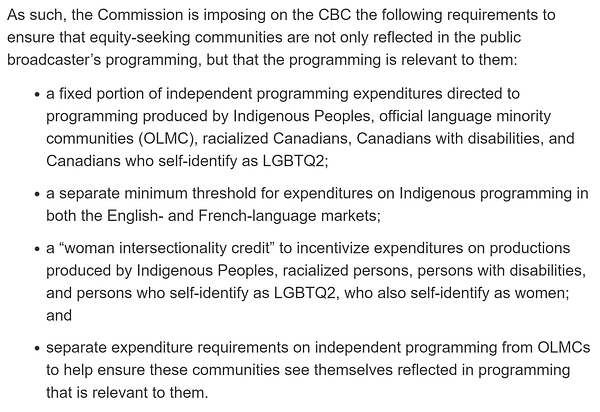
“As such, the Commission is imposing on the CBC the following requirements to ensure that equity-seeking communities are not only reflected in the public broadcaster’s programming, but that the programming is relevant to them.”

The CRTC is demanding a “fixed portion of independent programming expenditures directed to official language minority communities (OLMC), racialized Canadians, Canadians with disabilities, and Canadians who self-identify as LGBTQ2.” Additionally, it will grant a: “‘woman intersectionality credit’ to incentivize expenditures on productions produced by Indigenous Peoples, racialized persons, persons with disabilities, and persons who self-identify as LGBTQ2, who also self-identify as women.”

There are additional requirements for French language programming, of course. 

This line also caught our attention from the notice: 

“The Commission supports the Government of Canada’s commitment to renewing the relationship with Indigenous Peoples, based on the recognition of rights, respect, co-operation and partnership. On a broader level, the Commission also recognizes that Call to Action 84 of the Truth and Reconciliation Commission and the United Nations Declaration on the Rights of Indigenous Peoples (UNDRIP) tie into some of the objectives of the Broadcasting Act in that they refer to the reflection of Indigenous Peoples in the programming broadcast by the CBC.” 

The CRTC is demanding changes to the election of the CBC ombudsman to ensure he or she is “sensitive to issues surrounding Indigenous people, racialized Canadians and other equity-seeking communities.” 

It is also setting out “new expectations regarding the CBC’s Journalistic Standards and Practices to help ensure that journalists can provide relevant feedback and equity-seeking communities are consulted in any future review of the JSP.” 

(The JSP is basically the bible of CBC journalism and guides its employees in how it approaches reporting, analysis and opinion. The JSP has come under particular scrutiny in recent years when it was alleged that the expectation of “objective” journalism would distort how the outlet approaches racism. Attentive readers will note the obvious allusion to “moral clarity” here.)

Whether or not you agree with the outcomes being sought, what is clear is that the CRTC (which is appointed by the governor general, on advice of the privy council) is having explicitly political goals written into its license renewals. 

Now, don’t misread us, here. The CBC ought to be free to pursue equity goals in programming, or reviews of its JSP, or whatever it feels necessary to meet its mandate according to its own discretion. We happen think these outcomes are best exercised by trusted leaders and experienced producers who have the latitude to use editorial discretion, rather than by rigid quota or expenditure goals. 

To have these demands placed on it by an external regulator in order to fulfil the political goals of that regulator and, ultimately, its political masters, is playing with fire in the worst kind of way. 

For starters, one of the first pieces we ran here at The Line was from a documentary filmmaker who noted the ways in which diversity quotas shifted incentives in filmmaking. Just as students write to the test, quotas of this sort shift the focus in content production, forcing creators to produce content that checks a box, rather than fulfil a real audience desire. This creates a CBC that is dooming itself to be less relevant to the general public even as its relevance is growing more crucial thanks to the economic collapse of private media. The system is all the more insulting considering there is, in fact, a real audience desire for different voices and perspectives in our media landscape. 

(The Line can think of two such examples of CBC shows that were compelling and worth watching regardless of their diversity requirements: check out Sort Of and Trickster if you haven’t already. Unfortunately, the latter was cancelled when it was revealed that director Michelle Latimer was not as Indigenous as previously stated.) 

The second most obvious problem with all of this falls under the maxim “Do not give your enemies the weapons they will use to kill you.” In other words, having established this norm, do you not think that Prime Minister Pierre Poilievre, having done his damndest to stack the CRTC, will not do the same thing in turn? What is the CBC going to do when its license renewal is subject not to fulfilling the requirements of UNDRIP, but rather to concepts like “viewpoint diversity” and “journalistic objectivity,” as defined by Poilievre’s crew? The pendulum always swings back, friends, and it usually swings back harder when pushed. 

Source: The Line Dispatch 13 August

Jamie Sarkonak: Some are more equal than others, according to Canada’s immigration ministry

One of the early mainstream media commentaries on IRCC’s anti-racism strategy (see my earlier post (IRCC Anti-Racism Strategy 2.0: “Energy, Conviction and Courage” [too preachy for my taste]).
While I did not read it the same way as Sarkonak, reflecting my perspectives, reading this reminded me of my experience when working under the Conservative government and Jason Kenney when I was confronted with a very different worldview (shameless plug for Policy Arrogance or Innocent Bias: Resetting Citizenship and Multiculturalism).And while many of the specific provisions in the strategy are fairly standard anti-discrimination and anti-racism tools to help identify biases and discrimination, understandable that the framing of them would attract attention as being overly “woke” given the frame of CRT and the “wheel of privilege and power.”

In terms of some of Sarkonak’s specific solutions to IRCC, some are stronger than others. It makes sense to publish approval rates by country of citizenship as differences in approval rates may, but not necessarily, indicate biases. Similarly, monitoring of staff for arbitrary decision-making makes sense pending the development of more AI and other tools that can provide consistent decision making (as Kahneman and others argue in Noise). On the other hand, simply bolstering staff to address backlogs avoids the necessary policy and administrative changes needed to reduce future backlogs.

Sarkonak criticizes tying EX bonuses to DEI and anti-racism and ensuring targeted career development programs for minority staff but these types of policies have been in place for some time in one form or another (I remember in the early 1990s that Global Affairs identified women with potential to address the gender gap with considerable success).

But perhaps one statement in the strategy is the one that would provoke a possible future Conservative government the most, the policies are intended to survive “regardless of changes in government” as it smacks of bureaucratic arrogance rather than a more neutral phrase of something like “establishing the basis for further inclusion:”

In a corporate plan for an anti-racist “systems change,” Canada’s immigration ministry says it isn’t fair to treat people equally regardless of background. Instead, people should be treated according to their level of innate privilege.

In other words, Immigration, Refugees and Citizenship Canada (IRCC) has embraced critical race theory — or diversity, equity and inclusion (DEI), as it’s called in practice — with a plan called Anti-Racism Strategy 2.0. It openly signals a shift to the ideological left.Unfortunately, concerns about racism within IRCC aren’t unfounded. An external review reported dozens of openly racist comments in the workplace. Perhaps the worst allegation was that those within IRCC often refer to African countries as “the dirty 30” — an embarrassing display of prejudice for a department welcoming new citizens into a country that’s supposed to respect the right to equality.

It’s therefore no surprise that the question of racism comes up when rejection rates for applications vary by country. With few explanations from officials, advocates understandably come up with their own: systemic racism. This was the case when study permit applications from Nigeria were found to be disproportionately rejected by IRCC. Elsewhere, critics have correctly pointed out that Canada committed to taking an unlimited number of refugees from Ukraine, while capping Afghan applicants at 40,000.

The solution should be to bolster staff so that applications can be processed in a reasonable time (the immigration backlog is an astronomical 2.7 million) and to enforce workplace rules against instances of racism in the office.The department can also publish approval rates by country of origin, as it does with approval rates for foreign student study permits. If applications from certain countries are being disproportionately rejected, explanations should be offered as to why.

There isn’t a duty to accept an equally proportionate number of immigrants from each country in the world, and it’s quite possible that acceptance rates are lower for some countries simply because more applicants from there aren’t meeting our requirements — that’s not systemic racism, that’s just the fair application of the rules to everyone.

But Canadians have a right to know what’s going on, and the government can’t have its employees acting out of bigotry. Individual immigration officials should be monitored through annual performance reviews to ensure they aren’t arbitrarily rejecting would-be immigrants due to their country of origin. If unfair discrimination is going on, disciplinary action should be taken.

IRCC’s solution is more complicated. Instead of investigating bad managers and disproportionate immigrations outcomes between countries, it’s adopted the explanation of unconscious and systemic racism that stems from critical race theory. Racism isn’t just hatred, IRCC says, but includes unconscious and unintended actions that lead to any discrimination or prejudice against any group. Similar policies have emerged in Canadian public institutions, including schools (where anti-racist material is beginning to be taught to students), universities (where white males are barred from applying for certain jobs), the military (where applications from diverse candidates are prioritized) and even the Bank of Canada (where DEI is to be kept in mind when setting monetary policy).

Equality isn’t fair anymore, says IRCC. Fairness is traditionally thought to involve treating people equally, but it’s been redefined as a matter of outcome. Unfair outcomes happen when a group of people is “overrepresentative” of their population statistics. IRCC’s plan to “eradicate racism in all its forms” is paradoxical, because it requires identity-based discrimination (what we used to call racism) to achieve this version of a “fair” outcome (elimination of racism).

The ministry doesn’t limit this kind of thinking to race, ranking various identity genres according to privilege to help “correct power imbalances.” These include education level, Indigeneity, skin colour, brain structure, sexual orientation and gender.

It’s a dehumanizing way to look at people. Even so, the IRCC wants to permanently embed identitarianism into every aspect of the ministry, “regardless of changes in government.”

The idea is to transform everything from finances and organizational procedure to the relationships between people in the ministry and the way people think and talk. A number of practical goals are set out to achieve this, which will be monitored by report cards.

For management, IRCC wants to tie bonuses and promotions to anti-racist performance.

For staff, identity-specific career development programs will be made to help certain groups get promotions; “Indigenous, Black, Racialized, Persons with Disability, LGBTQ2+ and individuals with intersecting identities” are to be given special attention for staffing. Targeted workshops and focus groups are planned to teach the ministry’s expansive theory of racism within the ranks.

For the actual business of immigration, IRCC plans to fund resettlement initiatives that promote DEI, or the practice of critical race theory. Any community organization that resists will be risking precious grant dollars.

For the millions of people waiting in Canada’s immigration backlog, government commitments to reshape staff thoughts and civic ideology are about as useful as thoughts and prayers. Worse, these changes to the public service are political. Perhaps it sounds nice to those who believe in this version of social justice, but it’s a radical paradigm shift away from the Canadian values of fair procedure and equality.

If these basic values are going to be completely redefined in government, perhaps they should at least be debated in the House of Commons first. Instead, these political changes to the function of government are being made out of public view. The immigration ministry acknowledges they’re being made at the direction of the Clerk of the Privy Council and the Prime Minister’s Office (PMO), which have demanded more DEI in the public service.

It sends a bad message to those seeking to come to Canada for equal freedom of opportunity and open debate: Major changes aren’t up for discussion, but are instead the business of the PMO and the unaccountable ministry bureaucrats who write up corporate plans.

Source: Jamie Sarkonak: Some are more equal than others, according to Canada’s immigration ministry