Jamie Sarkonak: Liberals water down citizenship for grandkids of convenience Canadians

While there is a diversity of perspectives among right leaning media, Sarkonak represents the consensus:

…Applying the court’s logic to any other situation reveals the absurdity of it all. If withholding citizenship from Canadian spawn two generations removed from home is discrimination, why not three? Four? And if any rule somehow can be perceived by a judge to reinforce a negative stereotype, what else violates equality rights?

Any reasonable government would have appealed, but not our feds. This decision granted legalistic cover to hand out more passports Oprah-style, and a higher court may not have been so generous.

The PR campaign to advance C-71 has taken care to focus on the saddest, most sympathetic stories that can be found: the cases of Type-A parents whose children have high “Canadian-ness” — speak our language, participate in our culture, share our values — but can’t, for whatever administrative reasons, obtain citizenship. These individual cases could be resolved through ministerial intervention today by Miller, which he knows and admits, but his government wants a rule so broad to include all.

On the other hand, there are others who barely have a Canadian connection at generation zero. Some are passport babies, whose mothers travelled to Canada for the purpose of obtaining citizenship for their children. According to Canadian Institute for Health Information data, compiled by analyst Andrew Griffiths for Policy Options magazine, there have been more than 40,000 of such births from 2010 to 2022.

Others have obtained Canadian privileges but have returned home. This was especially apparent in 2006, when the Lebanon civil war broke out that July. Some 40,000 people in Lebanon were registered with the Canadian embassy at the time, and $94 million was spent to evacuate about 14,000 of them to Canada; by September, the government estimated that 7,000 of those evacuees had returned to Lebanon, providing the catalyst for the Harper government to tighten citizenship rules in the first place.

New conflicts shake out new numbers. After fighting erupted in Sudan last year, prompting Canada to evacuate 175 Canadian citizens and permanent residents, Post columnist John Ivison spoke with a government source who estimated that up to half of the evacuees were “refugees who were granted status in Canada and then returned to Sudan, with some continuing to claim welfare and child benefits.”

“Most of these people have been living in Sudan for years,” said the source. “Sometimes they never really lived in Canada and don’t speak English or French.”

And who knows what the tally in Gaza is; in November, the foreign affairs department estimated that 600 Canadians, permanent residents and family members were in the strip. Some of these no doubt include aid workers, but by news reports, they also include young families who are clearly being raised intentionally abroad.

Those children can grow up elsewhere, without learning any English or French, without becoming attuned to our ways of life, our common sense of right and wrong; without ever paying Canadian taxes. Without giving anything in return, they can turn to the Canadian state for help — rescue, health care, and so on. The same can be said for their children, who only need to spend a few years in Canada to be eligible to pass on the same to their children.

The Liberal bill would ensure that the rest of Canada — those of us who have received the Canadian tradition and intend to preserve it for our children, who have a direct interest in our state’s success, who pay income taxes throughout our lives — could be obligated to support three whole generations of convenience-citizens as if they were our countrymen the whole time. It would do so under the guise of helping a narrow group of expats who can, at best, receive help from the minister, and, at worst, have their children apply for citizenship the normal way.

Source: Jamie Sarkonak: Liberals water down citizenship for grandkids of convenience Canadians

Jamie Sarkonak: Zealous DEI commissars threaten integrity of Canada’s medical profession

Captures the perspective and views of what a possible Conservative government thinks about DEI and what they might do with respect to employment equity:

…The next place DEI intends to colonize is the foundational set of themes that underpin physician training in Canada, the CanMEDS framework. Last revised in 2015, CanMEDS is up for renewal in 2025. The most radical change? DEI.

Doctors involved in the revision are proposing to make progressive-left values standard in physician training, including anti-racism, social justice, cultural humility, decolonization and intersectionality — all concepts coined by progressive, redistributive racialists who tend to despise western culture.

Health equity experts are all-in on this stuff, so expect the “experts say” coverage to be overwhelmingly positive. A preview is offered by Kannin Osei-Tutu, a medical professor at U of C, who recently hailed the upcoming CanMEDS revision as an “unprecedented opportunity” for transformation.

“Transformative change in medical education and practice demands explicit integration of anti-oppressive competencies,” he wrote in last month’s issue of the Canadian Medical Journal of Health (which only ever seems to publish one side of this great debate).

“Progress hinges on cultivating a critical mass of physicians committed to this change, thus paving the way for more equitable and just health care.”

Wondering where all this goes? Look to New Zealand, a fellow British colony that has taken to reconciling with extreme self-flagellatory policies. In 2023, some of the island nation’s hospitals began prioritizing Indigenous Māori and Pacific patients on elective surgery wait lists on the basis of race.

“It’s ethically challenging to treat anyone based on race, it’s their medical condition that must establish the urgency of the treatment,” one anonymous doctor told the New Zealand Herald.

Plenty more like-minded doctors exist in Canada, but they are drowned out by heavy-handed administrations that insist on turning their profession into another stage of ideological performance. Their best recourse? Their provincial ministers of health and post-secondary education, who are uniquely empowered to turn things around.

Source: Jamie Sarkonak: Zealous DEI commissars threaten integrity of Canada’s medical profession

Advocates, union applaud legislative commitment for groups for Black, LGBTQ+ workers, Sarkonak: Liberals to mandate reverse discrimination with job quotas for Black, LGBT people

Two contrasting takes, starting with predictable support from advocates:

A news release by Employment and Social Development Canada said that, on top of creating the two new groups, “initial commitments to modernize the Act” included replacing the term “Aboriginal Peoples” with “Indigenous Peoples,” replacing “members of visible minorities” with “racialized people” and making the definition of “persons with disabilities” more inclusive.

Adelle Blackett, chair of the 12-member Employment Equity Act Review Task Force, said the recommendations were designed to address a lack of resources, consultation and understanding of how legislation should be applied.

Blackett noted that the report offered a framework to help workplaces identify and eradicate barriers to employment equity.

Nicolas Marcus Thompson, executive director of the Black Class Action Secretariat, a group that in 2020 filed a lawsuit against the federal government claiming systemic workplace discrimination against Black Canadians, said the commitment marked a “historic win” for workers.

He added this could not have been done without the work of the Black Class Action.

…….

Jason Bett of the Public Service Pride Network said that group “wholeheartedly” endorsed the report’s recommendation to designate Black people and 2SLGBTQIA+ people as designated groups under the Employment Equity Act.

“Our network has been actively engaged in the consultation process with the Employment Equity Review Task Force, and we are pleased to note our contribution to the report,” Bett said. “The PSPN is committed to collaborating on the effective implementation of the recommendations, contributing to a more inclusive and equitable employment landscape in the federal public service.”

Source: Advocates, union applaud legislative commitment for groups for Black, LGBTQ+ workers

Equally predictably, the National Post’s Jamie Sarkonak has criticized the analysis and recommendations (valid with respect to a separate category for Black public servants given that disaggregated data in both employment equity and public service surveys highlight that 2017-22 hiring, promotion and separation rates are stronger than many other visible minorities groups and indeed, not visible minorities: see ee-analysis-of-disaggregated-data-by-group-and-gender-2022-submission-1):

Why would the task force recommend a special category for Black people when the law already privileges visible minorities? The report writers largely cited history (slavery and segregation), as well as employment data. Drawing attention to hiring stats, it said that when comparing Black people to other visible minorities in the federal government, “representation between the period of job application, through automated screening, through organizational screening, assessment and ultimately appointment fell from 10.3 per cent down to 6.6 per cent.”

This analysis ignored the fact Black people, accounting for only four per cent of the population, apply and are hired at higher rates compared to Chinese (five per cent of the population) and Indian minorities (seven per cent). Because Black people are comparatively overrepresented in hiring, this should satisfy DEI mathematicians. The numbers also don’t explain why failed applicants were screened out: were these applicants simply unqualified?

The report also finds that Black employees from 2005 to 2018 had a negative promotion rate relative to non-Black employees — another non-proof of racism, because it’s possible those employees simply didn’t merit a promotion. Federal departments, noted the report writers, have nevertheless wanted to make up for these discrepancies by focusing their efforts on hiring Black people — but were unable to, because the diversity target law targets the broader “visible minorities” group.

The task force also pointed to Canada’s “distinct history of slavery,” abolished by the comparatively progressive British Empire in 1834 before Confederation, as another reason for special status

Slavery was objectively wrong, but it is much less clear why it should factor into special hiring considerations today. There were relatively few slaves in Canada and not all of them were Black. It would be notoriously difficult to determine who in Canada is still affected by this history — and impossible to hold others living today responsible. Additionally, the majority of Canada’s Black population is made up of immigrants who are unlikely to trace family lines back to enslaved Canadian ancestors.

Source: Jamie Sarkonak: Liberals to mandate reverse discrimination with job quotas for Black, LGBT people

Link to full report: A Transformative Framework to Achieve and Sustain Employment Equity – Report of the Employment Equity Act Review Task Force (on my reading list)

Jamie Sarkonak: Multicultural ‘awareness months’ fail to raise awareness

Unfortunately, she has a point. But they are important to specific communities and provide opportunities for political announcements and events.

Was essential part of the job when working at multiculturalism, drafting press releases and ministerial and other speeches and talking points:

October is Women’s History Month. It’s also Latin American Heritage Month. And German Heritage Month. And Canadian Islamic History Month. And 2SLGBTQQIA+ History Month (though this has not been recognized by the federal government — yet). Some provinces recognize this to be Canadian Library Month.

It’s a fairly busy time in our modern update to the old liturgical calendar. Instead of numerous saintly feasts, we get cultural awareness months, remembrance days and the like. Paradoxically, there are now so many of these observances that they don’t seem particularly worth observing at all. Everyone is special, so no one is.

Who actually celebrates these things? I don’t. October, to me, is simply “Halloween Month.” For the most part, these events — which don’t come with the benefit of time off, as statutory holidays do — seem to be an opportunity for corporations to market themselves and for public-sector communications staff to have something to write about.

In the federal government, efforts to fill the multicultural calendar are fairly recent. A 2017 list of Canada’s “important days” marked only 26 special events (back then, October’s only observance was Women’s History Month). In 2023, that number has more than doubled to 62, with many of the additions recognizing some flavour of cultural heritage. The number of LGBT-related observances on the list went from zero to six, indicating a new significance for the once under-the-radar demographic.

The list of “commemorative days” on the federal government’s website picks and chooses what to highlight, which makes it a decent gauge for identifying the priorities of whoever is in the driver’s seat. Other observances have been officially designated, but they aren’t on the list.

Examples include the obscure National Hunting, Trapping and Fishing Heritage Day in September and Pope John Paul II Day in April, both of which were established in 2014. Also established in 2014 was Lincoln Alexander Day, which actually did make the cut for the current federal government’s calendar. It celebrates the first Black member of Parliament (Alexander had many other achievements).

Why an emphasis on identity? Probably because of our national multiculturalism policy. Government departments and Crown corporations are beholden to the Canadian Multiculturalism Act, which states that Canadian policy involves the “recognition and appreciation of the diverse cultures of Canadian society” — hence, awareness months.

In their annual accountability forms to prove to Canadian Heritage that they’ve been adhering to the multiculturalism policy, departments must provide examples of actions taken to “promote and celebrate the historical contribution and heritage of communities of all origins to Canadian society.”

In its latest set of responses, CBC explained that it complied with the law by observing Asian Heritage Month, National Indigenous History Month and Black History Month. The Bank of Canada noted the same occasions, with the addition of Holocaust Remembrance Day.

Canadian Heritage dutifully carries out Parliament’s instructions to grow the list of observances. Irish Heritage Month and Emancipation Day (celebrating the abolition of slavery) were the “two new commemorative date initiatives” of 2021.

“These commemorative dates present an excellent opportunity for Canadians to learn more about the richness of the cultures and the historical contributions of these communities, and reflect upon both the proud moments in our history as well as the darker moments, to better shape our futures,” the department wrote in its annual report. “The Government of Canada looks forward to celebrating these new dates which play an important role in raising awareness of the richness of Canada’s cultural diversity.”

That is, the more calendar days celebrated, the better we’re upholding multiculturalism.

Holocaust remembrance and the end of slavery mark historical events of significance — they make sense to recognize. It’s important to keep memories of the Canadian past alive. In a similar vein, there’s a day dedicated to the first prime minister, Sir John A. Macdonald, and a day dedicated to a Swedish man who became Canada’s first honorary citizen for helping save more than 100,000 Jews from Nazi persecution. These additions to the calendar are worthwhile.

But broader heritage celebrations seem odd to build the national calendar around. Black History Month, one of the older awareness months intended to highlight stories that often went untold, seemed much more significant back when it was fairly unique. Now, it’s lost in the crowd.

Going forward, the list can still grow. We still lack heritage months celebrating the English (though we have one for the Irish), the Spanish (though we have one for the Portuguese) and the Japanese (though we have one for the Philippines). There are months that celebrate Jewish, Islamic and Hindu heritage — but nothing for the Buddhists or Christians.

More days could be added, which would be consistent with government policy. But to what end? As the calendar grows, the significance of each day shrinks. Anyway, happy Halloween Month.

Source: Jamie Sarkonak: Multicultural ‘awareness months’ fail to raise awareness

Canadian military sees rise in applications from new immigrants

Long standing challenge among general recruitment challenge:

More than 6,000 new immigrants have applied to join Canada’s Armed Forces (CAF) over the past two months after the military dropped citizenship requirements to bolster its ranks, according to the latest data provided to New Canadian Media.

“We have seen a huge interest from new Canadians since we’ve opened the door to permanent residents,” Lieutenant-General Jennie Carignan, the military’s Chief of Professional Conduct and Culture told NCM in an interview during her recent visit to Vancouver.

“The number of folks from different backgrounds…new Canadians has increased from 23 per cent to over 30 per cent of applicants,” she said. “This is very, very good news.”

NCM reported on Nov 11 that Canada’s military would be opening its doors wider to attract new immigrants into its ranks after the CAF recruitment site was updated to reflect policy change. Before the change, only Canadian citizens were eligible to apply for employment within the country’s military. Permanent resident status — except in certain categories — did not qualify.

Permanent residents who join the military now will not be subject to the minimum residency requirements — to keep permanent resident status, a new immigrant must be living in Canada for at least 730 days in the last five years — and will be allowed to leave the country for overseas postings or personal reasons. 

The CAF is now recruiting for more than 100 positions, including radiologists and marine technicians.  As of July 2022, the regular force had approximately 63,500 members — about 8,000 short of its mandated strength. The CAF had a target to bring in at least 5,900 new members through its recruiting centres by March 2023. 

Top down, bottom up changes

LGen Carignan, who leads the command team for the military group tasked with leading the Canadian Armed Forces’ cultural transformation, said the recruitment uptick bodes well with her unit’s efforts to modernize the institution.

The mother of four and the first woman in the Canadian Armed Forces to lead a combat unit said her central mission now is to unify and consolidate culture change within the various departments in the CAF and the Department of National Defence (DND).

“This is a whole defence undertaking – bottom up, top down, and horizontally across the CAF,” she said. 

“We need to move towards a space where people can be themselves, be authentic and at the same time, contribute to the common mission.

Within LGen Carignan’s organization, there are these five advisory groups that represent visible minorities, Indigenous peoples, the LGBTQA+ community, people with disabilities, and women’s rights advocates.

“We gather their feedback every time we build a new policy… every time we go out and implement various initiatives,” LGen Carignan said. “And they do inform our strategies, our processes and our policies.”

“We are bringing our game up in terms of inclusive behavior,” she said.

The sweeping changes being imposed under LGen Carignan include everything from a new gender inclusive dress code to other aspects of appearance, including the length of one’s hair, and establishing a restorative engagement process, which she expects will guide culture change strategies and resolve personnel conflicts.

There will also be a restructuring of the defence department’s complaints management system and an overhaul to improve the training and promotion of managers.

“I expect a performance measurement framework that will provide quantitative and qualitative data on whether CAF is progressing in terms of creating a healthy culture, to be ready soon,” she said.

LGen Carignan said NATO members are also looking at what the CAF is doing in terms of enabling culture change within its leadership and ranks.

“Recently, I sat down with 25 of our allies within NATO who are very very interested in what we are doing,” she said.

Backlash

LGen Carignan said while most of the military family is very supportive of the required culture changes, she acknowledged that there are some within the military and media who feel otherwise.

Among the critics are Retired Lt.-Gen. Michel Maisonneuve who got a standing ovation from serving senior military officers after a dinner speech last November in Ottawa where he slammed the changes to military dress regulations, reported the Ottawa Citizen.

Thomas Juneau, a former National Defence analyst wrote on Twitter that Maisonneuve’s speech “was an embarrassment and a good illustration of the culture of entitlement that has led to the systematic abuses of power in the senior ranks of the military,” the paper said.

Others like National Post columnist Jamie Sarkonak have suggested that the military’s focus on diversity, equity and inclusion is getting in the way of training for war. 

“It’s hard to see why any of this would be relevant to the Armed Forces, which should be focused on defending all Canadians equally,” Sarkonak wrote.

LGen Carignan said building lasting, positive culture change in the military will ensure Canada’s effectiveness in responding to growing threats at home and around the world.

“This has never been a distraction… your teams are not conducive to be the best that they can be if its members do not feel protected and respected when they wear a uniform,” she said.

“What resulted in success in the past will not be what makes us successful in the future. We are at a time where a shift is required in how’ we conduct ourselves, how’ we exercise leadership, and how we understand power and authority,” LGen Carignan responded in an update about her unit.

“We at CPCC are inspired by the changes and evolution we have seen over the past months and are convinced of our capacity to continue to improve together.”

Source: Canadian military sees rise in applications from new immigrants

Sarkonak: Why Canadian universities are blocking able-bodied white men from some positions

Affirmative action debates, Canadian version. From softer preference to hard requirement. Not a fan of hard quotas as softer approaches can be effective without raising concerns, valid or not, about qualifications and merit.

And will the government move to hard quotas in public service hiring and the employment equity act?

People should not be barred from jobs because of their skin colour, or their gender. We call that “discrimination” — and it’s generally considered a bad thing. It’s also bad that universities across Canada are refusing to hire white men for various research positions, simply because they’re white, male and don’t claim to have any disabilities.

That’s right: the federally funded Canada Research Chair program, which doles out roughly $300 million every year to 2,000 academics, adheres to an identity quota system. Universities risk losing funding for positions if they haven’t hired the designated number of research chairs by 2029 in each “identity category” (women, visible minorities, Indigenous people and people with disabilities). As a result, some resumes are going straight into the trash.

I wish I was exaggerating. Being not white, male or able-bodied was a requirement for the University of British Columbia’s 2022 research chair job postings in food science and quantum computing. A mathematics department job posting for a research chair in computational cell biology specifically says that the “selection will be restricted to members of the following designated groups: women, visible minorities (members of groups that are racially categorized), persons with disabilities and Indigenous peoples.” 

Similar requirements were listed for the University of Toronto’s positions in managementeducationdentistryengineering and medicine. Queen’s University only wants women for geotechnical engineeringnuclear waste storage and applied artificial intelligenceWestern University doesn’t care about the researcher’s area of study in one opening, but requires that the candidate have a disability. A McGill posting prefers those who say they have a disability or are Indigenous. 

There are 78 schools in the Canada Research Chair program. Just Google “CRC” and any university’s name to look for more.

The Canada Research Chair program is doing this because of a Federal Court order that requires research appointments to reflect the Canadian population by 2029. It’s just following the law. Personally, I don’t think equity, diversity and inclusion (EDI) should require exclusion, but alas. 

There’s a bigger picture to all this. The Canada Research Chair program is one of many under the nation’s three federal research funding agencies, which spend a combined $3 billion every year to advance our knowledge in health, science and the humanities.

They support numerous research positions, student jobs, academic awards and grants. Per their “Tri-Agency EDI Action Plan,” they’ve been tasked since 2018 with making students and researchers “representative of the Canadian population.” Universities, in their agreements to receive federal funding, must agree to promote “equitable practices.” 

At a glance, you’d think this means simply making sure that procedures are fair to everyone, regardless of background. But the Canada Research Chair program shows this can mean dismissing applicants outright if the quotas (or “equity targets”) haven’t been met. Good intentions appear to have paved the way to mandated discrimination.

Values attestations are making their way into job applications as well. A University of Ottawa job posting for a research chair in green chemistry — that is, the study of chemical reactions — requires a demonstrated history of incorporating EDI and a statement about doing so. Researchers should be free to talk about their values, including those who don’t agree with EDI. Academic freedom is supposed to allow for diverse ideas. Yet in this case, only one way of thinking is eligible. 

You might wonder if any professors oppose this kind of thing. Perhaps, but if promotions, funding and teaching positions are increasingly tied to their embrace of EDI, there’s a pretty big incentive to say nothing. Professors have families to feed, after all.

Those who have publicly dared to question these openly discriminatory practices haven’t been answered. During question period in the House of Commons on March 29, Bloc Québécois MP Martin Champoux raised concernsover the Canada Research Chair hiring exclusions at Laval University, and asked if the government agreed that exclusion is “not the way to go.” 

Reading from prepared notes, Andy Fillmore, the Liberal parliamentary secretary to the minister of democratic institutions, blamed former prime minister Stephen Harper’s government and assured the member that the current government is “committed to providing the resources and tools our scientists need to bring tangible benefits to Canadians’ health, environment, communities and economy,” which “will make Canada a leader in innovation.”

Although Fillmore refused to answer the question, it’s quite possible we’re headed for more mandatory diversity. The government used similar language in its bill to change the Broadcasting Act, Bill C-11, which would require media to “reflect” the viewpoints of the population. 

The problem isn’t that these ideas exist; the problem is that they’re being used to deny opportunities to people because of the body they were born in. When inclusion turns into active exclusion, it isn’t inclusion anymore.

Source: Sarkonak: Why Canadian universities are blocking able-bodied white men from some positions

CRTC CBC License Renewal: “equity-seeking communities” requirements

Of interest and thanks to Sarkonak for noticing this change and The Line for bringing it to wider attention.,

Significant change from softer encouragement to hard targets, one that suggests the government may adapt a similar approach to employment equity in the public service and possibly federally-regulated sectors (e.g., bank, communications and transport), even if the original policy based on self-declaration and annual reporting has resulted in a much more diverse public service.

I also think their caution that such overt political goals run the risk of undermining the perceived independence of the CRTC and the CBC, one that a future government may use for its own political priorities:

We at The Line have a confession: we don’t slavishly follow every item coming and going out of the CRTC — although it is becoming increasingly clear that we ought to. So we admit that we missed, in June, the decision that came from this regulatory body that renewed CBC’s broadcasting license for another five years. 

Because, frankly, this is usually pretty rubber stamp stuff. 

So credit where it is due, we must tip the hat to Jamie Sarkonak for noticing some pretty significant changes in this renewal notice. 

Jamie Sarkonak @sarkonakjThe CRTC @CRTCeng just imposed DEI requirements onto CBC programming. CBC must dedicate 30% of its independent programming budget to the following identity categories: Indigenous, language minorities, visible minorities, disabled, and LGBTQ. #cdnpoli crtc.gc.ca/eng/archive/20…

Image

We read through the renewal notice ourselves and, yeah, she is correct. The CBC has a vague public mandate to inform and entertain Canadians for the purpose of creating a kind of shared national identity. Implicit in this mandate is the notion that the public broadcaster ought to broadly reflect and represent the Canadians who pay its bills. To that end, although previously the CBC could certainly choose to devote resources to “Canada’s equity-seeking communities” (and it certainly has!) never before to our knowledge has it been required to devote specific expenditure requirements to those communities as part of its license renewal. 

From the ruling: 

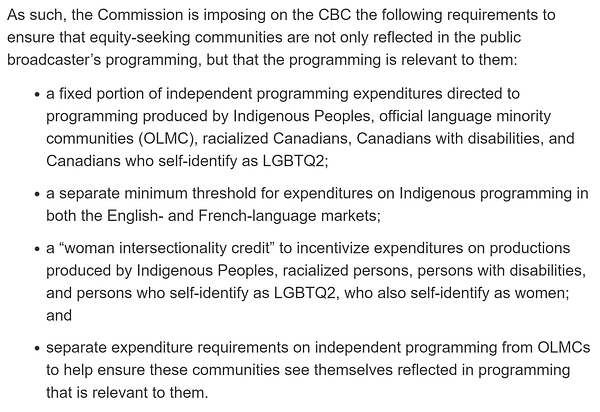
“As such, the Commission is imposing on the CBC the following requirements to ensure that equity-seeking communities are not only reflected in the public broadcaster’s programming, but that the programming is relevant to them.”

The CRTC is demanding a “fixed portion of independent programming expenditures directed to official language minority communities (OLMC), racialized Canadians, Canadians with disabilities, and Canadians who self-identify as LGBTQ2.” Additionally, it will grant a: “‘woman intersectionality credit’ to incentivize expenditures on productions produced by Indigenous Peoples, racialized persons, persons with disabilities, and persons who self-identify as LGBTQ2, who also self-identify as women.”

There are additional requirements for French language programming, of course. 

This line also caught our attention from the notice: 

“The Commission supports the Government of Canada’s commitment to renewing the relationship with Indigenous Peoples, based on the recognition of rights, respect, co-operation and partnership. On a broader level, the Commission also recognizes that Call to Action 84 of the Truth and Reconciliation Commission and the United Nations Declaration on the Rights of Indigenous Peoples (UNDRIP) tie into some of the objectives of the Broadcasting Act in that they refer to the reflection of Indigenous Peoples in the programming broadcast by the CBC.” 

The CRTC is demanding changes to the election of the CBC ombudsman to ensure he or she is “sensitive to issues surrounding Indigenous people, racialized Canadians and other equity-seeking communities.” 

It is also setting out “new expectations regarding the CBC’s Journalistic Standards and Practices to help ensure that journalists can provide relevant feedback and equity-seeking communities are consulted in any future review of the JSP.” 

(The JSP is basically the bible of CBC journalism and guides its employees in how it approaches reporting, analysis and opinion. The JSP has come under particular scrutiny in recent years when it was alleged that the expectation of “objective” journalism would distort how the outlet approaches racism. Attentive readers will note the obvious allusion to “moral clarity” here.)

Whether or not you agree with the outcomes being sought, what is clear is that the CRTC (which is appointed by the governor general, on advice of the privy council) is having explicitly political goals written into its license renewals. 

Now, don’t misread us, here. The CBC ought to be free to pursue equity goals in programming, or reviews of its JSP, or whatever it feels necessary to meet its mandate according to its own discretion. We happen think these outcomes are best exercised by trusted leaders and experienced producers who have the latitude to use editorial discretion, rather than by rigid quota or expenditure goals. 

To have these demands placed on it by an external regulator in order to fulfil the political goals of that regulator and, ultimately, its political masters, is playing with fire in the worst kind of way. 

For starters, one of the first pieces we ran here at The Line was from a documentary filmmaker who noted the ways in which diversity quotas shifted incentives in filmmaking. Just as students write to the test, quotas of this sort shift the focus in content production, forcing creators to produce content that checks a box, rather than fulfil a real audience desire. This creates a CBC that is dooming itself to be less relevant to the general public even as its relevance is growing more crucial thanks to the economic collapse of private media. The system is all the more insulting considering there is, in fact, a real audience desire for different voices and perspectives in our media landscape. 

(The Line can think of two such examples of CBC shows that were compelling and worth watching regardless of their diversity requirements: check out Sort Of and Trickster if you haven’t already. Unfortunately, the latter was cancelled when it was revealed that director Michelle Latimer was not as Indigenous as previously stated.) 

The second most obvious problem with all of this falls under the maxim “Do not give your enemies the weapons they will use to kill you.” In other words, having established this norm, do you not think that Prime Minister Pierre Poilievre, having done his damndest to stack the CRTC, will not do the same thing in turn? What is the CBC going to do when its license renewal is subject not to fulfilling the requirements of UNDRIP, but rather to concepts like “viewpoint diversity” and “journalistic objectivity,” as defined by Poilievre’s crew? The pendulum always swings back, friends, and it usually swings back harder when pushed. 

Source: The Line Dispatch 13 August

Jamie Sarkonak: Some are more equal than others, according to Canada’s immigration ministry

One of the early mainstream media commentaries on IRCC’s anti-racism strategy (see my earlier post (IRCC Anti-Racism Strategy 2.0: “Energy, Conviction and Courage” [too preachy for my taste]).
While I did not read it the same way as Sarkonak, reflecting my perspectives, reading this reminded me of my experience when working under the Conservative government and Jason Kenney when I was confronted with a very different worldview (shameless plug for Policy Arrogance or Innocent Bias: Resetting Citizenship and Multiculturalism).And while many of the specific provisions in the strategy are fairly standard anti-discrimination and anti-racism tools to help identify biases and discrimination, understandable that the framing of them would attract attention as being overly “woke” given the frame of CRT and the “wheel of privilege and power.”

In terms of some of Sarkonak’s specific solutions to IRCC, some are stronger than others. It makes sense to publish approval rates by country of citizenship as differences in approval rates may, but not necessarily, indicate biases. Similarly, monitoring of staff for arbitrary decision-making makes sense pending the development of more AI and other tools that can provide consistent decision making (as Kahneman and others argue in Noise). On the other hand, simply bolstering staff to address backlogs avoids the necessary policy and administrative changes needed to reduce future backlogs.

Sarkonak criticizes tying EX bonuses to DEI and anti-racism and ensuring targeted career development programs for minority staff but these types of policies have been in place for some time in one form or another (I remember in the early 1990s that Global Affairs identified women with potential to address the gender gap with considerable success).

But perhaps one statement in the strategy is the one that would provoke a possible future Conservative government the most, the policies are intended to survive “regardless of changes in government” as it smacks of bureaucratic arrogance rather than a more neutral phrase of something like “establishing the basis for further inclusion:”

In a corporate plan for an anti-racist “systems change,” Canada’s immigration ministry says it isn’t fair to treat people equally regardless of background. Instead, people should be treated according to their level of innate privilege.

In other words, Immigration, Refugees and Citizenship Canada (IRCC) has embraced critical race theory — or diversity, equity and inclusion (DEI), as it’s called in practice — with a plan called Anti-Racism Strategy 2.0. It openly signals a shift to the ideological left.Unfortunately, concerns about racism within IRCC aren’t unfounded. An external review reported dozens of openly racist comments in the workplace. Perhaps the worst allegation was that those within IRCC often refer to African countries as “the dirty 30” — an embarrassing display of prejudice for a department welcoming new citizens into a country that’s supposed to respect the right to equality.

It’s therefore no surprise that the question of racism comes up when rejection rates for applications vary by country. With few explanations from officials, advocates understandably come up with their own: systemic racism. This was the case when study permit applications from Nigeria were found to be disproportionately rejected by IRCC. Elsewhere, critics have correctly pointed out that Canada committed to taking an unlimited number of refugees from Ukraine, while capping Afghan applicants at 40,000.

The solution should be to bolster staff so that applications can be processed in a reasonable time (the immigration backlog is an astronomical 2.7 million) and to enforce workplace rules against instances of racism in the office.The department can also publish approval rates by country of origin, as it does with approval rates for foreign student study permits. If applications from certain countries are being disproportionately rejected, explanations should be offered as to why.

There isn’t a duty to accept an equally proportionate number of immigrants from each country in the world, and it’s quite possible that acceptance rates are lower for some countries simply because more applicants from there aren’t meeting our requirements — that’s not systemic racism, that’s just the fair application of the rules to everyone.

But Canadians have a right to know what’s going on, and the government can’t have its employees acting out of bigotry. Individual immigration officials should be monitored through annual performance reviews to ensure they aren’t arbitrarily rejecting would-be immigrants due to their country of origin. If unfair discrimination is going on, disciplinary action should be taken.

IRCC’s solution is more complicated. Instead of investigating bad managers and disproportionate immigrations outcomes between countries, it’s adopted the explanation of unconscious and systemic racism that stems from critical race theory. Racism isn’t just hatred, IRCC says, but includes unconscious and unintended actions that lead to any discrimination or prejudice against any group. Similar policies have emerged in Canadian public institutions, including schools (where anti-racist material is beginning to be taught to students), universities (where white males are barred from applying for certain jobs), the military (where applications from diverse candidates are prioritized) and even the Bank of Canada (where DEI is to be kept in mind when setting monetary policy).

Equality isn’t fair anymore, says IRCC. Fairness is traditionally thought to involve treating people equally, but it’s been redefined as a matter of outcome. Unfair outcomes happen when a group of people is “overrepresentative” of their population statistics. IRCC’s plan to “eradicate racism in all its forms” is paradoxical, because it requires identity-based discrimination (what we used to call racism) to achieve this version of a “fair” outcome (elimination of racism).

The ministry doesn’t limit this kind of thinking to race, ranking various identity genres according to privilege to help “correct power imbalances.” These include education level, Indigeneity, skin colour, brain structure, sexual orientation and gender.

It’s a dehumanizing way to look at people. Even so, the IRCC wants to permanently embed identitarianism into every aspect of the ministry, “regardless of changes in government.”

The idea is to transform everything from finances and organizational procedure to the relationships between people in the ministry and the way people think and talk. A number of practical goals are set out to achieve this, which will be monitored by report cards.

For management, IRCC wants to tie bonuses and promotions to anti-racist performance.

For staff, identity-specific career development programs will be made to help certain groups get promotions; “Indigenous, Black, Racialized, Persons with Disability, LGBTQ2+ and individuals with intersecting identities” are to be given special attention for staffing. Targeted workshops and focus groups are planned to teach the ministry’s expansive theory of racism within the ranks.

For the actual business of immigration, IRCC plans to fund resettlement initiatives that promote DEI, or the practice of critical race theory. Any community organization that resists will be risking precious grant dollars.

For the millions of people waiting in Canada’s immigration backlog, government commitments to reshape staff thoughts and civic ideology are about as useful as thoughts and prayers. Worse, these changes to the public service are political. Perhaps it sounds nice to those who believe in this version of social justice, but it’s a radical paradigm shift away from the Canadian values of fair procedure and equality.

If these basic values are going to be completely redefined in government, perhaps they should at least be debated in the House of Commons first. Instead, these political changes to the function of government are being made out of public view. The immigration ministry acknowledges they’re being made at the direction of the Clerk of the Privy Council and the Prime Minister’s Office (PMO), which have demanded more DEI in the public service.

It sends a bad message to those seeking to come to Canada for equal freedom of opportunity and open debate: Major changes aren’t up for discussion, but are instead the business of the PMO and the unaccountable ministry bureaucrats who write up corporate plans.
Source: Jamie Sarkonak: Some are more equal than others, according to Canada’s immigration ministry