Meet Robert Shillman, the Tech Mogul Who Funds Pamela Geller’s Anti-Islam Push

Only in America. If the same vitriol was directed to Christians or Jews, Shillman might not be so certain of his free speech justification:

Shillman said he remains a director of the David Horowitz Freedom Center, whose Jihad Watch website helped organize the cartoon event in a Dallas suburb with activist Pamela Geller’s American Freedom Defense Initiative.

The Southern Poverty Law Center (SPLC), which tracks what it describes as extremist groups, has called the Freedom Center’s founder, the right-wing commentator David Horowitz, “the godfather of the anti-Muslim Movement.” The Freedom Center says it “combats the efforts of the radical left and its Islamist allies to destroy American values.”

The SPLC also calls Geller’s AFDI a hate group because of the way it talks about and depicts Muslims.

Horowitz, in an email, called Shillman “an American hero” who is entirely transparent in his agenda. Horowitz also said the SPLC couldn’t produce one statement of his own that was anti-Muslim.

Geller did not return messages seeking comment.

…As founder of Natick, Massachusetts-based Cognex, which makes machine vision products that help automate manufacturing, Shillman says he is more outspoken than a typical U.S. corporate leader. “Most CEOs are hired guns and their future depends on what their boards think of them. I don’t give a f—-.”

The Freedom Center, whose P.O. Box address is in Sherman Oaks, California, runs several blogs and websites, including the online FrontPage Magazine and Jihad Watch. Shillman has funded four fellowships for journalists who have have worked on the FrontPage, which is the center’s online journal for news and political commentary. He declined to comment when asked if he helped pay for the cartoon contest.

Meet Robert Shillman, the Tech Mogul Who Funds Pamela Geller’s Anti-Islam Push – News – Forward.com.

Why does the left downplay antisemitism? All forms of racism should be abhorred | Dean Sherr

Fair commentary, and some good parallels between antisemitism, Islamophobia and other forms of racism and prejudice:

But Jews should not be required to parade our suffering, historical or contemporary, in a competition for attention with other forms of racism. Nor should we be expected to tolerate the constant appearance of antisemitic language and imagery at prominent anti-Israel rallies, which does seem to show that the use of antisemitic symbols and language in the west is seen as less threatening, or perhaps “understandable”, when connected with Israel.

….Her [Miriam Gargoyles’]  solution was for Australians to see that “not all Jews behave in the way Israelis are doing” – suggesting all the Jew has to do is denounce Israel loudly enough, or perhaps wear a sign, that indicates that we aren’t all “evil” like Israelis are, to avoid being victimised.

Ironically, it sounds remarkably like a demand so often made of Muslims. As Australian prime minister Tony Abbott said a week earlier, “I wish more Muslim leaders would say [they are a religion of peace] more often and mean it.” Abbott’s comments were widely denounced by the left and rightfully so, but Margolyes’ comments were not objected to, they were applauded by many in the audience and online.

It is surely obvious that mitigating bigotry or racism with victim-blaming is wrong regardless of the victim’s ethnic or religious background. Yet it persists in some left-wing circles that Jews are the exception to this rule – our communal connection to Israel makes us somehow more legitimate targets, unless we denounce the Jewish state.

The problem with this notion is twofold – firstly, because Jews do not wear signs declaring our position on Israel. A proud Zionist Jew can just as easily be targeted at a kosher supermarket as an anti-Zionist one. More than that though, why should we have a duty to detach ourselves from a vital aspect of our cultural identity to avoid victimisation?

The reality is that we are human beings with complex identities, defined by a wide range of societal, communal and ethnic influences. Must we carry the burden of answering for all of Israel’s actions because we were born Jewish? And are we so unlike other ethnic cultures that care for the safety and security of our relatives abroad, that we can be painted as immoral for not abstracting ourselves from their threatened existence?

In a political climate where fear is a weapon as much as a state of mind, where innocence isn’t automatically assumed, and where wars and foreign affairs can fuel prejudice at home, it is natural that many take great steps to defend embattled Muslim communities from the risk of dangerous incitement. In doing so, they recognise that Muslims deserve to have their rights – freedom of association, of safety, of speech – protected, if necessary by the state.

They also recognise that self-determination of cultural and national identity is not something we can impose on other people. Those rights and understandings must be equally extended to Jews without the expectation that we must first denounce Israel, fight it, answer for it, or be ashamed by it.

… When progressives downplay or diminish the threat of antisemitism in the diaspora because of Israel – or, worse, fuel it – they do not extend to us those equal rights they purport to stand for. Progressives do more than dishonouring their values in this case, they diminish the unique history of Jews in Australian (and western) society, failing to acknowledge and defend us as equal, regardless of our relationship with or opinions about Israel.

The left must act to repair its straining relationship with Jews and once again take up opposition to antisemitism as its cause. Antisemitism is, like all forms of racism, to be abhorred and condemned unequivocally, not reduced and marginalised by games of comparison and mitigation. It is not a partisan issue and it cannot be up to the right to own the unqualified outrage it deservedly generates. The left, and the values it holds, are far too proud and dear to our hearts for that.
Why does the left downplay antisemitism? All forms of racism should be abhorred | Dean Sherr | Comment is free | The Guardian.

ICYMI: Antisemitism — The Facts and the Hope | John Gerzema

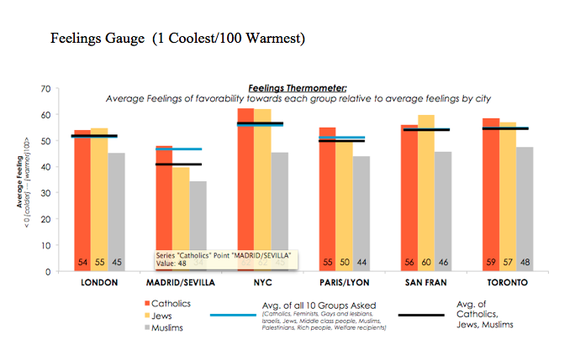
Comparative Religious Attitudes CitiesInteresting comparative study across religions and cities, with strong conclusion of how best to proceed:

The data shows that anti-Semitism, at least in the countries surveyed, is stubborn, deep-seated and chronic. It is worse than anti-Catholic bigotry but not quite as widespread as anti-Muslim feelings. Yet here’s a critical distinction: within nations, people act-out against Jews more often than they do against Catholics and Muslims. Some of this behavior seems linked to events involving Israel. However, it would be wrong to suggest a causal link between expressions of anti-Semitism and Israeli policy. Last Fall’s conflict in Gaza, for instance, may have “unleashed” anti-Semitism, acting as a false catalyst, but the feelings against Jews exist independent of the Middle East. After all, if someone predisposed to hate Jews cites Israeli policy to justify their anti-Semitism, he or she is still an anti-Semite.

Yet not all our findings were bleak. As part of our study we tried to determine whether people were affected by media mentions of Israel. When we asked our survey respondents last August to read an unbiased report on the ongoing events in Israel and Gaza we saw expressions of anti-Jewish feelings decline. People who told us they were “somewhat open” to new information moved from a 14 percent to 25 percent likelihood of sympathizing with Israel. Those that were “very open” moved from 35 percent to 42 percent likelihood of sympathizing with Israel. We saw related reductions in the number of people who said they had negative thoughts about Jews in general.

So the data offers hope that hearts and minds can be affected by honest, reliable, unadulterated information. We can inform instead of inflame. We can teach instead of just talk. We can exercise our freedom of speech and freedom of the press as a means to contest cultural boundaries. The alternative is watching bigotry of all kinds — against Muslim or Jew, Catholic and, sadly, a long list of other groups — dominate the discussions around the world. The evidence is there that we can create change and counteract the hate that occurred last week and continues to be so pervasive and pernicious. It is up to all of us to engage, enlighten and educate.

Anti-Semitism — The Facts and the Hope | John Gerzema.

Fear Inc.: Behind the $57 Million Network Fueling Islamophobia in the U.S.

Interesting short video on some of the forces behind anti-Islam and anti-Muslim messaging (under 2 minutes):


Charlie Hebdo just meeting demand for Islamophobia | NCCM

Not convinced that Abbas Kassam NCCM has done its homework and actually looked at Charlie Hebdo seriously, beyond a simplistic “no depiction” of the Prophet perspective:

Yet, the magazine and its supporters are just meeting the market demand for Islamophobia. It is now popular in our discourse to pitch western values against radical Islamists (no matter how empty these terms are). Charlie Hebdo met this demand in the worst possible way.

It is questionable whether the cartoons were even satirical. Satire is a classical tool of those without power to shed light on the weaknesses of the powerful. Satire is not about perpetuating negative stereotypes about a disenfranchised minority. Ultimately, Charlie Hebdo was promoting the very stereotypes it was supposedly trying to satirize. This might work as a business model, but it is detrimental for society.

…. It is essential that we also collectively reject the demand for Islamophobic material because it harms our valued social cohesion. As Canadians, we are living in a society that promotes tolerance and cohesion, not discrimination. However, Islamophobia stigmatizes Muslim communities, disenfranchises and isolates them from the mainstream. This creates conditions ripe for extremist radicalization, which has proven to be a danger to all of us, including Muslims themselves. And violence then creates demand for a response. This reaction can sometimes lead to the erosion of civil liberties and decreased freedoms for everyone.

Much of Canadian media should be lauded for their principled stand in declining to print the magazine’s incendiary cartoons. We can take a cue from their decision. As democratic societies we need to demand mutual respect and understanding, and reject the purveyors of intolerance. This may not sound as interesting or exciting as the clash of civilizations framework, but it is a long-term investment in our shared future.

After all, satire on the activities of fundamentalists and their political views is not necessarily Islamophobic, just as criticism of fundamentalist advocates of greater Israel is not necessarily antisemitic.

Charlie Hebdo just meeting demand for Islamophobia | TorontoStar.

For a more serious look at Charlie Hebdo, see Arun with a View for a range of commentary:

Understanding Charlie Hebdo

Juan Cole: President Hollande: Anti-Muslimism Is as Bad as Anti-Semitism

Worth reading, and an apparent ‘course correction’ nuancing the ‘war’ language :

French President Francois Hollande addressed the Institute of the Arab World on Friday, in a bid to reassure French Muslims, who fear being the victims of a collective guilt campaign or reprisals after the attack of radicals on Charlie Hebdo.

Hollande said:

“It is the Muslims who are the first victims of fanaticism, fundamentalism and intolerance…

We must remember that . . . Islam is compatible with democracy, and that we must reject lumping everyone together or mixing them up with one another, and must have in France French of Muslim faith who have the same rights and the same duties as all citizens.

They must be protected.  Secularism helps in this regard since it respects all religions… Anti-Muslim actions, like Antisemitism, must be denounced and severely punished…

France was formed by movements of population and the flux of immigration.  It is constituted by the diversity of what is in France.  A number of my compatriots have attachments in the Arab world, coming from North Africa or the Near East.  They might be Jews, Muslims, Christians, they might be believers or no.  But they have a link to the Arab world and they have contributed, generation after generation, to the history of France.”

In contrast to the racist discourse of the National Front, which paints Muslims as alien and dangerous and non-Muslim French as monochrome, Hollande adopted an almost American diction of celebration of immigrant communities.

He made the argument that it isn’t importing religion into government (as many states in the Middle East unfortunately do) that guarantees minority rights but rather secular government, which tolerates all religions equally.  He is being a little idealistic about actual French secularism as it is enshrined in law and practice, but the general principle is correct.  Secular government can neutralize religious competition for the state of the sort we have seen in post-Bush Iraq, with all its disasters.

Hollande surely made waves when he put anti-Muslimism on exactly the same level as Antisemitism, and pledged to be as vigorous in combating the one as the other.  I haven’t heard any other Western leader go so far as to equate these two.

Otherwise, his acceptance of the Muslim French as full French citizens is extremely important in the hothouse atmosphere of European politics today, where many right-wing parties determinedly “other” the European Muslims.

Juan Cole: President Hollande: Anti-Muslimism Is as Bad as Anti-Semitism – Juan Cole – Truthdig.

France Has A History Of Anti-Semitism And Islamophobia | FiveThirtyEight

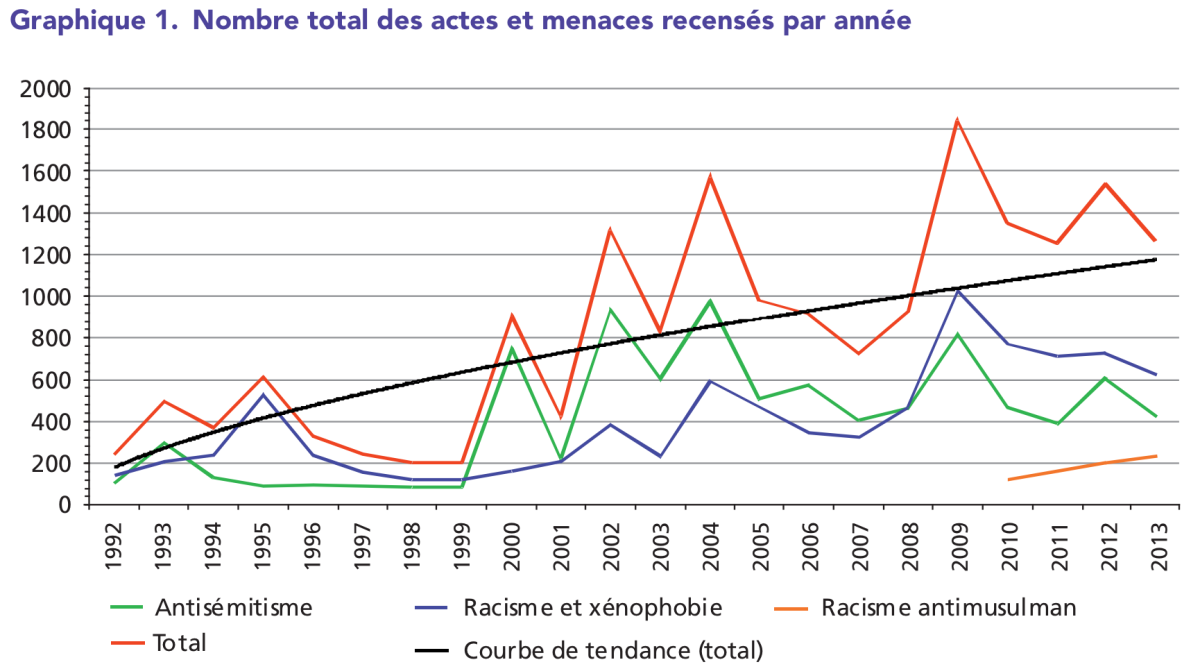
Hate crimes FranceBeyond the anecdotes, hate crime data (chart above) and public polling:

Public opinion surveys might offer some further insight into how Islamophobia is changing in France. In the spring of 2008, Pew surveyed 754 adults in the country about their views on various religious groups. Thirty-eight percent of respondents said they had a “somewhat” or “very” unfavorable opinion of Muslims. That figure was slightly higher than in previous years — in 2006, 35 percent said they had an unfavorable opinion of Muslims in 2005, and in 2004 it was 34 percent.

In 2014, Pew commissioned a new survey, this time posing a question to 1,003 French adults with a slightly different wording. Rather than asking about attitudes toward religious groups in general, the survey asked specifically about attitudes towards religious groups living in France. This time, 27 percent of respondents expressed a somewhat or very unfavorable opinion of French Muslims.

Three-quarters of French respondents believe Islam is an “intolerant” religion, incompatible with the values of French society, according to a January 2013 poll by the French newspaper Le Monde and the market research company Ipsos.

Anti-semitism in France

Rabbis in France have described the country’s Jewish population as “tormented with worry” after Friday’s attack on a French supermarket. On Monday, 5,000 police officers had been sent to Jewish schools and religious sites amid security concerns in addition to 10,000 troops deployed across the country.

The nonprofit Service de Protection de la Communauté Juive (the Jewish Community Security Service, SPCJ) publishes an annual summary of anti-semitic attacks reported to the organization and to police precincts in France. Its latest figures show that in 2013 there were 105 anti-semitics acts and 318 anti-semitic threats. Taken together, the number of threats and acts in 2013 was lower than in 2012 (when there were 614 total incidents) but higher than in 2011 (389).

Pew’s 2014 survey also asked about respondents’ attitudes toward French Jews, with 10 percent of respondents expressing an unfavorable opinion.

In September 2014, Fondapol, a French think tank, posed a range of questions that might reveal anti-semitic attitudes to 1,005 French people age 16 and over. The choice of wording in the survey is interesting. One question asked “when you learn that someone you know is Jewish, what reaction do you have,” to which 91 percent of respondents said “nothing in particular,” 3 percent said “I like them” and 3 percent said “I don’t like them” (the rest refused to answer). However, 21 percent of respondents said they would prefer to avoid having a Jewish president, 14 percent a Jewish mayor, 8 percent a Jewish doctor and 6 percent a Jewish neighbor.

France Has A History Of Anti-Semitism And Islamophobia | FiveThirtyEight.

Islamophobia Is Not a Myth – The Atlantic

The US debate on Islamophobia with Connor Friedersdorf of the Atlantic countering Brendan O’Neil’s piece in the National Review, “Islamophobia is a Myth” with evidence:

Says O’Neill, “According to federal crime stats, in 2009 there were 107 anti-Muslim hate crimes; in 2010, there were 160. In a country of 330 million people, this is exceptionally low.” But in 2000, there were 28 such incidents. What’s wrong with inveighing against anti-Muslim bigotry that’s responsible for 100 or so “extra” hate-crimes, or noting that the numbers were much worse immediately after 9/11… and worrying a spike could happen again? Calling for tolerance of a minority group at a moment of plausible peril is costless, prudent and humane, not objectionable. And if relative tolerance then prevails, that’s a success, not an occasion to complain that elites weren’t trusting enough in the masses.

There’s a non-trivial chance that efforts to stigmatize an anti-Muslim backlash are partly responsible for the fact that there haven’t been more hate crimes in the United States and that the post-9/11 spike has decreased, albeit not back to pre-9/11 levels.

That’s certainly the intention of liberals, as well as many conservatives who followed President Bush’s lead. The chance of success strikes me as a good reason to continue the campaign of stigma, even if the sensibilities of some conservatives are offended, as if suffering is a zero-sum game, or zealously guarding against Islamophobia somehow undermines the fight against terrorism. Insofar as mainstream Muslims are instrumental in informing on radicalized co-religionists who turn to violence, efforts to reach out in support of them are investments in counterterrorism in addition to being consistent with basic justice.

“Islamophobia is a code word for mainstream European elites’ fear of their own populations,” O’Neil writes, “of their native hordes, whom they imagine to be unenlightened, prejudiced, easily led by the tabloid media, and given to outbursts of spite and violence.” As it happens, human beings, in Europe and everywhere else, are often prejudiced, easily led by the media, and given to spite and violence. It is lovely to think that a violent faction on the European right will never again succeed in perpetrating horrific abuses against immigrants or ethnic minorities. To stigmatize those working to prevent such a future is a waste of stigma.

Islamophobia Is Not a Myth – The Atlantic.

Blatchford: Convicted hate-monger gets added jail time for his Muslim-offending ‘social experiment’

Worth reading. Eric Brazau, the person convicted, certainly seems a nasty piece of work.

Blatchford appears to be critical of the judge’s decision to “throw the book” at Brazeau. Would she be as critical of the judge’s decision had the comments been directed at Jews? Blacks?

Blatchford: Convicted hate-monger gets added jail time for his Muslim-offending ‘social experiment’.

Father Raymond J. de Souza: ‘Islamophobia’ is not the problem

While his argument that criticizing Islamic extremism and violence is not Islamophobic is of course correct, de Souza appears to dismiss the possibility of Islamphobia (or anti-Muslim prejudice and discrimination) as well as being silent on the language used (e.g., Pamela Geller and Robert Spencer are prime examples of the use of intemperate and overly broad condemnation of all Muslims as potential or actual extremists):

On the weekend Pope Francis was in Turkey to visit the leader of world Orthodoxy, Bartholomew, Patriarch of Constantinople. Like John Paul and Benedict before him, Francis went to show his esteem for the Orthodox Church and to foster the bonds of unity. But since Constantinople long ago fell to the Turks, this Christian meeting took place in a country that is 98% Muslim — and more to the point, in a country now led by an ambitious man, President Recep Tayyip Erdoğan, who is not above using Islamism to advance his desire to be the leader of global Islam, recapturing the influence of his Ottoman predecessors.

Erdoğan took advantage of the Holy Father’s visit to argue that Western leaders who seek his aid in combatting jihadism need to clean up their own house first. Erdoğan urged the Pope in his welcome address to combat the “the very serious and rapid trend of growth in racism, discrimination, and hatred of others, especially Islamophobia in the West.”

The point was further amplified by Mehmet Görmez, the minister of religious affairs. “We feel anxiety and concern for the future, that the Islamophobic paranoia that has already been spread among Western public opinion is being used as a pretext for massive pressures, intimidation, discrimination, alienation, and actual attacks against our Muslim brothers and sisters living in the West,” he said.

It is hardly phobic or paranoid for Christians on Turkey’s borders in Syria and Iraq to fear the jihadism that is slaughtering their communities

Like most countries that have government departments for religious affairs, Turkey does not permit full religious liberty. The Orthodox Patriarchate, present in Constantinople since before Islam existed, is being strangled by the state, with heavy restrictions placed on its institutions and freedom of governance. So it is a bit much to hear from Turkey about “Islamophobia” inflaming public opinion abroad when “Christophobia” is practiced by law at home. Moreover, it is hardly phobic or paranoid for Christians on Turkey’s borders in Syria and Iraq to fear the jihadism that is slaughtering their communities.

Erdoğan and his ministers were offering a sort of pact: We will combat jihadism in our backyard if you condemn “Islamophobia” in yours. It is an offer that merits firm rejection.

Drawing moral equivalence between lethal jihadism and people who say nasty things about the co-religionists of such jihadis is meant to be disabling, as was the case in the days of the anti-anti-communists. It sows confusion by suggesting that any challenge even to Muslim pathologies is ill-motivated and illegitimate.

The obligation of Turkey and other Muslim states to combat extremist violence in the name of Islam binds independent of what is being done elsewhere. Indeed, one might argue that reducing jihadist attacks would do more to reduce “Islamophobia” than any number of pieties about Islam being a religion of peace.

More outrageously, to juxtapose “Islamophobia” and Islamist violence ignores that the vast majority of victims of jihadism are Muslims themselves. For every Muslim in the West anxious about “Islamophobia,” there are far, far more within the house of Islam who fear for their lives.

Jihadism is a clear, present and lethal danger, for Muslims first, and it is waxing rather than waning. It is not “phobic” to condemn it.

Father Raymond J. de Souza: ‘Islamophobia’ is not the problem