Canada cannot sell gender equality abroad without practising it at home

Always surprised that these kinds of analysis and commentary fail to look at the intersectionality between gender, visible minorities and Indigenous peoples.

Here’s what the intersectionality between women and visible candidates:

However, Liberal women MPs form 45 percent of all visible minority MPs whereas for the Conservatives, it is only 11 percent:

….The idea is not new to Canada. In 2016, then-MP Kennedy Stewart introduced a private member’s bill that would have financially penalized parties that did not approach gender parity among their general election candidates. In 2019, the House of Commons Standing Committee on the Status of Women received evidence that quotas should be adopted to increase the number of women candidates.

A 2023 poll even showed that 50 per cent of Canadians would support gender quotas for federal elections.

Left to their own devices, parties cannot get the job done. Women comprised a dismal 22 per cent of Conservative candidates in the 2025 federal elections, but blame does not fall on Conservatives alone. Compared to 2021, the proportion of women candidates dropped in every party, save the NDP: by 11 percentage points for the Conservatives but also by eight percentage points for the Liberals and the Bloc.

Without quotas to make the parties perform better, Canada’s federal elections are failing voters’ expectations for what legitimate political institutions look like.

Public opinion speaks clearly. People do not mind gender quotas; what they really do not like is seeing men dominate politics. Canada has fallen behind other countries not just because it elects fewer women, but because it lacks any policy commitment to do better. The country cannot sell gender equality abroad without first practising it at home.

Jennifer M. Piscopo is professor of gender and politics at Royal Holloway University of London and a contributing researcher to Informed Perspectives’ Balance the Power Initiative.

Source: Canada cannot sell gender equality abroad without practising it at home

Nicolas: Faux dilemmes [intersectionality, LGBTQ+, visible and religious minorities]

Nuanced discussion of the issues:

Depuis les manifestations anti-LGBTQ+ de la semaine dernière, on entend à plusieurs micros et sous maintes plumes que « la gauche s’entre-déchire », que les « intersectionnelles » ne savent plus où donner de la tête, et autres clichés semblables.

Pourquoi ? Parce que le mouvement pancanadien qui s’est mobilisé contre l’inclusion des réalités — et donc des enfants — trans et non binaires dans les écoles au Canada s’est coalisé autour de complotistes auxquels la pandémie nous avait habitués, de militants d’extrême droite, de chrétiens fondamentalistes et d’ultraconservateurs musulmans. Les caméras, sans surprise, ont capté avec plus d’insistance les visages des manifestants musulmans. Depuis, on se dit en se frottant les mains : entre les personnes trans et les femmes voilées, la « gauche inclusive » fait enfin face à ses contradictions !

Sauf que non, désolée pour vous. Je ne peux que parler pour moi-même, qui suis engagée contre l’islamophobie comme contre la transphobie : je ne sens pas mon univers de sens s’écrouler.

Par contre, le commentaire me fait dire que bien des gens qui lancent des pointes aux mouvements sociaux peinent encore à comprendre leur logique la plus élémentaire.

On saisit d’abord encore mal ce que ça veut dire, défendre les droits de la personne. C’est là un engagement qui dépasse largement la logique de « ma gang contre ta gang ». Ça veut dire que je crois que toutes les femmes devraient être libres de porter ou de ne pas porter ce qu’elles veulent — même les femmes qui méprisent une partie de ce que je suis, moi.

Ça veut dire défendre le droit de toutes les personnes LGBTQ+ de vivre leur orientation sexuelle et leur identité de genre — y compris celles qui reproduisent le racisme dans la culture queer. Ça veut dire que même si un homme noir a déjà fait des commentaires ou posé des gestes profondément misogynes par le passé, je ne veux pas qu’il se fasse tabasser par la police. Ça veut dire que j’utilise ma visibilité sur la scène pancanadienne pour sensibiliser mon audience au bilinguisme et au droit de tous les francophones du pays de vivre leur vie pleinement dans leur langue maternelle — y compris ceux qui contribuent au racisme. Ça veut dire, en gros, que je souhaite que tout le monde, même les gens qui me manquent de respect, ait accès au respect et à la dignité.

En théorie, tout cela est bien noble. Dans la pratique, les choses peuvent rapidement devenir complexes. Le travail d’organisation dans les mouvements sociaux, c’est faire face au quotidien à cette complexité. Dans les relations interpersonnelles et la construction des liens de confiance, comme dans la négociation des messages clés qui permettent de faire coalition. Cette complexité ne surprend donc personne ayant quelque expérience de terrain en mobilisation.

Cette même complexité donne aussi parfois du fil à retordre aux juristes qui doivent tracer la ligne lorsque les libertés des uns entrent en conflit avec les droits des autres. Quand la liberté d’expression ou d’association d’un groupe menace la sécurité — ou simplement la dignité — d’un autre, il faut qu’une ligne soit tracée. On ne s’entend pas toujours sur l’endroit où elle devrait l’être, mais la ligne témoigne au moins toujours d’une recherche plus ou moins adroite d’équilibre.

Plus on a l’habitude sociale et politique de la complexité, plus on se sentira outillés pour agir justement dans ce type de situation. On comprend que, souvent, on est face à de faux dilemmes. Plutôt qu’hésiter entre deux options qui ne conviennent pas à tous, on est tout à fait capables, avec un peu de volonté, d’en imaginer une troisième.

Il y a des personnes queers, traumatisées par la violence qu’elles ont subie au sein de leur propre communauté religieuse, qui se mettent à mépriser toutes les formes de foi et à étaler leurs préjugés contre tous les croyants du monde. Il y en a d’autres qui ont trouvé dans la spiritualité un vocabulaire pour nommer leur identité et leur rapport au monde, et une communauté pour les épauler dans leur recherche de sens. Il y a aussi des personnes très croyantes qui justifient par la foi des valeurs patriarcales, sexistes, homophobes et transphobes, qu’on peut tout aussi bien entretenir en étant athée. Il y en a d’autres qui puisent dans leur foi une compassion, une recherche de justice et un souci des plus vulnérables qui les mèneront vers une tout autre vision du monde.

C’est pourquoi ni la chrétienté, ni l’islam, ni aucune communauté de croyants ne sont des monolithes que l’on peut caricaturer aisément.

Si l’on veut bien comprendre les liens entre religion et diversité sexuelle, on a tout avantage à écouter les personnes queers qui sont elles-mêmes croyantes. Pour ce faire, il faudrait au moins arrêter de prétendre qu’elles n’existent pas. On ne peut les honorer dans tout ce qu’elles sont à moins d’imaginer une société où la liberté de conscience, l’orientation sexuelle et l’identité de genre sont toutes également respectées. Du moment qu’on est à l’aise avec la complexité, les conversations difficiles mais nécessaires, la recherche de solutions et l’écoute aussi, surtout, je ne vois pas pourquoi ce serait impossible.

Si cet optimisme me vient aussi aisément, c’est grâce aux années que j’ai passées dans les mouvements sociaux. On peut y voir comment des alliés de circonstance, à force de vivre des moments forts ensemble, finissent par bâtir des liens de confiance nécessaires aux discussions qui permettent de faire reculer les angles morts qu’on a tous — mais absolument tous — lorsqu’on décide de s’engager socialement. À force de défendre les droits des uns et des autres sans attente de réciprocité, les militants finissent par voir une compréhension mutuelle s’installer, doucement.

Si on ne reprend pas le rythme des mobilisations progressistes bientôt, d’ailleurs, c’est à la droite de la droite que cette magie des liens de solidarité et de confiance construits dans l’action politique s’opérera.

Anthropologue, Emilie Nicolas est chroniqueuse au Devoir et à Libération. Elle anime le balado Détours pour Canadaland.

Source: Faux dilemmes

Bayard Rustin Challenged Progressive Orthodoxies

Of interest, a progressive who challenged progressive orthodoxies:

Bayard Rustin, a trusted adviser to Martin Luther King Jr. and chief organizer of the 1963 March on Washington, was a towering figure in the fight for racial equality. Remarkably for a man of his generation and public standing, he was also openly gay. When Mr. Rustin died in 1987, obituaries downplayed or elided this fact. Emblematic of this erasure was this paper, which made only passing mention of his homosexuality and obliquely described Mr. Rustin’s longtime partner as his “administrative assistant and adopted son.”

In the decade since President Barack Obama awarded him a posthumous Presidential Medal of Freedom, the country’s highest civilian honor, there has been a welcome resurgence of popular interest in Mr. Rustin’s extraordinary life. He was frequentlyinvoked in commemorations of the march’s 60th anniversary last month and will be the subject of a feature film produced by Barack and Michelle Obama’s company that will come out later this year.

Whereas remembrances of Mr. Rustin once evaded the issue of his sexual orientation, today, in accordance with our growing acceptance of gay people and awareness of the discrimination they have faced, such tributes are likely to center it. This past June, for instance, the PBS NewsHour aired a segment for Pride Month titled “The story of Bayard Rustin, openly gay leader in the civil rights movement.” Other representative encomiums celebrate the “gay socialist pacifist who planned the 1963 March on Washington”and “the gay black pacifist at the heart of the March on Washington.”

Mr. Rustin is today often extolled as an avatar of “intersectionality,” a theoretical framework popular among progressives that emphasizes the role that identities play in compounding oppression against individuals from marginalized groups. While it’s admirable that Mr. Rustin is being recognized for something he never denied (according to one associate, he “never knew there was a closet to go into”), these tributes studiously ignore another aspect of his life: how, throughout his later career, Mr. Rustin repeatedly challenged progressive orthodoxies.

Mr. Rustin, who was characterized by The Times in 1969 as “A Strategist Without a Movement” and, upon his death, an “Analyst Without Power Base,” would most likely find himself no less politically homeless were he alive today. A universalist who believed that “there is no possibility for black people making progress if we emphasize only race,” he would bristle at the current penchant for identity politics. An integrationist who scoffed at how“Stokely Carmichael can come back to the United States and demand (and receive) $2,500 a lecture for telling white people how they stink,” he would shake his head at an estimated $3.4 billion diversity, equity and inclusion industry that often prioritizes making individual white people feel guilty for the crimes of their ancestors while ignoring the growing class divide. A pragmatist who noted, “There is a strong moralistic strain in the civil rights movement which would remind us that power corrupts, forgetting that the absence of power also corrupts,” he would have no patience for social justice activists unwilling to compromise. And a committed Zionist — supportive of the state but likely critical of its government — he would abhor the Black Lives Matter stance on Israel and the recent spate of antisemitic outbursts by Black celebrities. Mr. Rustin’s resistance to party dogma is a neglected part of his legacy worth celebrating, an intellectual fearlessness liberals need to rediscover.

The origin of Mr. Rustin’s estrangement from the progressive consensus began with his belief that once federal civil rights legislation was achieved, the American left would need to turn its attention from racial discrimination to the much more pervasive problem of economic inequality. Four months after the march, Mr. Rustin was invited to deliver a speech at Howard University to the Student Nonviolent Coordinating Committee. According to the Times account, Mr. Rustin “said that the civil rights movement had gone as far as it could with its original approach and that the time had come to broaden the movement, which, he said, faces the danger of degenerating into a sterile sectarianism.” To avoid this fate, he argued, it must “include all depressed and underprivileged minority groups if their own movement is to make another leap forward.” Deriding direct-action protest tactics as mere “gimmicks,” Mr. Rustin counseled the young activists that “Heroism and ability to go to jail should not be substituted for an overall social reform program … that will not only help the Negroes but one that will help all Americans.”

Mr. Rustin expanded upon this analysis in a seminal 1965 Commentary magazine essay, “From Protest to Politics.” Published after the passage of the Civil Rights Act and several months before the signing into law of the Voting Rights Act, Mr. Rustin argued that the main barrier to Black advancement in the United States would soon no longer be racism but poverty. “At issue, after all, is not civil rights, strictly speaking,” he wrote, “but social and economic conditions” that transcended race. The problems facing Black America, therefore, needed to be seen as the “result of the total society’s failure to meet not only the Negro’s needs, but human needs generally.” A stalwart social democrat, Mr. Rustin argued that meeting these needs required a coalition of “Negroes, trade unionists, liberals, and religious groups” to push the Democratic Party to the left on economic issues.

Sectarian appeals based solely on race — whether from white segregationists or Black nationalists — threatened this aim. In May 1966, the moderate integrationist John Lewis was ousted from the chairmanship of SNCC by the Black Power radical Stokely Carmichael. Mr. Rustin responded with another Commentary essay, “‘Black Power’ and Coalition Politics.” Black Power, he wrote, was “simultaneously utopian and reactionary” as it “would give priority to the issue of race precisely at a time when the fundamental questions facing the Negro and American society alike are economic and social.” At a time when the Democratic Party is losing the support of working-class Americans of all races, this component of Mr. Rustin’s legacy is as important as ever.

Committed to a political program that would improve the lives of the poor and working class regardless of their skin color, Mr. Rustin opposed racial preferences . In 1969, he called a proposal for slavery reparations “preposterous,” elaborating that “if my great-grandfather picked cotton for 50 years, then he may deserve some money, but he’s dead and gone and nobody owes me anything.” Worse than a point of personal pride was the way in which the call for reparations divided the multiracial working class. As a “purely racial demand,” Mr. Rustin contended, “its effect must be to isolate blacks from the white poor with whom they have common economic interests.”

Testifying before Congress in 1974 against affirmative action, Mr. Rustin said: “Everyone knows racial discrimination still exists. But the high rate of black unemployment and the reversal of hard-won economic gains is not the result of discrimination,” but of the same, general economic conditions that affected the white unemployed. Contrary to contemporary “antiracism” advocates who claim that the existence of racial disparities necessarily constitutes evidence of racism, Mr. Rustin asserted, “That blacks are underrepresented in a particular profession does not by itself constitute racial discrimination.”

Another major source of tension between Mr. Rustin and the progressive left concerned American foreign policy. Briefly a member of the Young Communist League in the 1930s, Mr. Rustin followed the path of many a disillusioned ex-Communist by becoming a staunch anti-Communist. Although an early opponent of American military involvement in Vietnam, Mr. Rustin could not, as he wrote in 1967, “go along with those who favor immediate U.S. withdrawal, or who absolve Hanoi and the Vietcong from all guilt. A military takeover by those forces would impose a totalitarian regime on South Vietnam and there is no doubt in my mind that the regime would wipe out independent democratic elements in the country.”

In his role as chairman of Social Democrats, USA, the more hawkish faction to emerge from a split within the Socialist Party of America over the Vietnam War, Mr. Rustin was an outspoken critic of the Soviet Union and international Communism. He declined to endorse Democratic Senator George McGovern’s antiwar presidential candidacy in 1972 and joined other hawks in forming the Coalition for a Democratic Majority, an initiative to oppose the Democratic Party’s leftward lurch, becoming its vice chair. In the 1976 Democratic presidential primary, Mr. Rustin supported Senator Scoop Jackson of Washington, whose decades-long career combined strong support for civil rights and social welfarism at home with robust anti-Communism abroad.

Mr. Rustin’s evolution from absolute pacifist (epitomized by the two years he spent in a federal penitentiary during World War II as a conscientious objector) to Cold War liberal dismayed many of his allies on the left, who accused him of betraying the principles of Gandhian nonviolence he had brought to the civil rights movement. But Mr. Rustin’s transformation was born of long deliberation and genuine conviction; according to one biographer, Mr. Rustin repeatedly said that if he had been aware of the Holocaust during World War II, he most likely would not have become a conscientious objector.

If Mr. Rustin’s erstwhile comrades considered him a sellout, so too was he disillusioned with a political camp that posited a moral equivalence between the United States and its Soviet adversary. “Whereas I used to believe that pacifism had a political value, I no longer believe that,” Mr. Rustin stated flatly in 1983. “It is ridiculous, in my view, to talk only about peace. There is something which is more valuable to people than peace. And that is freedom.”

Yet another source of antagonism between Mr. Rustin and the left was his outspoken opposition to antisemitism within the Black community and fervent support for the state of Israel. “So far as Negroes are concerned,” he wrote in 1967, responding to an eruption of antisemitic statements by radical Black activists, “one of the more unprofitable strategies we could ever adopt is now to join in history’s oldest and most shameful witch hunt, antisemitism.” The following year, in an address to the Anti-Defamation League, Mr. Rustin condemned “young Negroes spouting material directly from ‘Mein Kampf.’” In 1975, as the United Nations General Assembly was preparing its infamous resolution condemning Zionism as a “form of racism,” Mr. Rustin assembled a group of African American luminaries including A. Philip Randolph, Arthur Ashe and Ralph Ellison into the Black Americans to Support Israel Committee (BASIC). “Since Israel is a democratic state surrounded by essentially undemocratic states which have sworn her destruction, those interested in democracy everywhere must support Israel’s existence,” he declared.

A descendant of slaves who was himself a victim of brutally violent racism, Mr. Rustin never let his country’s many sins overshadow his belief in its capacity for positive change. His patriotism was unfashionable among progressives while he was alive and is even more exceptional today. “I have seen much suffering in this country,” he said. “Yet despite all this, I can confidently assert that I would prefer to be a black in America than a Jew in Moscow, a Chinese in Peking, or a black in Uganda, yesterday or today.”

For his heresies against progressive dogma, Mr. Rustin was derided as a “neoconservative.” (Indeed, he was one of the first political figures to be branded with this epithet, coined as a term of abuse for members of the Social Democrats, USA by their more left-wing rivals.) But while Mr. Rustin may have taken part in various neoconservative initiatives and counted individual neoconservatives as friends and allies, he was not himself an adherent of this ideological persuasion. Unlike most of the thinkers and activists associated with neoconservatism, Mr. Rustin never abandoned his social democratic convictions, nor did he endorse Ronald Reagan. On the contrary, he wrote that “insensitivity and lack of compassion increasingly are becoming the hallmarks of the Reagan administration’s domestic program” and stated that the Black poor “have been victimized by years of Reaganism.”

Mr. Rustin’s life offers a sterling example of moral courage and personal integrity. Resisting the temptations of tribalism, standing up for one’s beliefs even when it angers one’s “side,” advocating on behalf of the least among us — Mr. Rustin embodied these virtues to an uncommon degree. And undergirding it all was a bedrock belief in our common humanity. Asked to contribute to an anthology of Black gay men the year before his death, Mr. Rustin respectfully declined. “My activism did not spring from my being gay, or for that matter, from my being black,” he wrote.

Rather it is rooted, fundamentally, in my Quaker upbringing and the values that were instilled in me by my grandparents who reared me. Those values are based on the concept of a single human family and the belief that all members of that family are equal. Adhering to those values has meant making a stand against injustice, to the best of my ability, whenever and wherever it occurs.

I am heartened to see a new generation of Americans belatedly acquaint themselves with Bayard Rustin’s life and work. If we truly wish to honor his remarkable legacy, we should begin by recognizing him as he would have wanted: for his ideas, not his identity.

Source: Bayard Rustin Challenged Progressive Orthodoxies

Ottawa utilise l’intersectionnalité comme «arme» contre le Québec, dit Blanchet

Hard to imagine this becoming an issue. While I dislike the jargon, the substance of intersectionality provides insights into the differences within and between groups:

Aux yeux du chef du Bloc québécois, Yves-François Blanchet, le féminisme intersectionnel n’est ni plus ni moins qu’une « arme » brandie par le Canada contre le Québec.

C’est ce qu’il a évoqué samedi, dans un discours devant les partisans péquistes au congrès ordinaire du parti, à Sherbrooke. Cette vision du féminisme avait récemment fait les manchettes à l’Assemblée nationale, en marge de la Journée internationale des droits des femmes.

« Les mêmes qui ont le courage de dénoncer qu’on fasse des mots “racisme systémique” une arme contre le Québec doivent se dresser, a lancé M. Blanchet lors de son allocution. Les mêmes qui ont le courage de dénoncer qu’on pervertisse l’idée – peut-être valable scientifiquement, quelque part – d’intersectionnalité pour en faire une arme contre le Québec doivent se dresser. »

Le leader bloquiste reproche au gouvernement fédéral de Justin Trudeau d’imposer une idéologie « woke » aux Québécois et de « pervertir la science » au détriment des valeurs du Québec. « Le Canada essaie d’effacer le Québec de la scène mondiale », a-t-il dit samedi.

À la fin du mois de février, le gouvernement de la Coalition avenir Québec s’est opposé à une motion de Québec solidaire — cosignée par le Parti libéral du Québec et le Parti québécois — qui encourageait « l’analyse différenciée selon les sexes dans une perspective intersectionnelle ».

Né dans les années 1980, le concept d’« intersectionnalité » vise à reconnaître que les différents types de discriminations — basées sur le sexe, la couleur de la peau, le statut socioéconomique — peuvent s’entrecroiser.

« Ce n’est pas notre vision du féminisme », avait affirmé le gouvernement de François Legault lorsqu’appelé à s’expliquer sur son rejet de la motion solidaire. Le Parti québécois, qui avait pourtant donné son aval à la motion, se dit, lui, pour un féminisme « universaliste », pas « intersectionnel ».

Interrogé samedi sur ses propos vis-à-vis de l’intersectionnalité, Yves-François Blanchet a affirmé que l’intersectionnalité, comme concept américain, avait été transposée de manière « assez incertaine » au Québec. « Je ne dis pas que la notion même n’est pas pertinente. Je dis que son instrumentalisation pour s’en prendre ultimement à des valeurs québécoises […] n’est pas acceptable », a-t-il dit.

Source: Ottawa utilise l’intersectionnalité comme «arme» contre le Québec, dit Blanchet

Why celebrating women’s rights without an intersectional lens is meaningless

I wouldn’t go as far as meaningless, and I find intersectionality is too jargony to my taste but of course, one should not celebrate or discuss any group, whether men, women, specific religious or ethnic groups, without consideration and acknowledgement of that diversity.

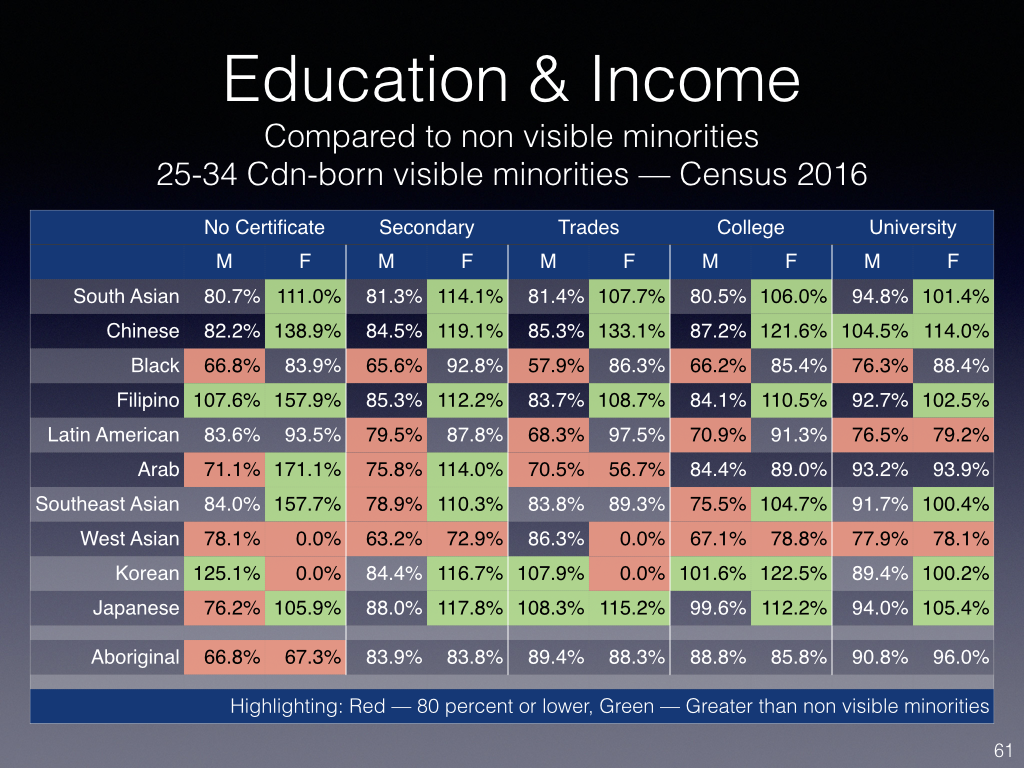
Ironically, when I analyse economic outcomes of visible minorities compared to not visible minorities, the gaps are larger between visible minority men and not visible minority men than is the case for women as the example looking at second generation 25-34 year olds below illustrates (similar pattern for first generation):

Not that many years ago, four to be precise, a senior journalist was sincerely trying to explain how his newsroom was attempting to diversify its staff.

Job applicants could check one of four boxes, he said. Gender, race, disability and sexual orientation. What box would I check, I wondered out loud.

“Race,” he said. And just like that, he erased major parts of my identity, rendering everything beyond my brown skin invisible.

This was about 25 years after civil rights advocate and scholar Kimberlé Crenshaw coined the term intersectionality to describe how people’s identities interact with power to create new forms of discrimination (specifically around Black women) when they overlap, and a few years after it had become a mainstream buzzword.

March 8 was International Women’s Day, a day that sprung from the women’s labour movement and began to be celebrated in many countries since the United Nations’ adoption of it in 1975. It gained a higher profile in recent years following important movements such as #MeToo.

But every day is every woman’s day. Celebrating the fierceness of the suffragettes who helped women win the right to vote doesn’t mean we forget that it was white women who won that right for themselves in Canada, Asians came decades later and that First Nations men and women didn’t have the right to vote until 1960.

If second-wave feminism looked at expanding rights beyond voting, I don’t know how we can celebrate representation in boardrooms and courtrooms without acknowledging that “diversity” initiatives have allowed white patriarchy to bend just enough to accommodate white women.

I don’t know how we can celebrate a narrowing gender wage gap without acknowledging that jobs traditionally done by women, often racialized women — health-care workers, daycare workers, nannies — are undervalued and underpaid. If full-time working women earned on average 75 cents to every dollar earned by a man, racialized and Indigenous full-time working women earned approximately 65 cents.

Women can use their own bodies however they choose, but I don’t know how we can celebrate Femen-type feminists and their topless protests without acknowledging that feminism is often reduced to sexual liberation or that sexual liberation is often reduced to the acreage of skin women expose.

For that matter, I don’t know how we think we’ve got anything close to liberation when women in the richest corporations are most valued when they show up to work looking thin, wearing tight clothes, tall heels and warpaint on their faces. And yeah, not in overly bright colours (too loud), not in overly short skirts (too slutty) or overly long ones (too daggy). Hair is ideally straight with a few waves permitted to flounce up at the bottom. While we’re at it, slow down those promotions if you must keep your hair grey, keep a ’fro or dreadlock or twist it, and heaven forbid you go home every time your kids are sick.

In other words, I don’t know how any reflection on the fight for women’s rights can be authentic unless it is intersectional. By that I don’t mean that we just include the voices of women who continue to be oppressed by identities of race, culture, caste, sexuality and disability.

To hell with “inclusion” and the paternalism inherent in it.

Inclusion is inviting a Black woman at a rally to speak about her experiences in a let’s-expand-our-minds sort of way. In this scenario, her experience — seen as a deviation from the norm rather than central to it — is still in service of non-Black women.

This kind of “inclusion” then allows organizations like the Toronto Public Library to claim diversity of thought and platform voices of those who reject trans women from the fold of womanhood.

On the other hand, true intersectional feminism means radically changing societal structures to put the most marginalized at the centre, making their concerns the first priority.

In this scenario, a discussion around sexual safety would yield not to more policing but less. In her book Invisible No More, Andrea Ritchie outlines how for white women, the concern around sexual assault and domestic violence is around police non-response. For women of colour, that police response is the problem, with too many experiences of officers responding to domestic violence calls sexually assaulting or otherwise violating the person who called for help.

The cases of the Missing and Murdered Indigenous Women and Girlsare not a sideshow from “mainstream” women’s issues, but central to it.

Prioritize those voices and support structures around sexual assault might start to look more like transformative education for all genders at schools and highly trained, legally empowered social workers might be brought to the front line.

On reproductive rights, if issues such as the forced sterilization of Indigenous women or the dignity of the poorest women were at the centre, the discussion would go beyond condoms and abortion rights. It would lead to a revolutionary battle to keep governments away from our bodies, a fight for free services including legal and medical support, among other solutions.

What is intersectionality? All of who I am


While I dislike the word as it is comes across as jargon rather than plain language (e.g., relationship between identities and circumstances) and find some of the language around oppression over the top, some useful context and history to the term.

While relatively easy to analyse some aspects of intersectionality (e.g., gender, race) with socio-economic data, this becomes harder with more aspects of identity to consider.

The recent article by Erin Tolley, Tolley: Racialized and women politicians still get different news treatment, provoked a twitter discussion (https://twitter.com/MalindaSmith/status/1103669339134160896) over the shorthand used to capture the concept of intersectionality::

Last year at the Golden Globes, many Hollywood actors got on stage in an act of unity for #TimesUp and #MeToo. Together they wore black and, in an attempt to bring together a diverse range of women, used the word “intersectionality.”

The Hollywood starlets were reflecting a current conversation within progressive and not-for-profit circles. Intersectionality has been recently used within academic fields such as psychology, human rights and political science.

My field — anti-racist, anti-oppression/colonial-centred health equity —relies heavily on the idea of intersectionality. As a concept, the term can help communicate complex realities.

What exactly is intersectionality?

Kimberle Crenshaw, legal scholar and critical race theorist, is generally credited with originating the term in the late 1980s.

Some activists and scholars, however, trace the earliest articulations of intersectionality back to the ’70s in the manifesto by the Combahee River Collective, a collective of Black (lesbian-identified) feminists who, in 1977, said:

“We … find it difficult to separate race from class from sex oppression because in our lives they are most often experienced simultaneously.”

To understand intersectionality and how to apply it, I believe it is essential to understand four concepts:

1. All of who I am: Factors of identity

Intersectionality embraces the idea of “all of who I am.”

One of the main critical concepts is “location:” To locate oneself politically and socially means to identify specific factors about your identity. These factors include: race, indigeneity, socioeconomic status, gender, gender identity, sexual orientation, age, (dis)ability, spirituality, immigration/refugee status, language, and education.

One of the ideas of intersectionality is for individuals, groups and communities to self-identify. This allows people to choose what they share about themselves.

For example, I locate myself within the African diaspora, as a woman who has survived African enslavement, a feminist from a working-class background, daughter of Caribbean immigrants, mother, living with a visual disability in Turtle Island (Canada). I also locate myself as a researcher, educator, therapist and community organizer.

Another factor of location is to identify power and unearned privilege. Dependent on one’s location(s), one may have power and privilege over others.

For instance, white men have more power and unearned privilege than white women based on systemic oppression supported by patriarchy, sexism and misogyny. Based on anti-Black racism, Black men have less power and unearned privilege than white men, but because of sexism, they have more unearned privilege than Black women.

Even though they experience sexism, white women have more power and unearned privilege than Black women due to anti-Black racism.

If you want to be an ally and support emancipatory changes, it is important to reflect on your location.

Allies are folks who actively support individuals and communities experiencing multiple forms of oppression; they share and give up their power to help make changes in the lives of the disempowered. However, it is important to note: an ally-centred person dependant on time, place and their location can also experience disempowerment.

2. Oppressions

What is oppression?

Oppression is ways of knowing and doing by those with power and authority as individuals, in governments and cultural institutions that create marginalization and subjugation of those who do not have institutional authority or power — often African/Black, Indigenous and racialized folks.

We need to understand systemic forms of disempowerment and brutality so we can actively create room for an intersectional analysis.

3. Violence

An intersectional analysis has to connect the human experiences of violence, historically and currently.

Violence includes the exercise of power to oppress and discriminate against communities individually and collectively. Violence is any abuse of power (public, private, and/or structural) that inflicts harm.

Violence includes physical, sexual, and psychological harm including: anti-Black racism, anti-indiegenity, classism, sexism, homophobia, transphobia and ableism.

Violence by police in Black communities is an example of public and private, race-gender-class based violence. The result is physical, psychological and financial violence against Black men, women, children and our families.

4. Resistance

Actualizing resistance is critical to intersectionality. Resistance is the struggle to survive, exist, persist and fight to eradicate ideologies and practices of colonialism, anti-Black racism, and all other forms of intersectional violence in the lives of Black, Indigenous and racialized folks and our communities.

A brief genealogy of intersectionality

In the ’80s, many scholars elaborated on the limitations of the isolation of categories such as race, class and gender as the primary category of identity, difference or oppression and their legal implications for Black communities.

Feminist scholar Moya Bailey at Northeastern University has coined the term “misogynoir” over the past decade on social media: it is used to describe the intersection of sexism and racism. But many before Bailey spoke of similar issues.

Many Black women in the 1800s and 1900s were discussing how racism and sexism intersect to create a racialized noir misogyny. In 1851, Sojourner Truth, a former enslaved Black woman, talked in her now famous speech “Ain’t I a woman” about the complexities and violence that Black, enslaved and poor women experienced living in America.

Other women who made these connections during that time period include: Mary Church Terrell, Nannie Burroughs, Fannie Barrier Williams, Anna Julia Cooper, Ida B. Wells and Harriet Tubman.

More recently, Black women who have influenced our knowledge base on intersectionality include: Shirley Chisholm, Angela Davis, bell hooks, Fannie Lou Hamer, Assata Shakur, June Jordan, Audre Lorde, Patrica Hill-Collins, Viola Desmond, Carol Boyce-Davies, Ama Ata Aidoo, Dionne Brand, Amina Mama and Afua Cooper.

Transnationally, many nameless Black women in our communities and professional spaces spoke about the intersections of their lives as women, as Black, as poor. Their experiences stem directly from shared histories of colonialism, enslavement, industrialization and democratization on the backs of African and Indigenous peoples.

Different phrases were used to describe their conditions. But their words and actions mobilized Black, Indigenous and racialized women globally to examine how race, gender and class simultaneously impact our lives and how we resist.

The anti-semitism intersectionality gap

While I dislike the term “intersectionality,” I haven’t found an alternative term that describes how the interactions between race, class, gender and religion and their complexities.

But conflating Jews with Whites misses the commonalities of discrimination and prejudice, even if they play out differently with respect to Jews compared to other groups:

My mom is stoic and rarely ever cries. Last week she FaceTimed me from California, dewy-eyed, while I was in the subway in New York. She mentioned the news—11 Jews shot in a synagogue in Pennsylvania. I had already read about it in the morning, but talking about it with my mom forced me to feel it.

She told me, “It’s okay to feel sad.”

I forget sometimes that I’m allowed to feel sad for Jews. The discourse in the School of Social Work around anti-Semitism has dwindled in large part due to the hyperbolic conflation of Jewishness with whiteness. I am therefore quick to forget that Columbia often fails to treat anti-Semitism with the legitimacy it deserves. My mom’s simple acknowledgement allowing me to feel Jewish pain reminded me that it was ok to feel so deeply.

My experience in the Columbia School of Social Work has often made me feel hollow. It can seem like I have no role as a Jew in both the course curriculum and in class discussions. “How Jews Became White Folks” is my school’s single mandatory reading regarding Jewish people in contemporary society. And, even though this piece takes a dive into important assimilation markers of the American Jew, this is only a 20-page reading shoved in among the several books and 40 articles that make up our curriculum. In discussions, fellow classmates have confessed that they have become frustrated when Jewish people speak up about their experiences. On one occasion, I tried to explain to a close peer how my Jewishness guides my social justice work and she told me that I needed to stop talking, since my white privilege dominated any authentic form of solidarity I could claim as a Jewish person. During my time at Columbia, I often wonder if I truly belong at the School of Social Work.

Why do my peers dismiss my Jewish identity due to my white skin? Why do I feel so disingenuous for being Jewish in social justice work?

This message from my peers, that Jews are white, isolates the Jewish people from the broader cultural context. It creates an assumption that renders the dialogue around anti-Semitism obsolete and minimizes the Jewish experience. Not only is this generalization detrimental to understanding the nuances and diversity of Jewish identity, but it also inhibits an honest conversation about the ways being Jewish has been contextualized in discourses of race, ethnicity, and culture. Frankly, perceiving Jewishness as a mere form of whiteness or as just a religion is ignorant. Holocaust survivor Elie Wiesel knew this, and cautioned us against these toxic and reductive comparisons when he said, “No human race is superior; no religious faith is inferior. All collective judgments are wrong. Only racists make them.”

Intersectionality—the interrelation between race, class, and gender—is a central theme in our curriculum that promotes a solidarity-driven approach to social justice. Unfortunately, it seems that this ideology is not being taught to address issues pertaining to anti-Semitism. Social workers are often so concerned about abiding by these pre-established intersectionality guidelines that they unintentionally perpetuate the very kinds of discrimination that they supposedly oppose. Thus, Jewish students whisper to each other in the secrecy of dimly lit dive bars about our shared experiences of anti-Semitism, but we don’t risk speaking out in class. An intersectionality gap exists between engaging in discussions of anti-Semitism and those pertaining to other forms of racism. Rather than avoiding discussions of anti-Semitism, we must break the silence by discussing solidarity.

Before this shooting happened, people didn’t seem to care about the plight of the Jew. But I have found myself obsessed with the topic and unable to stop writing about it in different forms. I’m calling upon Columbia School of Social Work and schools of social justice everywhere to break this silence and take meaningful action to change their current practices of omitting Jewish identity and experience from their classrooms and conversations.

Source: The anti-semitism intersectionality gap

The ‘Intersectionality’ Trap: Rothman | Commentary

While Noah Rothman mischaracterizes intersectionality – it can be used in an ideological or non-ideological manner – there is some merit is his critique of how the left, just as the right, overlooks the ‘sins’ of some of their supporters or advocates:

Republicans didn’t always scoff dismissively at the self-destructive, reactionary, fractious collection of malcontents who call themselves The Resistance. The hundreds of thousands who marched in the streets following Donald Trump’s election once honestly unnerved the GOP. This grassroots energy culminated in January’s Women’s March, a multi-day event in which nearly two million people mobilized peacefully and, most importantly, sympathetically in opposition to the president. It was the perfect antidote to the violent anti-Trump demonstrations that typified Inauguration Day, and it might have formed the nucleus of a politically potent movement. The fall of the Women’s March exposes the blight weakening the left and crippling the Democratic Party.

The fever sapping Trump’s opposition was evident in microcosm on Monday in the meltdown of the Women’s March’s social-media presence on Twitter. “Happy birthday to the revolutionary #AssataShakur,” the organization wrote, dedicating the day’s resistance-related activities in her “honor.” Shakur is perhaps better known as Joanne Chesimard, the name that appeared on the court documents in connection with her being tried and convicted of eight felonies, including the execution-style murder of a New Jersey State Trooper. She currently resides in communist Cuba, a fugitive from American justice.

The outrage that followed the Women’s March’s endorsement of a cop-killer, exile, and unrepentant black nationalist was such that the organization was compelled to explain itself. “[T]his is not to say that #AssataShakur has never committed a crime, and not to endorse all of her actions,” the group flailed. “We say this to demonstrate the ongoing history of government [and] right-wing attempts to criminalize and discredit political activists.” This fanatical display of befuddlement perfectly encapsulates the logic of “intersectionality.” It demonstrates why this vogue ideology shackles its devotees to doomed causes and sinking ships.

“Intersectionality,” the beast born in liberal hothouses on college campuses, slouches now toward the halls of power. It is a Marxist notion that all discrimination is linked because it is rooted in the unjust power structures that facilitate inequality. Therefore, there are no distinct struggles against prejudice. Class, race, gender, sexual identity; these and other signifiers are bound together by the fact that oppression is institutional and systemic. The problem with this ideology is it compels its adherents to abandon discretion. To sacrifice anyone with a claim to oppression is to forsake every victim of prejudice. So, sure, Assata Shakur robbed, assaulted, incited violence, and killed a cop. But she also hates capitalism and white supremacy. Therefore, she’s one of us.

It is this logic that has rendered the “Sister Souljah moment” a relic of the past, and The Resistance is drowning in Sister Souljahs.

One of the March organizers, Linda Sarsour, has enjoyed newfound popularity and legitimacy in the age of Trump. She is a self-styled organizer for civil rights and the Muslim-American community of which she is a part, and she’s been acclaimed by organizations like the ACLU and Demos. Democratic Senator Kirsten Gillibrand described Sarsour and her colleagues as “the suffragists of our time.” In return for this lavish praise, Sarsour has only forced her defenders into awkward positions.

Sarsour has praised Saudi Arabia’s social welfare state as appropriate compensation for stripping women of privileges such as driving a car. “I wish I could take their vaginas away,” she wroteof women like the Somali-born Dutch-American activist and genital-mutilation victim Ayaan Hirsi Ali. “You’ll know when you’re living under Sharia Law if suddenly all your loans [and] credit cards become interest-free. Sound nice, doesn’t it?” she asked. While delivering the keynote address to a Muslim-American conference, Sarsour advocated “jihad” against Donald Trump, defining the term to mean only speaking truth to power. Rather than admonish their political ally for this obvious indiscretion, the American left went to the mattresses to explain that only they understand the true meaning of the word “jihad.”

For some on the left, advocating violence is not only justified but fashionable. Misanthropic so-called “anti-Fascist” activists like Shanta Driver and Yvette Felarca have become a ubiquitous presence in pro-Resistance mythology. People like Driver advocate for “militant actions” while Felarca appears at the head of armed mobs “resisting” the white supremacist alt-right “by any means necessary” (which happens to be the name of the organization to which she belongs). For this “activism,” these and other “anti-fa” organizers are feted by left-wing magazines like Mother Jones and The Huffington Post.

Amid the celebration of left-wing political violence, a man who had been radicalized by liberal politics attempted the mass assassination of Republican members of Congress. Far from dwelling on this potentially generation-defining attack, the event passed through the national consciousness like an apparition. We don’t talk about that now. Perhaps we don’t want to think about what it might portend.

None of these individuals have roots in Democratic politics so deep that they cannot be deracinated relatively painlessly. Indeed, their counterproductive behavior would compel any competent political operation to make an example or two—particularly an operation struggling to demonstrate that it can be trusted again to govern seriously and effectively. Yet the Democratic Party and the liberals who animate it have come under the spell of a philosophy that explicitly forbids the exorcism of its demons.

Republicans have their devils, too. The excision of which may not seem a terribly urgent project today, given the GOP’s political dominance. They will confront that crisis soon enough. In the interim, Democrats should be remaking themselves to appeal to the existing electorate; the one that delivered to the GOP near total control of state and federal government over just six years. Instead, Democrats are voluntarily yoking themselves to their most radical elements even as the number of Americans who describe the party as “too extreme” continues to climb.

Republicans may have their troubles, but a competent opposition is not among them. 

Source: The ‘Intersectionality’ Trap | commentary

Toronto Councillor Kristyn Wong-Tam withdrawing ‘intersectional’ motion that clashed with Black activists: Paradkar

Eating their own rather than moving forward – action starts with awareness:

Toronto councillor is withdrawing a motion asking the council to establish an “Intersectional Awareness Week” after it ran afoul of detractors from unexpected quarters.

“I will be withdrawing the motion,” said Kristyn Wong-Tam, who also released a statement Wednesday morning, barely five days after the motion was launched. “I was hoping . . . that it was the beginning of a powerful movement to raise awareness that we are not single-issue people.”

The city council had directed Toronto’s city manager to create an “Intersectional Gender-Based Framework to Assess Budgetary Impacts” in next year’s budget, her statement said.

“A dynamic young, LGBTQ2S+ racialized woman working with my office proposed the creation of an Intersectionality Awareness Week. She diligently did her research and with the input of my office staff, drafted a motion which was wholeheartedly endorsed.”

The opposition to her proposal came not from the usual suspects such as Councillors Giorgio Mammoliti or Jim Karygiannis, who tabled an openly hostile motion against Black Lives Matter couched as support for Toronto police, but from several high-profile Black scholars, activists and community workers.

Intersectionality is the term coined by the American scholar and civil rights advocate Kimberlé Williams Crenshaw to describe the invisible overlapping or intersection of issues of class, race, gender, ethnicity and sexuality when it comes to discrimination. She first applied it in the context of Black feminism.

While she used the term in 1980s, it has entered the mainstream only in recent years, and though I have a distaste for what I call “academese” — jargon that serves to obfuscate rather than clarify — the word “intersectionality” has expanded into an exceptionally effective descriptor of marginalized people at the crossroads of multiple identities.

Wong-Tam’s proposal aiming to commence an educational campaign fell apart after her critics released an open letter asking for the motion to be withdrawn.

At issue were the following points:

  1. The timing. The proposal came on the heels of the inquest that ruled the death of Andrew Loku — a mentally ill Black man killed by police — a homicide, a verdict with no criminal liability. The timing suggested it was, yet again, a token gesture of mollification by the city, a symbolism without substance.
  2. The motion did not take into account the contribution of Crenshaw (an omission that was later amended) for the term intersectionality, and the work of other Black feminists, and it did not reference Blackness, suggesting it ignored Black struggles.
  3. The exclusion of Black activists from the planning of the proposal that suggested a disregard for their experiences.

“I was prepared to amend it after some of the comments I heard. I recognize there are individuals deeply attached to the discussion,” Wong-Tam told me. She says Crenshaw, whom she reached out to after the initial motion, was supportive of her proposal and described it as incredibly exciting news. The hope was that city council could partner with local universities to bring Crenshaw to Toronto to launch the initiative, she said.

The proposal also had the support of the Urban Alliance on Race Relations.

“Now that there’s this open letter,” Wong-Tam said. “I also want to be respectful of what they say. I understand their skepticism especially in light of police shootings.

“There was nothing behind the motion that was meant to harm anybody. It would allow us to create a forum to better understand the concept of intersectionality.”

Her critics didn’t see it that way. They saw the proposal as celebratory.

“What exactly has the city done in order to warrant the celebration of Intersectionality Awareness Week? What awareness does the city have that it feels that it can lead such an initiative?” asked OmiSoore Dryden, chair, department of women’s, gender and sexuality studies at Thorneloe University (at Laurentian). “I would really like councillors to focus on this job, instead of the time and energy they have put into the pretence of this ‘awareness week.’ ”

There are no bad people in this conflict — a rarity these days — only people on the same side disagreeing on the way forward.

As a racialized immigrant woman of colour in the LGBTQ community, Wong-Tam gets intersectionality.

As people experiencing daily oppression, Black people are opposed to yet another government awareness program with brochures and seminars.

There’s also a chicken-and-egg tension; Black activists want Wong-Tam to establish credibility and see action before words. “We want a commitment from the City of Toronto to actually do some substantive work in helping Black people live our lives fully,” the activists’ open letter says.

For Wong-Tam, spreading awareness would lead to action. “I don’t believe we can get to a place of full equity by not having these dialogues. This is how we build allyship.”

There is a gap in the understanding of the term “intersectionality” in the broader population, and Wong-Tam has identified it as one that needs to be addressed.

It does.

With the shock waves of the Loku verdict still reverberating, the time to address that gap may not be right now. But in time I hope these two sides get together to hammer out concrete steps to make it happen.

Source: Councillor Kristyn Wong-Tam withdrawing ‘intersectional’ motion that clashed with Black activists: Paradkar | Toronto Star