#COVID-19: Comparing provinces with other countries 7 October Update
2020/10/08 Leave a comment
Highlights:
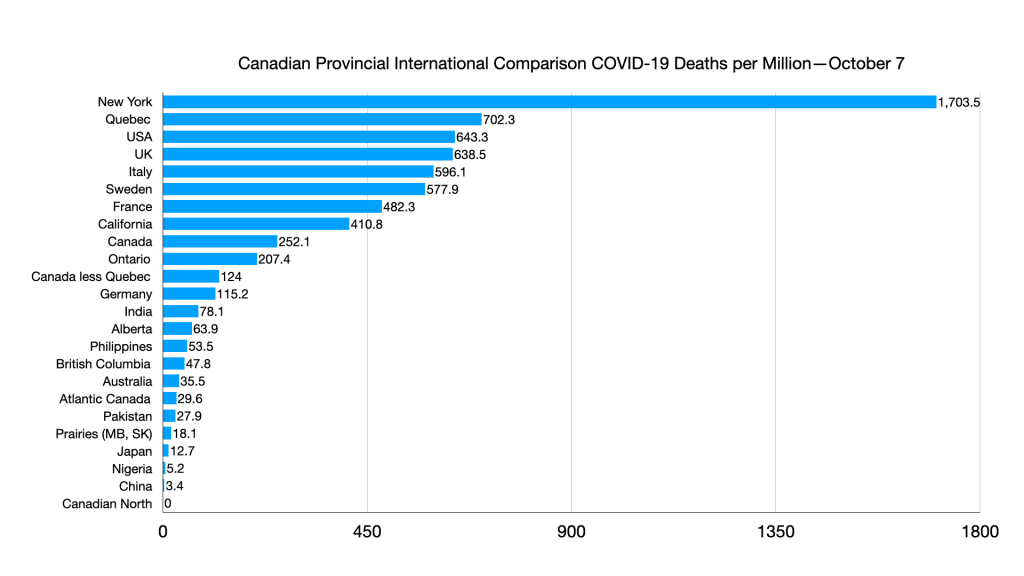
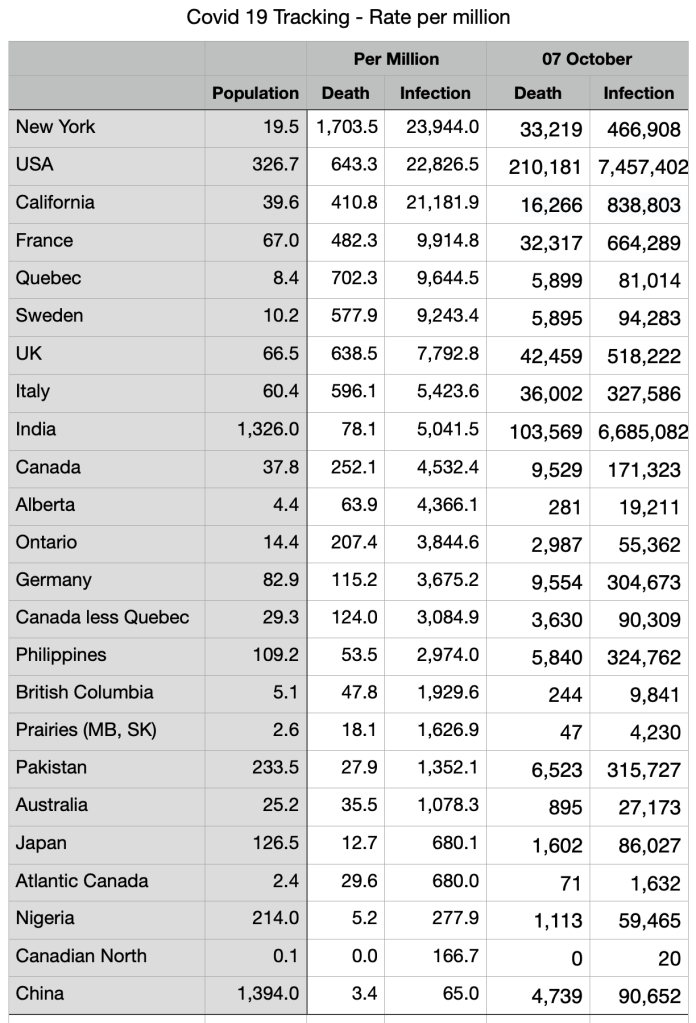
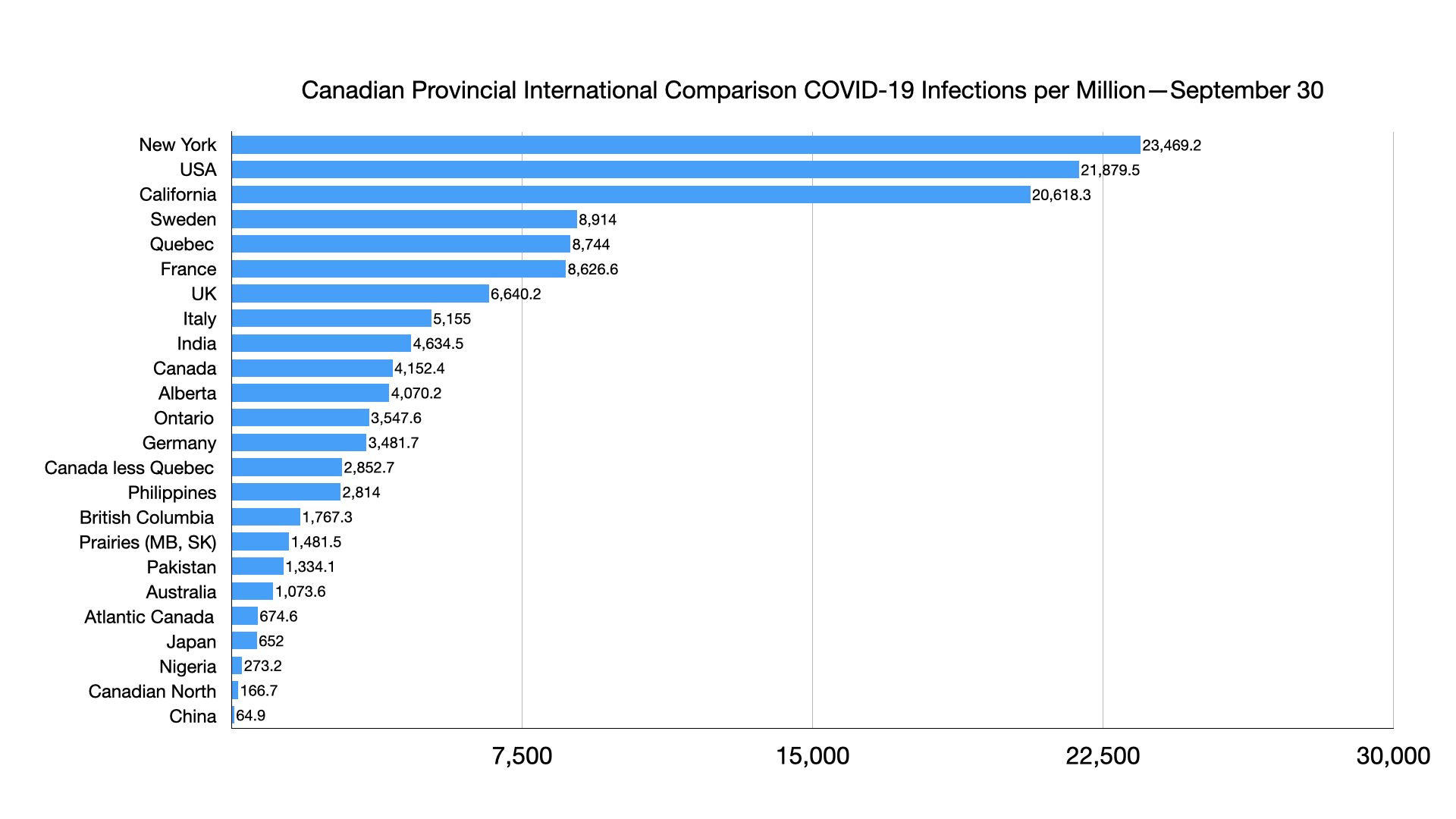
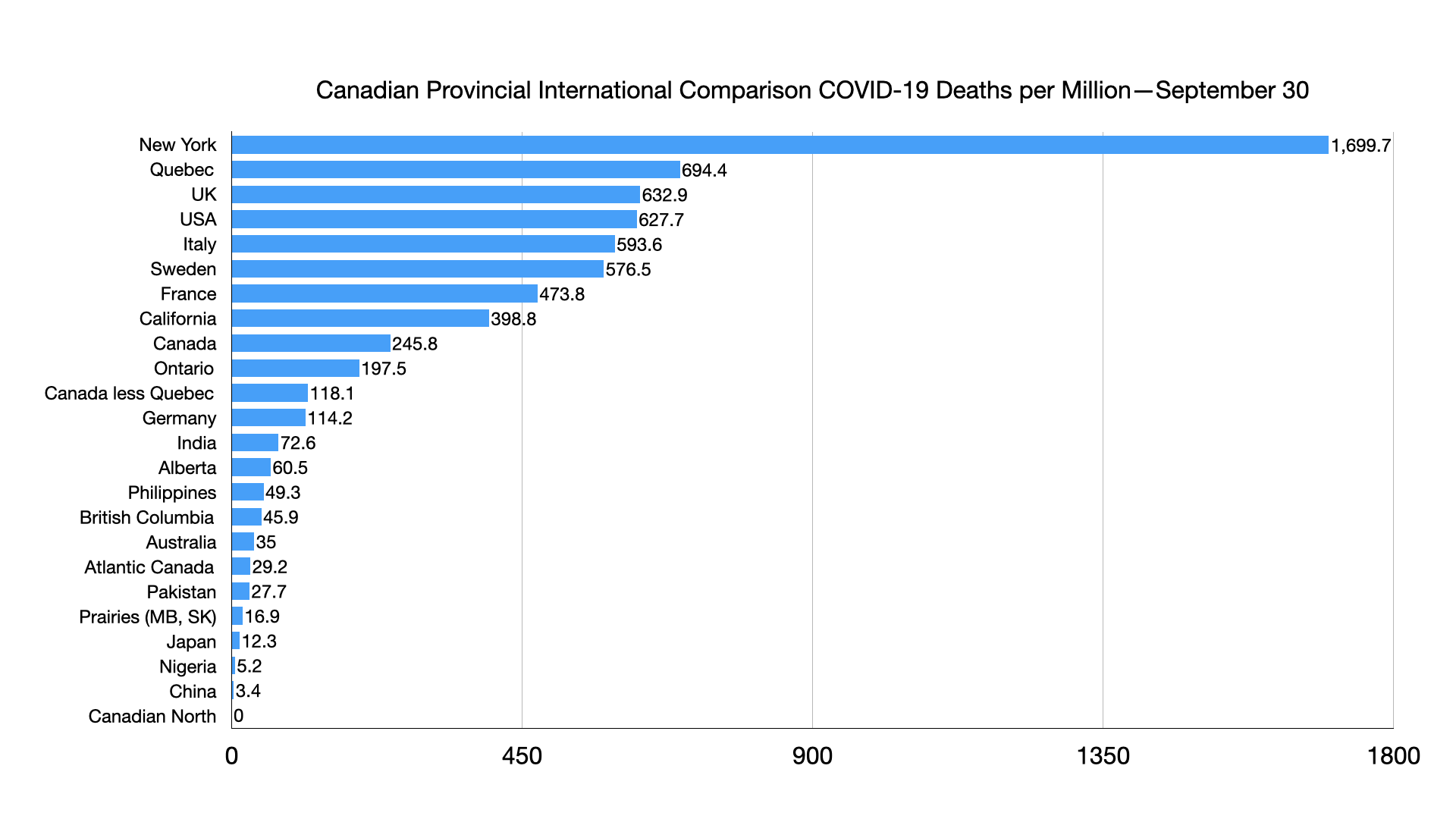
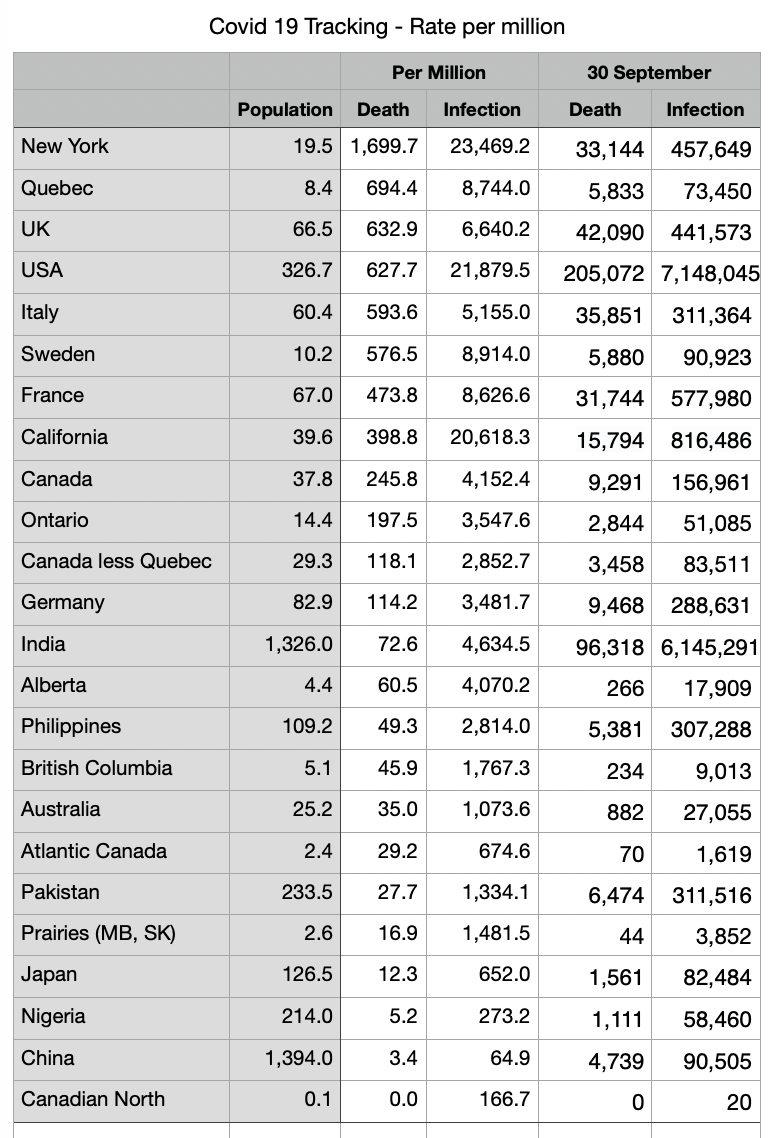
Deaths per million: USA now ahead of UK
Infections per million: France and Quebec ahead of Sweden, Japan ahead of Atlantic Canada

Working site on citizenship and multiculturalism issues.
2020/10/08 Leave a comment
Highlights:
Deaths per million: USA now ahead of UK
Infections per million: France and Quebec ahead of Sweden, Japan ahead of Atlantic Canada
2020/10/01 Leave a comment
Highlights:
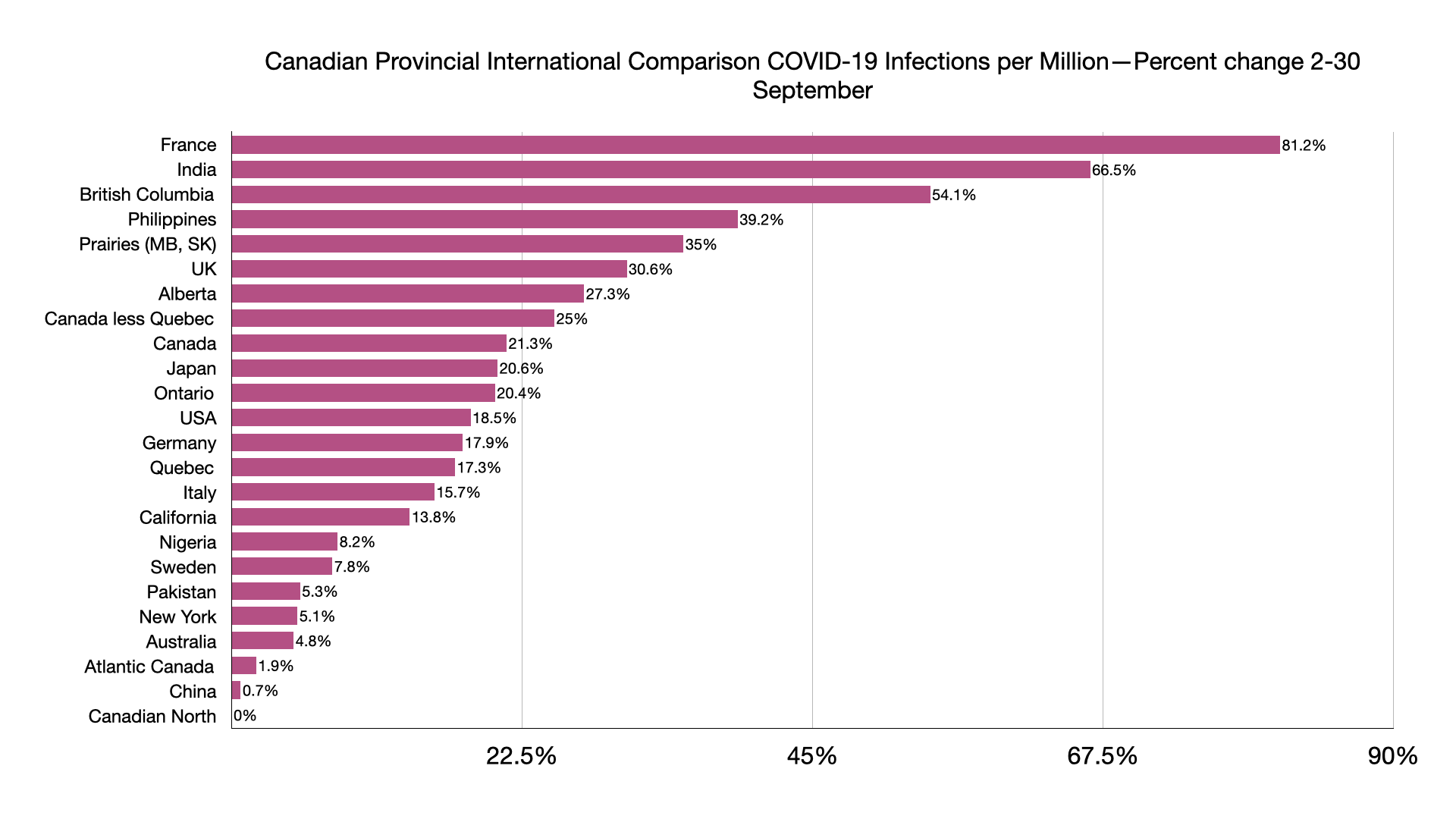
Deaths per million:Canada less Quebec now ahead of Germany
Infections per million: Ontario now ahead of Germany, Canada less Quebec ahead of Philippines
 The Globe has an editorial highly critical of the Ford government:
The German language probably has a word for the state of being surprised by the unsurprising, unprepared for the expected, and caught off guard by the danger you were on guard against. English does not have such a word. But when this pandemic is over, we are going to have to come up with one.
We’ll need it to describe what appears to be happening right now, in Canada.
Governments from coast to coast knew a second wave was coming. It was as predictable as fall. It was as expected as the rising of the sun. It was as surprising as the first snowfall – timing and severity uncertain; occurrence inevitable.
And yet, somehow, many governments have reacted like someone who forgot to set the alarm clock. Leading the parade of those surprised by the unsurprising is Premier Doug Ford’s Ontario government.
On Monday, Ontario reported 700 new cases of COVID-19, a new single-day record. Also on Monday, Ontario casinos reopened their doors to gamblers.
They say timing is everything in comedy and politics. In pandemics, too.
Also on Monday, the Ford government announced that, in response to the second wave, it would be hiring 3,700 more frontline health care workers. It’s a move that should have been made in May or June, not late September.
Still on Monday: Ontario reported processing more than 41,000 tests, but had a backlog of 49,586 waiting to be analyzed. By Tuesday, the backlog was nearly 55,000. The province, like many parts of the country, has recently seen enormous lineups at testing centres; lineups that are – how is this surprising? – driven by the predictable and predicted combination of rising infection rates and people needing to get tested to allow a safe return to school.
Yet again on Monday: The Ottawa Citizen obtained a memo showing that provincial health bureaucrats ordered a reduction in testing in some areas, owing to labs being overwhelmed. It’s another unsurprising result of too little test-processing capacity meeting growing demand for tests.
As of Tuesday afternoon, the pinned tweet at the top of Health Minister Christine Elliott’s Twitter feed still said: “It’s never been more important to get tested for #COVID19.” She’s right. The more people who get tested, the more often, the better. That should include lots of people who have no symptoms. But if everyone takes that advice to heart in the current system, where there are not enough tests or facilities to process them, Grade 3 math points to the inevitability of a surprisingly unsurprising outcome.
For anyone who remembers what Ontario went through last spring, that outcome looks all too familiar. We have lived this movie before.
Yes, Ontario is conducting several times more daily tests than it did back in April. Yes, Ontario has the second-highest provincial testing rate (Alberta is tops). There has been progress. There just hasn’t been enough.
With case numbers rising, as in the spring, and testing not keeping pace, as in the spring, this looks a lot like a sequel. The script has a disturbing amount of consistency. If it were run through plagiarism-detection software, someone would be getting an “F.”
More unsurprisingly surprising findings:
The most recent data from Toronto Public Health, as reported by the CBC, show that most people testing for COVID-19 don’t get results for at least two days. And nearly half of those who test positive are not followed up by contact tracers within 24 hours. Both of those numbers are well below the targets that need to be met for a program of heavy testing and contact tracing – which the province is supposed to have, but doesn’t – to be able to quickly find infected people before they infect others, and even more quickly track down anyone they may have infected.
In an effort to speed things up, the Ford government last week gave the green light for some pharmacies to begin administering tests to some asymptomatic individuals. The province also intends to hire more contact tracers. The mystery is why it didn’t do that months ago.
And last week, the province began rolling out plans for its response to the pandemic’s second wave. But this is like announcing in January that, in response to recent snowfalls, you plan to put out a tender for snowplows. It’s a bit late in the game.
2020/04/15 Leave a comment
Why is it that governments, no matter their political stripe, cannot resist the temptation to over-reach and reduce oversight, whether with respect to bloated omnibus budget bills or during the current COVID-19 pandemic?
And while the federal Conservatives, supported by the NDP, correctly forced the Liberals to back down given a minority government, in Alberta, there is no such check on the UCP government as this Globe editorial details.
Even more shameful than the attempted federal Liberal element given the UCP’s majority and its disregard for parliament (ironic, given that Premier Kenney was an effective parliamentarian at the federal level).
Hopefully, the same conservative-leaning pundits that rightly condemned the Liberal attempted power grab will also call out the Alberta UCP power grab (the first one to do so, John Carpay: Alberta’s Bill 10 is an affront to the rule of law):
Three weeks ago, the Trudeau government tried to use the cover of the coronavirus crisis to give itself unchecked powers once enjoyed by 17th-century European monarchs.
Prime Minister Justin Trudeau had recalled the House of Commons on March 23 to debate and pass emergency measures to shore up the economy and help Canadians who were losing their jobs.
The opposition were willing to back the minority government’s economic measures, but once they saw the draft bill, they realized the Liberals had something more in mind.
Along with tens of billions of dollars in aid for Canadians in need, the bailout legislation also included clauses that would have given the government the power to raise or lower taxes, and to spend money, without going through Parliament. These extraordinary powers were to last until Dec. 31, 2021.
The opposition, along with many in the media, this page included, were having none of it. By the end of the day on March 23, the government relented. It removed the offending clauses, the opposition offered its backing and, the next day, the bill became law.
Team Trudeau has not explained its attempted end run around democracy, probably because it can’t. There is never any reason to usurp Parliament’s critical role as overseer of government and keeper of the public purse. Every Canadian government, provincial or federal, should get that.
And yet, barely a week later, it happened again.
In Alberta, the United Conservative Party of Premier Jason Kenney used its overwhelming majority to push through a bill on April 2 that gives cabinet ministers unilateral power to write and enact new laws in public health emergencies, with zero oversight by the provincial legislature.
Under Bill 10, the only requirement for enacting a new law is that the relevant minister “is satisfied that doing so is in the public interest.” The only limit on that power is that a new offence cannot be applied retroactively.
It is utterly wrong for democratic governments to seek unilateral powers under the cover of an emergency. It is also unnecessary. There is no justification for it – especially not the one that says governments need to move quickly in a crisis.
Alberta passed Bill 10 in less than 48 hours; the Trudeau government, having secured the support of the opposition, passed its original bailout measures in the same short period. Last weekend, it took less than a day for Parliament to adopt a wage subsidy package. The government shared the legislation with the opposition in advance and made changes to ensure it would pass.
Giving legislators the chance to study, debate and vote on bills doesn’t result in unacceptable delays – if anything, as shown time and again, it improves legislation. More importantly, the transparency and accountability that comes from having to pass a bill through Parliament is the foundation of our system of government.
The Liberals and the opposition parties are now arguing about how often the House of Commons should sit during the remainder of the crisis, and whether sessions should be held in person with a skeleton crew of members, or with all MPs, via teleconferencing.
However it does so, Parliament must sit. Committees, too. And Question Period must happen, so that the government remains answerable to the House and to Canadians. That holds in Ottawa and in each of the provinces. It goes for both minority and majority governments.
Under no circumstances should any government see this emergency as an excuse to sideline the elected representatives of the people.
Thanks to their daily crisis briefings, government leaders are dominating the news coverage. Opposition voices have been sidelined, but they must be given their due in order for our democracy to function properly. That happens best in Parliament.
This crisis is demanding a lot of Canadians. They are self-isolating at home with their families. Many have lost their jobs, or are watching their businesses teeter on the precipice.
They will be able to decide for themselves whether federal and provincial opposition parties have helped the situation, or simply been a partisan nuisance. But Canadians must not come out the other end of this only to discover that their institutions and rights have been compromised by governments that grabbed for powers they were not entitled to.
2019/04/15 Leave a comment
Reasonable balance, as also seen in Ibbitson’s piece (Liberals’ immigration plan is sound policy delivered poorly: John Ibbitson):
Canada needs immigrants. Canada needs secure borders. These may sound like contradictory claims; they are not. They go hand-in-hand.
Over the past couple of weeks, the Trudeau Liberals have abruptly woken up to this reality. They’ve started talks with the United States to close a loophole in the Safe Third Country Agreement that allows people who enter Canada at irregular border crossings to make a refugee claim, rather than being turned away. They also introduced legislation – buried in an omnibus budget bill – to make anyone who has filed an asylum claim in the United States and several other countries ineligible to do so in Canada.
The target is the influx of migrants at Roxham Road. Over the past two years, about 40,000 people have walked across the Canada-U.S. border, most on a street that dead-ends where New York stops and Quebec starts. These people are not illegal immigrants; the vast majority willingly surrender to authorities so that they can make an asylum claim, giving them legal status in Canada, including the right to work for as long as it takes an extremely slow and backlogged refugee system to decide on the merits of their claim.
Our refugee system is generous, but it’s also very slow-moving. And it’s breaking down and losing public confidence under the strain of too many people trying to use it. Many appear to be travelling to the United States on tourist visas for the purpose of making a refugee claim in Canada.
The Liberals’ latest steps to address this risk is damaging Prime Minister Justin Trudeau’s brand. His government is now doing something that it spent the past three years attacking the Conservatives for even talking about. But though it’s out of sync with the Trudeau government’s previous rhetoric, it’s in line with how Canadian governments of all stripes have dealt with immigration over the past few decades.
Under a series of administrations, Liberal, Progressive Conservative and Conservative, the vast majority of immigrants – whether economic migrants, family-reunification arrivals or refugees – have always been chosen from overseas and only entered Canada after having been vetted. It has been immigration by choice – Canada’s choice.
That’s true, for example, of the influx of Syrian refugees into Canada early in the Trudeau government’s mandate. They chose Canada, but first Canada chose them.
Next to its open immigration door, Canada has long had bureaucratic walls and moats. Canadian governments have consistently taken steps, most of which go largely unnoticed by Canadians, to make it extremely difficult for anyone to come to Canada if there is a risk that person may attempt to remain in the country, whether as an illegal immigrant or as an asylum-seeker.
That’s mostly been about making it very difficult to get to Canadian soil and gain access to the Canadian legal system. To take just one example, a 2017 World Economic Forum survey of travel and tourism professionals ranked Canada as one of the worst countries in the world – 120th out of 136 – for the restrictiveness of visitor visa requirements. But that’s not a bug of Canada’s visa system. It’s a feature.
Compared with our southern neighbour, Canada is a high-immigration country. That’s long been true. Relative to population, Canada takes in roughly three times as many legal immigrants as the United States. And while the number of foreign-born American residents recently hit a high of 13.5 per cent, at no time since the 1901 has Canada’s level of foreign-born residents been that low. Today, 21.9 per cent of Canadians were born overseas.
Compared with our southern neighbour, Canada has also always had low levels of irregular, unauthorized, unexpected and illegal immigration. Washington doesn’t even know how many illegal immigrants the country has; estimates range from 10.7-million to 22-million to nearly 30-million.
That has poisoned the American immigration debate, and made rational immigration discussions almost impossible.
For a growing number of voters and politicians on the American right, all immigration, legal or illegal, is seen as a threat. For a large number of their opponents on the left, any distinction between legal and illegal immigrants is similarly rejected. Talk of higher legal immigration is unacceptable on the American right; talk of lower illegal immigration is unacceptable on the left.
For Canadians, it should be a cautionary tale.
Source: On immigration, the Trudeau Liberals are going off-brand – and hitting the mark
2018/09/25 Leave a comment
Kind of revealing that after two full-page editorials, all the Globe can come up with is the need for more funding for the refugee determination process and no legal analysis of its legitimate question regarding possible streamlining of the refugee determination process for irregular arrivals and limiting appeals for those refused.
Thin gruel, highlighting the difficulties in finding solutions that address legitimate public concerns regarding numbers and perceive abuse in a manner that will withstand legal challenge.:
….That won’t be easy, since every person who makes a refugee claim in Canada is legally entitled to an oral hearing. As well, courts in Canada have repeatedly protected the rights of refugee claimants, including those coming from countries deemed to be safe.
But there must be a way to find a compromise between respecting those rights while giving the government the ability to limit abuses of the refugee system and to show determination in controlling our borders. For instance, could Ottawa pass legislation that gives it the discretion to deny appeals to people whose refugee claims are refused, and who didn’t come into the country at a legal port of entry?
At the very least, the government needs to signal that it is looking at long-term solutions. What Mr. Trudeau fails to understand, and politicians in Germany have come to rue, is that dismissing concerns about border security is unwise. The Prime Minister needs to demonstrate that he is willing to act decisively and take away the incentives that have led to this moment.
2017/08/22 Leave a comment
If only …
But even a neutral body would have a challenge drafting a text that would be viewed as neutral by all:
Immigrants who want to become citizens of Canada have to pass a test demonstrating a basic knowledge of this country. To prepare for the test, the federal government provides a study guide filled with facts, names, dates and – these days – subtle little plugs for the party in power.
It’s sad, really. After reading the current version of the guide prepared by the Harper government and parts of a draft of the new one coming any minute now from the Trudeau government, one is left with the impression that the chief goal of the exercise isn’t to help newcomers be better citizens but, rather, to tickle the biases of the governing party’s supporters.
Take the Harper version. It tells newcomers that Canadian law prohibits “barbaric cultural practices that tolerate spousal abuse, ‘honour killings,’ female genital mutilation, forced marriage or other gender-based violence.”
It also says that one of the chief responsibilities of citizenship, along with obeying the law and serving on juries, is “getting a job, taking care of one’s family and working hard.”
Conservative voters reading this are going, What’s wrong with either of those things? Liberal voters, on the other hand, are going, Typical Conservative bashing of immigrants’ culture and work ethic!
Which explains why, under the Liberals, the references to barbaric cultural practices and the responsibility of getting a job aren’t in a draft of the new guide obtained by the Canadian Press.
Can you guess what Trudeau government canon will soon be included in the “mandatory” responsibilities of citizenship, along with obeying the law and doing jury duty?
Filling out the census and respecting treaties with Indigenous peoples, that’s what.
If the NDP ever gets into power, we swear the guide will be re-written to say that supporting the right to collective bargaining is a responsibility of Canadian citizenship, and that the colour orange isn’t just for Halloween anymore.
The guide has become a silly competition, with successive governing parties redefining the obligations of citizenship along ideological lines. Citizenship – this country’s greatest gift – should be less fickle than that.
Ottawa should give the job of writing the guide to a neutral body, and leave the politicking to election campaigns.
Source: Globe editorial: Ottawa should stop politicizing the citizenship guide – The Globe and Mail
2017/07/06 1 Comment
Valid points – backlogs will only increase, requiring more funding and personnel to handle.
Hard to understand why IRB appointments are taking so long – after all, the government has been able to appoint almost 100 judges over the past year and a half (after a slow start):
Our neighbour to the south has taken a pronounced nativist turn in recent months, and the government of Canada’s response has been to throw the doors open – rhetorically, at least.
Last January, Prime Minister Justin Trudeau took to social media and proclaimed, “To those fleeing persecution, terror & war, Canadians will welcome you, regardless of your faith. Diversity is our strength #WelcomeToCanada.”
As political marketing goes, it was nicely timed. But to be completely insulated from truth-in-advertising complaints, it should have included a disclaimer – “Offer available only to genuine refugees, as defined by law. As we are experiencing an unusually high number of claimants at this time, it could take many years for our government to decide whether you are legally entitled to welcome, or removal.”
According to the latest federal statistics, more than 14,000 people have registered their intention to seek asylum in Canada through the first five months of 2017.
That number doesn’t include refugees from Syria, who are being fast-tracked, and it adds upon the 23,900 who arrived in 2016 – itself a sharp increase from the 16,000 who came in 2015.
Last month, the federal government offered a modicum of good news to 5,500 people whose claims had been shunted to the back burner by the former Conservative government. Most have been waiting in limbo since at least 2012; their cases are expected to proceed in the fall.
Unfortunately, this will barely dent the application backlog, which is estimated at close to 40,000 cases.
The wait faced by refugee claimants – legitimate or otherwise – is too lengthy, and also unfair. It is well known that the longer an application is delayed, the lower the chance of it being accepted.
Meanwhile, the influx of asylum-seekers is unlikely to abate. There’s been a surge in the number of claimants showing up at Canada-U.S. border crossings since President Donald Trump took office in January, but even that is not the whole story.
The United Nations’ Refugee Agency calculates there are more displaced people on the planet right now – 65 million – than at any point since the Second World War.
A government analysis obtained by the Canadian Press forecasts the number of refugee claimants in Canada will hit 36,000 this year, and rise by as much as 20 per cent a year after that.
If the current trends hold, the time required to process an application will reach 11 years in 2021, and could cost $3-billion in social support payments. This must not be allowed to happen.
Hiring more staff and expanding budgets are an unavoidable aspect of correcting the situation, but it isn’t a matter of applying a simple fix.
The new federal appointments process announced earlier this year, billed as independent and competence-based, has been a disaster for the Immigration and Refugee Board. Dozens of key jobs remain vacant, while the number of claims is rising rapidly.
On June 21, the IRB announced its Western Canada immigration appeal division – which deals primarily with applications involving family members and dependents abroad – would be working at reduced capacity “for at least the next six months” because of staffing shortages.
The re-appointment of two outgoing members to one-year terms, announced that same day, won’t do much to ease the bottleneck. There should be 11 on the job, but there are currently only four.
Across all regions, the IRB’s refugee and immigration appeals divisions have a shortage of at least 29 members, and the terms of another 29 are set to expire at the end of this year, according to one news report.
The vacancies, and the slowness with which the Trudeau government is filling them, have led to accusations that Ottawa is culling IRB members who were appointed by the Conservatives in order to replace them with Liberal supporters.
Whatever the reasons, the IRB is unable to handle the load because Ottawa is allowing members’ terms to end while failing to appoint new people in a timely fashion.
Immigration Minister Ahmed Hussen recently announced a third-party review to examine resource levels and the various bureaucratic mechanisms involved. However, it won’t be concluded until next year, and that’s not good enough.
The IRB has raised the alert about under-staffing for years. An overwhelmed immigration and refugee process, already buffeted by an ill-advised overhaul under the Harper government, has real-world impacts. It’s bad for asylum seekers, and undermines public confidence.
Ottawa must move quickly to show Canadians that their government is doing more than drifting in its response. Tweeting “#WelcomeToCanada” is an empty gesture by the Prime Minister, if it’s not accompanied by action.
2017/01/21 Leave a comment
Agree:
Toronto, the non-profit organization that holds Toronto’s annual Pride Parade, lists “inclusivity” as one of its main values. “We welcome everyone and want everyone to be welcomed,” reads the group’s website.
They should rewrite that. Pride Toronto has officially banned Toronto Police Services from putting a float in the parade, or having stands along the route. LGBTQ people who are police officers can march on their own, but not as an identifiable group.
It’s a horribly misguided decision. Yes, we know, Toronto’s Pride Parade began in 1981 in part as a reaction to police harassment of the city’s gay community. The history is real. But it’s also history.
Last summer, members of Black Lives Matter Toronto held a sit-in during the parade, bringing it to a standstill for half an hour. The group only ended its blockade when Pride Toronto officials agreed to its demands, one of which was that police participation be banned.Black Lives Matter is a group that spends a lot of its energy protesting the police. In a democratic society, it has every right to. It also has reason to: Police often deserve to be criticized – the TPS’s long-standing practice of carding, which fell most heavily on black Torontonians, was only recently curtailed by provincial legislators.
BLM thinks it’s taking Pride Toronto back to its protest roots. After all, the police weren’t invited to take part in the first gay pride rally in 1981. And now Pride Toronto, in deference to a group that claims to speak for all black Torontonians, has agreed to go back in time.
But surely Pride Toronto would agree that the willingness of groups to work with the police to end harassment has been a key part of the social progress that has made Toronto one of the world’s most diverse and tolerant cities. The Pride weekend is a hugely popular annual event and a major symbol of Toronto’s inclusivity. Or it used to be, anyway.
Then there is the fact that Pride Toronto has agreed to the ban while accepting hundreds of thousands of dollars in support from all levels of government. To take that money and then discriminate against members of an important public institution is problematic, to put it mildly. There will be a taint on this year’s parade if the ban isn’t lifted.
Source: Globe editorial: Toronto Pride parade marches backwards – The Globe and Mail
2015/07/23 5 Comments
 Two contrasting views on expatriate voting.
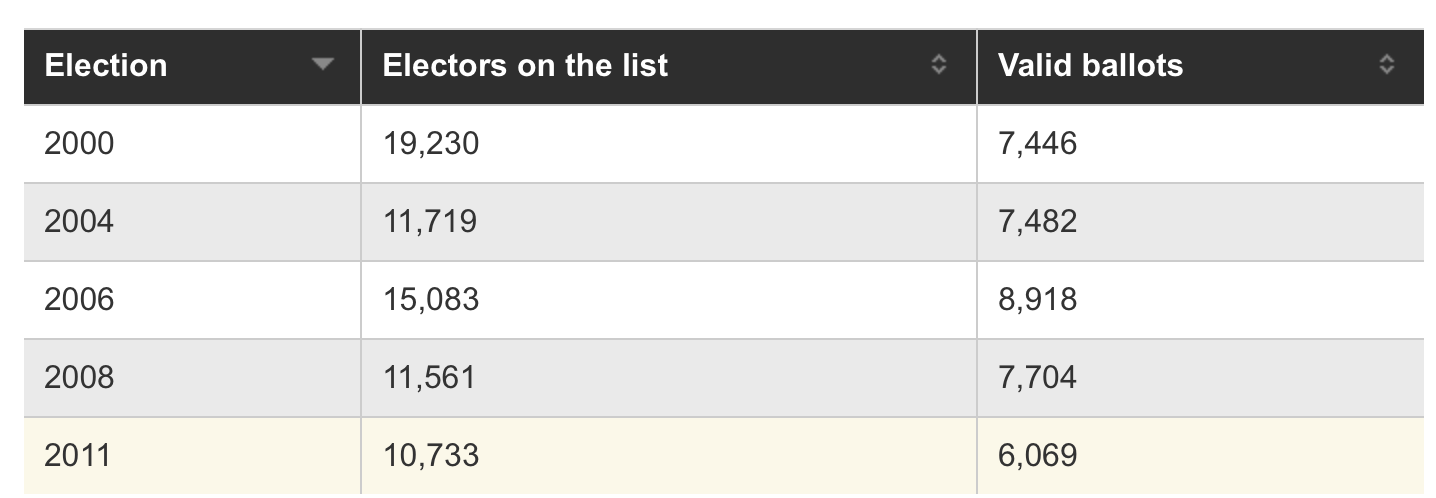
The first, by Peter Russell (a former excellent and insightful professor of mine) and Semra Sevi (who has written before Canadian expatriates should never lose the right to vote), provides useful data on the number of expatriates who actually vote.
The number, as shown above, is minuscule compared to the estimated almost three million Canadian expatriates. The article also has the following international comparisons:
The five-year limitation, as opposed to some other limit, is overly drastic and Canada’s provision is not comparable with similar democracies around the world.
Americans living outside of the country have the right to vote no matter how long they have been abroad providing they pay taxes. The right to vote expires in the United Kingdom after 15 years abroad. To put this into perspective, this is three times longer than what Canada permits even though Canada is part of the Commonwealth.
Australian citizens abroad are allowed to vote so long as they intend to return to Australia within six years. After six years, citizens can renew their status by making an annual declaration of their intention to return “at some point” thereby voting for an indefinite period. In New Zealand, there is a three-year limit but the clock restarts every time citizens visit the country. Moreover, New Zealand extends the right to vote to non-citizen residents from other Commonwealth countries.
The United Kingdom extends similar voting rights to citizens of Commonwealth countries and citizens of the Republic of Ireland. The five-year limit in Canada is an arbitrary number and is unnecessarily onerous. On the surface, it is a year less generous than Australia, but Australians can renew their status by expressing a mere intent to return to the country “at some point” in the future. Canadians, on the other hand, need to resume residency to regain their right to vote abroad.
The right to vote is a fundamental right of citizenship that is protected by the Charter and does not depend on place of residence. The five-year limitation does not conform to the 21st-century demands of globalization. While there is currently an NDP-sponsored bill to repeal the provision that limits voting rights for Canadians abroad as unconstitutional, it is possible that the unconvincing judgment of two Ontario appellate judges could be overturned on appeal to the Supreme Court of Canada—but, alas, not in time to restore democratic rights to the close to a million and a half Canadians living abroad for the fall election.
Reframing the debate over expat voting – Macleans.ca.
 The Globe editorial takes, correctly in my view, takes the opposite view:
We think the decision is the right one, for three reasons.
First, because our electoral system, based as it is on residence in a particular electoral district, assumes a connection between residence and voting, governors and the governed.
Second, because we live in a world of national borders and laws that do not apply extraterritorially, which means the lives of non-resident Canadians are largely not governed by Canadian law. As Ontario Chief Justice George Strathy put it, “permitting all non-resident citizens to vote would allow them to participate in making laws that affect Canadian residents on a daily basis, but have little to no practical consequence for their own daily lives.”
And third, because reasonable people can disagree, reasonably, over how long a citizen should reside outside of Canada before having her vote suspended. Should the limit be five years? Ten? Two generations? Never? The practical question of setting reasonable limits is best left where the Ontario Court of Appeal left it, in the hands of Parliament.
The Canada Elections Act says that Canadian citizens are entitled to vote in the riding in which they typically reside. However, the Act also says that Canadian citizens living abroad for more than five years cannot vote. There are exceptions for people sent overseas in service to the country, such as members of the Armed Forces.
All of which is not unreasonable. Justice Strathy noted that “residence is a determinant of voter eligibility in all provinces and territories.” If you move from Nova Scotia to Alberta, you can’t continue voting in Nova Scotia in perpetuity.
He also pointed out that “residence is a requirement of the electoral laws of the other Westminster democracies. The U.K., Australia and New Zealand limit the voting rights of non-resident citizens to those temporarily resident abroad.” The maximum time overseas before one loses the vote is 15 years in Britain, six years in Australia and three years in New Zealand. Canada’s current law is fair.
2015/05/23 Leave a comment
Reminder by The Globe editorial board and the need for de-radicalization or deprogramming initiatives, not just passport confiscation and other security measures:
Incarceration isn’t an option without clear evidence of criminal intent. The seizure of passports is a first step in isolating potential jihadis and limiting their ability to act on their beliefs, but it can’t be the last step. In some cases, the RCMP has sought peace bonds against suspects, requiring them to wear a monitoring device and limiting their social-media activity.
Yet we know from Mr. Couture-Rouleau that surveillance is no guarantee of public safety. With the 10 youths in Montreal, and others like them, the catch-and-release approach of passport confiscation is little more than a placebo – it draws attention and buys time until we come up with a better solution.
Teenagers in rebellion, many of whom are as likely to be idealists, however misguided, as aspiring holy warriors, would benefit far more from intelligent dialogue, education and a chance to change their minds. A sincere attempt at reprogramming is required – through conversations that counter the allure of ISIS with both persuasive arguments and an empathetic understanding of what it is that can drive young students to such a state. Removing a passport may be necessary. By itself, it’s insufficient.
The Montreal would-be jihadi 10, and what comes next – The Globe and Mail.

Click image for book purchase
 Multicultural Meanderings
