What should expatriates’ voting rights be? – Policy Options

My latest on expatriate voting by Canadians in IRPP’s Policy Options:

With the decision by the Supreme Court of Canada to hear the challenge to the five-year restriction on expatriates’ voting rights, it is timely to review the arguments in favour and against extending the time. In addition, we need a better idea of the number of Canadian expatriates abroad and the nature of their ongoing connection to Canada.

Starting with the number of Canadian expatriates, recent advocates have relied on the estimate from the Asia Pacific Foundation (APP) Canadians Abroad: Canada’s Global Assets of 2.8 million expatriates. This figure does not control for age or citizenship. When we do so (using the 2006 Census), the figure is just under 2 million (of whom 77 percent are aged 18 or over, and 78.1 percent of whom were immigrants had become Canadian citizens).

There is also a dearth of data on expatriates’ degree of connection to Canada, and what exists is based on anecdote rather than government data. Consular data for 2007 to 2015 show that approximately 20,000 expatriates annually accessed services for people who had been abroad for five years or more. The number of passports issued abroad was about 184,000 in 2015, and there were approximately 725,000 Canadian passport holders living abroad.

Looking at nonresident Canadians’ tax filing data, 136,310 returns were filed, which was 7 percent of the number of expatriates in 2013, the most recent year that complete data is available. While this figure may understate the proportion of nonresident Canadians filing taxes, as some may use Canadian addresses, it suggests that the vast majority of expatriates do not pay Canadian income tax. I have not seen any reliable data on nonresidents’ property taxes.

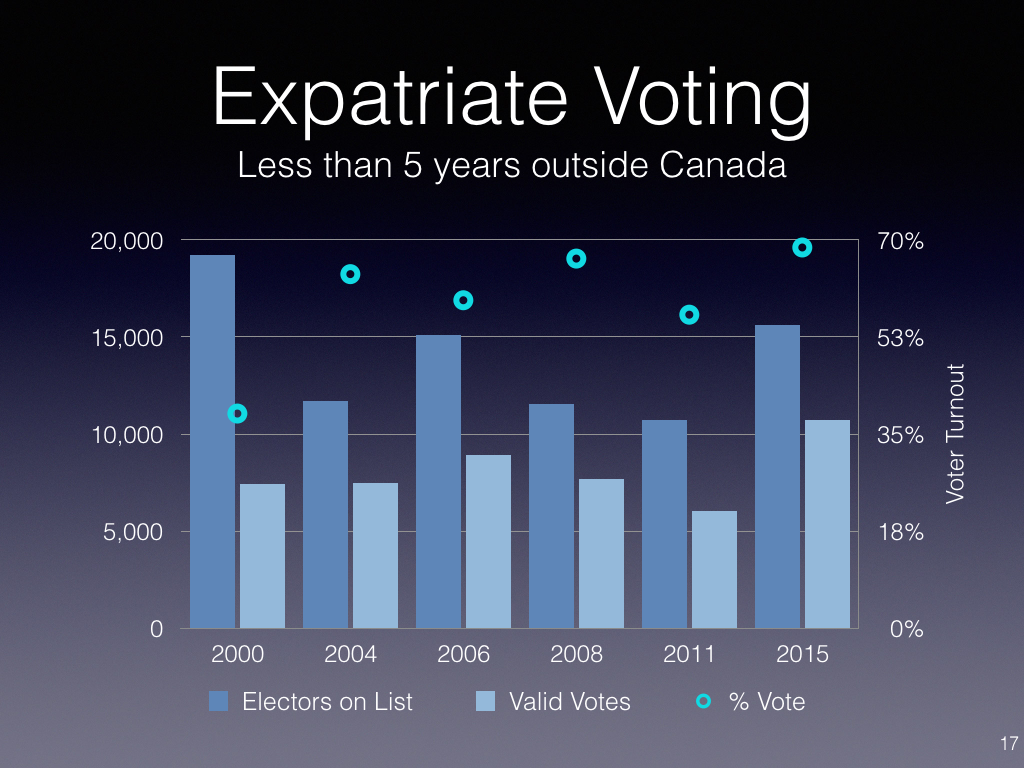
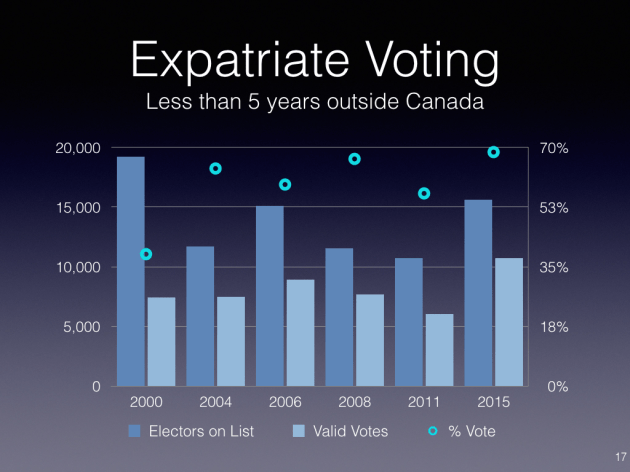
Data on voting among those who have been abroad less than five years indicates the number of expatriates who register and vote is very low. (This also applies to Canada as a whole: in 2015, out of a total of 26 million eligible voters 17.6 million voted.) Figure 1 shows the number of nonresident electors, valid votes and percentage of voter turnout for the last six elections. This data suggests that relatively few of those who have lived abroad for five years or less are politically engaged (of course, some may return to Canada to vote, but we do not have data on this).

Canadian Expatriates Data Gaps.017

Figure 1

The data we have, imperfect as it is, suggests that of the 2 million Canadian citizens living abroad aged 18 or over, the number who have ongoing active connections with Canada is likely quite low. Even advocates of expatriate voting rights, after citing the APF number of 2.8 million expatriates abroad, go on to quote the figure of “over one million” who have active connections, but they do not explain the basis for that number.

Arguments in favour of expanding the expatriates’ voting rights are based on the Charter’s protection of voting rights without qualification. The main substantive arguments, by the plaintiffs, by academics such as Semra Sevi, Peter Russell, Alison Loat and John McArther), and by former Global Affairs director general Gar Pardy, can be resumed as follows:

  • Canadians living abroad contribute to Canada and the world, and many retain an active connection with Canada, whether it is business, social, cultural, political, or academic. These Canadians’ global connections should be valued as an asset;
  • Patriotism and civic engagement are not tied to location;
  • The internet and online communities make it easier for Canadians to remain in touch with Canada and Canadian issues;
  • As Judge Laskin said in his dissenting statement in the July 2015 Ontario Court of Appeal ruling, Canadians living abroad pay “Canadian income tax on their Canadian income, and property tax on any real property they may own in Canada,” and are subject to Canadian laws and foreign policy decisions;
  • As Russell and Sevi note, the expatriate vote will not “completely change the tide of an election.
  • The five-years-or-less limitation is more restrictive than those of other Western countries; for example:
    • United States: no limitation, but expatriates are required to file US tax return;
    • United Kingdom: the limitation is fifteen years;
    • Australia: the limitation is six years, and expatriates must file an annual declaration of their intent to return at some point;
    • New Zealand: the limitation is three years, and the clock restarts when citizens visit New Zealand.
  • The Canadian five-year limitation ignores the increasing globalization and population mobility, and it sends the wrong signal to young Canadians;
  • As Jean-Pierre Kingsley, former chief electoral officer, said when he advocated eliminating the five-year limit: “The right to vote is a fundamental right of citizenship that is protected by the Charter and does not depend on place of residence.” A parliamentary committee reviewed his report in 2006 and endorsed his position.

The principle arguments against are the following:

  • The “social contract” argument, used by the Ontario Court of Appeal to uphold the policy, states that voting “would allow them [expatriates] to participate in making laws that affect Canadian residents on a daily basis, but have little to no practical consequence for their own daily lives. This would erode the social contract and undermine the legitimacy of the laws.” Examples of policies and programs that are considered part of the social contract include economic and social policies and programs, at the federal level; health care and education, at the provincial level; and policing and transit at the municipal level;
  • While some expatriates may pay Canadian taxes and may own property in Canada, the data suggests over 90 percent do not, as they pay tax where they work and live;
  • Interest in voting among expatriates appears to be low;
  • Apart from consular and passport services, most Canadian government economic and social programs are tied to residency;
  • In general, the longer the time spent abroad, the looser the bond with Canada, as family, work and local connections become more meaningful. Over time, day-to-day living — work, education, raising a family, consuming media — predominate important for expatriates, whether in the United States, Hong Kong or the Mid-East;

The Supreme Court will have to rule whether the right to vote is qualified by residence and the degree to which the social contract argument justifies certain limits.

Some of the advocates of expatriate voting, for example, Gar Pardy, argue for no limits, which Loat and McArthur also imply. Sevi and Russell imply limits, but ones that are more in line with those of other countries, but they do not indicate their preference.

To cite an extreme example of the “no limit” argument, Canadian expatriates born abroad (citizenship by descent) who have never lived in Canada would be entitled to vote, even if they had never set foot in Canada. A less extreme example is that of people born in Canada who move abroad as children and remain outside Canada. In both cases, it is hard to justify non-residents having voting rights when they have spent no time or extremely limited time living in Canada.

The “comparability” with other nations argument is more reasonable and convincing, and opens the discussion as to which option — taxation, as in the United States, extending the limitation to 15 years, as in the United Kingdom, or renewable voting rights, as in New Zealand — makes the most sense from a policy and implementation perspective. I suspect most Canadian expatriates would not welcome linking voting to filing tax returns. It would go against long-standing Canadian tax policy, and judging by US expatriates’ opposition to the over-reach of Foreign Account Tax Compliance Act, this option is likely a nonstarter.

If the Supreme Court rules against the five-year limit, my preference, would be some variant on the Australian and New Zealand approach, i.e., allowing voting rights to be renewed but requiring some action by expatriate voters to extend their right, perhaps through a written declaration or periodic visit to Canada. This does not seem to be an unreasonable obligation, and it allows for mobility but requires a concrete and a relatively easy to administer test of the expatriates’ connection to Canada.
Source: What should expatriates’ voting rights be? – Policy Options
Supreme Court should let long-term expats vote: Pardy

Gar Pardy joins the extend the expatriate vote advocates.

Like most advocates, they appear to argue for this right to be indefinite, no matter how long outside Canada, no matter how little the connection.

All – unless I have missed it – are silent with respect to those born-abroad but who are able to ‘inherit’ their citizenship, and who may never have lived in Canada:

Two Canadians living in the United States started the right-to-vote case now before the Supreme Court nearly five years ago. They filed a constitutional challenge with the Ontario Superior Court of Justice when they discovered they could not vote in the 2011 federal election.

Judge Michael Penny of the Ontario court ruled in May 2014 that Parliament could not take away the voting rights of non-resident Canadian citizens. In doing so, Judge Penny struck down sections of the Canada Elections Act since they violated Section 3 of the Charter of Rights and Freedom.

The Harper government appealed this decision to the Ontario Court of Appeal. In a split decision (two to one) last July, it overruled Judge Penny. The majority ruled that while Section 3 of the charter had been violated, the “pressing and substantial” standard of Section 1 provided enough reason for the violation.

The dissenting judge, Justice John Laskin, strongly and substantively took issue with the majority decision. He argued that Judge Penny’s judgment was a “thorough and well-reasoned analysis of the issues.” He went on to argue that the majority’s use of the “the pressing and substantial objective of preserving the social contract at the heart of Canada’s system of constitutional democracy” was not valid.

The introduction of the “social contract” element in the case was not reflected in the government’s arguments before Judge Penny nor was it reflected in the documentation presented before the appeal court. Rather, the government’s lawyers did so only in oral arguments to which Justice Laskin disagreed. He concluded that Parliament did not have a “social contract” objective in mind when it passed the “five-year non-residency limitation in 1993.”

The majority decision of the appeal court in using the gaseous concept of “social contract” to deny a fundamental right of all Canadians to vote is without precedent. It does reflect many aspects of policy-making by the previous government where reason, evidence, and attention to detail were discarded. In the words of Judge Penny, the government’s arguments demonstrated that “there is simply no evidence of a problem. Rather, the government’s objectives are rhetorical, vague, and generic.”

Social contracts between the state and its citizens have long been an idea that philosophers have argued over far into the night without adding much useful light. Rather, as Justice Laskin concluded, the deprivation of the right to vote solely on the basis of residence turns Canadians abroad “into second-class citizens and so undermines the values of equality and inclusiveness…underlying our charter rights.”

In due course we can all hope the Supreme Court overrules this aberrant decision by the Ontario appeal court and in doing so establishes the charter right for some one million Canadians to vote.

Source: Supreme Court should let long-term expats vote |

Why is Ottawa still defending disenfranchisement of expats? – Sevi and Frank

The usual weak arguments by Semra Sevi and Gillian Frank.

Starting with the evidence-base on the number of expatriates. The Asia Pacific Foundation number of 2.9 million is composed of 58 percent Canadian-born and 42 percent foreign-born. For the latter (1.2 million), it does not distinguish between those who became Canadian citizens (who can vote) and those who did not, as the purpose of their study was not related to voting rights. Nor does the APF study provide an overall age profile to determine how many are of voting age.

Sevi and Frank admit as much by then later on just referring to ‘over a million’ rather than the higher figure (Canadian-born expats in the US total about 900,000 according to the OECD, total OECD figures are 1.2 million, which exclude major expatriate centres such as China, Hong Kong and the Gulf countries, but these lower figures do not include naturalized Canadians).

Moreover, none of these numbers do not measure the degree of the connection to Canada. Sevi and Frank assert that ‘many’ are connected. How many of the ‘many’ pay Canadian taxes and own property? How many have substantial business ties to Canada? Social ties? I have not seen any such data but readers may correct me.

We do have a sense of how many seek consular services (about 20,000 per year for those who have been abroad for five years or more) and the number of passports issued abroad (about 184,000 in 2015, with about 725,000 passport holders living abroad). These numbers suggest a smaller yet nevertheless significant number of ‘connected’ expatriates.

We also have voting data, for those with under 5 years abroad, that show very small numbers, as in the table below, suggesting that relatively few of those who have lived abroad for this period are politically engaged (of course, some may return to Canada to vote, but again, data is lacking).

Canadian Expatriates Data Gaps.017.png

But beyond the weak evidence base, and the challenges of determining – and implementing – a ‘connection’ test, living outside of Canada for extended periods of time invariably weakens the connection to the day-to-day reality of living in Canada, whether from the perspective of government services such as healthcare, education, transit and the like, or the related political debates and discussions.

Interestingly, neither Sevi nor Frank propose a new number if five is considered too short. 10 years, 15 years, indefinitely? Should those born abroad to Canadian parents be allowed to vote even if they have never lived in Canada?

In the hands of the Supreme Court now, for better or worse.

Despite claims of expat apathy towards Canada, many Canadians living abroad continue to maintain close ties with the country, visit family and friends regularly, pay taxes, own property, follow the news, seek consular services, and desire to continue voting in spite of the bureaucratic hurdles that prevent them from doing so. Many of these Canadians do not hold dual citizenship and cannot vote elsewhere.

The current lawsuit before the Supreme Court reflects the strong ties Canadians abroad maintain with their country, as well as their belief that the democratic process should be modernized to reflect a globalized world with a large Canadian diaspora.

In 2012, Gillian Frank and Jamie Duong, two Canadians living in the United States, filed a lawsuit to restore the right of Canadians abroad to vote. In 2014, Ontario’s Superior Court struck down the law and re-enfranchised expats. The Conservative government responded by appealing this decision and in July 2015, the Ontario Court of Appeal, in a split decision, accepted the attorney-general’s argument.

It’s 2016 and our new Prime Minister recently visited the United States where he rubbed elbows with expat celebrities and met with Canadian business leaders in Washington and New York, lauding their accomplishments while encouraging them to invest in our economy. Prime Minister Trudeau sent a message that he values citizens who reside outside of the country. As much was clear during the 2015 elections when Anna Gainey, the president of the Liberal Party, wrote to the Canadian Expat Association: “We believe that all Canadians should have a right to vote, no matter where they live, and we are committed to ensuring that this is the case.”

In early 2017, the Court will hear arguments about the rights of Canadians abroad to vote. Mr. Trudeau has an unprecedented opportunity to welcome many of these citizens back into our democratic process. One way he could do this is by not defending the litigation before the Supreme Court. Will the Liberals live up to their much-anticipated campaign promise to restore democracy to citizens living abroad? The voting rights of over a million Canadians hang in the balance.

Source: Why is Ottawa still defending disenfranchisement of expats? – The Globe and Mail

Canadians living abroad should be allowed to vote: Editorial | Toronto Star

I disagree.

Long-term (over 5 years) expats may or may not remained connected to Canada (the various imperfect data sources I am looking at present a varied picture) but most  do not pay Canadian taxes and are disconnected from the day-to-day issues (e.g., healthcare, transit) that often drive elections and voters:

The rule used to deny the vote to Canadians who have lived abroad for longer than five years actually dates back to 1993. But it was only enforced by the government of former prime minister Stephen Harper after 2007. The decision was based on a claim that it was unfair to give equal voice to Canadians living abroad and those who live in the country because expatriates won’t live with the consequences of their choice.

It’s a flawed argument and one rejected by most other democracies, which place fewer restrictions on expatriates. Canadians abroad who are passionate about this country’s affairs — to the extent that they’re determined enough to vote — should have a say in the affairs of their homeland.

Given the vast information resources available online and the ease of international travel, Canadian expats can easily keep up to date with what’s going on at home. And their opinions have real value. Indeed, it can be argued that it’s in the national interest to allow these well-travelled and typically well-educated citizens a hand in the political process.

As reported by The Canadian Press, the constitutionality of existing law is being challenged by plaintiffs Jamie Duong and Gillain Frank, both Canadians working in the United States. Frank, from Toronto, teaches at Princeton University, and Duong, of Montreal, works at Cornell.

They won before the Ontario Superior Court in 2014; lost when the government appealed last July; and then took the matter to the Supreme Court of Canada, which has agreed to hear their case.

The court would do well to overturn an unfair law and bring Canada’s rules more in line with international practice.

Britons living abroad are allowed to cast a ballot if they’re citizens and had registered to vote within the last 15 years. Americans can vote all their lives, regardless of where they happen to live. And Italy goes so far as to set aside seats in parliament specifically to be filled by citizens living abroad.

It’s estimated that more than a million Canadians living outside the country are blocked from voting by the current rule. That constitutes a large-scale disenfranchisement and it’s manifestly unfair. If these people want a say in the affairs of their homeland they should be allowed to have it, regardless of how long they’ve been away.

Source: Canadians living abroad should be allowed to vote: Editorial | Toronto Star

The Issue With Malaysians Giving Up Their Citizenship, Here Are Their Real Stories

Some of the debates in Malaysia regarding expatriates:

The obvious reasons to migrate to another country includes better economic conditions abroad, specialised work opportunities as well as several social related reasons among many others, all of which is experienced by not just Malaysians but for people in other countries too.

Selective reporting of statistics often play up this lop-sided view of Malaysians abandoning their country. In March last year, it was widely reported that 93% of Malaysians would gladly leave the country if offered better job prospects and career advancement in a poll conducted by recruiting firm Hays.

What was not reported was that in the same poll, a whopping 97% of Singapore job seekers were willing to relocate overseas if job opportunities came along. According to the same poll, 96% of China’s citizens were willing to leave their country to work overseas while 94% of Hong Kong residents felt the same.

“The opportunity to gain highly valued international experience is the number one factor driving local talent overseas,” said Christine Wright, managing director of Hays in Asia commented on the poll results.

“These candidates want to gain a job overseas because employers increasingly value local talent with international experience and an international mindset.”

So instead of throwing around insults like ‘unpatriotic’ opportunists or our country treating some of its citizens unfairly, why not hear from our citizens who do end up spending probably most of their lifetime abroad.

Malaysian Digest approached several former Malaysians and also Malaysians currently living abroad to share with us their stories that go beyond stereotypical labels, discussing with us their experiences with maintaining Malaysian ties without being ‘technically’ Malaysian themselves.

Source: The Issue With Malaysians Giving Up Their Citizenship, Here Are Their Real Stories

The Franco-American Flophouse: Flophouse American Diaspora Reading List

Victoria Ferauge’s latest impressive compilation:

Sometimes we feel we straddle two cultures; at other times, that we fall between two stools.”

Salman Rushdie, Imaginary Homelands: Essays and Criticism 1981-1991

Time for an update of the Flophouse American Diaspora Reading List – the best books and articles I’ve read recently about American citizens and communities abroad.  New books are in green.  As always, please feel free to add to the list.

This list has three sections:  Upcoming titles – Books that have not been published yet but that I plan on reading; General books/articles – the larger view.  Some talk about specific issues (like citizenship), others are studies, portraits or serious research about Americans abroad;  Expat autobiographies – Accounts of Americans in different countries.  These are not books that tell a potential American migrant how to live abroad.   These are personal accounts that talk about what happens to American identity when it gets transplanted somewhere else for a year or two, or for a lifetime.

Source: The Franco-American Flophouse: Flophouse American Diaspora Reading List

Confusing vote rules for expats ‘ridiculous;’ Elections Canada denies blame

More on expatriate voting and the rules that apply:

The finger-pointing highlights the confusing rules in play, which include:

  • Long-term expats, with some exceptions such as diplomats, cannot vote from abroad;
  • Long-term expats can vote in person at an advance poll or on election day in the riding they lived in before leaving Canada;
  • Long-term expats cannot vote under rules allowing resident Canadians, who will be away during the voting period, to vote at their local returning office;
  • Long-term expats can run in any riding in the country, if they meet other basic requirements;
  • Long-term expats who become candidates cannot vote for themselves, unless running in the riding in which they last lived before leaving Canada.

The current situation is patently absurd, O’Kurley said.

“All this ridiculous hair-splitting over time and place would be so unnecessary if the only litmus test for voting was citizenship,” O’Kurley said. “Policies that suppress Canadians’ ability to participate in their democracy are not worthy of Canadian democratic leadership in the world.”

O’Kurley noted that Elections Canada facilitates voting for long-term expats who work for the Canadian government, but not if they work for a private Canadian company.

Elections Canada conceded the legislation can be confusing but said it only enforces rules made by government _ and it’s up to government to fix any problems.

While I disagree with Kurley (perhaps a better test would be citizenship and filing a Canadian tax return would a future government wish to go down that road), making the rules clearer and more consistent should be doable.

Source: Confusing vote rules for expats ‘ridiculous;’ Elections Canada denies blame

Long-term Canadian expats lose right to vote, court decides

Good call and passes the common sense test.

In a split decision, the Court of Appeal overturned a ruling that had restored the right of more than one million long-term expats to vote.

Canada’s “social contract” entails citizens submitting to laws because they had a voice in making them through voting, the ruling states.

“Permitting all non-resident citizens to vote would allow them to participate in making laws that affect Canadian residents on a daily basis but have little to no practical consequence for their own daily lives,” Justice George Strathy wrote for the majority court.

“This would erode the social contract and undermine the legitimacy of the laws.”

Strathy said the relevant part of the Canada Elections Act aimed to strengthen the country’s system of government. While it infringed on the rights of the expats, he said, the infringement is reasonable and can be justified in a free and democratic society.

Two Canadians living in the United States — Montreal-born Jamie Duong and Toronto-born Gillian Frank — launched the constitutional challenge, arguing the five-year rule was arbitrary and unreasonable. Both argued they had only left for educational and employment opportunities and still had strong attachments to Canada and a stake in its future.

In May last year, Superior Court Justice Michael Penny threw out the voting ban, noting that mass murderers have the right to cast ballots but long-term expats who care deeply about the country do not. Penny also said expats could well be subject to Canadian tax and other laws.

The Appeal Court said Penny’s judgment was clouded by the government’s assertion that expats “do not have the same connection” to Canada as residents.

“This caused the debate to be cast as whether non-resident citizens were worthy of the vote,” said Strathy. “As a result, he overlooked Canada’s democratic tradition and the importance of the social contract between Canada’s electorate and Parliament.”

Long-term Canadian expats lose right to vote, court decides – The Globe and Mail.

Tory bill raises too many barriers for expat Canadian voters: Globe editorial

Unfortunately, all too characteristic of the Government in making it harder to vote (as in the case of Elections Act revisions), even if  maintaining the 5 year rule makes sense:

Last year, an Ontario Superior Court judge struck down a rule that barred citizens living abroad for more than five years from voting in federal elections. The government has rightly appealed that decision, while also introducing legislation that will enshrine expats’ voting rights, but with a twist. Expats will get to vote – it will just be really, really hard.

So hard, in fact, that many of the 2.8 million expats around the globe may well not bother. Others will try but won’t be able to meet the onerous new requirements in Bill C-50.

Under the bill, currently in committee after second reading, Elections Canada will eliminate the international register of electors, the long-established list of expat Canadians eligible to vote federally. In future, expats will have to re-register for each election, and can only do so after the writ is dropped.

That means an overseas Canadian would have about 36 days, the minimum length of an election campaign, to write to Elections Canada to request a ballot, wait while officials examine the extensive paperwork the bill requires, receive a ballot in the mail, make their mark, and then return the ballot by mail.

Critics say many long-time expats won’t be able to produce the new documentation required, which includes proof of the voter’s last Canadian address provided by a Canadian company or government office. The alternative is to find someone in the voter’s last riding who will vouch that the person in question once lived there – a time-consuming process.

The Harper government says the goal of the new rules is to prevent voter fraud, the same canard that it used to justify the Fair Elections Act. There are widespread concerns that as many as 400,000 eligible voters will be unable to cast a ballot in the fall election because of the Fair Elections Act. If Bill C-50 is adopted before Parliament is dissolved, the franchise of thousands of expats could also be compromised.

We are not convinced that the right to vote extends to Canadian who have chosen to live outside the country for decades, or even a lifetime. The government was right to appeal, and we hope a higher court will side with it. But in the interim, that lower court’s decision has to be respected. The bill should not be recognizing a right with one hand, while effectively taking it away with the other.

Tory bill raises too many barriers for expat Canadian voters – The Globe and Mail.

Flophouse American Diaspora Reading List

Victoria Ferauge’s updated American diaspora and expatriate reading list:

“Sometimes we feel we straddle two cultures; at other times, that we fall between two stools.”

Salman Rushdie, Imaginary Homelands: Essays and Criticism 1981-1991

Time for an update of the Flophouse American Diaspora Reading List – the best books and articles I’ve read recently about American people and communities abroad.  New books are in green.  As always, please feel free to add to the list.

This list has three sections:  Upcoming titles – Books that have not been published yet but that I plan on reading; General books/articles – the larger view.  Some talk about specific issues (like citizenship), others are studies, portraits or serious research about Americans abroad;  Expat autobiographies – Accounts of Americans in different countries.  These are not books that tell a potential American migrant how to live abroad.   These are personal accounts that talk about what happens to American identity when it gets transplanted somewhere else for a year or two, or for a lifetime.

The Franco-American Flophouse: Flophouse American Diaspora Reading List.