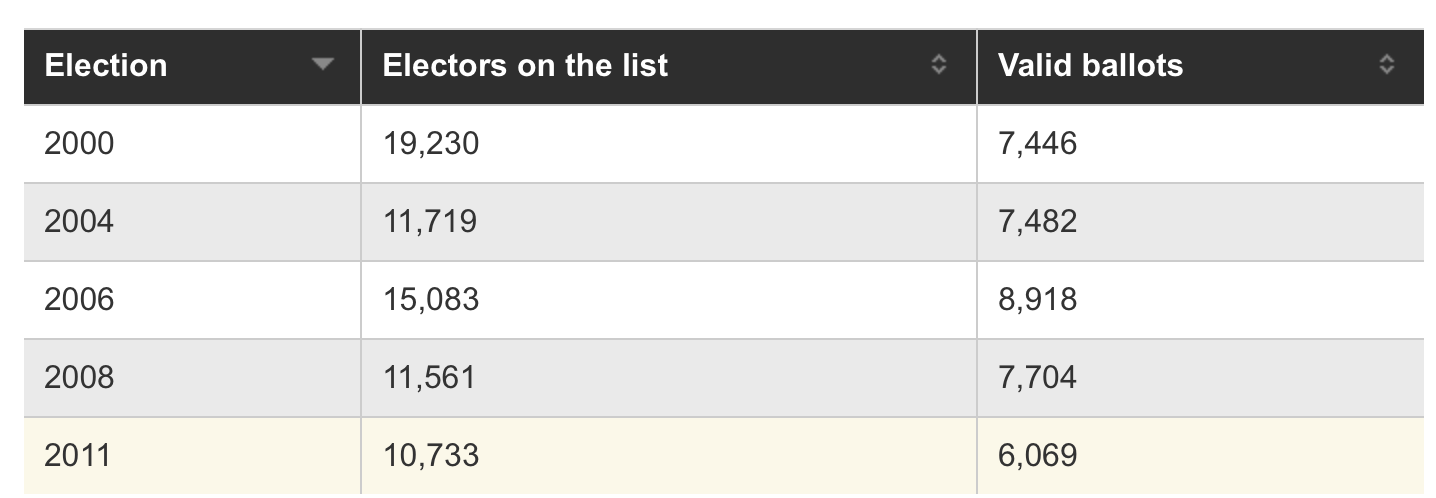
 Two contrasting views on expatriate voting.
The first, by Peter Russell (a former excellent and insightful professor of mine) and Semra Sevi (who has written before Canadian expatriates should never lose the right to vote), provides useful data on the number of expatriates who actually vote.
The number, as shown above, is minuscule compared to the estimated almost three million Canadian expatriates. The article also has the following international comparisons:
The five-year limitation, as opposed to some other limit, is overly drastic and Canada’s provision is not comparable with similar democracies around the world.
Americans living outside of the country have the right to vote no matter how long they have been abroad providing they pay taxes. The right to vote expires in the United Kingdom after 15 years abroad. To put this into perspective, this is three times longer than what Canada permits even though Canada is part of the Commonwealth.
Australian citizens abroad are allowed to vote so long as they intend to return to Australia within six years. After six years, citizens can renew their status by making an annual declaration of their intention to return “at some point” thereby voting for an indefinite period. In New Zealand, there is a three-year limit but the clock restarts every time citizens visit the country. Moreover, New Zealand extends the right to vote to non-citizen residents from other Commonwealth countries.
The United Kingdom extends similar voting rights to citizens of Commonwealth countries and citizens of the Republic of Ireland. The five-year limit in Canada is an arbitrary number and is unnecessarily onerous. On the surface, it is a year less generous than Australia, but Australians can renew their status by expressing a mere intent to return to the country “at some point” in the future. Canadians, on the other hand, need to resume residency to regain their right to vote abroad.
The right to vote is a fundamental right of citizenship that is protected by the Charter and does not depend on place of residence. The five-year limitation does not conform to the 21st-century demands of globalization. While there is currently an NDP-sponsored bill to repeal the provision that limits voting rights for Canadians abroad as unconstitutional, it is possible that the unconvincing judgment of two Ontario appellate judges could be overturned on appeal to the Supreme Court of Canada—but, alas, not in time to restore democratic rights to the close to a million and a half Canadians living abroad for the fall election.
Reframing the debate over expat voting – Macleans.ca.
 The Globe editorial takes, correctly in my view, takes the opposite view:
We think the decision is the right one, for three reasons.
First, because our electoral system, based as it is on residence in a particular electoral district, assumes a connection between residence and voting, governors and the governed.
Second, because we live in a world of national borders and laws that do not apply extraterritorially, which means the lives of non-resident Canadians are largely not governed by Canadian law. As Ontario Chief Justice George Strathy put it, “permitting all non-resident citizens to vote would allow them to participate in making laws that affect Canadian residents on a daily basis, but have little to no practical consequence for their own daily lives.”
And third, because reasonable people can disagree, reasonably, over how long a citizen should reside outside of Canada before having her vote suspended. Should the limit be five years? Ten? Two generations? Never? The practical question of setting reasonable limits is best left where the Ontario Court of Appeal left it, in the hands of Parliament.
The Canada Elections Act says that Canadian citizens are entitled to vote in the riding in which they typically reside. However, the Act also says that Canadian citizens living abroad for more than five years cannot vote. There are exceptions for people sent overseas in service to the country, such as members of the Armed Forces.
All of which is not unreasonable. Justice Strathy noted that “residence is a determinant of voter eligibility in all provinces and territories.” If you move from Nova Scotia to Alberta, you can’t continue voting in Nova Scotia in perpetuity.
He also pointed out that “residence is a requirement of the electoral laws of the other Westminster democracies. The U.K., Australia and New Zealand limit the voting rights of non-resident citizens to those temporarily resident abroad.” The maximum time overseas before one loses the vote is 15 years in Britain, six years in Australia and three years in New Zealand. Canada’s current law is fair.
No, Canadians living abroad shouldn’t get to vote

 Multicultural Meanderings