Feds announce new panel to help address discrimination in the public service

We’ll see what they come up with:
The federal government has announced the assembly of a new panel that will support the design and creation of a new “restorative engagement program” to address discrimination, violence and harassment in the federal public service.President of the Treasury Board Anita Anand announced the creation of the panel of experts at a press conference Monday.

“We are working to create a safe and inclusive workplace where everyone can be their true self,” Anand said in a statement. “This panel of experts will bring a wealth of knowledge and experience to help shape the new restorative engagement program. Their insights and contributions will be instrumental in shaping recommendations that support truth, healing, and respect.”

The panel comprises four recognized experts in clinical psychology, mediation, dispute resolution and restorative justice.They include Jude Mary Cénat, an associate professor at the University of Ottawa’s School of Psychology and chair of the Interdisciplinary Centre for Black Health, and Director of the Vulnerability, Trauma, Resilience & Culture; Linda Crockett, founder of the Canadian Institute of Workplace Bullying Resources and the Canadian Institute of Workplace Harassment and Violence; Gayle Desmeules, founder and CEO of True Dialogue Inc., which provides customized training, facilitation, mediation and consulting services; and Robert Neron, a senior arbitrator and workplace investigator and former adjudicator for the Independent Assessment Process of the Indian Residential School Secretariat.

The announcement comes less than a week after a report by the auditor general of Canada, Karen Hogan, criticized federal departments and agencies for not doing enough to measure inequalities and improve the experiences of racialized employees in the workplace.

Analyzing six government departments and agencies between 2018 and 2022, Hogan’s office found that, while many initiatives have been launched to address inequities in the workplace, none have resulted in the “full removal of barriers and in the achievement of equity.” It highlighted that organizations have failed to effectively report on progress, identify barriers faced by staff and, at the manager level, take accountability for behavioural and cultural change.Among the organizations analyzed in the report, a higher percentage of visible minority respondents than non-visible minority respondents indicated that they were a victim of workplace discrimination. However, the surveys showed that racialized respondents were more likely to feel they couldn’t speak about racism in the workplace without fear of reprisal.

Joining the conference virtually, Crockett said the panel “cannot not” deal with the issues raised by the report, adding that employees’ fear of retaliation and reprisal is a critically important issue to address. At this stage, however, panelist Neron said it’s “premature” to determine the recommendations that will be made as engagement has not yet taken place.

The restorative engagement program is part of a broader government-wide strategy to identify, address and prevent harassment, discrimination and violence in the workplace, according to a news release shared by the Treasury Board of Canada Secretariat (TBS).“The goal of a restorative engagement program is to identify, through open dialogue, ways to address harm and promote healing for employees who have reported experiencing harassment, discrimination and violence in the workplace,” the release stated. “By placing individuals at the centre of the process and focusing on understanding the connections, root causes, circumstances, and impacts related to harm, the restorative engagement program will help drive cultural and systemic change within the public service.”

TBS said similar programs are being used “increasingly” across Canada, including by the Canadian Armed Forces and the Department of National Defence.

Anand said the announcement of the program is not just an exercise in public relations. As a racialized person herself, she said it’s crucial the government continue to address discrimination in the public service.

While she is not a member of the panel, Anand said she believes the work happening across the government to develop programs supporting the better treatment of minorities and women who have been subject to sexual harassment can serve as valuable examples for the team.Participating online, Desmeules said Monday that an interdepartmental advisory working group had been established to support the program’s engagement process, made up of public servants from departments and locations across Canada who have experience in diversity, inclusion, harassment, discrimination, conflict management, labor relations, disability management and restorative justice, with the Canadian Armed Forces “sitting at that table.”

“We’re just capturing collective wisdom here,” Desmeules said.

In its 2023 budget, the federal government committed $6.9 million over two years to TBS to advance a restorative engagement program to “empower employees who have suffered harassment and discrimination, and to drive cultural change in the public service.” It said the program would allow employees to have a safe, confidential space to share experiences of harassment, discrimination and violence.

“According to the 2020 Public Service Employee Survey, certain federal public servants are more likely to experience harassment, racism, and discrimination in the workplace,” the budget stated. Those public servants include those identifying as Black, racialized, women, Indigenous, persons with disabilities or 2SLGBTQI+.

The budget outlined that $1.7 million would be sourced from existing departmental resources, with funding to also support a review of “the processes for addressing current and historical complaints of harassment, violence and discrimination.”

TBS said the panel’s work will come with a price tag of about $550,000.

The panel is expected to write a public report on its findings in early 2024, with recommendations on the design of the program to be submitted to the government in the spring.

Source: Feds announce new panel to help address discrimination in the public service
ICYMI: How well is the government meeting its diversity targets? An intersectionality analysis

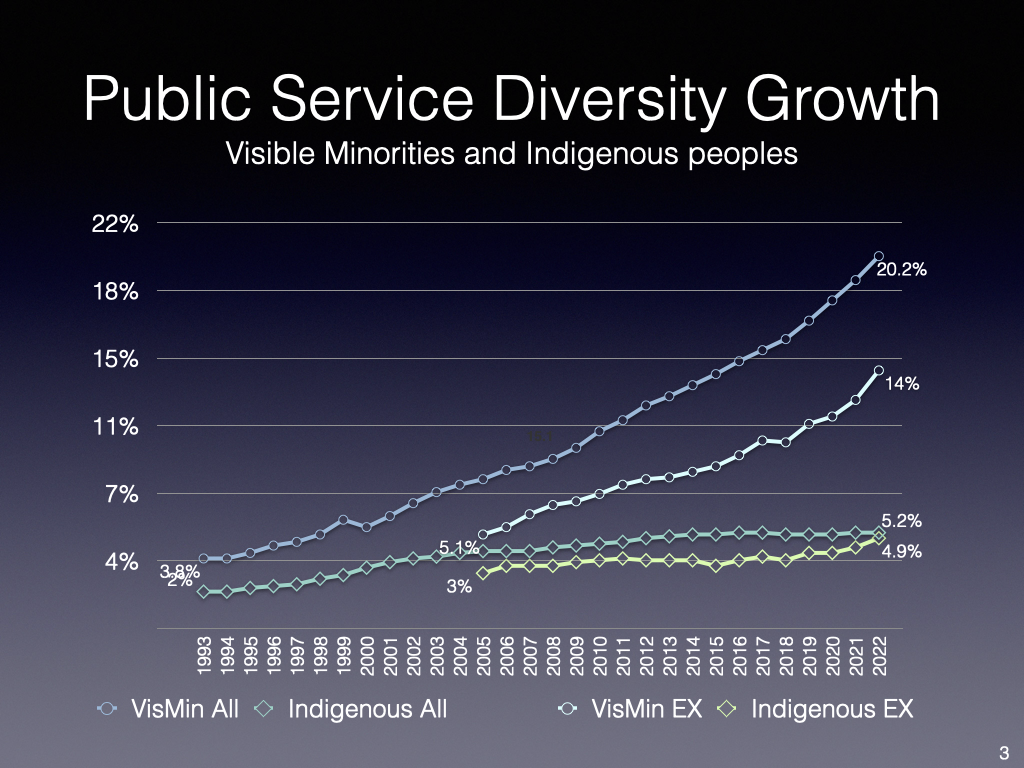
As you know, I have been looking for some time at how the diversity within the public service continues to evolve. The overall trend over the years demonstrates that the original policy objectives of improved diversity are being met but arguably too slowly for some.

For the past six years, TBS has provided disaggregated data for the various equity groups. In 2022, TBS also provided gender breakdowns within the disaggregated data. Following up on a suggestion from a member of Black Lives Matter, I looked at hiring, separation and promotion rates for visible minority and Indigenous groups, showing that visible minority representation is growing faster than non-visible minority, not indigenous, with a more mixed picture for Indigenous public servants.

When originally published by National Newswatch and subsequently posted on LinkedIn, the analysis received a range of commentary, ranging from this who appreciated the data and analyis to those who contested it. The latter ranged from those genuinely interested in discussing the approach I took while raising valid points (I learned more about disproportionately analysis), to those, “activists on a pension,” as we sometimes called them while working in the multiculturalism branch at Canadian Heritage.

The latter appeared to have not read the article or understood that I had used the same disproportionality approach to assess the differences between hiring, separation and promotion rates, highlighting the improvements over the past six years, particularly but not exclusively, for Black public servants. Media needs to be more careful in citing individual examples without this broader context (e.g., Sandra Griffith-Bonaparte has worked 22 years for the government. She’s never gotten a promotion):

Adam: Racial minorities have more concerns than cash as PSAC strikes

TBS desegregated visible minority and gender data for the last six years portrays increasing diversity, with net hirings (hirings less separations) and promotions significantly greater for visible minorities than not visible minorities. Highlights the danger of over-emphasizing personal stories rather than analyzing the data more closely:

Massive disruptions to government services were expected across the country as thousands of public servants went on strike this week in a dispute over wages and working conditions. The walkout affects 155,000 workers, but about 47,000, who are classified as essential workers, will remain on the job. That leaves some 100,000 for the picket lines.

The strike comes at a time when Canadians are struggling with the high cost of living, and many small businesses still have yet to fully recover from the effects of the pandemic. The public service union however, says its members have been affected by inflation, and is demanding a 4.5 per cent annual raise. At the time the strike was called, the federal government had offered three per cent, which the union rejected. The striking workers must walk a fine line to ensure public support because Canadians may be in no mood to tolerate a long walkout.

Significant as it is, the strike should not overshadow what, for many Black and other minority public servants, is an existential crisis: the lack of advancement that has confined them to low-paying entry-level jobs, and undermined their dignity and self-worth. Imagine working in the same job for 20 or 30 years and never getting a promotion. The shame of it is that this is what’s happening to Black and other minority employees of our federal government.

In the Citizen last week, Sandra Griffith-Bonaparte revealed how she never got a promotion in 22 years as a public servant at the Department of National Defence. It’s not because she lacks ambition. She worked hard to acquire two undergraduate degrees from Carleton University, as well as a master of arts and public ethics at St. Paul’s University and the University of Ottawa. She applied for numerous promotions but was rejected by her employer, watching as others climbed the job ladder and left her behind.

It was as if her employer was telling her she is not wanted; she doesn’t belong there. “Time and again, I’m either blocked, overlooked, ostracized, and this has me questioning: Why?” she said. “My story is not unique, this is happening all over in the Canadian government, in the public service in the city, in provincial workplaces.”

Indeed. Her case is a reflection of the discrimination many Black and minority people face in the public service: qualified people trapped in the same job for decades without any hope of progress or advancement, simply because of the colour of their skin.

It shows in a 2021-22 Treasury Board employment equity report, which lays out how Indigenous people, Blacks and other members of so-called visible minorities continue to languish in the lowest salary ranks in the public service, while fewer and fewer of them are found in the higher levels.

It is this kind of discrimination that prompted a group of public servants to launch a lawsuit against the federal government seeking redress and compensation. The lawsuit highlights stories of others like Griffith-Bonaparte — people who have been toiling at the lower echelons of the public service for decades.

There is Carol Sip, a former Canada Border Services Agency employee whose supervisor constantly made derogatory remarks to her without management doing anything about it. She worked 26 years without promotion. Then there is Jennifer Phillips, who worked for the Canada Revenue Agency for 30 years and was promoted only once. Time and again, she watched as people she trained get promoted.

None of the claims in the class action lawsuit has been proven in court, but the sad thing is that these people were not looking to fill quotas or get preferential treatment. All they wanted was the same opportunity given to others to compete and advance on merit.

Responding to the equity report, Treasury Board president Mona Fortier promised the government would do better to build a more “inclusive and diverse” public service. When confronted with problems, politicians have a habit of offering comforting words without any real action. Federal workers are on strike for more money, but for racial minorities, there’s much more than cash at stake.

Mohammed Adam is an Ottawa journalist and commentator. Reach him at nylamiles48@gmail.com

Source: Adam: Racial minorities have more concerns than cash as PSAC strikes

Sandra Griffith-Bonaparte has worked 22 years for the government. She’s never gotten a promotion

The numbers are less negative than presented in the article and by the Black Class Action Secretariat given the ongoing increase in representation at all levels.

Will be doing an intersectionality analysis once I have the 2022 data tables broken down by visible minority and Indigenous groups and gender but last year’s analysis showed women visible minorities and Indigenous peoples were doing better than men and that recent hiring was largely representative of overall demographics.

Sandra Griffith-Bonaparte hasn’t gotten a promotion in her 22 years of working for the government.

And it’s not for a lack of trying.

Despite having work experience as a high school teacher in Grenada, before she immigrated to Canada from Grenada in 1988; two undergraduate degrees from Carleton University; a Master’s of Arts and Public Ethics at St. Paul’s University and the University of Ottawa, she still does the same clerical work at the Department of National Defence.

“Time and time again, I’m either blocked, overlooked, ostracized, and this has me questioning: Why?” she says. “My story is not unique, this is happening all over in the Canadian government, in the public service, in the city, in provincial workplaces. Highly qualified, hardworking and dedicated public servants, like me, are being really kept in very low positions.”

Griffith-Bonaparte’s struggle for her own career—and financial—advancement echoes data shared in the Treasury Board of Canada Secretariat’s latest employment equity report, which indicates that women, Indigenous people, members of visible minorities and people with disabilities continue to be over-represented in the lowest salary levels of the public service.

In its Employment Equity in the Public Service of Canada report for the 2021-2022 fiscal year, Treasury Board President Mona Fortier states the government is committed to working towards creating an “inclusive and diverse federal public service,” with the document outlining plans to continue modernizing self-identification methods and improving the recruitment, retention and advancement of employees with disabilities.

Fortier acknowledged there is “still work to do” to improve representation.

“As the country’s largest employer, we know that strength lies in our diversity, which is why we must continue to work to create a workplace that is truly inclusive and one that better reflects the diverse communities we serve,” Fortier said.

Between 2020-21 and 2021-22, the core public service gained 7,788 employees, according to the report. Over that time, the number of employees identifying as belonging to the four employment equity groups — women, visible minorities, Indigenous people, and people with disabilities — increased by 7,472 to a total of 161,649 (or 68.4 per cent) of the 236,133 public servants, as of March 31, 2022.

The report found that Black employees represented 20.6 per cent of the visible minority population, or 4.2 per cent of the entire core public service.

Despite growing numbers of people in equity groups, those employees were over-represented in the lowest salary levels and under-represented at the highest, the report found.

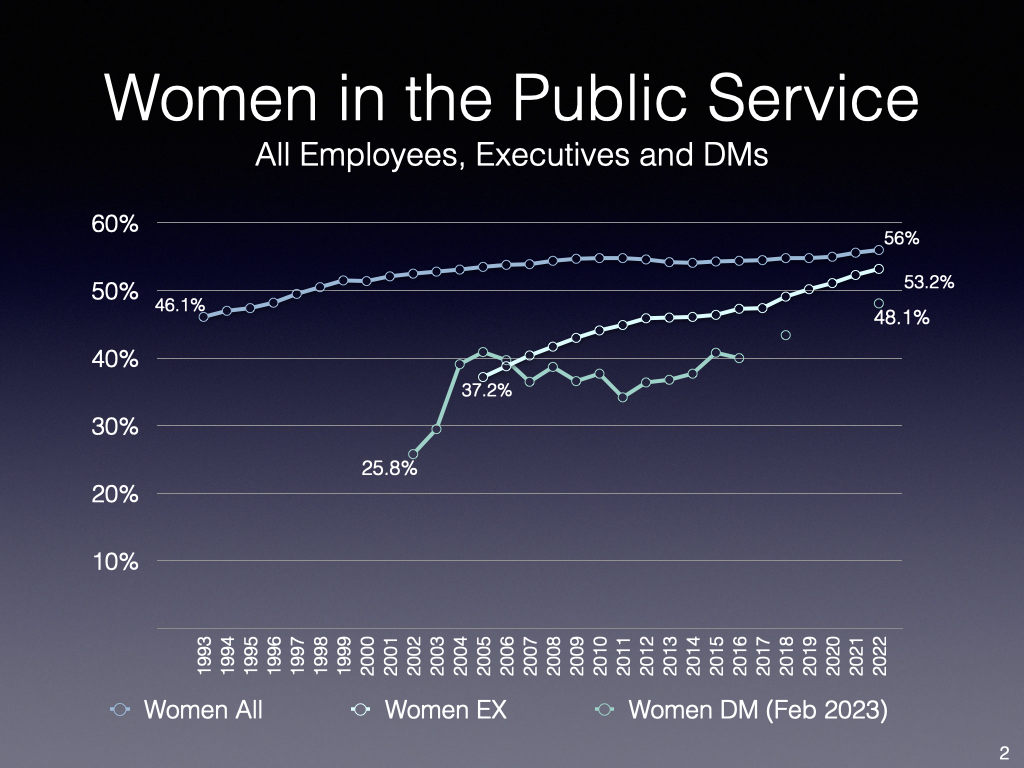
While women account for 56 per cent of the 236,133 total employees, they made up less than half all employees earning more than $75,000, according to the report. And of the nearly 95,000 employees earning in the $50,000 to $74,999 salary range, two-thirds of them are women. However, half of the 422 employees earning between $200,000 and $250,000 are women.

Indigenous employees were similarly over-represented in salary ranges below $100,000 and under-represented in all salary ranges of $100,000 and above.

Employees with disabilities and employees identifying as members of visible minorities were also over-represented among those with salary ranges below $75,000.

Though not included as an equity group, the report found that Black employees were disproportionately earning salary ranges below $75,000.

Nicholas Marcus Thompson, executive director of the Black Class Action Secretariat, which has launched a lawsuit seeking long-term solutions to permanently address alleged systemic racism and discrimination within the public service, said the Treasury Board’s latest report demonstrates that Black employees remain at entry-level positions within the government.

He said it also points to the need for amendments to the Employment Equity Act, specifically including Black employees as a separate equity group.

“It confirms that the systemic barriers are continuing with very small progress,” Thompson said. “We want real change.”

When she first entered the public service, Griffith-Bonaparte said she was paid around $30,000, a number that has slowly grown to $54,800 due to inflation.

Without being promoted, Griffith-Bonaparte said she had been stuck doing clerical work such as booking conference rooms, which has both left her in a difficult financial situation and has greatly affected her mental health, leading her to suffer from anxiety and depression. While she has applied for countless jobs within the public service in hopes of moving up, she has never been offered an opportunity to advance within her unit or other units.

Due to her low-paying salary, Griffith-Bonaparte said she started teaching singing lessons on the side in order to make her mortgage, buy food, pay utilities, and support her family. She also started working as a union representative over 16 years ago to have something rewarding to work on related to the public service, and is now the president of the Union Of National Defence Employees Local 70607 in the National Capital Region.

“Sometimes I regret ever entering the public service,” she said, “It saddens me greatly to see I’ve accomplished nothing in the federal public service at all.”

Source: Sandra Griffith-Bonaparte has worked 22 years for the government. She’s never gotten a promotion

Biden administration releases first-ever report on diversity in federal government 

Of note, embryonic to Canada’s tracking diversity for close to 30 years. USA data is hampered by the limited groups captured in the USA census.

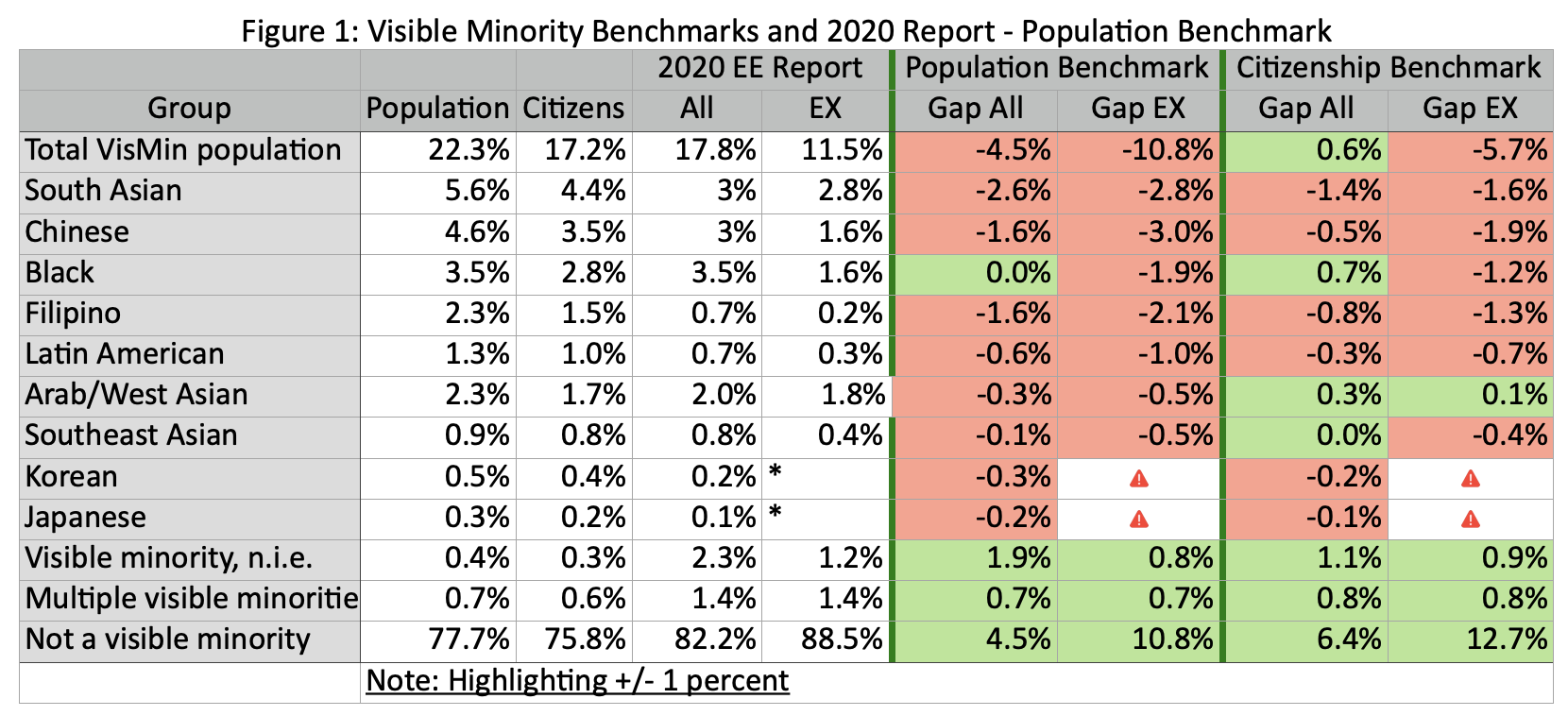
Canadian numbers for comparison purposes (core public administration) are in the table below:

2021 Census2021 EE ReportPopulation BenchmarkCitizenship Benchmark
GroupPopulationCitizensAllEXGap AllGap EXGap AllGap EX
Total VisMin population26.5%19.6%18.9%12.4%-7.6%-14.2%-0.7%-7.2%
South Asian7.1%4.9%3.3%2.8%-3.7%-4.3%-1.5%-2.1%
Chinese4.7%3.6%3.2%1.5%-1.6%-3.2%-0.4%-2.1%
Black4.3%3.3%3.8%1.9%-0.4%-2.4%0.6%-1.4%
Filipino2.6%1.9%0.7%0.2%-1.9%-2.4%-1.2%-1.7%
Latin American1.6%1.1%0.8%0.4%-0.8%-1.2%-0.3%-0.7%
Arab/West Asian2.9%2.0%2.1%1.9%-0.8%-1.0%0.2%-0.0%
Southeast Asian1.1%0.9%0.8%0.5%-0.3%-0.6%-0.1%-0.4%
Korean0.6%0.4%0.3%0.2%-0.3%-0.4%-0.1%-0.2%
Japanese0.3%0.2%0.1%0.1%-0.2%-0.2%-0.1%-0.1%
Visible minority, n.i.e.0.5%0.4%2.1%1.3%1.6%0.8%1.1%0.9%
Multiple visible minorities0.9%0.8%1.5%1.7%0.6%0.8%0.7%0.9%
Not a visible minority73.5%71.7%75.9%83.2%2.4%9.8%4.2%11.5%
Arab and West Asian2.9%2.0%-2.0%
    Arab1.9%1.4%-1.4%
    West Asian1.0%0.6%-0.6%

The Biden administration has a new warning for private employers: “We are going to start being a competitor of yours,” said Dr. Janice Underwood, director of the Office of Diversity, Equity, Inclusion, and Accessibility (DEIA) at the federal Office of Personnel Management (OPM), in an interview with The 19th. 

The federal government will fight to attract top talent to its workforce. To that goal, OPM, which serves as the human resources arm of the federal government, has released its first-ever report on diversity across the federal workforce. The 31-page document breaks down hiring and retention across agencies and gives a snapshot of the administration’s efforts to remove barriers for applicants from underrepresented communities. It’s an area where the federal government has historically struggled, Underwood concedes. 

In June 2021, Biden issued an executive order directing OPM and other federal agencies to draft a strategic plan for prioritizing diversity in hiring and retention. The February 15 report is a result of that order and offers some of the first simple, publicly accessible demographic data on the federal workforce, with breakdowns by race, gender and disability. 

The numbers reflect a federal government that made marginal gains toward racial diversity between 2017 and 2021. Black employees accounted for 18.15 percent of the federal workforce in 2017 and 18.19 percent in 2021, while the percentage of Latinx employees jumped from 8.75 percent to 9.95 percent. Asian workers went from 5.99 to 6.49 percent, and Native American and Alaskan Native workers dipped in representation from 1.69 percent in 2017 to 1.62 in 2021. Native Hawaiian and Pacific Islanders made up 0.51 percent of workers in 2017 and 0.59 percent in 2021. 

Women made up 43.38 percent of the workforce in 2017, a number that grew to 44.44 percent in 2021. Nonbinary workers are largely excluded from the tracking, an area that the report and Underwood note will change with future reporting. 

“Having this gender binary doesn’t go far enough [and] is not inclusive for our workforce,” Underwood told The 19th. “So OPM and the office of DEIA in particular are really taking the lead and reimagining what that could look like, everything from what it looks like on forms to what it looks like when you apply for jobs.”

Underwood said the government can’t change what it doesn’t measure. Officials add that the tracking effort, in general, is critical to serving an increasingly diverse public and also competing for the top minds in hiring.

“In order to recruit and sustain the best talent, we must ensure every service-minded individual feels welcome and supported in contributing their talents to the Federal workforce,” said OPM Director Kiran Ahuja in a statement. 

The first-ever report reflects a government in the midst of cultural change. Last September, OPM launched a council of chief diversity officers across federal agencies. The group has been tasked with setting government goals and benchmarks and identifying obstacles that might keep some groups from applying for jobs. 

Among the first changes has been to the federal government’s practices for hiring interns, positions that have historically been unpaid. 

“Everybody can’t afford to move to Washington, D.C., for an unpaid internship, and we have amazing talent all over this nation that does not have proximity to Washington, D.C.,” Underwood said. “I’m really excited about the launch of the paid internship guidance that all of our federal agencies have received.”

While the report does not track employees’ LGBTQ+ status, it does emphasize the expansion of LGBTQ+-friendly practices, including increased use of pronouns throughout government to affirm trans and nonbinary colleagues, as well as reiterating that all contracted insurance carriers cover gender-affirming care. 

It also offers data on disability hiring for the first time. Efforts to increase disability employment in the federal government are long-standing. Since the passage of the Rehabilitation Act of 1973, the federal government has been obligated to hire people with disabilities, although the law did not set any particular numbers or benchmarks. 

In 2010, President Barack Obama issued an executive order stating that the federal government, as the nation’s largest employer, must “become a model for the employment of individuals with disabilities.” The order directed federal agencies to improve efforts to recruit, hire and retain workers with disabilities, with the goal of hiring 100,000 more people with disabilities into the federal government over five years. 

According to a 2015 report from the OPM, the government slightly exceeded that goal, at 109,575 new hires. However, the federal government has struggled with retention. People with disabilities working for the government are three times more likely than their non-disabled colleagues to quit. 

In January 2017, before President Donald Trump was sworn in, the Equal Employment Opportunity Commission released a rule to amend regulations related to the Rehabilitation Act of 1973 that set a goal for 12 percent representation of people with disabilities among the federal workforce. At that time, 11.1 percent of federal employees identified as disabled. 

According to the latest report from OPM, 16.6 percent of federal employees identify as having a disability, surpassing the benchmark set under the Trump administration. The report did not include information on disability representation in leadership.

Biden’s executive order requiring a government-wide strategic plan brought disability employment under the same umbrella as other diversity, equity, inclusion and accessibility efforts. 

The report is expected to have broad implications because the federal government often sets a standard for the private sector in business practices. 

“We endeavor to be the model employer for the nation,” Underwood said. “But we have a lot to learn as well.” 

Source: Biden administration releases first-ever report on diversity in federal government

Encore loin de la représentativité dans la fonction publique québécoise

Of note. But as in the case of the federal government, progress:

Le gouvernement du Québec tarde à atteindre ses objectifs d’accès à l’emploi pour les fonctionnaires des minorités visibles et ethniques. La fonction publique doit ajouter au strict minimum deux milliers d’employés issus de la diversité d’ici l’an prochain, mais le compte à rebours est bien amorcé.

Pour que « l’ensemble de la population du Québec puisse se reconnaître dans la fonction publique », Québec s’était fixé l’objectif que 18 % des employés de l’État fassent partie d’une minorité visible ou ethnique (MVE) en mars 2023. Or, selon des statistiques tout juste rendues publiques, le gouvernement est encore loin du compte.

Le 31 mars 2022, le taux de présence des personnes racisées parmi les quelque 60 000 employés de l’État s’élevait à 15,4 %, révèlent les données du Secrétariat du Conseil du trésor. C’est 1,4 point de pourcentage de plus que l’année précédente (14 %), mais encore loin de la cible réitérée l’an dernier par le Groupe d’action contre le racisme (GACR).

Mis sur pied lors du dernier mandat caquiste, ce comité interministériel n’a pas pu faire le bilan de ses actions en 2022 à temps pour les Fêtes. Celui-ci paraîtra « cet hiver, [donc] en 2023 », a indiqué au Devoir le cabinet du ministre responsable de la Lutte contre le racisme,Christopher Skeete. En décembre 2021, cependant, le ministre responsable de l’époque, Benoit Charette, avait convenu que la fonction publique en faisait « trop peu » en matière d’embauche de personnes racisées.

En quatre ans, la représentativité des personnes issues des MVE au gouvernement a grimpé de 4,1 points de pourcentage.

Des meilleurs aux pires

Le ministère de l’Immigration, de la Francisation et de l’Intégration remporte, et de loin, la palme de la représentativité. En mars, près de la moitié (46,1 %) de ses employés provenait de la diversité, et l’ensemble de ses objectifs régionaux avaient été atteints. Au second rang : le ministère de la Famille, à 28,4 %, puis l’Économie, à 21,1 %.

Parmi les cancres, le ministère de la Forêt, de la Faune et des Parcs — depuis scindé —, qui comptait dans ses rangs 3,4 % de personnes racisées en mars 2022. Non loin de là, le ministère de l’Énergie et des Ressources naturelles — lui aussi remanié cet automne — (8,9 %), ainsi que celui de la Culture et des Communications (10,9 %).Interrogé par Le Devoir à ce sujet, le ministère de la Forêt, de la Faune et des Parcs n’a pas répondu dans les temps impartis. Son rapport annuel de gestion 2021-2022 indique cependant que sur 1112 nouvelles embauches, 63 personnes étaient issues des MVE.

Le ministère du Conseil exécutif, qui est piloté par l’équipe du premier ministre, atterrit aussi parmi les moins représentatifs. Au total, 8,3 % de ses employés sont des personnes racisées.

Dans son plan d’action déposé en décembre 2020, le GACR avait formulé cinq recommandations quant à l’emploi des minorités visibles et ethniques. « Pour faire de la fonction publique […] un employeur exemplaire », Québec s’engageait notamment à « négocier et à conclure, d’ici cinq ans, des ententes internationales en matière de reconnaissance des qualifications professionnelles » et à « garantir la présence d’au moins un membre provenant d’une minorité visible au sein de la majorité des conseils d’administration des sociétés d’État ».Le Secrétariat du Conseil du trésor, qui gère l’embauche des fonctionnaires, assure « met[tre] en place des actions pour soutenir les [ministères et organismes] dans l’atteinte des cibles ». « Au printemps et à l’automne 2021, le secrétaire du Conseil du trésor a transmis deux communications aux sous-ministres et aux dirigeants d’organismes afin de dresser le portrait de la situation et les inciter à mettre les efforts nécessaires en vue d’atteindre la cible de 18 % en 2023 », a écrit l’équipe des communications au Devoir vendredi.

Source: Encore loin de la représentativité dans la fonction publique québécoise

Proportion of women civil service leaders improves internationally – but only one G20 country [Canada] has achieved gender parity in top jobs

Of note. When I last looked at EX breakdowns a number of years ago, there was, as one would expect, greater representation at more junior levels (directors and DGs EX1-3) than at the ADM level (EX4-5):

Less than one in three senior civil servants across the governments of G20 countries are women, new research from Global Government Forum has found.

The latest Women Leaders Index found that only one G20 country – Canada – has reached gender parity in the top five grades of its public service (at 51.1%), and just four more are within 10 percentage points of doing so.

However, there has been improvement – the G20 mean (29.3%) has increased by 1.6 percentage points since our last Index in 2020 and by 6.0 points since our first 10 years ago.

The long-running Women Leaders Index is a league table ranking G20, EU and OECD countries on the proportion of women in senior roles within their national civil services. As well as tracking progress over time, it includes comparisons with women in government, women politicians, and women on private sector boards, alongside interviews with public service leaders in two of the top performing countries – Canada and South Africa.    

Those leading the G20 pack behind Canada, are Australia and South Africa – which tie in second place – the UK, Brazil, and Mexico and the European Commission, which tie in fifth place. Mexico has increased the representation of women in civil service leadership positions the most of all G20 nations, by a dramatic 24.3 percentage points over the last decade, while South Africa has made the most improvement in the two years since the last Index – a jump of 7.2 points.

Bringing up the G20 rear are Saudi Arabia, Japan, South Korea, China and Turkey, in which representation of women in the senior civil service is between 2.5% and 11.7%.

Countries including Germany, Italy, France and the US reside in the middle of the G20 ranking, with women accounting for between 32.0% and 38.0% of top roles in each.   https://datawrapper.dwcdn.net/rr33B/4/

EU and OECD countries faring better than those in the G20  

Though the G20 has traditionally been the main ranking in the Women Leaders Index, it also analyses representation of women in the highest grades of national civil services in EU and OECD countries.

The Index found that overall, EU and OECD countries are doing better on representation of women in senior positions in government departments and agencies – for which the mean proportions are 42.7% and 36.2% respectively – than those in the G20*.

The mean across the European Union’s member states has improved by 0.8 percentage points since 2020, and by 7.5 points since 2012, with nine of the EU’s 27 member states having reached gender parity in the top two tiers of their civil services. Bulgaria tops this ranking, with women accounting for 59.5% of those running government departments, followed by Croatia, Slovenia, Greece, Finland, Latvia, Romania, Lithuania, and Portugal.https://datawrapper.dwcdn.net/GU3A7/4/

Read our Canada perspective from seasoned public service leader Yazmine Laroche, including transferable lessons on how to make progress towards gender parity

Croatia has made the most improvement of all EU nations since 2012 – a rise of 21.1 percentage points, while Bulgaria has made the greatest improvement since the 2020 Index, of 7.8 points.

Latvia, where women account for 56% of the top tiers of its civil service, tops the OECD ranking, while six more – Sweden, Iceland, New Zealand, Greece, Canada and Slovakia – have reached or exceeded gender parity.https://datawrapper.dwcdn.net/wpOb5/2/

Regression in some countries – but public services performing better overall

While most G20, EU and OECD countries have improved the representation of women in the highest grades of their civil services in recent years, some have regressed.

The G20 data shows that in Russia and Argentina there are fewer officials in senior positions now than in 2020, while China, Turkey and South Korea have regressed since 2012.  

Six EU countries – Sweden, Poland, Cyprus, Italy, the Czech Republic and Luxembourg – perform worse in terms of representation of women in the top two tiers of the civil service since 2020, while Hungary is worse off now than 10 years ago.  

However, on a positive note, when looking at the means across the G20, EU and OECD, it is clear that civil services are doing better on representation of women in leadership roles compared with ministerial cabinet appointments, elected politicians and the boards of publicly-listed private sector companies.

Read our South Africa perspective from Zukiswa Mqolomba, deputy chairperson of the country’s Public Service Commission, on why making real and positive change isn’t just a numbers game

“Many governments have made impressive gains on representation of women in leadership positions in recent years as a result of concerted efforts to make change and should be applauded,” said Mia Hunt, author of the Women Leaders Index report and editor of globalgovernmentforum.com. 

“However, while it is widely accepted that civil services with diverse workforces that resemble the populations they serve turn out better policies and better outcomes for citizens, the mean proportion of women in top civil service positions across G20 nations is still less than 30%. Clearly, there is much more work to be done.

“We hope this Index gives the countries that have made progress the recognition they deserve, whilst serving as a wake-up call for those most in need of improvement. Let us see what’s changed when we publish the next in this Women Leaders Index series.”

*Please note that grade definitions vary between the G20, EU and OECD datasets. Caution should be exercised when making comparisons – see methodology here.

Source: Proportion of women civil service leaders improves internationally – but only one G20 country has achieved gender parity in top jobs

‘Be an ally’: Black public servants facing ‘trauma’ amid class action, says organizer

Thompson is an effective communicator and advocate.

Unfortunately, the employment equity data for the public service does not indicate that Black public servants representation are disproportionately under-represented at the EX and other levels compared  to other visible minorities for the most part.

However, the public service employee survey does show higher perceptions of discrimination than most other visible minority groups.

One of the organizers behind the class action lawsuit filed against the federal government by Black public servants says he wants Canadians learning about the experiences of claimants in the case to “be an ally” amid a process that is causing “trauma” for those involved.

In an interview with The West Block‘s Mercedes Stephenson, Nicholas Marcus Thompson said the government is “speaking from both sides of its mouth” when it comes to squaring the treatment of claimants in the lawsuit in court with the comments officials make publicly about dismantling racism.

“They’re saying one thing publicly and they’re fighting Black workers in court,” he said, adding federal lawyers keep bringing forward motions “to delay the case.”

“The government has fully acknowledged that this issue exists in all of its institutions and that the pain and damage that it causes is real. And then it shows up in court fighting Black workers, forcing Black workers to recount the trauma that they’ve endured at the hands of the government for decades.”

The class action lawsuit filed last year alleges systemic discrimination by the government when it comes to hiring and promotional decisions in the federal public service, dating back decades.

Plaintiffs in the case are seeking $2.5 billion in compensation for lost income, opportunities, and lost pension values as a result of systemic discrimination that prevented qualified Black public servants from being promoted into higher paying and more senior jobs.

Federal public service pensions are calculated based on the averages of an individual’s highest earning years, meaning those who get paid less throughout their careers get smaller pensions when they retire.

“There has been a de facto practice of Black employee exclusion from hiring and promotion throughout the Public Service because of the permeation of systemic discrimination through Canada’s institutional structures,” the statement of claim says.

The statement of claim also says that equity measures taken to date have “merely masked the increasing disparity, exclusion and marginalization of Black Canadians” from equal opportunities in the public service, and that there remains a “pernicious” underrepresentation in the upper ranks.

Thompson said he wants to see the government come to the table and commit to working towards the solutions that plaintiffs say would help fix the problem, and to make legislative changes to the Employment Equity Act as well.

“We’re seeking to create a separate and distinct category for Black workers under the legislation to ensure that Black workers are not left behind when it comes to hiring and promotional opportunities,” he said. Thompson also added there needs to be a commission formed to track concrete progress on preventing future discrimination.

“Black people want to fully participate and they’re being denied that opportunity at the highest level and the largest employer in Canada,” he said.

“So listen to us. Be an ally and let’s work together because we want to make Canada a better place and to fully participate in Canada.”

Source: ‘Be an ally’: Black public servants facing ‘trauma’ amid class action, says organizer

Diversity of UK senior civil service falls, rises at lower grades

Of note. Canadian figures by way of comparison, all visible minorities 18.9 percent, executives 12.4 percent, EX-4 10.1 percent, EX-5 9.2 percent (EX-4 and 5 likely equivalent to senior UK public servants):

The percentage of UK civil servants from an ethnic minority background is at a record high, according to the latest figures, but the proportion in top jobs has fallen for the first time since 2015.

Official figures for 2022 revealed that, of those with a known ethnicity, the percentage of government officials who are from an ethnic minority background is at a record high of 15.0% – up from 14.3% in 2021, and 9.3% a decade ago.

There was a year-on-year increase at all grades, with the exception of the senior civil service – the group of officials who run government departments or hold other top posts. In this group, there was a year-on-year decline from 10.6% in 2021 to 10.3% in 2022.

Percentage of civil servants from an ethnic minority background by grade 2012 to 2022

Civil Service Statistics 2022

The government had previously pledged to increase the percentage of senior civil servants who are from an ethnic minority year-on-year to reach 13.2% in the three year period from 2022 to 2025. However, in its Diversity and Inclusion Strategy: 2022 to 2025, published earlier this year, the government said it had stopped using targets to measure progress. “We will mainstream our success measures with our broader organisational priorities, such as Places for Growth [the plan to move officials out of London and into the regions of the UK], senior civil service workforce planning, talent schemes and recruitment priorities. Rather than relying on standalone targets, our ambitions will be embedded in these key deliverables designed to improve our delivery for citizens. Where our data indicates progress is not being made, action will be taken,” the strategy said.

The strategy made only one mention of people from ethnic minority backgrounds, stating: “We will make sure that people from minority ethnic backgrounds, those living with disabilities and those who have experienced disadvantage in their early lives can flourish in public service.”

Source: Diversity of UK senior civil service falls, rises at lower grades

Employment Equity Act Review: My submission