Citizenship: getting the balance right | hilltimes.com

My piece in The Hill Times regarding transition advice should there be a change in government (entire article given paywall):

With a federal election upon us and a possible change of government, what are the policy changes an incoming government may wish to consider, and which policies may it wish to keep?

The Conservative Government made “citizenship harder to get and easier to lose.” Residency, knowledge and language were all tightened (with reduced administrative discretion to waive language requirements and an exhaustive residency questionnaire introduced), fees more than quintupled, credit for pre-Permanent Resident time was ended, and citizenship revocation was made easier.

Some of these changes were overdue and needed. Any new government should maintain the tougher residency requirements (particularly the requirement to be physically present). Similarly, administrative measures to ensure integrity (rotating test questions, more consistent language assessment, filing Canadian tax returns) or improving efficiency (abandoning incomplete applications, simplified one-stop decision-making model) are sound and enhance the meaningfulness of Canadian citizenship.

However, a new government would likely seek to overturn other changes, based upon testimony during the 2014 Citizenship Act hearings and campaign commitments.

An early symbolic signal would be to reduce the $530 fee back to $300 (the $100 fee of almost 20 years ago being unrealistic), with consideration for hardship cases (e.g., refugees). A second change would be to abandon any current revocation cases for dual nationals before the courts, and announce the government’s intent not to launch any further cases.

The writing of a new citizenship guide that offers a more balanced interpretation of Canadian history, society and government could be achieved administratively. Ideally, this would build upon some of the strong points of Discover Canada (e.g., emphasis on history, role of the Crown and democratic institutions, military, rights and responsibilities, Quebec context), balanced with greater emphasis on social history, rights of women, Charter equality rights, arts and culture, and a reduced Monarchist flavour, along with more inclusive language. This should be accompanied by revising material handed out during citizenship ceremonies, including the Charter of Rights and Freedoms.

However, other changes could only be achieved through legislation. These include abolishing the “intent to reside” provision (requiring applicants to declare that they will continue to reside in Canada) given possible ambiguities in interpretation, restoring pre-Permanent Resident time credit towards citizenship residency requirements for some groups (e.g., international students), abolish testing 14-17 year-olds for knowledge and language given they would have been in the school system, restoring the Governor-in-Council role for revocation in cases of fraud or misrepresentation rather than only the Minister (or at least provide for oral hearings), and removing the revocation provision for dual nationals convicted of terror or treason, given that it creates two classes of citizenship and is likely unconstitutional.

In addition, any incoming government (and the public servants advising them) need to reflect on the government machinery and organizational weaknesses of Citizenship and Immigration Canada. While CIC is organized to deliver stable levels of new immigrants (about 250,000 annually), the citizenship program has been subject to recurring backlogs (over 300,000 in 2013), delays and uneven delivery (the number of new citizens has fluctuated between 113,000 and 263,000). While some reflects political direction, some is intrinsic to citizenship being a secondary priority, with less resources and management attention.

An external review of CIC’s management structure (shift from a functional to business-line model?) and governance needs to be done to ensure stronger management and oversight of citizenship.

Service standards of one-year for citizenship acquisition with regular public reporting are needed.

Apart from the question of whether an incoming government will appoint a strong minister (history suggests that Minister Kenney was an exception), there is also the question of whether citizenship will be a priority in relation to immigration and refugee policy.

Whatever changes a new government chooses to pursue, comprehensive public consultations and a willingness to entertain opposition suggestions (and in the case of legislation, amendments) should be an essential part of building consensus and ongoing support for whatever approach an incoming government pursues.

Previous governments made citizenship too easy to get and too hard to lose. The Conservative government redressed that imbalance. Hopefully, a new government will be able to achieve a new balance, maintaining the increased integrity bequeathed to them, but making needed adjustments to reinforce a more inclusive and welcoming approach to citizenship.

Source: Citizenship: getting the balance right | hilltimes.com (behind paywall)
A Tory blend of burqa-bashing and sex-education protests: Cohn

Martin Regg Cohn on the odd alliances at play and how he perceives Canada has changed:

Welcome to Canada, a country of diversity that imagines itself a beacon of multiculturalism, a bulwark of secularism, and a bastion of pluralism (which means, by the way, freedom for and from religion).

Now, Conservative Leader Stephen Harper is lifting the veil on the phobias still lurking beneath our vaunted tradition of tolerance. Who knew so many of us could get so hot and bothered about burqas and whipped into such a frenzy about homosexuality and sexuality?

When I returned to Canada a decade ago, after 11 years abroad as a foreign correspondent, I never fathomed that niqabs — a misplaced symbol of Islamist fundamentalism that I encountered overseas — would one day distract voters in a federal campaign.

And when I took over the Ontario politics column four years ago, I never imagined that dogmatic religious conservatism — the intolerance and inwardness I’d left behind abroad — would make a comeback in my home province.

Some days I feel like I’m still stuck in the Middle East watching Palestinians and Israelis at war with one another — or worse, turning on themselves: The baiting, the poking, the code language.

Overseas, it’s fear and loathing. Here at home, it’s smear and goading.

Sex-education protests and burqa-bashing are crossover issues. Like cross-dressing, they can be curious fetishes and phobias.

The fight against sex-education makes for strange bedfellows, for it is the flip side of the battle over the burqa. A vocal fringe within our Muslim minority — many of them clad, it’s worth noting here, in niqabs or hijabs — has made common cause with social conservatives protesting against the provincial sex-education curriculum.

It’s a classic case of the enemy of my enemy is my friend. But with friends like that, who needs enemies?

Oddly for anti-sex-ed Muslim parents, their allies in intolerance of gays are in some cases Conservatives stumping on the campaign trail by stirring up mistrust of Muslims who wear the niqab (which tends to drag down all Muslims).

It’s a teachable moment for any Canadian tempted to join in burqa-bashing: Tolerance is a two-way street.

Not every single parent who has reservations about the provincial sex-education curriculum is homophobic. But if you read the work of the Star’s education reporters, Kristin Rushowy and Louise Brown, it’s hard to ignore the homophobic impulses driving many of the protest organizers — rallying religious newcomers by preying on prejudices they may have carried over from their homelands, where homosexuality equals criminality.

People who defend the right to wear a niqab in public (while requiring them to identify themselves when necessary) aren’t pro-burqa, as NDP Leader Tom Mulcair argued in Friday’s French-language debate, any more than people who are pro-choice are “pro” abortion. Their position is more a variation on the Voltarian dictum, “I disapprove of what you say, but I will defend to the death your right to say it.”

One can disapprove of the niqab without disenfranchising women of citizenship and voting rights. But as a wedge issue, the burqa is unbeatable.

It presses our buttons, offends our sense of openness, makes it hard to connect with our interlocutor. Hence Harper’s undisguised glee in stirring up public mistrust of Muslims who cover up, and wounding his political opponents in the process.

Today the niqab. Tomorrow the hijab?

Will those armchair religious scholars who argue that the niqab has nothing to do with Islam (they are almost certainly right) next turn their sights on Canada’s ultra-orthodox Jews, the Hassidic (putatively pious) who persist in wearing black hats and silk stockings in public because they believe it an essential tenet of the faith (most Jews would disagree)? Shall we judge them next, stripping them of their garb as others did only a few decades ago?

Ah, but black hats and kippah and kirpans do not offend us as niqabs now do, you say? Recall that they were both proscribed in a proposed Quebec law banning religious symbols just a couple of years ago — so spare me the niceties on niqabs.

As for those who oppose an updated sex-education curriculum — the campaigning Conservatives having mischievously transposed a provincial responsibility to the federal polity — beware your bedfellows. All those Conservative candidates who tempt you into intolerance will lead you astray one day soon. Doubtless after voting day.

Myth-busting ridings: Shedding light on visible minority women in federal politics

Worth noting (apart from my book being quoted!):

A new myth-busting study by Equal Voice, a national, multi-partisan organization dedicated to electing more women to all levels of political office in Canada, provides a fresh way of looking at female representation on the federal stage. In analyzing Canada’s 33 most ethnically diverse ridings, they found that, contrary to stereotypes that visible minority communities are less open to women leaders, representation of female visible minority candidates is far higher than that of the non-visible minority candidate pool. Part of the reason? Political parties cultivate visible minority women in these communities in a way we don’t see them do with so-called “old stock” Canadians, to employ the risible term used by Stephen Harper in a recent leaders’ debate.

The Equal Voice study was undertaken to determine candidate diversity in diverse ridings, says its executive director Nancy Peckford. Researcher Grace Lore, a Ph.D. political science student at the University of British Columbia, crunched data on 33 ridings where more than 50 per cent of the population is visible minority as identified by Andrew Griffith in Multiculturalism in Canada: Evidence and Anecdote —23 ridings in Ontario, eight in B.C., one in Quebec and one in Alberta. Forty per cent of visible minority candidates were women; among candidates of the non-visible minority pool, women comprised just 21 per cent. These aren’t lame-duck contenders, says Lore: “Many of the visible minority women in those 33 ridings are absolutely in winnable ridings.”

Parties are strategic in these ridings, says Peckford, many of which are battlegrounds in the current federal campaign: “Parties inherently understand that to be competitive they need to reflect the community back to them,” she says. “I think there is a lot of diligence to ensure they’re choosing candidates who have fairly comprehensive reach.” The effort seems to be encouraging women to come forward, she says: “It’s auspicious. We need more of it.”

Asked why less diverse ridings don’t field women, Peckford is quick to answer: “I don’t think they have to try as hard,” she says.

The study’s finding is consistent with research documenting that female visible minority MPs are better represented in Parliament than in the general population. A 2008 study, “Ethnoracial minorities in the 38th Parliament: Patterns of change and continuity,” by Jerome Black reveals that representation of minority women doubled between 1993 and 2004, from just 4 per cent to 8 per cent (though, as Lore points out: “that’s hardly a level to cheer about”). By 2004, minority women comprised 40 per cent of minority MPs. “Given that, in 2004, women overall comprised just 21 per cent of all MPs, that’s pretty incredible,” Lore says. Minority women have done better than minority men, she points out: “So the way we can phrase this is when we do more to get more women, we end up with more diverse candidates overall.”

Mulcair, the niqab and ‘a dangerous game’ – Patriquin

Patriquin gets it right:

It’s gross stuff, reminiscent of the Parti Québécois identity campaign of 2014, and it deserves to be shouted down. Tonight, finally, one of the leaders did just this. Tom Mulcair’s statement during the fifth and final election debate on those few square inches of face-covering cloth deserves to be quoted in its entirety.

“The way Mr. Harper says it, it’s like there are people here that are pro-niqab. No one here is pro-niqab. We realize that we live in a society where we must have confidence in the authority of the tribunals, even if the practice is uncomfortable to us. If a journalist says something that is uncomfortable to me, I still support his right to say it. Mr. Harper, you are playing a dangerous game of the kind I’ve never seen in my life.”

Since the outset of the campaign, the NDP leader has been dogged with accusations of political pandering—of changing his message depending on the audience. Yet here he was in Quebec, the NDP’s power base and the place where anti-niqab sentiment is at its highest, saying exactly what much of his electorate doesn’t want to hear.

….But back to Mulcair. In the throes of the 2014 Quebec election, when the Parti Québécois introduced a bill that would ban religious head coverings of all sorts from Quebec’s civil service, it was Trudeau who denounced it as an unseemly electoral gambit. Mulcair remained largely silent. “We don’t want to give ammunition to the separatists,” his aide told me at the time.

The PQ ended up losing the election. As it turned out, the scapegoating of religious minorities wasn’t boffo electoral fodder after all. Quiet then, Mulcair was anything but tonight, giving Conservative and Bloc attempt to capitalize on fear the full-throated condemnation it deserves. Mulcair is nothing if not calculating, and perhaps he has calculated that the niqab isn’t nearly the electoral millstone some of his opponents hope. That is a hell of a gamble. It is also an honourable one.

Source: Mulcair, the niqab and ‘a dangerous game’ – Macleans.ca

Nenshi and ‘people like him’ are the ones politicizing niqab issue, Jason Kenney says (with a straight face)

The back and forth between Calgary Mayor Nenshi and senior Minister Jason Kenney on the politicization of the niqab, starting with Nenshi (who I think has it nailed):

Stephen Harper is playing a “dangerous” political game with his position on the niqab and “dog whistle politics” when he speaks about the Syrian refugee crisis, said Calgary Mayor Naheed Nenshi.

In an interview on SiriusXM’s Everything is Political, Nenshi told Evan Solomon that Harper’s decision to challenge the Federal Court of Appeal decision over the ability of a woman to wear a niqab during citizenship ceremonies is being done merely in the service of scoring political points.

“This is unbelievably dangerous stuff,” Nenshi said. “I spoke with a group of mayors and councillors from all over Alberta last week, and in my speech with all of these people from small town Alberta, I stood up and said this is disgusting and it is time for us to say stop it—to say this is enough,” Nenshi said.

He called out the Conservatives’ request for stay on the Federal Court of Appeal decision on the niqab. “They are spending millions of millions of dollars of yours and my money on what is an unwinable appeal in order to appeal to a certain political segment because they think the polls say that most people don’t want this,”  Nenshi said.

Nenshi was complimentary on the stances both Thomas Mulcair and Justin Trudeau have taken on the issue.

Source: Nenshi’s harsh words for Harper – Macleans.ca

Hard to imagine him saying this with a straight face as he knows better (no matter how seriously he believes in the substance of the Government’s position):

But Kenney, the Conservative cabinet minister from Calgary who introduced the niqab ban, denied the Tories are seeking to gain political advantage from the issue.

“If anything’s dangerous, it would be legitimizing a medieval tribal custom that treats women as property rather than people,” Kenney, currently running for re-election in Calgary Midnapore, said in an interview Thursday.

“It seems to me that it’s the mayor and people like him who are politicizing it. I don’t think this should be an issue of contention.”

The Conservatives point to surveys showing public support for banning the niqab in citizenship ceremonies and they have jumped in the polls since the issue became prominent during the campaign, which will see voters cast their ballots on Oct. 19.

Kenney, who is currently defence minister, said Nenshi’s comments would have no impact on the campaign, either nationally or in Calgary.

And he said it would have no affect on his working relationship with Calgary’s mayor moving forward.

“We’re all used to Naheed’s running social commentary on everything. That’s nothing new,” said Kenney.

Source: Nenshi and ‘people like him’ are the ones politicizing niqab issue, Jason Kenney says

Stephen Harper writes open letter to Canada’s ‘world-class public service’ in order to correct ‘misinformation’ | National Post

This is funny and is likely not targeted at public service voters:

After publicly taking swipes on the campaign trail at bureaucrats in Ottawa, Stephen Harper and the Conservatives say they are the party to best protect the interests of federal public servants and are proud of Canada’s “world-class public service.”

Harper released an open letter Thursday to Canada’s public service that thanks them for their hard work on implementing government policies and cutting red tape, but also tries to correct “misinformation” he says is being spread by opposition parties and unions about the government’s plans on sick leave and pensions.

With Conservatives facing tough challenges in a number of Ottawa-area constituencies – including John Baird’s former riding of Ottawa West-Nepean – the Tories put on a full-court press Thursday to try to solidify the support of voters in the National Capital Region and combat recent announcements from the NDP and Liberals about their commitments to the public service.

Unfortunately, in the current election context, misleading statements are being made about certain issues that matter to you and your families, including sick leave and pension entitlements

Senior Ottawa Conservative MP Pierre Poilievre, flanked by several Ottawa-area Conservative candidates, Thursday unveiled Harper’s letter to the public service and try to reassure bureaucrats that they have nothing to fear should the Conservatives win another mandate.

Harper, in his two-page letter, lauded the work of federal bureaucrats in Ottawa and elsewhere.

“Canadians are well-served by our world-class public service, and I have seen this first-hand as Prime Minister. During our time in Government, we have worked with you to ensure your efforts are focused on the things that matter most to Canadians, and to create a healthier workplace where good work is recognized, red tape is removed, and benefits meet real needs,” Harper says in the open letter.

“Unfortunately, in the current election context, misleading statements are being made about certain issues that matter to you and your families, including sick leave and pension entitlements.”

Source: Stephen Harper writes open letter to Canada’s ‘world-class public service’ in order to correct ‘misinformation’ | National Post

Full text of the letter: Open letter 2[1]

Political Parties Respond to OCASI Questions for General Election 2015

OCASI [Ontario Council of Agencies Serving Immigrants] surveyed the major parties regarding immigration-related issues. The following excerpts their responses to the question below on citizenship. The Conservative Party did not submit a response given that it has largely implemented its policies:

“3. Citizenship

Only 26 per cent of permanent residents who settled in Canada in 2008 acquired Canadian citizenship, compared with 44 per cent for immigrant who arrived in 2007 and 79 percent for those who arrived in 2000. These are the findings of research on citizenship acquisition released earlier this year. Access to citizenship has become more restricted, and naturalized citizens and those with dual citizenship are treated differently under the law.

Question: How will you ensure access to citizenship and exercise of citizenship is equitable?”

NDP:  Under Stephen Harper and the Conservatives, it has become harder and harder for immigrants to come to Canada and succeed. They’ve created huge backlogs, increased fees, politicized the citizenship test, made children and seniors pass language tests, and created new categories of citizenship rights. An NDP government will work with stakeholders to restore fairness and transparency to our citizenship and immigration system and to undo harmful Conservative changes. We will repeal Conservative legislation that treats naturalized and dual citizens differently from other citizens. We will review the citizenship test. And we will remove the requirement for 14-17 year olds and 55-64 year olds to pass a language test in order to receive citizenship.

Liberal:

Citizenship application wait times have ballooned during Mr. Harper’s time in office. Not content to quadruple fees and double processing times, the Conservatives have unnecessarily erected new barriers for aspiring citizens. We are witnessing ever more difficult language testing imposed on older potential Canadians, and the scrapping of the credit for time spent in Canada, which was previously extended to international students. In all of these areas, a combination of Conservative cynicism and budget cutbacks have abandoned those people who find themselves in the immigration system.

Over and over during the Harper decade we have heard how Canadians cannot get access to the services they need in a timely manner. A Liberal government will create new performance standards for services offered by the federal government, including streamlining applications, reducing wait times, and money- back guarantees. Performance will be independently assessed and publicly reported, including immigration processing. After years of cuts, all of these services take too long and do not provide the service that Canadians deserve.

Liberals believe that leading this country should mean bringing Canadians together, not dividing them against one another. We will repeal the parts of Bill C-24 that introduce unnecessary barriers and hardships for people to become Canadians. With C-24, the Conservative government has created a second class of citizen—dual nationals whose Canadian citizenship can revoked by the government without due process. Liberals believe in a Canada that is united and strong not in spite of its differences, but precisely because of them. These values have been abandoned under Stephen Harper, who wants us to believe that some of us are less Canadian than others.

Liberals believe that citizenship is a fundamental building block of Canada. No elected official should have the exclusive power to grant or revoke this most basic status. This bill devalues Canadians citizenship and undermines Canada’s economic well-being by making it harder to attract international talent and expertise to Canada.

Green:

The research clearly demonstrates that access to citizenship is rapidly becoming an unrealizable pursuit for many immigrants to Canada. Our immigration and refugee protection system is not prepared for 21st­century realities or challenges. A system with more than 50 entry streams that by 2010 had produced a backlog of one million applications ­ many of which languished in the queue for up to five or six years ­ is a dysfunctional nightmare at best. It is an embarrassment to a country like Canada that increasingly depends on interconnectedness with the rest of the world.

Immigration is first and foremost about citizenship. The Green Party is the only federal party to have concluded that the Temporary Foreign Worker Program (TFWP) is irredeemably flawed and must be scrapped. Weak mechanisms for assessing labour shortages have allowed the TFWP to undermine wage and labour standards. At the same time, the program exploits foreign workers.

Any reforms to Canada’s immigration system must strengthen our social fabric and be consistent with our fundamental values of the rule of law, equality, and fairness. The Green Party will initiate a comprehensive overhaul of Canada’s immigration and refugee protection system. Our reforms will ensure an efficient and predictable path to citizenship for all immigrants and their families. In addition to the policies discussed in depth here, we will establish pathways to citizenship for temporary foreign workers and the families of new Canadians. Greens will work with municipalities and provinces to improve the integration of new Canadians. We will also repeal Bill C­24 which allows the minister of citizenship to revoke citizenship. Citizenship is a category that cannot have classes.

New Democratic Party response to OCASI – Election 2015 [PDF]

Liberal Party response to OCASI – Election 2015 [PDF]

Green Party response to OCASI – Election 2015 [PDF]

Visible minority communities and the Election: More interesting articles from New Canadian Media

Round-up of some interesting stories on the ‘ethnic vote’ in New Canadian Media.

No surprise that Tory Candidates Make Joint Pitch to Chinese Voters, given that Chris Cochrane’s analysis shows considerable support for the CPC (see Immigrants are not a monolithic voting block). Of note is the diversity within the Conservative candidates:

The seven candidates who participated were Bin Chang representing for Scarborough-Agincourt; Joe Daniel, for Don Valley North; Jobson Easow for Markham-Thornhill; Maureen Harquail for Don Valley East; Chungsen Leung for Willowdale; Michael Parsa for Richmond Hill; and Bob Saroya for Markham-Unionville.

Ranjit Bhaskar, in Courting the “Ethnic Vote” notes, among other observations, that:

However, in a blog post on the refugee issue, Andrés Machalski, president of MIREMS, a media monitoring and research firm, observed that many of the stories in the ethnic media reflected those in the mainstream.

But harsher tones could also be seen and heard. A radio host on a Punjabi show said Canada has already admitted enough refugee, adding that settling them costs an enormous amount of money. A former refugee claimant suggested in Sing Tao Toronto that only 5,000 refugees should be let in a year as otherwise Canadian residents might have to pay more taxes.

Silke in The Niqab – Competing Traditions Clash Over Women’s Clothing, captures the diversity of opinion within different ethnic groups, and concludes, erroneously that:

In Canada, the call to allow niqabs at citizenship ceremonies is mostly based on cultural relativism – a call for tolerance of diverse customs – notably a value not practiced by any fundamentalist religion, including the Islamists it is trying to accommodate. The Conservatives’ call to ban it is based on an appeal to traditional Canadian values of having one’s face uncovered when making a commitment – looking people in the eye, so to speak. Others have called for a ban on the niqab not just at citizenship ceremonies, but more widely, as a matter of women’s rights.  However, looking at the question from a gender equality perspective, one wonders why Islamist men should be allowed to swear the oath of allegiance to Canada in their traditional attire, but not their wives and daughters.

It has actually been framed as a Charter human rights issue, given the Supreme Court has ruled that the test for a religious practice is not theological but rather whether it is sincerely held.

Pentagon’s take on ISIS fight nothing like Canada’s campaign rhetoric

Contrast between measured and political language, the latter used to install fear and division:

The leaders of the Liberal and New Democratic parties, Stephen Harper tells his election rallies, are such a couple of timorous wet smacks that they can’t possibly be trusted to shield Canadians from the evil that constantly bears down upon us all.

“Justin Trudeau and Thomas Mulcair are so wrapped up in some form of twisted form of political correctness that they won’t even call jihadist terrorism what it is,” Harper told cheering supporters in Sault Ste. Marie this month.

“If you cannot even bring yourself to call jihadist terrorism what it is, then you cannot be trusted to confront it, and you cannot be trusted to keep Canadians safe from it.”

So, to summarize, and I’m using the words of the prime minister here, ISIS is a barbaric, fanatic, radically violent bunch of jihadist terrorist murderers. And they threaten Canadians every single day. And fighting them begins with calling them all those things, and if you can’t call them those things, you aren’t a fighter.

Now, here are the words of Christine Wormuth, the under-secretary of defence at the Pentagon, in testimony to Congress last week:

“While not 10 feet tall,” she told the Senate armed services committee last week, ISIS “remains a thinking enemy that adapts to evolving conditions on the battlefield.”

Wormuth, of course, is not running for office, and it is her job to take a clear-eyed view of her adversary.

She is tasked by President Barack Obama to help lead the military offensive in which Canada has been a proud participant, to use Stephen Harper’s words again.

Wormuth and the two top American generals who flanked her in the hearings tried to focus on the coalition’s meagre gains, but couldn’t obscure the utterly bleak reality that has emerged in the year since Obama announced the offensive.

Just a few days earlier, the outgoing chairman of the joint chiefs, Gen. Martin Dempsey, described the situation as “tactically stalemated.”

Senator John McCain, former naval commander, chairman of the armed forces committee and easily the Republican party’s reigning expert on war, used more pungent language.

“It seems impossible to assert that ISIL is losing and that we are winning. And if you’re not winning in this kind of warfare, you are losing. . . It’s an abject failure.”

McCain, like Wormuth and the generals, didn’t bother with any of the jihadist-murderer-terrorist-barbaric-fanatic-radical references Stephen Harper says a leader must make in order to protect the nation.

Source: Pentagon’s take on ISIS fight nothing like Canada’s campaign rhetoric – Politics – CBC News

Immigrants are not a monolithic voting block

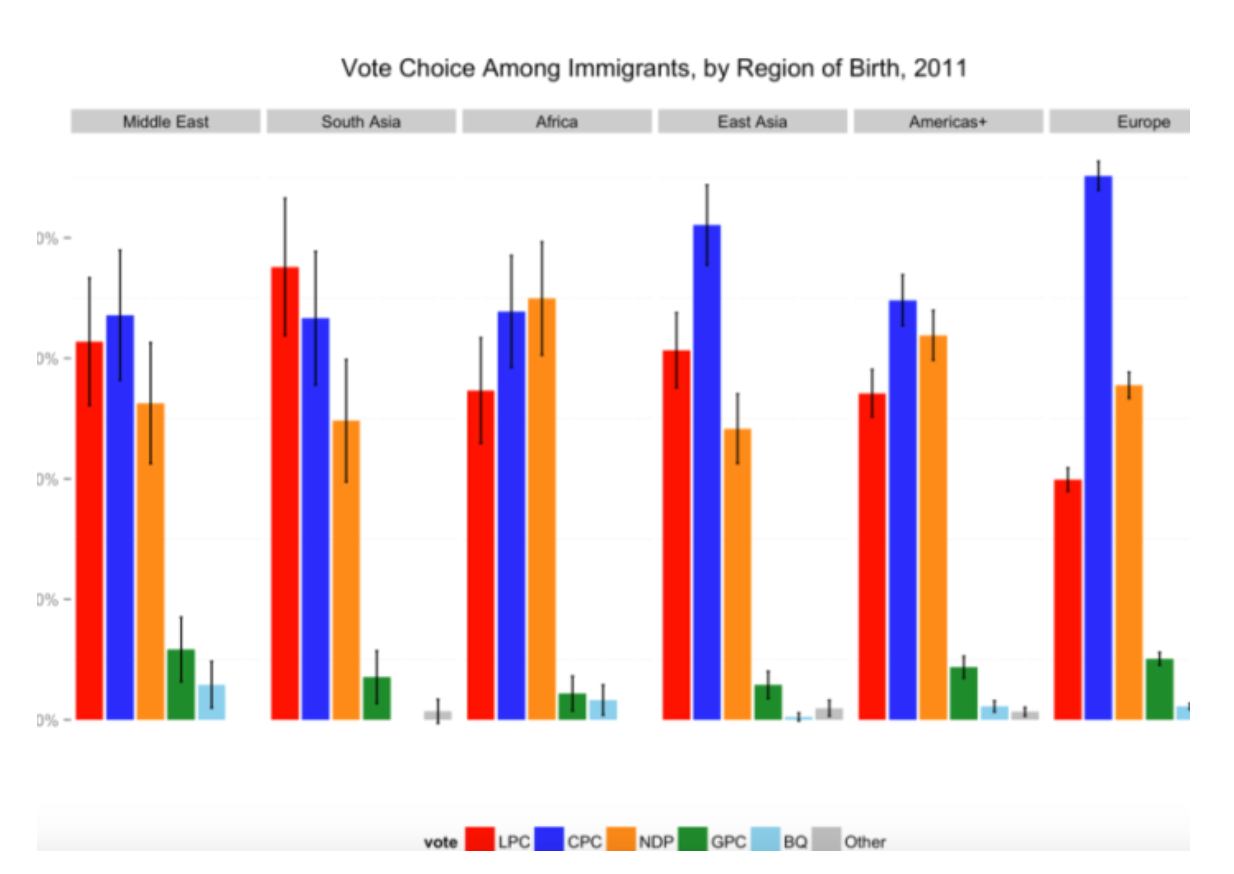
Ethnic_Voting_Cochrane_SlideGood panel organized by the Munk Centre:

If the Conservative Party is banking on the immigrant and ethnic minority vote to win them the election, as some believe they did in 2011, they might need to revisit that narrative.

“They do well with white immigrants, not visible minority immigrants. I think there is a disconnect with the narrative and reality,” says Chris Cochrane, an associate professor of political science at the University of Toronto Scarborough.

Cochrane took part today in the University of Toronto’s Munk School panel, “Courting the Ethnic Vote: Immigration and Multiculturalism in the 2015 Federal Election.” The panel of experts discussed a variety of topics facing ethnic minorities, from the racialization of candidates to the importance of diversity in politics.

Jeffrey Reitz, the president of the Harney Program in Ethnic, Immigration and Pluralism Studies at the Munk Centre, moderated the panel and opened it by discussing the traditional voting narrative of immigrants in Canada: for generations, immigrants voted for the Liberal Party of Canada, because “they were the party of open immigration,” or for the New Democratic Party, because they were the “party of the underdog.”

There was an apparent breakthrough for the Conservative Party in getting the ethnic vote when the former minister of citizenship and immigration, Jason Kenney, embarked on a major outreach effort during the last federal election, said Reitz.

“Old-stock Canadians with conservative values meet new-stock Canadians with conservative values, that was the story.”

“There is no question about the dominance of the narrative of Conservative inroads among immigrant communities,” said Cochrane, but his findings show different conclusions.

But immigrants who have moved to Canada from the Middle East showed an almost equal vote distribution amongst the parties. South Asians voted strongly for the Liberals, and African immigrants voted for the NDP. The Conservatives were favoured by Europeans, East Asians and Americans.

“A story of a massive special immigrant vote that abandoned the Liberal Party, and shifted to the Conservative Party, outside of Quebec doesn’t seem to be consistent with the data.”

Cochrane’s findings on ethnic minority and immigrant voting patterns came from the “exit surveys” conducted by the research company IPSOS. They surveyed over 100,000 Canadians in the past three federal elections — including over 12,000 immigrant voters.

“This is a unique data set that allows us to look at small communities and discuss it with high statistical confidence, he told iPolitics.”

“Outside of Quebec, the immigrant as a whole mirrors to a larger extent the vote of other Canadians, and is equally heterogeneous. There is a lot of variation in diversity in the immigrant community — just as there is in the non-immigrant community.”

Source: Immigrants are not a monolithic voting block (paywall)

Another good presentation was by Erin Tolley, looking at the news coverage of immigrants and minorities in Canadian politics, sharing the results of her forthcoming book, Framed: Media and the Coverage of Race in Canadian Politics (see her earlier op-ed in the Globe Parties pigeonhole visible minority candidates)