The big problem with calling it ‘radical Islam’: McWhorter – CNN.com

Great piece by John McWhorter of Columbia on the semantics of what to call and not to call, terrorism and extremism carried out by Muslims:
Still, the right claims the two are ignoring the fact that a disproportionate number of men who perpetrate acts such as Mateen’s are Muslims infuriated at the West.
They assert further that as long as we say “radical Islam” rather than “Islam” alone, we are suitably specifying that we don’t hate Muslims. But that isn’t how it would appear to Muslims themselves, and — if we break the language down to its structure and meaning — they’re right.
In a sentence such as “We must eradicate radical Islam,” the object of the verb eradicate is technically “radical Islam,” yes, but the core object, the heart of the expression “radical Islam,” is “Islam.” Radical Islam is a kind of Islam. The object of the eradication in the sentence is “Islam,” modified — not redefined into something else — by “radical.”
That truth affects how one processes such a sentence. The adjective can come off as a kind of decoration — it feels parenthetical, even when talking about something innocuous. Take the sentence, “I’m thinking about one of those juicy steaks.” We process the speaker mainly as thinking about steak, not steaks with the particular quality of being juicy.
We must take heed of such qualities of language, especially when the object in question is already loaded with pungent associations. Perhaps if Islam were something most of us had little reason to think about, then qualifying its name with an adjective could qualify as neutral expression. “Restorationist Zoroastrianism” — OK, maybe.
But this is the real world. Let’s face it: These days, most of us need reminding that Islam is a religion of peace. Human beings generalize; we harbor associations. In such a climate, it’s particularly easy to interpret “radical Islam” as a summation of Islam in general. It’s how many of us might guiltily hear it, and how many Muslims would process it. Certainly Islamist terrorists would: Of all the qualities one might attribute to them, subtlety of interpretation is not one of them.
Suppose someone decided to battle “radical Christianity”? Note that whatever justifications that person offered along the lines of “We don’t mean all Christians,” they’d sound a little thin. Note also that in modern American English, “radical” can mean not only “extreme,” but also, by extension, “genuine.” After all, the “radical” Islamist considers himself to be the “true” Muslim just as the “radical” feminist might consider herself more devoted to her cause than someone who would shirk that label. Meanwhile, with the pop-culture exclamation “Rad!” thrown into the mix, there’s an even finer line between its connotation “Amazing!” and the implication “That’s the way it should be!”
There actually is room for terminological compromise here. “Radical Islam” is an unhelpful term because it sounds too much like “Islam” and has been used so much that it practically sounds like “Islam” alone at this point. However, one could get the point across with something like “violent Islam” as some have tried. “Violent Islam” actually sounds like a subset of Islam rather than the thing itself, and “violent” has no alternate connotation of “authentic,” as “radical” does.
It’s important to stress, however, that semantics — used one way or another — will not change any terrorists’ minds. Omar Mateen did not shoot up the Pulse because people said “radical Islam” instead of “Islam.” Accounts of ordinary, seemingly secular Muslims mysteriously but implacably deciding to leave comfortable existences in Western Europe to join ISIS in Syria likewise make it plain that word choice will not win or lose this battle for us.
Rather, we must maintain the cognitive equipoise that refuses to revile members of a worldwide religion because of the actions of a small band of amoral true believers. In doing so, we are embodying a more enlightened worldview than ISIS and its sympathizers.
We must resist overgeneralization — a tendency hardwired into human nature — not because we think it would have restrained an Omar Mateen, but because it makes us better human beings, and possible models for future ones. Virtue, Aristotle called it. And not in the sense of stalwartly refusing to call someone a dirty name a la Dudley Do-Right, but in the sense of cultivating personal excellence simply because, in the end, it’s a perfect foundation for an existence, especially if as many people do it together as possible.
So, the indignant right-wing columnists who yearn for America to express a more direct, religiously inflected contempt for terrorists are missing the strength in what they misread as a sign of weakness. In saying we are battling “terrorists” rather than “radical Islam,” we reveal ourselves as better than the barbarians who wish to harm us.
The alternative that the right would prefer would be a nyah-nyah contest, what we might euphemistically call a competition in the distance one can cover via the act of urination. Make no mistake: I detest what people like Mateen do — the mere thought of that man this week, for example, nauseates me. Neither Sykes-Picot, nor American support for Israel, nor brown skin, nor any other historical or present-day factor justifies actions like his. But that’s why we must do better than they do, including in how we use language. I’m glad that many of us are.
And I, for one, am not against using language that allows us to refer to the painfully obvious fact that so many of these attacks stem from a perversion of the doctrine of a particular religion. Those who feel that the mere observation of this reality constitutes racism or incivility carry their own burden of justification here.
However, I highly suspect that the people who despise the President and Hillary Clinton for not saying “radical Islam” wouldn’t be quite satisfied with “violent Islam.” Why? Because it doesn’t sound like an insult, and that would reveal, again, what these detractors are really seeking — to win a competition, not to solve a problem. Like I said, we can — and must — do better than that.

Source: The big problem with calling it ‘radical Islam’ – CNN.com

Fear of Islam, immigrants and diversity are leading indicators of Donald Trump support – The Washington Post

Fear_of_Islam__immigrants_and_diversity_are_leading_indicators_of_Donald_Trump_support_-_The_Washington_PostHardly surprising:

That headline may be self-evident these days, but at least we have some pretty solid data to back it up.

According to a new Pew Research study, if you look just at Republican voters who think the growing number of newcomers in the United States “threatens traditional American customs and values,” more than twice as many have “warm feelings toward Donald Trump” as have cold ones. Among those who say immigrants strengthen U.S. society, it’s about 2-to-1 in the other direction.

What’s more, only 21 percent of Republicans said that immigrants “strengthen” America. But among these Republicans, only 30 percent told pollsters they have “warm feelings” about Trump and an even smaller share — 14 percent — feel “very warmly” about the presumptive Republican nominee.

The same was true of feelings about Islam and the fact that the U.S. population, in a few decades, will be mostly black, Latino and Asian, not white. In both cases, attitudes more antipathetic toward Islam and the country’s increasing diversity were more in-line with Trump support, while people who thought Islam is not more violent than other religions and that increased diversity isn’t a bad thing were colder toward Trump.

Source: Fear of Islam, immigrants and diversity are leading indicators of Donald Trump support – The Washington Post

Donald Trump proves racial nationalism is alive and well: Doug Saunders

Doug Saunders on Trumpism and its variants:

In a big survey conducted this month by the think tank PRRI, one thing stands out, and it isn’t economic. When given the statement “It bothers me when I come in contact with immigrants who speak little or no English,” a whopping 64 per cent of Trump supporters agreed. Among backers of other candidates, fewer than half agreed.

As surveys by San Francisco political scientist Jason McDaniel have shown, expressions of “racial resentment” among voters increase with their level of support for Mr. Trump – something that doesn’t happen with other candidates.

This is explained well in the study White Backlash: Immigration, Race and American Politics, by political scientists Marisa Abrajano and Zoltan Hajnal. Their surveys show that racial resentment has displaced class, income inequality, education, income, gender and age as identifying factors among a large part (but not majority) of white Republican voters. The group who came to support Mr. Trump are clearly defined by anger and resentment at having a black president, and a sense that their racial identity is their country’s, and is therefore threatened.

But, as the authors note, this is not an inevitable turn in Republican politics. “The United States faces two radically different futures,” they conclude. “In one scenario, the Republican Party

alters its stance on immigration, it garners more votes from the nation’s expanding racial and ethnic minority population, the worrisome racial divide … shrinks, and wide-ranging racial conflict is averted. In a more ominous scenario, though, the Republican Party continues to fuel a white backlash against immigrants and minorities … the racial divide in U.S. party politics expands to a racial chasm, and the prospects for racial conflict swell.”

The fact that the first scenario offers a clearer path to victory – as conservatives in Canada, Britain and Germany have found – suggests that this last big idea will not become a map of the future.

Source: Donald Trump proves racial nationalism is alive and well – The Globe and Mail

Trump Voters’ Aversion To Foreign-Sounding Names Cost Him Delegates | FiveThirtyEight

Not surprising, given the focus of his campaign and the demographics of those who support him:

If Donald Trump somehow falls three delegates short of reaching the magic 1,237 delegates needed for the Republican nomination, he may be haunted by an obscure outcome from the primary voting in Illinois on Tuesday. There’s clear evidence that Trump supporters in Illinois gave fewer votes to Trump-pledged delegate candidates who have minority or foreign-sounding names like “Sadiq,” “Fakroddin” and “Uribe,” potentially costing him three of the state’s 69 delegates.

This pattern appears to be a phenomenon unique to Trump’s supporters.

Illinois Republicans hold a convoluted “loophole” primary: The statewide primary winner earns 15 delegates, but the state’s other 54 delegates are elected directly on the ballot, with three at stake in each of the state’s 18 congressional districts. Each campaign files slates of relatively unknown supporters to run for delegate slots, and each would-be delegate’s presidential preference is listed beside his or her name. As a result, the top presidential candidate in each congressional district usually claims all three of the district’s delegates.

Except on Tuesday, a handful of congressional districts split their delegates in ways that cast doubt on voters’ racial motivations. Did voters have genuine personal preferences for the mostly anonymous individuals running for these slots, or was it a case of “what’s in a name?”

A FiveThirtyEight analysis of the dozen highest vote differentials within district-level Trump slates reveals a startling pattern: In all 12 cases, the highest vote-getting candidate had a common, Anglo-sounding name. But a majority of the trailing candidates had first or last names most commonly associated with Asian, Hispanic or African-American heritages. Of the 54 Trump delegate candidates in the state, two of the three worst-trailing candidates were the only two Trump candidates with Middle Eastern-sounding names.

Source: Trump Voters’ Aversion To Foreign-Sounding Names Cost Him Delegates | FiveThirtyEight

Trudeau on Trump: Not ‘smug’, Mr. Kenney — just sensibly alarmed: Kheiriddin

Tasha Kheiriddin on Trudeau’s comments and Jason Kenney’s reaction:

Some criticized Trudeau’s remarks as ungracious. “Regrettably smug comment by PM Trudeau,” sniffed Jason Kenney on Twitter, “re our American friends, who help to defend Canada & our interests globally.” The American Spectator’s Aaron Goldstein called Justin Trudeau “smug and condescending just like Obama.”

But Trudeau wasn’t being smug. He was speaking truth to power, or power-in-waiting — at a time when many in the U.S. would do well to listen. Like his father, Trudeau pointed out something about Americans that Americans are seldom going to notice themselves — that they are all too often oblivious of the interests and experiences of the people with whom they share the planet. The elephant won’t crush the mouse out of malice — but he might do it out of ignorance.

In Trump’s case, the ignorance is wilful — even celebrated by those who profess it. Anti-elitism has combined with racism to fuel Trump’s rise. Malicious verbal — or physical — attacks are visited on those who disagree with him. The ends aren’t justifying the means this time, because the ends have nothing to do with protecting American values or interests. They’re all about Donald Trump — what he wants, the lies he’s willing to tell to get what he wants.

Trump’s campaign carries all the hallmarks of tyranny — towards other nations, towards the American people themselves. And it won’t help Americans defend themselves … or us.

Trudeau on Trump: Not ‘smug’, Mr. Kenney — just sensibly alarmed

ICYMI: How Ann Coulter inspired Donald Trump

Interesting little nugget connected to Canadian politics, the reference in the last para to Peter Brimelow, a seminal influence on the Reform party and Stephen Harper, according to William Johnson and Paul Wells.

Helps explain some of the anti-Muslim rhetoric during the last campaign:

Being a pundit is a show business occupation, and Coulter, like many show business stars, seemed to have been supplanted by younger models. She had become famous in the cable TV world of the 1990s as a good-looking blond lawyer willing to say the most outrageous things about liberals, especially Bill Clinton. As this kind of put-down became more common, and channels like Fox News put conservative blond women all over television, her uniqueness seemed to fade and her sales with it: in 2011, the Washington Post reported weak sales for her book Demonic: How the Liberal Mob is Endangering America.

¡Adios, America! changed that, debuting at No. 2 on the New York Times non-fiction bestseller list and reinventing Coulter’s image. The younger pundits who were eclipsing her have been thrown for a loop by Trump’s rise—Glenn Beck contributed to National Review’s “Against Trump” issue last month—and left Coulter as the voice of pro-Trump punditry. When Trump walked out on a Fox News Republican debate, Coulter, writing in the Hollywood Reporter this week, trashed Fox as “trivial and self-important” and praised Trump as the only candidate who “takes principled stands.” Trump fans can count on her to defend their idol against mainstream conservatism.

If Trump is pulling Coulter back into the limelight, she might end up pulling a lot of other people in with her. The Southern Poverty Law Center pointed out that Coulter “routinely cites white nationalists” in ¡Adios, America! In an interview with Chronicles magazine, she stated that one of her key inspirations for writing the book was Alien Nation author Peter Brimelow, who recently called for the expulsion of Muslims from the U.S. and declared “whites are America.” A year ago, such associations seemed like a bad move for a mainstream conservative. But, thanks to Donald Trump, Ann Coulter might be the head of the new conservative mainstream.

Source: How Ann Coulter inspired Donald Trump

Can America’s political discourse get any cruder? Neil Macdonald

Interesting if uncomfortable parallel Neil Macdonald makes between the religious extremists in the Iranian revolution and the US evangelicals:

In fact, Palin’s speech reminded me of another one I attended, years ago, in Tehran during my time as CBC’s Middle East correspondent.

Mohammed Khatami, the reformer, had been elected president of Iran, and you could taste the craving for change in the city’s mountain air.

On a whim, I decided to attend a Friday sermon by Ayatollah Taghi Mesbah Yazdi, probably the most hardline cleric in the theocracy.

He scorned the reformers and called down divine judgment on them, and exhorted the crowd to go and impose the will of the people.

It was a speech filled with hatred and religious bigotry and nativism, and the crowd absorbed it with the same sort of ecstasy U.S. conservatives evidently experience at Republican rallies nowadays.

I spoke to several people as they exited the sermon; most were rural, uneducated, and were bused in for the event. In cosmopolitan Tehran, Yazdi wouldn’t likely have been able to fill a big classroom, let alone pack in thousands of panting zealots.

‘You’re fired’

Sarah Palin, likewise, feels most comfortable outside America’s big cities, talking to the white evangelical Christians she calls “real Americans,” as opposed to the ethnic stew of the more permissive, homosexual-tolerating, non-God-fearing souls who populate the coastal population centres.

…Watching Palin and Trump, it was impossible not to wonder, once again, how America, a country that has achieved such excellence, and has so often shown the world a better way, descended into a political discourse that demonizes enlightened thought and glamorizes mean-spirited, lowbrow crudeness.

And something else occurred, a notion I’ve always shied away from because I find jingoism distasteful: None of this stuff would go anywhere in Canada. It would draw snickers and derision, not cheers.

The only reason I can cite for this difference in national attitudes is religion. Not the quiet, old-line religiosity whose adherents believe worship is a private matter, best practised in church.

I’m referring to the messianic, aggressive religion of certain evangelical Christian sects, which believe that even other streams of Christianity, never mind other faiths, are false, and that their job is not just to spread the word of God but to impose it, and that the best way to do that is to run the government.

That sort of religion happily ignores inconvenient facts and contradictions, and has always been ripe for the con job pulled by the Republican elite: promise to end atheistic permissiveness, then get into office and implement an economic agenda most friendly to Manhattan billionaires like Trump and multi-millionaires like Palin. (She recently put her 8,000 square-foot Arizona compound up for sale for $2.5 million.)

To be fair, this loopy form of religio-political fantasy is particular to the Republicans, and lots of religious Americans find it offensive to rational thought.

But it should not be dismissed, as clownish as its heroes can seem.

Think about Iran: Yazdi and his fellow hardliners triumphed. The reformers were shut down and jailed. The urban elites were cowed. It can happen.

Source: Can America’s political discourse get any cruder? – World – CBC News

Canadians turned off by Donald Trump’s inflammatory policies: poll

Canadians_turned_off_by_Donald_Trump’s_inflammatory_policies__poll___National_PostInteresting but not terribly surprising result that largely correlates with the Conservative Party base, providing a possible explanation for the wedge politics of the previous Conservative government and its election strategy:

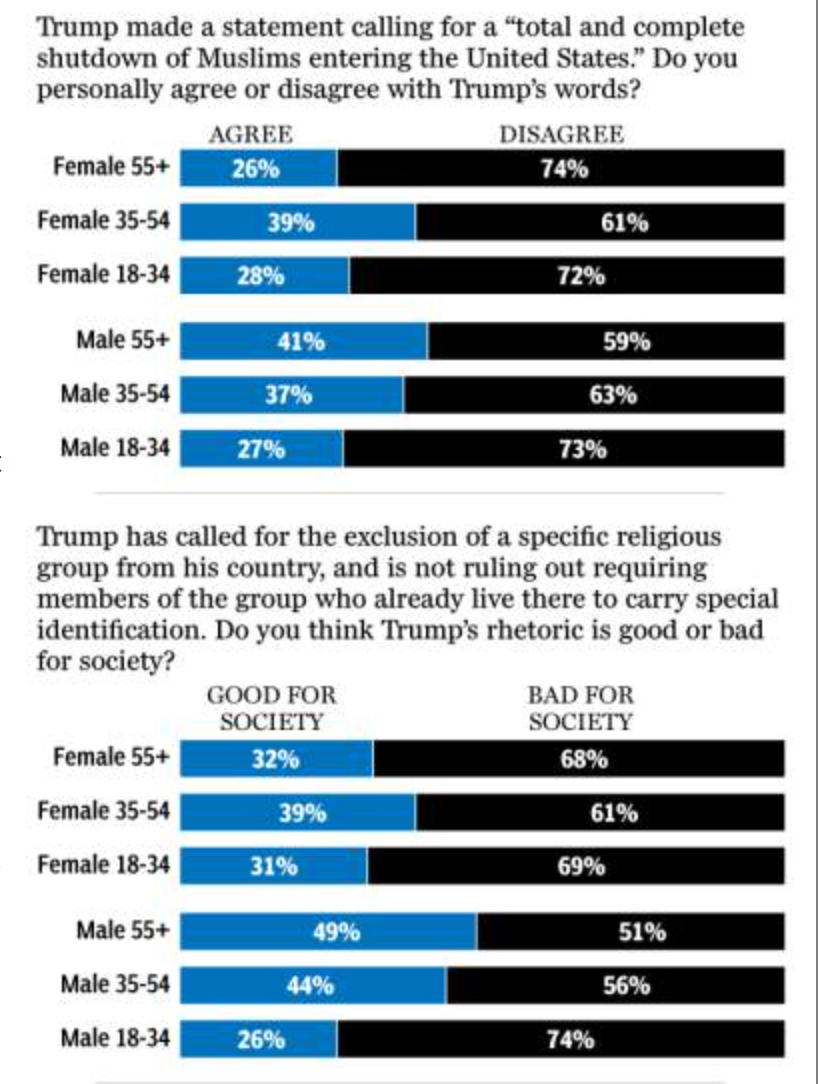
Respondents were also questioned about Trump’s call for a ban on all Muslims entering the United State: 67 per cent said they personally disagree, while about 50 per cent “strongly” disagree.

However, the poll notes that still leaves a sizeable minority — a full one in three — who agrees with Trump, 13 per cent “strongly” so.

Women aged 35-54 and men 55 or older were mostly likely to agree with Trump — by 39 per cent and 41 per cent respectively.

Responses varied across the country.

In every case, support for Trump was more apparent in rural settings, and at its lowest in urban centres like Toronto, Montreal and Vancouver.

Residents of central Canada and the west coast were most likely to dislike Trump, compared with 46 per cent of Saskatchewan residents who said they agreed with him.

Responses were also dictated by politics: people who voted Conservative in the last federal election were far more likely to support Trump, 55 per cent,

Respondents were also divided on whether or not Trump’s remarks are good or bad for society.

Unsurprisingly, the same minority that agrees with Trump’s police is also likely to say his rhetoric is good for society because it brings to light “timely issues without fear of political correctness, ” while 63 per cent disagreed, saying it “encourages fear and hatred towards Muslims.”

Kurl said that while the poll was clear a majority of Canadians do not support Trump, it is important to note the minority results, too.

“There is a significant number of Canadians who agree with Trump’s statements calling for a complete shutdown of Muslims entering the United States,” she said.

“Two in three disagree. The majority disagree. But one in three agree and that is a significant segment of Canadians.”

The poll has a margin of error of 2.5 percentage points, 19 times out of 20.

Source: Canadians turned off by Donald Trump’s inflammatory policies: poll | National Post

Kelly McParland: Refugee hysteria reaches a new low with plan to search migrants for jewelry

Contrast with Canadian approach striking, as is sad state of conservatism:

Perhaps it had to come to this.

In the squalid competition for the most wretched position on Middle East refugees, Denmark can claim a new low. Having already placed an ad in Lebanese newspapers making clear to asylum-seekers they weren’t welcome, the Danish government is debating a new measure: it wants to seize their jewelry.

In an email to the Washington Post, the Danish integration ministry said the bill — which is expected to pass — would empower officials to search the clothes and luggage of asylum-seekers “with a view to finding assets which may cover the expenses.” Authorities would allow claimants to keep “assets which are necessary to maintain a modest standard of living, e.g. watches and mobile phones,” or which “have a certain personal, sentimental value to a foreigner.”

It is only looking for items with considerable value: for example, the minister of justice said on TV, refugees arriving with a suitcase full of diamonds.

One wonders why a person with a suitcase full of diamonds would need to plead for a place to live, especially one as distant and chilly as Denmark. And while they’re at it, why not search their teeth for gold fillings? But the abject assault on people fleeing the chaos of Syria and Iraq isn’t troubled by simple logic. It’s all about fear, bias and discrimination. Unfortunately, it’s also a cause that has been taken up with enthusiasm by right-wing politicians and ultra-conservative governments, who see political gain to be had in spreading hysteria.

Akos Stiller/Bloomberg

Akos Stiller/BloombergHungary’s Prime Minister Viktor Orban

Conservatism is not about hate, bigotry or exploiting the needy. But its brand is in danger of being permanently tarred by the outspoken braying of demagogues like Donald Trump, or small-minded governments like those in Denmark, Poland and Hungary. The Hungarian government’s response to the flood of people fleeing Syria was to erect a razor-wire fence, accompanied by Prime Minister Viktor Orban’s declaration that Muslims were not welcome and his rejection of European Union resettlement quotas. Hungary’s fence forced others to soon erect their own, as each sought to direct asylum-seekers elsewhere.

The ugliness of discrimination is not lessened by the political gains it sometimes brings.

Poland’s newly-elected right-wing government announced it would refuse to accept the 4,500 refugees assigned it under the quota system, reversing the acceptance of the previous government.

Trump, of course, has assured himself the attention he so openly craves with increasingly loathsome remarks about the purported threat of the refugee hordes. His proposal to ban all Muslims from entering the U.S. — even though the U.S. has millions of honest and patriotic Muslim citizens – has been overwhelmingly denounced, but succeeded in cementing his runaway lead in the Republican presidential sweepstakes.

The ugliness of discrimination is not lessened by the political gains it sometimes brings. The more Trump is attacked, the more support he seems to gain. Orban’s policies were initially reviled, but have been highly popular in Hungary and are now being quietly studied across the EU. Poland’s government was elected on the back of anti-immigrant fervour, and includes a stark anti-Semitic streak.

It’s a trend that should be roundly condemned, and resisted at all costs.  The new Liberal government, of course, has begun accepting — indeed, welcoming — refugees to Canada, and has pledged more aid for those still overseas. Canada’s interim Conservative leader Rona Ambrose has made clear her party welcomes refugees and will continue Canada’s tradition as “a compassionate country and … compassionate people.” The point can’t be made strongly enough, and whoever succeeds Ambrose as leader should ensure it is a bedrock of future policies. There will come a time when the hysteria will subside and people will look back in embarrassment at the ugliness of the debate it has inspired. Canadians should ensure that when that time comes, they won’t be among those with something to regret.

Source: Kelly McParland: Refugee hysteria reaches a new low with plan to search migrants for jewelry

If Donald Trump were campaigning in Canada, could he be charged for hate speech?

Good comparative analysis:

On Monday Donald Trump called for a complete ban on Muslims entering the United States “until our country’s representatives can figure out what’s going on.” Despite universal outrage, the billionaire presidential candidate has only doubled down on his vow, the latest in a string of anti-minority comments ranging from the offensive to the downright absurd. Even respectable commentators have started calling him a fascist.

These comments are in bad taste at best and hateful at worst, why are there no legal repercussions for Trump making them? 

The short answer is because it’s the United States. The U.S. has extremely strong protections for free speech, which is only considered hateful if it will incite direct and immediate violence. Trump pontificating at a podium or in an interview doesn’t qualify. Until he starts an angry mob, he’s free to say whatever he likes.

So for argument’s sake, what if this were happening in Canada? Would anything be different?

Trump’s most recent comments might offend you, but they likely still couldn’t be prosecuted under Canadian law. Though hate speech laws in Canada are broader than they are south of the border, speech needs to meet some very specific requirements to be considered hateful here, too.

Section 319 (1) of the Criminal Code states that hate speech “incites hatred against any identifiable group where such incitement is likely to lead to a breach of the peace” and where the comments are made in a public place.

This would pose two problems for charges under hate speech law.

“[T]he immediacy of the breach of the peace would make it extremely difficult to convict someone for saying what Trump said,” said Faisal Kutty, a Toronto lawyer and human rights activist.

Trump also isn’t making any outright claims despite the subtext of his statements, said Richard Moon, a law professor at the University of Windsor.

“That’s the main problem with trying to fit his current statement under the hate speech law: it doesn’t have any real hateful content in the sense of making a claim about the nature of character of Muslims,” said Moon. “Of course, why should they be excluded other than, presumably, on the belief that they are somehow dangerous? But he leaves that slightly open.”

But I’ve seen and heard people call his comments hate speech. What does that mean?

That’s due to the technicality of law. While his comments might be considered hateful, the burden of proof under the law is higher. The comments must meet specific criteria to be prosecuted, and his comments likely don’t meet these standards.

What about some of his other comments? He’s said a lot more extreme things in the past.

Some of his previous remarks could more easily be prosecuted, like his remarks about Mexican immigrants during his announcement speech on June 16: “They’re bringing drugs. They’re bringing crime. They’re rapists.”

“That is the very stuff of hate speech, and a claim like that made in Canada might well constitute hate speech contrary to the Criminal Code,” Moon said.

So why are Canadian and American hate speech laws so different?

It’s probably due to a lot of factors, but part of it traces back to the founding of the country. America is old, and so are some of the laws, said David Matas, a Winnipeg-based lawyer and author of Bloody Words: Hate and Free Speech.

“In the United States you’ve got a bill of rights which is very old.  It comes from the 18thcentury. Everywhere else, the concept of rights is post-Holocaust, post-Declaration of Human Rights. Being ahead of the gun at the time has left them far behind when it comes to the 21st century.”

Source: If Donald Trump were campaigning in Canada, could he be charged for hate speech?