Diversity Hires Punished For Valuing Diversity « The Dish

Seems counter-intuitive but it does reinforce the difficulty in changing corporate and individual cultures. And of course, ambitious women and minorities will tend to adapt to the corporate culture, consciously or not, part of a normal and human integration process:

A woman who shepherds women up the ranks, for example, is perceived as less warm, while a non-white who promotes diversity is perceived as less competent. Both end up being rated less highly by their bosses, according to the paper, which is set to be presented at an Academy of Management conference next month. … Often, having women or minorities atop a company is perceived as a marker of progress for diversity efforts, but [David] Hekman’s research suggests their presence might not have a large impact on the rest of the organization. If they believe it’s too risky to advocate for their own groups, it makes sense that successful women and non-white leaders would end up surrounded by white males in the executive suite, he said.
Diversity Hires Punished For Valuing Diversity « The Dish.

Don’t call it diversity, call it real life

ABC President Paul Lee on diversity in television programming:

ABC is not on a mission to change TV, Lee insisted. He sees it as reflecting society as it is today.

“We think that’s our job,” he said. “Its not so much diversity as authenticity, if you’re reflecting America. We think these shows are deeply relatable, When I watch Black-ish or when I watch Cristela, I am one of those families.”

……ABC president Lee said his own background as an outsider – a British immigrant who studied Portuguese at Oxford and worked in Brazil before settling down in the U.S. – has helped give him a different perspective.

“Being an outsider is sometimes a great advantage and sometimes a disadvantage,” Lee said. “Sometimes you gain more than you lose from that perspective. It gives me a chance to look at things from another angle. The reality is, great stories resonate in the heart and gut of the audience, and that’s true anywhere in the world.

“I was brought up on American shows as much as I was on British shows,” Lee said. “My job isn’t to sit here as a Brit, commissioning American shows. My job is to see whether these shows move me, whether they move me to laughter or tears. If they do, and they do it in an authentic way, then we have a chance to resonate in the U.S. and beyond.”

Don’t call it diversity, call it real life.

How diversity actually makes us smarter

In other words, diversity requires us to shift from automatic to deliberative thinking (from System 1 to System 2 in Kahneman’s terms):

In more homogenous parishes, towns, states and countries, residents aren’t necessarily obliged to take that extra intellectual step. In places where the overwhelming majority of residents share a common background, they are more likely to maintain an unspoken consensus about the meaning of institutions and practices. That consensus, Dutch philosopher Bart van Leeuwen reminds us, is enforced “through sayings and jokes, in ways of speaking and moving, and in subtle facial expressions that betray surprise or recognition.” In other words, the way things are is so self-evident that they don’t require a second thought.

Diversity, however, requires second thoughts. When the consensus is challenged in a homogenous place by the presence of new people, things get interesting. The familiar signs and symbols that undergird our implicit understanding of the world can change in meaning. The presence of conflicting worldviews causes confusion, uncertainty, and alienation for holdovers and newcomers alike. These feelings can either cause people to draw back into themselves — or force them to articulate and justify themselves to those who don’t share their view of the world. Or both.Because of our long history of immigration, the disruptions of diversity have been commonplace in American life. The late historian Timothy L. Smith famously called migration to the U.S. a “theologizing experience” that forced newcomers into the existential dilemma of having to “determine how to act in these new circumstances by reference not simply to a dominant ‘host’ culture but to a dozen competing subcultures, all of which were in the process of adjustment.”

How diversity actually makes us smarter – The Washington Post.

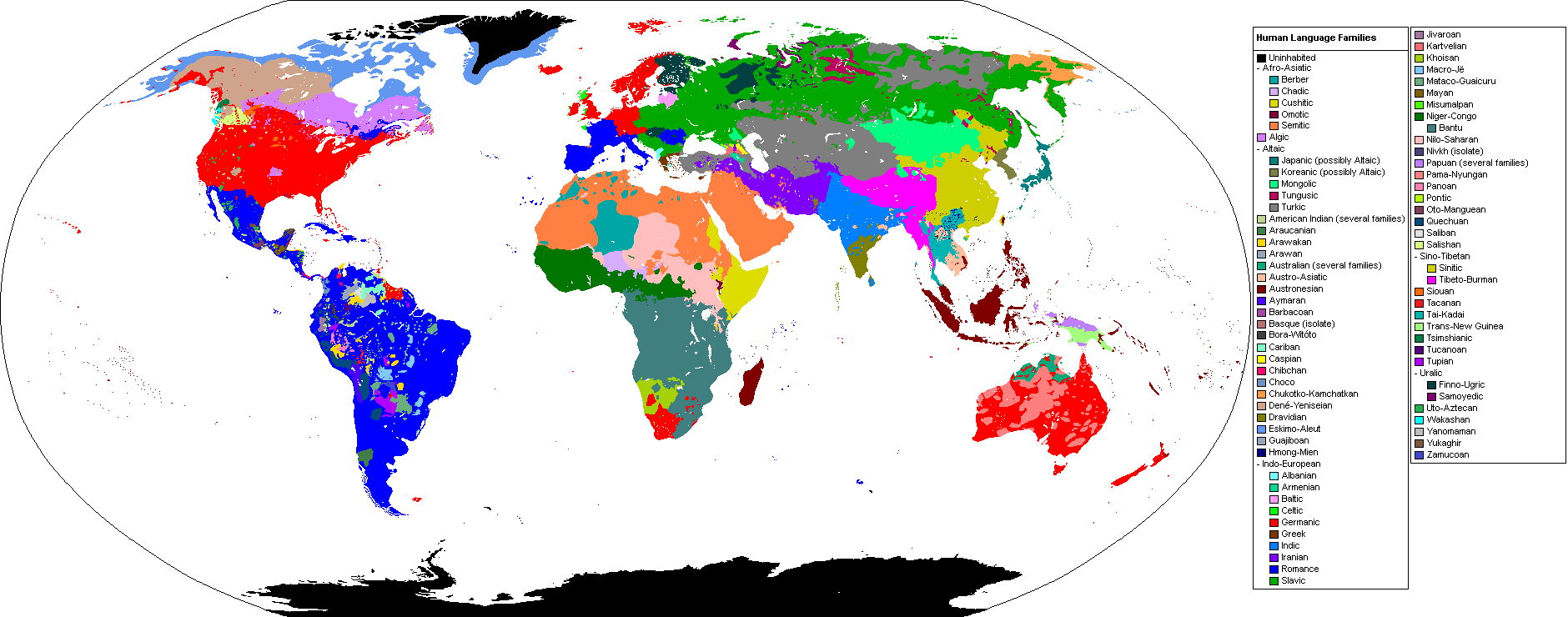
Chart of the Day: The amazing diversity of languages around the world by language families (2)

Primary_Human_Language_Families_Map


Another thing that’s interesting, though, is the global dominance of Indo-European languages. This category includes Romance languages, Germanic languages like English and German, Indic languages like Hindi, and even Iranian languages like Farsi. When you merge all of the Indo-European sub-families, you see how much of the globe that family represents:

One last note: though the globes linguistic diversity is impressive, its shrinking. In 2011, David Harmon, a scholar who runs the Index of Linguistic Diversity, warned of a potential for linguistic “mass extinction” in the 21st century. Though there were 7,000 spoken languages in 2011, global linguistic diversity has been in decline. Only 80 percent of languages spoken in 1970 still existed by 2005.

The amazing diversity of languages around the world, in one map – Vox.

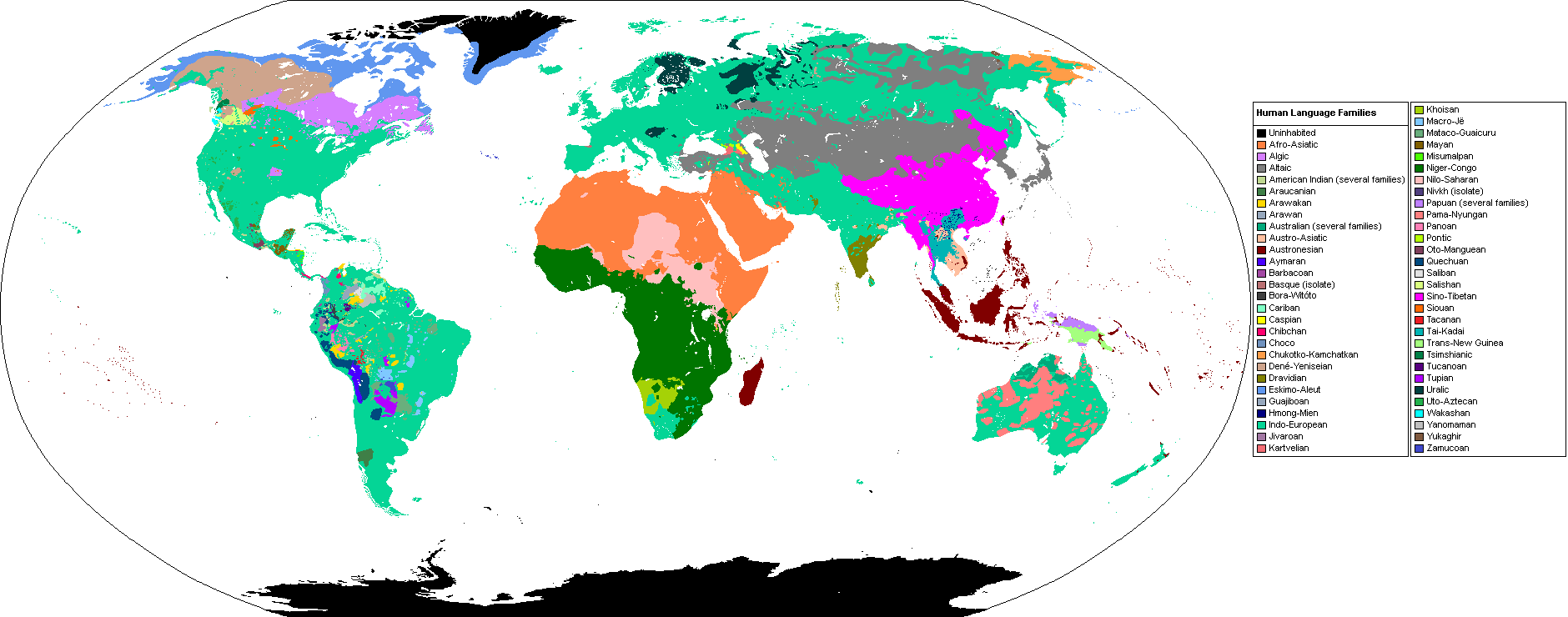
Chart of the Day: The amazing diversity of languages around the world, in one map (1)

Human_Language_Families_Map


People on Earth speak thousands of different languages. But given the ubiquity of some languages, like English and Mandarin, its easy to forget just how many there are around the planet.

This map provides some great perspective. Instead of representing each language, the map groups territory by which broader language family the dominant local language falls into. For instance, western and southern Europe are deep blue, because most locals speak one of the Romance languages like French, Spanish, and Italian that descended from Latin. When you look globally, the diversity is dizzying:

The amazing diversity of languages around the world, in one map – Vox.

A rethinking of homogeneity as the baseline used to study diversity

Interesting take on diversity vs homogeneity, and the tendency to take homogeneity as the default, from a study by the MIT Sloan School of Management:

In the paper, Apfelbaum, Phillips, and Richeson survey past literature and raise the possibility that homogeneity may be one underlying cause of “groupthink,” in which people fall into an unwarranted consensus.

“It may be that part of what is driving these classic cases of groupthink is having people who are similar to one another,” Apfelbaum says.

Other scholars who have read the paper say it presents a useful reframing of diversity discussions. Samuel Sommers, an associate professor of psychology at Tufts University, calls the paper “very interesting work” that “makes the convincing argument that homogeneity has effects, too, and we should be studying and debating those as well.”

Apfelbaum is working on further experiments aimed at isolating the effects of both homogeneity and diversity. One study looks at peoples activities in financial markets, examining how accurately people price assets in markets that are ethnically diverse or homogenous.

“Being with similar people serves a very basic psychological need to belong and feel comfortable,” Apfelbaum observes. “Were not arguing theres no value in that. Were arguing there is a trade-off with that. The social settings that make us feel good are not necessarily the ones that produce accurate judgments.”

A rethinking of homogeneity as the baseline used to study diversity.

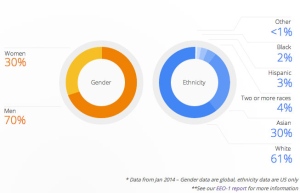
Google diversity report highlights white male workforce

google-diversity-dataInteresting piece on Google’s efforts to increase diversity. The problem applies to much of the tech industry:

Gender and ethnic disparities are reflected throughout the tech industry. About seven per cent of tech workers are black or Latino in Silicon Valley and nationally. Blacks and Hispanics make up 13.1 and 16.9 per cent of the U.S. population, respectively, according to the most recent Census data.

In the coming months, Google said, it will work with the Kapor Center for Social Impact, a group that uses information technology to close gender and ethnic gaps in the Silicon Valley workforce. The centre will be organizing a Google-backed conference in California focusing on issues of technology and diversity.

Co-founder Freada Kapor Klein, who started the Level Playing Field Institute 13 years ago to teach and mentor black and Latino students in science and math, said Google is showing leadership “which has been sorely needed for a long time.”

“Google is the company known for the moonshot, and applying that part of Google DNA to this problem is a breath of fresh air,” she said.

Google diversity report highlights white male workforce – World – CBC News.

Tire Review – Embracing Diversity

I never thought I would see a tire magazine talking about diversity but makes sense, given the need for differentiated marketing strategies:

“Being diverse opens you up to a whole world of customers, which at the end of the day means more sales,” says Corey Miller, president of Halifax, Nova Scotia-based Miller Tirecraft. “There’s no point in limiting yourself to just 75% of the market; you may as well try to reach 100% of it. There’s a business case to support that it’s more profitable. I truly believe when you’re open and inclusive, the logical result is that you attract more customers.”

Community Tire, based in Phoenix, has undertaken two highly successful marketing campaigns, first one for the LGBT community and subsequently one targeting women.

While both groups actually have much in common from a customer standpoint, CEO Howard Fleischmann Sr. says, “The difference between marketing to the female community and the gay community is if you do a good job with women and they trust you, they’re going to come back. If you do that for someone in the gay community, they’re going to come back but they’re going to bring six of their friends. It’s a very good group of customers to have.”

“Women are loyal customers,” agrees Tania Flynn Warminski, vice president of Hermitage, Pa.-based Flynn’s Tire & Auto Service. “Once they find a professional who they know is knowledgeable, honest and values their business, they will not only be loyal to that business, but they will tell all of their friends about it.”

Tire Review – Embracing Diversity.

Companies see diversity pay off

An example of diversity leadership in legal practice, Denton’s Canada (highlighting their Calgary office):

“From a cultural perspective, we’ve had zero pushback from senior leadership on embracing (diversity and inclusion) programs,” says Ghitters. “Diversity isn’t a fad. We’re in it for the long term.”

Having been recognized recently as one of Canada’s Best Diversity Employers by Mediacorp Canada Inc., Ghitters said diversity has to be built into the culture of a company with buy-in from the top down.

In the past six to eight months, the company has done everything from host several events supporting the LGBT community, had inspirational speakers, and ongoing support from the firm’s regional diversity committees for its array of programs.

It’s all part of an effort to instil a sense of support for diversity in every aspect of the company’s operations.

It appears to be working. “Any good workplace culture has some fun to it and this is a good way to celebrate diversity,” said Jordan Deering, partner and co-lead of the diversity committee in Calgary with Ghitters.

They use the simple method of reflecting the naturally diverse nature of the clients they serve and the cities they operate in across Canada.

“It also assists us in approaching legal issues from different perspectives and ways of thinking,” says Deering. “It helps us look at things from all angles.”

Companies see diversity pay off.

Tories chastised for lack of racial diversity in judicial appointments – The Globe and Mail

While the Conservatives have been successful in their outreach to ethnic communities, it would appear much less so in some of the more substantive aspects such as judicial appointments:

In the past five and a half years, the federal government has appointed just three non-white judges, out of nearly 200 first-time judges named to the bench, despite growing numbers of lawyers who are members of racial minorities.

1.5 percent of appointments, and the usual government response that it is “guided foremost by the principles of merit and legal excellence in the appointment of judges and Canada has many candidates that meet these criteria” suggests insensitivity to diversity issues. The Government has been assiduous in appointing a number of senators from ethnic communities as well as having reasonable representation among its caucus. Why the difference in judicial appointments? Does the government wish to say that there are only a handful of qualified candidates among minorities?

Tories chastised for lack of racial diversity in judicial appointments – The Globe and Mail.