Intel Discloses Diversity Data, Challenges Tech Industry To Follow Suit : NPR

Intel_Discloses_Diversity_Data__Challenges_Tech_Industry_To_Follow_Suit___All_Tech_Considered___NPRAn ambitious approach with clear, quantifiable goals, publicly available that provide accountability:

Intel set a goal last year: of all new hires, 40 percent have to be women or under-represented minorities (black, Latino, Native American). The company had never hit that level in the past. So for Intel, it was an ambitious goal. And the company reports today: it managed to exceed it, hitting 43.1 percent.

Intel CEO Brian Krzanich shares some of his motivation: “I have two daughters. They’re both technically very bright. I want them to come into a workplace that’s a better place than the way the workplace is today.”

To do that, he says, Intel has to open up about how it’s doing inside. “There’s nothing here [that’s] top secret or should not be shared with the rest of the world in my mind.”

Other tech giants don’t agree. Google, Facebook, Apple, Microsoft — companies that value metrics so much — have not publicly stated any measurable goals when it comes to diversity hiring, or the retention of employees. They haven’t disclosed the numbers of new hires or of exits from their companies, by gender and race.

Facebook, Google and Microsoft say their goals are not publicly available. An Apple spokesperson says the company has purposely decided to not set goals.

Intel is now an exception. Today’s report gets in the weeds. The company aims to increase its external diverse hiring rate to 45 percent this year, and it’s establishing a new target within this goal of a 14 percent hiring rate for underrepresented minorities.

There’s a sense of urgency. By 2020, Krzanich says, Intel must reach “full representation.”

By that he does not mean the company will look like America or its global consumer base. He means it’ll reflect the available talent pool. Intel has a long way to go — currently at 75 percent male and a combined 86 percent white and Asian.

Source: Intel Discloses Diversity Data, Challenges Tech Industry To Follow Suit : All Tech Considered : NPR

#OscarsSoWhite: How a Lack of Diversity Historically Dooms Oscars Ratings – The Daily Beast

Interesting correlation how greater diversity of Oscar nominees is reflected in greater viewership. While other factors may also be at play as noted in the article, the business argument appears persuasive:

Using ratings data provided by Nielsen that broke Oscars viewership down by race, stretching back to the 2004 telecast, we found that the largest percentage of black viewers and non-white viewers tuned in to the Academy Awards in years when the most nominees of color and films featuring protagonists of color were in contention.

The reverse is also true: Generally, the years with the least diversity were the least-watched among people of color.

Not only that, but the years that had the highest percentages of black and non-white viewers also happened to be the highest rated Oscars telecasts overall. That means that people of color have been a major force in driving the biggest Oscars ratings.

Simply put, a more diverse slate of nominees leads to better ratings. Assuming that the Academy needs big ratings numbers to make money and stay relevant, #OscarsSoWhite—or, at the very least, a resistance to diversity—is bad for business.

For example, 2005 was the year with the highest ratings among black viewers, with 5.3 million tuning in, amounting to 12.5 percent of that year’s total viewers. It was also among the highest rated Oscars ceremony in the years that we surveyed, topping out at 42 million viewers.

That year, six nominees were actors of color: Don Cheadle and Sophie Okonedo (Hotel Rwanda), Morgan Freeman (Million Dollar Baby), Catalina Sandino Moreno (Maria Full of Grace), and Jamie Foxx, who won for Ray and was nominated for Collateral.

Plus Ray was a Best Picture nominee, one of only nine Best Picture nominees in the 12 years we surveyed featuring a protagonist of color. (The others: CrashBabel, Precious, The Help, Django Unchained, 12 Years a Slave, and Selma. And we will concede that several of the films on that list are dubious inclusions.)

Over the course of the 12 years we looked into, viewership among black and non-white viewers, which includes Hispanic and Asian viewers, reliably spiked in years with the most nominees of color.

In 2007, there were a remarkable eight nominees of various non-white races contending for acting trophies: Forest Whitaker (Last King of Scotland), Will Smith (The Pursuit of Happyness), Penelope Cruz (Volver), Djimon Hounsou (Blood Diamond), Eddie Murphy and Jennifer Hudson (Dreamgirls), and Adriana Barraza and Rinko Kinkuchi (Babel).

That year 12.15 percent of the total viewership was black, the second-highest in that period. Just more than 20 percent of the viewership was non-white as a whole—the highest of any year. And it was the year with the second-biggest ratings overall, with 40.2 million viewers tuning in, signaling again that people of color help to drive viewership in the biggest Oscars years.

Babel was also a Best Picture nominee that year. Though it didn’t get a Best Picture nod, Dreamgirls was the most nominated film of the year. Beyoncé and Jennifer Hudson were among the performers at the ceremony, and Hudson and Forest Whitaker were presumed victors long before the ceremony aired.

There’s no factual correlation between an Oscar telecast that spotlights black performers and higher ratings, but there certainly is an anecdotal case to be made suggesting that.

And while the numbers indicate that total viewership surges when black viewership surges—2010’s telecast, in which Precious was nominated, scored a stellar 42 million viewers and was third-ranked among black viewers and nominees of color—there is also a correlation between a lack of diversity and ratings.

Up until last year’s first #OscarsSoWhite telecast, during which Selma was nominated for Best Picture, the least watched Oscars telecasts among black and non-white viewers were, perhaps expectedly, the years featuring only two nominees of color or less, and no Best Picture nominees featuring diverse protagonists.

The lowest percentage of black viewers tuned in for the 2004, 2008, and 2011 telecasts. In 2004, only Djimon Hounsou (In America) and Ken Watanabe (The Last Samurai) were nominated. In 2008, only Javier Bardem (No Country for Old Men) and Ruby Dee (American Gangster) got nods. In 2011, it was only Bardem, for Biutiful.

And with the exception of 2004’s ceremony, which aired during an era when the Oscars ratings didn’t fluctuate as wildly as they tend to now and were almost always guaranteed blockbuster numbers, total viewership over the years we surveyed was reliably lowest when the films in contention were woefully, well, “white.”

The ratings for last year’s #OscarsSoWhite fiasco were the worst since 2009, a fact that you can’t help contrast with the numbers for the year before. The ceremony in 2014—when 12 Years a Slave won Best Picture, Lupita Nyong’o won Best Supporting Actress, and Chiwetel Ejiofor and Barkhad Abdi were also nominees—was the highest rated ceremony of the 12 years we surveyed.

Oh, and the lowest ratings? That was for 2008’s ceremony, a year that was almost laughably white: No Country for Old Men defeated There Will Be Blood, Juno, Atonement, and Michael Clayton for Best Picture.

Admittedly, this isn’t a perfect argument.

There are many reasons why ratings for the Oscars surge or plummet. A theory that is often floated correlates high ratings to the box office totals of the nominees. The year of Titanic remains the most-watched Oscars ever. In our surveyed range, Lord of the Rings: Return of the King help stoke big ratings in 2004, while the year that Avatar competed (but lost) also put up big numbers.

Still, there is a compelling case to be made by looking at the data that diversity in nominees and the films in contention also plays a major part in driving viewership; it should also be noted that the year Avatar competed was also one of the most diverse years in terms of nominees.

Plus, years featuring the largest percentages of black and non-white voters also had the highest Oscars ratings, suggesting that people of color play a large part in fueling bigger viewership numbers. And that happens when there are diverse nominees.

So what does all of this mean for this year, a year when the lack of diversity among the nominees isn’t just fodder for thinkpieces and social media handwringing—but actual calls for action?

This is an unprecedented situation—two consecutive years with no acting nominees of color and, this year, no Best Picture nominees either—and therefore an unprecedented case study.

Despite our argument that a lack of diversity hurts Oscars ratings, there’s a valid rebuttal that the zeitgeist-seizing controversy surrounding #OscarsSoWhite could actually lead to bigger numbers. A lot of people are desperate to know how the Academy and especially Chris Rock will address the situation, if at all, and what repercussions there will be from the grassroots Oscars boycott—again, if any.

Read more of this post

#OscarsSoWhite controversy prompts changes to film academy

Hopefully, someone who knows Hollywood and the Academy well will do a detailed analysis of the impact of these changes on the current composition of Academy members (currently 94 percent white, 76 percent male, and an average of 63 years old):

The changes come after an unanimous vote of the academy’s board of governors Thursday night, with the goal of making “the academy’s membership, its governing bodies, and its voting members significantly more diverse.”

The changes include:

  • Beginning later this year, each new member’s voting status will last 10 years, and will be renewed if that new member has been active in motion pictures during that decade.
  • In addition, members will receive lifetime voting rights after three 10-year terms; or if they have won or been nominated for an Academy Award.
  • The above will be applied retroactively to current members.
  • Those who do not qualify for active status will be moved to emeritus status. Emeritus members do not pay dues but enjoy all the privileges of membership, except voting.
  • Three new seats will immediately be added to the ruling board of governors, to be nominated by the president and confirmed by the board, for three-year terms.
  • New members will be immediately added to the academy executive and board committees deciding on matters of membership and governance.

The new changes will not affect voting for the Oscars in February.

The academy also plans to launch a global campaign to identify and recruit new, more diverse members.

The sweeping new measures were prompted by an uproar over the fact that, for a second consecutive year, only white actors were nominated for Oscars — which many have blamed on a larger problem of systemic racism in the Hollywood studio system.

Source: #OscarsSoWhite controversy prompts changes to film academy – Arts & Entertainment – CBC News

Diversity of Deputy Ministers – Current Baseline

With the announcement that Janice Charente is being replaced by Michael Wernick as Clerk of the Privy Council, I thought it might be interesting to see what the baseline is before further appointments and changes take place this year.

Including the 22 deputies for departments (per GEDS), eight deputies at PCO, and the heads of CBSA, CRS, CSE, CSIS, PSC, RCMP, SSC, StatsCan and TBS (39 deputies or equivalents), generates the following results (14 women, 25 men, 1 visible minority):

Untitled.001

Will update this at the end of the year to see if any significant changes given the government’s focus on diversity and inclusion (and of course if I have missed anyone or mischaracterized anyone, happy to revise).

Kathryn May’s analysis of the appointment worth reading:

The announcement left many public servants scratching their heads as to why Trudeau replaced Charette with Wernick and asked him to help find his replacement.

It’s unclear how long Wernick will be in the job, but one of his key tasks will be studying how to select the next clerk. “The Prime Minister has asked Mr. Wernick for advice on a process to fill the position on a permanent basis,” said the press statement.

Ralph Heintzman, the University of Ottawa research professor who has long argued for an independent appointment process to pick the clerk and all deputy ministers, said the move is in line with the new approach Trudeau is taking to all appointments.

He said finding a new arm’s length process for appointing the clerk is the first step to a “renaissance” of Canada’s non-partisan public service, which many argued had become politicized as more power shifted to the Prime Minister’s Office.

Michael Wernick new Clerk of the Privy Council

Montréal toujours loin de la parité hommes-femmes

Unfortunately, we do not have consistent cross-municipality data (the NHS/Census allows us to compare gender and median income but the shift to the NHS in 2011 makes comparisons problematic). For all municipal employees across Canada, 59 percent are male:

La proportion de femmes parmi les employés de la Ville de Montréal a diminué depuis huit ans, alors que la métropole s’était pourtant engagée à tendre vers la parité avec les hommes. Le nombre de femmes ayant obtenu un poste de cadre a augmenté, mais celles-ci continuent à gagner moins que leurs collègues masculins. Ce sont là quelques-uns des constats qui se dégagent du plus récent avis du Conseil des Montréalaises, qui sera présenté aux élus de la métropole lors de la prochaine réunion du conseil municipal.

La proportion de femmes parmi les employés de la Ville de Montréal a diminué depuis huit ans, alors que la métropole s’était pourtant engagée à tendre vers la parité avec les hommes. Le nombre de femmes ayant obtenu un poste de cadre a augmenté, mais celles-ci continuent à gagner moins que leurs collègues masculins. Ce sont là quelques-uns des constats qui se dégagent du plus récent avis du Conseil des Montréalaises, qui sera présenté aux élus de la métropole lors de la prochaine réunion du conseil municipal.

Le nombre de femmes cadres progresse

Malgré le recul de la proportion de femmes au sein du personnel de la métropole, le Conseil des Montréalaises se réjouit de constater que leur nombre a tout de même progressé chez les cadres. En 2006, 40 % des cadres étaient des femmes, proportion qui a grimpé à 44 % en 2014 parmi les 1836 cadres de la métropole. Les femmes continuent toutefois à être sous-représentées dans les plus hauts échelons de l’appareil administratif, note le rapport. Celles-ci n’occupaient que 32 % des postes de cadre de direction, soit ceux répondant directement au directeur général. Cette proportion représente tout de même une progression par rapport à 2006, où elles étaient 24 %.

Source: Montréal toujours loin de la parité hommes-femmes | Pierre-André Normandin | Montréal

Anti-Establishment MPs Shake Up Spain’s New Parliament : NPR

Diversity in the new Spanish Parliament:

A brass band marched up to the doors of Spain’s Congress, escorting a new crop of lawmakers, younger and more diverse than ever before. Many arrived by bicycle, wearing T-shirts instead of neckties and sporting ponytails and even dreadlocks. A dozen of them are in their 20s, recent college grads. The new lawmakers include Spain’s first black MP and a physicist confined to a wheelchair. Podemos has arrived. The left-wing party has transformed and unsettled Spanish politics, weaning about a fifth of parliamentary seats in last month’s election. In large part because of Podemos, this parliament has a record number of women – 40 percent.

Source: Anti-Establishment MPs Shake Up Spain’s New Parliament : NPR

The Oscars’ Racist Refusal to Honor Modern Black Heroes – The Daily Beast

The Academy member numbers say it all:

As of 2014, the Academy was 94 percent white, 76 percent male, and an average of 63 years old. Do 63-year-old white men readily identify with a gangsta rap biopic set in the late ‘80s? Do they see it in the same grandiose fashion as they would, say, a film about a ‘50s country star or ill-fated ‘60s rock ‘n’ roller? Do the “fucks” and “niggas” in the soundtrack make it hard for them to view it in the same light as a movie about Steve Jobs or Brian Wilson? Maybe they can only relate to black struggle when it’s couched in a package they find acceptable, like a biopic about a soul singer they grew up listening to or a period piece about an embattled slave fighting for his freedom. Maybe old white men don’t know shit about new, black cinema.

Source: The Oscars’ Racist Refusal to Honor Modern Black Heroes – The Daily Beast

Canada Council’s diversity focus brings new opportunities, challenges

Ironic that this story comes out the week of the #OscarsSoWhite nominations. And interesting that this initiative dates from the Harper government, not the new government’s diversity and inclusion agenda:

The Canada Council for the Arts is getting a new funding model in April of 2017 – a total rethink of the Ottawa-based granting council that reduces its number of programs from 148 to a streamlined six.

As details of this shift have started to emerge in recent weeks, however, the most striking change may be the direct tying of diversity to funding for large arts organizations for the first time since the Canada Council was established in 1957. It’s not just the diversity of art and artists that will come under scrutiny in the future at institutions with revenue of more than $2-million. If the administration or backstage crew at your opera or ballet company, or the audience for your symphony or theatre company, or the board of directors of your art gallery, does not demonstrate a “commitment to reflecting the diversity of your organization’s geographic community or region,” this will now affect the size of grant received from the federal arts council.

“It’s clearly an assessment criteria – it’s no longer a wish,” says Simon Brault, appointed the director and CEO of the Canada Council in 2014 for a five-year term. “The companies that are performing the most will get more money – it’s a real incentive.”

With the Canada Council’s budget expected to double over the next two years – from $180-million to $360-million, if the Liberal government keeps its campaign promise – Brault will actually have the new funds needed to achieve his objectives. “We want to make sure [the doubled budget] is not a money pit – to make sure that we are advancing the quality of production and the progression of diversity.”

With this move, the Canada Council finds itself in line with current thinking in other multicultural countries. Just over a year ago, for example, Arts Council England (ACE) shifted its priorities – announcing that arts organizations that did not show progress in diversifying their programming and audiences could see their grants cut. And results are already being seen, with Black and Minority Ethnic (a British term) representation in the arts work force supported by ACE increasing from 13 to 13.7 per cent – the equivalent of an additional 576 jobs.

Judging by conversations with many of the artistic directors, executive directors and administrators at Canada’s top theatre and dance companies and orchestras this week, the initial reaction to the Canada Council’s new assessment criteria – where diversity is second only to artistic excellence – has been overwhelmingly positive, even if these arts heads eagerly await more concrete details on how it will work.

Source: Canada Council’s diversity focus brings new opportunities, challenges – The Globe and Mail

Mainstreaming Multiculturalism: Implementing Diversity and Inclusion Deck

For those interested, a slightly modified version of the deck I presented to the Centre on Public Management and Policy, University of Ottawa to mid-level government executives, highlighting the key findings of my book, Multiculturalism in Canada: Evidence and Anecdote, the history and evolution of multiculturalism, and the implications and opportunities of the Government’s diversity and inclusion agenda:
Mainstreaming Multiculturalism – Implementing Diversity and Inclusion

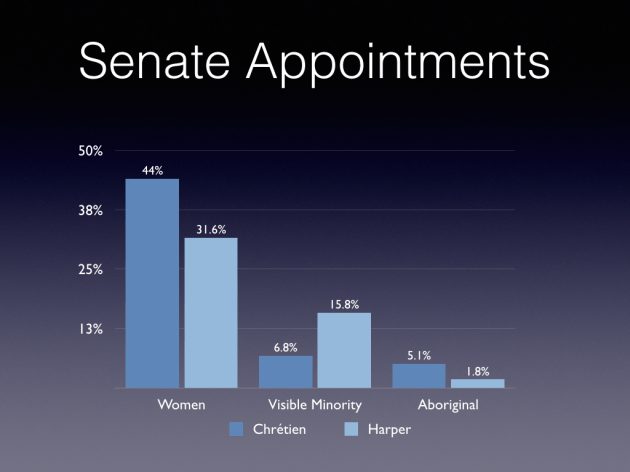
Diversity of Senate Appointments – Comparing Chrétien and Harper

Senate Appointments.001Given the push for gender parity and greater diversity in upcoming Senate appointments (see Trudeau urged to create gender-balanced Senate), I thought it might be interesting to compare the Chrétien and Harper records with respect to diversity.

Chrétien, with his 75 appointments, achieved close to parity for women, with aboriginal peoples slightly over-represented. Visible minorities were under-represented, however.

Harper with his 57 appointments, in contrast, slightly over-represented visible minorities while under-representing women and aboriginal peoples (the fewer number of appointments over a comparable time period reflects his decision to stop appointing senators in response to the Duffy and other scandals).

Will see what PM Trudeau and the advisory body come up with.

John Ibbitson’s take on how gender parity would result in a more ‘progressive’ Senate:

 The other reason Trudeau would want gender parity in the Senate