Having a Difficult Conversation with Someone from a Different Culture: HBR

A good piece outlining some of the cultural differences and how to be mindful of them, particularly in difficult conversations:

When you think of it this way, having a difficult conversation with someone from another culture can appear perilous — and it can be. So, what can you do about it?

  • Survey the landscape of the conversation you need to have, and identify potential places where these trip wires might ensnare you.
  • Take stock of what you know about the other person and her culture. If you don’t know anything at all, now is a good time to do some research, because chances are that if it’s a difficult conversation you have to have, then it’s also an important one.
  • Look for places where you can overlap with their style. For most people, it’s not all or nothing. Someone from a task-oriented culture can preface what they say with five to ten minutes of tea and conversation about the relationship, for example, and someone from a more formal culture can intentionally dial down the seriousness for one conversation.
  • Focus on the trip wire that matters the most. If it’s too much pressure to sail over all four of these, prioritize the one you think could be most vital in this particular context.

By definition, it’s never easy to have a difficult conversation. However, when we have these across cultures, it can be downright confounding. By being mindful of these trip wires and delicately stepping over and around them, you can prevent the conversation style from getting in the way of the content.

Source: Having a Difficult Conversation with Someone from a Different Culture

Governor in Council Appointments – 2016 Baseline diversity

GiC Baseline 2016.010With the overall Government commitment to diversity and inclusion in all appointments, this deck provides a detailed analysis of the more the 1,300 current GiC appointments.

Governor in Council Appointments – 2016 Baseline

The fashion world is keeping stats on runway diversity, but what’s the real goal?

I really don’t get the point of Robin Givhan’s piece. Without numbers, we are left with impressions and anecdotes. What doesn’t get measured doesn’t get managed. Numbers and data are useful tools.

But I have a bias towards evidence and data:

Surely success is when those models are regularly just part of the mix at PradaCélineSaint Laurent and other shows that have far-reaching aesthetic influence and can launch a model into a lucrative advertising contract.

Ideally, diversity should be part of the story-telling and myth-making, not a mathematical equation. All the counting is well-intentioned, but what’s the goal? If it’s to have a runway show more honestly reflect the consumer base of a luxury brand, well, clear the runway for 30-something men of Asian and Middle Eastern descent. Is it to more accurately represent womankind — at least the American version? Then there should be a glut of size 14 models who stand 5-foot-4. But no one is counting the number of short models on the runway (Lady Gaga in the Marc Jacobs show notwithstanding).

We understand that fashion must balance fantasy with the reality of doing business in a diverse world. Those models booked for a runway show are cast to express a unique vision, to make viewers dream. They are, by definition, a rare and lucky lot. They are the chosen.

They should also be a diverse group because they bear the responsibility of embodying a cultural standard.

But as we all become more invested in fashion, there is the temptation to expect that each show should offer a unique representation of every conceivable consumer. To some degree, we are looking to see near mirror-images on the runway. But fashion has a responsibility to reflect the culture, not the individual.

It’s fine to dissect diversity in all its many iterations. The question is whether all those fractions add up to a more welcoming industry or just a growing list of numbers.

Source: The fashion world is keeping stats on runway diversity, but what’s the real goal? | National Post

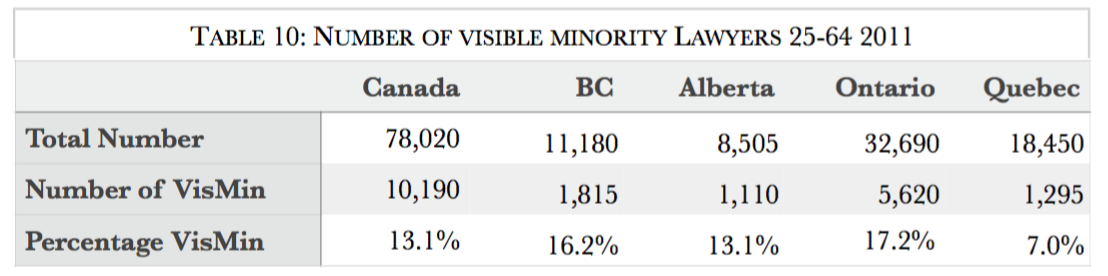
Time to name an Aboriginal justice to the Supreme Court: Hassan and Siddiqui

 Visible Minority LawyersNader Hassan and Fahad Siddiqui make the argument (the number of visible minority lawyers is higher than their article, based upon NHS data that I used in my book, Multiculturalism in Canada: Evidence and Anecdote):

These criteria narrow the field considerably [member of provincial superior court, bilingual, Maritime], and risk obscuring another important fact: our high court does not look like the rest of Canada. No Aboriginal or visible minority has ever been appointed to the Supreme Court. Regional representation — which convention so assiduously protects — is important, but in an increasingly ethnically and religiously diverse country, it is only one of many indicia of diversity.

Since the Abella Equality in Employment Royal Commission Report in 1984, a consensus has emerged among judges, lawyers and academics that judicial diversity matters. A diverse judiciary results in a broader range of perspectives, which is crucial to judicial decision-making. And greater judicial diversity fosters public confidence in the administration of justice.

Little progress has been made so far. Professor Rosemary Cairns Way of the University of Ottawa reports that Aboriginal and visible minority members account for roughly 23 per cent of the population, and yet from 2009 to 2014, only 1.04 per cent of appointees to the provincial superior courts were Aboriginal, and only 0.5 per cent were members of a visible minority group.

The same appears to be true of the senior reaches of the legal profession. The body that regulates lawyers in Ontario, the Law Society of Upper Canada, does not regularly collect comprehensive demographic data. But a Society report, released in 2010, shows that only 5 per cent of lawyers in Ontario between the ages of 45 and 64 are Aboriginals or visible minorities even though those two groups make up more than a fifth of that segment of the population.

It is sometimes argued that as Canada’s population diversifies, the legal profession will too. Problem solved — some years or decades down the line.

The statistics we have don’t bear out that claim though. Even among younger generations, Aboriginals and visible minorities are under-represented at the bar. And those who have managed to gain a foothold in the profession face unique challenges. The society reports that a majority of Aboriginal and visible minority lawyers believe that having a different cultural background has disadvantaged their careers. In that sense, the legal profession reflects trends in the broader job market. According to a recently released study led by University of Toronto researchers, black job applicants are 25.5 per cent more likely to land a job interview when they scrub their resumé of clues of their race.

The time has come for change. And this change requires leadership from the top. We need out-of-the box thinking, such as Trudeau’s laudable decision to name women to half his cabinet positions — including Canada’s first Aboriginal justice minister. The prime minister will have to take a similarly bold approach to fill the high court vacancy. An Aboriginal candidate should take priority. It’s an absolute shame that Canada’s highest court has never had representation from among our First Nations.

Mr. Trudeau: Don’t be so quick to brag about Sikhs in your cabinet – Ramesh Thakur

The latest complaint regarding the number of Sikhs in Cabinet (the selection of Parliamentary Secretaries somewhat addressed under-represented groups – see my deck Big Shift or Big Return? Visible Minority Representation in the 2015 Election for the numbers):

India is an exemplar par excellence of power sharing and political accommodation in a multi-ethnic, multireligious society. In a country where 80 per cent of the people are Hindus, at one point the heads of government, state and army were a Sikh, Muslim and Sikh respectively; and the real power behind the throne was an Italian-born Catholic widow. Diversity and pluralism have no better champion. At the official White House banquet hosted by U.S. President Barack Obama for India’s Prime Minister Manmohan Singh – a Sikh – on Nov, 24, 2009, a glittering new dimension of Indian soft power was in evidence with the presence of many Indian and Indian-American women from the political, business, literary, cultural and educational worlds.

Sikhs make up under 2 per cent of India’s population, so two Sikhs in Mr. Modi’s cabinet is a better reflection of India’s diversity than four in Mr. Trudeau’s is of Canada’s demographic makeup. In fact the Congress Party, not Mr. Modi, needs a reckoning on Sikhs. After Indira Gandhi’s assassination by Sikh bodyguards in 1984, 3,000 Sikhs were slaughtered in a pogrom often orchestrated by senior Congress leaders, including more than 2,000 killed in the nation’s capital. One of the extraordinary features of modern Indian history is how Mr. Modi was demonized internationally for his alleged role in the anti-Muslim riots of 2002 in Gujarat but the Congress Party escaped global odium for its role in the worse atrocities of 1984. It is hard to see how there can be closure for the victims’ families until such time as there is criminal accountability for those events.

Moreover, any mention of Sikhs in the context of Indo-Canadian relations inevitably rakes up ugly memories from three decades ago, when Canada seemed to be home to a large number of separatist Sikh extremists.

On June 23, 1985, Air India flight 182 was blown up over the Irish Sea en route from Montreal to Delhi via London, killing all 329 people on board. Most were Canadian citizens of Indian ancestry. This was the first bombing of a 747 jumbo jet, the deadliest plane bombing, the deadliest attack involving an aircraft until 9/11 in New York and remains the biggest mass murder in Canadian history. The perpetrators are believed to have been Sikh terrorists, although the subsequent trials were less than satisfactory.

All in all, what may have been a lighthearted quip by Mr. Trudeau is fraught with hidden dangers and best avoided in future.

Source: Mr. Trudeau: Don’t be so quick to brag about Sikhs in your cabinet – The Globe and Mail

In a highly competitive world, is diversity Canada’s advantage? Momani and Stirk

Op-ed by Bessma Momani and Jill Stirk on their research supported by the Pierre Elliott Trudeau Foundation on the business benefits of multiculturalism or pluralism (disclosure: I have been discussing with them how some of my data from my research and book Multiculturalism in Canada: Evidence and Anecdote could assist their work):

Research shows that diverse organizations make better decisions, and companies with diverse leadership see rewards in their bottom line. A 2015 study by McKinsey and Co., for example, shows that “companies in the top quartile for gender, racial and ethnic diversity are more likely to have financial returns above their national industry medians.” A recent study by the Peterson Institute found that 22,000 companies whose executive management was gender-diverse realized 6-per-cent higher corporate earnings.

Business leaders, both at home and abroad, tell us that the country’s diverse work force makes Canada an attractive partner for investment and trade. As one executive of a high-tech company noted, “I want my team to be diverse, and I know I can get that in Canada.” Research from the Conference Board of Canada shows that businesses operated by immigrant entrepreneurs are twice as likely to export outside Canada and the United States, and not necessarily to their country or region of origin.

But despite all this anecdote and evidence, it’s not clear that business leaders, even in today’s knowledge-based economy, truly embrace diversity of thought, experience, gender and ethno-cultural background as a key input into an innovative service or product. They understand that they must invest in science and technology, and generate ideas to create value. But is Canada taking full advantage of its rich diversity? Are we leveraging our globally connected citizens to the same extent as India, Australia or Britain?

Even though it’s increasingly clear that pluralistic societies are a magnet for talent and investment, governments too often focus on reinforcing borders or on protecting local monopolies, while businesses fail to see the opportunities that come with diverse international experience. Going forward, a national strategy to realize the benefits of diversity must involve a closer look at policies on labour mobility, taxation, fast-track visas for specialized needs, international research collaboration, foreign credential recognition and bridging, and ways to expand young Canadians’ opportunities to study and work abroad so they can gain vital international experience and build global connections.

With support from the Pierre Elliott Trudeau Foundation, we are taking an in-depth look at the links between pluralism and economic prosperity. Together with our partners, we are generating new academic research and consulting with business leaders, industry associations, universities and civic organizations to compile a comprehensive study of how diversity can be leveraged for greater economic advantage. We are documenting how Canadians are contributing to and benefiting from global connections, and how the growing Canadian diaspora – three million people living and working abroad – contribute to our role in an interconnected global economy.

Now, more than ever, as the discussion of global migration and diversity are increasingly polarized and scrutinized, it’s time to demonstrate the economic value of having a pluralist society. A diverse work force could be the comparative advantage for us to capitalize on in a highly competitive but slow-growing global economy.

Source: In a highly competitive world, is diversity Canada’s advantage? – The Globe and Mail

Exploring the lack of diversity in Quebec police forces

This has been an issue for a considerable time.

Police_ForcesThe table above compares police force diversity in Montreal, Toronto and Vancouver; what surprised me when collecting this information directly from the respective police forces was the degree to which the information is not public on their website and does not appear to be systematically collected (Surête de Québec does keep good stats):

Quebec’s police academy doesn’t have “a lot of influence” over whether visible minorities apply to become officers, says a spokesman for the academy.

Pierre Saint-Antoine, director of communications of École nationale de police du Québec in Nicolet, said racial minorities made up five per cent of its student population in 2015, despite attempts to “recruit people from all diversities and communities in Quebec.”

“We don’t have a lot of influence on the people that apply here,” Saint-Antoine said, adding that Nicolet has a program in place, in conjunction with the Quebec government, to encourage more diversity among applicants.

Saint-Antoine’s comments come after numbers compiled by CBC News show that Quebec police forces are lagging in their hiring of visible minorities.

For instance, the Sûreté du Québec serves more than 2.5 million people, however, fewer than one per cent of its officers are not Caucasian.

Community activists have said a lack of diversity among police leads to strained relationships with racial minorities.

But getting more people to apply is no easy task, says Paul Chablo, the head of John Abbott’s police technology program.

Before going to Nicolet, prospective police officers must first complete a three-year CEGEP program, and Chablo said many people from minority backgrounds don’t apply.

Out of roughly 250 students at John Abbott, 49 define themselves as having an “ethnic background” and only seven are visible minorities.

‘They have to adjust their techniques’

Chablo, who is also the former director of communications for the Montreal police, points to a multitude of factors — including lacklustre recruiting efforts and poor relationships with some ethnic communities — to explain the lack of diversity among applicants.

He said Quebec police need to a better job of reaching out to prospective employees to encourage them to apply to CEGEP programs in the first place.

“I think they have to adjust their techniques,” he said in an interview.

Source: Exploring the lack of diversity in Quebec police forces – Montreal – CBC News

Grassroots coding, gaming groups tackle tech’s diversity crisis

Striking – but not surprising given Toronto’s (and Canada’s) diversity – the confluence between minority and women diversity:

Hina Mir sees a future for herself in technology. She’s only 16, so it’s not entirely clear what that future will look like. But one thing is almost certain: she’ll be coding.

The Toronto high school student already knows elements of multiple programming languages and has studied with experts working for some of the biggest names in the tech sector.

“With all the things I’ve learned with coding, as well as on the engineering and business sides of technology, there’s so much that I think I could do,” Hina said.

She’s part of an up-and-coming generation of potential programmers, software engineers, developers, designers and entrepreneurs who could help the tech world face down an uncomfortable reality: it is very white and very male.

Companies from across the industry have acknowledged the problems: specifically, that there is both a considerable disparity between the sexes and a troubling lack of diversity in the workforce.

The response from Silicon Valley has been to raise a small army of “diversity consultants” and use more inclusive recruiting and hiring strategies.

Iqra Alam, Tajmim Ahmed, Mariam Sayed Girls Crack the Code diversity

The group has members as young as six and as old as 16. International studies have found that starting to teach coding as early as kindergarten is the most effective way to ensure young people stick with it. (Lucas Powers/CBC)

“But it’s not enough to rely only on what big companies are doing if we’re going to create a tech world that reflects the society we live in,” said Ashley Jane Lewis.

A tech workforce that reflects society

The 26-year-old is a mentor with Girls Crack the Code, the community organization where Mir got her start in coding.

The Toronto-based group, which is funded by its organizers and the local school board, helps girls and young women of colour get a head start in tech, and not just with coding classes. In the four years it has existed, Girls Crack the Code has grown into an advocacy network that connects members with all kinds of tech-related opportunities, such as scholarships and workshops.

Ashley Jane Lewis, right, is a mentor with Girls Crack the Code. ‘I think in 10 years, when a younger generation looks to the tech world and sees women of colour who learned in communities like this, working in the field, they’ll see a trail that has been blazed for them,’ she said. (Lucas Powers/CBC)

“I’ve already been to Google, Twitter, Salesforce and coding camp, and I’m in a technology program at school,” Hina said.

Critically, Girls Crack the Code works out of Nelson Mandela Park Public School in Regent Park, one of the most diverse neighbourhoods in the city and home to Canada’s largest social housing development. Bengali, Mandarin, Urdu, Somali and Swahili are just some of the languages spoken there.

The neighbourhood is undergoing a billion-dollar “revitalization” ultimately aimed at creating a community with housing for families of different socioeconomic levels.

Khadija was one of about 30 girls who visited Twitter Canada’s headquarters earlier this month. (Lucas Powers/CBC)

In many ways, Girls Crack the Code is trying to build a tech industry informed by all of the voices, perspectives and experiences found in a place like Regent Park.

It’s part of a growing grassroots movement to cultivate talent in places where diversity is woven into the fabric of everyday life.

A ‘powerful’ message

Earlier this month, 30 girls from the group visited Twitter Canada’s trendy downtown office to listen to a talk by Helen Zeng, a 25-year-old software engineer who grew up in Windsor, Ont., and now codes for the tech giant in San Francisco.

Zeng says that while many companies are trying to hire more women and people of colour into tech jobs, there is a “very loud” effort to push back against built-in biases and attitudes that can’t be undone with corporate policy alone.

Diversity and Inclusion Agenda: Impact on the Public Service, Setting the baseline

My article in The Hill Times, slightly updated:

The Liberal government included in its mandate letters to all ministers a “commitment to transparent, merit-based appointments, to help ensure gender parity and that Indigenous Canadians and minority groups are better reflected in positions of leadership.”

While the focus is clearly with respect to political appointments, this commitment will likely extend to the senior ranks of the public service in a renewed emphasis on diversity. Deputy minister appointments are made by the Prime Minister upon the recommendation of the Clerk of the Privy Council. While the Foreign Affairs Minister recommends  ambassadorial appointments or equivalent, largely reflecting public service recommendations, the Prime Minister approves. The PM also has the power to select candidates for high-profile positions. ADM appointments in Canada, on the other hand, are by the public service only. All positions at this level are bilingual.

With this in mind, I have established the baseline for the current representation of women and visible minorities that will allow tracking of progress over time.

Overall, the Public Service is reasonably diverse with respect to women (54.1 percent), visible minorities (13.2 percent compared to the 15 percent who are Canadian citizens) and Indigenous Canadians (5.1 percent). For the executive ranks, women are almost at parity (46.1 percent) but visible minorities are under-represented (8.5 percent) as are Indigenous Canadians (3.7 percent). All figures are from the Treasury Board Secretariat report, Employment Equity in the Public Service of Canada 2013–14.

To determine representativeness, the government applies a labour market availability (LMA) benchmark (i.e., “the share of designated group members in the workforce from which the employers could hire”).  For ADMs and other members of the EX category,  the respective LMA is 45 percent for women, 7.5 percent for visible minorities and 4.5 percent for Indigenous Canadians.

Arguably, a more appropriate measure of inclusion is derived from comparison to the overall share of the population (or, in the case of visible minorities, the percentage of those who are also Canadian citizens – 15 percent).

However, these aggregate numbers — both actual and LMA — do not give a detailed sense of diversity within the senior ranks of the public service, defined as deputy and assistant deputy ministers (DM and ADM or equivalent).

Ministers and Parliamentary Secretaries are relatively diverse (41 percent women, 21 percent visible minority men or women).  The question is how diverse are those public servants at senior levels, with whom they work.

My information sources are reasonably accurate. For the 85 Deputies, their Associates and equivalents, public sources such as GEDS (the government electronic contact database), the Parliamentary website, cross-checked with PCO Deputy Committee lists, were used for both Deputies and Associate Deputies. This data does not include any of the recent changes announced by the Prime Minister.

For ADMs, Treasury Board Secretariat (TBS) provided official statistics for the 282 officials at the EX-4 or 5 rank for the 2013-14 year in the core public administration (77 organizations),  along with estimated labour market availability.

For senior heads of Mission (HoM), Global Affairs Canada provided a list of the 16 missions whose Ambassadorial and High Commissioner positions are currently classified at the EX4-5 level (these are a subset of the overall ADM numbers).

Some of these positions are over-filled by people at the DM level (e.g.,  Jon Fried at the WTO) or former politicians (e.g., Lawrence Cannon in Paris, Gordon Campbell in London, and Gary Doer in Washington). This data predates the announcement of the two Ambassador-designates in Washington and the UN (New York), both men replacing men.

While the data for gender is reliable, data for visible minorities is less so, given that official reports rely on self-reporting and that there are limits to using names and photos to identify visible minority status. However, this methodology is also used with respect to MP diversity.
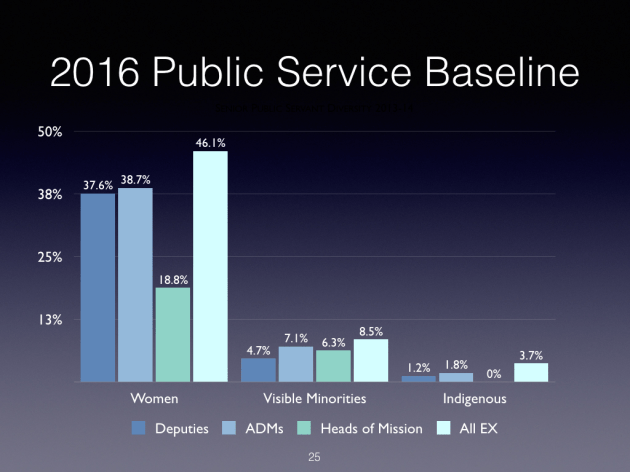
Election 2015 and Beyond- Implementation Diversity and Inclusion.001What does the data show? As seen in the chart above, representation of women is relatively close to gender parity, save for Ambassadors and their equivalents (Heads of Mission and other ADM-equivalent officials abroad).

However, visible minorities are less than half of the percentage of those that are Canadian citizens (15 percent) or in the House of Commons (14 percent).

The ‘all EX’ category has more junior executive positions (EX1-3) and thus the greater diversity in these feeder groups suggests that over time, diversity  at more senior levels should naturally increase.

The public service may feel compelled to take a more active approach given the Government’s commitment.

Likely early tests of the Government’s commitment to increased diversity will occur as deputy ministers retire and are replaced along with changes to Heads of Mission over the course of the year.

13 new Deputies have been named to date by the Prime Minister including 6 women (46 percent, reflecting in part the four women: appointed on International Women’s Day!) and one visible minority (8 percent). Future appointments will indicate whether this portends a trend.

By tracking this on an annual basis, along with changes to ADM ranks, progress can be assessed.

Diversity and inclusion agenda: impact on the public service

Diversity on parliamentary committees: Does it matter? | My piece in The Hill Times

Diversity_on_parliamentary_committees__Does_it_matter____hilltimes_comMy piece in The Hill Times (excerpt):

If we look at the overall committee membership of 288 members in both the 25 House of Commons and three joint Senate-Commons committees (some MPs are members of more than one committee), only 21.2 per cent are women, significantly lower than the overall 26 per cent of women MPs.

For visible minorities, however, committee representation largely matches overall Commons representation at 14.6 per cent, just marginally under the number of visible minorities who are Canadian citizens. Indigenous peoples committee representation is less than their share of the population (3.1 compared to 4.3 per cent).

Looking at individual committees, only the Access to Information, Privacy and Ethics and Industry, Science and Technology committees have no women members. Veterans Affairs, Agriculture and Agri-Food, Environment and Sustainable Development, Fisheries and Oceans, Official Languages, National Defence, Physician-Assisted Dying have no visible minority members.

Women are predictably over-represented in Status of Women (nine out of 10 members) and visible minorities are similarly overly represented in Citizenship and Immigration (seven out of 10 members).

Source: Diversity on parliamentary committees: Does it matter? | hilltimes.com