How Trudeau can bring diversity to Supreme Court: Ranjan Agarwal

Some good practical suggestions. The ones I favour include publishing the demographics of applicants and focussing efforts on improving the diversity of other judicial level appointments, where the potential pool is larger.

The easing of the official languages requirement is a non-starter, so those with judicial ambitions should make knowledge of both official languages part of their education.

Needless to say – but I keep saying it – the Office of the Commissioner for Federal Judicial Affairs Canada should include in its reporting, the number of visible minority and Indigenous judges, not just women:

So, can this missed opportunity be salvaged? Yes, if the prime minister takes four steps.

First, he should make clear that Justice Rowe was appointed because he was the best Canadian for the job, not the best Atlantic Canadian. In doing so, he would affirm that his next appointment in September 2018 does not have to be from British Columbia (since Chief Justice Beverly McLachlin, who will retire then, notionally holds that seat on the Court), leaving open the possibility of appointing an aboriginal or minority judge from outside B.C.

In particular, the current convention does not allow for the appointment of a Northern Canadian, even though the courts in the territories are some of the most diverse in Canada.

Second, the prime minister should publish demographic statistics of the applicants for this appointment. How many women applied? Self-identified minorities? Aboriginals? Non-Atlantic Canadians? How many judges? How many lawyers? The problem with promising diverse appointments is that the talent pool at the senior levels of the bar or on the trial and appeal benches may simply not be there. Demographic statistics allow the government and the legal profession to consider where more work must be done to create a pool of good, diverse candidates.

Third, the prime minister should revisit (though not necessarily reconsider) the “functional bilingualism” requirement. Potential applicants have two years to immerse themselves in French-language training. But the government should test whether the bilingualism requirement had a disproportionate impact on aboriginal and immigrant communities, where French-language education may not have been a priority for their parents.

Finally, the prime minister should disproportionally fill the 60 other judicial vacancies with qualified women, aboriginal and minority judges. A more diverse Supreme Court is, in many ways, symbolic. The real work of the justice system happens in our trial courts — that may be the only interaction many Canadians have with a judge.

After every hearing, the Court’s justices gather over lunch to discuss their views on the appeal. The appointment of Bertha Wilson in 1982 surely changed the discussion around that table about many issues, including perhaps most importantly abortion, gender rights and spousal abuse.

The appointment of an aboriginal or minority judge will have the same impact, providing a much needed perspective on novel issues facing an increasingly diverse Canada and in an age of truth and reconciliation. Our justice system is the finest the world has ever known. But, sometimes, not only must justice be done, it must also be seen to be done.

Source: How Trudeau can bring diversity to Supreme Court | Toronto Star
Diversity of Heads of Mission 2016

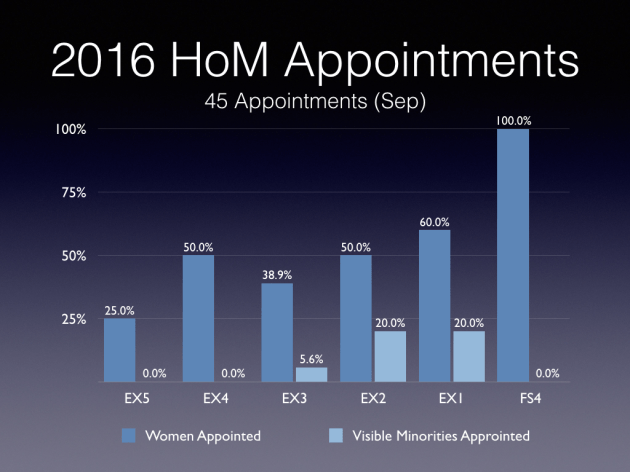
With likely all of the heads of mission (HoM) announcements made, combined with knowledge of their classification levels, we now have a more complete picture on the degree to which the government is delivering on its diversity commitments. Overall, they are.

election-2015-and-beyond-implementation-diversity-and-inclusion-040

Chart 1

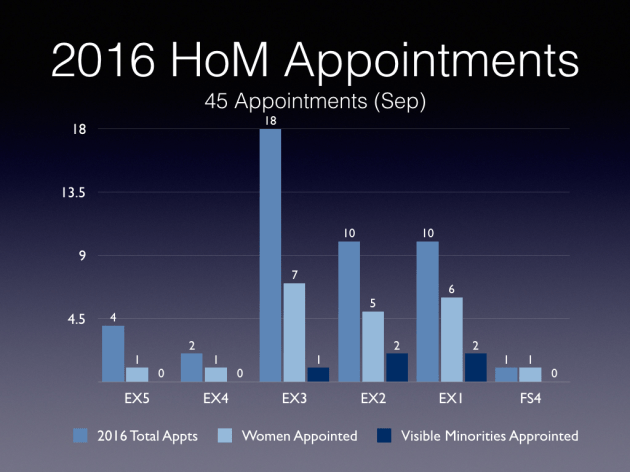
Overall, of the 45 appointments, 21 were women (47 percent, virtual parity) and five were visible minority (11 percent, or under-represented in relation to the 15 percent benchmark of visible minorities who are also citizens).

Chart 1 breaks down the these overall numbers by classification level (note that this reflects the level of the position, not necessarily the head of mission, as some positions are overfilled with former DMs and equivalents, and some are underfilled).

election-2015-and-beyond-implementation-diversity-and-inclusion-041

Chart 2

Not surprisingly, there is greater representation of women and visible minorities at more junior levels, particularly apparent between EX4-5 (ADM level) and EX1-3 (DG and Director level), as shown in Chart 2.

election-2015-and-beyond-implementation-diversity-and-inclusion-039

Chart 3

Finally, as a point of reference, Chart 3 shows the classification breakdown of all 137 head of mission positions.

Note: I am grateful to Global Affairs Canada for having provided the classification data. However, as an illustration of the limits of the newer, more open approach, they did not provide this information in spreadsheet form, using the (false) argument that: “Understandably, the GoC cannot send records in a spreadsheet format that could otherwise be manipulated or ‘edited.’ ” (fortunately, I have software that can convert a scanned pdf into spreadsheets or documents).


Law Society report proposes changes to combat systemic racism

Will be interesting to see whether the report and its recommendations are fully or partially adopted, and the degree to which they are implemented.

But it all starts with data and pleased that one of the recommendations is for just that:

Law Society of Upper Canada working group is proposing that the regulatory body step in to ensure that law firms and other legal workplaces move to eradicate systemic racism in the legal profession, and to penalize those that fail.

The Challenges Faced by Racialized Licensees Working Group spent the past four years studying the issue and holding consultations and will present its final report and recommendations Thursday to the Law Society’s benchers — its board of directors — for information purposes. A final vote is expected on Dec. 2.

“The challenges faced by racialized licensees are both longstanding and significant,” reads part of the report, obtained by the Star. “In our view, the Law Society must take a leadership role in giving legal workplaces reasonable deadlines to implement steps that are important to bring about lasting culture change.”

The report goes on to say: “It is clear from the working group’s engagement and consultation processes that discrimination based on race is a daily reality for many racialized licensees; however, many participants stated that they would not file a discrimination complaint with the Law Society for various reasons, including fear of losing their job, fear of being labeled as a troublemaker, and other reprisal-related concerns.”

Lawyer Paul Jonathan Saguil said it’s important that the public, as well as lawyers, see themselves reflected in the legal profession.

“What happens when you get to the pinnacle of the profession — people who are applying to the bench or to tribunals? As you go up the pipeline, you get people who are more and more removed from what is the true diversity of the Canadian population, and that has an impact,” he said. “For lawyers, too, it has a psychological impact when they don’t see themselves reflected at their firm, and wondering how they can succeed.”

Saguil, who is Filipino-Canadian, mentioned as his role model Superior Court Justice Steve Coroza, believed to be the first Filipino-Canadian appointed to a superior court.

“Once you see someone advance in that position, you start hoping that one day you can achieve even a modicum of that success,” Saguil said.

Major recommendations — most of which the working group envisions would be implemented over the next three years — include requiring legal workplaces of at least 10 licensees (which include lawyers and paralegals) to develop and implement a human rights/diversity policy, “addressing at the very least fair recruitment, retention and advancement.”

A representative of each of those workplaces would also have to complete an equality, diversity and inclusion self-assessment of their office every two years, according to one proposal.

Another recommendation proposes “progressive compliance measures” for workplaces that don’t implement a human rights/diversity policy, and/or workplaces “that are identified as having systemic barriers to diversity and inclusion.”

The 15-member working group, made up of benchers, proposes a “gradation of responses,” from meeting with representatives of legal workplaces to discuss concerns, “to disciplinary approaches if there is deliberate non-compliance with requirements, despite multiple warnings, or no efforts are made to address systemic barriers.”

Observers say change is needed now more than ever, as the number of racialized lawyers in Ontario has doubled — from 9 per cent of the profession in 2001, to 18 per cent in 2014. According to the 2011 census, 26 per cent of Ontarians identified as racialized.

“The overall goal is to change the culture of the legal profession,” said lawyer Raj Anand, co-chair of the working group.

“We had a very important issue that has not been addressed — certainly not to this extent by any law society in Canada . . . I don’t think there’s any law society that has gone to the point of mandatory measures in order to effect culture change.”

Anand said he hopes other law societies can use his working group’s report as a model to change the culture in other provinces.

“The issues are still serious ones, and enough time has passed. It’s time to put in place some base minimums. These are not radical recommendations.”

Progress would be measured by annually providing legal workplaces of 25 licensees or more with the self-identification data of their firm’s lawyers and paralegals. That information, compiled by the Law Society, would then allow the firm to compare its numbers with the profession as a whole.

Licensees would also be asked to answer questions about inclusion at their workplace every four years, and a summary would be given to the workplace.

The Law Society would also be required to publish an “inclusion index” every four years that would contain the legal workplace’s self-assessment information, demographic data and information collected from the inclusion questions.

The group also recommends mandatory training for every licensee on equality and inclusion, to be taken once every three years, as well as improvements for mentoring.

Source: Law Society report proposes changes to combat systemic racism | Toronto Star

Toronto Film Festival: Black Filmmaking Has A Breakthrough : NPR

TIFF does have an amazing diversity of films, with this but one example:

This year we’ve seen endless loops of online commentary and Hollywood hand-wringing about the enduring whiteness of American cinema and how structural challenges continue to restrict filmmakers of color. So it was not surprising that there was so much anticipation around the October release of first-time director Nate Parker’s film The Birth of a Nation. The story of Nat Turner’s slave rebellion and self-empowerment, as seen through the artistic vision of a young, black filmmaker, caused a bidding war at the Sundance Film Festival at the height of the #OscarsSoWhite campaign.

But by the time the Toronto International Film Festival opened last week, Parker was embroiled in a much louder conversation about sexual assault and toxic masculinity after debate about his acquittal on rape charges during his college days resurfaced. A month before the film that would prove Hollywood’s diverse bona fides was to open, it was already in full-blown public relations free fall.

Fortunately, The Birth of a Nation was neither the only nor the most anticipated film about black life to screen in Toronto, which hosts the largest film festival in North America; one that sets the tone for the Oscars and tests the viability of serious American cinema. Festival artistic director Cameron Baily told me that this year’s festival may have been its blackest edition ever. It pushes back against the idea that Hollywood can only absorb one black story at a time, and challenges the limited parameters of a “black film”.

This year’s festival shifted the conversation about diversity from a focus on the absence of black faces in movies to a feast of cinematic styles and stories as wide-ranging as the black experience itself.

Most importantly, the films opening at Toronto explored stories about justice, family, and selfhood without didactic or conventional Hollywood bluster about race. From the struggle for interracial marriage rights in the restrained drama Loving to a young boy’s battle to reconcile his masculinity and sexuality in Barry Jenkins’ lyrical second film Moonlight, this year’s program introduced a new set of faces and performances for critics to savor and nominate.

Indian-born filmmaker Mira Nair premiered Queen of Katwe, a story about a young Ugandan woman’s journey to become an international chess champion. The movie was filmed in Uganda and South Africa and opens in wide release as a Disney production. It stars Oscar winner Lupita Nyong’o and David Oyelowo (Selma), and features no white saviors.

Perhaps the best-received film of the festival to directly confront the limited portrayal of blackness on screen was I Am Not Your Negro, filmmaker Raoul Peck’s searing new documentary about writer James Baldwin. The film won the festival’s prestigious top documentary prize and was purchased for wide release by Magnolia pictures. Made in collaboration with the Baldwin estate, Peck’s documentary tells the story of American racism through the words of Baldwin’s unfinished manuscript, archive interviews, and his essays on race relations. It features no talking heads, hazy footage or conventional biographical framing devices. Instead, it blends Baldwin’s writing with arresting footage of contemporary police brutality to underscore the writer’s powerful insight and voice.

At this year’s Toronto festival, neither the filmmakers nor the curators wished to have these films categorized as ‘diverse’ and, therefore, seen as niche. There’s such range in the films, Bailey told me, that to just “call them all ‘black films’ really reduces their context, their variety, their differences and their power.”

Emmy 2016 Awards: The Most Diverse Emmys Ever. Finally. – The Daily Beast

Noteworthy contrast with the Oscars, reflecting the range of TV programming:
Sunday’s Emmys were a celebration of diversity, an indictment of sexism, a championing of LGBT acceptance—and a plea for all these things to stop being Hollywood news.
“The only thing we value more than diversity is congratulating ourselves on how much we value diversity.” And so Jimmy Kimmel opened the Emmy Awards, offering a tongue-in-cheek critique on how self-congratulatory the television industry has become for its well-timed rewarding of a diverse slate of performers and creators.

Airing a little more than half a year after the Oscars, which famously embarrassed Hollywood while exposing our culture’s institutionalized racial biases, failed to nominate a single actor of color for the second year in a row, the Emmy Awards arrived Sunday night with a record number of diverse nominees.

Eighteen of the nominees for acting awards this year were people of color, and for the first time in the show’s 68-year history, performers of color were nominated in every leading acting category.

“The Emmys are so diverse this year, the Oscars are now telling people we are one of their closest friends,” Kimmel continued to joke, taking the piss out of the otherwise very serious conversation that’s lit up the zeitgeist over the deplorable state of diversity in media over the last few years.

Whatever the word you prefer—diversity, normalization (Shonda’s favorite), inclusivity (Ava DuVernay’s preference), or representation (my pick)—the fact that we’re even at a stage where a white guy in a suit is poking fun at the debate insinuates how important the discussion is.

Should we be past the point where we chart progress in awards milestones? That is, the firsts, the records, the groundbreaking achievements? Yes. But in acknowledging them and celebrating them, hopefuly we make room for progress. And Sunday night at the Emmys? Progress was made.

Sure, it was funny when Kimmel, during his opening monologue, had nominees of color reach out to a white nominee to thank them for their bravery. (It’s hard to nail this tone of joke, and we must give Kimmel credit for getting it right on the head.)

But it was funny and important when Alan Yang, from Tawainese parents, alongside Aziz Ansari, whose parents are from India, accepted their award for Best Writing in a Comedy Series.

“There’s 17 million Asian Americans in this country and there’s 17 million Italian Americans. They have The GodfatherGoodfellas, RockyThe Sopranos. We got Long Duck Dong,” Yang said, shaming all of our opportunity blindspots and institutionalized cultural (even if unintended) reductivism and, yes, racism in only five seconds.

 “We’ve got a long way to go,” Yang said, with one final plea: “Asian parents out there, do me a favor, just a couple of you. Give your kids cameras instead of violins.”

Apple says it has investigated recent allegations of sexism on campus and ‘actions have been taken’ – Recode

Parts of interview with Apple HR head on sexism and diversity challenges at Apple and in tech more generally:

Young Smith said Apple is committed to diversity in its many forms, noting it is an issue long important to Apple and one that CEO Tim Cook has made a priority.

Without a wide range of perspectives, she said “we cannot continue to be the great innovator we constantly strive to be.”

Cook himself came out rather famously in a column he wrote and has since been vocal with regards to LGBTQ issues, including the need for a national employment non-discrimination act.

But even companies like Apple and Intel, which have been more vocal advocates on the need for diversity, remain largely white and male. Women only make up 32 percent of Apple’s workforce, for example. That’s up two percentage points from two years ago and roughly on par with Google and Facebook, but still far short of having a truly representative workforce.

This has consequences — in hiring and recruitment as well as when it comes to creating an inclusive culture. Most of Apple’s engineering teams are dominated by men and it is not uncommon for women in tech to experience sexism in different forms.

In another incident described in the Mic article, a female employee recalled hearing one male co-worker tell another that he sounded like he was on his “man period.”

Asked how she would respond if she heard such talk, Young Smith noted that people tend not to say such things around her, but added that if she did hear that kind of talk, she hoped she would have the courage to call “time out.” Other employees, she said, might prefer to address things afterward, but Young Smith said she wants a company where people do call one another out.

“I don’t think people are too shy about doing it,” Young Smith said, “but I am also very cognizant that we are still 70/30 in our very hard-core engineering team. We have to be cognizant that someone may not feel that their voice is heard or valued.”

Deciding just what to do to change that is trickier, Young Smith said.

The company is looking at ways to improve the training it gives its managers as well as some of the courses in Apple University, but Young Smith said she is skeptical of top-down corporate lectures.

Nor does she see creating a giant diversity team as the answer. Rather, she said she wants 140,000 people who all feel it is their personal responsibility to make Apple more inclusive.

As for the articles, Young Smith said she is most concerned that Apple employees, especially women and people of color, will now feel like they can’t safely speak up if they experience discrimination.

“The unfortunate consequence of this is that we may have lost the trust of others,” she said.

Young Smith is particularly concerned about preserving the women-at-Apple mailing list that was the source of the emails leaked to Mic. The list has more than 1,000 participants and is an important place for people to talk about their experiences, good and bad, Young Smith said.

“We cannot risk losing that,” she said. “We have to have a safe place for people to do that.”

At the same time, Young Smith says the company may need to also find new places for people to share their concerns. “I think we need to constantly reevaluate the tools we have and think about what could be more effective.”

As we talked on Friday, Young Smith said she was finalizing an email she planned to send to the group talking about the issues raised in the articles and her personal commitment to making sure women at Apple are supported.

“As a woman (and a) leader, I think I have an even greater responsibility that I am listening to all the women, all the people of color, who may not feel as heard,” she said.

Addressing the impact of the articles, in addition to the specific incidents described, quickly became a top priority this week, not just for Young Smith, but also for Cook.

“In the midst of all this, he was deep down with all of us to understand what has transpired and what can we learn,” Young Smith said. And that came in a week where Cook was taking part in a board meeting and overseeing a major product launch.

“I think what that says is this is every bit as important as our products,” Young Smith said.

Vancouver police launch big recruitment drive to reflect city’s diversity

Article would benefit from including the current diversity numbers (which Vancouver currently does not publish these):

Vancouver is launching the largest police recruiting drive in almost a decade, and the key word for this new class of officers will be diversity, officials said.

Deputy Chief Steve Rai said the police force wants hire 85 new officers by next spring, the largest recruiting figure since the pre-Olympics effort in 2008 and more than twice the size of a normal recruiting class.

Add in 20 recruits sworn in on Thursday, and that’s an addition of more than 100 officers to a police service of 1,400 — a big injection of new blood.

While the VPD has no quotas for members from specific communities, Rai said it is crucial that the police department reflects the multicultural community that it serves. With that in mind, VDP has been stepping up its outreach to cultural communities, hoping it will lead to a multicultural mix of recruits.

“You look at what happens when your police force don’t reflect the community, and you only have to look south of the border,” he said. “You see people feeling it’s ‘us-against-them,’ and there’s a lack of trust.

 “It’s about acquiring, building and maintaining public trust … We are all in this together, so it starts with citizens seeing their police forces reflecting of them and the community. It has to reflect the fact it’s not ‘us-against-them,’ but ‘we.’”

According to the 2011 census, Vancouver has 18 languages identified as “most spoken at home” by more than 1,000 residents each. Besides English, the most spoken language at home for 98,855 Vancouverites were Chinese languages. Punjabi (10,500), Tagalog (9,345), Vietnamese (7,475), Korean (5,445) and Spanish (5,245) all topped 5,000 speakers.

Rai admits that there remains a stigma in some communities about policing, stemming from experiences and perceptions of police in other countries. He said the VPD is trying to break down the walls by attending as many community events as possible, and that as the second-generation acclimatizes to Canadian culture, the acceptance level has correspondingly risen.

“I know a lot of parents who aren’t supportive of their kids to go into policing because of the stigma that exists in their countries of origin,” Rai said. “But as time passes, barriers come down. You build that trust by talking to people and being sincere.

“We understand we have to flexible with changing society norms, and we want to make sure we hire the best,” he added. “We will mentor you to be successful, no matter what your background is. I’m a 25-year member, and there’s not one day that I’ve ever regretted my decision to become a police officer. The profession sells itself.”

Source: Vancouver police launch big recruitment drive to reflect city’s diversity | Vancouver Sun

Meanwhile:

The Vancouver Police Department says street checks are not on the rise, two weeks after the police complaint commissioner expressed concern about the department’s use of the practice.

The Office of the Police Complaint Commissioner, a provincial body that oversees complaints involving municipal police, in a report late last month cited “an increasing trend in complaint allegations involving the police practice of conducting street checks.” The report, however, did not provide a total.

Street checks, or carding, can refer to stopping individuals to gather information without a reasonable suspicion of an offence. The issue has drawn significant attention in Ontario, where the provincial government announced regulations restricting carding in March after complaints were raised about privacy violations and police were accused of disproportionately targeting minorities.

Vancouver Police Chief Adam Palmer said he has not seen any numbers to validate the police complaint commissioner’s claim.

“I’ve got no data to suggest that that is the case. I’d be happy to see data if someone is providing it,” he told reporters outside a police board meeting Thursday.

A Vancouver Police Department spokesman said it conducted about 6,200 street checks last year – compared with 6,900 two years ago, and 7,300 three years ago.

…Chief Palmer said he meets with his department’s professional standards section every week but has not seen an increase in complaints involving street checks.

A spokesperson for the Office of the Police Complaint Commissioner said it has observed an increase in such complaints, but is still working to pull the exact number from its files.

 Vancouver Police Department denies that carding is on the rise 

Port du hijab: le SPVM «ouvert» à l’idée pour ses policières

Good that it provokes discussion in other police forces located in diverse communities (the SPVM does not report publicly on its diversity last time I checked):

La Gendarmerie royale du Canada (GRC) permet désormais à ses policières musulmanes de porter le hijab, mais qu’en est-il des principaux corps policiers du Québec ? Le Service de police de la Ville de Montréal (SPVM) n’a jamais reçu de demandes à ce sujet, mais se dit « très ouvert » à l’idée.

Afin de refléter davantage la population canadienne et d’encourager des femmes musulmanes à envisager une carrière policière, la GRC a récemment décidé d’autoriser le port du hijab. La GRC insiste sur le fait que le foulard a été conçu pour être sécuritaire, après une série de tests rigoureux. La nouvelle a fait le tour du monde.

« Nous n’avons pas pris position sur le sujet, mais nous sommes très ouverts à ce genre de demandes », a indiqué hier la commandante du SPVM Marie-Claude Dandenault. Cette prise de position de la GRC incite le corps policier montréalais à évaluer la question, dit-elle. Au Canada, les forces armées, la police de Toronto et la police d’Edmonton permettent déjà le port du foulard.

« J’ai toujours dit, tant qu’il y a le visage découvert, je n’ai pas de problème avec ça », a quant à lui déclaré hier le maire de Montréal, Denis Coderre, en réponse à une question sur le sujet.

Comme le SPVM, la Sûreté du Québec (SQ) n’a jamais reçu de demandes de ses membres en ce sens.

 « On n’a jamais pris position », a indiqué le lieutenant Jason Allard, responsable des communications au sein de la police provinciale, qui a souligné qu’il ne voulait pas commenter la décision de la GRC

« On n’a jamais eu de demandes d’accommodement d’uniformes pour des motifs religieux », indique le lieutenant Jason Allard, responsable des communications à la SQ.

Le lieutenant Allard affirme que la Sûreté du Québec a fait des efforts au cours des dernières années afin d’augmenter le nombre de femmes et de membres issus des communautés culturelles au sein du corps policier. « On privilégie une meilleure représentation de toutes les cultures, mais on ne vise pas de groupe spécifique comme l’a fait la GRC », dit-il.

And Calgary is already ahead:

The head of Google’s Brain team is more worried about the lack of diversity in artificial intelligence than an AI apocalypse – Recode

The next frontier of diversity?

As some would have it, robots are poised to take over the world in about 3 … 2 … 1 …

But one machine-learning expert — who is, after all, in a position to know — thinks that’s not the biggest issue facing artificial intelligence. In fact, it’s not an issue at all.

“I am personally not worried about an AI apocalypse, as I consider that a completely made-up fear,” Jeff Dean, a senior fellow at Google, wrote during a Reddit AMA on Aug. 11. “I am concerned about the lack of diversity in the AI research community and in computer science more generally.” (Emphasis his.)

Ding, ding, ding. The issue that the tech industry is trying to maneuver their way around, for better or worse, is the same issue that can stunt the progress of “humanistic thinking” in the development of artificial intelligence, according to Dean.

For the optimists in the audience, Google Brain wants to improve lives, Dean wrote. And how can you improve lives without people with diverse perspectives and backgrounds helping to build and develop the technology you hope will impact positive change? (Answer: You can’t.)

“One of the things I really like about our Brain Residency program is that the residents bring a wide range of backgrounds, areas of expertise (e.g. we have physicists, mathematicians, biologists, neuroscientists, electrical engineers, as well as computer scientists), and other kinds of diversity to our research efforts,” Dean wrote.

“In my experience, whenever you bring people together with different kinds of expertise, different perspectives, etc., you end up achieving things that none of you could do individually, because no one person has the entire skills and perspective necessary.”

Source: The head of Google’s Brain team is more worried about the lack of diversity in artificial intelligence than an AI apocalypse – Recode

Farhad’s and Mike’s Week in Tech: Betting on … Diverse Work Forces – The New York Times

More on lack of diversity in tech, this time with respect to Snapchat and its obliviousness to diversity:

Farhad: Finally, Snapchat put out a racist picture filter — again. This week the photo-messaging app unveiled a feature that lets you turn your face into that of an anime character. At least, that was what it said it intended. What it ended up with was “yellowface” — a filter that turns your face into a crude racial caricature of Asian people. This is bad enough on its own, but it’s made worse by the fact that it isn’t the first time this happened. Snapchat released a blackface filter in April.

The company has taken the filter down, but what’s the deal? Should we read something more into the fact that the company has recently put out two obviously overtly racist products?

Mike: So it’s pretty mind-boggling that both of these things got through the organization and into the app. It brings up a few questions.

What do the ranks of the organization look like in order to make something like this O.K. in the eyes of at least a number of people in the company? Questions of diversity obviously spring to mind — which Snapchat has never really addressed or divulged numbers on publicly — and I imagine a more diverse staff might have at least caused some people to question their choices in putting these filters out.

If there were indeed people inside of Snapchat that found these filters objectionable — and I certainly hope there were — what does the organization structure look like and how does it function in a way that allows these decisions to go unchecked and ultimately carried out? Are those people who would object able to make their voices heard internally? And if not, why not?

I doubt we’ll get a ton of transparency from Snapchat on the issue, since they’re quite a secretive company anyway.

Farhad: katie zhu, a Chinese-American engineer and product manager who works at Medium (and who prefers that her name be rendered in lowercase), published a really insightful post on this incident. She urged people to delete Snapchat.

 “They’ve repeatedly demonstrated their blasé attitude towards issues of diversity, inclusion and representation,” she wrote.

She pointed out that Evan Spiegel, Snapchat’s chief executive, was unwilling to disclose how diverse his company is during an interview at the Code Conference last year. Spiegel also seemed uncomfortable with the notion that the tech industry has had a particular problem hiring a diverse work force (which seems obvious according to the numbers).

“I think I’m saying that diversity is a challenge everywhere, including tech — and that’s kind of that,” Spiegel told the interviewer, Walt Mossberg. When Mossberg pressed him, Spiegel still seemed hesitant. “There are so many things that feed into diversity and inequality that unpacking them on the stage is probably not the best use of time,” he said.

Mike: I was at that conference. It was super awkward.

Farhad: Snapchat says it recently hired a recruiter to focus on hiring underrepresented minorities, so perhaps Spiegel’s view has changed.

To me, these two incidents do underscore the importance of a diverse work force: Tech companies are usually small groups of homogeneous people who are trying to make products that satisfy the entire planet. At the very least, a diverse work force can help guard against them making choices that offend large swaths of their potential userbase. Even more than that, a diverse work force can help them come up with new ideas that may not have occurred to 20-something Stanford bros.

Mike: That’s why I applaud companies that make it a goal of theirs to strive for diversity at the outset, something that, unless you’ve really made it a point to think about these issues, an entrepreneur may not have even thought of. Perhaps it is also on the venture capitalists and mentors to remind young entrepreneurs that aiming for diversity is, in fact, a strength, and something to be considered when growing the company.

One would hope this doesn’t happen again, but this is tech: anything goes, however terrible.

Source: Farhad’s and Mike’s Week in Tech: Betting on Jet and Diverse Work Forces – The New York Times