Five years on, Trudeau’s vow to build a diverse public service still unfulfilled

I find this report unbalanced and does not reflect that the government largely met its commitment to increase diversity in appointments as I wrote in 2019 (Taking stock of Ottawa’s diversity promises) while public service diversity continues to increase for women and visible minorities for both employees and executives albeit at a slow but steady pace.

The main issue is with respect to Black Canadians at senior levels and I will be looking at data to take this concern from the anecdotal and symbolic (only one Black DM) to quantify the occupational groups and levels where this is most prevalent, as well as looking at other relatively under-represented particular visible minority groups.

I agree with Michael Wernick that while the employment equity act is ripe for a review, opening it up would indeed be a hornet’s nest. And looking back over the over 30 years of EE data, hard to argue that it has not been a success in improving representation given its focus on representation:

When they took power in 2015, the Trudeau Liberals promised to “build a government that looks like Canada.”

But their government, now in its second mandate, still hasn’t hired enough minority senior staff members to truly reflect the country’s diverse makeup.

Only four chiefs of staff to 37 ministers are people of colour — roughly 11 per cent of the total — while they constitute more than 22 per cent of the national population, according to the last census in 2016.

As protests against anti-black racism — triggered by George Floyd’s police custody killing in Minneapolis — have grown in size and spread around the globe, Prime Minister Justin Trudeau has been talking more about “systemic” racism in Canadian institutions. The prime minister also kneeled in a crowd of anti-racism protesters in Ottawa last Friday as a symbolic gesture of support for their calls for change.

“Systemic racism is an issue right across the country, in all our institutions, including in all our police forces, including in the RCMP. That’s what systemic racism is,” Trudeau said Thursday morning.

“Here are the facts in Canada. Anti-black racism is real, unconscious bias is real, systemic discrimination is real,” the prime minister said in a speech in the House of Commons last week, vowing that his government is committed to breaking down barriers and providing opportunities for marginalized communities.

The lack of diversity among Liberal staffers was keenly felt by Omer Aziz, who worked briefly as an adviser to Chrystia Freeland when she was foreign affairs minister.

“I would go into meetings and I’m the only non-white person there. I felt that when I would raise my voice and give my advice, that it wasn’t taken seriously,” Aziz told CBC.

“That is eventually why I left what was my dream job.”

Getting better … slowly

Other senior staffers told CBC that while being one of just a few people of colour around the table may not be an ideal job situation, diversity in the higher ranks of the federal public service has come a long way in the past decade.

The government is also responsible for appointing people to hundreds of bodies outside the core public service, such as agency boards, foreign missions and Crown corporations.

The Trudeau Liberals reformed that hiring process early in its first mandate to serve its goal of attracting diverse applicants. The result: a dramatically improved ratio of people of colour to other hires, from 4.3 per cent when the Liberals were elected in 2015 to 8.2 per cent as of June 2020.

As for the most senior civil servants (deputy and associate deputy ministers), the number coming from diverse backgrounds is still less than 10 per cent of the total — so low that the Privy Council Office won’t release the figure, arguing it would compromise privacy rights because it would be easy to work out who these senior civil servants are.

‘You have to represent’

“We are in 2020. How come it took so long? It shouldn’t have,” said Caroline Xavier, the only Black person serving as an associate deputy minister in the federal government. She was appointed to the post at Immigration, Refugees and Citizenship Canada back in February.

“Sometimes the burden is heavy because you have to represent. It’s a burden I’m prepared to take on because it’s my job to open more doors for others.”

Xavier said there’s no easy solution, but conversations about breaking down barriers “are happening” within government.”There is a recognition at the most senior levels that this has got to be rectified.”The federal government fares far better when it comes to appointing women; the ranks of deputy ministers and other high-level positions are close to gender parity now.

The Trudeau government isn’t the first to pursue greater diversity in the upper ranks of the public service.

In 2000, a task force struck to look into the participation of people of colour in the federal public service cited an “urgent imperative to shape a federal public service that is representative of its citizenry.”

Seven years later, the Senate published a report on employment equity in the public service with the title: “Not There Yet.” Ten years after that, in 2017, a Treasury Board of Canada Secretariat task force reported that “many gaps in representation persist in the executive category … the very leaders who shape and influence the culture of federal organizations are not sufficiently diverse.”

‘People don’t want to admit that’s going on’

Since 2000, there has been a slow but steady increase in the number of Canadians of colour in the public service — from just under six per cent of the total then, to more than 16 per cent today.

But annual employment equity reports and the census show that Black civil servants, along with Filipinos and Latinos, are still grouped at the lower end of the salary ladder.

Liberal MP Greg Fergus, chair of the parliamentary Black caucus, told CBC News this week that he wants to see the government address that disparity.

“It doesn’t make sense that there’s been no Black deputy ministers — you can’t convince me that there aren’t Black people who are competent,” he said. “But there’s something that went into the calculation over time, that that person didn’t make the right fit, or didn’t get that promotion. We can justify any individual decision, but when you aggregate all these decisions, you end up with a biased result.

“Those are the things that we’ve got to take a look at. But it’s hard to do the things which are hard to do. And it’s hard to see bias. People don’t want to admit that’s going on.”

Trudeau has tasked his parliamentary secretary, Ontario MP Omar Alghabra, with looking at public service renewal. While the Black Lives Matter protests have given the file more urgency, the government has no clear plan yet.

Sharon DeSousa has suggestions. A regional executive vice president with the Public Service Alliance of Canada, she served on the 2017 task force on diversity in the public service. She points out that only one recommendation out of 43 was implemented.”We keep having committees and reports and, to be honest, we’re coming up with the same data,” DeSousa said.”We’ve got systemic barriers and we need to address them,” she said, adding that if the Liberals were serious about going after unconscious bias, they would take a hard look at how data on hiring are being collected, and the problems baked into legislation like the Employment Equity Act.

A ‘hornet’s nest’

The Employment Equity Act hasn’t been updated in nearly two decades and still uses the broad term “visible minorities” — a phrase the United Nations has called discriminatory because it lacks nuance and assumes the experience of a Black employee is the same as that of a South Asian one.

Former head of the privy council Michael Wernick said he believes now is the time to look at changing legislation.

“I think to get at issues in the 2020s, you’re going to want to dig down into each of those communities and have more precise strategies for them,” Wernick said, adding that employment equity laws are still an important tool for promoting diversity.

Still, he said, opening the act up for debate could be like turning over a “hornet’s nest” and coming to a consensus won’t be easy.The Liberals also have flirted with the concept of “name blind” recruitment for the public service — the practice of concealing a candidate’s name to protect those with more ethnic-sounding names from conscious or unconscious bias in the hiring process.A pilot project in 2017 produced a report suggesting name blind recruitment made no difference to outcomes, which prompted former Treasury Board president Scott Brison to declare that “the project did not uncover bias.”

But it turned out the methodology was flawed. Departments had volunteered to take part in the pilot and knew their hiring decisions would be evaluated.

The Public Service Commission is still examining other random recruitment processes.

Some factors that serve to prevent people of colour from being hired by the federal government — the country’s largest single employer — are harder to work around, said Andrew Griffith, a former director-general with Citizenship and Immigration Canada who has written extensively about the issue.

“There’s a preference in the public service to hire Canadian citizens and not all visible minorities have become citizens yet,” Griffith said. He said he believes that factor narrows the gap between the diversity of the general population and that of the federal public service.

Other factors that could be frustrating the push for a more diverse public service, he said, are language requirements and a need for regional representation in parts of Canada that are not so diverse.

That second factor could be less of a problem in the longer term, with a pandemic crisis forcing many civil servants to work from home. But Griffith said getting into government work is “just a long convoluted process.”

Source: Five years on, Trudeau’s vow to build a diverse public service still unfulfilled

To increase diversity at the top, show them what it looks like to be there

Sounds like a good program:

Twenty-year-old student Mohammed Ali felt an immediate connection with Jennifer Jackson, president Capital One Canada, when he shadowed her recently as part of the CEOx1Day program – and not just because of their shared passion for sports.

“I sensed that Ms. Jackson, as a black person like myself, as well as being a female [business leader] in Canada, has probably gone through some adversity,” says Mr. Ali. “Our upbringing was very similar. Ms. Jackson shared how she also went to a high school outside her area to get a better education, so we immediately had that talking point. She seemed like someone I’d known for a long time.”

Encouraging diverse representation at the top is just one of aims of the CEOx1Day program, which was created by executive search firm Odgers Berndtson in 2013 to give students the opportunity to learn business and leadership skills from top executives.

Programs like these may be especially helpful for participants like Mr. Ali, who was raised in a low-income area of Toronto by his Somalian immigrant parents. He is a third-year bachelor of business administration student at York University’s Schulich School of Business. He’s also a mentor himself to students at Toronto-based Schulich and in his community.

“I started to become a mentor for students who are in my position trying to move up because I know it’s a lonely journey,” he says. “I wish I could have had someone push for me, so I want to be that person for other students.”

Research shows that mentors are instrumental for the academic success and career development of diverse talent. According to a 2019 U.S. study from the National Academies of Sciences, Engineering and Medicine, taking a more intentional, inclusive and evidence-based approach to mentoring students could help engage and retain a broader group of students. The report also found that effective mentoring relationships had an overall positive effect on academic achievement and degree attainment, as well as on career success and satisfaction.

Ms. Jackson chose to participate in CEOx1Day because she believes that the power of mentors in this type of program is to give a window that a student might not otherwise have into how she and her organization operates. Then they can build on their strengths by taking what they learn with them.

“My ability to have an imprint on the rising next generation was really appealing,” says Ms. Jackson. “I did answer a lot of questions and give unsolicited advice because that’s what mentors do and that’s important to me. I liked that the program had a good mix of students from underrepresented groups that you don’t see as much in corporate Canada.”

When she thinks about the most powerful mentors she’s had along her career, she says the ones whose guidance went the furthest were available when she was at the point of moving up.

“I also found mentors to be most helpful when there were some commonalities, and by that I don’t mean they were women or a person of colour, but when they were in positions that I aspired to be in,” says Ms. Jackson. “That could work for Mohammed by reaching out to an upperclassman who is in a same trajectory or major and asking for their advice because they’re a little ahead.”

“One key thing I wanted to communicate to him was to be unapologetically true to himself, even at times when it may be uncomfortable being authentic, as he enters his professional life,” adds Ms. Jackson. “And to know the value he brings, especially in moments when he may doubt himself, and more importantly when others may underestimate him.”

Ms. Jackson had more advice for when Mr. Ali would be deciding on where he might work: that he should be thoughtful about the culture and environment because while many companies aspire to be collaborative and respectful, that’s not always the case.

“I hope he’ll take some of the most positive things that he witnessed at Capital One and use that when he’s thinking about joining a company,” she says. “While he’s interviewing for those jobs, he should take the opportunity to interview those companies, too, and see if all the things that he liked and respected here match up with the place where he starts his career.”

Source: To increase diversity at the top, show them what it looks like to be there

Multicultural Film Fund AUM Group Is Here to Empower Creatives of Color and Save Hollywood From Itself

Of note:

For creators of color, one of the biggest challenges is securing the funding needed to bring our dreams to life. That’s why producer Nina Yang Bongiovi (Fruitvale Station, Dope, Sorry to Bother You) has assembled a super team of film and tech heavyweights to launch the multicultural film fund AUM Group.

Comprised of Bongiovi, Gold House Chairman Bing Che, Twitch Co-Founder Kevin Lin, XRM Media’s Michael Y. Chow, MNM Creative’s Michael K. Shen, and Silicon Valley vets Jason A. Lin and Maggie Hsu, AUM Group will develop and acquire creative IP, finance multicultural motion pictures, and invest in the next generation of storytellers.

“Forest Whitaker and I have been backed by my Asian-American partners in leading the financing on every Significant Productions’ project since Fruitvale Station through Sorry to Bother You when no one else in the marketplace was willing to take the initial risk,” Bongiovi told The Root. “Partnering with an all-star team of business leaders in AUM Group is the next natural evolution in continuing to shift culture, amplify important dialogue, and elevate commercial opportunities.”

AUM Group led the financing of the upcoming suspense-thriller Passing, which stars fan-favorite Tessa Thompson, Ruth Negga and Andre Holland and navigates the complicated intersection of race, class and culture. It’s an adaptation based on the Nella Larsen novel published during the Harlem Renaissance.

For an industry in dire need of more people of color in positions of power in order to exert more control over the content being created, AUM Group is a welcome breath of fresh air. Just last month I wrote about UCLA’s latest Hollywood Diversity Report and…its findings were a bit concerning, to say the least.

But with its producer-led approach and Bongivoi’s track record of launching the careers of several noteworthy filmmakers, AUM Group could create a much-needed paradigm shift in entertainment.

Creatives, get your pitches ready.

Source: Multicultural Film Fund AUM Group Is Here to Empower Creatives of Color and Save Hollywood From Itself

And a related article:

With Asian and Asian American actors and filmmakers gaining prominence in Hollywood — the latest example: Parasite and The Farewell winning top honors at the Oscars and Spirit Awards — their counterparts in the executive suites are stepping up as well.

Nina Yang Bongiovi, who runs Forest Whitaker’s Significant Productions, revealed Feb. 24 that she has teamed with a coalition of film and tech veterans including Bing Chen, chairman of the Asian American nonprofit Gold House, and Twitch co-founder Kevin Lin to launch the film fund AUM Group. Although founded by Asian Americans, the fund will back an array of multicultural film projects, starting with Rebecca Hall’s directorial debut, Passing. Now shooting, the drama is an adaptation of Nella Larsen’s 1929 novel about the evolving relationship between light-skinned black women (played by Tessa Thompson and Ruth Negga).

AUM Group’s announcement came four days after Mary Lee, most recently head of film at Justin Lin’s Perfect Storm Entertainment, unveiled her own banner, A-Major Media, which will focus on producing Asian American film and TV content. The company is backed by a non-exclusive majority investment from The Hollywood Reporter parent Valence Media, meaning that Lee is free to shop her projects to various production partners. Financial terms for A-Major and AUM Group were not disclosed.

Yang Bongiovi will continue to run Significant (Sorry to Bother You, Dope, Fruitvale Station), whose future projects will be supported by AUM Group, as could films from other companies — such as A-Major’s. “I’m excited about the fact that Mary could have support from AUM Group,” Yang Bongiovi tells THR. “We’re here to complement each other on our growth and presence in the business.”

A-Major already has a handful of projects on its slate, including an untitled film set up at New Line produced by John Cho and a TV series produced by Gemma Chan and Franklin Leonard. The company also is developing an adaptation of the 2015 YA novel I Believe in a Thing Called Love, about a teenage girl using K-drama techniques to woo her crush; an autobiographical film from Fresh Off the Boat co-executive producer Kourtney Kang about her high school experiences; and We Stan, a comedy about K-pop fans and friends from Atypical scribe Lauren Moon.

Yang Bongiovi and Lee cited 2018’s Crazy Rich Asians as a watershed moment that sparked faith to start their ventures. There have been Asian American studio toppers (including current DC Films chief Walter Hamada) and artists with their own shingles (Daniel Dae Kim’s 3AD), but few producer-driven companies like Dan Lin’s Rideback. That’s changing, Lee says: “[The presence of Asian Americans] has been good on the talent side, but it’s very important to be on the executive side as well. There have to be people in positions of power to champion these stories.”

Source: Asian American Producers Gain New Backing In Hollywood


Reducing immigration will not stop America’s rising diversity, Census projections show

Good long analysis:

Immigration has become a dominant issue in America, as the Trump administration continues to curtail the flow of both legal and undocumented immigrants. Now, newly released Census Bureau population projections through the year 2060 provide an assessment of what differing levels of immigration would mean for the nation’s demographic future. These are the first projections in more than a decade that lay out how changing immigration flows would impact the nation’s future population size, its race-ethnic makeup, and its age structure.

The projections show that the current level of immigration is essential for our nation’s future growth, especially in sustaining the younger population. Moreover, despite suggestions to the contrary from the administration, lowering immigration levels further will not keep the nation from becoming more racially and ethnically diverse. Even if the number of migrants was reduced to zero, the percentage of the population that identifies as a nonwhite race or ethnic group would continue to rise.

IMMIGRATION IS ESSENTIAL TO COUNTER SHARP DECLINES IN GROWTH

Just how much do different immigration levels affect future U.S. population growth? The new census projections through 2060 provide four scenarios about immigration [1]. The one used in existing census projections is termed the “main” scenario, and assumes that immigration to the U.S. will follow the trends seen from 2011 to 2015. The other three scenarios are: 1) a “high immigration” scenario, which assumes a 50% increase in immigration going forward; 2) a “low immigration” scenario, which assumes a roughly 50% decrease; and 3) a “zero immigration” scenario, which assumes no new immigration to the U.S., but does allow for out-migration from the country.

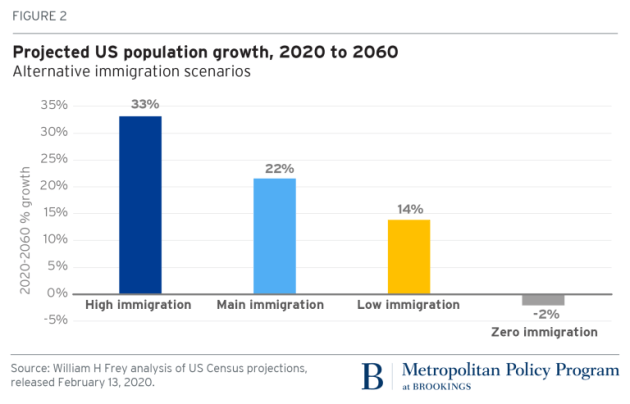
The projected populations over the 40-year period between 2020 and 2060 indicate a wide range of outcomes. The “main” immigration scenario would lead to population growth of 22%, from 333 million to 404 million. This is less than half of the 46% growth observed over the previous 40-year period, and reflects the fact that—compared to the past—the nation’s aging population will be experiencing higher death rates and more modest fertility rates.

Fig1

Fig2

The results of the three alternative scenarios are varied. The 2060 U.S. population size in the high-, low-, and zero-immigration scenarios is 447 million, 376 million and 320 million, respectively—representing growth rates of 33%, 14%, and -2%. In the zero-immigration scenario, the population begins to decline in 2035 due to a combination of more deaths than births and that emigration from the U.S. would not be countered by immigration into it.

Zero immigration would be demographically unsustainable and unlikely to occur. However, even the low-immigration scenario would lead to tepid population growth rates—in the range of 0.2% to 0.3%—over the final 20 years of the projection period.

DIVERSITY WILL RISE UNDER ALL IMMIGRATION SCENARIOS

Much of the current political discourse equates immigration with a rise in racial and ethnic diversity. While it is true that a large share of immigrants are people of color (especially those arriving from Latin America, Asia, and Africa), the new projections show that the U.S. will continue to become more racially diverse under all migration scenarios, even with zero additional immigration.

A major reason for this is the aging and projected decline of the population of whites who do not identify with another race or ethnic group. In 2018, the median age of this population was 44, compared to 38 for the nation as a whole, 29.5 for the Latino or Hispanic population, and 21 for those of two or more races. With a rising number of deaths compared to births, the older white population will experience a natural decrease in all projection scenarios, which immigration flows will not counter.

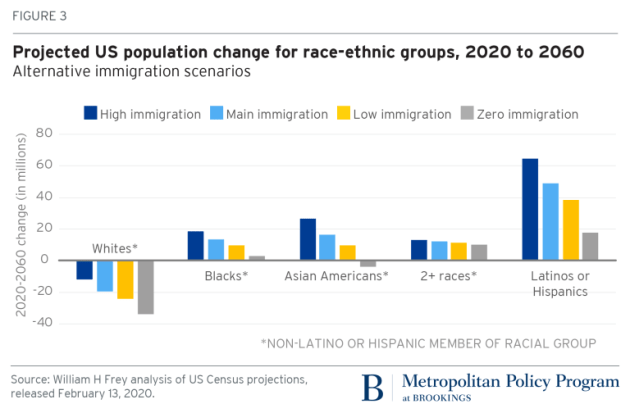
Fig3

The other race-ethnic groups will show mostly positive population contributions over each projection scenario. The largest will occur for the Latino or Hispanic population, which will increase between 18 million and 64 million over the 40-year period, depending on the scenario. Births from existing Latino or Hispanic residents will lead to a natural increase in this population even under low- and zero-migration scenarios.

All other race and ethnic groups contribute to projected population gains with the exception of Asian Americans, whose size is reduced under the zero-immigration scenario. In this case, Asian emigration from the U.S. is not countered by a natural increase. It is noteworthy that in both the low- and zero-immigration scenarios, persons identifying with two or more racial groups contribute more to projected population gains than Black or Asian American residents.

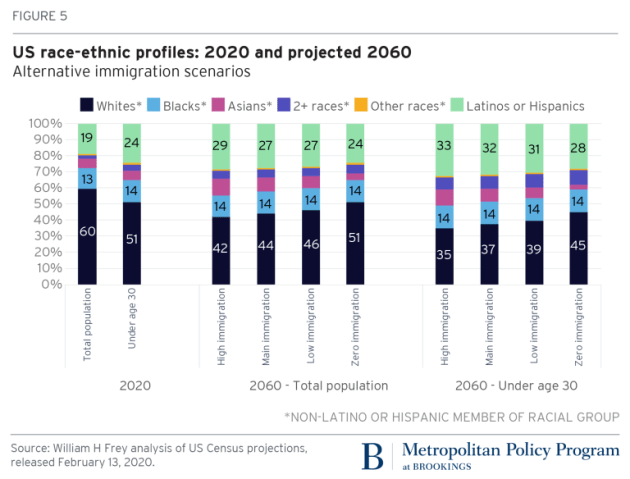
No matter the scenario, the U.S. will experience a rise in the share of the total population that identifies as a nonwhite race or ethnic group.

Fig4

Table 1

Fig5

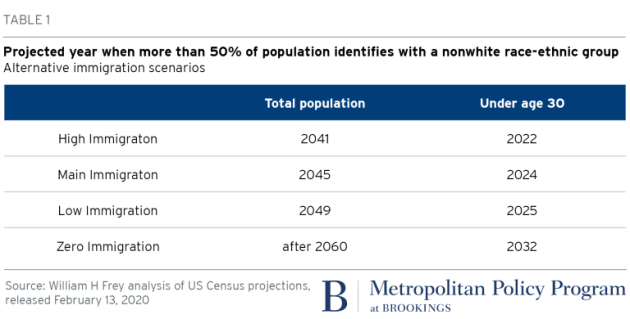
As previously reported, the “main” immigration scenario shows that in 2045, more than 50% of the U.S. population will identify as a nonwhite race or ethnic group, rising to 56% in 2060. In the high-immigration scenario, the 50% tipping point occurs in 2041; in the low-immigration scenario, it is 2049. Even in the zero-immigration scenario, the share of the U.S. population that identifies as a nonwhite race or ethnic group will rise to 49% by 2060.

Because all nonwhite race and ethnic groups are, on average, younger than white residents, their shares of the under-30 population are even larger than for the population as a whole. More than half of the under-30 population is projected to identify with a nonwhite group by the year 2024 in the main immigration scenario; in 2022 for the high-immigration scenario; and in 2025 for the low-immigration scenario. In the zero-immigration scenario, the share of the under-30 population that identifies as a nonwhite race or ethnic group exceeds 50% in 2032 and all years thereafter.

While shrinking in size, the white population is projected to comprise a larger share of the total population than any other single racial or ethnic group in all scenarios. The next largest group in all projections is the Latino or Hispanic population, which is projected to comprise around a quarter of the total population and roughly 30% of the under-30 population by 2060. 

IMMIGRATION IS NEEDED TO BOLSTER YOUNGER POPULATION GROWTH

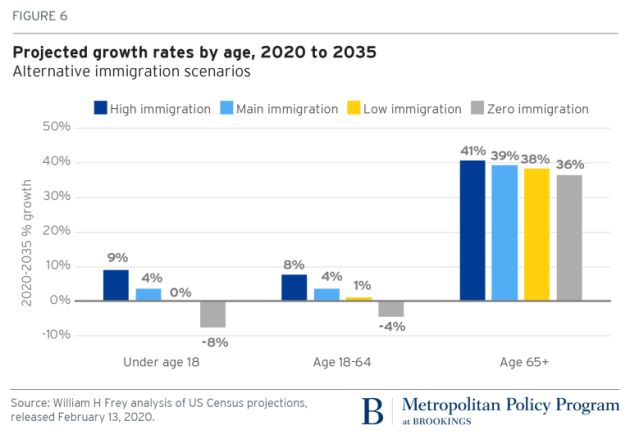
The aging of the U.S. population over the next decade will be propelled by the large baby boomer generation entering its senior years. Meanwhile, the younger population will be growing far more tepidly. This aging will be especially acute over the 2020 to 2035 period—as a result, immigration will make an important difference in how much the nation’s youth (under-18) and primary labor force (ages 18 to 64) populations grow.

Fig5

Under the high-immigration scenario, the youth population would grow by 9% and the labor force population would grow by 8% from 2020 to 2035. Both populations would grow by a modest 4% if current immigration patterns persist. A low- or zero-immigration scenario, however, would lead to stagnating growth or declines for these populations, while the 65-and-older population experiences a projected growth rate exceeding 36%.

The short-term implications of lower immigration levels could lead to noticeable labor force shortages. The longer-term impact is increased age dependency: the extent to which the retirement-age population will be dependent on younger workers for support. In 2020, the old-age dependency ratio (a measure of age dependency found by dividing 65-and-older population by the 18- to 64-year-old population) is 28. But as the population ages over the next 40 years, and age dependency rises, immigration will make a difference. In 2060, the dependency ratio can vary from 39 (under the high-immigration scenario) to a whopping 48 under the zero-immigration scenario. The latter would mean there would be only two working-age persons for every retiree.

THE NECESSITY OF IMMIGRATION TO THE NATION’S FUTURE

The Census Bureau’s alternative population projections make plain that continued immigration at current levels—at a minimum—is necessary to maintain the nation’s growth. With a rapidly aging native-born population, immigration will ensure growth—especially among the youth and labor force populations. Any appreciable lowering of immigration levels will lead to tepid national population growth, potentially negative growth in the youth population, and extreme age dependency.

It is also important to note that the nation will continue to become more racially and ethnically diverse under all immigration scenarios. This is a function of the country’s already large and youthful nonwhite populations, and the projected aging and decreased size of the white population.

Any political rhetoric suggesting that reduced immigration will make the nation “whiter” flies in the face of demographic evidence. In fact, the main reason the United States is growing more rapidly than most other industrialized counties stems from its healthy immigration levels over the past four decades. The Census Bureau’s projections suggest that similar or higher immigration levels will be necessary for the nation to grow and prosper in the decades ahead.

Source: Reducing immigration will not stop America’s rising diversity, Census projections show

‘We Saw There Is Disparity.’ Italian Fashion World Adopts Diversity Agenda

Better late than never:

The Italian National Fashion Chamber is promoting a diversity agenda among Milan’s major fashion houses, a year after several top Italian brands faced criticism for designs and remarks seen as culturally and racially insensitive.

Its manifesto backed by major Italian fashion brands aims to increase racial and gender diversity in key roles in Milan’s fashion houses, which fashion chamber president Carlo Capasa acknowledged was lagging in a recent interview with The Associated Press ahead of Milan Fashion Week.

‘’We have been speaking for many years against discrimination based on gender, religion, skin color and physical ability. But we must acknowledge that this has not been truly implemented,’’ Capasa said. ‘’We looked at our industry and we saw there is disparity. We saw that a disparity of gender persists, that there are conditions not favorable to women in the workplace and in some cases there is discrimination.’’

While Capasa resisted framing the manifesto as a direct reaction to the scandals involving blackface designs by Gucci and Prada, and a Chinese backlash that forced fashion house Dolce&Gabbana to cancel a major Shanghai show, the incidents show the cultural blind spots that can arise when a fashion house is too homogeneous.

Capasa said the Milan fashion world must work harder to attract people of color. “If global companies want to represent the world they are targeting, they must welcome diversity and look beyond their own borders,’’ he said, citing the relative homogeneity of Italian society.

Milan has lagged the other main fashion cities of Paris, New York and London in racial diversity on the runway, according to season diversity reporting by the Fashion Spot. Capasa said the stories that fashion houses want to tell are often linked to their Italian roots, and that runway choices are linked to model agencies’ offerings since not all models come to Milan.

While many Milan fashion houses take their creative direction from women — including Miuccia Prada, Donatella Versace, Silvia Venturini Fendi and Angela Missoni — and more women than men work in the fashion industry, Capasa said efforts are needed to get more women into decision-making roles.

‘’If we look at the boards, at the CEOs, at other key roles, there might be an advantage for men,’’ Capasa said. ‘’But we don’t want to introduce quotas obligating companies to promote women. We want to create the conditions so that women can have the same chances.’’

The chamber’s manifesto does not include hard commitments. Instead, it presents concepts that ‘’will serve as a model for a radical reform in terms of diversity and inclusion.’’

They were adopted by the chamber’s more than 100 members, which include most major Milan fashion houses with the notable exception of Dolce&Gabbana, and will be monitored every year for progress.

They call for changing representations of the standards of beauty on runways and in magazine campaigns, acknowledging that ‘’canons of physical beauty and harmful psychological models have spread throughout the industry.’’ They also present inclusion as a business opportunity that can boost financial results while improving trust with clients.

Gucci and Prada have independently made efforts to address the scandals. Gucci’s efforts include launching a scholarship program to reach students who have been underrepresented in the fashion industry, while Prada announced a diversity council headed by two Americans, artist Theaster Gates and film director Ava DuVernay.

Capasa put the fashion chamber’s initiatives in the context of an ever more globalized industry where 2.5 billion people follow the fashion world on social media accounts and can, with a single post, shift a fashion company’s fortunes.

Meanwhile the center of fashion’s commercial gravity has shifted to Asia, with Chinese consumers accounting for 90% of luxury sales growth last year, according to a study by the consultancy Bain & Co.

“The push to speak about diversity of inclusion comes directly from the fact that globalization made us understand that you cannot speak in the same way that you spoke before,” Capasa said. “The audience has become much bigger.’’

Source: ‘We Saw There Is Disparity.’ Italian Fashion World Adopts Diversity Agenda

How Nestlé’s radically stepped up its diversity game in last two years

Yet another example of a company’s recognition of the diversity of its customer base and thus the need for greater employee diversity, with what appears to be a coherent and meaningful strategy:

This might be one of the most important brand diversity case studies out there right now.

In the space of two years, Nestlé has radically improved its inclusion story and now boasts stats including: 50 percent female senior marketing leadership and 70 percent in marketing roles at manager level and above; 41 percent of summer associates from ethnically diverse backgrounds; 87 percent of diverse employees participating in culture programs feeling more engaged as a result and; a 1:1 gender pay equity for salaried employees at Nestlé USA.

“Diversity and inclusion are right for our talent, right for our culture, and right for our business, and help us build for the future,” states Nestlé USA CEO Steve Presley.

With products found in 97 percent of American kitchens, Nestlé has no choice but to hold diversity at the center of its marketing ecosystem.

Nestlé USA Chief Marketing Officer Alicia Enciso has leaned on her own experience growing up and working in Mexico to bring insights into multicultural consumers, contribute to industry-wide improvements in representation, and create a new perspective on building brands steeped in diversity.

“Marketing is the beating heart of our business and drives our closeness and connection to all our diverse consumers,” she said. “It’s critical that our teams leverage and empower underrepresented talent across gender, race and ethnicity, and LGBTQ status.”

Nestlé outlined its steps for greater inclusion in a case study as part of the ANA’s recent Diversity Report.


Recruit

Leveraging partners
With diversity-focused talent partners like The Consortium and Prospanica, we’re able to engage diverse talent early in their educational and professional journey. Through these partnerships, 45 percent of undergraduate and MBA campus candidates came from diverse backgrounds. By combining that attraction with diverse interview panels of current employees, we’re ensuring leaders of tomorrow reflect our consumers and our community.

Equipping candidates
Our Diversity Leadership Symposium brings together college students from diverse backgrounds for an intensive on-site program. Participants join career development sessions, network with business leaders, take part in a hands-on culinary experience, and interview for internships, co-ops, and trainee opportunities with a chance to return to school with a job offer in hand.

Exposure and skill-building help close the gap for diverse students and make corporate opportunities accessible, while interview opportunities create a direct line from development to hiring.

Ensuring pay equity
Nationwide, American women are still paid a lower average salary than their male counterparts, a problem that is exacerbated for women of color. A 2018 analysis found that salaries for female and male employees have reached a 1:1 gender pay equity at Nestlé USA. We have shared this information publicly with two purposes in mind: to attract strong female marketing talent to our company, and to encourage other businesses to follow our lead on equal pay. In 2018, we increased the portion of women hired for management roles by more than 50 percent.


Retain

Promoting workplace flexibility
While workplace flexibility adds value across our employee base, groups with diverse and valuable perspectives have been constrained from growth in marketing careers due to inflexible working environments, whether that’s new parents, military spouses, or those with elder care responsibilities.

Our Parental Support Program offers up to six months of leave for primary caregivers regardless of gender, including 14 weeks of paid leave and options for phased/ part-time return. Leave does not impede advancement or growth, and breastfeeding mothers returning to work have guaranteed access to dedicated breastfeeding rooms.

Broader flexibility programs support employees who need to adapt when, where, and how they do their work, from flexible hours to job-sharing. Flexibility, support, and empowerment have helped us retain strong diverse marketing talent throughout their careers.

Fighting unconscious bias, building community, and advocating for employees
Alongside providing unconscious bias training for Nestlé managers, we advocate for diverse groups within our company and in the national dialogue. Internally, we support Employee Engagement Groups as they develop programs and events to help employees thrive, from organizing involvement in LGBTQ Pride events to hosting panels on marketing to diverse consumers.

Externally, we have voiced strong support for national employee protections, such as the Equality Act, letting our employees know that we support them beyond our bottom line.


Promote

Building diversity in talent pipelines
To develop internal talent, Nestlé invests in a strong pipeline approach for leadership with a focus on diversity. When identifying strong pipeline talent, we create paths to leadership through specific development assignments, helping take ambiguity and bias out of the professional development process and equipping a diverse generation of high-potential talent with the practical experience required to progress in their careers.

In conjunction with these assignments, we employ a hemisphere-wide leadership monitoring program with a strong emphasis on women in leadership, where cross-country mentorship also helps develop greater multicultural opportunities.

Developing people leaders
We are developing leaders from all backgrounds to drive our company forward. Our SPARK training sessions focus on employees’ individual skills and experiences to help them understand how they can tap into their leadership potential. All marketing employees across the organization have taken this training, promoting courage in seeking new opportunities and creating a level playing field for leadership development.

Source: How Nestlé’s radically stepped up its diversity game in last two years

Diversity, inclusion minister should act as ‘catalyst’ with cross-ministerial power, say advocates

Some good commentary but more speculation until we actually see the ministerial mandate letters:

Renaming the multiculturalism ministry to diversity and inclusion has drawn mixed reactions from affected communities, as advocates await the release of the ministerial mandate letter to signal whether action is likely to come with the new title, or if it’s just “window dressing,” as some fear.

Within Prime Minister Justin Trudeau’s (Papineau, Que.) expanded 37-member cabinet, announced on Nov. 20, multiculturalism has been hived off from the heritage minister’s responsibility, with a separate portfolio for diversity, inclusion, and youth created, to be overseen by Bardish Chagger (Waterloo, Ont.) as minister.

Shireen Salti, interim executive director at the Canadian Arab Institute, said she’ll be watching to see if Ms. Chagger will be empowered to “act as a catalyst ensuring that diversity and inclusion is evenly applied across governments,” and that it doesn’t work as “a stand-alone ministry.”

The role should involve looking at the various functions of government and ensuring that underrepresented communities see some outreach and affirmative action, and that equal opportunities apply across sectors, something Ms. Salti said needs to be addressed for Arab Canadians, who represent the largest demographic of newcomers right now.

Former Liberal MP Celina Caesar-Chavannes said she was critical of the position in the beginning, but it presents an opportunity to “shift the conversation,” which in the past has mostly focused on gender-balance, to one that addresses equity for all. It should envelope intersecting identities, including race, class, ability, sexual orientation, and religious minorities, she said, and the gender-based analysis that was applied to government work in the 42nd Parliament should be broadened.

The position should act as an “accountability” check on the Liberals promises, and she said she hopes Ms. Chagger is tasked to work across all ministries to ensure that policy is looked at from an equity perspective. That’s the key, said Ms. Caesar-Chavannes, who is critical of the term “diversity,” calling it a frame that may draw in more people, but doesn’t always lead to systemic change.

Diversity just means numbers, echoed Black Vote Canada’s Velma Morgan, while inclusion means actual participation, she said, and she hopes the minister’s mandate letter is “starting at home,” namely, addressing the dearth of diversity in government offices. It should include outcomes that lead to more people of colour among the political staff surrounding ministers, and those reporting to them in the bureaucracy, said Ms. Morgan.

“We need to have people at the decision-making table so it reflects our community, but also brings the voice of our community to those tables,” she said. “A policy may seem very neutral on the surface but it might have an adverse effect on our community, and if you don’t know the nuances in our community, then you wouldn’t be able to catch them.”

Without specific measures in mandate, it’s ‘window dressing’

To former Conservative staffer Angela Wright, Ms. Chagger’s new title is “very typical of the way” Liberals have done things, and doesn’t necessarily signal a change in direction or adoption of new policies.

“When it comes to diversity and inclusion, they’ve already done all the studies and the reports, and at this point we need to see action and we need to see money from government to signal this is actually a commitment and something they’re going to work toward,” she said.

Anything less than actual money, changes in law, and policy implementation “is just window dressing,” she said.

NDP Leader Jagmeet Singh (Burnaby South, B.C.) has dismissed the new ministry as “pretty words,” rather than “real actions,” to address inclusion.

Political scientist Anita Singh was equally critical, noting cabinet positions like this one—and the newly formed ministry echoing the Liberal Party’s tagline of middle-class prosperity—are “a catch-22”.

“On one hand, the prime minister is trying to signal that these are issues that are important to his party, but on the other hand, by isolating these ministries, it fails to show how diversity, inclusion, and youth issues are interrelated to other key portfolios,” she said.

The biggest issues for youth, for example, are job creation, housing supply, and education, and so a ministry separate from that core work “makes little sense,” said Ms. Singh, while immigrant groups and people of colour face issues around immigration, credential recognition, and economic growth and housing.

“It is a weird irony that integration is being isolated this way,” she said. “There seems to be a lack of understanding about how these are all interrelated challenges.”

Though the Heritage office, Ms. Chagger declined an interview with The Hill Times until her mandate letter was issued. The office did not respond to follow-up questions about the renamed ministry, its budget and departmental resources, and whether it marks a change in approach.

These files are coming together because “there are synergies between these different roles,” Ms. Chagger told reporters on Nov. 21, the day after she was sworn in. She’ll also take on the LGBTQ2 Secretariat, created last Parliament, which has been transferred, along with the Youth Secretariat, from the Privy Council Office to the department of Canadian Heritage. The government also previously announced an Anti-Racism Secretariat, under the purview of the heritage minister, and $4.6-million to bring in a “whole-of-government approach” to address racism.

“These are areas that we take very seriously and the fact that it is a responsibility at the cabinet table tells you that we are going to ensure that when we are making decisions, we are making good decisions not only for today, but for future generations,” said Ms. Chagger.

Ruby Latif, a former Dalton McGuinty adviser who has worked at various levels of government and in Liberal circles, said she was pleased the government has taken this “step forward,” calling it a helpful position.

“When you have someone whose specialty [is] looking at inclusion and diversity, it ensures there is a lens being applied to all aspects,” said Ms. Latif, adding she thinks Ms. Chagger is the right person for the job.

Ms. Latif knew Ms. Chagger through Liberal politics, and said the minister’s experience through her work at the Kitchener-Waterloo Multicultural Centre, before the second-term MP became a candidate, means Ms. Chagger “actually brings that lens of understanding of diversity.”

File typically considered a junior minister

This will be Ms. Chagger’s third portfolio since being elected in 2015. First, she was named small business minister in Mr. Trudeau’s first cabinet, and less than a year later moved to the high-profile House leader post. Now, she’s paired with the Heritage department in a post that’s traditionally been seen as a junior minister, noted University of Toronto professor Erin Tolley.

Asked by reporters if she felt demoted, Ms. Chagger said with cabinet positions, it’s the prime minister’s prerogative. She said she faced the same questions when she was small business minister, and as House leader, and that it’s “important” to sit at the cabinet table.

Ms. Chagger is one of seven people who are visible minorities who were named to the 37-member, gender-balanced cabinet. She’s the fifth racialized minister to take on multiculturalism—the now-renamed portfolio has been the most common assignment among the 20 or so visible minority people who have occupied cabinet posts since Pierre De Bané was named to former prime minister Pierre Trudeau’s cabinet in 1978, soon after the post was first created.

Where racialized ministers are named is noteworthy, Prof. Tolley said, and while it may make sense to have people of colour to serve in positions that deal with anti-racism and multiculturalism, governments should see those objectives as everybody’s responsibility.

“You can’t meet these equity objectives unless white Canadians are doing some of the work,” she said. “If you want to stack up the comparison between symbols and actual outcomes from this particular minister’s perspective, she went from a prominent role to one of less visibility and less importance.”

Multiculturalism has historically been one of the “hot potato posts” that’s been “all over the map,” with governments dealing with it in different ways, added Prof. Tolley.

It was first housed within the old department of the secretary of state, which later morphed into Canadian Heritage, and it’s also lived with the department of Citizenship and Immigration. Some prime ministers had a separate minister of state for multiculturalism, while others didn’t have a minister whose post specifically included multiculturalism in the title, as was the case in Mr. Trudeau’s first cabinet.

Economic Development Minister Mélanie Joly (Ahuntsic-Cartierville, Que.) was responsible for multiculturalism in 2015, but it wasn’t brought into the title until now-House Leader Pablo Rodriguez (Honoré-Mercier, Que.) replaced her in the post in July 2018.

Semantics are important to politics, said Prof. Tolley, because it’s an explicit choice.

“The portfolios are not named accidentally,” she said, invoking the middle-class prosperity file as an example of a “symbolic and semantic” choice

“I’ll be curious to read the mandate the letter so see how, in practical terms, that symbolic choice materializes,” said Prof. Tolley, adding she also found it curious that the government isolated “youth” as a particular category.

It suggests something about government priorities, she said, whereas the words “diversity and inclusion” are “doing a lot of work” and are capturing a lot of different interests and identities and categories the government might be interested in. Last Parliament, Mr. Trudeau himself held the youth portfolio.

“From my perspective the name change, it doesn’t really go that much further, unless the mandate letter includes something about equity and outcomes,” she said, and it may be a case of simply renaming what was already there, and “in some ways almost diluting it, because now you’re dumping more and more elements into this bucket of diversity.”

Source: Diversity, inclusion minister should act as ‘catalyst’ with cross-ministerial power, say advocates

Hiring rule hampers diversity among teachers, says Ontario Education Minister

Classic challenge between competing objectives, experiences and diversity. Experience should not be used as a proxy for merit or suitability :

A regulation that forces boards to hire the most experienced supply teacher for full-time jobs — rather than the best fit — hinders efforts to bring in educators from more diverse backgrounds in schools, Education Minister Stephen Lecce said after hearing from parents in Peel who are concerned about racism in the board.

“What is really the challenge that impedes the ability of boards to make decisions based on merit or equity is Regulation 274, which creates some impediments to hiring talented educators based on their qualifications,” Lecce told the Star in an interview Monday.

He said the rule “eliminates the ability of boards to find, to choose, merited candidates that happen to be (diverse) or of specific backgrounds to better reflect the communities they represent. Their advice to me was to very seriously look at removing those impediments and I committed to them to doing so.”

Lecce has sent in two troubleshooters to probe complaints of anti-Black racism at the Peel District School Board, and last week personally met with families.

The issue, however, is one provincial negotiators will raise during the current round of talks with teacher unions, who support Regulation 274. It was originally implemented to curb nepotism, a huge concern for the Ontario English Catholic Teachers’ Association, OECTA.

OECTA declined to comment on the regulation, saying it is a matter for the bargaining table.

The hiring rule was brought in by the former Liberal government during contract negotiations in 2012 with OECTA, requiring principals to hire from among the five most qualified senior candidates in the supply pool for long-term and permanent jobs.

The regulation was later extended to cover all other school boards in Ontario over the objections of the boards themselves, as well as directors of education and deans of Ontario’s faculties of education.

Teachers have also complained that they lose seniority if they move to another board.

By 2013, even then-premier Kathleen Wynne admitted the regulation was an “overcorrection” and said her government would work to “get it right” during the next round of contract talks, though no changes were made.

Then, last April, Lecce’s predecessor Lisa Thompson called the regulation was “outdated” and that the government would address it because it “rewarded teachers based on seniority and did not recognize teachers who were excelling at their jobs.”

Lecce said changing the regulation “will have implications at the bargaining table, but I made commitments to understand the problem and work in good faith with all the parties, given this is about student success,” he said.

“ … The point really is taken that if you are not able to have a mechanism to draw upon talented people from various visible minority communities and racialized communities then we don’t do justice to our kids from those communities,” Lecce also said.

Earlier this year, the Elementary Teachers’ Federation of Ontario said a 2014 provincial report allayed concerns about the regulation and found that boards were not hiring unqualified candidates, nor was it preventing more diverse candidates from getting jobs, though boards and principals disagree.

Unions have, however, said they are willing to look at the lack of mobility to switch boards that Regulation 274 has created.

Source: Hiring rule hampers diversity among teachers, says Ontario Education Minister

Newsrooms not keeping up with changing demographics, study suggests

Likely not but not sure that focussing on columnists is the best measure of whether or not diversity is improving or not.

The analysis would also benefit from examining diversity in J-schools to see how that has changed over time:

Over the past two decades, as Canada’s demographics have shifted, news organizations have failed to reflect the country’s increasing diversity in both content and staffing.

Research on media coverage of race-related stories on politics from scholars like University of Toronto professor Erin Tolleyhas highlighted how far newsrooms have still to go.

But in Canada, most print and digital news organizations have resisted processes to examine their staffing. The conversation on the impact of industry job losses on newsroom diversity cannot advance until fundamental questions about staffing numbers are answered.

Our new study aims to fill in important information about newsroom staffing by showing how the demographics of national newspaper columnists compare to the increasing diversity of the Canadian population.

When it comes to news, who makes the decisions behind the scenes is just as important as whose byline is on the front page.

While Canadian broadcasters are federally mandated to report on their workforce demographics, newspapers and digital publications have no such requirement. In the United States, several national news organizations, including the New York Timesand BuzzFeed, have begun self-reporting the race and gender make-up of their newsrooms.

The American Society of News Editors (ASNE) has been conducting annual diversity studies of major newsrooms since 1978, allowing for the mapping of meaningful trends in how newsrooms hire, retain and promote journalists from diverse backgrounds.

“Counting gives us a starting point,” said Linda Shockley of the Dow Jones News Fund, which uses such demographic data to design training for U.S. journalists, in a recent interview with Poynter.

Racialized journalists drive diversity conversations

Recent conversations around diversity in media have been largely driven by racialized journalists, including the Toronto Star’s Shree Paradkar. Former Globe and Mail reporter Sunny Dhillon wrote about his decision to leave the paper after 10 years, frustrated by a continued editorial pattern of approaching complex stories through a “colour-blind lens.”

Columnist Desmond Cole stopped writing his twice-monthly freelance column for the Toronto Star after the paper’s editorial board editor barred him from his civic activism.

“If I must choose between a newspaper column and the actions I must take to liberate myself and my community, I choose activism in the service of Black liberation,” Cole wrote in a blog post.

There is little data on the breakdown of Black, Indigenous and people of colour (BIPOC) journalists in Canadian newsrooms. In 2004, Ryerson School of Journalism professor emeritus and former Toronto Star editor John Miller relied on voluntary participation for a survey on the demographic makeup of Canadian news organizations.

Some editors returned the survey empty; one scribbled across the page, “I find these questions insulting.” A few years later, Miller and Wendy Cukier, a professor at Ryerson University’s Ted Rogers School of Management, examined visible minority leadership at Toronto media organizations by using publicly available information and having it reviewed by researchers trained in employment equity.

Publications such as Canadaland (in 2016) and J-Source (in 2014and 2017) have also sought voluntary co-operation from news organizations and individual journalists with limited results.

‘Self-reporting’ offers window into staffing

To address the failure to engage in self-reporting by many Canadian news organizations, our study looks at the section of the newspaper where journalists often self-identify: the op-ed pages. In the process of expressing their perspectives on the issues of our time, columnists often disclose their identities.

We focused on news, city, opinion page and political columnists as they are most likely to shape social and political discussions.

For our 21-year study, we looked at Canada’s three largest publications, the Globe and Mail, the Toronto Star and the National Post, narrowing the scope of our research to include only those who wrote weekly columns or a minimum of 40 columns a year. In the end, we analyzed the work of 89 columnists, beginning in 1998 with the birth of the Post and ending in 2018.

Using terms of self-identification found in the columnists’ own words, in their published work and on their social media posts, we categorized their race and gender by census category.

Examples of self-identification that we found include phrases from columns such as “I, for one (old WASP),” “I, middle-class white lady” and “(as an) affluent white woman.” We then compared the numbers with corresponding census blocks over the 21-year period to chart how closely, along the lines of race and gender, columnists at Canadian newsrooms reflect Canada’s demographics.

In the 1996-2000 census period, white people comprised 88.8per cent of all Canadians, with two per cent Black, 2.8 per centIndigenous, 2.4 per cent South Asian and 3.5 per cent East Asian. By 2016, the numbers changed significantly: white, 77.7 per cent; Black 3.5 per cent; Indigenous 4.9 per cent; South Asian 5.6 per cent; and East Asian 5.4 per cent.

Our preliminary research shows that this demographic shift was not reflected in the makeup of Canadian columnists. Over the 21 years, as the proportion of white people in Canada’s population declined, the representation of white columnists increased.

Between 1998 and 2000, 92.8 per cent of columnists at the Globe and Mail, the Toronto Star and the National Post were white, over-representing corresponding census statistics by four per cent. And during the 2016-18 comparative period, while overall representation of white columnists dropped to 88.7 per cent of the columns pool, those numbers over-represented against the census numbers by 11 per cent.

Over the period of our study, not one of the publications had an Indigenous columnist who appeared regularly. Only three Black men and no Black women met our criteria for columnists.

Upholding trust and accountability

Our preliminary findings are concerning. For more than two decades, the voices that these publications chose to give prominence to did not reflect the perspectives and interests of a large segment of Canada’s population.

Self-reporting on newsroom diversity would encourage a culture of trust and accountability, one that the journalism profession upholds in its role as a watchdog of public institutions.

We are working on the development of a self-reporting tool for Canadian newsrooms, with the hope that such a strategy will be seen by media outlets as an invitation for redress.

After all, it’s impossible for Canada’s newsrooms to address a problem they can’t see. We are concerned that for the many who refuse to co-operate, that just may be the point.

Source: Newsrooms not keeping up with changing demographics, study suggests

Federal judiciary edges closer to gender parity, but numbers of minorities drop


Hmm. Effect of change in Minister?:

The federal judiciary is edging closer to gender parity after the second consecutive year in which more women than men were appointed judges, new data show. Women now make up 43 per cent of the 905 full-time judges.

But the numbers of minorities dropped, also for the second year in a row. There were just four members of visible-minority groups chosen, and two Indigenous persons, out of 86 new judges.

In the wake of the new statistics, some members of the legal community are urging the government to do more to appoint minorities to the bench.

“I think it is time now to redefine what we mean by merit,” said Daphne Dumont, a former president of the Canadian Bar Association who practises law in Charlottetown.

“I think you can be highly meritorious for all sorts of reasons that aren’t necessarily the reasons given in the application form that you have to fill in.” For instance, Indigenous lawyers who have returned to their home communities to bring them access to justice have shown merit. The process, she and others said, typically rewards those who are perceived as leaders through volunteering, teaching and participating on boards of legal associations.

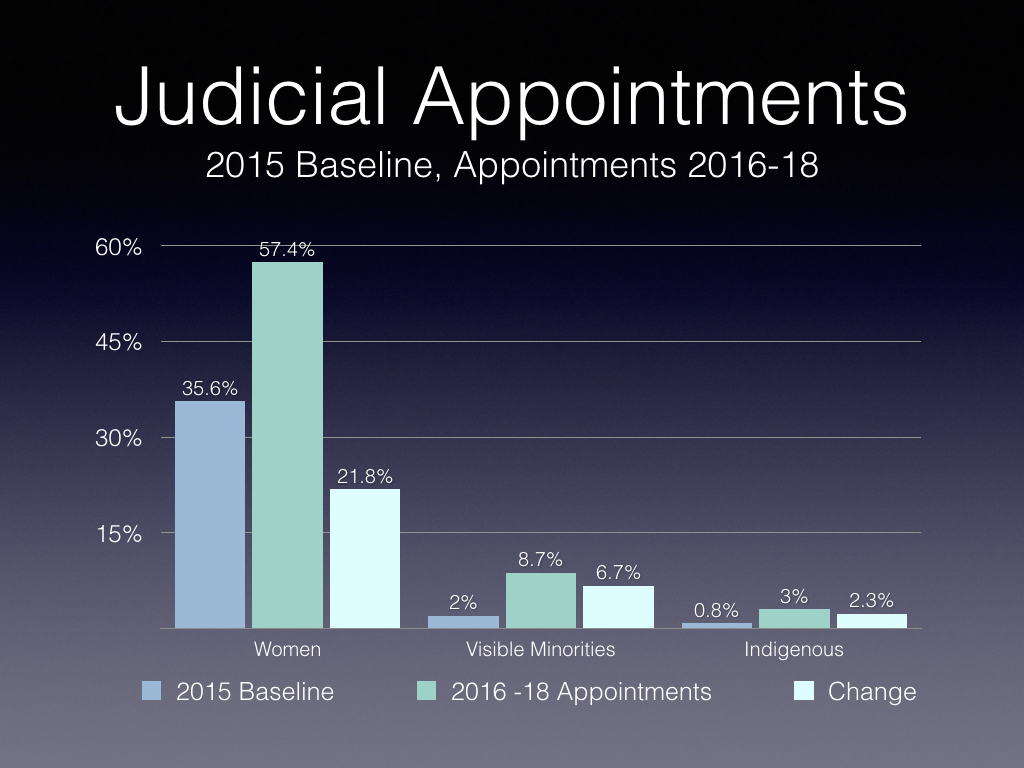
The Liberal government revised the appointment process in 2016, with a stated emphasis on diversity. For the first time, the government asked judicial applicants whether they are disabled, a member of a visible minority or an ethnic/cultural minority, LGBTQ2 or Indigenous.

Each year, the Office of the Commissioner for Federal Judicial Affairs reports on the numbers of applicants and appointments from each of the groups. The numbers cover federally appointed courts such as the superior courts of provinces, the Federal Court of Canada and the Tax Court.

From October, 2016, to October, 2017, an equal number of men and women – 37 – were appointed to these courts, although men far outnumbered women among applicants. The following year, female applicants for the first time outnumbered males, and the numbers appointed also exceeded those of males – 46 to 33. This year, appointments were 47 women, 39 men.

By contrast, the numbers went down among the minority groups. This year (from October, 2018, to October, 2019), there were 20 appointees – 14 from ethnic/cultural groups; four visible minorities; two Indigenous; and zero categorized as LGBTQ2 or disabled. (There were 19 LGBTQ2 applicants and six disabled ones. Applicants can stay in the pool for two years.) The previous year, there were seven visible minorities, three Indigenous and 29 overall. The first year of the reports, in 2017, there were 32 – including nine visible minorities.

Rachel Rappaport, a spokeswoman for Justice Minister David Lametti, said the minister has met with legal organizations since his appointment early this year to encourage applicants from visible-minority, Indigenous, linguistic-minority and LGBTQ2 communities. The meetings were also a chance to identify barriers and work together on solutions to further expand the pool of candidates, she said.

Lori Anne Thomas, president of the Canadian Association of Black Lawyers, said the appointments of black and Indigenous judges have been “woefully lacking.” She said she was singling out those two groups because they are overrepresented in the criminal-justice system, and among families in the child-protection system.

“The women who are appointed are white women. It shows there have been a lot of efforts in the legal community to create fairness and equality when it comes to gender, but it’s still not there in terms of race, or Indigenous persons,” she said in an interview.

Ms. Thomas said she would like to see “more consideration” given to members of overrepresented communities – for instance, for overcoming obstacles.

“Those who are racialized won’t be given the same kind of opportunities to speak on panels, to lead cases in the same way that especially their white male counterparts would be given.”

On that point, Scott Maidment, president of the Advocates’ Society, a lawyers’ group, said change needs to come from within the legal profession, too. To become a judge, “You need opportunities for leadership within the profession.” The Advocates’ Society has revised its leadership principles to stress inclusivity, he said.

Source: 43 per cent of federal judges