Pet Owners Are Diverse, but Veterinarians Are Overwhelmingly White. Black Veterinarians Want to Change That

Of interest:

As a child, Tierra Price was mesmerized by Dr. Dolittle, portrayed by Eddie Murphy in the 1998 film—not only because he could talk to dogs and sad circus tigers, but because he was a person of color who treated animals. “That resonated deeply with me,” says Price, who wore an oversized white coat and carried around a stuffed Dalmatian for her first-grade career day. “I grew up thinking that I was going to be one of the first Black veterinarians because I had never seen any,” says Price, now 26.

There were no Black doctors at vet clinics near her Louisville, Ky. home or at the local animal shelter where she volunteered. Price didn’t see her first real Black veterinarian until she was 19 and participating in a veterinary program for minority undergraduates. By the time she started veterinary school, she felt like an outcast. In 2018, Price created an online networking group for Black vets just to connect and commiserate with people who looked like her. “I was going into a profession I didn’t really belong in,” she says.

Years later, not much has changed. Veterinarians are projected to be among the most in-demand workers in the next decade. As more people of all races own pets, the U.S. Bureau of Labor Statistics (BLS) predicts jobs for vets and vet technicians will grow 16% by 2029. Nearly 65% of white households have pets, 61% of Hispanic households have pets, and almost 37% of Black households have pets, according to the most recent industry data. Yet pet lovers are faced with a predominantly white world once it’s time to see a vet. Of the more than 104,000 veterinarians in the nation, nearly 90% are white, less than 2% are Hispanic and almost none are Black, according to 2019 BLS figures.

This spring, Kimberley Glover spent nearly two months searching for a Black veterinarian in Birmingham, Ala., to care for her 2-year-old puppy Stokely—named after civil rights activist Stokely Carmichael—and to serve as a role model for her two children, who attend predominantly white schools. After scouring the internet and Facebook groups for Black pet owners, she finally received a suggestion from a college classmate, but the clinic was too far away.

“I have given up the search, honestly,” says Glover, 46. “It just tells me there’s more work to do.” Price, who graduated from the Virginia-Maryland College of Veterinary Medicine in May and is now a veterinarian in Los Angeles, agrees. “We have so much catching up to do,” she says.

Stark disparities have permeated the vet world for decades, advocates say, long before George Floyd’s death in May sparked a national movement for racial justice. In 2013, the profession was dubbed the whitest in America. “It has always been a problem,” says Annie J. Daniel, who founded the nonprofit National Association for Black Veterinarians (NABV). “This was just the wake-up call.”

Despite youth outreach efforts at schools and community partnerships to grow the number of Black veterinarians, the group has barely moved the needle since it was formed in 2016. In fact, the number of Black vets dropped from 2.1% of the total vet population in 2016 to below 1% in 2019, which Daniel says is largely due to systemic racism. “In this day and time, you don’t stay that way unless you’re ignorant to the fact that diversity is good,” Daniel says. “Or,” she adds, “you just don’t care that you’re purposefully omitting a group of people.”

Many issues prevent the veterinary profession from becoming more diverse. Chief among them is a lack of access and exposure to veterinarians at an early age, particularly among children who live in urban or low-income areas, where pet healthcare is considered more of a luxury, advocates say. “It’s not that they don’t want to become veterinarians,” Price says, “but they don’t know that it’s a career option.”

Such was the case for Dr. Will Draper, 53, who didn’t live near vet clinics or animal shelters while growing up in a predominantly Black community in Inglewood, Calif. Differing cultural views on animals also limited his exposure to veterinarians. “I didn’t really have many pets growing up because my father didn’t like animals,” says Draper, who now runs his own practice in Decatur, Georgia with his wife. Draper loved animals, but he didn’t realize he wanted to enter the field until his father took him to see the College of Veterinary Medicine at his alma mater, Tuskegee University. The historically Black college has educated more than 70% of the nation’s current Black vets. Draper was hooked after one visit.

‘Mountains and mountains of debt’

For many others, getting into vet school and paying for it pose additional challenges. On top of requiring prospective students to complete a number of undergraduate prerequisite courses, which can be costly, many top vet schools require or recommend that applicants have hundreds of hours of clinical experience working with animals and licensed veterinarians. Even before the pandemic, Price says that was tough for applicants who don’t live near clinics or shelters, especially if they have to work to support themselves or their families. “A lot of the experience that you have to have to get into veterinary school, you’re not paid for,” Price says. “That really selects for populations that have the luxury of forgoing income.”

In 2019, veterinary students in the U.S. graduated with an average of $150,000 in debt, according to the American Veterinary Medical Association (AVMA). Yet federal data shows the median annual wage for veterinarians in 2019 was about $95,000. Starting salaries were much lower. It costs graduate students attending in-state vet schools at Cornell University in New York and at the University of California, Davis upwards of $32,000 per academic year for just tuition and fees, according to the schools’ websites. Tuition for Tuskegee’s vet school costs more than $20,000 per semester. “When they come out of veterinary school,” Price says, “they’re under mountains and mountains of debt.”

While many young veterinarians are wracked with student debt, no matter their race, daily discrimination in the workplace is another job challenge. Draper—who stars in a reality TV show called Love & Vets on Disney Plus—is often the first Black veterinarian his clients have ever seen. In turn, at least two have refused his service. More than 30 years ago, Draper says an older white man balked when he saw that Draper was Black. The man insisted a white doctor treat his chihuahua, Tiny, who was suffering from congestive heart failure.

“He said Tiny doesn’t see colored people,” Draper recalls. He saved the chihuahua that day, but the man referred to Draper as “the colored doctor” for the next couple of appointments. “Nobody would have blamed me if I told that guy to screw off,” Draper says. “But that’s not what it was about.” When asked if clients have mistaken Draper for a technician or assistant, Draper laughs. “All the time,” he says, adding that they often insist on speaking to the clinic’s owner. “One time, I even said, ‘Hold on,’” Draper says. “I walked away and came back and said, ‘I am the owner.’”

For Black veterinarians and pet owners, systemic racism in the industry is the norm. That’s why Cheryl Kearney, 65, has no problem driving more than 50 miles to and from Detroit each time her 6-month-old kitten, Roger, needs to see a doctor. Kearney says she’s had negative experiences with her own white doctors speaking to her condescendingly, assuming that because she’s a Black woman, she wouldn’t understand their explanations unless they dumbed them down. Kearney says she couldn’t bear enduring that discomfort when it came to caring for her “baby” Roger, so she made it a point to find a Black vet. “It was a much more personal experience,” she says.

Dion Hobbs, a 46-year-old Houston financial advisor, also noticed that difference when he switched to a Black vet. Hobbs had been taking his 11-year-old dog Sadie to the same vet, who’s white, for more than a decade when Sadie cut open her back leg in June—her first major injury. Hobbs says he was disappointed with the clinic’s bedside manner during a vulnerable and frightening time.

“Competency wasn’t the issue,” he says. “I thought there would at least be a little bit more warmth in the conversion.” Hobbs says he doesn’t think race played a major role in what he considered Sadie’s chilly treatment, but he saw the experience as an opportunity to give his business instead to a Black veterinarian, who he says has shown more compassion. “If I’m going to spend my dollars,” he says, “why not have it go to someone who looks like me?”

An industry slow to change

When an industry is stifled by homogeneity, it can breed a culture of leaders often inflexible to change, advocates say. Amid a pandemic, when social distancing restrictions limited in-person appointments, some veterinarians criticized the AVMA for not tweaking its telemedicine policy, which discourages vets from prescribing medication or diagnosing new pet patients remotely except in emergency situations. The AVMA said it does not regulate or set laws that govern the use of telemedicine, but some vets say industry leaders should be better champions for changing those laws nationwide. For some, it was the latest example that the industry was not keeping up with the times.

<strong>“Pets need us. People need us, and aspiring veterinarians need us to drive a change for the profession.”</strong>“The veterinary industry, in general, has been very resistant to change in every facet,” Price says. Since July, nearly 6,000 people have signed an online petition, written by nearly a dozen multicultural advocacy groups, calling for the AVMA to take concrete steps to assess where it stands with inclusion issues and to ensure an equitable process for all. “Our profession could really benefit from more diversity because it brings creativity,” Price says. “It brings innovation and it brings new ideas.”

In a statement to TIME, the AVMA, which has more than 95,000 members, said it was “building on” efforts to “further infuse” inclusion into its programs and outreach. It added that it would develop new programs to bring leaders of color to the forefront and that it would work to amplify multicultural vet advocacy groups. In July, the AVMA approved the idea of forming a commission to assess diversity issues, but it has not yet been created. “Transformative change doesn’t happen overnight,” says AVMA President Dr. Douglas Kratt. “It will take an industry-wide, profession-wide collaborative effort to move the needle and to attract more young people to consider a career in veterinary medicine. No single organization can do this alone.”

Now, amid America’s racial reckoning, more leaders are pledging to step up. On Sept. 14, Banfield Pet Hospital, one of the nation’s largest employers of veterinary professionals, announced it would invest $1 million in diversity efforts and ensure at least 30% of its veterinarians and support staff are people of color by 2030. “This is absolutely just the start,” says Dr. Molly McAllister, Banfield’s chief medical officer. Banfield also gave $125,000 to help in-need Tuskegee vet students afford their schooling. “This is a critical time,” McAllister says. “Pets need us. People need us, and aspiring veterinarians need us to drive a change for the profession.”

A new vet school that opened at the University of Arizona in August is among those that have stopped requiring applicants to have a minimum number of hours of clinical experience. Instead, applicants can explain how they’ve found success in the face of hardship or how they’ve adapted to change. Of the 110 students in its inaugural class, 33% were minorities, officials say.

“We should not exclude someone from our profession just because they may come from an underserved community,” says Julie Funk, the vet school’s dean. “The very future of the veterinary profession is dependent on our ability to serve society as a whole.” Several other vet schools have recently hired managers to oversee diversity efforts or have donated to scholarships that help underrepresented minority students. The Association of American Veterinary Medical Colleges says it reached a milestone in 2020 of having about 20% of its total enrollment consisting of racial and ethnic underrepresented minorities.

There’s no better moment for industry leaders to commit, advocates say. The demographics of the U.S. are changing, and so are those of pet owners. A record high number of Americans own pets, according to the American Pet Products Association trade group, with estimates ranging from 56.8% to more than 65% of U.S. households. Minority groups are fueling that growth, a 2019 study found. Between 2008 and 2018, the number of Hispanic pet owners increased 44%, the number of Black pet owners grew 24% but the white pet owner population went up only 2%, according to the study. At this rate, Daniel says, the industry could suffer financially if it doesn’t keep up with the needs of the changing pet-owning population.

“We have to do more,” Daniel says, “and this is the time.”

Source: Pet Owners Are Diverse, but Veterinarians Are Overwhelmingly White. Black Veterinarians Want to Change That

Men accounted for more than two-thirds of Order of Canada appointments last year

I have been tracking Order of Canada appointments since 2013 from a diversity perspective.

While my initial interest was sparked by the Harper government’s effort to increase the number of appointments from Western Canada and the business community (limited success), I increasingly viewed this a an integration indicator and one that likely reflected other award and recognition program (my 2017 detailed review can be found here: The Order of Canada and diversity):

Less than a third of Canadians appointed to the Order of Canada last year were women — a figure that represents the widest gender imbalance in appointments to the order in years.

Analysis by diversity researcher Andrew Griffith, a former senior government official, shows that 71.4 per cent of appointees in 2019 were men. The low number of women among the 2019 appointees — just 28.6 per cent of the total — and the low number of visible minorities — just 5.4 per cent — show the Order of Canada falling short of representing Canada’s diverse population.

Griffith said there may be a lag effect because the Order of Canada tends to be given in recognition of a lifetime’s body of work — and high-profile women were scarce in many fields until relatively recently. But he said he expected to see progress toward gender parity among Order of Canada recipients mirror the advances experienced by women in the public service.

“It indicates where the country has been because these are previous contributions that are being recognized, and yet it says how far we have to go to ensure that, at the honours level where we recognize Canadians, that we’re actually recognizing a broad, diverse spectrum of Canadians,” he said.

A lack of balance

Griffith looked into Order of Canada appointments since 2013. He said he found that, on average, the gender balance on appointments over the seven-year period was 65.6 per cent male and 34.4 per cent female. The appointments came closest to gender balance in 2015, when 54.4 per cent were men and 45.6 per cent were women.

Over the seven-year period Griffith studied, members of visible minorities made up an average of 4.8 per cent of Order of Canada appointments — well below the 22.3 per cent of the population who identified as visible minority in the 2016 census.

In that same period, Indigenous nominees comprised 4.7 per cent of the appointments — very close to the 4.9 per cent identified as Indigenous in the last census.

More than 7,000 people have been invested in the Order of Canada since it was launched in 1967 as one of the country’s highest civilian honours. Appointments are made by the governor general based on recommendations by an independent advisory council, which reviews nominations and holds confidential discussions before voting on each nominee.

Natalie Babin Dufresne, spokesperson for the Office of the Secretary to the Governor General, said there has been some progress toward gender balance in the Order of Canada in recent years. She noted that just 21 per cent of the appointees in 2000 were women.

Although the number of women nominated to the Order of Canada has remained steady at about 200 a year, out of roughly 500 to 800 total nominations, Babin Dufresne said the success rate for nominations is higher for women — 72 per cent, compared to 58 per cent for men.

“Progress remains slow, and new initiatives continue to be developed to improve this situation so that we can achieve results with the Order of Canada that are comparable to other programs, such as the Sovereign Medal for volunteers, where close to 48 per cent of the recipients are women,” she said in an email.

“Data collection to get a better understanding of historical trending for other diversity groups began during the current mandate, and will offer us some important insights in the coming years to better target our initiatives and efforts to increase representation for all groups, including gender, visible minority and Indigenous representation.”

Babin Dufresne said modernizing the broader Canadian honours system is one of Gov. Gen. Julie Payette’s top priorities.

While there is no mention of diversity representation in the Order of Canada’s constitution and regulations, Babin Dufresne said steps have been taken to boost its diversity, such as new data collection on gender identity, disabilities, visible minority and Indigenous status, and a new, more user-friendly nomination platform.

She also pointed out that all Order of Canada ceremonies are now livestreamed to boost visibility and accessibility.

Babin Dufresne said the best way to improve diversity in a merit-based public program like the Order of Canada is to get more Canadians to nominate more people — which is why her office is working to increase the public profile of all of Canada’s honours programs and to make the nomination process user-friendly.

Sarah Kaplan, director of the Institute for Gender and the Economy at the University of Toronto, said more must be done to make the Order of Canada reflect the country.

‘Not acceptable’

“It’s not acceptable, in the Canadian context — a country that considers itself to be a land of opportunity, a land of equal opportunity, a land that pays attention to the diverse communities that exist within Canada — that we would see the awards going mainly to men,” she said.

Kaplan rejected the notion that bringing in quotas could erode the merit-based selection process, arguing that there are plenty of Canadians from all backgrounds who have made extraordinary contributions to Canadian society who aren’t recognized because they don’t fit the “historical template.”

“Our definition of merit is one that is self-reinforcing, about giving the same elite people the same awards. And so, when people say it should be based on merit, they’re not recognizing the fact that the idea of merit itself has been designed by the people in positions of privilege to reinforce their privilege and keep others out,” she said.

Rideau Hall said the Order of Canada advisory council makes appointment recommendations based on merit, but also takes factors like diversity into account.

The spring meeting of the advisory council was postponed due to the pandemic so the July appointments were not named. A new group of appointees is to be announced later this year.

Source: Men accounted for more than two-thirds of Order of Canada appointments last year

EU unveils plan to combat racism, increase diversity

Better late than never (collecting basic data):

The European Commission presented a series of measures Friday aimed at tackling structural racism and discrimination, acknowledging a blatant lack of diversity among the European Union’s institutions.

The bloc’s executive arm set out its action plan for the next five years, which includes strengthening the current legal framework, recruiting an anti-racism and increasing the diversity of EU staff.

The European Commission’s for values and transparency, Vera Jourová, said that recent anti-racism protests in the U.S. and Europe highlighted the need for action.

“We have reached a moment of reckoning. The protests sent a clear message, change must happen now,” Jourová said. “It won’t be easy, but it must be done.

“We won’t shy away from strengthening the legislation, if needed,” she said. “The commission itself will adapt its recruiting policy to better reflect European society.”

The current College of Commissioners, which oversees EU policies, is made up of 27 members, one from each EU country. All the members of the team set up last year by European Commission President Ursula von der Leyen are white.

Under the plan, data on the diversity of commission staff will for the first time be collected on the basis of a voluntary survey that will help define new recruitment policies.

Meanwhile, the new for anti-racism will be in charge of collecting the grievances and feelings of minorities to make sure they are reflected in EU policies.

The EU said that more than half of Europeans believe that discrimination is widespread in their country. According to surveys carried out by the EU Agency for Fundamental Rights, or FRA, 45% of people of North African descent, 41% of Roma and 39% of people of sub-Saharan African descent have faced such discrimination.

The EU’s racial equality directive will also be assessed, with possible new legislation introduced in 2022. In the wake of the Black Live Matters protests triggered by George Floyd’s death in the U.S., the European Commission said it would look carefully into discrimination by law enforcement authorities such as unlawful racial profiling. Meanwhile, the EU agency for fundamental rights will continue to collect data on police attitudes towards minorities.

The European Commission also wants to combat stereotypes and disinformation by setting up a series of seminars and promoting commemorative days linked to the issue of racism. It also encouraged member states to address stereotypes via cultural and education programs, or the media. A summit against racism is planned next year.

“Nobody is born racist. It is not a characteristic which we are born with,” said Helena Dalli, the EU commissioner for equality. “It’s a question of nurture, and not nature. We have to unlearn what we have learned.”

Earlier this year, the European Parliament approved a resolution condemning the Floyd’s death and asking the EU to take a strong stance against racism.

Source: EU unveils plan to combat racism, increase diversity

OECD Report: All Hands In? Making Diversity Work for All

This report has some very useful comparative charts that I will draw from in the future. This takeaway is a useful reminder of the differences between and among groups:

Existing frameworks must better differentiate the needs of diverse groups

Despite the variety of instruments in place, whether diversity policies actually work in practice and why is still under-researched. This is partly due to few countries evaluating or monitoring the impact of existing policies. Yet, understanding “what works” for which groups and why is crucial. Evidence suggests that existing diversity measures often disregard the considerable heterogeneity both between and within groups and consequently have unequal effects on diverse populations. For example, evidence shows that affirmative action programmes in the United States have benefitted white women more than ethnic minorities. Quota regulations, which have proven effective in getting more women in corporate boards, can be counterproductive when applied to other groups, such as people with disabilities. Such findings demonstrate that there are group-specific barriers, which cannot be addressed through “one-size-fits-all” diversity policies.

Crucially, most existing diversity policies tend to neglect socio-economic disadvantage. Studies on access to higher education suggest that diversity policies primarily benefit the most privileged within an ethnic minority group, e.g. those from families with relatively high incomes or high levels of education. While the principle of equal opportunities should apply to people of any socio-economic background and status, policies fail to help the most disadvantaged within minority groups will not end injustice. Finally, policy makers have to face the danger that disadvantaged individuals who do not happen to fall into the category of any particular “diverse group” may feel left out and discriminated against. Diversity policies, therefore, can only be one part of a broader package of policies to promote equal opportunities among all members of society.

page21image1385687056 page21image1385687344 page21image1385687840 page21image1385688032 page21image1385688320 page21image1385688896

Note: The chart compares differences in employment rates of men and women; native-born and foreign-born; and prime-age (25-54) and older workers (55-64). Disability status is defined as self-perceived, long-standing activity limitations. Employment gaps and perceived attitudes are shown as colour-coded percentiles. Evolution over 10 years (2008 and 2018 for attitudes; 2006/07 and 2016/17 for labour market gaps): “red”: more than a 2 percentage points change to the favour of diverse groups, “yellow” between a +2 percentage points change and a -2 percentage points change, “red“: more than a 2 percentage points change to the detriment of diverse groups (regardless of statistical significance). The evolution refers to differences vis-à-vis the respective comparison group and not absolute values. “Grey”: data are not available.

Source: OECD Gender Portal; OECD/EU Settling In: Indicators of Immigrant Integration 2018; OECD Employment Outlook 2018; OECD Connecting People with Jobs 2014; World Gallup Poll.

Source: https://read.oecd-ilibrary.org/social-issues-migration-health/all-hands-in-making-diversity-work-for-all_efb14583-en

Oscars make historic change to encourage diversity in best picture nominees

Overdue:

In a historic move, the Oscars are raising the inclusion bar for best picture nominees starting with the 96th Academy Awards in 2024. The Academy of Motion Picture Arts and Sciences on Tuesday laid out sweeping eligibility reforms to the best picture category intended to encourage diversity and equitable representation on screen and off, addressing gender, sexual orientation, race, ethnicity and disability.

The film academy has established four broad representation categories: On screen; among the crew; at the studio; and in opportunities for training and advancement in other aspects of the film’s development and release.

Each standard has detailed subcategories as well. To meet the on-screen representation standard, a film must either have at least one lead character or a significant supporting character be from an underrepresented racial or ethnic group, at least 30 per cent of secondary roles must be from two underrepresented groups or the main storyline, theme or narrative must be focused on an underrepresented group.

According to the academy, underrepresented groups include women, people of colour, people who identify as LGBTQ or people with disabilities

The best picture award, which is handed out to the producers of a film, is the one category which every film academy member can vote for. Earlier this year, the South Korean film Parasite became the first non-English language film to win the award.

‘Long-lasting, essential change’

All other categories will be held to their current eligibility requirements.

“The aperture must widen to reflect our diverse global population in both the creation of motion pictures and in the audiences who connect with them,” said Academy president David Rubin and CEO Dawn Hudson in a written statement. “We believe these inclusion standards will be a catalyst for long-lasting, essential change in our industry.”

The second category addresses the creative leadership and crew composition of a film. In order to meet the standard a film must have either at least two leadership positions or department heads be from an underrepresented group and at least one be from an underrepresented racial or ethnic group; at least six other crew be from an underrepresented racial or ethnic group; or at least 30 per cent of the film’s crew be from an underrepresented group.

The third category deals with paid internship and apprenticeship opportunities as well as training opportunities for below-the-line workers, and the fourth category addresses representation in marketing, publicity and distribution teams.

The inclusion standards form will be confidential and will not be required for best picture hopefuls for the 94th and 95th Academy Awards.

The inclusion standards were developed by a task force led by academy governors DeVon Franklin and Jim Gianopulos and in consultation with the Producers Guild of America. They also took into account diversity standards used by the British Film Institute and the British Academy of Film and Television Awards.

These changes will also not affect the 93rd Academy Awards, although the academy has had to make a few alterations because of COVID-19’s effects on the movie business, including pushing the ceremony back two months to April 25, 2021 and allowing films that debuted on a streaming service to be eligible for best picture.

Source: Oscars make historic change to encourage diversity in best picture nominees

Feds creating ‘inventory’ of racial minorities to fill senior public service posts

Reasonable approach. I recall when I worked for Global Affairs in the 90s, that a similar practice existed, run by HR, to identify promising women foreign service officers for development assignments and advancement. Some 20-30 years later, most of the names became senior officials:

The Liberal government wants to create an “inventory” of Black, Indigenous and other racialized people who could play high-ranking roles in the federal public service.

It is looking for an executive search firm to create and maintain the list of candidates from minority groups, as well as people with disabilities, who could be considered for deputy minister and assistant deputy minister positions.

Details of the planned database are contained in a request for proposals posted on the federal government’s procurement and public tenders website.

They were first reported by the True North Centre for Public Policy on its news site.

The call for the staffing consultant to do this work was put out by the Privy Council Office, a bureaucratic operation that supports the prime minister and cabinet.

The request for proposals does not disclose how much the contract will cost.

“The federal public service is stronger and most effective when it reflects the diversity of the Canadians it serves,” says the request for proposals.

“While progress has been made in recent years to achieve gender parity in the senior leadership community, there is more progress to be made in increasing representation of Black people and other racialized groups, Indigenous people, as well as persons with disabilities.”

Ordinarily, public servants rise through the ranks before attaining the most senior executive posts of deputy minister and assistant deputy minister.

However, the Employment Equity Act, which applies to federally regulated industries, Crown corporations and some portions of the federal public service, designates women, Indigenous Peoples, other visible minorities and people with disabilities as groups requiring special measures to overcome barriers to employment.

According to an analysis by Andrew Griffith, a former director general at the Immigration Department, in the October 2017 issue of Policy Options, less than four per cent of executive positions in the federal public service were Indigenous and less than 10 per cent were other visible minorities.

Caroline Xavier is the only Black assistant deputy minister, appointed in February at Immigration, Refugees and Citizenship Canada.

“We are in 2020. How come it took so long? It shouldn’t have,” she told the CBC in June.

The winning bidder will be required to update the list every two months.

Source: Feds creating ‘inventory’ of racial minorities to fill senior public service posts

Police service boards grapple with diversity, inclusion amid calls for change

Source: Police service boards grapple with diversity, inclusion amid calls for change

Elsewhere they get it but the Australian media is still living in White Australia

Haven’t seen anything as comprehensive with respect to Canadian media although there have been partial samples showing underrepresentatioon:

Few would argue that Australian media does well at representing cultural diversity. Certainly not in a way you’d expect when we are a multicultural society, often trumpeted as the most successful of its kind in the world.

Now, for the first time, we have the numbers that show us just how representative – or rather, unrepresentative – the state of play is.

In our report, Who Gets to Tell Australian Stories?, we gathered data to provide the first comprehensive picture of who tells and produces stories in Australian television news and current affairs. We examined about 19,000 news and current affairs items broadcast on free to air television during two weeks in June 2019.

In their frequency of appearance on screen, we found that more than 75 per cent of presenters, commentators and reporters have an Anglo-Celtic background. While about 18 per cent have a European background, only 6 per cent of those on screen have an Indigenous or non-European background. Within our sample, none of the commercial networks had more than 5 per cent of presenters, commentators and reporters who have a non-European background.

Compare this with the Australian general population. Based on the 2016 Census figures on ancestry, the Australian Human Rights Commission has previously estimated that 58 per cent of Australians have an Anglo-Celtic background, 18 per cent have a European background, 21 per cent have non-European backgrounds, and 3 per cent identify as Indigenous.

It has been nearly five decades since an official multiculturalism was adopted in Australia. Yet that has had limited visible impact on our media.

To be fair, Australian media isn’t the only arena where this is the case. Anglo-Celtic and European backgrounds dominate the leadership ranks of politics, business, the public service and our universities. Our institutions fail to make the most of the talents within our society.

Diversity is often embraced only in name, and not in norms. If there’s a glass ceiling that many women in work hit, then those from minority backgrounds hit a cultural one. According to a survey we conducted as part of our research, more than 85 per cent of non-European background journalists believe having a culturally diverse background represents a barrier to career progression.

Representation, though, matters. It particularly matters for our television media: the medium shows us who we are as a people and as a culture. News and current affairs media have a special role in identifying and telling stories about issues of importance to all Australians.

Yet it’s overwhelmingly journalists who have Anglo-Celtic backgrounds who report, select and produce these stories. The result? Too often, media does a poor job of covering race issues.

For example, just about every time there’s a panel discussion about racism on commercial breakfast television, it involves an all-white panel that has minimal understanding of what has happened. Worse, commercial breakfast television currently seems to thrive on stoking prejudice. For sections of the media, racism is part of their business model.

Even our public broadcasters have their blind spots. For the past 10 years, the ABC’s Insiders program had no journalist who was a person of colour on its panel – something it has only rectified last month. Multicultural broadcaster SBS has recently been criticised for how it treated Indigenous journalists, and for the lack of cultural diversity within its senior management.

It’d be unthinkable for any television network to have a football commentary team on air, where not a single commentator would have experience playing the sport. By the same logic, networks should understand it’s a problem, in a multicultural society, when there’s little or no diversity within its news and current affairs.

Media elsewhere seem to get it. Indeed, Australian media lags significantly behind English-speaking counterparts. What we look like on screen can seem decades behind the United States and the United Kingdom. While they are themselves far from perfect, US and British media organisations have better collection and monitoring of data on their diversity. They’ve also been bolder at setting targets for minority talent.

For change to happen here, Australian media organisations will need to take similar steps. But more than that, there needs to be a cultural change in mindset. Too often, there is unwarranted defensiveness about criticisms concerning diversity. People can wrongly feel that a critique of systemic patterns of under-representation amount to personal attacks, or even a form of “reverse racism”. Deflections and denials come all too easily.

Talk about diversity and race will always spark debate. But it’s hard to argue with the evidence. In the case of our media, the numbers tell us we are still living in a White Australia, even if the White Australia policy was dismantled nearly 50 years ago.

Source: Elsewhere they get it but the Australian media is still living in White Australia

How to find the right words for your next chat about diversity

Some useful insights that all can benefit from, including the point regarding grace and forgiveness (to which I would add humility):

In these polarized times, we need conversations that span differences within our organizations, building trust and uncovering solutions. But fear and grievances from past injustices get in the way.

In her work as a diversity and inclusion consultant, Mary-Frances Winters sees people struggling to find the right words for such chats. “It’s not that most people do not want to engage in inclusive conversations; they do not know how. They do not know what to say so as not to offend or be accused of insensitivity or worse,” she writes in her just-published book, Inclusive Conversations.

She divides those in an office into two sets: Those who have historically found themselves in dominant power (even if they never saw it that way) and those who have traditionally been subordinated and marginalized because of their identity – race, ethnicity, gender, religion, sexual orientation or some other dimension of difference. We don’t normally view the organization in those terms; we’re all supposed to be on the same team. But it’s a vital description to keep in mind if you want to bridge differences.

Many people who have long been part of the dominant group fear that a slip of the tongue – one wrong word – might lead to a verbal attack or worse by colleagues and superiors. And while those in power have for a long time promised an equitable and inclusive working environment, many in the same workplace still feel excluded.

It therefore takes more than good intentions and a desire for equity to bridge those divisions. Indeed, Winters lists eight conditions necessary to allow inclusive conversations to occur: Commitment; cultural competence; brave and psychologically safe spaces; an understanding of equity and power; the ability to address fear and fragility; grace and forgiveness; trust and empathy; and belonging and inclusion.

Don’t slide by commitment too quickly. Many leaders would argue they have always had a commitment to equity, but in her 35 years as a consultant, Winters doesn’t feel we have fundamentally changed the structures and systems that either maintain or worsen the conditions for historically subordinated groups. Think through how dedicated you truly are to changing things and where that desire stems from. As well, think of how you can improve your own knowledge and understanding of the differences in culture within your workplace, so that you can be competent enough to help make change.

It’s routine to talk about the need for psychologically safe spaces for touchy conversations, but the consultant says we need to move beyond that to create brave zones, where deep truths can be expressed without fear of retribution. She argues that for dominant groups discussing race, “safety” means, “You will not make me feel uncomfortable.” But for those who have historically been marginalized, “safety” often means, “I can make you feel uncomfortable (even if that is not my intention) and you will listen without defensiveness, dismissiveness, and ‘whitesplaining,’” which Winters defines as a situation in which a white person explains to a Black person the true nature of racism. So expect in these brave spaces that there may be discomfort and discord, but everyone will feel safe enough to be brave.

Winters asks you to distinguish between equity and equality. Equality means treating everyone the same way. Equity is treating people according to what they need and deserve. That assumes some groups have historically been denied what they need due to entrenched inequitable systems. How do you achieve equity given that situation? She warns that attaining equity will involve conversations about power – not a normal or easy topic in the office.

You will also need to face up to the fear and fragility that exists these days. “Many people are afraid of talking about diversity and inclusion topics for fear they might get it wrong and not be forgiven. Acknowledging these fears is an all-important step in engaging in inclusive conversations,” the consultant says.

She urges you to literally talk to yourselves about these issues – in quiet contemplation but also out loud – as part of the self-understanding needed to then talk with others. The idea is for you in your reflection to bring unconscious thoughts into the foreground, where they can be challenged. Where are you clinging to behaviours that are inequitable?

Winters also warns that race is a dynamic in all cross-race conversations. If you are white, you need to realize the Black person you speak to is aware of that dynamic, even if they might not admit it. So if you are white, reflect: What role does my whiteness play in the conversation? How might someone with a different identity might feel?

Inclusive conversations are a beguiling concept, but they are highly challenging for managers. They require moving beyond traditional power dynamics in the office that many managers have taken for granted and benefited from. But if you aim for inclusion, such conversations are now something more you need to learn. And as with all learning, that will involve periods of incompetence before it becomes more natural. You’ll only learn by trying.

Source: https://www.theglobeandmail.com/business/careers/management/article-how-to-find-the-right-words-for-your-next-chat-about-diversity/

PM’s ‘Tiger Team’ meant to address diversity, inclusion in Canada’s national intelligence and security community hasn’t met since 2018

Of note. Yet another initiative without apparent follow-up.

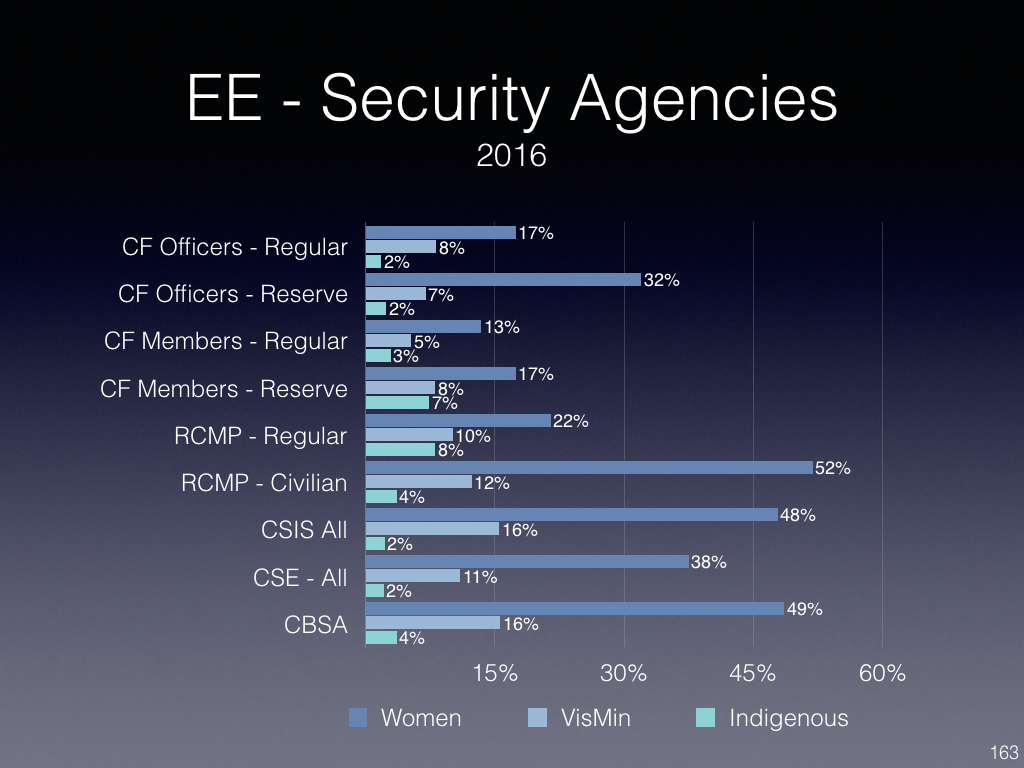
Although somewhat dated, this overall picture is unlikely to have changed significantly (in process of requesting updated reports for the CF (non-civilian), RCMP (non-civilian), CSIS and CSE as not covered in the TBS report):


The federal government still has “much work to be done” on addressing diversity and inclusion issues within its intelligence and security apparatus, according to a recent parliamentary committee report, with one leading intelligence expert suggesting more senior leadership within the Privy Council Office with “power and clout” is needed to oversee the problem—and questioning why Prime Minister Justin Trudeau’s launch of the “Tiger Team” in 2017 meant to address diversity and inclusion issues hasn’t met since July 2018.

In their lengthy 2019 annual report, which was tabled in Parliament only a few days before the nation-wide COVID-19 lockdown began in March, the National Security and Intelligence Committee of Parliamentarians, composed of 11 MPs and Senators and chaired by Liberal MP David McGuinty (Ottawa South, Ont.), focused considerable attention on the issue of diversity and inclusion in the security and intelligence community.

The review was conducted for several reasons, according to the report, most importantly because “challenges to increasing diversity and inclusion persist in the security and intelligence community even after decades of legislation, multiple reports and repeated calls for change.”

“These issues are particularly important for organizations responsible for protecting the national security of Canada and the rights and freedoms of Canadians.”

The report also notes that the “Tiger Team” established in 2017, created “with the stated aim of ‘exploring, advancing and implementing joint efforts to learn from one another and share best practices to enhance diversity and inclusion within and across [their] organizations through a variety of activities and initiatives,’” has not met since July 2018.

In January 2017, The leaders of the Canadian Armed Forces, the Canadian Coast Guard, Canadian Border Services Agency, CSIS, Canadian Security Establishment, Department of National Defense and the RCMP established the Tiger Team.

National security expert Wesley Wark, a professor at the University of Ottawa, told The Hill Times that the initiative to create a Tiger Team was a product of a push by Prime Minister Justin Trudeau (Papineau, Que.) in late 2016, and ultimately resulted from a meeting Mr. Trudeau requested with the heads of agencies in the security and intelligence community as well as with the Privy Council Office.

“Sadly, the tigers seem ultimately to have gone to sleep,” according to Prof. Wark’s April 2020 working paper addressing the NSICOP’s findings. “It is time, perhaps, for the prime minister to crack the whip again.”

“This kind of Tiger Team concept moved into the lane of deliverology, in the sense that it was overseen by the deputy secretary to the cabinet, but I’m not sure that was the original idea—that’s just where it ended up in terms of maintaining some momentum and producing reports for a period of time,” according to Prof. Wark.

When it comes to the specifics of diversity and inclusion in the security and intelligence community, it was “probably a mistake to move it into that lane or allow it to be moved into that lane,” said Prof. Wark.

“If an initiative of this kind was going to be sustained and picked up by all the different elements of the security and intelligence community, it needed to be overseen by senior leadership in the PCO [outside] of the deliverology mechanism,” said Prof. Wark. “In other words, it should have been taken up as a priority by the national and security and intelligence advisor, and it’s that senior officer in PCO who would have the power and clout to really make sure that something significant happened in this way.”

“I don’t understand why the national security and intelligence adviser himself did not take this up, and the committee of parliamentarians notes that although it doesn’t attach any explicit criticism to this, the whole Tiger Team effort obviously just faded away all together after a period of time,” said Prof. Wark.

The deputy secretary to the cabinet resides within the PCO, underneath the Clerk, and the national security and intelligence advisor is a very senior deputy minister position that ranks almost as an equivalent position to the clerk of the Privy Council, according to Prof. Wark.

According to PCO spokesperson Pierre-Alain Bujold, the work of the Tiger Team is ongoing, and currently chaired by the Department of National Defense (DND).

“The Government of Canada appreciates the work undertaken by [NSICOP],” according to Mr. Bujold, [and] sees diversity and inclusion as an important means to making its national security and intelligence community even more effective in protecting Canadians,” according to Mr. Bujold in an emailed statement to The Hill Times.

“We have been working for a number of years to improve diversity and inclusion in the security and intelligence community. This is critical, not just in terms of better representing Canadian communities, but in making security and intelligence agencies more effective at doing their job.”

‘Diversity is particularly important inside security and intelligence organizations’

Mr. McGuinty, the committee’s chair, was not available for an interview, but in an emailed statement to The Hill Times, the executive director of the committee, Rennie Marcoux, wrote that although the report did not make any findings or recommendations as to the national security and intelligence adviser’s role within the Tiger Team, the committee recognizes the merit of the community approach to address diversity and inclusion issues—and that its recommendations reinforce the value of the coordinated effort.

“The security and intelligence community is best placed to determine which individual or office is best suited to lead or direct this work,” according to Ms. Marcoux.

In its conclusions, the report notes that “building diverse and inclusive workforces is essential to the effectiveness of the security and intelligence community.”

When asked to expand, Ms. Marcoux noted that in addition to the “well-documented” benefits of a diverse workplace and inclusive workforce across a large body of research, as well as the committee’s belief that Canada’s public service should reflect the population it serves, “a more diverse workforce ensures that organizations are benefitting from the broad range of perspectives and talent that Canada has to offer.”

“Finally, the committee notes that diversity is particularly important inside security and intelligence organizations because it allows them to leverage language skills, community contacts and cultural competencies, and protects against groupthink mindsets that permeate more homogeneous organizations,” according to Ms. Marcoux.

Tim McSorley, national coordinator with the International Civil Liberties Monitoring Group, told The Hill Times that “there needs to be a level of accountability and transparency in terms of what the words on paper mean.”

“I think a big question is that we see, year-after-year, whether it’s three-year plans or five-year plans or in line with Treasury Board recommendations, it seems like there’s a plan and then the next plan seems to repeat very similar issues around the importance of lowering barriers [around] increasing diversity and inclusion within these organizations,” said Mr. McSorley. “While it does seem that the numbers have gotten slightly better over the last 10 or 11 years, it doesn’t seem like anything new is coming out, it seems that it remains the same question each time a new plan is put together.”

“So what are they doing on the ground to actually change and to increase diversity and inclusion in the security and intelligence community,” said Mr. McSorley. “Who is accountable if they don’t meet those goals, and what kind of consequences are there?”

When asked about the Tiger Team, Mr. McSorley said that looking at some of the critiques within the report, the fact that it was concentrated solely of members from HR departments was part of the problem.

According to the report, the committee noted several shortcomings with this initiative, including the lack of specific objectives for diversity and inclusion as well as the development of a performance measurement framework to assess the success of its initiatives.

“The representatives from each organization were all from human resources departments and organizations did not seek out members of employment equity groups for membership or participation on the Tiger Team,” according to the report. “[Throughout] its discussions, the Tiger Team focused on short-term initiatives without considering systemic challenges raised in various organization-specific studies or class-action lawsuits (the CAF and the RCMP), such as workplace culture and discrimination.”

‘Things won’t change on their own’

The Abella Commission, which led to the creation of the Employment Equity Act, unfolded in 1984, said Noa Mendelsohn Aviv, director of the equality program at the Canadian Civil Liberties Association.

“The first Employment Equity Act was in 1986. The current [act] is 25 years old, and that act calls for serious accountability measures, serious long-term and short-term goal setting, serious monitoring and reviews for organization accountability,” said Ms. Aviv.

“So we always need to be optimistic and hopeful and try to move things forward, but we’ve also been working on these issues for a very long time,” said Ms. Aviv. “There are clear obligations there, obligations that, according to this report, have simply not been met.”

Ms. Aviv said she believes that there is a notion that things are getting better, they get better on their own, and that patience is required to change organizational culture.

“But if you actually look at the trajectory and the amount of time that’s passed, and the amount of harm that’s been done to people in these organizations, and the ill-effect it’s having on the effectiveness of the organizations themselves, then you understand that things won’t change on their own,” said Ms. Aviv.

According to RCMP spokesperson Catherine Fortin, the RCMP has implemented a number of initiatives to increase the ratio of women, visible minorities, and Indigenous people within their ranks, with objectives to include 30 per cent women, 20 per cent of people from visible minority groups, and 10 per cent Indigenous people.

“We intend to reach these goals through a targeted approach to recruiting, using advertising and marketing to position the RCMP as the employer of choice to people who may not have considered a career in policing,” according to Ms. Fortin. “The RCMP is committed to inclusiveness and diversity of all types within the organization. We believe that the more diverse we are when it comes to gender, ethnic background, religion or sexual orientation, the better we are able to serve all Canadians.”

According to DND spokesperson Major T.A. Smyth, “DND and the CAF place unprecedented emphasis on ensuring diversity and gender equality in military human resource management as part of efforts to strengthen the operational force and to position DND and the CAF as inclusive organizations. Diversity is viewed as a source of strength and flexibility to build the capacity of the CAF and the civilian workforce.”

“DND and the CAF are working with other government departments as a community and considering the findings and recommendations of this report to inform future decision making,” according to Mr. Smyth. “Various experiences, knowledge, and skillsets contribute to our operational effectiveness. By increasing the representativeness of our Forces and our civilian personnel to reflect Canadian society, diversity enables DND and CAF to be forward-looking, resilient, and relevant.”

—-

The National Security and Intelligence Committee of Parliamentarians made the following recommendations in it’s 2019 Annual Report, released in March 2020:

1. The committee conduct a retrospective review in three to five years to assess the security and intelligence community’s progress in achieving and implementing its diversity goals and inclusion initiatives.

2. The security and intelligence community adopt a consistent and transparent approach to planning and monitoring of employment equity and diversity goals, and conduct regular reviews of their employment policies and practices.

3. The security and intelligence community improve the robustness of its data collection and analysis, including GBA+ assessments of internal staffing and promotion policies and clustering analyses of the workforce.

4. The security and intelligence community develop a common performance measurement framework, and strengthen accountability for diversity and inclusion through meaningful and measurable performance indicators for executives and managers across all organizations.

Source: PM’s ‘Tiger Team’ meant to address diversity, inclusion in Canada’s national intelligence and security community hasn’t met since 2018