Skuterud et al: How We Subverted our Skills Based Immigration System

Valid critique:

In 2023, with little fanfare and no political opposition, the federal government gave itself the power to subvert Canada’s world-renowned skilled immigration system.

That system was formerly centred on the “points system,” called the Comprehensive Ranking System (CRS) in its most recent incarnation. 

Under the CRS, applicants for permanent residency were evaluated on their education, work experience, and language proficiency and the highest scoring applicants were admitted. The result was a continuous inflow of top talent chosen without political influence that benefited the Canadian economy and was admired by many countries (and emulated by some).   

But in 2023, the government created a new category-based feature in the system. That feature gave the immigration minister the power to prioritize categories of immigrants and move them to the front of the line. A rules-based system was replaced with a discretion-based system. 

The result is an opaque system that is exposed to political lobbying, looks like a lottery to prospective migrants, and squeezes out highly skilled candidates. In 2025, the leading category of immigrants under the new category-based system are francophones applying to live outside Quebec. 

Contributing to Canada’s patchwork immigration system, provincial nominee programs, which give provinces the ability to prioritize groups unable to meet the standard of the points system, account for an ever-increasing share of immigrant admissions. 

Admitting fewer skilled immigrants reduces our country’s productivity and tax revenue making it harder to fund social programs. It also affects Canada’s ability to attract the world’s best and brightest students to our post-secondary institutions, which are collectively reeling from plummeting international enrolment. 

Under the Canadian Experience Class (CEC) program, former international students with a Canadian postsecondary credential and one year of work experience in a skilled occupation are eligible to transition to permanent resident status without leaving the country. 

The CEC program’s intention is a good one – we attract whiz kids from around the world and provide them with an education that Canadian employers can easily evaluate. When this path works, it works well. International students pay high fees, lowering tuition costs for Canadians, and those who stay end up doing well in Canada’s labour markets. 

However, this approach can be abused when postsecondary institutions use immigration, not education, to lure foreign students. This has contributed to the growth of low-quality programs and distorted incentives on all sides. The problem lies in policy design.

In response to unsustainable growth in Canada’s non-permanent resident population and worries about housing, healthcare and labour market effects, the government has cut international student admissions for 2026 by 50 percent. 

The reduction is facing criticism from the postsecondary sector, but critics are overlooking that universities and colleges are not even reaching the quotas they have been given under the already reduced caps. New foreign student arrivals are on track to reach less than 160,000 in 2025, far below the government’s cap of 305,900. 

Foreign student applications to Canada’s universities and colleges have declined dramatically because prospective students no longer see a clear path to staying in Canada. Graduate students in computer science who want to stay are being told that learning French is their best option. And they fear that when they graduate, a different arbitrary category will be the priority. The current system discourages the best foreign students from applying to Canadian postsecondary institutions and blocks many of those who graduate from remaining in Canada.  

What should be done?

First, turn back the clock. Return to the immigration system that existed as recently as 2019 when immigrants were admitted through a single selection system that prioritized candidates with the highest future Canadian earnings. That system was transparent, predictable, and not easy for lobbyists to manipulate.  

Second, send a clear message that Canada welcomes foreign students. At a time when our goods exporting industries face major challenges, we should promote one of our most valuable services exports – educating international students. Education is an export that is uniquely dependent on trust, as students must live in Canada to consume the product.

Third, refine the points system to better target international graduates with the best earnings prospects. This would lead to increased demand by international students for programs with high post-graduate earnings and benefit our immigration program. Demand for programs that offer low earnings returns would moderate attracting only those international students who are coming solely for the education, since these programs would provide no realistic pathway to PR status.  

Canada needs immigration reform now. What we have now is a bungled system that prioritizes lobbying effort over the very real contribution that immigration can make to the Canadian economy.

David Green is a professor at the Vancouver School of Economics, Philip Oreopoulos is distinguished professor in economics at the University of Toronto. Craig Riddell is emeritus professor at the Vancouver School of Economics. Mikal Skuterud is economics professor at the University of Waterloo, and the Rogers Phillips Scholar of Social Policy at the C.D. Howe Institute and Christopher Worswick is professor of economics at Carleton University and a research fellow at the C.D. Howe Institute.

Source: How We Subverted our Skills Based Immigration System

Todd: The summer job is threatened by Canada’s misguided migration strategy

Good op-ed, featuring comments by David Williams of Business Council of British Columbia, David Green of UBC, Pierre Fortin, Anne Michèle Meggs and food service data compiled by me.

The search for a summer job is a rite of passage.

Filled with anxiety and reward, the quest in Canada offers young people an introduction to the marketplace, where they will spend a large portion of their lives, hopefully leading to independence and self-confidence.

But this summer in Canada, opportunities for people between the ages of 15 and 24 are abysmal. Their hunt is full of dead ends and discouragement. Talk about making hope-filled young people feel unwanted.

What can we make of the contradictory economic signals? Young Canadians are increasingly facing an employment brick wall. But at the same time many corporations say they’re struggling with “labour shortages.”

For clarity, we should listen to the economists, business analysts and migration specialists who say a big part of the problem for young job seekers is Canadian industries are increasingly addicted to low-wage foreign workers, especially of the temporary kind.

There are now 2.96 million non-permanent residents in the country, most of whom work. And that doesn’t count more than half a million who are undocumented or have remained in the country after their visas expired.

In a typical summer of the recent past, young people would look for jobs in the restaurant, hospitality, tourism, retail, landscaping and food and beverage industries.

But Postmedia reporters Alec Lazenby and Glenda Luymes are among those who have noted that unemployment among people between 15 and 24 is at a record 20 per cent across the country. That’s nine percentage points higher than three years ago.

And the real numbers could be worse. In B.C. in the month of June, for instance, more than 21,000 young people simply dropped out of the job market from discouragement.

The Liberal government has been doing young people a terrible disservice through its stratospheric guest worker levels, says David Williams, head of policy for the Business Council of B.C.

“If the government intends to expand the labour supply explicitly to fill low-skill, low-experience, low-paying job vacancies,” like those sought by young people, Williams said, “it is helping to keep Canada on the dismal path” to the lowest income growth among the 38 countries of the OECD.

Rather than trusting in the labour market to resolve wage and price imbalances on its own, Williams said the federal government’s high-migration strategy “is like believing Christmas dinner will be made easier if you invite more people because they can help with the washing up.”

Ottawa’s approach to migration is setting young people up not only for early job disappointment, he said, but long-term stagnant wages.

UBC economics professor David Green, who specializes in labour, is among many who say Canada’s immigration program is moving away from raising all Canadians’ standard of living.

“The research shows that immigration tends to lower wages for people who compete directly with the new immigrants, who often consist of previously arrived immigrants and low-skilled workers” — such as young people, Green says.

As the UBC professor makes clear, high migration rates “can be an inequality-increasing policy.” They hurt inexperienced workers and “improve incomes for the higher-skilled, and business owners who get labour at lower wages.”

To illustrate, it’s worth looking at migration numbers related to the food industry, where many young people in Canada used to find summer jobs.

Figures obtained by a former director in the Immigration Department, Andrew Griffith, reveal a rise in temporary foreign workers in Canada’s food industries since 2015, when the Liberals were first elected.

There has been a 666 per cent jump in a decade in the number of temporary foreign cooks, as well as a 970-per-cent hike in “food service supervisors.” There has also been 419 per cent increase in “food counter attendants” and “kitchen helpers.”

Ottawa approved a 419% jump in foreign “food counter attendants” and “kitchen helpers” in a decade. Those are decent starting positions for inexperienced job seekers. (Source: IRCC / Andrew Griffith)

The problem extends beyond summer jobs, says Pierre Fortin, past president of the Canadian Economics Association. Too many Canadian bosses who don’t find it easy to hire staff, he said, now think it’s their “right” to hire non-permanent migrants.

“But immigration is a public good, not a private toy,” Fortin said. “The employer gets all the benefits and the rest of society is burdened with all the time and costs for the successful integration of the newcomers, in the form of housing, services and social and cultural integration.”

B.C. and Ontario have the highest proportion of temporary residents in Canada. The rate is 9.3 per cent in B.C.; 8.6 per cent in Ontario. The national average is 7.1 per cent. And that level is far above what it was before 2020, when it was just three per cent. 

Canada’s temporary foreign worker, and international experience, programs were initially supposed to provide employers with short-term relief during a specific labour shortage, says Anne Michèle Meggs, a former senior director in Quebec’s immigration ministry who writes on migration issues.

But too many employers now rely on the programs as a long-term strategy, including to keep wages low. Meggs is surprised, for instance, the food-services industry relies so heavily on migrants.

“I admit I was shocked that Tim Hortons would be hiring through the temporary foreign workers program.”

Meggs is also taken aback that so many food chains even find it profitable to hire foreign workers over local ones. “It costs a lot, and there’s considerable bureaucracy,” she said. That includes spending more than $5,000 on each visa worker’s labour market impact assessment, to convince Ottawa a local worker isn’t available for the position.

To make matters worse, guest workers themselves often get exploited by employers, said Meggs. “Many are still expecting to be able to settle in Canada, obtain permanent residency and bring their families. But for those with limited education and language skills, that is very unlikely.” She points to how last year a U.N. report said Canada’s temporary guest worker programs are a “breeding ground” for contemporary slavery.

It’s hard to say if Prime Minister Mark Carney is ready to revise the Liberal party’s long-standing strategy of handing industries what they want: large volumes of low-skilled foreign labour.

Since its peak at the end of last year, the proportion of temporary residents in Canada this June has gone down only slightly, by less than three per cent.

Unless Carney orchestrates a bigger drop, it suggests he is ready to maintain his party’s record migration rates. That will mean young Canadians unable to find summer work will continue to suffer.

And, since migration policies have ripple effects on wages throughout the economy, they won’t be the only ones.

Source: The summer job is threatened by Canada’s misguided migration strategy

Douglas Todd: Remarkably popular book on baby boomers distorted by politicians

More on some of the false or at least misleading demographic arguments underlying current government immigration policies and organizations like the Century Initiative:

Daniel Stoffman was co-author of one of the most popular books written in Canada.

Boom, Bust and Echo: How to Profit from the Coming Demographic Shift sold more than 300,000 copies after it was published in 1996, with a followup in 2000. Stoffman, who died this summer in Vancouver, shared the royalties equally with University of Toronto economist David Foot.

The theme of Boom, Bust and Echo was that “demographics explains two thirds of almost everything.”

Stoffman and Foot maintained the baby-boomer bulge of Canadians, born between 1947 and 1966, would have a huge impact on trends in real estate, the stock market, eating habits, health care, and leisure activities, including, for instance, the future of birdwatching.

But an odd thing happened largely because of this best-selling book. Its spotlight on Canada’s baby-boom cohort of almost 10 million people has often been misinterpreted, if not distorted, by corporate leaders and federal politicians. That did not please Stoffman, a journalist, author and secular Jew who described himself as a “radical centrist.”

Stoffman, who once worked as a reporter at The Vancouver Sun and edited the University of B.C. student newspaper, The Ubyssey, wrote 13 books before he died in Vancouver at age 78 on July 3. They included profiles of Canadian Tire, Barrick Gold, Boston Pizza and McCain Foods, plus The Money Machine, an unusually readable look at the mutual fund industry.

But the more risky book for Stoffman, in contrast to the crowd-pleasing Boom, Bust and Echo, was the one he wrote to challenge business leaders and politicians who maintain, to this day, that aging baby boomers are the No. 1 reason Canada needs one of the highest immigration rates in the world.

Most commentators, scholars and journalists have only recently been catching up with some of Stoffman’s analysis in his book Who Gets In: What’s Wrong with Canada’s Immigration Program — and How to Fix It, which was a finalist for the Donner Prize in public policy.

Stoffman was pro-immigration. But in the early 2000s he wanted Canadians to think seriously about the complex, almost taboo subject. That’s what he did after winning an Atkinson Fellowship from his liberal newspaper, The Toronto Star, to write a groundbreaking series on it.

Today, more mainstream voices are joining Stoffman in questioning the platitudes streaming out of Ottawa, particularly from Prime Minister Justin Trudeau, who is currently justifying increasing Ottawa’s immigration target to a record 500,000 this year, double the 250,000 when the Liberals came to power.

Stoffman also anticipated the questions pundits are now raising about the federal Liberals’ related migration decisions to allow the number of foreign students and other non-permanent residents to reach almost two million, a figure CIBC’s Benjamin Tal cited this week. That compares to about half a million when Trudeau was first elected.

Former immigration minister Ahmed Hussen, echoing Trudeau’s talking points about the need to welcome immigrants, foreign students and guest workers to “grow our economy,” often justified his approach by referring to what he characterized as the baby boom problem.

“The question is: Why do we need immigration? Well, five million Canadians are set to retire by 2035. And we have fewer people working to support seniors and retirees,” he said, echoing similar remarks by other immigration ministers about the high costs of public health care for the elderly.

Stoffman’s book, Who Gets In, laid out some of the counter arguments economists are making today, which is that high in-migration can never replace an aging workforce.

The main reason is that immigrants also age. The baby boom generation is now aged 56 to 77, a cohort that includes millions of immigrants.

The second reason is many immigrants bring dependants. That is especially true under the Liberals, who quadrupled the number of parents and grandparents that could be sponsored.

The University of B.C.’s David Green and McMaster’s Byron Spencer, both economists, have their own unique way of responding to the supposed dilemma of aging baby boomers. Wryly, they say, the only conceivable way high immigration could offset Canada’s retiring workforce would be if every newcomer was a 15-year-old orphan. That’s because it would take 50 years for the teens to reach retirement age and, as orphans, they would not seek to bring in parents or grandparents.

Stoffman maintained there are two main reasons corporate leaders lobby Ottawa to keep immigration levels high, roughly triple per capita those in the U.S.

“I think the main purpose of Canada’s high immigration policy is to lower wages — and inflate real estate values,” he said in 2015.

The authors of Boom, Bust and Echo were aware, decades ago, of the two dangers. They recognized hiking immigration rates does indeed, as the politicians boast, increase the country’s overall GDP. But it also tends to lower GDP per capita, especially for low-skilled workers.

Stoffman said struggling immigrants best understood this downward pressure because they were the ones most likely to come to him after his speeches to express their worries.

In recent years, economists like Don Wright, former head of the B.C. government’s civil service, Mikal Skuterud of the University of Waterloo, and the B.C. Business Council’s David Williams have been strongly making the argument about lagging wages.

And a host of housing analysts, such as Steve Saretsky, John Pasalis and Ben Rabidoux, have also been warning about how high in-migration, including by foreign students and guest workers, puts intense pressure on rent and housing prices, which are at crisis levels in Vancouver and Toronto.

Stoffman was among the first to argue that Canada could deal with the societal costs of a large baby boom (which once made up 31 per cent of the population, but is now down to 23 per cent) by increasing productivity through innovation. Alas, in recent years productivity has fallen.

Another way is to offer incentives for Canadians to stay longer in the workforce, which the baby boom is doing. Canada could also encourage more people to have children, he said, particularly by providing better and cheaper daycare.

What would be an optimum number of permanent residents coming to Canada, leaving aside guest workers and foreign students? Eight years ago, Stoffman suggested a balanced number for Canada would be about 150,000 new immigrants annually.

Stoffman said he understood why right-wing people — “who think wage inflation is worse than income equality, and don’t want to see cab drivers and cleaning ladies earn more” — would promote “apocalyptic visions” about the need for higher in-migration targets.

“But it’s weird,” he wrote in Who Gets In, “that so many Canadians, who pride themselves on their social consciences and progressive politics, hurl nasty names at those who call for a more limited immigration program.”

Source: Douglas Todd: Remarkably popular book on baby boomers distorted by politicians

ICYMI: Ottawa to focus on tech-related immigration despite industry headwinds

Some good notes of caution by Statistics Canada experts and UBC’s David Green:

The federal government is upending its points-based system for immigrant selection this year and prioritizing candidates with experience in the technology sector, despite recent layoffs and weakening labour demand in the industry.

Since June 28, Ottawa has invited people with particular attributes to apply for permanent residency (PR), a departure from how the Express Entry system, which accounts for a large portion of economic immigration to Canada, usually works.

Candidates in that pool are assigned a score – based on such factors as age and education – and the government regularly selects those with the highest scores to apply for PR status.

Under the new approach, Immigration, Refugees and Citizenship Canada (IRCC) is frequently sending out invitations to apply to a subset of individuals. This year, IRCC will focus on people with French-language skills or recent work experience in one of five fields, including STEM (science, technology, engineering and math) and health care.

Sean Fraser, who until recently was immigration minister, said category-based selection would help Canada to bring in health care and construction workers that it desperately needs in ailing sectors of the economy.

“Realistically, we need to leverage the new flexibilities that will kick in in 2023 to do targeted draws for people who have the skills to build more houses,” he said at a press conference last November.

But the federal government will put considerably more emphasis on the recruitment of STEM workers, according to targets that IRCC shared with The Globe and Mail.

Between 28 per cent and 31 per cent of PR invitations that are issued through the Express Entry system this year will go to people with recent experience in certain STEM jobs, such as data scientists and software developers. Most applications are processed within six months of being received.

This easily exceeds the target ranges for candidates with French-language proficiency (11 per cent to 15 per cent) or those with experience in specific occupations within health care (nine per cent to 12 per cent), trades (three per cent to four per cent), transportation and agriculture (one per cent to two per cent each).

The emphasis on tech-savvy immigrants is part of a broader recruiting strategy that’s taken shape in recent weeks. This month, for example, the federal government invited skilled workers with H-1B visas in the United States to apply for Canadian work permits, hitting its cap of 10,000 applications within 48 hours of the initiative’s launch.

But this push also coincides with a challenging time for the tech sector, which has endured a series of high-profile layoffs over the past year, including two rounds of sweeping cuts at Shopify Inc.Tech-related job growth has slowed dramatically this year, while postings for some roles have plunged to below pre-pandemic levels.

There’s been “a huge shift in the job market when it comes to recruiting activity and hiring appetite,” said Brendon Bernard, senior economist at hiring site Indeed Canada.

Economists and policy experts have warned that Canada has a checkered history in matching immigrants to specific jobs.

Just under 50 per cent of STEM-educated adult immigrants in the U.S. and Canada worked a STEM job in the mid-2010s, according to a report that Statistics Canada published in 2020.

Of the remaining STEM-educated immigrants, about 50 per cent in the U.S. found a job that required a university degree, while in Canada, just 20 per cent did. “In Canada, most STEM-educated immigrants who could not find employment in a STEM occupation found lower-skilled jobs,” Garnett Picot and Feng Hou wrote in the report.

The authors noted that Canada experienced a rush of STEM-educated immigrants in the 1990s, in response to the ill-fated dot-com boom, and their ranks “have remained at high levels” ever since. “In the absence of a shortage of STEM workers, employers may prefer to hire those educated in Western countries,” the report said.

Tech companies, on the other hand, frequently say that Canada suffers from a shortage of skilled workers, making it tough to compete globally.

To date, IRCC has invited 8,600 people to apply for permanent residency over five rounds of category-based selections. There has been one round of STEM invites that went to 500 people.

IRCC will continue to select people from the broad pool of Express Entry candidates, not just those with specific attributes; if a STEM worker receives a PR invite in this manner, it counts toward the target for that category. And depending on a person’s attributes – say, a French-speaking engineer – they can be counted in multiple categories.

The Immigration Department developed its list of desired occupations after a public consultation that drew 289 responses from various stakeholders, including Amazon and the Council of Canadian Innovators, a lobby group for prominent tech companies. The categories are in place for 2023 and subject to change thereafter.

The Express Entry system is being shaken up in the process. By filtering for specific job experience, the government is reaching deeper into the pool of candidates, which means that some high-scoring candidates will get passed over. (The scores correspond to their expected earnings in Canada, based on the outcomes of previous newcomers.)

“You’re going to bring in STEM workers whose points, in terms of education etc., would actually not get them in here” under the usual approach, said David Green, an economics professor at the University of British Columbia.

“It’s not like there’s an infinite number of really good STEM workers out there. There’s going to be a distribution, and by doing this, we are going down to the less competent part of the distribution.”

Source: Ottawa to focus on tech-related immigration despite industry headwinds

‘Too much, too quickly’: economists warn of Liberal ‘pro-business’ immigration policy

Great counterpoint to the simplistic and misguided arguments of the government and immigration arguments in favour of the current high levels, with Mikal Stuterud, Chris Worswick and David Green being cited extensively:

The Liberal government’s move to admit record numbers of immigrants to fill a purported “labour shortage” has prompted warnings from economists with years of experience studying immigration to Canada.

The government is selling the policy change as a way to boost economic growth and “help businesses find workers.”

But there’s no evidence, the economists said, that the plan to eventually accept a half million new residents per year will benefit the average Canadian resident—though it might help businesses looking for low-cost labour.

The higher immigration targets—along with a growth in the use of temporary foreign workers and working international students under the Liberal government—have the potential to push down wages for the lowest-paid workers in the country, many of whom are recent immigrants or refugees, they said.

Source: ‘Too much, too quickly’: economists warn of Liberal ‘pro-business’ immigration policy

ICYMI – Green: No, immigration is not some magic pill for saving the economy

Useful reminder…:

“When all you have is a hammer, all the world’s a nail.” This saying isn’t usually seen as a complimentary description of any policy approach but it appears to capture Canada’s immigration policy.

Immigration, undoubtedly, touches on nearly every aspect of our economy – from employment to output growth to health care to housing. And to hear the government speak, you would think it’s the right tool for the job in every one of them. The problem is, it’s at best an ineffective hammer for every one of them, and using it more will cause more problems than it will solve.

The size of the hammer is big and getting bigger. At the start of November, the federal immigration minister announced the new levels plan, taking Canada from receiving 405,000 permanent immigrants last year to 500,000 in 2025. Matching that is an expansion of the number of temporary foreign workers, to more than 770,000 in 2021 – almost double the high levels under the Harper government 10 years ago.

I am in favour of immigration at the levels of the recent past. But now the main argument made to ramp up immigration is that it will spur economic growth, and this is a tantalizing promise that turns out not to be true. Study after study after study shows that sudden expansions in immigration increase the size of the economy (the GDP) but don’t change GDP per person or the average wage – how well off people are. The research shows that immigration tends to lower wages for people who compete directly with the new immigrants (often previously arrived immigrants and low-skilled workers) and improves incomes for the higher skilled and business owners who get labour at lower wages. That is, it can be an inequality-increasing policy.

But isn’t this time different? Don’t we have such a high number of unfilled jobs that the economic machine is threatening to break down? First, the employment rate is now much higher than in the past and GDP per capita growth is strong. There is no evidence the machine is breaking down from lack of workers.

Second, the economy is not a machine that breaks down when parts are missing. It is an organic being that flows, guided by prices. If we didn’t bring in immigrants to match the vacancies, that does not necessarily lead to catastrophe.

When that happens, wages would have to increase to attract domestic workers. Some firms would not be able to pay the higher wages and might shut down or not undertake some projects. But those would be the least productive projects – the ones that don’t warrant the market wage. There’s nothing wrong with that. It’s the way markets work.

Immigration thus keeps wages down in occupations in high demand, and that reduces incentives for firms and workers already here to invest in the skills needed to fill those positions, reducing opportunities, missing an opportunity to increase the skill level of the work force and getting in the way of training and education policies intended to help workers with those opportunities.

Using immigration to solve the labour crunch therefore has the potential to weaken productivity and lower wages.

Linked to the argument about labour shortages is the aging of our population. The retirement of the baby boom will lead to substantial increases in the ratio of non-workers to workers over the next decade. Surely, bringing in more immigrants is the right solution to this? The answer is that it will help a little bit but immigrants aren’t that much younger than the people already living here, and adding 100,000 more immigrants a year won’t move the age dial enough to seriously alter the dependency ratio.

And while it’s not solving these problems, a jump in immigration will put strains on other parts of our economy and society. Adding 100,000 more immigrants a year will mean a big increase in people looking for housing in our cities each year, where the housing markets are already at the breaking point.

The government’s response to this most obvious of problems is that immigrant trades workers will fill shortages in construction trades, increasing housing production. But the construction sector isn’t grinding to a halt because of lack of workers – employment in the sector is already above 2019 levels and there is plenty of activity. The problem in housing supply is rooted in municipal regulations around density and offshore buyers treating our housing as an investment. Immigration won’t hit those nails. It will make problems worse. And when it does, it will put a strain on Canadians’ much vaunted immigration-welcoming attitudes.

Further strains on the health care system are also concerning. A case might be made for bringing in the front-line health workers our system needs now. But the current system underutilizes foreign-trained immigrants, and the problem lies with rigid professional associations, not with the federal government. Bringing in more health workers without solving this problem is unfair to the people we are bringing in, adding them to the large number of frustrated foreign-trained health workers already here. Again, increasing the numbers is not the solution to the problem.

Immigration is both necessary and positive. Immigrants make our society more vibrant. And the evidence is they don’t lower standards of living. But neither do they raise them. Labour markets are finally poised to give workers the wage gains they have been waiting for. Housing markets are straining. Blocking the first and worsening the second in pursuit of pounding nails that immigration doesn’t even hit well isn’t wise policy. A sudden jump without better preparing housing markets and creating mechanisms to integrate the new immigrants is irresponsible.

David Green is a professor in the Vancouver School of Economics at the University of British Columbia and an international fellow at the Institute for Fiscal Studies in London.

Source: No, immigration is not some magic pill for saving the economy

Canada wants to welcome 500,000 more immigrants in 2025. Can our country keep up?

The Globe’s Matt Lundy is doing some of the best reporting and analysis of immigration these days, with this article raising one of the elephants in the room, housing availability and affordabilty, healthcare, infrastructure:

Every year, Canada adds a big city – in a sense. The mass of individuals are spread around, mostly to urban centres, but increasingly to suburbs and far-flung communities. They are here to work, to study, to build a better life.

The expansion is historic. From July to September, Canada’s population grew by around 285,000, a 0.7-per-cent gain that was the largest since Newfoundland joined Confederation in 1949. More than 700,000 people have been added over the past year, roughly the same as the population of Mississauga, the seventh-largest municipality in the country.

The trend picked up when the federal Liberal Party came to power. Since 2016, the country has grown at nearly double the rate of its Group of Seven peers. For the most part, that growth is driven by immigration.

The push is deliberate. Policy makers say higher immigration is necessary to fuel Canada’s economic growth, and in particular, to ease labour shortages that have frustrated the corporate sector.

It is, however, a population boom with its share of growing pains

Consider that over the past year, fewer than 200,000 housing units were completed. There were 3.6 new residents for every home added, the highest ratio since at least 1991. Affordability is deteriorating in most places. There is a fundamental mismatch between home supply and demand – and the population boom is contributing to the divide.

At the same time, Canadian governments are struggling to deliver basic services. Surgeries are getting cancelled in crammed hospitals. Canadians can’t find family doctors, let alone newcomers trying to navigate an ailing health care system. Cash-strapped cities can’t refurbish their infrastructure as fast as it’s falling into disrepair.

To cope with the affordability crisis, a growing number of people are fleeing our cities. They include teachers, nurses and construction workers – the very people who keep those cities running.

In this fraught environment, Ottawa has its foot on the accelerator. After admitting about 405,000 permanent residents last year, the federal government is aiming for 500,000 in 2025. And that’s just a portion of the migration wave: At last count, there were 1.4 million residents with temporary work or study permits.

Canada is facing a complicated adjustment. Notably, developers are scrapping or delaying housing projects, owing to rising interest rates and waning profitability. Just when more homes are needed, fewer are being built.

Several economists question why the federal government would create more demand for services, when so many pillars of social infrastructure are in distress. They wonder if Ottawa is singularly focused on hitting its immigration targets, with insufficient planning for how to successfully absorb those newcomers.

For its part, the federal government says the solution to so many of these problems is simple: more immigration. They’re planning to bring in more doctors and nurses from abroad, along with people to build homes.

Many recent immigrants have waited years for admission. Now they’re arriving at a time of decades-high inflation and slowing economic growth. Highly-skilled newcomers will likely manage the transition just fine. But others are discovering the Canadian dream is a pricey proposition – and perhaps not what they bargained for.

Ash Gopalani knew Toronto would be expensive. Just not this expensive.

He and his wife, Sneha, arrived in September, after a stressful three-year process to get their permanent resident cards. Finding an apartment was the next hurdle. Too often, the listings were in cramped basements, with little natural light, or far removed from the city’s core or public transit.

Mr. Gopalani eventually signed a lease for a one-bedroom unit in the city’s west end for $1,800 a month, the top end of his expected range. What he didn’t anticipate was paying six months of rent – $10,800 – up front, because the couple from Mumbai has no credit history here. Now, they have less of a financial buffer as they search for jobs.

Mr. Gopalani was hoping to follow a familiar playbook for newcomers. Establish a career. Save up money. Then buy a house – preferably big enough that their family from India could stay a while.

But the experience of moving here has been a reality check.

“We don’t know if we can afford building a life in Canada,” he said.

The rental market is ground zero for where immigrants get a taste of the cost-of-living crisis, in which fierce competition and bidding wars for relatively few units have led to jacked-up prices.

For Alexiane Sauvaire, it was a rude awakening. She thought finding an apartment in Toronto would be easier than in her native Paris. After eight frustrating days of looking, following her arrival, she moved to Montreal.

“Maybe for rich people, it’s easy. But when you’re not rich, it’s impossible to live right now in Toronto,” she said.

Increasingly, recent immigrants are bypassing the largest metro areas – Toronto, Vancouver and Montreal – to settle elsewhere, although a slim majority still favour those regions, according to the latest census results. However, costs are rising quickly in other cities, too, as they experience fervent demand from migrating people.

Over the past year, the average rent in Calgary has jumped 18 per cent to around $1,720 a month, according to data for new listings on Rentals.ca. London, Ont., is up 26 per cent. Halifax: 21 per cent.

From a labour standpoint, the affordability crisis is making it difficult to recruit – and retain – important workers.

“There are very significant economic risks to large cities if they do not get housing costs under control,” Aled ab Iorwerth, deputy chief economist at the Canada Mortgage and Housing Corp., said on a conference call this summer. “It’s getting increasingly difficult to attract skilled workers and even highly-skilled workers to these cities because they’re just becoming simply unaffordable.”

The task ahead is nothing short of gargantuan. CMHC says that, in order to restore affordability back to levels in 2003 and 2004, Canada would need to build 3.5 million morehomes than projected by 2030.

Earlier this year, the federal government unveiled billions in new spending for housing, with a goal of doubling construction over the next decade. That plan looks dead on arrival amid higher borrowing rates.

There is, of course, another problem: labour. In a recent report, CMHC said there were not enough skilled workers to build the homes so desperately needed.

“Even under more ideal conditions, I don’t think we have the capacity to build at a pace that matches the demand through population growth that we’re seeing,” said Shaun Hildebrand, president at real estate firm Urbanation.

Immigration lawyers have a blunt message: The application system is a mess.

And it’s a mess that was largely created in Ottawa.

Immigration, Refugees and Citizenship Canada (the federal immigration department) had around 2.2 million applications in its inventories as of Oct. 31. About 1.2 million of them were in backlog, meaning they’ve been in the system for longer than service standards for processing. That’s far higher than before the COVID-19 pandemic.

“The system is falling apart. I’ve never seen it like this, in the 20 years that I’ve been practising,” said Kerry Molitor, an immigration consultant in Toronto.

After failing to hit immigration targets in 2020, owing to pandemic challenges, the federal government wanted a rebound. Through various decisions, it invited thousands of people already in Canada to apply for permanent residency. The surge in applications overwhelmed a civil service that struggled to process files efficiently amid office closings and the shift to remote work.

In some cases, applicants are waiting years for a decision. Mr. Gopalani and his wife applied for permanent residency in the fall of 2019. They expected an approval within months, a typical outcome in their stream of immigration. They weren’t approved until July, 2022.

“The immigration system could have been more sensitive, empathetic, towards the kind of transition that people go through, which didn’t happen,” he said.

Because of the backlog, applicants such as Mr. Gopalani have put their lives on hold for years. Others are working in Canada, but their permits are nearing expiry, putting their future plans in doubt. These are individuals who, in Canada’s points-based system for economic immigrants, would often be shoo-ins for approval, but now are caught up in a bureaucratic nightmare.

There are “really good, quality people in the pool, and they’re not getting invitations,” said Mikal Skuterud, an economics professor at the University of Waterloo. “What happens now when these folks leave? They say, ‘The hell with this, I’m going back to my country or the U.S. or wherever.’ Now you’re losing all that talent. That’s completely not what this process is supposed to be.”

Despite the administrative headaches, Canada is on pace to welcome 431,000 permanent residents this year, right on target. The trouble is that talented people are slipping through the cracks – and the immigration system is taking a beating in public opinion.

“There’s this massive psychological toll that the backlogs, the delays and the lack of transparency have on people,” said Lev Abramovich, an immigration lawyer in Toronto. “I don’t think IRCC bureaucrats and politicians understand how much suffering this has caused.”

For all of Ottawa’s talk of targeting the best and brightest, the federal government is also allowing more cheap foreign labour into the country. Earlier this year, it overhauled the Temporary Foreign Worker (TFW) program, largely so employers could access more low-wage labour.

Colleges and universities, meanwhile, are ramping up their intake of foreign students, who mostly don’t need work permits. Increasingly, those students are taking jobs to rack up points for their permanent residency applications.

Around 1.4 million people had temporary work or study permits at the end of 2021, an increase of 85 per cent since 2015. That’s 640,000 people – about equal to the city of Vancouver – who have been added in just six years. Their ranks are set to accelerate this year, after policy changes.

While Ottawa has targets for admissions of permanent residents, there are no such guidelines for other migrants. With students, the federal government has essentially ceded that responsibility to postsecondary institutions, which are inclined to boost their revenues through higher intake of foreign students, who pay lofty tuition fees.

“The number of foreign nationals who receive study permits in any given year is based on demand, not predetermined targets,” Rémi Larivière, a spokesperson for IRCC, said in a statement.

An extreme example: Cape Breton University. Nearly 4,000 of its full-time students this fall had study visas, up a whopping 68 per cent from last year, according to preliminary survey data from the Association of Atlantic Universities. About three-quarters of CBU’s full-time students are from abroad. That’s injecting a surge of new demand for services in sleepy Sydney, N.S. (population: 31,000).

Gurmeet Singh, a second-year student, is trying to help people with their transition. He’s part of a volunteer group that verifies rental listings for incoming students. On average, the group gets three requests daily to check out potential residences. Mr. Singh visits those listings to see if they’re suitable for living – and if they exist.

Fraudulent listings are fairly common, Mr. Singh said; the group finds a scam every couple of days. “We felt it was our moral duty to help our fellow international students,” he said.

That’s not the only source of frustration. In local media this week, CBU students complained that a majority of classes in the two-year postbaccalaureate business program – a popular choice among foreign students – were being held in an unexpected venue: a Cineplex Inc. movie theatre off campus

Higher immigration is a guiding principle for this iteration of the federal Liberal Party.

Time and again, the party frames immigration as the antidote to an aging population, helping to grow the pool of labour market participants – and thus, too, the economy.

“Immigration is not just good for our economy, it’s essential. We can’t get by without it,” Immigration Minister Sean Fraser told reporters at a recent news conference.

The truth is more complicated. A vast body of economic literature shows that immigration has little effect on gross domestic product per capita, a popular measure of living standards. Furthermore, while new immigrants are younger than existing residents, the intake is too meagre to offset a demographic wave of aging citizens.

This doesn’t mean immigration is bad for the economy. But it’s not an accelerant, either.

“Often, the argument is made as if it’s obvious that immigration generates economic growth,” said David Green, an economics professor at the University of British Columbia. “Not if you look at the numbers.”

Of late, Ottawa has said various policy changes – including the expansion of the TFW program and allowing foreign postsecondary students to work longer hours – are aimed at easing labour shortages. This has led several economists to accuse the federal government of kowtowing to corporate pressure, flooding the job market with low-wage foreign labour, rather than forcing companies to hike wages or make investments.

“There’s lots of evidence that holding employers’ feet to the fire in times of tight labour markets is the best way to spur innovation, automation and productivity. Those are the things you want in an economy,” said Jim Stanford, director of the Centre for Future Work, a think tank.

“And if you say to employers, ‘Don’t worry, we’ll let you bring in some low-priced temporary migrants to solve your problem,’ you’re just dissipating the pressure that’s required to achieve a more productive economy.”

Prof. Green questioned the need to admit half a million permanent residents in 2025, given the fragile state of Canada’s social infrastructure and the questionable economic rationale for that target.

“I don’t see the planning here,” he said. “Do you really want to ramp up to 500,000 a year, at a time when we seem to be heading into recession and our housing markets and our health care system are straining at the seams? That’s a discussion that should be had.”

By and large, surveys suggest Canadians welcome immigrants. A recent poll, conducted by the Environics Institute for Survey Research, found nearly seven in 10 respondents support current levels of immigration, about double the share in late 1970s. The vast majority of respondents – 85 per cent – agreed that immigration is positive for the economy, a view that has held strong for decades.

But Prof. Green suggests we shouldn’t take that for granted. If the country struggles to integrate newcomers, then perhaps Canadians will start to eye them suspiciously. “It’s politically dangerous, to my mind,” he said.

For now, that’s a worry. But it’s not the experience of Tanushree Holker and Nishant Kalia, who moved to Toronto from New Delhi in the summer of 2019. Their expectation of Canada as a welcoming country has checked out.

“That perception about Canada being a country which accepts immigrants with open arms, it is true when you come here,” Ms. Holker said.

The couple has shared their journey in Canada on YouTube; their channel, In The North, has nearly 100,000 subscribers, to whom they dispense their acquired wisdom on everything from buying a car to navigating a complex immigration system. Mr. Kalia started the channel after getting laid off early in the pandemic. He’s since built a career in human resources, while his wife works for a Big Six bank.

In recent videos, they’ve documented a major life change: They moved to Calgary. By doing so, they’re saving $350 a month on a similar-sized rental unit, and they expect to buy a home within six to nine months. Despite any number of financial complications, their version of the Canadian dream is going to plan.

“After we made our trip to Alberta, we realized that there is actually a life in Canada beyond Toronto and Vancouver,” Mr. Kalia said in a video. “To our surprise, [Calgary] was much better than we expected.”
Source: Canada wants to welcome 500,000 more immigrants in 2025. Can our country keep up?

Douglas Todd: Dramatic jump in guest workers hurts Canadians on low wages

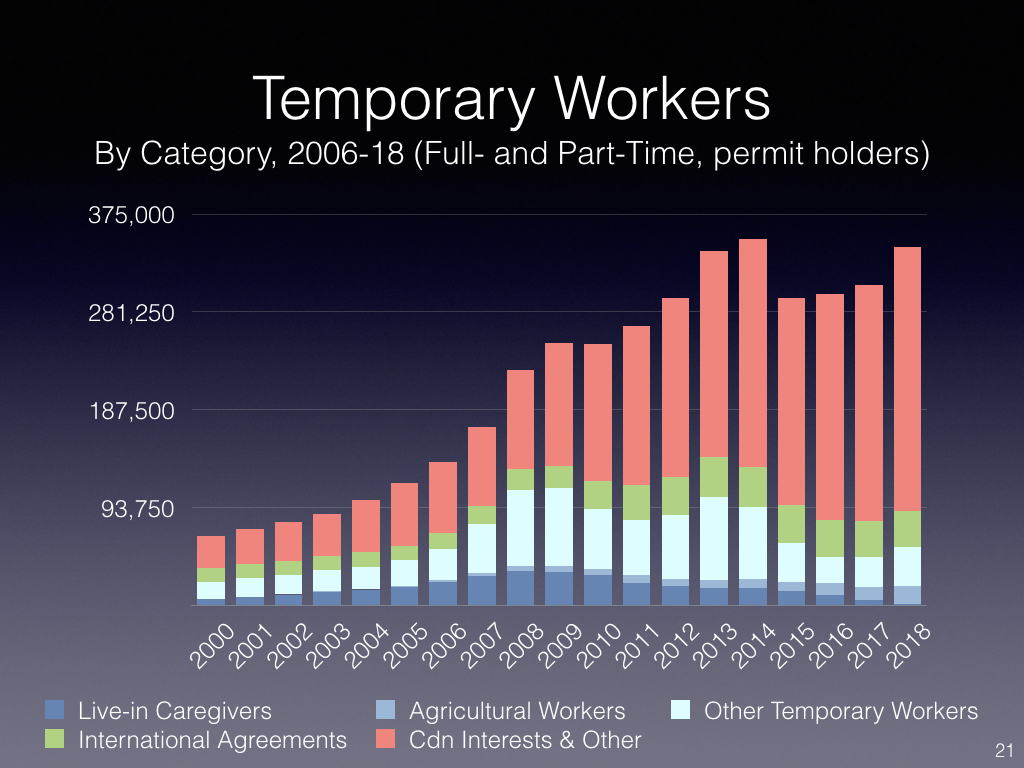
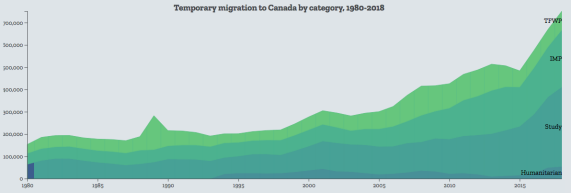
Not sure where Todd is getting the numbers to state his case. The largest part of the increase actually happened under the Conservatives, 2007-15: from 92,000 to 234,000 (IMP), with only Temporary Foreign Workers showing a decline following the reversal of their facilitating their entry in response to business pressures (from 78,000 in 2007, rising to a peak of 104,000 in 2013 before declining to 60,000 in 2015).

The bulk of the Temporary Foreign Workers increase under the Liberal government has been with respect to agriculture workers (a doubling to 52,000, 2016-18), not fast food workers.

And while there are linkages with international students, better to focus on IMP and Temporary Foreign Workers in this kind of analysis:

A big jump in the number of guest workers is hurting low-wage employees and others across Canada, according to economists.

The number of non-permanent foreign workers arriving in Canada each year has doubled in the past decade, escalating particularly after the federal Liberal government was elected in 2015.

Partly as a result of the increasing flow of guest workers, UBC economist David Green and Carleton University’s Christopher Worswick say in a paper that new immigrants are doing “worse and worse” in regards to earned incomes. And it’s Canada’s low-wage workers who are suffering the most.

Even though businesses frequently lobby politicians to allow more guest employees, Green says the latest hikes are putting downward pressure on wages and threatening respect for workers. They’re exacerbating the kind of scenario, he said, that lead to the rise of Donald Trump and Britain’s Brexit movement.

Saying it’s “truly dumb” for the federal government to continue boosting low-skilled guest workers in the country, Green emphasized the vast majority of Canadians don’t appear to be aware of the labour-market shift. “It’s totally under the radar.”

While temporary workers were initially billed as a way to rescue businesses that needed to make up short-term skill shortages in certain sectors, low-skill guest workers from overseas are now increasingly being brought in to staff fast-food restaurants, fill shelves at supermarkets and perform basic kitchen duties.

In the face of a 2013 backlash against the increased volume of foreign workers in Canada, former Conservative immigration minister Jason Kenney drastically cut their numbers. But Prime Minister Justin Trudeau has jacked up the totals much higher.

The new river of guest workers in Canada “releases the pressure on firms to provide better jobs, jobs where you have control over your time, where the pay is decent. It lets the steam off. And that pushes us toward a society that doesn’t respect workers so much,” said Green, a professor in the Vancouver school of economics and a fellow at the Institute for Fiscal Studies in London.

It’s difficult for the public to recognize that guest worker numbers have grown at a much faster pace than more-often discussed immigration levels, which have expanded by 30 per cent since 2015, with about 320,000 now being approved annually.

The official temporary foreign worker program, which attracted such controversy in the Conservatives’ era, has not greatly expanded. But other guest-worker efforts have.

One jump has come through the doubling of international students. In 2015 about 200,000 foreign students were arriving each year. By last year the number arriving annually on study visas had ballooned to more than 400,000. Most foreign students are allowed to work 20 hours a week, plus full-time during their summer or other breaks.

The least-known migration policy change, however, has arguably been the biggest one for the labour market. That is the fourfold expansion of the so-called “international mobility” program, about which few Canadians have heard.

In 2005 about 70,000 guest workers arrived under the “international mobility” category. But by 2018 Canada was accepting more than 250,000 in this category, which is typically made up of people on two-year visas, many of whom find jobs in the service sector.

Informally known as travellers on “holiday worker” visas, such employees are often associated with young Australians working at ski resorts like Whistler, or with British globe trotters serving beer in pubs in Vancouver or Toronto.

A UBC-backed website called Superdiversity, which has created interactive graphics based on immigration department data, shows the largest group of the more than 250,000 “international mobility” workers who arrived in Canada last year were from India, followed by those from the U.S., China, France and South Korea. Toronto took in about 70,000 international mobility workers in 2018, while Vancouver absorbed 30,000.

In line with the research of American economist Giovanni Peri and the University of Ottawa’s Pierre Brochu, Green described how owners of a Tim Horton’s franchise, a café or a supermarket often try to justify bringing in more guest workers by saying they can’t find anyone to fill the low-skill slot.

“So they go to their local MP and say, ‘I’m in trouble here. I can’t get enough workers for my front counter.’ The real response to them should be, ‘Well, pay them more.’ But it’s not the answer they want to hear, because they want to make more profit,” Green said.

Economists don’t really think it’s a problem that a fast-food restaurant owner or other service sector employer can’t hire workers at low wages, said Green. “When something is scarce, the price for it goes up and people and companies adjust. That’s the whole wonder of the capitalist system.”

The low-wage problem is exacerbated in places like Metro Vancouver, where the cost of renting or owning homes is extreme. Instead of offering decent living wages to the people who live here, Green said many bosses are inclined to hire “people who live in housing with five other foreign workers.”

A second trouble with Canadian companies increasingly relying on low-wage guest workers, Green said, is it leads to a more fearful workforce, incapable of demanding adherence to local labour standards or of forming a union.

“Everyone knows these guest workers have no rights. If they lose their jobs they’re gone. They’re not about to complain. Canadian firms are now not only getting just lower-wage workers these days, they’re getting very compliant workers,” said Green.

Even though a lot of commentators write off the supporters of Trump and Brexit as just “stupid people,” Green said, many have been workers who have felt that the promise of globalization, the transnational movement of capital and labour, has not benefited them.

“These are people who feel there was a deal promised to them, where everyone would share in the benefits of deregulation and a more flexible labour market,” said Green.

“But then governments did things like bring in more temporary foreign workers and those people are feeling like, ‘What the hell just happened?’ If you want people to feel like they have a share, don’t bring in somebody to replace them every time their wages start looking like they’re going to go up.”

Source: Douglas Todd: Dramatic jump in guest workers hurts Canadians on low wages

Immigration’s impact on Canadian economy cuts many ways for economists

Good summary of what the data shows, largely based on UBC economist David Green:

Are immigrants good for the Canadian economy?

Forty-five per cent of Canadians answer “yes” to this broad question, while 22 per cent say “no” and 33 per cent are not sure. There’s an argument to be made those who told Ipsos pollsters they don’t know are the most honest — and also the most realistic.

Most Canadians don’t follow the economists who track how immigration and temporary workers have an impact on Canada. If they did, they’d soon realize economists’ findings often conflict with the views championed by corporate executives and politicians.

Canada’s traditionally high immigration rates actually cut many unpredictable ways. The more than 300,000 immigrants and 700,000 temporary migrants recently arriving in the country help expand the overall economic pie. But to most economists that doesn’t mean much.

Economists, instead, mine data to discover whether average wages rise or fall because of migration, which types of migrants do best, whether a foreign education or offshore work translates to Canadian success and how much it matters to be proficient in English or French.

UBC economist David Green says it can be misleading to emphasize the gross domestic product. Yet I’d suggest it’s what almost half of Canadians are probably thinking about when they tell pollsters immigration is good for the economy.

“The size of the whole economy is not really what we care about. What we really care about is per capita income. We care about how much each one of us gets in income,” Green said in an interview.

“Think about whether you’d rather be living in India or living here, just in terms of your material wealth. India, in terms of GDP, is bigger than us. But in terms of GDP per capita we’re way ahead of them. So you’d rather be in a rich society than a big society.”

Designing immigration policies mainly to boost the GDP “makes little sense,” Green says. That is, unless you’re a business owner who wants a bigger market for your product (such as real estate or automobiles) and more choice in who you can hire.

Here’s a second lesson from economists: When it comes to what really matters for most Canadians — per capita wages — Green explains the impact of immigration is over time “very close to zero.”

The extreme boosters or critics of immigration, as a result, may have to tone down their rhetoric in light of findings by Green and others that, overall, immigrants neither “steal jobs” nor “magically grow them either.”

Here are eight other discoveries economists have made about migration:

New immigrants aren’t doing as well in Canada as in the 1980s

Historical graphs show immigrants’ earnings, compared to that of the native-born in Canada, were strongest in the 1980s and declined precipitously until about 2003, when they slowly began improving.

There are two reasons for this decline in the 1990s, says Green. One is that all new entrants to Canada’s labour market, including domestic-born, struggled with lower wages during that period. The other is that fewer immigrants came from Europe.

Language matters, a lot

Economic studies have consistently shown the most successful immigrants to Canada are those who are adept at English or French. “There is a positive correlation between language skills and earnings,” says Green.

Source country also makes a difference

“People from source countries where English or French is not the main language, or with different educational institutions, do less well in the Canadian economy … compared to immigrants from Northern Europe or the U.S.,” says Green.

When Australia introduced stricter language testing of immigrants, economist Andrew Clarke and others found immigrants earned higher incomes. But that could be because the new language demands led to more people going to Australia from Europe.

Foreign degrees not quite as valuable as Canadian degrees

Immigrants with a foreign degrees don’t always gain greatly from it, unless they’re literate in French or English, according to economist Joseph Schaafsma.

“The implication is that, on average, immigrants have lower returns on education because their education skills are not as productive in the Canadian economy,” says Green, who nevertheless adds it’s still valuable to select educated immigrants.

It might help if Canadian officials improved efforts to recognize the credentials of people trained outside the country, Green says, “but it won’t be a panacea.”

Offshore work experience doesn’t pay off as expected

This is a harsh reality for many new immigrants.

“Foreign-acquired work experience obtains a zero return in Canada,” both Green and Carleton’s Christopher Worswick discovered. Work skills that immigrants develop in their home countries might not be as useful in the Canadian labour market as they would like.

While it’s hard to pin down exactly why immigrants do not benefit greatly from work experience in a foreign land, Green says it could partly be attributed to “discrimination.” But it’s also a result of old-country experience not easily transferring to a new land.

There are winners and losers in migration

Although the across-the-board impact of immigration on Canadian wages is flat, some low-wage workers can get hit.

American economist Giovanni Peri is among those who have found that relatively recent immigrants can be financially hurt when a new wave of immigrants arrives soon after them.

Although U.S. evidence doesn’t translate easily to Canada, it suggests immigration can have a negative impact on the wages of lower-skilled workers, including both immigrants and the native-born. Some domestic workers adjust by moving into jobs that require strong English-language skills.

There can also be negative impacts on the wages of those in the host society when temporary workers come to Canada, says the University of Ottawa’s Pierre Brochu. The number of temporary workers in Canada, including the low-skilled, has roughly doubled since the 2015 election of Prime Minister Justin Trudeau.

Immigrants tend to pay less in taxes

Since immigrants start in Canada with earnings that are below the national average before they gradually catch up, Green says it “implies they will tend, on average, to contribute less to the public purse.”

Immigrants lean to self-employment and small businesses

Even though commentators point to the way immigrants appear slightly more likely than the native-born to “create businesses,” the trend is a bit more complicated.

“We find that immigrants are more likely to open firms, but they are much more likely to be spells of self-employment, rather than incorporated firms that employ others,” says Green. “And even the incorporated firms tend to be small.”

• • •

Although the financial data is not all rosy for immigrants to Canada, it doesn’t mean most don’t benefit from leaving their homeland.

Most economists agree nearly all immigrants gain tremendously by moving to a high-wage country such as Canada from their own countries, which typically offer lower wages and are often dysfunctional.

What’s more, the United Nations’ Happiness Report, co-run by UBC economist David Helliwell, finds that immigrants who move from “unhappy” countries (where residents report low rates of life satisfaction) to happier ones such as Canada soon end up as happy as the host society.

In addition, many immigrants make their life-changing move to a new land as part of a long game for their families, so their children can get better educations and grow up in more stable societies and stronger economies.

Indeed, Statistics Canada studies reveal the offspring of immigrants do far better than the native-born in both obtaining university degrees and high-skilled jobs. Says Green: “There are potential gains to Canada as whole from the second generation.”

Many people make sweeping generalizations for and against immigration, but instead of going with bombast, economists show the truth is in the details.

Source: Immigration’s impact on Canadian economy cuts many ways for economists

Todd: High migration might trim wages … in some places, in some jobs

Valid notes of caution by the economists cited:

University of B.C. economists Craig Riddell and David Green, and Carleton University’s Christopher Worswick, caution both boosters and critics of high in-migration to temper their rhetoric.

The economists could have been referring to Immigration Minister Ahmed Hussen, who on Nov. 1 pushed up immigration levels while showcasing a prosperous newcomer family.

“Our ambitious plan,” Hussen said, “will benefit all Canadians because immigration contributes to our economic growth and keeps our country competitive in a global economy.”

The federal Liberals’ target for immigrants in 2020 is 340,000, which is a 36 per cent jump from 250,000 in 2014.

Without publicizing it, Ottawa has also sharply increased the number of temporary workers. The number of non-permanent residents in Canada last year, 891,000, was more than twice the total in 2006. 

More than 330,000 of them are international students. Another 55,000 are temporary foreign workers, while 289,000 are “international mobility” workers.

Metro Vancouver gets almost 30,000 immigrants each year, in addition to being home to 130,000 non-permanent residents, mostly international students (who also get work visas).

The economists focused on immigration rates, not necessarily temporary workers, in concluding that “increased immigration inflows have small impacts on wages and employment in the medium to long run.”

The UBC economists, however, caution that “immigration cannot be relied upon as a source of higher per capita incomes.”

In a major article in Policy Options, the three economists warn “it is important not to get distracted by individual stories of successful immigrant entrepreneurs. They certainly do exist, but that is not really relevant.”

The economists challenge the immigration minister’s claim that increasing immigration rates “will help us ease the great challenges of the coming years, such as … labour shortages linked to Canada’s aging population.”

It’s not possible to replace the aging baby-boomers, the economists say. “The results are definitive: Immigration is not a means to substantially alter Canada’s age structure and impending increase in the dependence ratio. Inflows of immigrants are just too varied in their age structure.”

Similarly, SFU’s Wu Qiyan says bringing new people to Canada’s major cities is a “double-edged sword.”

At one level, Wu said, an influx of newcomers into Toronto and Vancouver can “create less job opportunities for locals,” while raising rents and housing costs.

On the other hand, Wu said, more people “can also create more opportunities,” by increasing consumers and businesses.

UBC economist Thomas Lemieux said the question of whether more immigrants and temporary residents reduce wages is one of the most controversial in his field, particularly in light of rising nativist movements in the U.S., Europe and Quebec.

Lemieux’s own research focuses on how immigrants themselves fare in Canada’s labour market, with the general conclusion being they’re doing worse financially than in the 1990s.

Newcomers from Europe “tend to do much better” than those from India and other South Asian countries, Lemieux said, “even while there are fewer and fewer coming from Europe.”

Virtually every labour economist says the Canadian public and prospective immigrants deserve more research into, and more robust discussion of, the links among immigration, non-permanent workers, economics and wages.

With Canadian politicians making the country a unique global experiment in mass migration, few issues call out for more investigation.

via Todd: High migration might trim wages … in some places, in some jobs | Vancouver Sun