How Canada’s crucial data gaps are hindering the coronavirus pandemic response

Good long read on data gaps. Have excerpted the intro and the section on the lack of visible and ethnic minority data:

Gaps in key health and economic data are hindering Canada’s response to the COVID-19 pandemic, leaving Canadians in the dark about who is being infected or struggling with the devastated economy, say researchers, politicians and scientists.

These blind spots could blunt the federal economic rescue effort, hide inequities in deaths from the disease and slow our emergence from self-isolation in the months ahead. Experts are urging provincial and federal leaders to open up more streams of data immediately, as doing so might save lives and livelihoods.

Canada has a long-standing problem of information gaps, The Globe and Mail found in a year-long series, and that has left us vulnerable during public health crises before. A government audit found that during the 2009 swine flu pandemic, data deficiencies left the Public Health Agency of Canada “unable to answer basic questions such as the rate of spread” of the virus.

….

Nationally, the ethnicity of those who have been infected or have died is unknown. Because of data gaps, the death toll likely is being underestimated.

On the economic front, Canadians don’t know how many in each province are applying for employment insurance every week (as the United States does by state). They don’t have up-to-date numbers on bankruptcies, mortgages in arrears, how workers in the gig economy are faring, the extent of layoffs or the degree to which the federal government’s plan for an enhanced wage-subsidy program has spurred rehiring.

Arjumand Siddiqi, the division head of epidemiology at the University of Toronto’s Dalla Lana School of Public Health, said she and her colleagues are eager to help analyze the fast-moving crisis to a greater extent, but have been stalled by a lack of detailed figures on the demographics and locations of confirmed cases, among other things.

“We have the will, we have the expertise, but we don’t have the data,” she said. “It would be good to know what is actually happening.”

One of the most pressing gaps, Dr. Siddiqi said, is information about the ethnicity of those who have tested positive for COVID-19 or died of the disease. No Canadian province makes this data available, in keeping with a long-standing national aversion to publishing statistics about racial disparities in health. (Toronto’s Medical Officer of Health, Eileen de Villa, has announced that the city is exploring ways to collect race-based coronavirus data on its own.)

But there is reason to suspect race may be a factor in determining who is being infected and dying from the virus, Dr. Siddiqi said, both because of the prevalence of various underlying health conditions in some racialized communities, and their over-representation in low-wage jobs such as nursing, delivery and retail, which make them highly prone to exposure to the virus. Early U.S. data indicate that black Americans are being admitted to hospital and dying from COVID-19 at a disproportionate rate.

“We are very clear that we want to know who is at risk,” Dr. Siddiqi said. “But we’re just very hesitant – and that’s kind of putting it mildly – to add race to the set of dividing factors that we’re willing to entertain.”

This blind spot extends to Indigenous people, whose health care is largely provided by the federal government. NDP MP Charlie Angus would like to change that. In a letter to Health Minister Patty Hajdu last week, he urged the government to start keeping data on COVID-19 cases among Indigenous people, saying, “It would be irresponsible at this time to turn a blind eye to the movement of COVID through vulnerable populations.”

“It seems bloody obvious that you would want to track this and make policy based on this information,” he said in an interview. “I think there’s a naive arrogance in the principle of saying: ‘We’re not the United States, we don’t have their problems, we don’t discriminate like that.’ ”

Even government-funded groups such as the Canadian Institute for Health Information (CIHI) have begun calling for race-based data around coronavirus cases. The organization now supports the idea of health care providers asking a common question about the race of COVID-19 patients and says it would be willing to compile the data.

“The COVID pandemic is certainly exposing gaps in important data flows within and between health care systems in Canada,” CIHI spokeswoman Alex Maheux said.

Source: How Canada’s crucial data gaps are hindering the coronavirus pandemic response ‘We have the will, we have the expertise, but we don’t have the data’: Nationally, the lack of coronavirus-related health and economic data is stalling efforts to analyze the fast-moving COVID-19 crisis

Being Counted in Canada’s Coronavirus Data, Ontario’s lack of diversity data for COVID-19 is an embarrassment

Two good commentaries on the lack of diversity data, starting with Howard Ramos of Dalhousie:

The lack of COVID-19 data on immigrants and racialized minorities collected and shared by Canada’s many layers of government could lead to health inequities.

Canada is not alone in having a data gap on immigrant and racialized groups. In the United States civil rights groups and doctors have called on its federal government to release demographic data on coronavirus infections.

Analysis that looks at the number of COVID-19 cases based on publicly available American data and census information shows that counties that are majority African-American have three times the rate of infection and almost six times the rate of deaths as counties where white residents are in the majority. It is a trend that has raised alarm across American cities.

Understanding Canada-U.S. differences

Past research suggests, however, that Canadians should be cautious in reaching conclusions and not automatically assume that what takes place in the U.S. naturally holds true north of the border.

The ‘healthy immigrant effect’ debate, for instance, which shows that many newcomers to the country self-report better health than native-born Canadians may mean that immigrants, who are also largely racialized, may not follow the same patterns as seen in the U.S.

What is needed to answer that question, and many others, is access to quality data. And just like personal protective equipment – it is currently in short supply.

Part of the problem in capturing immigrants and racialized groups in health data rests with how they are captured. Health data is largely the domain of provinces and territories, leading to uneven data collection and reporting across them.

When asked if Ontario could offer insights on the pandemic’s impact on racialized communities, Dr. David Williams, the province’s chief medical officer of health, noted that “statistics based on race aren’t collected in Canada unless certain groups are found to have risk factors.”

Ironically, if data are not collected, one cannot tell if a group has risk factors to begin with. This could lead to health inequities for African-Canadian, Indigenous, racialized, and other new Canadians.

That scenario is a big reason why the African, Caribbean and Black Network of Waterloo Region recently launched a petition demanding that data on race, ethnicity, sexual orientation, and socio-economic status be collected and reported on.

Data gap flows all the way to Ottawa

The data-gap is also seen at the federal level too. For instance, the new and innovative crowd sourced survey on the social and economic impacts of COVID-19 run by Statistics Canada measures age and gender but not other demographic features. The same absence is also seen in the Public Health Agency of Canada’s ‘detailed confirmed cases of coronavirus disease’ data, which is hosted by Statistics Canada.

The detailed data does not provide geo-coding or additional information on the location of the cases which means that researchers cannot link it to census tracts or other geographic units to do the kinds of analysis that was done for American communities.

As a result, the maps offered through the interactive Canada’s COVID-19 Situational Awareness Dashboard are fairly coarse. In many cases, more detailed information can be found through non-governmental sites such as ViriHealth. But, once again, sociodemographic characteristics are not provided and the location data is where people are treated over where they live.

Lastly, once Canada begins to move towards recovery, Statistics Canada’s data on job loses and employment can report on immigrants and racialized groups. Much of this data is collected through the Labour Force survey, which is good news. It’s only logical that measures of health and wellbeing be captured with the same level of detail.

If there’s one thing silver lining to Canada’s experience during the COVID-19 pandemic, it’s reinforcing the point that collecting data matters. It’s essential to insure that everyone, regardless of race or ethnicity, is treated equally as citizens.

Source: newcanadianmedia.ca/being-counted-…

Secondly, the Ontario situation by Adam Kassam a Toronto-based physician:

The United States recently earned the unfortunate distinction of having the highest number of COVID-19 cases in the world, at more than 575,000. The true number of infected individuals, of course, is likely much higher given the lack of widespread and available testing.

But in that U.S. data, an alarming trend emerged: The coronavirus appeared to be disproportionately killing African-Americans. Last week, the Centers for Disease Control and Prevention (CDC) released a preliminary report suggesting that there were higher rates of hospital admissions and death among black Americans compared with other communities.

These revelations have intensified a nationwide conversation on the social determinants of health and the necessity to collect better data. The CDC report is far from comprehensive, which has led to presumptive Democratic nominee Joe Biden calling on the organization to be more transparent by releasing more information. Even U.S. President Donald Trump has expressed concern, and instructed his African-American Surgeon-General, Dr. Jerome Adams, to formulate a federal response to address the problem.

This discourse about diversity data and its impact on racialized communities in the U.S. stands in sharp relief against the Canadian experience. Last week, Dr. David Williams, Ontario’s Chief Medical Officer of Health, summarily dismissed calls for the collection of racial data. He asserts that statistics on race aren’t collected unless certain groups are found to have risk factors, and that “regardless of race, ethnic or other backgrounds, they’re all equally important to us.”

We have a problem in this country when Donald Trump sounds more progressive about racial disparities than our own public health officials. Imagine if our Chief Medical Officer of Health claimed that it wasn’t important to collect gender-based data? This would be a fireable offence. It is, therefore, inconceivable that this same official, in the country’s most diverse province, would willfully choose to effectively ignore the unique needs of the nearly four million visible minorities who call Ontario home.

This is the manifestation of structural and systemic biases that have been omnipresent within our medical community for generations. Canada’s poverty of diversity data has been an indefensible blind spot, both in terms of health care and in our educational institutions. It is the symptom of an insidious disease, whose current hallmark is a leadership that looks increasingly less like the communities which it serves.

How else could you explain the dearth of visible minorities in some of the top leadership roles in health care across Ontario? Public Health Ontario’s executive does not appear to include a single visible minority. A visible minority has never served as Ontario’s health minister. And because diversity data of this nature is not collected or made public, we don’t know how many deputy ministers of health, deans of medicine or chiefs of medical departments have represented diverse backgrounds.

In many ways, you only measure what you really care about. Ontario’s Chief Medical Officer has unfortunately made that very clear. Never mind that collecting race-based data wouldn’t be an onerous task; crucially, it is part of good science. Only by intentionally studying diverse populations have we learned that women experience certain health challenges, such as heart attacks, differently from men. In the same vein, disease has been shown to manifest differently for patients from different ethnic backgrounds. It is my belief that all people deserve to know the details of their lives and to know that their lives are worthy of study.

While we don’t know whether racial differences influence COVID-19′s effect on individuals, Canada should be invested in determining this definitively, instead of taking its cues from the World Health Organization.

Early reports from the U.S. have pointed to disadvantaged and marginalized groups – the poor, immigrant, black and brown communities – being more significantly affected, and this has prompted crucial scrutiny of the deep and enduring fault lines between the haves and have-nots. Yet we cannot have those conversations here, as we cannot know whether the U.S. data reflect Canada’s, even though just a border separates us.

In Canada, where we are quick to declare that diversity is our strength, we must now dispense with the empty platitudes and put our money where our mouth is. Our governments should openly commit to funding the collection and publication of diverse health data during and after this pandemic. Their explicit goal should be to create policy that improves the health care of all its citizens. What’s clear is that this ethos will only become a priority when our medical leadership more closely reflects the Canada of today.

Source: Ontario’s lack of diversity data for COVID-19 is an embarrassment: Adam Kassam

Paradkar: Unlike Canadians, Americans at least know how Black people are faring with COVID-19 (very badly)

Agreed but not only a Black issue.

Need better health data on all visible minority groups (and Indigenous) given that poorer health outcomes generally go hand-in-hand with more vulnerable socioeconomic outcomes:

“Let me rant,” said Angela Robertson, “because you’ve sparked me.”

As executive director of the Parkdale Queen West Community Health Centre, Robertson has long been a front-line witness to the lives of the most marginalized in the city — the homeless, the undocumented, the working poor — all of whom are also disproportionately racialized.

We are discussing the horrendous data streaming from the U.S. on the rates at which COVID-19 is infecting and killing Black people. In Chicago, African-Americans account for 70 per cent of the 86 recorded deaths, but make up 29 per cent of the city’s population. Louisiana saw the same 70 per cent of deaths among African-Americans who constitute just 32 per cent of the population.

What about Black people in Canada, I ask her. Are they better off here compared to the U.S because of universal health care and because — here I wave the red flag — Canada is not as bad as the U.S.?

“As much as we have critiques of the health-care system in America, they have done data collection, they can disaggregate by race within health care,” she said.

“We in Canada have been glacial in our movement in the collection of race-based data in our health-care system. As a result we will not be able to identify the disproportional access challenges, deaths, illnesses that Black communities will experience as a result of COVID-19.

“My fear is that the real health impact on Black community will be hidden.”

COVID-19’s impact on Black people is highlighting the similarities and differences between the U.S. and Canada. They collect data. We don’t. We have universal health care. They don’t. But underlying structures in both nations are deeply racist, which means Black people on both sides of the border live in circumstances that leave them more vulnerable to illnesses at the best of times — and now make them susceptible to the ravages of the pandemic.

These structures are unleashing what the American author and anti-racism scholar Ibram X. Kendi called “a racial pandemic with the viral pandemic.”

Last Friday, Black health leaders in Toronto released a statement that identified the underlying risk factors that COVID-19 would amplify. “Ontario is home to the largest proportion of Black people in Canada. Here too, as in the rest of Canada, race is a determinant of health,” they said.

Who are the people who still need to use public transport to get to work? Who hold precarious jobs? Who don’t have the luxury to shelter at home and buy healthy provisions for a week or two? Who need rent relief? Who are most at risk from higher policing on the streets? Who are at risk in the prison system?

While race-based data exists around these social factors, hospitals and clinics don’t collect detailed demographic data including race as a matter of routine. Advocates have long railed against this lack of data, calling it harmful to Black women after research found they may be underscreened for breast and cervical cancer.

Andrew Pinto is a doctor at St. Michael’s Hospital. He is also the director of the hospital’s Upstream Lab — a research group that looks at interventions or remedies to the socio-economic factors that affect health.

The St. Michael’s Hospital Family Health Team, and other groups in Toronto including Toronto Public Health, was part of a pilot program to ask patients questions on income, race, gender, housing, religion, etc., and then use this data to identify health inequities, Pinto said. Researchers found doing such a survey was “feasible and acceptable.”

“Social factors are definitely associated with health outcomes,” he said. Many studies show income and race play a big role. “We lack the data that we need in Canada to really be able to pinpoint inequity by race. That’s what our work is trying to move toward.”

Why do we need the data if we know discrimination already exists? “Data helps with accountability. It’s not just to document inequity. We need to anticipate the inequity and think about how do we hold our systems to account.”

On the plus side of the ledger against the U.S, Canada has universal health care. Even then there are gaps.

While Ontario advocates who campaigned under OHIP For All managed to open health care for people regardless of their immigration status, “what we are concerned about while policy has changed, practices on the ground have not changed,” Robertson said.

Even during the pandemic, Robertson heard reports of people turning up in emergency departments and being asked to pay $500 for treatment.

What about the people who don’t turn to agencies for support? “For folks who because of fear walk away, they walk away ill,” she said.

Pinto points out that the “danger of data collection is it can convey that something is being done. Data alone is not sufficient. There has to be commitment that it should come with change.”

In a crisis like this, governments at all levels have to look at their response policies through the eyes of the most vulnerable and account for bias. This is particularly important for Black people who are among the most discriminated people here.

If this is not done, as the Black leaders’ statement said, “Black people will be exposed to greater harm.”

No time to fly blind: To beat COVID 19, Canada needs better data

As we always do! Bit surprised no discussion of what role the Canadian Institute of Health Information (CIHI) could play:

Accurate information is critical to fight a health emergency like the COVID-19 pandemic. Robust data identifies the scale of the problem. It enables the prioritization of human, financial and material resources for an effective and efficient response. It allows for public scrutiny, advocacy and accountability. It builds trust. It provides authorities with tools to counter misinformation. It will enable us to slowly and safely return to economic and social activity.

In short, good data can mean the difference between life and death – or in the case of a pandemic, tens of thousands of deaths. Yet in the face of the greatest international health crisis in a generation, Canada is falling short.

Prime Minister Trudeau promised better data. To deliver on this promise, the Public Health Agency must mandate standardized information reporting for provincial and district public health authorities. These standardized templates would outline the data and information to be reported, how it should be collected and how it should be shared. Moreover, the Agency should urgently provide financial and technical resources to improve information management at all levels of the public health response.

At first glance COVID-19 data appears to be plentiful – case numbers and graphs are splashed across news reports and public health websites. Public health agencies produce epidemiological reports with colourful graphs and charts. Officials quote modelling estimates of projected case numbers and fatalities.

But in reality the value  of this information is limited. Efforts to fill in information gaps with modelling is a short-term and imperfect substitute for real-time data.  The data that does exist is of questionable validity given low testing numbers within the population and delays in receiving test results. Moreover, the data is not gathered, compiled or presented in a consistent manner by health authorities across the country. Different case definitions make comparison within and across provinces difficult. Sex and age disaggregated figures are not always provided. Some areas report hospitalization and intensive care unit numbers, some do not. Warnings of medical equipment and personal protective equipment (PPE) shortages are widespread, yet inventories of PPE stockpiles are frequently not given.

Moreover, public health officials report cases but do not discuss population context. They do not present important statistics about communities including age, sex and socio-economic data and specific vulnerabilities. Authorities rarely provide information on the number of health workers employed in the response, hospital beds available or PPE stockpiles. Officials cite testing numbers with little concrete data on laboratory capacity or efforts to expand it.

It is confusing. Overwhelming. And unhelpful.

Without accurate data and information, authorities cannot identify and manage human, financial and material resources to engage in the fight against COVID-19.  Nor can they monitor the effectiveness of interventions and stop its spread.

We can do better. During humanitarian crises, which often occur in data-scarce contexts, central coordinating bodies prioritize the collection and transparent dissemination of information. They develop standardized “Situation Reports” at multiple levels – the community, the region and the country – to identify need, prioritize interventions and target scarce human, material and financial resources. In the health sector, reports include population size disaggregated by sex, age and vulnerability; the number of health facilities in operation; key causes and rates of illness and mortality; medical procedures and treatment courses. These reports are published openly and disseminated widely. Information is critical for an effective and efficient response in complex and rapidly changing environments. It allows resources to be targeted to save lives.

COVID-19 warrants something similar. We need to understand the progress of the disease and our response – in real time. Proper information management will not only improve the effectiveness of our interventions, but it will also enable the safe resumption of economic and social activity.

A standardized reporting template would include case numbers and hospitalizations (sex and age disaggregated).  But counting the numbers of outbreak cases is only one piece of the information puzzle. Reports should include community baseline data. Important information includes population demographics (age, sex and particular vulnerabilities), neighbourhoods with higher risks, and the number of vulnerable institutions (retirement and nursing homes, corrections facilities). Authorities would identify financial, human and material resources available and required. Reports should document laboratories with COVID-19 testing capacity and provide inventories of PPE.

Better data would allow us to identify critical intervention points to stop the spread of COVID-19 and to slowly get our lives and economy back on track. The lack of prioritization on testing is both a symptom and a consequence of Canada’s failure to prioritize information management. Given testing capacity, public health officials discourage tests for those with mild symptoms. This undermines the validity of most of the numbers used by public officials to track the COVID-19 outbreak. Without the total ‘real’ numbers of individuals infected, we lack an accurate denominator, which undermines the accurate calculation of hospitalization or case fatality rates. Lag times in test results also make accurate contact tracing very difficult.

More critically, without expanded testing, we lack the ability to quickly test health workers and those employed in other essential services (such as retirement homes) to protect them, their co-workers, patients or residents and the public. Nor do we have the ability to test people to gradually and safely scale up economic and social activity. Instead we are told to wait for testing innovations while COVID rates numbers rise. Yet many private labs as well as lab facilities in university and colleges remain unutilized over three weeks into Canada’s full scale COVID-19 response. With better information would come increased accountability for mobilizing such capacity.

COVID-19 has sparked one innovation in information production – the use of outbreak models to guide public health responses to COVID-19, often funded by public health authorities. The federal government recently provided $192 million to BlueDot – a Toronto based digital health firm, not a university research department – to support its modelling activities. After calls to release modelling estimates, some provincial governments have provided projections of case and mortality numbers.

But transparency warrants more. Modelling in general is extremely challenging and COVID-19 modelling is particularly complex. Population demographic characteristics appear to determine the speed of COVID-19 transmission as well as severe illness, hospitalization and fatality rates. While the professionalization of the modellers is not in question, research driving policy decisions should be published openly and subject to scrutiny. The lack of clarity contrasts unfavourably to models published in scientific journals, or those published online by Professor Neil Ferguson of Imperial College, University of London. If governments release model estimates, they should release the assumptions and data that inform these estimates.

Moreover, modelling is an imperfect and flawed substitute for real data and concrete information about the response. Policy makers urgently need to pay attention to the generation and management of accurate and valid data, mandate standardized reporting from all public health authorities and provide public funds to make it happen.

We are in unprecedented public policy territory. Yet we lack the information needed to effectively navigate the COVID-19 pandemic and get our economy and our lives back on track. Prime Minister Trudeau’s commitment to better data and improved information management provides Canada’s Public Health Agency with the opportunity to exercise leadership. It is time to up our game.

Source: No time to fly blind: To beat COVID 19, Canada needs better data

Andray Domise: The deterioration of data is robbing marginalized communities of their voice

The Globe’s ongoing series on Canadian data gaps is welcome and continues to draw attention to the gaps. As someone who relies on various data sources, particularly the Census, I find these concerns reasonable when it comes to health outcomes, incarceration rates, foreclosure data, children’s aid, police checks.

I am less convince, however, in some of the other areas. We do collect race-based data (visible minorities) in the Census which has finer gradations than the US Census (11 categories compared to 5 in the US). Census data allows analysis of participation and unemployment rates, average and median income, low-income, highest level of educational achievement, areas of study, employment in the public sector (federal, provincial, municipal, healthcare, education, social services, police) and whether in more senior or support positions.

In education, as I have argued earlier (Karen Robson: Why won’t Canada collect data on race and student success?), we actually have good data in terms of the outcomes of the different visible minority groups and the absence of comparable data to the TDSB data from other school boards is more a “nice-to-have” than necessary (see my analysis of education outcomes Education fields of study and economic outcomes).

Researchers and others will always want more data. How this gets priorized and implemented requires some choices given resource implications. In the meantime, researchers should explore creative ways of teasing out the insights from existing data sources:

The Institute for Policy Studies released a study last month on median wealth in American households, and the findings were unsettling, if unsurprising. While the inflation-adjusted median wealth of white families in the United States had grown from US$110,160 to US$146,984 over the past three decades, it had hardly increased at all for Hispanic families (US$4,289 to US$6,591), and dropped by roughly half for Black families (US$7,323 to US$3,557). By 2082, the study concluded that, should current trends hold, the Black family will have a median net worth of zero.

I posted excerpts from the study online, and an acquaintance of mine asked how Black families in Canada compared with their U.S. counterparts. I had no idea, I said. In Canada, we don’t collect, study and distribute such information.

This has long been a point of frustration. When I was a financial planner in a previous life, I often found myself having to debunk misconceptions about the ever-shrinking middle class. One of the more pernicious narratives was the long-term effects of the 2008 financial crisis, which, more than a decade later, many still erroneously blame on irresponsible, low-income “deadbeat borrowers.”

A 2010 study conducted by the American Sociological Review, I would note, found that banks not only targeted low-income areas for risky and complicated subprime loans, but denied traditional loans to qualified Black and Hispanic applicants, effectively creating a segregated class of borrowers who were disproportionately impacted when the interest on those loans skyrocketed.

A slew of follow-up studies in the United States eventually spurred federal investigations, which found that lenders did engage in discriminatory and predatory practices. One of the worst offenders, Wells Fargo, was hit with a US$175-million judgment in 2012 for saddling non-white borrowers with higher interest and worse deals on their mortgages than their white peers of similar credit standing.

Without publicly available municipal census metropolitan data, federally legislated land data and foreclosure information from private oversight agencies, not only could banks have gotten away with enriching themselves through illegal lending practices, there would have been no counternarrative to the myth that broke borrowers of colour collapsed the global economy.

And equivalent data, available and freely usable for such comprehensive studies, does not exist in Canada.

Not so long ago, the collection of race-specific data was seen as unseemly at best, and targeting at worst. That data was often used as a cudgel by police forces to stereotype marginalized communities, and often there was no counternarrative offered. But now, with data analysis having become essential to the global economy and our political systems, everything boils down to the numbers. Geopolitics are being tilted and societies are being reshaped by information asymmetries. Avoiding discussions about race has effectively left policy-makers wandering blindfolded through a forest, at the expense of communities of colour.

Our federal and provincial governments, for instance, have responded to increasing conversation about racialized state-sanctioned violence and discrimination by declining to quantify the problem. Even as policing agencies across the country tout the value of street checks as a tool for preventing and solving crime, data on their efficacy have typically not been studied nor reviewed by independently operated and funded oversight agencies. In Edmonton’s case, the police service funded a study in which the dataset was described as “contaminated” by officers’ subjective evaluations; in Vancouver, the data was only released to the public after a Freedom of Information request. Meanwhile, in Ontario, a report by a provincial judge declared it bluntly: “There is little to no evidence that a random, unfocused collection of identifying information has benefits that outweigh the social cost of the practice.”

While Canadians thank the heavens we don’t experience the statistically proven dysfunctions in the United States’ health, financial and public-safety systems, that gratitude is rooted in ignorance. We know that south of the border, Black mothers are three times as likely to die during childbirth as their white peers, but Canadians have no way to understand the scale of the Indigenous child-welfare crisis beyond the blunt sum of Indigenous children being funnelled into the children’s aid system. We have no aggregated national data on maternal (or even infant) mortality rates among specific ethnic groups, preventing Ottawa from creating targeted health policy. We have no comprehensive data on sexual-health practices among teens and young adults, which effectively granted the Ontario government carte blanche to roll back the sex-education curriculum by 20 years.

Time and again, marginalized communities have had to rely on an irregular flow of data to validate our stories and lived experiences – forced to marshal math in support of our stories that broader Canadian society too often dismisses as hysterics. Canada’s data deficiencies are not merely problems of public policy: They reflect an unacceptable level of neglect that’s become an obstacle to our ability to advocate for ourselves.

Source: The deterioration of data is robbing marginalized communities of their voice

The related Globe article: How Canada’s racial data gaps can be hazardous to your health


In the dark: The cost of Canada’s data deficit

This incredibly valuable investigative reporting. I have excerpted a few of the sections I found most interesting but the entire article is worth a good read, and I look forward to future segments in this series.

I use StatsCan and other data frequently and generally find I can find what I need, or an alternate way to identity issues and trends. So I do have some sympathy for StatsCan Head Anora’s comments that sometimes researchers don’t try hard enough (e.g., see my critique of Karen Robson: Why won’t Canada collect data on race and student success?, weak to non-existent municipal diversity statistics can be found in census occupation group data).

But the example of birth statistics is where I cam up short. The vital statistics agencies do not capture visible minority data or accurate residency data, and do not verify identity documents of the parents. All of which mean, in addition to the all important health-related differences, that births to non-residents are drastically undercounted by StatsCan (in the end, I found better if imperfect numbers from hospital financial statistics: Hospital stats show birth tourism rising in major cities).

I look forward to their analysis of the data available on the government’s open data website as I did an analysis a few years back on the IRCC datasets, the most comprehensive ones available, but where timeliness is becoming an issue (IRCC Datasets: What they say about government priorities):

….

And yet, in fields ranging from public health to energy economics to the labour force to the status of children with disabilities, there’s a lot that Canada simply doesn’t know about itself.

Consider that we don’t have a clear national picture of the vaccination rate in particular towns and cities. We don’t know the Canadian marriage or divorce rate. We don’t know how much drug makers pay the Canadian doctors who are charged with prescribing their products. We don’t have detailed data on the level of lead in Canadian children’s blood. We don’t know the rate at which Canadian workers get injured. We don’t know the number of people who are evicted from their homes. We don’t even know how far Canadians drive – a seeming bit of trivia that can tell us about an economy’s animal spirits, as well as the bite that green policies are having.

Our ignorance is decades in the making, with causes that cut to the heart of Canada’s identity as a country: provincial responsibility for health and education that keeps important information stuck in silos and provides little incentive for provinces to keep easily comparable numbers about themselves; a zeal for protecting personal privacy on the part of our statistical authorities that shades into paranoia; a level of complacency about the scale of our problems that keeps us from demanding transparency and action from government; and a squeamishness about race and class that prevents us from finding out all we could about disparities between the privileged and the poor.

But if the problem has deep roots, it has never mattered more. We live in a data-driven age, when the internet and the processing power of computers has made it easier than ever to hoover up statistics about a society, make them public and accessible, and crowdsource better decisions about how to deliver everything from income support to green incentives to job training. Governments around the world have harnessed that power to make themselves smarter, leaner and more effective.

But government data are a different thing. It’s the information that various ministries, agencies and bureaus collect about citizens through administrative sources – such as tax filings and birth records – and questionnaires such as the census and community surveys. And unlike the tech companies that probe our digital lives for profit, governments aren’t in the business of caring what the numbers say about us individually: They’re looking for patterns.

The best way to spot trends is to enlist the public’s help by making your data open. At its best, this produces a charmed cycle: The government collects numbers, makes them anonymous and puts them on a website; a researcher, or even an ordinary citizen, notices something in the numbers (a spike in deaths! or a decline in productivity!); the government hears the alarm and can begin figuring out ways to address the problem.

….

In Canada, though, this cycle too often breaks down. Either the government hasn’t collected the relevant numbers or it won’t make them public. Important questions go unanswered. That’s especially dangerous for Canadian patients: Our health-care system is pockmarked with data gaps that leave people unsure of the quality and integrity of the care they’re getting, and leaves us in the dark about whether the system is meeting people’s needs.

….

No one asks themselves that question more often than academics. They are patient zero for Canada’s data-gaps epidemic. And the frustration they experience has implications for us all: When scholars work without access to proper data, they are unable to tell us stories about our world and ourselves that can only be unearthed when expert analysis is applied to a thorough rendering of the raw facts.

Lindsay Tedds, a professor of economic policy at the University of Calgary, has been struck recently by the difference, between the United States and Canada, regarding one of the most fundamental subsets of demographic data: birth records.

To begin with, the standard U.S. certificate of live birth collects all kinds of detailed information about the child’s parents – particularly their level of education and their race. “We know that African-American women die in childbirth at an alarming rate. We know that non-white babies are born smaller and earlier,” says Prof. Tedds. “Both of these factors are highly related to [the] poverty of the parents.” In Canada the picture is far less clear. “Imagine,” she says, “if we had similar detailed, population-level data, including for pregnancy and birth outcomes, for Indigenous moms.”

But even if the records were more detailed, she notes, the information would be harder to dig out: “The United States birth data, you just go onto a website and download it.”

In Canada, by contrast, birth data are kept in a series of facilities called Research Data Centres – the bane of many researchers trying to unlock tricky problems in Canadian social science. Statistics Canada opened the first RDC in 2000, with the aim of giving researchers access to so-called confidential microdata – the previously hidden guts of Statscan’s collections, such as census responses, health-survey results and birth records – without compromising anyone’s privacy.

But while they contain a rich trove of data, the fact that it is embedded with potentially identifying details about individual Canadians – not names, which are scrubbed ahead of time, but occupation and gender, for example – means that researchers must jump through a series of bureaucratic hoops before they can get their hands on it. Wendy Watkins, a Carleton University sociologist and former Statscan analyst, calls the centres “little data jails.”

There are 30 RDCs across Canada, almost all on university campuses – although Brandon, Sudbury, Trois-Rivières, Charlottetown and Peterborough, Ont., all university towns, have no such research centres. There are no RDCs at all in Nunavut, Yukon or Prince Edward Island. Because researchers have to visit them in person, that often means travelling hundreds of kilometres.

And that journey only gets them to the jailhouse gates. Then the real hurdles emerge. These can include providing a five-year address history, submitting a research proposal well ahead of time, and being formally sworn in as a government employee for the duration of your visit, complete with a legally binding oath of secrecy. If you are not a graduate student or university faculty, you’re likely to face more than a dozen steps before being able to actually publish your research. In some cases, researchers have to pay a sizable fee – routinely more than $5,000 – to access the information.

“I had to get fingerprinted,” says Prof. Andersen of Western, “even though I had my passport. What did they think, I was faking my passport?”

In other countries, the kind of data we keep cloistered in RDCs for privacy reasons is often simply scrubbed of identifying details and opened to the public. Says Calgary’s Prof. Tedds, “We know enough about how to censor and anonymize data that those concerns … they shouldn’t be concerns.”

Placing the burden of security onto individual researchers, in turn, means that reams of information, painstakingly gathered by our government and waiting to be sorted, distilled and interpreted – and, possibly, put to use improving Canadian lives – remain untapped. “I’ve had a few colleagues tell me they don’t study Canada because it’s too much of a pain in the neck,” Prof. Siddiqi says. “Of course I also want to study Canada, but at a certain point you have to throw your hands up.”

The recent controversy over Statscan’s plan to request customers’ personal financial data from Canadian banks might have given the impression of an outfit with a cavalier attitude toward privacy. In fact, the episode was deeply out of character for the agency. Typically, Statscan suffers from the inverse problem, what former assistant chief statistician Michael Wolfson calls “excessive privacy chill.”

The secrecy, bureaucracy and plain eccentricity that have come to characterize the country’s central data-gathering agency are far from unique among federal departments and ministries. Almost every one of them gathers and publishes its own significant stores of data – and Canada’s Auditor-General has spent years quietly pointing out how badly they tend to manage the task.

Glenn Wheeler, a principal in the federal watchdog’s office, says ministries often don’t gather enough data about their own policies to have a good sense of whether those policies are working – or don’t release enough data to convince the public, which is paying for the programs through tax dollars. “It’s a serious issue we find across our audits, across departments, across a number of years,” he says.

What Mr. Wheeler doesn’t mention, but is hard not to notice, is the number of data gaps that threaten to undermine policies the government of Justin Trudeau has put a lot of stock in – policies meant to address such issues as sexual abuse, the settlement of refugees and improving the lot of Indigenous Canadians. “Good policy is impossible without good data,” said Finance Minister Bill Morneau in a 2016 speech. But this government’s trademark policies often don’t have good data behind them.

In an audit of the Canadian Armed Forces released last fall, the auditor-general found that the military had “no centralized system to collect and track incidents of inappropriate sexual behaviour in a systematic way,” despite launching Operation Honour to combat sexual misconduct in its ranks in 2015. An Armed Forces spokesperson told The Globe that the military is now addressing the issue: a sexual-misconduct tracking system was “implemented” this past October and it will be “fully operational” some time in 2019.

Meanwhile, a 2017 study of the government’s efforts to settle Syrian refugees – one of the Trudeau government’s signature initiatives – found that Immigration, Refugees and Citizenship Canada was not gathering numbers on such key measures as the average number of months those refugees spent on income assistance, the effectiveness of the language training they have received, or the percentage of refugee children attending school.

….

As the benefits of open government data become more widely accepted, Canada is falling behind many of its peer countries in making use of the stuff. Ireland publishes a comprehensive biennial data set on the well-being of children; Denmark tracks every aspect of gender equality; Britain breaks down many social-welfare indicators by ethnicity; and Australia publishes national workplace-injury rates – none of which can be said of Canada.

But no country throws our data failures into starker relief than does the United States. You might expect our southern neighbours to be data laggards: After all, theirs is a country that tends to prefer small government and emphasize individual rights over the common good.

Instead, Americans are world leaders at gathering and sharing an abundance of national numbers. “The U.S. has awesome data on almost everything,” says Jennifer Winter, director of energy and the environment at the University of Calgary school of public policy.

Some attribute U.S. public-data excellence to the country’s (small-r) republican form of government, which treats government property as the people’s. But it’s not just a question of national DNA. The United States has made strides in recent years as a result of deliberate government policy.

In 2013, then-president Barack Obama signed an executive order making government data open and machine-readable by default – a move which, remarkably, Donald Trump signed into law just this month after being presented with a bipartisan bill giving Congressional approval to the broad strokes of president Obama’s order.

During his tenure, Mr. Obama also hired Silicon Valley whiz D.J. Patil as the country’s chief data scientist. Mr. Patil’s marching orders: to free up more of the information that had been mouldering, unseen and unused, in federal government vaults. He realized, in short, that the country could solve more of its problems if it had more eyeballs trying to identify them. “Through these data sets, you get brilliant insights,” he says. “We’re harnessing the power of the country’s entire knowledge base.”

Embedded in Mr. Obama’s health-care law, meanwhile, was a sunshine list for payments made by drug companies to doctors. The data helped reveal some chastening facts. Among them: The more money the average doctor receives from opioid makers, the likelier she is to prescribe opioids; and even such small gifts as a single meal tend to tilt doctors toward prescribing more expensive brand-name drugs.

That analysis would not be possible in Canada; the numbers aren’t there. (Under its previous Liberal government, Ontario was on the verge of forcing pharma-payment disclosure, but the program has been put on hold by Doug Ford’s Conservatives.)

A disarming number of people who have spent time thinking about the problem come to the same conclusion about why this is: Yes, federalism creates data silos, and yes, Statscan is too risk-averse and cash poor, and yes, provinces and federal departments have a built-in incentive to keep their failures hidden with data blackouts. But maybe, just maybe, the problem has even deeper cultural roots. Maybe we’re just not curious enough about what goes on within our borders – blissful in our ignorance. Maybe, these people suggest, the problem comes down to Canadian complacency.

Tellingly, Canada’s Copyright Act, signed in 1921, gave the Crown the rights, for a full 50 years, to any work produced by any government department – a stark contrast with our southern neighbour, which banned government copyright in the 19th century. “The U.S., in its early history, made legislation that said, ‘We shall make this information available to the people,’ ” says Mark Leggott, executive director of Research Data Canada, a non-profit that helps researchers use public data. “In Canada, we made it so that the information was the property of the Queen.”

It doesn’t have to be this way. The Liberals’ 2015 election platform promised to “embrace open data” and stated that a Liberal government would “make government data available digitally, so that Canadians can easily access and use it.”

And, to be fair, the Trudeau government has certainly made some progress over the past three years. Most famously, it reinstated the mandatory long-form census, which Stephen Harper’s Conservatives had axed in 2010.

A spokesperson for Jane Philpott, the minister of digital government, a portfolio recently created and tacked on to the Treasury Board, also noted that 81,909 data sets are available through the federal open-government portal (though many of those were published by previous governments). Anyone can now open their laptop and look up everything from Canada’s sulphur-oxide emissions, over time, to the country’s “spatial density of oats cultivation.”

Like the governments of every industrialized country, Canada posts far more data online than anyone would have thought possible 30 years ago. It actually tied for first with Britain in a recent “open-data barometer” created by the World Wide Web Foundation (though it’s worth noting that the ranking awards points for fairly basic achievements, like publishing government budgets and election results, and that Canada scored poorly on national environmental statistics).

Statistics Canada would like you to know that it is making progress, too. Anil Arora, the agency’s chief statistician, points to new technologies and techniques that are changing the way it collects public data. Last year, for instance, the agency crowdsourced black-market cannabis prices by asking the public to use an app called StatsCannabis. More than 20,000 people responded. Statscan is also experimenting with “virtual data research centres” that will make microdata more easily accessible by computer, although their inauguration is likely years away.

Notwithstanding the backlash to Statscan’s banking-information scheme – and anxiety in some quarters about giving government more power to gather the personal information of citizens – the public has also shown signs of embracing the value of government data in recent years. The cancellation of the 2011 mandatory long-form census had the unexpected consequence of raising the census’s profile, and maybe even its popularity. The 2016 response rate was the highest ever, at 98.4 per cent, suggesting that Canadians see taking part in data collection as their civic duty, provided their confidentiality is protected and they feel it’s for the public good.

To be sure, a problem as vast and diffuse as a country’s ignorance about itself can hardly be laid neatly at one government’s door, much less one ministry’s. Still, given the Liberals’ enthusiasm for evidence and openness, their reluctance to frankly admit that Canada has a data deficit and to propose concrete solutions is notable.

When asked to comment for this story, the Prime Minister’s Office deferred to the minister of digital government, whose spokesperson’s answers focused on the government’s achievements, especially relative to the Harper Conservatives, and who spoke in general terms about plans for more data openness in the future. For example, in response to a question about the dozens of data gaps identified by The Globe, the spokesperson replied, “We have reinstated the long-form census, unmuzzled government scientists, and made ministerial mandate letters public while tracking progress on those commitments to Canadians. We know there is always more work to do.”

The leaders of Statscan were also reluctant to take ownership of Canada’s data-gap problem. In an interview last year, Mr. Arora pointed a finger at academic researchers who are unable to ferret out the numbers they need. “I would argue that there’s still a lot of data that we have that either researchers don’t even know about or underutilize,” he said. “They find the vetting steps, the confidentiality component, to be a little too much for them.”

In the meantime, Canadian public data remains full of lapses, hesitations and holes – for things as basic as average wait times for mental-health services and the number of homeless people who die on our streets. And the data we have is often so hard to access, it might as well be hidden. Even Mr. Arora knows the dangers of asking the country to fly blind this way: “There could come a day when the population says, ‘You had access to all of these data stores and you could have reasonably used it to prevent something nasty from happening. Why didn’t you?’ ”

Mr. Arora posed his question as a hypothetical – but didn’t need to. Every day, Canadian governments have the chance to prevent nasty things from happening, by putting stark numbers in front of Canadians, so that the public can demand change where it’s needed and build on what the country is doing right. And every day, governments pass up the opportunity to do so. On maternal health, on Indigenous education, on environmental action, on the safety of drugs and the integrity of the doctors who prescribe them, on matters as seemingly mundane as how far Canadians drive and as patently urgent as the rate at which whole demographic groups are dying, governments deprive Canadians of the data needed to make good decisions. Every day, they leave Canadians in the dark.
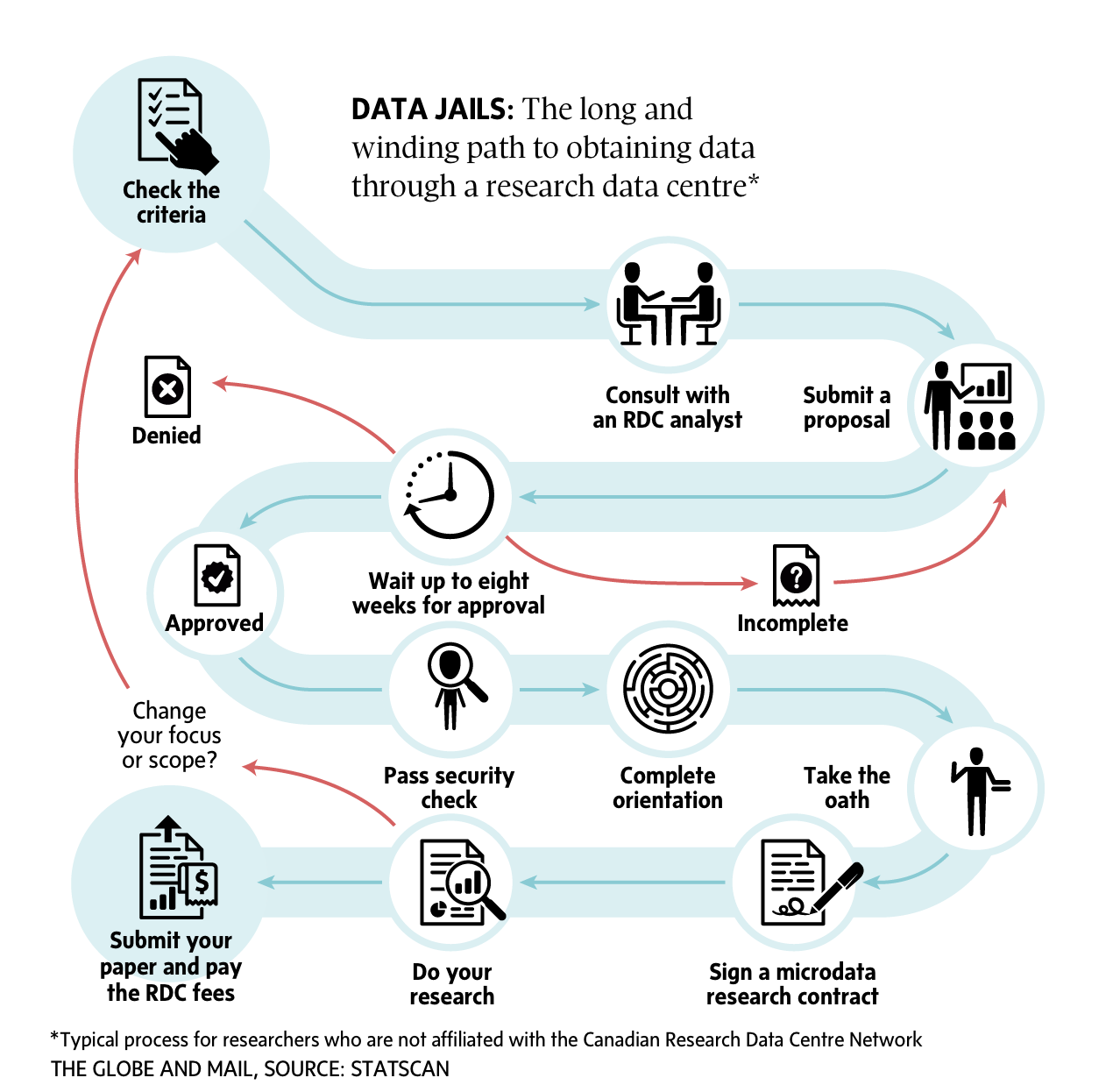
Source: The cost of Canada’s data deficit When it comes to basic data about its own citizens – from divorce rates to driving patterns to labour trends – Canada simply doesn’t have the answers. If information is power, this country has a big problem.

Trump Claims There Is a Crisis at the Border. What’s the Reality?

Good analysis of the numbers:

President Trump has frequently called the situation at the southern border with Mexico a crisis and insists that building his long-promised border wall will fix it. Here are some of Mr. Trump’s most common assertions of a crisis, and the reality of what we know about immigrants and the border.

“We can’t have people pouring into our country like they have over the last 10 years.”

THE REALITY Illegal border crossings have been declining for nearly two decades. In 2017, border-crossing apprehensions were at their lowest point since 1971.

Total number of arrests for illegally crossing the Mexican border

Undetected illegal border crossings have dropped at an even faster rate, from 851,000 in 2006 to approximately 62,000 in 2016, according to estimates by the Department of Homeland Security.

However, there is one group of migrants that is on the rise: families. A record number of families have tried to cross the border in recent months, overwhelming officials at the border and creating a new kind of humanitarian crisis.

Number of arrests for illegally crossing the Mexican border

Asylum claims have also jumped, with many migrant families telling officials that they fear returning to their home countries. Seeking asylum is one way to legally migrate to the United States, but only 21 percent of asylum claims were granted in 2018, and many cases can take years to be resolved.

“Every week, 300 of our citizens are killed by heroin alone, 90 percent of which floods across from our southern border.”

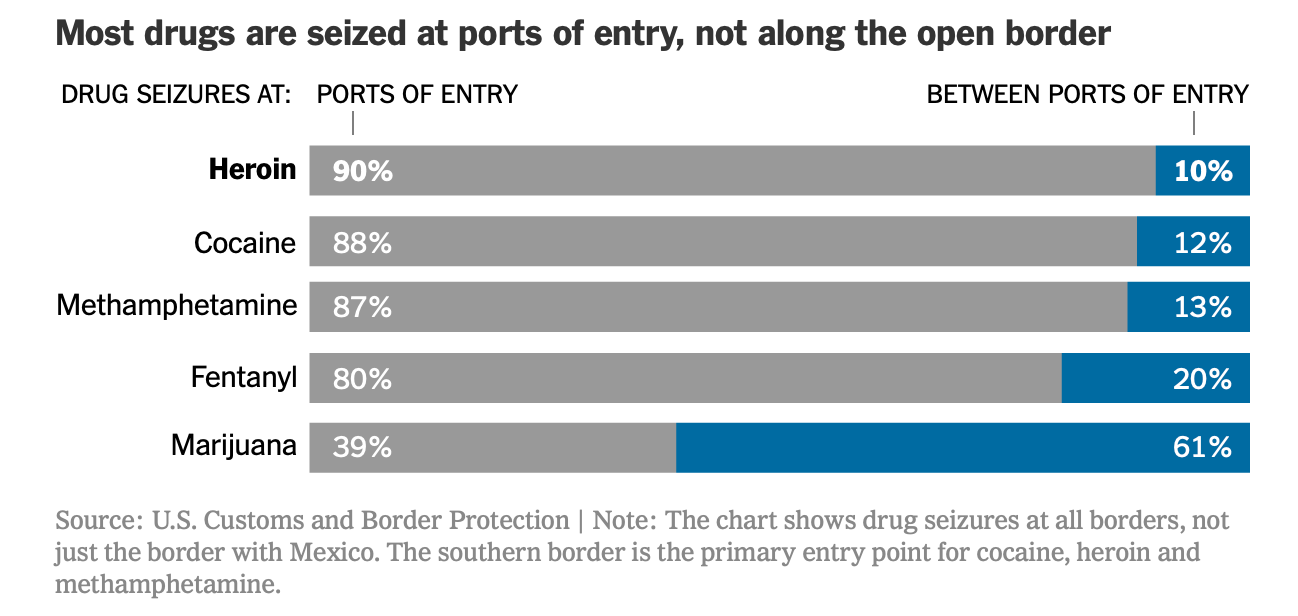
THE REALITY It is true that the majority of heroin enters the United States through the southern border, according to the Drug Enforcement Administration. But the D.E.A. also saysthat most heroin is brought into the country in vehicles entering through legal border crossings, not through the areas where walls are proposed or already exist.

Most drugs are seized at ports of entry, not along the open border

There are more than two dozen ports of entry along the southern border. Barriers are already present in Border Patrol sectors with the highest volumes of heroin seizures.

“Over the years, thousands of Americans have been brutally killed by those who illegally entered our country, and thousands more lives will be lost if we don’t act right now.”

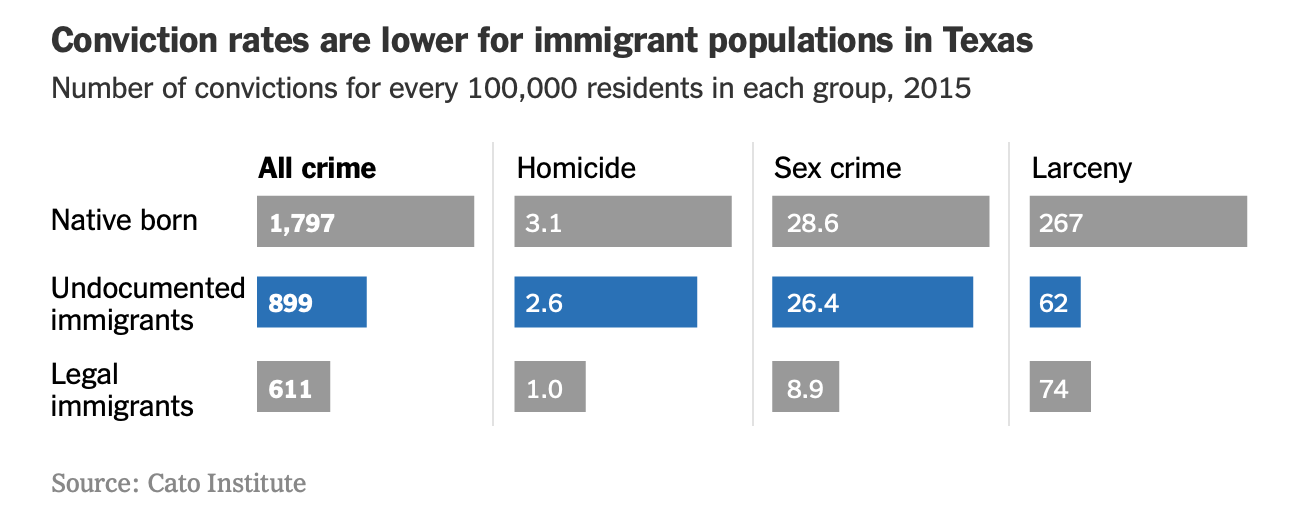
THE REALITY It is difficult to assess the president’s claims that illegal immigration leads to more crime because few law enforcement agencies release crime data that includes immigration status. However, several studies have found no link between immigration and crime, and some have found lower crime rates among immigrants.

Texas, which has the longest border with Mexico and has one of the largest populations of undocumented immigrants of any state, keeps track of immigration status as part of its crime data. The Cato Institute, a libertarian research center, analyzed the Texas data in a 2015 study and found that the rate of crime among undocumented immigrants was generally lower than among native-born Americans.

Conviction rates are lower for immigrant populations in Texas

Some critics of the study argued that the reason undocumented immigrant conviction rates were low was because immigrants were deported after they served their sentences, which prevented them from committing another crime in the United States, reducing their rate of crime relative to native-born Americans.

Alex Nowrasteh, senior immigration policy analyst at the institute, addressed the complaint by comparing first-time criminal conviction rates among undocumented immigrants in Texas and native-born Americans in Texas. He found that undocumented immigrants still committed crimes at a rate “32 percent below that of native-born Americans.”

President Trump frequently tells the stories of Americans who have been killed by undocumented immigrants as examples of criminal behavior. These terrible crimes have happened, but there is no comprehensive data that shows whether these killings are happening at crisis levels.

Karen Robson: Why won’t Canada collect data on race and student success?

While I always favour more data to better understand the differences in outcomes between groups, I am puzzled by the assertions regarding data gaps made by Karen Robson in her recent opinion piece.

First, the OECD PISA study includes both first generation children, born abroad, and the second generation, born in the destination country, where issues related to racism and discrimination can be separated out more clearly from more basic integration issues (e.g., language fluency).

Secondly, while the visible minority category may not be perfect, it does provide a race-based breakdown in the Census with respect to education, along with other economic and social outcomes, which can be used to provide municipal level data at the census tract level. Toronto school board data uses largely comparable categories.

Ironically, the same pattern she cites with respect to Toronto, where the school board collects race-based data, can be seen nation-wide: Asian and South Asian students with stronger outcomes, Black and Latino weaker ones.

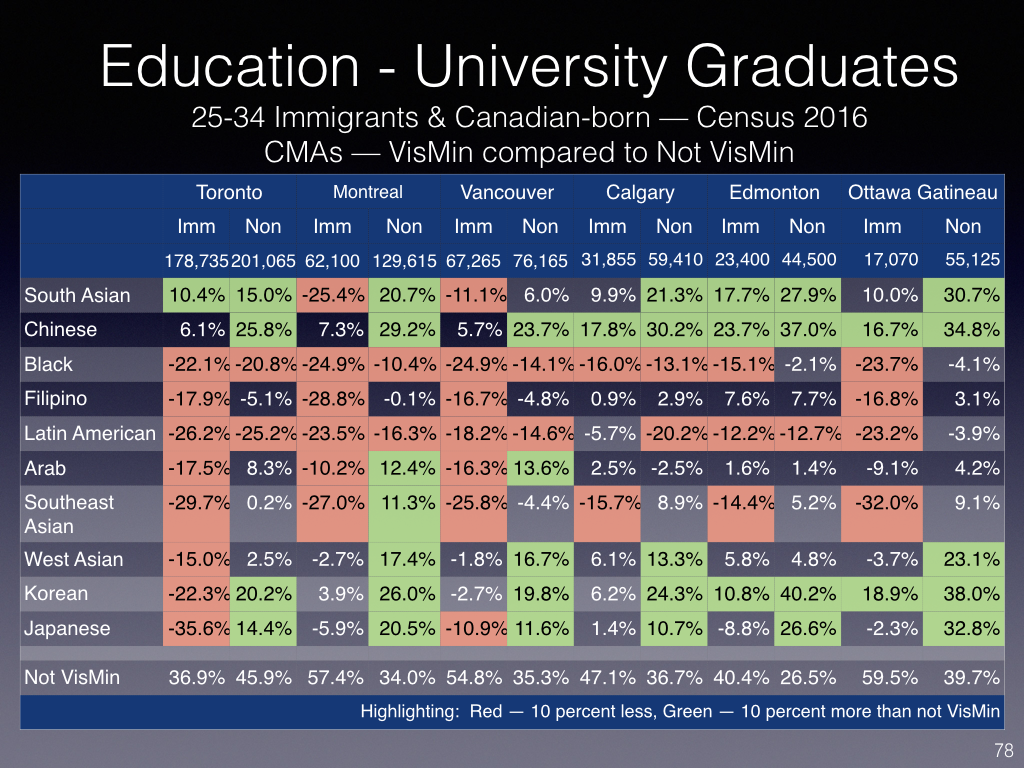
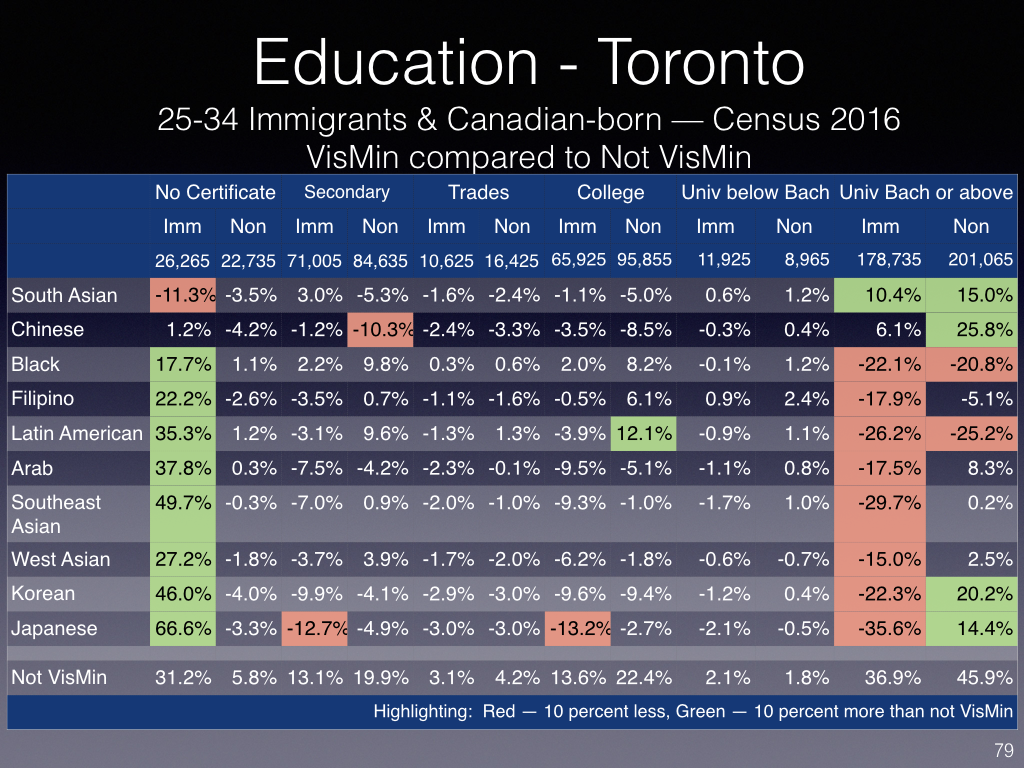
The following three charts illustrate this, looking at the highest level of education attainment for 25-34 year olds, or later than the high school data that she cites (i.e., the social and economic outcomes that reflect, in part, high school outcomes). The first looks at the university graduation rates for visible minorities, immigrant and non-immigrant (Canadian-born) compared to not visible minorities, the second provides a breakdown of the highest level of educational achievement for Toronto (I have done the same for the other cities) and the third looks at median employment income for university graduates:


Her academic article (journals.sfu.ca/cjhe/index.php…), on which this op-ed is based, doesn’t make these mistakes and is a comprehensive and interesting study of Toronto District School Board data.

But her arguments that the lack of comparable data to Toronto across the country is a significant data gap is less convincing.

Census data allows comparisons between municipalities (and down to the census tract level) and the richness of the data provides considerable scope for analysis. Whenever I find a blockage elsewhere (e.g., police force diversity numbers), I usually can find census data to respond to my key questions:

Although the impact of income inequality and gender on education outcomes is much discussed in Canadian government-level policy debates, factors of race and racism are seldom measured or addressed.

However, as an education researcher comparing student outcomes in Toronto, Vancouver, New York, Chicago and London, I can see Canada’s policy-makers have a big knowledge gap because they don’t deal with or have access to information regarding race.

Students are impacted by factors of income, gender and also race. The combinations of these identities undoubtedly shape how students experience access to education, work and other types of social mobility.

Research shows that low-income can be highly racialized, yet in Canadian cities, the patterns are not completely divided along racial lines. Therefore, examining income alone overlooks the many important ways that inequalities in education are not simply an issue of economics.

In the United States and the United Kingdom, research reports regularly provide summaries of student outcomes by various characteristics, including race.

In Canada, we have a tendency to focus exclusively on whether a student comes from immigrant parents. I believe this focus is problematic.

Canada has been deemed an education superpower because comparisons between the standardized test scores (PISA) of Canadian children with those in other OECD nations find Canada near the top. As well, the 2016 federal census revealed that Canada has the highest proportion of post-secondary graduates in all 36 member countries of the Organization for Economic Development (OECD). This mean that more than half of adult citizens in Canada between the ages of 25 and 64 have a college or university credential.

In particular, the success of immigrant children is used to argue that Canada is leading the way in equity.

In a country grappling with the heritage of colonialism, the success of immigrant children comes as good news to share and promote. This success can be interpreted as a sign that multiculturalism has been successful, that racism is not a barrier to education attainment and that immigrants are treated equally and have the same opportunities as children born in Canada.

This story continues in other arenas. Education researcher Trevor Gulliver analyzed citizenship guides for new Canadians and found that group identities in these education texts creates an idealized version of Canada as “Canada the redeemer.”

Such celebratory concepts of Canada need to be carefully considered.

There is a common misconception that racism is something that occurs in the U.S. and not in Canada.

One of the reasons that children of immigrants do so well in Canada is because of our immigration system which favours certain assets. The “points system” of immigration awards points to applicants who speak one of Canada’s official languages. Points are also awarded for job skills and level of education.

This is not to discount the work that teachers and schools do to integrate, educate and welcome students of immigrants; my point is that there are some reasons that such children who already speak an official language may be doing better than immigrants who arrive as refugees in another immigrant receiving country, like Sweden.

Focusing on the success of immigrants detracts from the problem of how systemic racism contributes to inequality in educational experiences and outcomes. Another common misconception is that race and immigrant status are equated; of course they are not the same thing.

The celebrated study about how well Canada did with global assessment scores only carries information on immigrant status, not race. With the exception of the Toronto District School Board, boards of education across the country do not record race data.

This lack of data has led to a dearth of studies examining the relationship between race and educational outcomes in Canada. Researchers simply do not have the data to analyze.

In response to research demonstrating a gap between Indigenous and non-Indigenous student outcomes in Canada, a Canadian think-tank reports that some provinces have pledged to begin asking Indigenous students attending mainstream schools to self-identify when provinces collect their PISA data. No known similar move is afoot, however, with regards to collecting data about racialized students or their income levels.

The Ministry of Education in B.C. has opted to ask students about the language students speak at home rather than their self-identified race.

Not only do we not have data on race, but it seems Canadians are also reluctant to talk about race. Even Statistics Canada defers to its old and outdated notion of “visible minority” when attempting to measure and discuss issues around race.

Lumping all non-whites together masks the huge differences we see in the educational outcomes of racialized students in Toronto.

Basically, this means comparisons are made between white and non-white people. This comparison happens even in areas like Toronto where “visible minorities” make up more than half of the population, making whites in fact, a minority. Further, the data tells us nothing about poverty by postal code.

In Toronto, where we do have data, the figures show that Asian and South Asian students trend toward having high marks and are more likely to go on to university. Black and Latino students trend toward lower grades and are more likely to be placed in the “applied” stream of high school courses (which are not eligible for university).

Considerable research in Toronto has identified Black males as having the lowest post-secondary opportunities due to their disproportionate placement in the “applied” stream of study.

These problems are not unique to Toronto; they are only measured in Toronto.

Lack of data does not mean lack of a problem. By not collecting data on race and other important sociodemographic factors of students, we fail to correct systemic barriers to success in our educational system.

By conflating immigrant success with a blanket commitment to equality, we blindly assume we are doing OK as we do not have any evidence to the contrary — because we haven’t taken the time to collect it.

Source: Karen Robson: Why won’t Canada collect data on race and student success?

Asylum-seeker surge at Quebec border choking Canada’s refugee system, data show

Good in-depth analysis of the numbers:

The wait time for a refugee claim hearing in Canada increased more than a third over the past two years, to 19 months, as more than 30,000 asylum seekers arriving via unauthorized border crossings placed significant pressure on the system.

Overwhelmed by the number of migrants, the Immigration and Refugee Board (IRB) has only managed to finalize 15 per cent of the 27,674 asylum claims made by people who illegally entered Quebec – where the majority of the crossings took place, mostly at a single location near St. Bernard-de-Lacolle – between February, 2017, and this June.

The resulting backlog has created a growing queue for any and all asylum seekers. Under the Supreme Court’s landmark 1985 Singh decision, all refugee claimants on Canadian soil are entitled to an oral hearing.

Asylum seekers who cross illegally at the U.S.-Canadian border eventually face the same questions as all other refugee claimants: Are they genuine refugees, fearing persecution in their home countries? Data from the IRB show that less than half of the claimants in finalized cases – 1,885 – have been accepted as legitimate refugees in Quebec, significantly lower than the proportion for all refugee cases in Canada.

Canada has only deported a small number of the nearly 30,000 asylum seekers who
illegally entered Quebec through unauthorized border crossings since last year, accord-
ing to statistics from the Canada Border Services Agency.

The majority of border crossers have entered Canada through Quebec, mostly at an
unauthorized port of entry in St. Bernard-de-Lacolle. While a breakdown of adjudicated
cases was not available for Quebec, national statistics paint a picture of a refugee deter-
mination system that has been slow to finalize asylum claims.

But a separate data set from the Canada Border Services Agency shows that only a handful of those who have been denied refugee status have been deported. The CBSA said it had removed just 157 people who entered Quebec through unofficial border crossings since April, 2017 – about one in every 200. It said another 582 are being processed for deportation.

Canada-wide, the CBSA said it has deported 398 of the 32,173 people who crossed into Canada illegally since April, 2017. Of those, 146 were sent back to the U.S., while the rest were deported to 53 other countries, including Haiti (53), Colombia (24), Turkey (19) and Iraq (15).

Refugee lawyer Lorne Waldman said the relatively low number of deportations is simply an indicator of the system.

“It doesn’t surprise me because it takes a while for cases to make their way through the system. So people who came a year ago, if the system works efficiently, they should be at the end of the system and subject to removal if their claims are rejected,” he said.

But the situation at the border has put pressure on Canada’s already-strained refugee determination system. The projected wait time for a refugee claim hearing is currently 19 months, up from 16 in September, 2017, and 14 in September, 2016 – just before the influx of asylum seekers.

Tens of thousands have flooded the Canada-U.S. border since last year. Initially, many of the border crossers were Haitians who had been living in the U.S. under a temporary protected status (TPS) they had been given after the massive 2010 earthquake in Haiti. When the Trump administration announced its intention to end the TPS for Haitians, word spread among the community there that they could apply for refugee status in Canada if they headed north and found a way into the country.

But it wasn’t as simple as showing up at the border and claiming asylum. The Safe Third Country Agreement between Canada and the U.S. requires both countries to refuse entry to asylum seekers who arrive at official border crossings, as both countries are considered safe for refugees. However, since the agreement applies only to people who arrive at official points of entry, asylum seekers can avoid being turned away by entering between official border crossings – a loophole thousands have taken advantage of.

This year brought a new wave of asylum seekers in St. Bernard-de-Lacolle: Nigerians travelling on valid U.S. visas. It’s not exactly clear why Nigerians choose to travel on U.S. visas instead of Canadian ones, but Mr. Waldman said the U.S. visa system is seen as more generous than Canada’s. Many of the Nigerian asylum seekers obtain visitor visas and use them to fly into the U.S. They then head north to the Quebec border, cross into Canada and apply for asylum.

Earlier this year, Immigration Minister Ahmed Hussen and senior government officials travelled to Nigeria to raise their visa concerns directly with U.S. officials there. Mr. Hussen said the Nigerian government also pledged to discourage its citizens from claiming asylum in Canada after crossing between official points of entry along the U.S. border.

The IRB has finalized just 4,181 asylum claims made by border crossers in Quebec between February, 2017, and June of this year (more current data were unavailable), of which only 45 per cent – 1,885 – were accepted. Another 1,614 claims were rejected, and 682 were abandoned or withdrawn.

That number of accepted claims is significantly lower than the Canada-wide acceptance rate for all refugee claims. As of June, the IRB had approved 7,831 of 13,687 – 57 per cent – of all processed asylum cases made since Dec. 15, 2012, including claims made by asylum seekers who crossed illegally into Canada. Another 55,567 claims were still pending. A small number of refugee claims made before 2012, when the refugee determination system underwent significant changes, are documented separately.

As a part of the 2018 federal budget, the government invested $72-million in the IRB, which will be used to hire 64 new decision-makers in an effort to improve processing times.

Montreal refugee lawyer Mitchell Goldberg said he is optimistic processing times will start to decrease as the government dedicates more resources to the matter.

The deportation process can take even longer, especially if an asylum seeker chooses to exhaust all their appeal options – a source of concern for the Conservative opposition.

“It’s completely unreasonable for our asylum system to be backlogged for years and then for us to not have a functioning system to remove people who don’t have a legal reason to be in Canada,” said Conservative immigration critic Michelle Rempel.

However, NDP immigration critic Jenny Kwan said the former Conservative government, in which Ms. Rempel served as a cabinet minister, is also to blame for the delays at the IRB.

“There’s been pressure on the system for many, many years, from the Conservatives to the Liberals. Successive governments have not resourced the IRB accordingly so that they can get the job done,” Ms. Kwan said.

Asylum seekers waiting for their cases to be heard have had to find accommodation, with thousands heading to Toronto, where the city has paid to house them in hotel rooms, dormitories and shelters for the homeless. Ottawa has pledged $50-million to defray the costs incurred by the provinces, with Quebec receiving $36-million, Ontario $11-million and Manitoba $3-million. But Toronto and Ontario have been pressing the federal government to pay much more, with the provincial Progressive Conservative government demanding a reimbursement of $200-million.

Mr. Waldman also said the government must do more to address the IRB delays, as the long wait times serve as a “magnet” for illegitimate asylum claimants who know they can potentially spend years in Canada while their cases linger in the system.

Source: Asylum-seeker surge at Quebec border choking Canada’s refugee system, data show

Animation: Visualizing Two Centuries of U.S. Immigration

Great animation and charts:

https://youtu.be/fiPq7C06zjQ

America is a nation of immigrants, and though the country has seen a lot of new arrivals over the past two centuries, the rate of immigration has been far from steady.

War, famine, economic boom and bust, religious persecution, and government intervention have all caused wild swings in the rate of immigration from countries around the world.

Today’s striking animation, by Max Galka, is a great way to see changes in immigration over time. Inflows from specific countries rise and fall, and the top three countries of origin change numerous times over the years.

Below, is another way to look at the ebb and flow of American immigration since the early 1800s.

U.S. Immigration Charts
An important note. This data excludes forced migration (slavery) and illegal immigration.

Let’s look at the “waves” in more detail.

WAVE ONE: THE OLD IMMIGRATION

From 1820 to 1870, over 7.5 million immigrants made their way over to the United States, effectively doubling the young country’s population in only half a decade.

Ireland, which was in the throes of the Potato Famine, saw half its population set sail for the U.S. during that time. This wave of immigration can still be seen in today’s demographics. There are now more Irish-Americans than there are Irish nationals.

The magnetic pull of the New World was profoundly felt in Germany as well. Growing public unrest in the region, caused by heavy taxation and political censorship, culminated in the German revolutions of 1848-49. Faced with severe hardship at home, millions of Germans made their way to America over the 1800s. It’s estimated that one-third of the total ethnic German population in the world now lives in the United States.

WAVE TWO: GOLD RUSH

Much of America’s early immigration was from various points in Europe, but there was one prominent exception: China.

The discovery of gold in California inspired Chinese workers to seek their fortune in America. After a crop failure in Southern China in 1852, tens of thousands of Chinese immigrants flooded into San Francisco.

Although the State of California was making millions of dollars off its Foreign Miners Tax, sentiment towards Chinese workers began to sour. Gold mines were being tapped out and white Californians blamed the Chinese for driving wages down.

Chinamen are getting to be altogether too plentiful in this country.

– John Bigler, Governor of California (1852-1856)

By 1882, the newly enacted the Chinese Exclusion Act had a chilling effect on Chinese immigration. The Exclusion Act has the dubious distinction of being the only American law barring a specific group from immigrating to the United States.

WAVE THREE: THE NEW IMMIGRATION

The wave of immigration leading into the 20th century is referred to as The New Immigration.

In 1890, Ellis Island was designated as the main point of entry for newcomers entering the United States. In 1907 alone, Ellis Island processed a staggering 1,285,349 immigrants. To put this number in perspective, if all of those people settled in one place, they would’ve formed America’s fourth largest city almost overnight.

This massive influx of people into New York had profound implications on the city itself. In 1910, Manhattan’s population density was an astronomical 101,548 humans per square mile.

The immigrants arriving during this period – heavily represented by Italians, Hungarians, and Russians – were seeking religious freedom and economic opportunity. Certain industries, such as steel, meat-packing, and mining, were staffed by many new arrivals to the country.

During this time, one in four American workers were foreign-born.

THE GREAT DEPRESSION

The National Origins Act’s quota system, which took effect in 1929, essentially slammed the door on most immigrants from Southern and Eastern Europe. Shortly after, the Great Depression further put a damper on immigration that would last well into the 20th century.

WAVE FOUR: MEXICO

After decades of sluggish immigration, the United States’ percentage of foreign-born citizens reached a low of 4.7% in 1970. But that was all about to change.

During the next decade, the number of states where Mexico was the top country of origin doubled in a single decade, and Mexicans became the dominant foreign-born population in the country. This migration was fueled by the Latin American debt crisis and later by NAFTA. The influx of cheap corn into Mexico caused hundreds of thousands of Mexicans from rural areas to search for more favorable economic opportunities. America was the obvious choice, particularly during the economic expansion of the 1990s.

U.S. Hispanic Population Map

This wave of immigration has shifted the country’s demographics considerably. Today, nearly one in five people in the United States are Hispanic.

CURRENT TRENDS

Immigration trends are continually evolving, and America’s newest immigrants are often more likely to come from China or India. In fact, both countries surpassed Mexico as countries of origin for immigrants arriving in the U.S. in 2013. Today, the trend is even more pronounced.

us immigration top 5

Recent immigration numbers indicate that Asian immigrants will continue to shift America’s demographics in a new direction. Perhaps a new wave in the making?

via Animation: Visualizing Two Centuries of U.S. Immigration