Rempel Garner: Conservatives to end leniency for non-citizen criminals

Likely a winner in terms of public opinion, likely among established immigrants and non-immigrants alike. Less divisive than 2015 “barbaric cultural practices” tipline or citizenship revocation:

…This is why once the House of Commons resumes in the fall, Conservatives will introduce legislation to amend the Criminal Code to rectify this issue. Our bill will add a section after Section 718.202 of the Criminal Code which will expressly outline that any potential impact of a sentence on the immigration status of a convicted non-citizen offender, or that of their family members, should not be taken into consideration by a judge when issuing a sentence.

The rationale for this change is straightforward. Anyone seeking residence or citizenship in Canada has responsibilities as well as rights. The citizenship guide clearly states that citizens must obey Canada’s laws and respect the rights and freedoms of others, and IRPA outlines the potential consequences for non-citizens who fail to do so. Without legislative clarity on considering immigration status in sentencing, judges can apply aspects of the Pham ruling to undermine that principle for non-citizens, effectively end-running the deportation consequences already enacted by Parliament through IRPA

In effect, the Criminal Code amendment that Conservatives plan to propose this fall will prevent judges from using aspects of the Pham ruling to prioritize the process of entering and staying in Canada over the responsibility to respect Canadian law required of those seeking to do so. It will also help quell anger from Canadians who have read about high-profile rulings where the perception has arisen that non-citizens are receiving leniency for a crime committed on Canadian soil simply by virtue of their non-citizen status.

The vast majority of people in Canada who have immigrated here or are on temporary visas  abide by the law. Removal from Canada for non-citizens after being convicted of a serious crime is a no-brainer to both protect Canadians, the value of Canadian citizenship, and every person who resides in Canada and plays by the rules. 

After a decade of Liberal post-nationalism and excessively high immigration levels, accepting this change would allow the Liberals to demonstrate some respect for Canadian citizenship by affirming that, at minimum, the privilege of residing here for non-citizens depends on adherence to the rule of law.

Source: Conservatives to end leniency for non-citizen criminals

German study: Immigration does not raise crime rate

Of note, similar to other countries:

Immigrants or refugees do not have a higher tendency to commit crime and there is no correlation between the proportion of immigrants in a given district and the local crime rate, according to a new analysis of the latest German crime statistics carried out by the renowned ifo institute.

The Munich-based institute correlated the latest national crime stats from 2018 to 2023 with location-specific data in the new study to show why the fact that immigrants are overrepresented in crime statistics had nothing to do with where they came from.

Migrants tend to settle in urban areas, where there is more population density, more nightlife, and more people in public spaces at all hours of the day. That means the general crime rate is higher, and crime suspects are just as likely to be German as of foreign background. In other words, districts with higher levels of “immigrant” crime also have higher crime rates among Germans.

“These places increase the risk of becoming perpetrators for residents, regardless of nationality, due to the infrastructure, economic situation, police presence or population density,” the study said.

The researchers pointed to other reasons why immigrants tend to be overrepresented in crime figures: Immigrants are generally younger and more often male than the German population — but those, according to the researchers, were less important contributing factors.

Studies contradict the populist narrative

The supposed propensity of immigrants to commit crimes has become the dominant narrative in the current German election campaign. In a recent Bundestag debate on restricting immigration, Friedrich Merz, chancellor candidate for the conservative Christian Democratic Union (CDU), spoke of “daily occurring gang rapes in the asylum seeker milieu.”

Those words echoed the narrative now routinely propagated by the far-right Alternative for Germany (AfD). In early February, the AfD’s Beatrix von Storch told German public broadcaster ARD, “We have two gang rapes a day, we have ten normal rapes a day and we have had 131 violent crimes a day on average over the last six years — by immigrants, primarily Syrians, Afghans and Iraqis.”

“We have skyrocketing crime statistics. We have skyrocketing crime among foreigners, youth crime, migrant violence,” AfD co-leader and chancellor candidate Alice Weidel said in 2024. “Rapes are high, knife crimes are high, 15,000 in the last year.”

The numbers were found to be false by media outlets’ fact-checking teams.

Much-reported attacks by people of immigrant background in Munich, Aschaffenburg, and Magdeburg have fueled this popular narrative, but statistical studies draw a very different picture.

“Even for violent crimes such as homicide or sexual assault, the study shows no statistical correlation with an increasing share of foreigners or refugees,” the ifo researchers said.

Source: German study: Immigration does not raise crime rate

Trump’s Immigration Policies Made America Less Safe. Here’s the Data.

Yet another example:

Listen to just about any of former president Donald Trump’s rallies, and you’ll hear claims that President Joe Biden’s border policies have made the country less safe. At a recent town hall, Trump said Biden is releasing murderers, “drug dealers, drug addicts, everybody” into the country.

But new data reveal that Trump was the one whose immigration policies damaged the country’s security. In fact, he released more convicted criminals into the United States than his successor.

This is not to lend credence to Trump’s efforts to demonize immigrants as dangerous or violent. Data from the Census Bureau shows that immigrants — both legal and illegal — are at least half as likely as citizens to be incarcerated for crimes committed in the United States. (This is why deporting everyone living here illegally would increase crime rates.)

But when it comes to the small percentage of noncitizens who do commit crimes, Trump did not prioritize removing them during his term in office. In fact, he explicitly deprioritized them.

Trump released more criminals into the United States than Biden.

In his first week in office, Trump signed an executive order rescinding Obama-era orders that directed the Department of Homeland Security to focus its resources on detaining and removing noncitizens who committed serious crimes. Trump said he would not “exempt classes or categories of removable aliens.” His goal, he said, was enforcement “against all removable aliens.”

What did that mean in practice? Immigration and Customs Enforcement agents were no longer required to focus on felons. They could arrest anyone caught here illegally, and they did — from pizza delivery drivers to domestic-violence victimsto spouses of U.S. citizens with no criminal records.

New government data obtained by the Cato Institute highlight what happened next: Immigrants with serious criminal records were frequently released into the country instead of being detained for deportation. This included individuals who were transferred to the custody of ICE after serving their sentences and those who were previously deported and encountered ICE after crossing into the country again.

From January 2017 to February 2020, the Trump administration released more than 58,000 convicted criminals into the United States, including more than 8,600 violent criminals and 306 murderers. Contrast that with the Biden administration, which reinstated enforcement priorities: Overall, the average month under Trump saw twice as many releases as under Biden.

Bier WaPo1

Source: Trump’s Immigration Policies Made America Less Safe. Here’s the Data.

MPI: Immigrants and Crime in the United States

A reminder given the falsehoods in the USA election:

Immigrants in the United States commit crimes at lower rates than the U.S.-born population, notwithstanding the assertion by critics that immigration is linked to higher rates of criminal activity. This reality of reduced criminality, which holds across immigrant groups including unauthorized immigrants, has been demonstrated through research as well as findings for the one state in the United States—Texas—that tracks criminal arrests and convictions by immigration status.

A growing volume of research demonstrates that not only do immigrants commit fewer crimes, but they also do not raise crime rates in the U.S. communities where they settle. In fact, some studies indicate that immigration can lower criminal activity, especially violent crime, in places with inclusive policies and social environments where immigrant populations are well established….

Source: MPI: Immigrants and Crime in the United States

Where Germany’s Immigration Debate Hits Home

Of note. Incidents like this naturally raise worries and fears:

The leafy market square, ringed by Middle Eastern restaurants in a quiet city where nearly half the residents have immigrant backgrounds, seems like the last place that would spur Germany’s latest explosive wave of nationalist backlash.

But it was in Mannheim where prosecutors say an Afghan man stabbed six people in May at an anti-Islamist rally, killing an officer who had intervened. No motive has yet been determined. But the death and the fact that the man accused had his asylum claim denied years ago set off calls for the expulsion of some refugees. Such sentiments were once viewed as messaging mostly reserved for the far right.

That this could occur in Mannheim, a diverse community of over 300,000 people known for its sensible plotting along a grid as a “city of squares,” has rattled Germany. It has been particularly painful for the longtime Muslim population of the city, where, according to some estimates, nearly one in five people are of Turkish descent.

Overtly, the political discussion concerns refugees, but in the lived experience of German Muslims, many said they felt like they were steps away from becoming a target. That worry has heightened since January, when an exposé revealed a secret meeting by members of the extreme right during which the deportation of even legal residents of immigrant descent was discussed.

Some expressed fears that what happened in Mannheim may have broken a dam.

Source: Where Germany’s Immigration Debate Hits Home

Posts linking crime to immigration in Canada are unfounded

Of note and unhelpful misrepresentation of the data:
Crime rates in Canada have been on a slight rise over the last decade, but there is no evidence linking this to immigration encouraged by Prime Minister Justin Trudeau’s government. Research shows Canadian immigrants commit fewer offenses overall than native-born citizens.

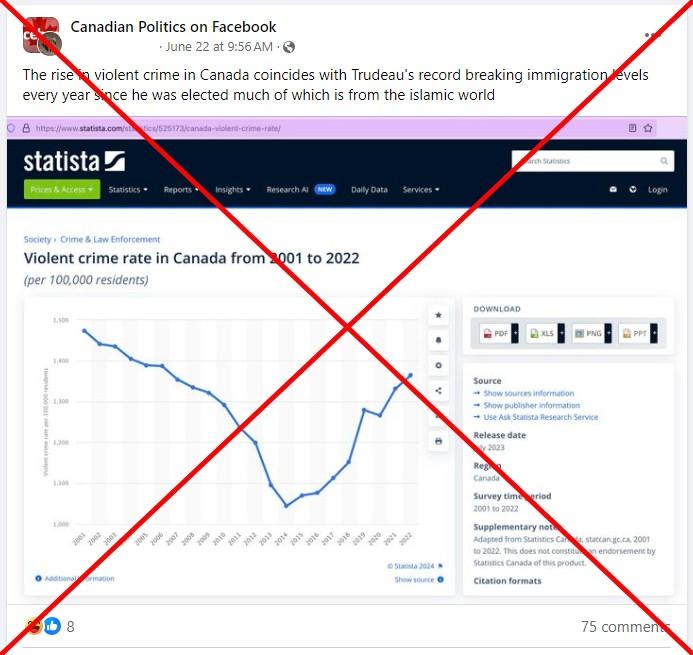
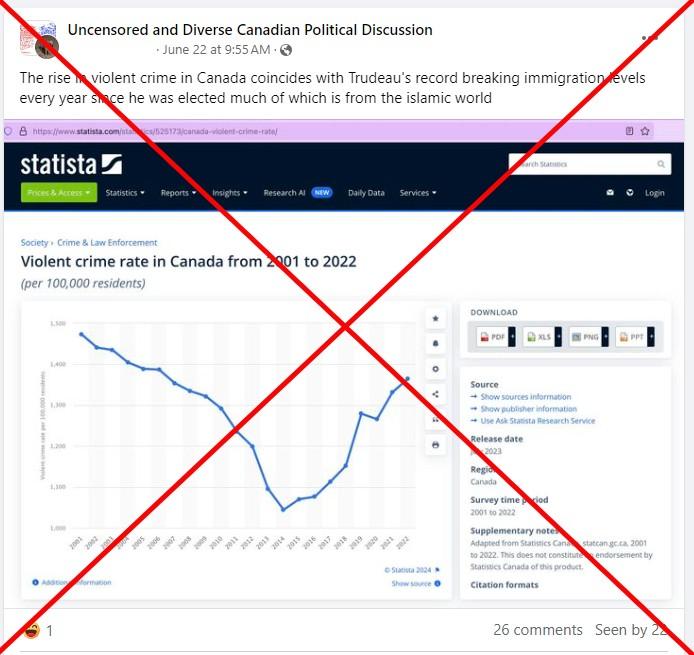
“The rise in violent crime in Canada coincides with Trudeau’s record breaking immigration levels every year since he was elected much of which is from the islamic world,” says a June 22, 2024 Facebook post.

The post includes a graph from the data-gathering site Statista that shows the violent crime rate in Canada fell between 2001 and 2014 before climbing again after 2015 — the year Trudeau assumed office. The same graph has circulated in multiple Canadian Facebook groups.

Image

Screenshot of a Facebook post taken July 9, 2024

Image

Screenshot of a Facebook post taken July 9, 2024

The Liberal prime minister’s term has been marked by a push to increase immigration, triggering debates about the availability of housing, food and jobs — as well as misinformation.

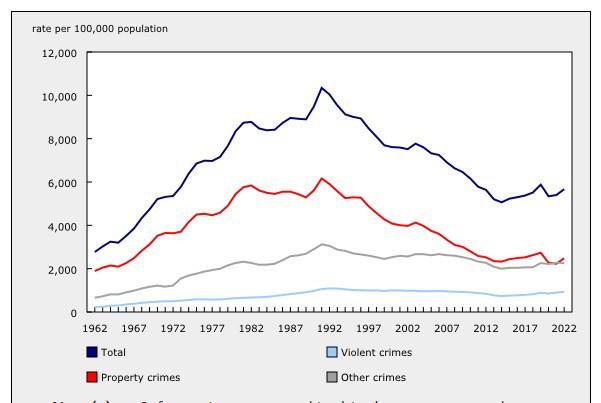
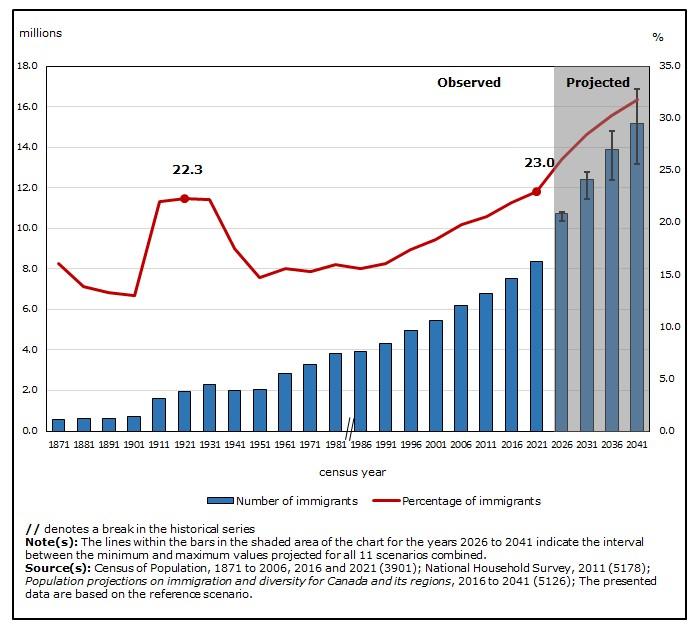
The Statista chart cited in the posts roughly matches data on violent, police-reported crime from Statistics Canada (archived here and here). However, government data do not indicate a relationship with immigration, which has steadily risen since the 1950s (archived here).

Image

This screenshot taken July 9, 2024 shows a Statistics Canada graph depicting police-reported crime between 1962 and 2022

Image

This screenshot taken July 9, 2024 shows a Statistics Canada graph depicting immigration rates from 1871 to 2021, as well as future projections

Anyone can find a correlation between any two things,” said Frank Cormier, a criminologist at the University of Manitoba (archived here). “In-correlation most certainly does not always — actually very rarely — indicates causation.”

He added that research shows “areas that have higher rates of immigration actually tend to see lower crime rates.”

“So, there is absolutely zero evidence that links higher rates of immigration with higher rates of crime,” he said July 4, 2024.

Examining crime, immigration

Researchers have for decades found an inverse relationship between immigration and crime in Canada.

A 2009 study from the University of Toronto found any trends towards youthful criminal activity among immigrants in the city decreased between two generations growing up in the 1970s and 1990s (archived here).

More recently, a 2020 paper from Toronto Metropolitan University examining crime rates between 1976 and 2011 also found the proportion of foreign-born residents was “either not significantly associated or negatively associated with changes in crime rates within Canadian cities” (archived here).

Cormier said one possible explanation is that immigrants must abide by the law to preserve their sometimes tenuous status within the country.

“Adults who are immigrants know that if they commit a crime that is serious enough, they face deportation,” he said. “So, the average immigrant has far more to lose than the average non-immigrant in Canada.”

Cormier said new arrivals also tend to place a higher emphasis on familial bonds and education, which generally lead people away from criminal activity.

Nicolas Ajzenman, an assistant professor in the economics department at McGill University (archived here), agreed that in Europe and the Americas, the effect of immigration on crime is practically non-existent.

However, he emphasized that immigrants are a heterogeneous demographic and that no trend applies globally.

“There are also a few papers documenting a positive effect, especially when the regulations to work legally are tougher,” he said in a July 4, 2024 email, noting that some research has found evidence of increased property crime rates.

A 2013 study found this trend in the United Kingdom, for example (archived here).

But property crime is not the same as violent crime, the category mentioned in the social media posts — and Ajzenman said immigrants who can fully integrate into local labor markets are usually associated with a reduction in delinquency.

Comparing crime statistics

Cormier said data alone do not paint a complete picture of crime, since they only measure incidents recorded by law enforcement.

“If police concentrate their efforts looking at certain types of crime or against certain parts of a city, then crime rates in those areas or on those certain crimes will tend to go up quite significantly,” he said.

Cormier said the Statista graph shared online also shows a relatively small date range, implying that crime has jumped dramatically in the past 10 years.

However, more complete data from Statistics Canada indicate crime reports are still below the level seen in 1990s.

We’re still not anywhere close to where things were before,” Cormier said.

Statistics Canada reported in 2018 that while there was not one single cause for decreasing crime near the end of the 20th century, the dip could be related to an aging population, changing police strategies and shifting attitudes toward illegal behavior (archived here).

Researchers and news reports say Canada’s violent crime rate has risen since 2015 due to a combination of factors, including waning social safety nets — especially following the Covid-19 pandemic — over-reliance on police and firearms entering from the United States.

Read more of AFP’s reporting on misinformation in Canada here.

Source: Posts linking crime to immigration in Canada are unfounded

Douglas Todd: More rigorous study needed on ‘systemic racism’ in Canada’s justice system

Looking forward to the more detailed report correlating crime rates by ethnic status is scheduled to be released on Sept. 30 by StatsCan that will help avoid some of the broad generalizations in the article:

Federal Justice Minister David Lametti has been emphasizing to journalists that it’s time to weed out “systemic racism” in the Canadian police and court system.

“It’s part of a larger foundation of colonialism that sadly has played an important part in our history,” Lametti told Postmedia News in the midst of sweeping anger and debate about police violence against Blacks in the United States.

The report found over a 10-year period that Canadian whites accounted for 61 per cent of the serious crimes that warranted federal custody and a mandatory minimum penalty, even as whites in 2011 made up 76 per cent of the population.
The study revealed that Indigenous offenders were incarcerated for 23 per cent of the serious crimes, despite accounting for only 4.3 per cent of the population.

Blacks were jailed for nine per cent of the serious offences, despite comprising 2.9 per cent of the population.

In contrast, other visible minorities were responsible for just nine per cent of the offences involving firearms, sex with minors and drug trafficking, even though they make up 16 per cent of all Canadian residents.

The 2017 StatsCan report on mandatory minimum penalties provided no analysis or commentary related to whether the incarceration imbalances based on Indigenous or ethnic status had anything to do with racism.

Justice Department media officials, in addition to highlighting the single report on mandatory sentencing, also suggested asking Statistics Canada about relevant data that would back up Lametti’s claims about “shocking” systemic racism.

Statistics Canada media officials, in response, provided links to data on homicide rates, which showed the overall murder rate was going down but in 2018 Indigenous people were disproportionately its victims — in 21 per cent of all 651 homicide cases.

While the homicide data compiled by Statistics Canada shows that nen are the most common victims of murder, it didn’t track homicide rates based on whether someone is white or a visible minority (also referred to as a person of colour.)

However, the Statistics Canada media official highlighted how, for the first time in Canadian history, that data correlating crime rates by ethnic status is scheduled to be released on Sept. 30.

That should be an important improvement, because Canada is far behind Britain, Australia and the United States in providing comprehensive analysis of how crime data relate to ethnicity.

Associate Prof. Rick Parent, who has taught criminology at SFU, The University of the Fraser Valley and elsewhere, says the big problem in Canada is that there is no central entity probing the “deeper meaning” of crime data.

“Statistics Canada just sort of throws things on the wall,” he said. It normally publishes police and crime-related data without putting it in broader, relevant perspective.

“The situation does a disservice to marginalized groups,” Parent said, pointing to how Britain, the U.S. and Australia have research teams devoted to understanding how ethnicity relates to arrest rates and other aspects of the justice system.

The problem in Canada, Parent said, is that elected officials and others tend to fling out their positions on crime rates mainly in response to “the loudest voices” on social media and elsewhere.

The justice minister, for instance, used charged concepts, including “colonization” and “racialized,” when he maintained discrimination based on ethnicity is rampant in Canada’s legal system. (“Racialized” is a new term in sociology that refers to ascribing ethnic or racial identities to a group that did not identify itself as such.)

The term “systemic racism” is also disputed. For many it means that racism is a fixed, often subconscious practice within an organization. As some say, a system can be racist even when the individuals in it are not. The term has become so hotly contested that The Oxford Dictionary this summer acknowledged it’s working on clarifying what exactly it means.

For his part, Parent, a former Delta police veteran, says: “Nobody can really say” what contributes to higher incarceration rates for Canada’s Indigenous and Black people.

“Wealth distribution” and lack of adequate housing, he said, may have a more significant correlation to high crime statistics than membership in an ethnic group.

Studies by researchers such as UBC’s Haimin Zhang have consistently shown, for instance, that most immigrants to Canada, three out of four of whom are people of colour, have low arrest rates, Parent said.

“There are lots of well-off and extremely well-off immigrants in North Vancouver and West Vancouver and they’re not committing many crimes. Broad generalities about race and the justice system just don’t fly,” Parent said,  adding people of different economic classes tend to engage in different times of crimes.

Parent also doesn’t believe choices made by specific police officers, prosecutors and judges can explain the disparities in Canada’s incarceration rates. “It’s naive to say individuals have that much power in the justice system.”

Rather than blaming systemic racism, Parent said Canada should follow the lead of other countries that have developed more rigorous ways to examine why Indigenous, Black people or others are more likely to be jailed.

“We have to be more proactive and figure out why these things are happening.”

Source: Douglas Todd: More rigorous study needed on ‘systemic racism’ in Canada’s justice system

USA: Is There a Connection Between Undocumented Immigrants and Crime?

Spoiler – no:

A lot of research has shown that there’s no causal connection between immigration and crime in the United States. But after one such study was reported on jointly by The Marshall Project and The Upshot last year, readers had one major complaint: Many argued it wasunauthorized immigrants who increase crime, not immigrants over all.

An analysis derived from new data is now able to help address this question, suggesting that growth in illegal immigration does not lead to higher local crime rates.

In part because it’s hard to collect data on them, undocumented immigrants have been the subjects of few studies, including those related to crime. But the Pew Research Center recently released estimates of undocumented populations sorted by metro area, which The Marshall Project has compared with local crime rates published by the F.B.I. For the first time, there is an opportunity for a broader analysis of how unauthorized immigration might have affected crime rates since 2007.

A large majority of the areas recorded decreases in both violent and property crime between 2007 and 2016, consistent with a quarter-century decline in crime across the United States. The analysis found that crime went down at similar rates regardless of whether the undocumented population rose or fell. Areas with more unauthorized migration appeared to have larger drops in crime, although the difference was small and uncertain.

(Illegal immigration itself is either a civil violation or a misdemeanor, depending on whether someone overstayed a visa or crossed the border without authorization.)

Most types of crime had an almost flat trend line, indicating that changes in undocumented populations had little or no effect on crime in the various metro areas under survey. Murder was the only type of crime that appeared to show a rise, but again the difference was small and uncertain (effectively zero).

For undocumented immigrants, being arrested for any reason would mean facing eventual deportation — and for some a return to whatever danger or deprivation they’d sought to escape at home.

There is no exact count of unauthorized immigrants living in the United States. To create estimates, experts at Pew subtracted Department of Homeland Security counts of immigrants with legal status from the number of foreign-born people counted by the Census Bureau. Many organizations and agencies, including the D.H.S., use this residual estimation method; it is generally considered the best one available. As of 2016, there were an estimated 10.7 million undocumented immigrants nationwide, down a million and a half since 2007.

Jeffrey Passel, a Pew senior demographer, and his team estimated changes in undocumented populations for roughly 180 metropolitan areas between 2007 and 2016. For comparison, The Marshall Project calculated corresponding three-year averages of violent and property crime rates from the Uniform Crime Reporting program, and the change in those rates.

The results of the analysis resemble those of other studies on the relationship between undocumented immigration and crime. Last year, a report by the Cato Institute, a libertarian think tank, found that unauthorized immigrants in Texas committed fewer crimes than their native-born counterparts. A state-level analysis in Criminology, an academic journal, found that undocumented immigration did not increase violent crime and was in fact associated with slight decreases in it. Another Cato study found that unauthorized immigrants are less likely to be incarcerated.

At the more local level, an analysis by Governing magazine reported that metropolitan areas with more undocumented residents had similar rates of violent crime, and significantly lower rates of property crime, than areas with smaller numbers of such residents in 2014. After controlling for multiple socioeconomic factors, the author of the analysis, Mike Maciag, found that for every 1 percentage point increase in an area’s population that was undocumented there were 94 fewer property crimes per 100,000 residents.

More research is underway about the potential effects of undocumented immigration on crime. Robert Adelman, a professor at the University at Buffalo, SUNY, whose group’s research The Marshall Project and The Upshot have previously documented, is leading a team to expand on the Governing analysis. Early results suggest unauthorized immigration has no effect on violent crime, and is associated with lower property crime, the same as Mr. Maciag found.

Preliminary findings indicate that other socioeconomic factors like unemployment rates, housing instability and measures of economic hardship all predict higher rates of different types of crime, while undocumented immigrant populations do not.

Many studies have established that immigrants commit crimes at consistently lower rates than native-born Americans. But a common concern is whether immigrants put pressure on native-born populations in any number of ways — for instance, by increasing job competition — that could indirectly lead to more crime and other negative impacts.

According to Mr. Adelman and his team, however, the impact of undocumented immigrants is probably similar to what the research indicates about immigrants over all: They tend to bring economic and cultural benefits to their communities. They typically come to America to find work, not to commit crimes, says Yulin Yang, a member of the team.

The data suggests that when it comes to crime, the difference between someone who is called a legal immigrant and an illegal one doesn’t seem to matter.

In this election year, it’s cop versus cop: Akin

Not so sure that the dynamics will be as clear cut as presented by Akin.

There is a range of views within the police community on approaches. The Conservative one-sided (and overly simplistic) approach that runs counter to most of the evidence may not come out as well as Conservative MPs hope:

“The focus on being tough on crime — and I’ve been tough on crime, personally — but I think the focus needs to be on preventing our kids from choosing a life of crime and I don’t think that focus has been there.”

Sajjan and Blair — should Blair win his nomination fight — will help boost the Liberal profile on public safety issues. And many Conservatives couldn’t be happier. They believe a voter thinking about law and order puts their ‘X’ beside the Conservative candidate on the ballot.

“I would be just delighted,” said Daryl Kramp, an eastern Ontario Conservative MP. Kramp is the chairman of the House of Commons Public Safety and Security committee and, before a long career as a businessman, spent some time as a constable with the OPP.

Kramp, in fact, is one of at least eight Conservative MPs, including two in cabinet, to have worn a police uniform.

And that thin blue line in the House of Commons exists only on the government side. Not a single opposition MP has a background as a police officer.

“We’ve been identified as the law-and-order party and now (Bill Blair) wants to join a party that has voted against just about every measure we’ve put forward,” Kramp said Monday.

Those measures include new laws to help victims of crime, increasing sentences for some crimes, removing some judicial discretion and giving more power and resources to police.

In this election year, it’s cop versus cop | AKIN | Columnists | Opinion | Toron.