Germany: Coronavirus protests increasing anti-Semitism

Of note:

The Central Council of Jews in Germany has warned of increased anti-Semitism due to the protests against coronavirus measures.

“For months, conspiracy theories with anti-Semitic tendencies have been deliberately stirred up in the coronavirus debate,” Council President Josef Schuster told German daily newspaper Bild.

“If, for example, the Rothschilds are blamed for the pandemic, then this is a synonym for Jews,” said Shuster.

He added that not everyone who protested in Berlin in August was anti-Semitic or racist, “but they walked among them.”

Two recent protests have drawn tens of thousands from across the country to Berlin. The demonstrations were mainly peaceful, but at one point, hundreds of demonstrators broke through a blockade in an attempt to storm the Reichstag building.

Police also see uptick

The police trade union, the GdP, said it has also seen a rise in radicalization of protesters against coronavirus protective measures.

“Since the first demonstrations, right-wing groups have influenced the corona protest movement,” GdP vice-chairman Jörg Radek told newspapers of the Funke Media Group. “The right-wingers are there and are about to completely take over the movement.”

Some protesters have used signs and flags associated with far-right politics, from the Reichskriegsflagge (Imperial War Flag) to costumes comparing themselves to Holocaust victims.

“Nobody can say they are just a follower now. Anyone who stays with the movement must ask themselves whether they want to join forces with right-wing extremists and combine personal concerns in the coronavirus crisis with the extremists’ anti-democratic goals,” said Radek.

Source: Germany: Coronavirus protests increasing anti-Semitism

As Coronavirus Reappears in Italy, Migrants Become a Target for Politicians

The phrase “Patriotism is the last refuge of the scoundrel” comes to mind:

As the summer vacation season draws to a close in Italy, a flare-up of Covid-19 cases is fueling a surge in anti-immigrant sentiment, even though the government says that migrants are just a small part of the problem.

Sicily’s president, Nello Musumeci, ordered the closure of all migrant centers on the island last weekend, saying it was impossible to prevent the spread of the illness at the facilities. And although a court blocked him, saying that he did not have the authority to close them, his order underlined the challenges Italy faces as right-wing politicians seek to rekindle a polarizing debate about immigration in a country hit hard by the pandemic.

In Pozzallo, a town in southern Sicily that has the highest rate of infection among newly arrived migrants, Roberto Ammatuna, the center-left mayor, has found himself trying to balance fears of a coronavirus influx with an obligation to rescue migrants in distress at sea.

“Our citizens need to feel safe and protected, because we are here in the front lines of Europe,” he said in an interview in his office overlooking the turquoise waters of the Mediterranean. “No one wants migrants who are sick with Covid,” but, he said, “we can’t stop rescuing people at sea.”

In one week in August, 73 migrants tested positive out of about 200 quarantined in Pozzallo. About 11,700 migrants have reached Sicily since June, and 3 percent either tested positive upon arrival or during the quarantine period that the Italian authorities imposed inside shelters.

But Franco Locatelli, the president of Italy’s Superior Health Council, a government advisory body, said migrants’ role in bringing Covid-19 back to Italy was “minimal.”

In the first two weeks of August, around 25 percent of new infections registered in the country were imported from abroad, according to Italy’s National Health Institute. Over half of those were Italians who had traveled abroad, and many others were foreigners who already lived in Italy and were returning to the country.

Less than 5 percent of the total were new immigrants, according to Italy’s Health Ministry.

University of Toronto research to explore racism in health care during pandemic

Should be an interesting study which hopefully will identify some pragmatic approaches:

A new research project will look at the impact of the COVID-19 pandemic on racialized communities as well as existing biases in the health-care system.

The national project was launched by Roberta Timothy, an assistant professor with the University of Toronto’s Institute for Pandemics.

Timothy says many members of the Black and Indigenous communities already avoid interacting with the health-care system mostly due to experiences with racism and biases.

During a global pandemic, Timothy says that can have grave consequences for the well-being of those communities.

“People will seek help when it’s an emergency and by then it’s too late,” she says. “Because of the bias, because of anti-Black racism, because of violence they experience, their health becomes more at risk.”

Timothy says there’s a need for more data to effectively understand the impact of COVID-19 on racialized communities.

The Ontario government refused to collect race-based data earlier in the pandemic, but it was forced to change course in June. Now it mandates the collection of data around race, income, household size and language when following up with people who’ve been infected with COVID-19.

A spokesman for the Ministry of Health said the government is engaging with people from racialized communities and other health equity experts regarding the data collection.

“We plan to share findings of this data collection, informed by this engagement,” David Jensen said in an email.

Jensen said the ministry is concerned about the spread of the virus in “certain groups of people and in certain neighbourhoods,” and would welcome additional insights and information about how COVID-19 is affecting racialized communities.

Early data compiled by Toronto Public Health showed that 83 per cent of COVID-19 cases occurred in racialized people. Black people represented 21 per cent of cases in Toronto, but only nine per cent of the city’s population.

“There is growing evidence in North America and beyond that racialized people and people living in lower-income households are more likely to be affected by COVID-19,” said Dr. Christine Navarro,  associate medical officer of health for Toronto.

“While the exact reasons for this have yet to be fully understood, we believe it is related to both poverty and racism.”

Timothy’s project will collect more data about how Black people interact with the health-care system, but also about economic impacts, evictions, support networks and essential work being done by marginalized communities.

“An underlying part of the project is not only to bring better data, but to support the community in strategizing and finding interventions to find how we get through this,” said Timothy.

Rudayna Bahubeshi, a Toronto resident and post-graduate student in public policy, says she has first-hand experience with racism in the health-care system. During a stint in a mood disorder ward when she was 18, Bahubeshi said a nurse mistook her for a 30-year-old patient — the only other Black person in the ward at the time — and tried to make her take the other person’s medication.

Bahubeshi says she argued but was ignored, and believes her race was a factor in the way she was treated by staff. She says the nurse only realized the mistake when the other patient happened to walk by.

In another hospital visit during the pandemic, Bahubeshi says she was taken to a “COVID ward” because she had fever. She says staff would not answer simple questions about whether there were risks involved with using a shared washroom, or about the fact that some staff weren’t wearing PPE.

“The way she (the nurse) was engaging with me was very much that I was the problem,” says Bahubeshi. “When I talked to a doctor afterwards they told me I was fully in the right and that was unacceptable.”

Bahubeshi says experiences like those erode her trust in the public health system and its ability to provide quality care for her. She says more data about the experience of Black people in health care will be a first step in the right direction.

“The fact that we don’t have race-based data is a way we’ve decided that Black communities are not a priority,” said Bahubeshi.

Timothy’s national project is set to begin in a few months, and will involve surveys and focus groups among Black Canadians.

Source: University of Toronto research to explore racism in health care during pandemic

Quebec won’t use COVID-19 notification app for now

Again, surprising given Quebec’s overall poor performance in managing and containing the pandemic. And another kudos to Premier Ford for his plain language messaging “Just do it…”:

Quebec won’t use a smartphone application to notify the public about potential exposure to COVID-19 for now, arguing its testing and contact-tracing capability are sufficient at this stage of the pandemic.

While the province is not closing the door on using an app in the future, Premier François Legault says he would rather use one that was developed in Quebec.

“We would prefer a Quebec company, but I don’t think this is our main argument,” Legault said Tuesday afternoon in Saint-Hyacinthe, Que.

He says there is a lack of broad support for such an app in the province, due to privacy concerns.

“Maybe in six months we will come to another decision,” he said.

The decision puzzled the federal Health Ministry. Thierry Bélair, a spokesperson for Health Minister Patty Hajdu, pointed out that the app offered by the federal government, COVID Alert, does not track a user’s location nor collect any other personally identifiable information.

“It’s also an additional tool we can use as we prepare for a possible increase in cases this fall. So why not make it available now in Quebec?” said Bélair.

COVID Alert, which uses open-source technology built by a volunteer team of engineers at Ottawa-based Shopify, is designed to warn users if they’ve spent at least 15 minutes in the past two weeks within two metres of another user who later tested positive for the coronavirus.

It was launched at the end of July and currently only works in Ontario, where it has been downloaded more than two million times.

Adoption of one app across Canada would be “very helpful” to ensure those who travel between provinces are notified of possible exposure to the virus, Dr. Theresa Tam, Canada’s chief public health officer, said at a Tuesday news conference.”From the federal perspective, we want as many Canadians as possible to be participating,” she said.

Experts in both technology and public health stress that the more people who use the app, the better it will be.

Canada’s Chief Public Health Officer Dr. Theresa Tam says more widespread adoption of the COVID Alert app is one more layer of protection. This comes as Quebec announces it will not sign on to the app for now. 1:03

Éric Caire, Quebec’s minister responsible for digital transformation, said the government is interested in a made-in-Quebec app and is also running tests on the federal app to ensure it is secure.

He said the province has learned from public consultations and legislative hearings that a solid understanding of the technology used in an app makes Quebecers more open to installing it.

“The more that people are told what it does and does not do, the more they will be reassured,” said Caire.COVID Alert relies on Bluetooth technology to detect proximity to other users, instead of GPS data.

The province heard from 16,456 Quebecers in online public consultations about the use of a COVID-19 notification app. Seventy-seven per cent believed such an app would be useful, and 75 per cent said they would install it, the province said in a statement.

But the voices heard at hearings, held by the Institutions Committee in Quebec City, about a possible contract-tracing app were more skeptical.

“Quebec’s legal framework is inadequate in terms of data and personal information protection and access to information, informed consent and the fight against discrimination,” said a report prepared by the committee once those hearings concluded.

Committee members acknowledged that almost all of the 18 experts who testified at the hearings expressed serious reservations about the effectiveness and reliability of the technology.

Dr. David Buckeridge, an epidemiologist at McGill University’s School of Population and Global Health, said the right time to start using such an app would be before the number of daily new cases reaches the crisis levels seen in the spring.”I think the risks, frankly, from this app are relatively quite low, and it was designed in that way,” he said.

“The main issue here is going to be trust and adoption.”

Caire said the province will continue to watch how widely the app is used in Ontario and that Quebec will consider using an app in the event of a second wave.

Ontario Premier Doug Ford said he would ask Legault to reconsider his government’s decision.

“Just do it. It protects everyone,” he said to reporters Tuesday afternoon. “It’s not a big deal.”

Source: Quebec won’t use COVID-19 notification app for now

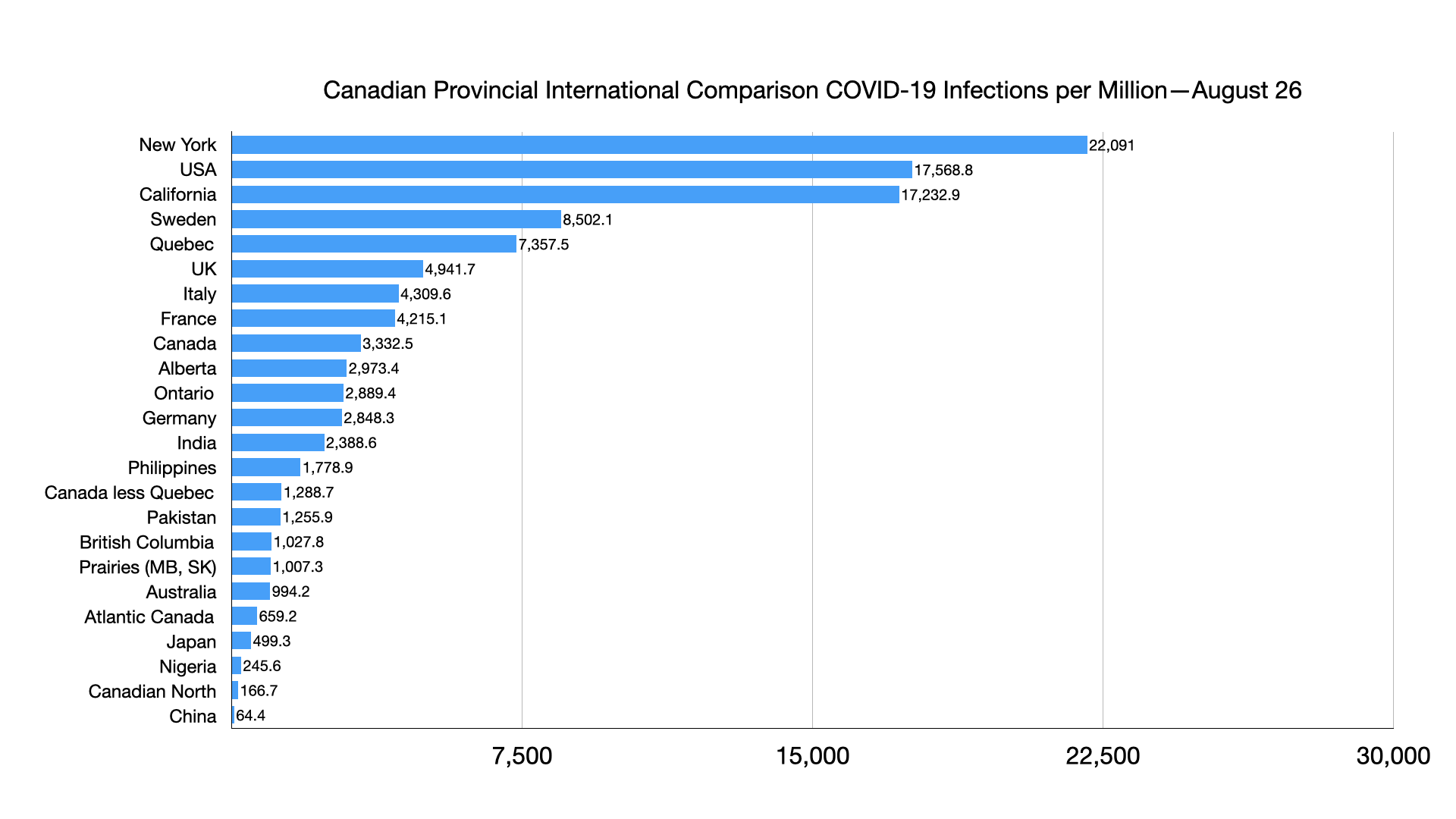
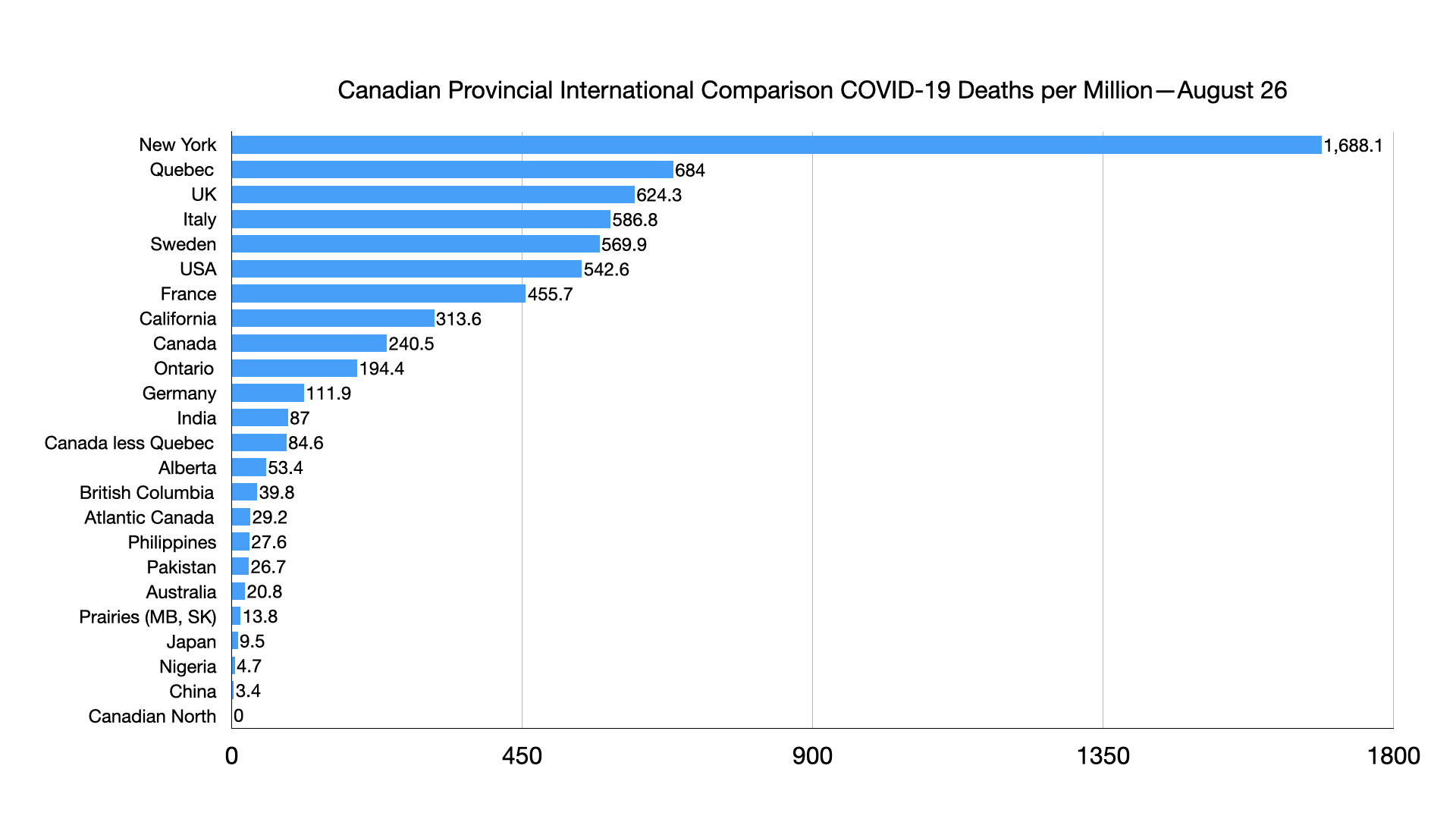
#COVID-19: Comparing provinces with other countries 26 August Update and Globe editorial on Quebec’s handling of the pandemic

Changes of interest include Alberta now has a higher number of infections per million than Ontario, with India and the Philippines having higher infection rates than Canada less Quebec.
India’s death rate per million now exceeds Canada less Quebec.


Lastly, a good Globe and Mail editorial on the failures of the Quebec government in managing the pandemic (Quebec’s COVID-19 death toll is Canada’s highest, and one of the worst in the world. No, that’s not fake news):

There is no province in Canada that has done a perfect job of limiting the spread of the COVID-19 virus. But there is one province that stands out as having done the least perfect job of all, and that is Quebec.

As of Tuesday, Quebec had recorded 724 confirmed cases of COVID-19 per 100,000 people. The national average is 332 per 100,000. The province with the next highest rate, Alberta, stood at 295 on Tuesday.

The same gaps exist in the number of deaths per capita. Quebec has had 67 deaths per 100,000 people – one of the highest death rates in the world, and well above Italy, Spain or the United States. The next highest province, Ontario, is at 19 deaths per 100,000.

It may not be entirely fair to compare across jurisdictions, but Quebec Premier François Legault has invited such scrutiny by resorting to divisive tactics to distract from the painful reality of the crisis in his province.

Last week, he once again accused the veteran health reporter at The Gazette, Montreal’s English-language daily newspaper, of being biased. It was the third time he has claimed that Aaron Derfel is trying to undermine his government with false reporting.

The Premier also said that, if anglophones in Quebec are more worried about catching COVID-19 than francophones, as at least one poll suggests, it must be because they are spending their time reading Mr. Derfel’s tweets and watching CNN and other American news channels.

Attacking journalists and taking cheap shots at a minority group is no way to address a crisis that has claimed the lives of more than 5,700 Quebeckers. Columnists in the province’s French-language newspapers have rightfully pilloried Mr. Legault for trying to shoot the messenger.

Mr. Legault’s tactic has backfired in another way, too, by shining a spotlight on his government’s handling of the crisis. It’s fair to say the Premier has not had a good pandemic.

Not that it’s entirely his government’s fault. Quebec had the misfortune of scheduling its annual school spring break in late February, a week ahead of the rest of the country. Many Quebeckers holidayed in the United States and Europe just as the pandemic was picking up steam. Some experts believe Quebec’s early spike in cases was mostly bad luck.

But the curve of new cases continued to climb after lockdown was imposed in March. And Quebec’s outbreaks in long-term care homes were bigger, longer and deadlier than anywhere else in Canada.

The government’s most glaring misstep occurred on June 24, a provincial holiday, when Quebec’s public-health agency announced it would no longer release data about new cases and deaths on a daily basis – a practice common around the world – and would instead only make them public once a week.

The surprise decision came after Horacio Arruda, Quebec’s chief public-health officer, attended a provincial cabinet meeting at which the issue was discussed, raising concerns that Dr. Arruda had yielded to demands from the Legault government.

Dr. Arruda denied there was any political interference. But three days later, after much criticism from epidemiologists and francophone commentators, the decision was reversed.

In the midst of all that, Mr. Legault demoted his health minister, Danielle McCann, and replaced her with Treasury Board president Christian Dubé.

Firing your lead minister in the middle of a major crisis is never a good look, but Mr. Legault was reportedly fed up with the endless bad news battering his government.

The government has also come under fire for reopening bars in late June, causing a fresh spike in cases, and for raising the maximum number of people at an indoor public gathering to 250 from 50 as of Aug. 3, a move that has backfired in European countries and many American states.

This week it’s the government’s back-to-school plan that is drawing fire. Unlike most other provinces, Quebec students will not have to wear masks or physically distance in classrooms. And parents will not have the option of keeping their children at home to learn remotely, unless they provide a “valid medical note.”

Mr. Legault is not the only premier facing tough questions about their handling of the COVID-19 pandemic. But he’s the only one trying to make a farce of this tragedy, by blaming a reporter for reporting the news.

Source: https://www.theglobeandmail.com/opinion/editorials/article-quebecs-covid-19-death-toll-is-canadas-highest-and-one-of-the-worst/

Bouchard: La souveraineté du Québec, plus nécessaire que jamais

Ironic to cite COVID-19 as a justification for Quebec independence while ignoring that Quebec has the highest number of infections and deaths per million of all Canadian provinces and on par with the most affected European countries.

And of course, both multiculturalism and interculturalism are similar models of civic integration, with more semantic rather than substantive differences:

Du point de vue de notre avenir politique, deux leçons peuvent être tirées de l’actuelle pandémie. Nous avons pu constater que, presque partout, les populations plongées dans l’insécurité se sont tournées vers leur nation pour se protéger. Les instances supranationales, à commencer par l’Union européenne, se sont montrées étonnamment impuissantes à mettre en œuvre des initiatives efficaces pour contrer la pandémie.

Chacun a pu ainsi prendre conscience du recours indispensable que l’État-nation continue de représenter comme rempart dans un contexte de crise. Cette enceinte a montré une grande capacité à susciter une solidarité, montrant ainsi qu’elle est loin d’avoir perdu sa pertinence. Il y a intérêt à la soutenir et à la perpétuer. C’est la première leçon.

La pandémie a aussi révélé la fragilité des réseaux supranationaux. La mondialisation ne s’en trouve pas pour autant condamnée, loin de là, mais elle a accusé d’inquiétantes carences. Il sera prudent de mieux définir nos engagements et nos articulations avec cette sphère qui demeure largement chaotique et imprévisible. On voit l’importance de pouvoir se reposer sur un État doté de tous les pouvoirs essentiels. C’est la deuxième leçon.

Les raisons profondes qui ont toujours motivé le mouvement souverainiste restent d’actualité : le combat pour le français, l’émancipation économique, sociale et culturelle de notre société, le renforcement d’une francophonie nord-américaine et, plus généralement, une plus grande liberté collective pour traiter à notre façon, suivant nos traditions et nos choix, les grands problèmes de l’heure. Ces raisons sont clairement rappelées et mises à jour dans le dernier numéro de la revue Action nationale. La pandémie en fait voir d’autres : renforcer la nation-refuge et procurer à l’État une marge de manœuvre accrue qui lui permet de mieux naviguer à travers les écueils de la sphère planétaire.

Sur l’enjeu identitaire

Tout cela survient au moment où le Parti québécois, occupé à se redéfinir, se donnera bientôt un nouveau chef. J’aimerais, dans ce contexte, soumettre trois réflexions. La première concerne la thématique identitaire, toujours bien vivante au sein de ce parti. Écartons d’abord un malentendu. Il est incontestable qu’une nation a besoin d’une identité comme expression d’une appartenance et source de solidarité. On imagine mal comment, privée de ces ressorts, elle pourrait mobiliser ses citoyens et ses citoyennes autour d’idéaux et de projets communs.

Le danger, c’est lorsque la quête d’une identité glisse vers une auscultation de soi qui l’appauvrit et rétrécit le « nous » de la nation. Un déplacement de ce genre est néfaste pour une société diversifiée. Il tend aussi à diminuer la place d’une dimension essentielle, celle de l’action collective, des grands projets que nous pourrions réaliser tous ensemble comme Québécois. Or, la mémoire de ces réalisations contribue justement à fortifier l’identité.

La population québécoise est de plus en plus diversifiée et le vieux noyau francophone jadis largement majoritaire se contracte progressivement (de 79 % en 1971, sa proportion serait passée à 64 % en 2014). Il est donc nécessaire d’ajuster la définition de la nation et de l’identité à la nouvelle réalité.

Est-ce là succomber au multiculturalisme ? On en est loin. Premièrement, il s’agit simplement de reconnaître les droits de tous les citoyens du Québec, en particulier là où ils sont compromis. Cette règle n’est pas copiée du multiculturalisme, elle fait partie de l’héritage général de toutes les horreurs commises durant la première moitié du XXe siècle en Occident. L’éthique qu’elles ont engendrée invite à respecter la diversité plutôt que de la broyer. Le multiculturalisme canadien en est lui-même une expression parmi bien d’autres, tout comme l’interculturalisme québécois.

Deuxièmement, le modèle canadien en matière de relations interculturelles est très différent de l’approche québécoise. Dans le premier cas, les groupes ethnoculturels se voient accorder une latitude exceptionnelle, si bien que le souci de cimenter ces minorités devient quasiment secondaire.

Au Québec, au contraire, c’est une priorité. Nous sommes une petite nation constamment soucieuse d’intégration, de solidarité, de concertation, de rassemblement — et de survie. Troisièmement, le multiculturalisme canadien reconnaît l’existence de minorités mais nie celle d’une majorité. Comment ce modèle pourrait-il s’appliquer ici ?

Le prochain chef du PQ

Je reviens au Parti québécois. La recherche d’une identité forte, au sens défini plus haut, et la promotion d’une conception vraiment inclusive de la nation ne sont nullement incompatibles. Il suffit de revenir à la tradition instaurée par le parti à ses années glorieuses. La loi 101 en est une parfaite illustration. D’un côté, elle servait les intérêts de la majorité en renforçant le français. De l’autre, elle servait les intérêts des minorités en leur procurant le moyen de mieux s’intégrer à la société et d’y faire leur chemin.

Dans l’intérêt du parti et de celui du Québec, il est éminemment souhaitable qu’il renoue avec cette philosophie qui lui a valu une grande partie de ses succès. Cette tradition est toujours porteuse d’avenir parce qu’elle est étroitement alignée sur le Québec en devenir que les fondateurs avaient remarquablement anticipé.

Concernant la course à la chefferie, ces réflexions invitent à favoriser le candidat qui incarne le mieux à la fois la grande tradition et l’avenir du parti suivant les voies esquissées ici. Parmi les candidatures en lice, celle de Sylvain Gaudreault me semble la plus proche de ce profil.

Source: La souveraineté du Québec, plus nécessaire que jamais

RBC report says immigration slowdown due to COVID-19 threatens Canadian economy

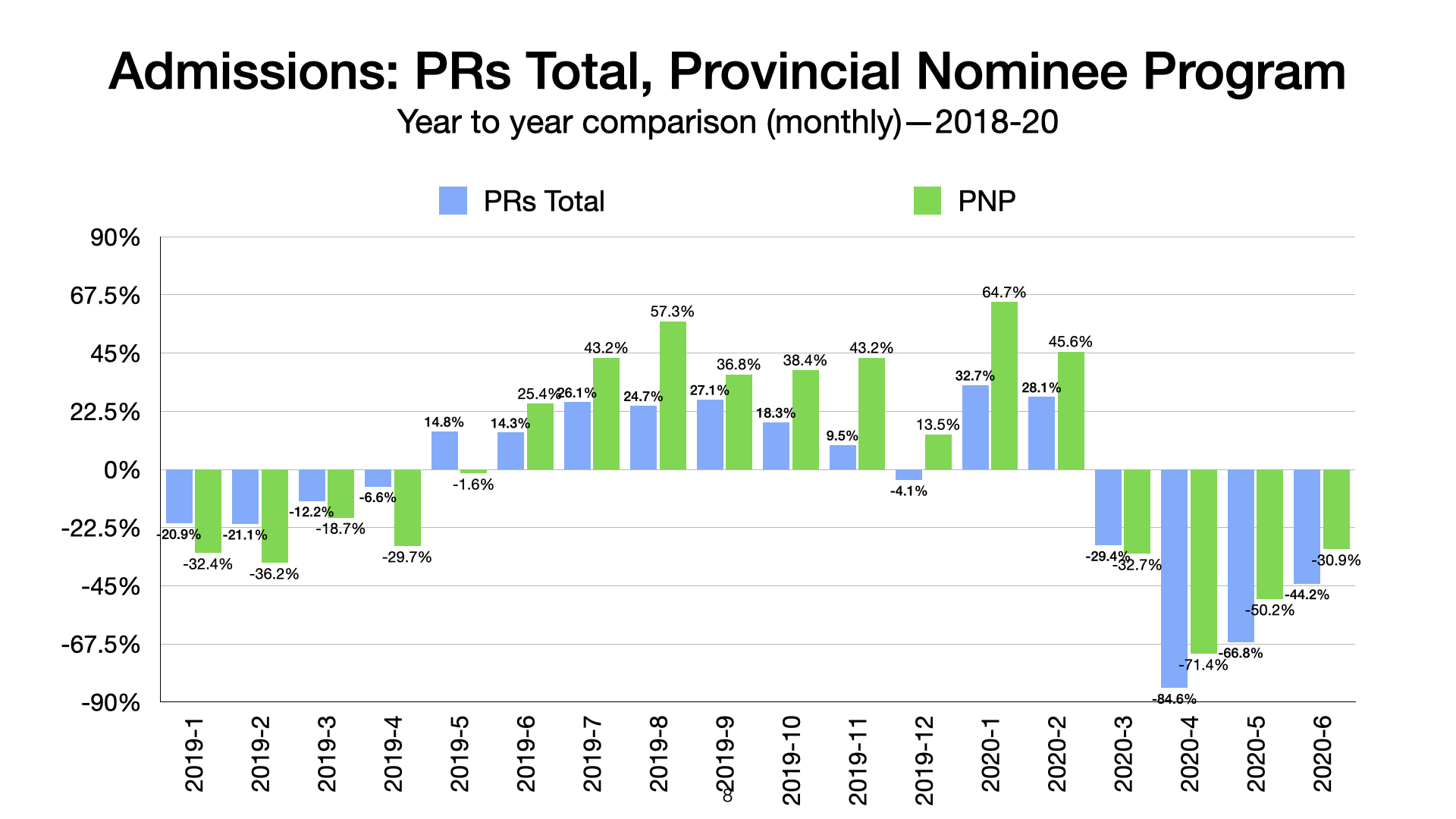
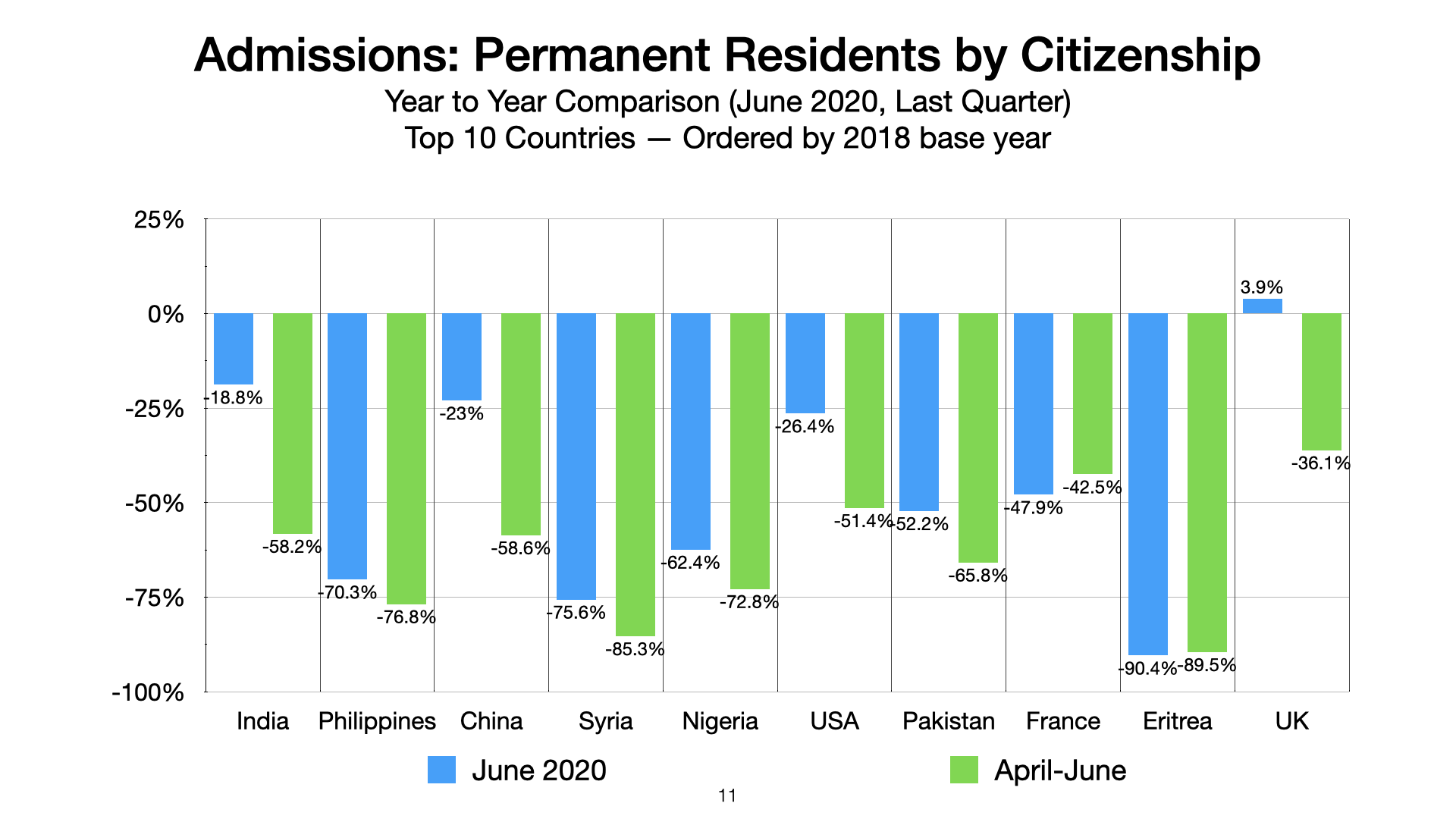
Not much new, but still a reckoning for Canada. The charts below show the year over year for immigrants (economic, family and refugees) as well as the subset coming under the various Provincial Nominee Programs, along with the top 10 countries:

A slowdown of immigration to Canada due to the COVID-19 pandemic threatens to derail a major source of economic and labour force growth, according to a report from the Royal Bank of Canada.

The shortfall jeopardizes the ability of the country to find employees needed in sectors such as health and elder care as the baby boom generation moves into retirement over the next few years, the report says.

It calls on the federal government to find new ways to encourage more immigrants to move to Canada.

“Canada does rely on having large numbers of people coming to the country to fuel growth and, if we see these large declines, one concern could be that people may decide maybe they don’t want to come to Canada anymore,” said report author Andrew Agopsowicz, a senior economist for RBC who studies labour trends.

“I think it’s really important for Canada to ensure the process is clear and that we still put out this attitude that we are open and we want people from the rest of the world to come to our country.”

Canada added 34,000 permanent residents in the second quarter, down 67 per cent from the same period last year, the RBC study said.

Meanwhile, new permanent residency applications to Canada were down 80 per cent and just over 10,000 new study permits were processed, down from 107,000 a year earlier.

Despite a recent recovery in the pace of immigration, the bank expects to see only 70 per cent of the originally targeted 341,000 new permanent residents at the end of the year, a decline of about 100,000 people.

The shortfall is particularly bad news for elder care as labour shortages have gotten worse in the wake of the pandemic’s deadly sweep through the country’s nursing homes, said Dr. Samir Sinha, director of health policy research at the National Institute on Ageing at Ryerson University and director of geriatrics at Mount Sinai Hospital.

“We’ve been having a huge struggle finding workers and retaining workers in this sector for years … and we were only keeping it afloat by often recruiting immigrants who are willing to take on these jobs that we as Canadians didn’t want to do,” he said.

“The fact it’s low paid and not valued also speaks to one of the reasons it’s been incredibly hard retaining (staff).”

Sinha said higher wages are needed not only to recruit Canadian-born workers but also to keep ambitious immigrants on the job longer.

Canada’s ability to attract immigrants with meaningful work as the economy struggles to rebound from the pandemic may be difficult.

A Statistics Canada report published Thursday finds that recent immigrants were harder hit by pandemic-related job losses, with 17 per cent becoming unemployed from March to April compared with 13.5 per cent of workers who are Canadian-born or immigrants who have been in Canada more than 10 years.

The percentage was higher, almost 20 per cent, for recent female immigrants.

The difference is significant, said Statistics Canada analyst Feng Hou, adding it is attributed mostly to recent immigrants having less work experience and earning lower wages.

“From past experience, when immigrants come during hard times, they tend to have a hard time finding jobs,” he said, adding there’s no data as yet to tell if that will happen in the current environment.

Travel restrictions that began in March and continue today make it difficult for people to physically come to Canada, Agopsowicz said.

At the same time, the lockdowns in the early days of the pandemic slowed processing of applications in Canada and prevented potential immigrants from accessing programs to ease application in their home countries.

An unknown is whether the COVID-19 virus, which hits senior citizens hardest, will have a dampening affect on the desire of foreigners to come to Canada and leave behind their vulnerable elderly relatives, Agopsowicz said.

“There’s a lot of uncertainty, I think, when people arrive already during normal times, so I think people are starting to work through what that means,” he said.

“This may be somewhat of a lost year (but) is this going to be easy to recover from next year in terms of bringing increased numbers back?”

Only about 20 per cent of new permanent residents are former students or temporary workers, he pointed out, suggesting Ottawa could do more to try to convince those people to permanently reside in Canada to bolster numbers.

Source: RBC report says immigration slowdown due to COVID-19 threatens Canadian economy

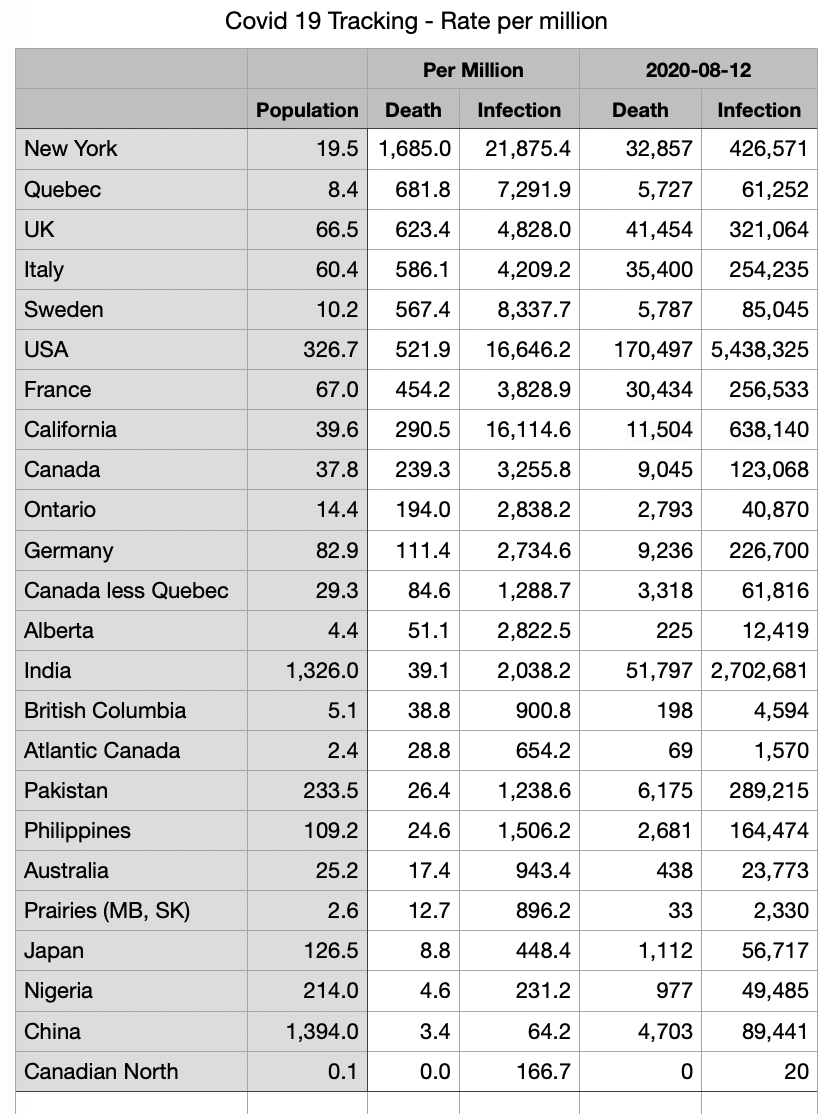
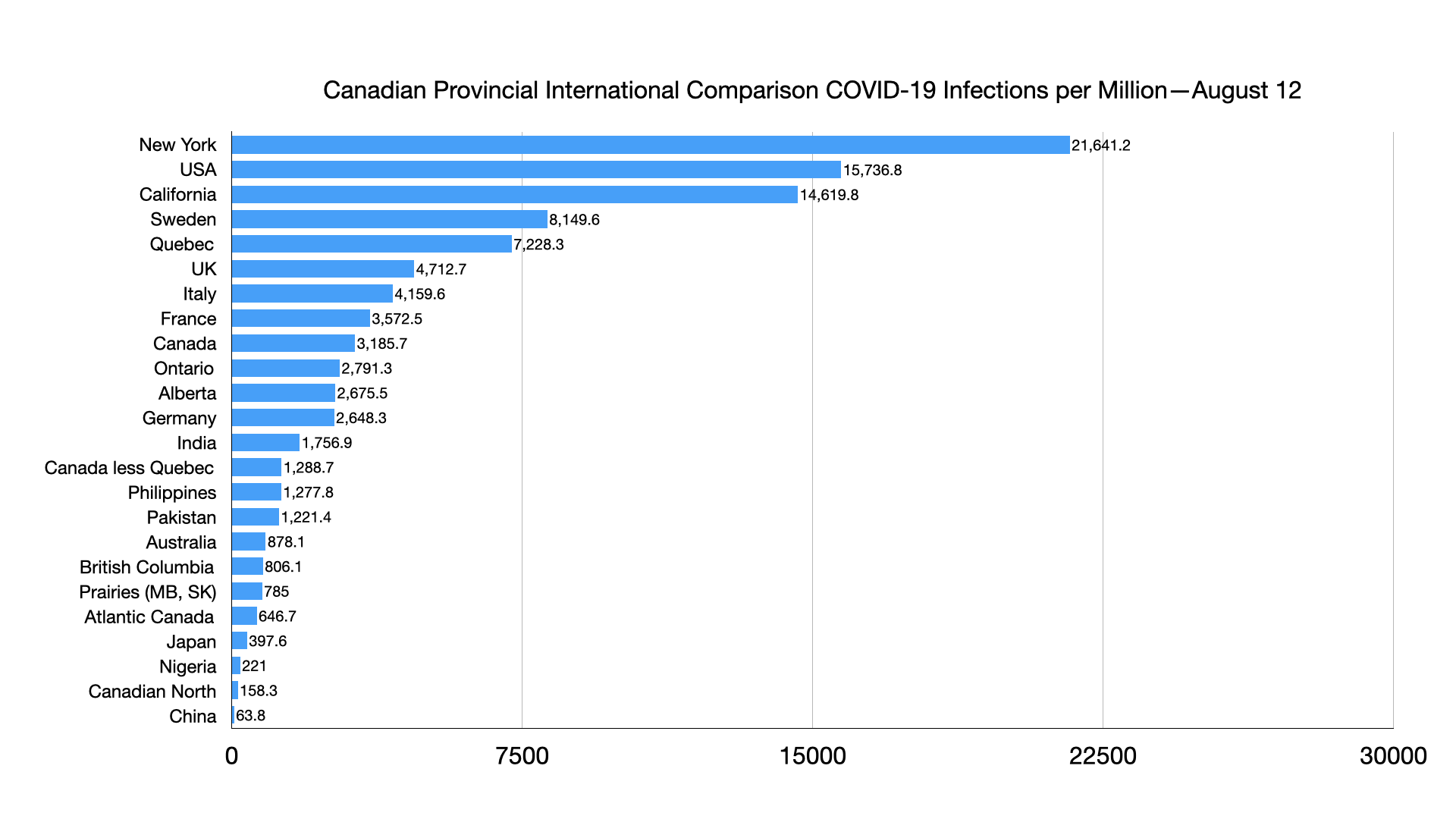
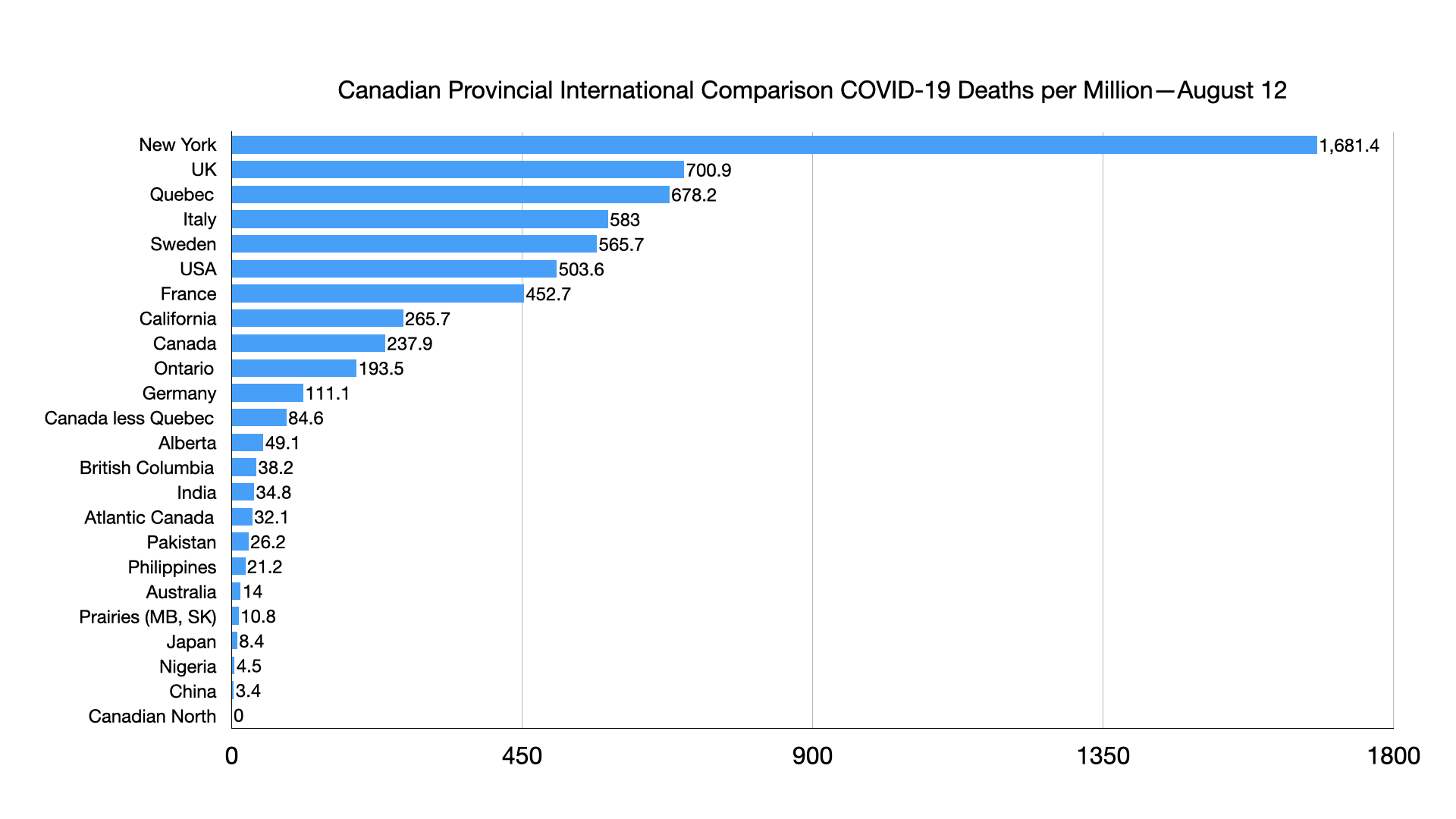
#COVID-19: Comparing provinces with other countries 19 August Update

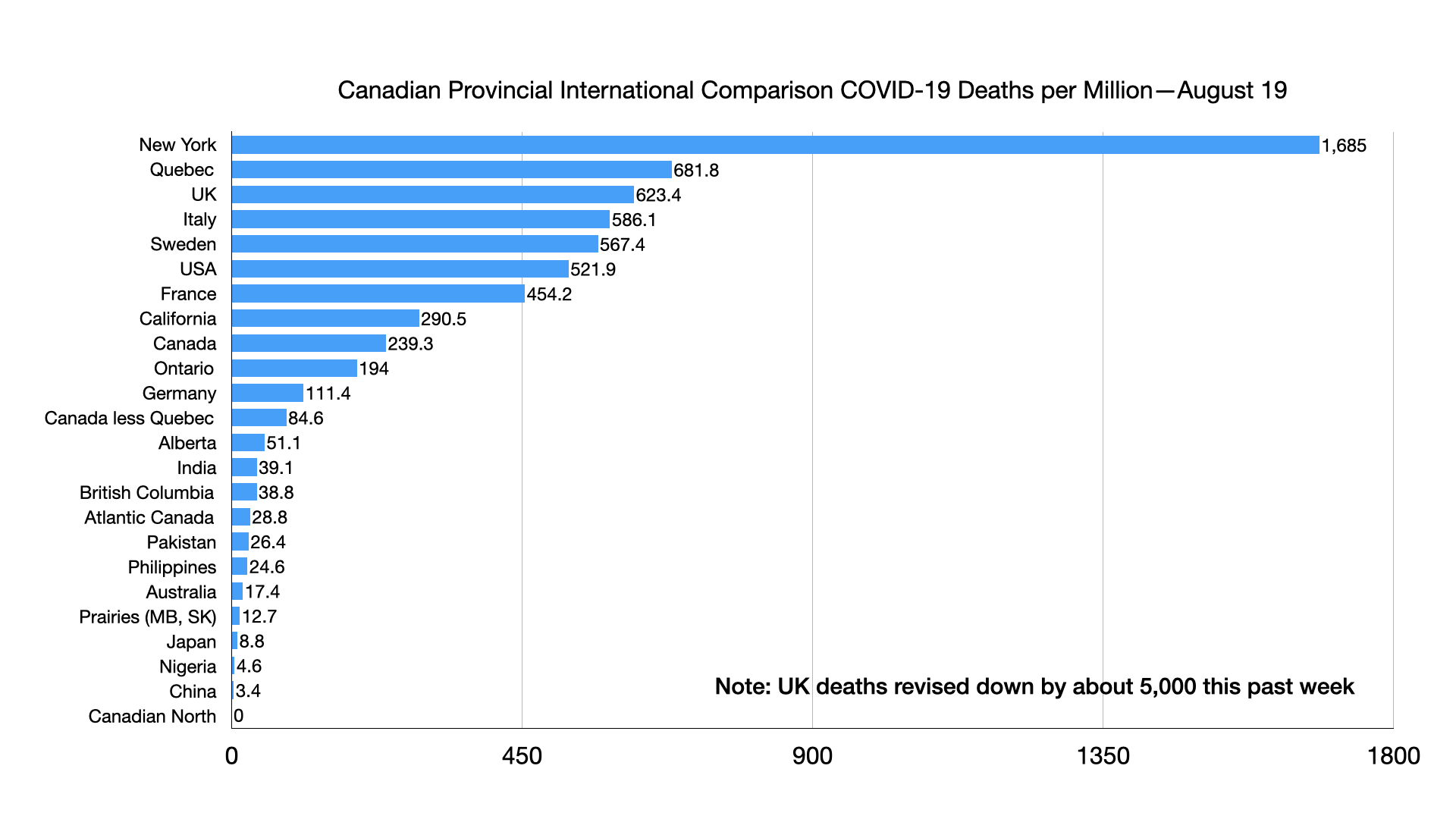
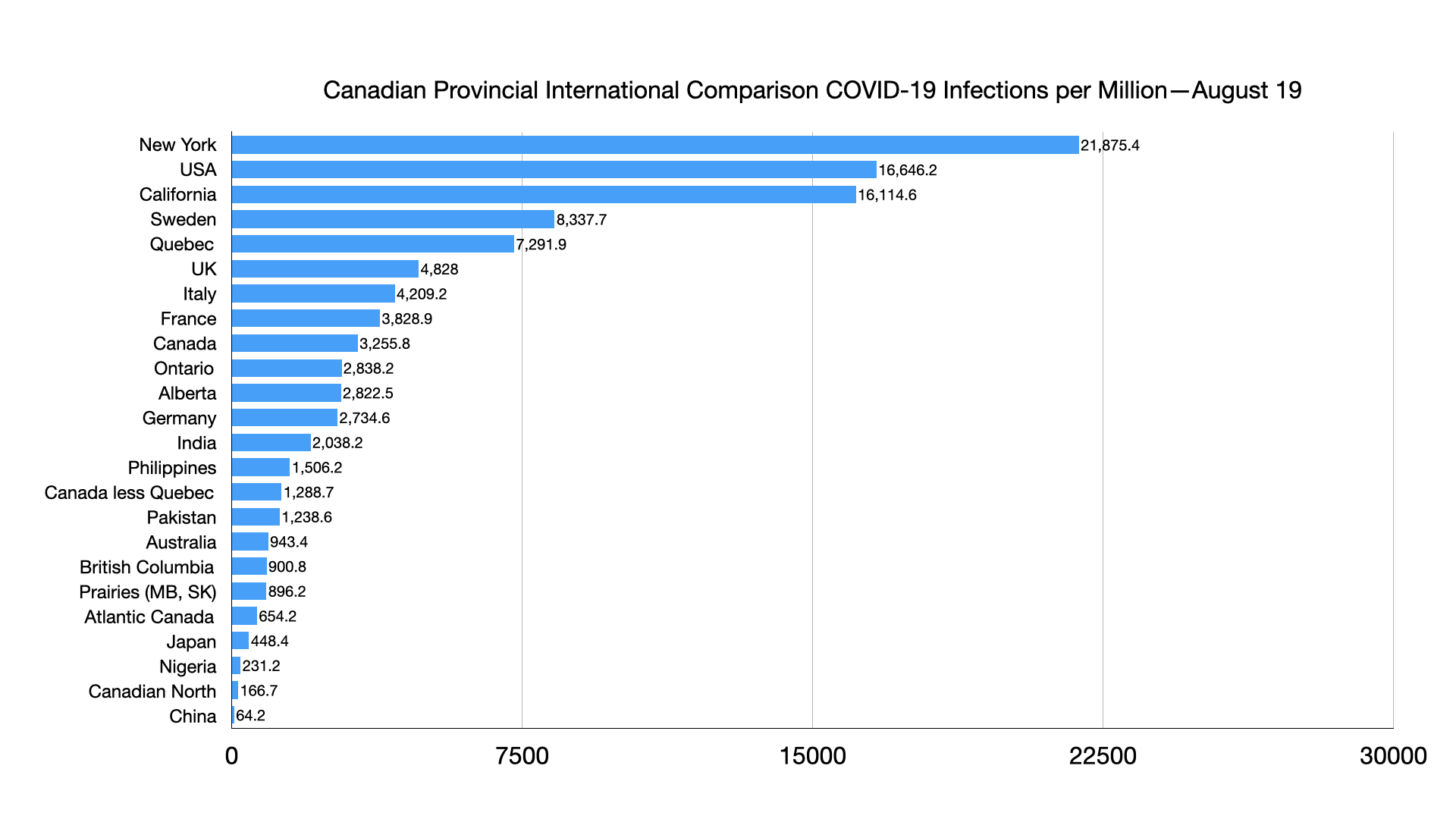
Latest update. As UK revised the number of deaths by about 5,000, Quebec now has the highest death rate per million. Overall infection and death numbers continue to increase given the impact of some of the opening up measures.

Does COVID-19 mean the age of global migration is over?

Good overview of one of the more significant papers on immigration post-COVID by Alain Gamien that policy makers need to consider and reflect upon:

Is the age of migration coming to an end?

For decades, easy air travel, globalization and international competition for talent in some sectors have made the growing movement of people around the world seem unstoppable.

Until now.

With the pandemic leading to less demand for skilled labour, a smaller aging population to support, and a proliferation of travel restrictions, the future of human migration looks pretty grim post-COVID-19.

“We have had the migration boom, now we are heading into the bust,” said Alan Gamlen, a human geographer at Monash University in Australia and author of a new paper about the outlook of migration, Migration and mobility after the 2020 pandemic: The end of an age?

If Canada’s immigration numbers between April and June — the first full quarter under the influence of the pandemic — are any indication of what is to come, things don’t bode well.

According to a new study to be released later this week by the Association for Canadian Studies, the number of permanent residents admitted to Canada dropped by 64 per cent to 34,260 in the second quarter of 2020, compared to 94,275 during the same period last year.

Those who came under the skilled economic class fell a whopping 52 per cent to 24,805 from 51,665; the family class is down 78 per cent to 5,990 from 27,080; and resettled refugees and protected persons declined by 83 per cent to just 2,685 from 14,570.

While much of that is due to border closures, experts say it’s not immediately clear if the downward trend will be totally reversed once travel restrictions are eased.

In his paper, released in August as part of the International Organization for Migration’s “think series,” Gamlen posed ten key questions that guide future migration and mobility trends.

The No. 1 question on the list is whether countries will need less labour migration.

Unemployment has skyrocketed during the pandemic. With corporate borrowing at a historic high, Gamlen said many companies now lack the revenue to service debt and are either folding or cutting staff.

The net result will be a reduction in demand for migrant labour, with a large pool of unemployed domestic workers and mounting political pressure to hire them over migrant workers.

“It is hard to find grounds for much optimism regarding the short- to medium-term outlook,” Gamlen told the Star.

“We will continue to see dependence on migrant labour in certain sectors of the economy, particularly at the high and low ends of the skills spectrum. This is because some sectors involve work that native workers can’t or won’t do, and because innovation will remain a key driver of prosperity.”

Further complicating the forecast is the uneven death toll COVID-19 has taken on the elderly population, a group that’s particularly vulnerable to the virus as seen in the death rates around the world.

“If high mortality rates persist until a vaccine can be mass produced, the overall death toll could amount to a significant portion of the elderly cohort,” said Gamlen, a long-standing research associate at Oxford University’s Centre on Migration, Policy and Society.

“If the pandemic devastates a specific generation, it will affect long-term dependency ratios and dynamics of demographic transition. It could reduce the proportion of dependent elderly people in the population and the financial cost of aged care, while generating a boom of babies conceived in lockdown.”

Places where people can move freely to another country by choice will likely see a decline in those rates as they put their migration plan on hold, but the traditional labour-sending countries in the developing world will see a “buildup” of people longing to leave their homelands, said Gamlen.

“The interaction of these changing flows from different places will, I think, lead to a period of unstable, non-linear changes in migration patterns,” he argued.

“The overall volume will decrease, but flows might be less predictable — like when you turn the kitchen tap halfway off, and the water starts spraying out sideways instead of flowing nicely down into the sink.”

Gamlen said it’s inevitable that the numbers of people crossing borders, especially on a permanent and long-term basis, will fall further before they bounce back — if they ever do.

“A huge amount depends on how governments manage all this. They will have a lot of control over when and how borders start to reopen and their choices in this regard will affect both the recovery timeline from the pandemic and from the economic crisis,” he said.

“Opening too early could reignite the spread of the virus. Opening too late could stifle growth and lead to a new era of closed-shop nationalism — which has ended very badly in the past.”

In its immigration study, the Association for Canadian Studies polled 1,531 Canadians between July 31 and August 2 about their attitude to immigration. Forty-six per cent of respondents still believed immigration would have a very positive or somewhat positive impact on Canada while 26 per cent of people held the opposite view.

Given the pandemic, 36 per cent of the respondents said Ottawa should prioritize the admission of those with family members in Canada, followed by refugees (16%), temporary foreign workers (12%), skilled immigrants (8%) and international students (7%).

Jack Jedwab, the academic association’s president, said whether the pandemic will mark the end of migration depends on how long the contagion lasts.

“Canadians seem comfortable with the reduced numbers and are still positive about the impact of immigration and committed to immigration as a strategy for medium to long term economic growth,” Jedwab said.

“But it is not clear when the medium term will occur. The contagion does not provide us with a time frame. There will be a need to reassess the needs regarding immigration given the economic uncertainty and what the changing circumstances call for.”
Source: https://www.thestar.com/news/gta/2020/08/17/does-covid-19-mean-the-age-of-global-migration-is-over.html

COVID-19’s latest victims: Would-be citizens waiting to take their oath face new delays over expired clearances

Appears to be a case for some flexibility on a case-by-case basis as has been done elsewhere:

The backlog and wait time for new citizenship ceremonies are bound to grow due to a new complication brought on by COVID-19.

The traditional in-person oath-taking mass ritual has already been cancelled since March as a result of public health concerns during the pandemic. As long as someone hasn’t sworn their allegiance to the country, they are still just permanent residents and are unable to vote or run for political office.

The immigration department has since slowly moved the citizenship ceremonies online.

But in the meantime, some would-be citizens who have already passed their exam and are in the queue to go in front of a citizenship judge are being told they can’t take their oath because their criminal clearances expired while they’ve been waiting for their turn.

“As required by the Citizenship Act, all citizenship candidates must meet the requirements for citizenship, including being free of prohibitions prior to taking the oath of citizenship. As such, individuals must have valid clearances in order to be permitted to take the oath,” said immigration department spokesperson Lauren Sankey.

“The criminality clearance is valid for 12 months and must be valid at the time citizenship is granted and the oath of citizenship is taken.”

According to a response to an access to information request, at least 76 virtual citizenship ceremonies were cancelled in Montreal, Greater Toronto and the Atlantic region up until the end of June as a result of expired criminal clearances.

A would-be new citizen told the Star his original in-person citizenship ceremony for March 20 was cancelled and he was then rescheduled for a virtual ceremony for June 25. But less than 24 hours before the event, he was told by email that it was cancelled because he needed a new clearance certificate.

“Getting citizenship is like being adopted by Canada. Imagine you’re in an orphanage waiting to be adopted. You met your adopted parents and they said they’d pick you up and take you home on a certain day. Before that day comes, they call the orphanage and say they can’t come,” said the American immigrant, who asked that his name not be used for fear of repercussions.

“You don’t hear anything for several months. Then less than 24 hours before the next pickup day, they call and cancel again. That’s pretty deflating there.”

The man, who moved to Toronto 12 years ago after marrying a Canadian, said he was told by his MP’s office that the citizenship application process is all paper-based. Hence, there are no automated systems warning immigration officials when a criminal clearance is about to expire.

He said he’s still waiting for instructions from the immigration department about what to do next.

Sankey said immigration officials will request new criminal checks from other federal agencies in the event clearances have expired before a citizenship ceremony.

“It is not necessary for applicants to reapply,” she said. “Once valid clearances are returned, these clients will be prioritized and rescheduled at the earliest opportunity.”

Additional delays are expected because the department depends on its partners to complete the process.

“Generally, clearances should take about a week to complete, however in the current context, our partners are making assessment on a case-by-case basis, consequently IRCC (Immigration, Refugees and Citizenship Canada) cannot provide specific processing time frames,” Sankey said.

Source: COVID-19’s latest victims: Would-be citizens waiting to take their oath face new delays over expired clearances