HASSAN: Pakistan’s particular second wave challenge

Given Pakistan one of our top five immigration source countries,  of interest, with similarities with some of the fringes in Western countries:

Pakistan’s management of the pandemic was initially lauded even by the World Health Organization. Not so, the second wave.

The latest outbreaks have wrought havoc across the world, and Pakistan is no exception. COVID-19 appears to be spreading rapidly in many parts of the country. The rest of the world is beginning to see the hope of ending the pandemic in the development of various vaccines.

But Pakistan poses a special challenge toward fighting the pandemic within its borders. According to Younis Dar, Pakistan’s situation is “far more dangerous” as a significant number of Pakistanis refuse to embrace the idea of inoculation because of rampant suspicion against the vaccines.

Source: HASSAN: Pakistan’s particular second wave challenge

Impact of Covid-19 on Immigration to Canada – Working Deck – October 2020 Numbers Updated with temporary resident data

This is an updated version, including the October numbers for temporary residents (International Mobility Program and Temporary Foreign Workers Program). The most interesting data point is the sharp increase in the number of post-graduate employment, which increased more than five-fold compared to September, and more than doubled compared to October 2019.

I went on Punjabi radio to share COVID information with my community. I learned that multicultural media has been kept in the dark

Ethnic media is often unappreciated at times like these:

“I would encourage listeners to not take medicine as there are lot of side effects.” These are the types of uninformed messages I heard being blasted on a Punjabi radio show as I awaited my turn to speak about COVID-19 precautions.

As a General Surgery Resident at the University of Toronto, I decided to personally reach out to this media outlet to promote awareness around COVID-19 in Punjabi. I had recognized the importance of dissemination of cultural and language specific information while working with my patients, and colleague physicians from different specialties including Public Health, and Infectious Disease.

I was also inspired to connect with Punjabi radio and TV shows after seeing the way my family and friends relied on information from these sources. As part of my social media campaign, Humans in Brampton, I also spoke to a few truck, and taxi drivers who sometimes go on long cross border trips and they informed me that their sole knowledge about COVID-19 is from Punjabi, Hindi, and Urdu radio shows.

Moreover, I came across multiple tweets from community advocates urging physicians and public health officials to speak to the community directly. These tweets were in response to conversations in national media about the rise of COVID-19 cases in specific communities such as North East Calgary in Alberta, and Peel region in Ontario. What emerged from these discussions was the role of socioeconomic status, language barriers, health care and workplace inequities that exacerbated the pandemic burden in such communities.

Speaking to some of the Punjabi Radio and TV media outlets, I was surprised to learn how underutilized these platforms have been throughout the pandemic. One of the spokesmen for such a media platform informed me, “We have hardly been approached by physicians, public health or government bodies to run COVID-19 specific messaging on a regular basis. We would be more than thrilled to have them on our shows,” they said.

In another live Punjabi TV discussion that was being broadcasted throughout North America, I received a question from a New York resident who had tested positive for COVID-19 regarding precautions, and this solidified my belief that these highly impactful public platforms have not been utilized during the pandemic to disseminate life-saving information even across the continent.

I was also shocked to learn that more homeopathy and alternative care providers used these language specific platforms to deliver health related information than government bodies, and physicians. The lack of information and even worse, misinformation, can be dangerous for the community members as they are essentially in the dark about how to protect themselves from COVID-19.

Based on 2016 Statistics Canada data, Peel region in Ontario for instance had the lowest percentage (60.92 per cent) of population speaking in English at home. 4 per cent of the Peel population had no knowledge of English or French. Language, on top of other inequitable factors is another barrier many of these communities face when it comes to inaccessibility to health care and information.

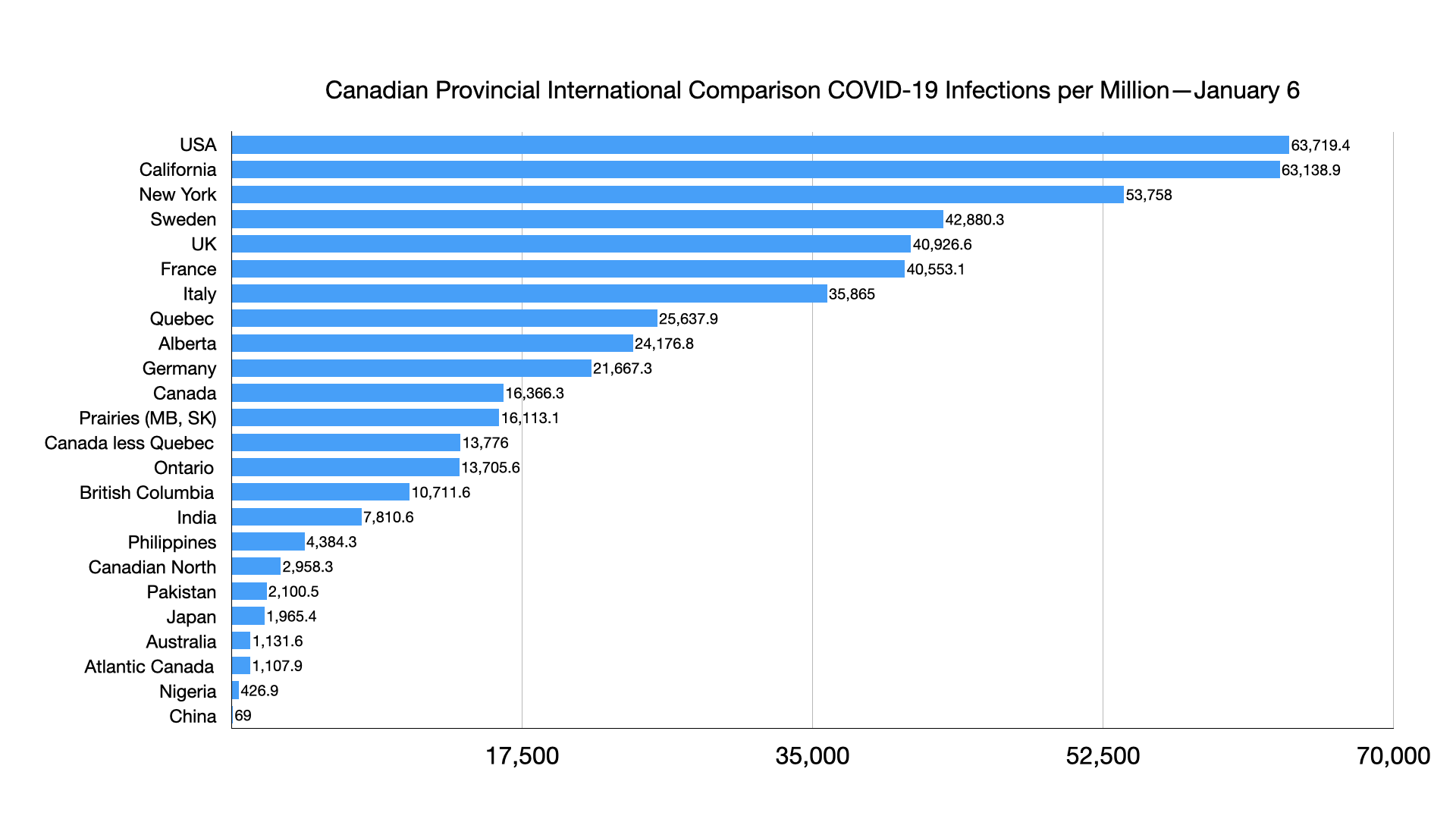
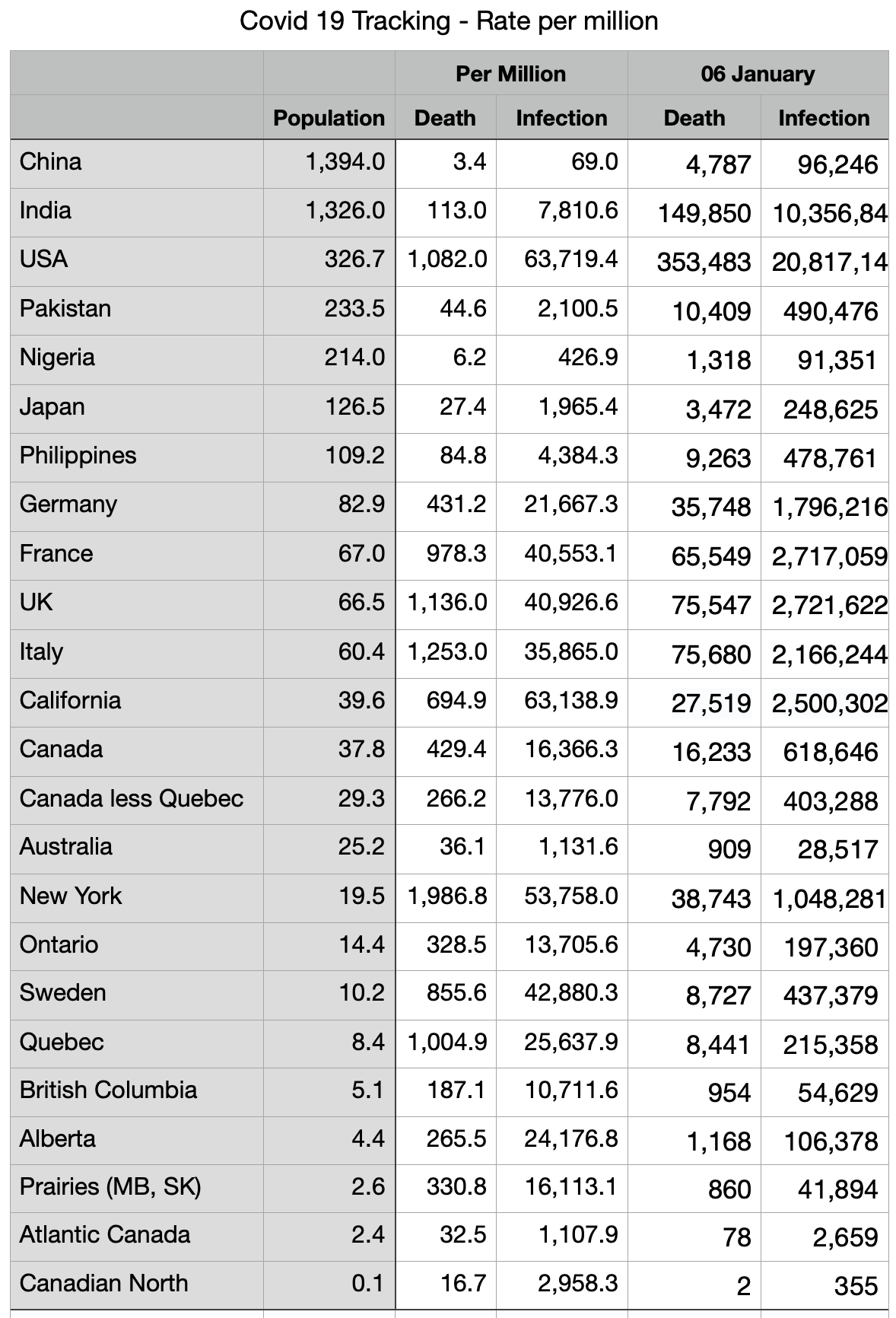
#COVID-19: Comparing provinces with other countries 6 January Update

The standard charts can be found below.

There has understandably been a “feeding frenzy” regarding federal and provincial parliamentarians who have disregarded public health and their own government’s advice to forego travel, domestic or international, during the holidays.

In some cases, this has been to visit elderly family members (e.g., Sameer Zuberi and Kamal Khera of the Liberals, Niki Ashton of the NDP), in others for holidays (the various Alberta MLAs and Premier Kenney’s Chief of Staff, Quebec MNA Pierre Arcand) along with others.

Responsibility and accountability has been mixed. The federal NDP handled Ashton’s case the best, removing her quickly from her critic responsibilities, setting the tone for the federal liberals to follow sui. Ontario Premier Ford initially botched it being aware of his former finance minister Rod Phillips vacationing in St Barts but recovering quickly by accepting (insisting?) on his resignation. In rare tone deafness, Alberta Premier Kenney initial response not to sanction minister Allard, his Chief of Staff Huckabay and a number of MLAs, for travel during the holidays, that prompted outrage on all sides of the political spectrum and led to belated resignations and discipline.

Highly ironic given Kenney and the UCP reliance of “personal responsibility” and “good judgement” to reduce COVID risks when so many in the government have demonstrated neither.

Some good examples of Alberta commentary:

Rick Bell: Premier Kenney, it’s time to face the music

Don Braid: Kenney fires and demotes to spike scandal, but Albertans will decide if they forgive

And the contrary arguments from C2C’s editor George Koch:

In Alberta, Premier Jason Kenney first avoided meting out Ford-style punishment upon Allard and her fellow travellers. When the news broke, Kenney himself shouldered much of the blame and said he would provide new and crystal-clear “guidelines” covering ministers, MLAs and senior bureaucrats. The opposition, however, gleefully called for Allard’s headwhile the media republished tweets demanding Kenney’s own resignation. It has become fashionable to criticize nearly anything Kenney says or does; his handling of the pandemic is, according to one poll, approved of by just 30 percent of Albertans.

Personally, I found the Alberta premier’s initial response not only courageous but admirable and honourable. Unlike Ford and innumerable politicians, corporate leaders and heads of other organizations in countless analogous situations, Kenney declined to throw Allard under the bus. This is not the first time Kenney has gone to the mat for a subordinate, at considerable short-term political cost to himself. Who would you rather work for? Further, someone who clearly cares about the people who work for him might, just might, also be sincere in his concern for small businesspeople and voters at large.

Sadly, however, Kenney ultimately could not resist the stinking red tide of public opinion; on Monday, he accepted Allard’s resignation from cabinet, as well as that of his chief of staff, who had travelled to the UK, and demoted the other MLAs.

Source: https://c2cjournal.us19.list-manage.com/track/click?u=e8efce716429c34122979e2de&id=cb2f1e50a3&e=4174a59277

Minor week to week changes:

Infections per million: Sweden moves ahead of UK which in turn moves ahead of France, Canada total ahead of Prairies

Deaths per million: Germany moves ahead of Canada

And the standard weekly charts and table.

Palestinians excluded from Israeli Covid vaccine rollout as jabs go to settlers

Of note and undermines claims not to be an apartheid-type state:

Israel is celebrating an impressive, record-setting vaccination drive, having given initial jabs of coronavirus shots to more than a 10th of the population. But Palestinians in the Israeli-occupied West Bank and Gaza can only watch and wait.

As the world ramps up what is already on track to become a highly unequal vaccination push – with people in richer nations first to be inoculated – the situation in Israel and the Palestinian territories provides a stark example of the divide.

Israel transports batches of the Pfizer/BioNTech vaccine deep inside the West Bank. But they are only distributed to Jewish settlers, and not the roughly 2.7 million Palestinians living around them who may have to wait for weeks or months.

“I don’t know how, but there must be a way to make us a priority, too?” said Mahmoud Kilani, a 31-year-old sports coach from the Palestinian city of Nablus. “Who cares about us? I don’t think anybody is stuck on that question.”

Two weeks into its vaccination campaign, Israel is administering more than 150,000 doses a day, amounting to initial jabs for more than 1 million of its 9 million citizens – a higher proportion of the population than anywhere else.

Vaccine centres have been set up in sports stadiums and central squares. People over 60, healthcare workers, carers and high-risk populations have priority, while young, healthier people who walk into clinics are sometimes rewarded with surplus stock to avoid the waste of unused vials.

The prime minister, Benjamin Netanyahu, has told Israelis that the country could be the first to emerge from the pandemic. As well as a highly advanced healthcare system, part of the reason for the speed could be economics. A health ministry official said the country had paid $62 a dose, compared with the $19.50 the US is paying.

Meanwhile, the cash-strapped Palestinian Authority, which maintains limited self-rule in the territories, is rushing to get vaccines. One official suggested, perhaps optimistically, that shots could arrive within the next two weeks.

However, when asked for a timeframe, Ali Abed Rabbo, director-general of the Palestinian health ministry, estimated the first vaccines would probably arrive in February.

Those would be through a World Health Organization-led partnership called Covax, aimed at helping poorer countries, which has pledged to vaccinate 20% of Palestinians. Yet vaccines intended for Covax have not yet gained “emergency use” approval by the WHO, a precondition for distribution to begin.

Gerald Rockenschaub, the head of office at WHO Jerusalem, said it could be “early to mid-2021” before vaccines on the Covax scheme were available for distribution in the Palestinian territories.

The rest of the doses are expected to come through deals with pharmaceutical companies, but none have apparently been signed so far.

Despite the delay, the authority has not officially asked for help from Israel. Coordination between the two sides halted last year after the Palestinian president cut off security ties for several months.

But Rabbo said “sessions” with Israel had been held. “Until this moment, there is no agreement, and we cannot say there is anything practical on the ground in this regard,” he said.

Israeli officials have suggested they might provide surplus vaccines to Palestinians and claim they are not responsible for Palestinians in the West Bank and Gaza, pointing to 1990s-era interim agreements that required the authority to observe international vaccination standards.

Those deals envisioned a fuller peace agreement within five years, an event that never occurred. Almost three decades later, Israeli, Palestinian and international rights groups have accused Israel of dodging moral, humanitarian and legal obligations as an occupying power during the pandemic.

Gisha, an Israeli rights group, said Palestinian efforts so far to look elsewhere for vaccines “does not absolve Israel from its ultimate responsibility toward Palestinians under occupation”.

The disparities could potentially see Israelis return to some form of normality within the first three months of this year, while Palestinians remain trapped by the virus. That may have a negative impact on Israel’s goal of herd immunity, as thousands of West Bank Palestinians work in Israel and the settlements, which could keep infection rates up.

In Gaza, an impoverished enclave under an Israeli-Egyptian blockade, the timeframe could be even longer than in the West Bank. The strip’s Islamist rulers, Hamas, have been unable to contain the virus and are enemies with Israel and political rivals with the Palestinian Authority.

Salama Ma’rouf, head of the Hamas-run Gaza press office, estimated vaccines would arrive “within two months”, adding that there was coordination with the WHO and the Palestinian Authority.

Heba Abu Asr, 35, a resident of Gaza, jolted when asked how she felt about others getting the vaccine first. “Are you seriously trying to compare us with Israel or any other country?” she asked. “We can’t find work, food, or drink. We are under threat all the time. We do not even have any necessities for life.”
Source: https://www.theguardian.com/world/2021/jan/03/palestinians-excluded-from-israeli-covid-vaccine-rollout-as-jabs-go-to-settlers

Impact of Covid-19 on Immigration to Canada – Working Deck- October 2020 Numbers

This deck reviews the impact of COVID-19 on immigration-related programs as of October 2020 (the latest data that is publicly available) with exceptions noted. 

Programs covered include permanent residents, temporary residents (IMP, TFWP, students), asylum claimants, citizenship and visitor visas. Data is from IRCC/Opendata. 

The deck highlights the commonalities and differences in impact between different programs, their respective categories or types and the top 10 source countries for each program. 

The deck also includes website outside Canada traffic for work permits, study permits, integration services and citizenship. This can be seen as a leading indicator as this data becomes available immidiately after end month (e.g., December 2020). 

The data for IMP and TFWP dates from August, settlement services from May (special run). 

While there has been a slight recovery from the virtually complete shutdowns of the April-June quarter, the decline in all programs is over 60 percent for the April-October period.

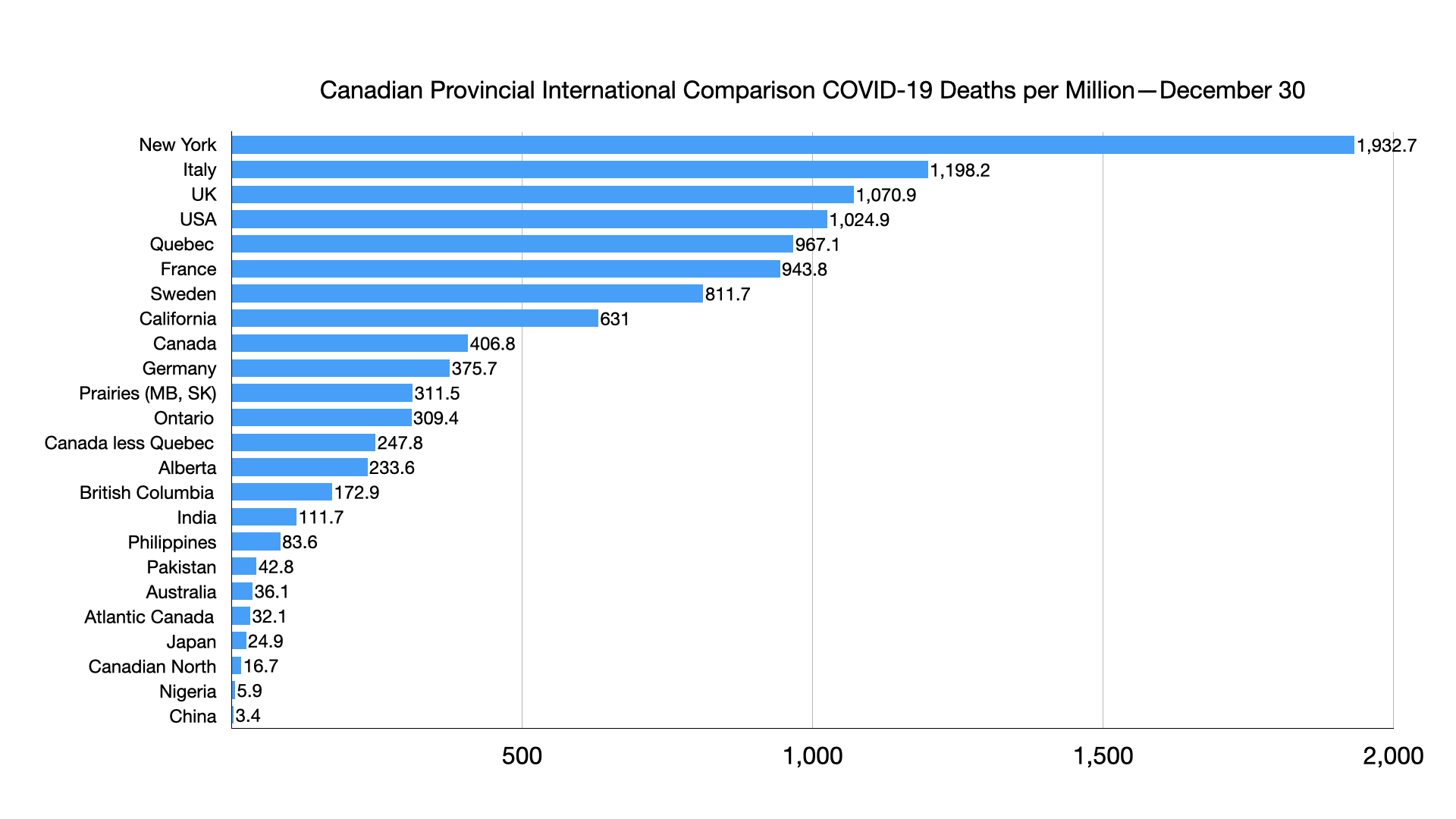
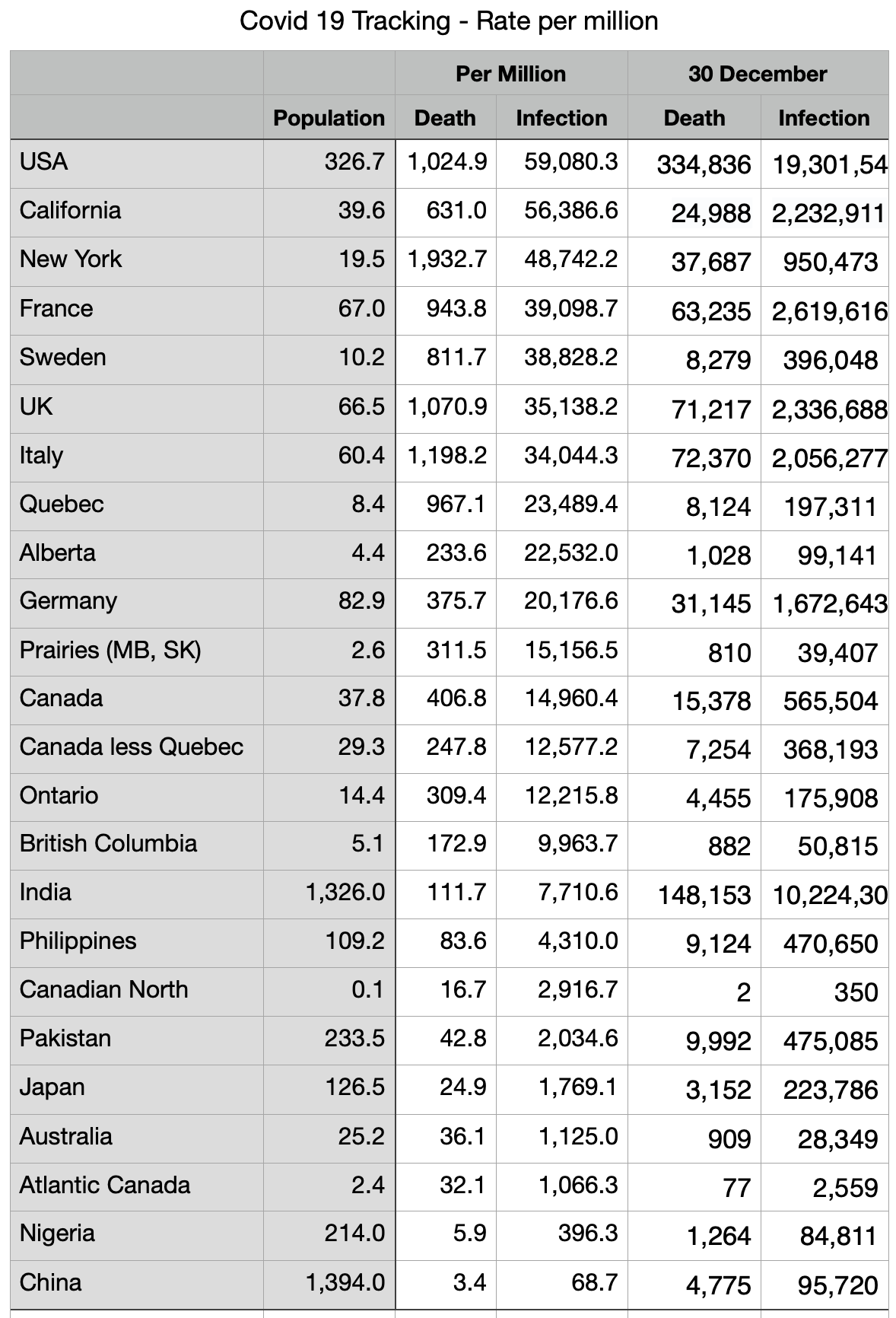
#COVID-19: Comparing provinces with other countries 30 December Update, including cumulative data

Will now provide the trend line and weekly data to provide a more complete picture. As the charts are self-explanatory (advise me if not), will continue to keep narrative to a minimum.

Alberta’s infection rate maintains its overall convergence with Quebec whereas the death rate of the Prairie provinces (Manitoba, Saskatchewan) have converged with Ontario’s.

The other related news, despite all the warnings and advice from political leaders, the Ontario finance minister was caught “off message” with a trip to the exclusive Caribbean of St Barts. Not the only one, Quebec MNA Pierre Arcand went to Barbados. Not to forget federal health minister Patty Hajdu’s repeated trips home to her riding during the first wave.

One expects better.

Lastly, may I wish you a happier new year.

Weekly updates below. Minor changes only:

Infections per million: UK moves ahead of Italy

Deaths per million: Prairies (Manitoba, Saskatchewan) moves ahead of Ontario

And the standard weekly charts and table.

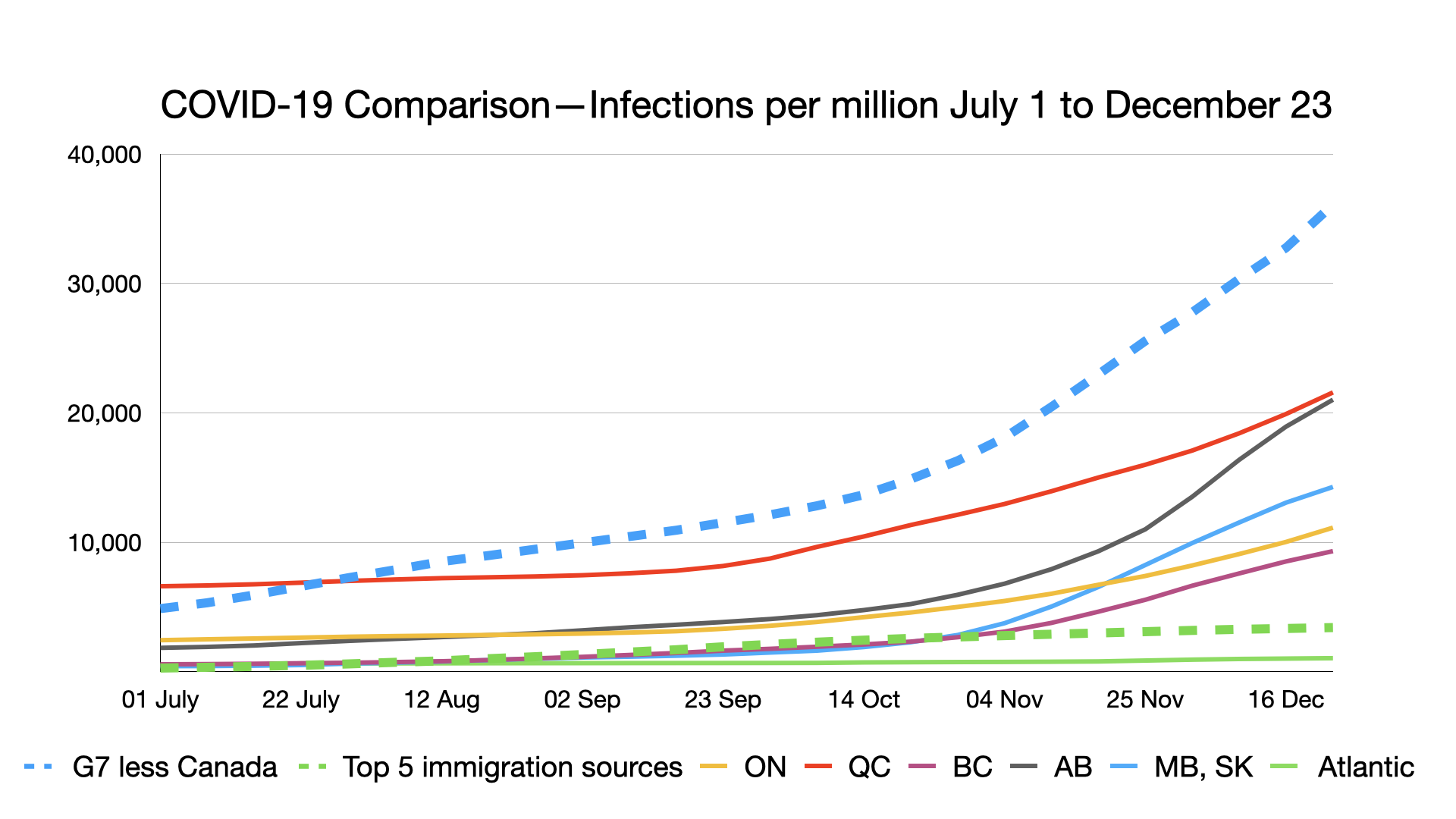
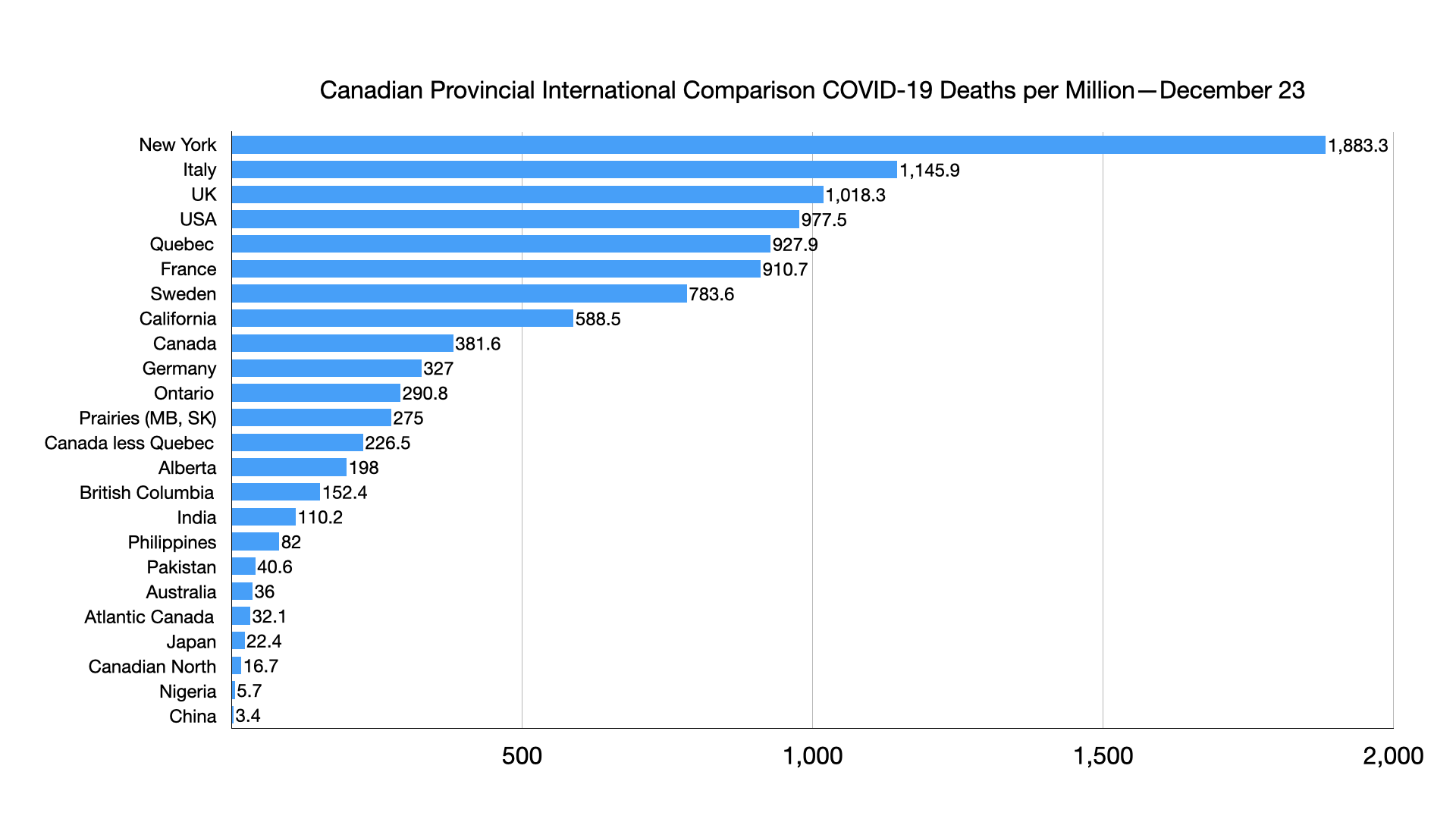
#COVID-19: Comparing provinces with other countries 23 December Update including cumulative data

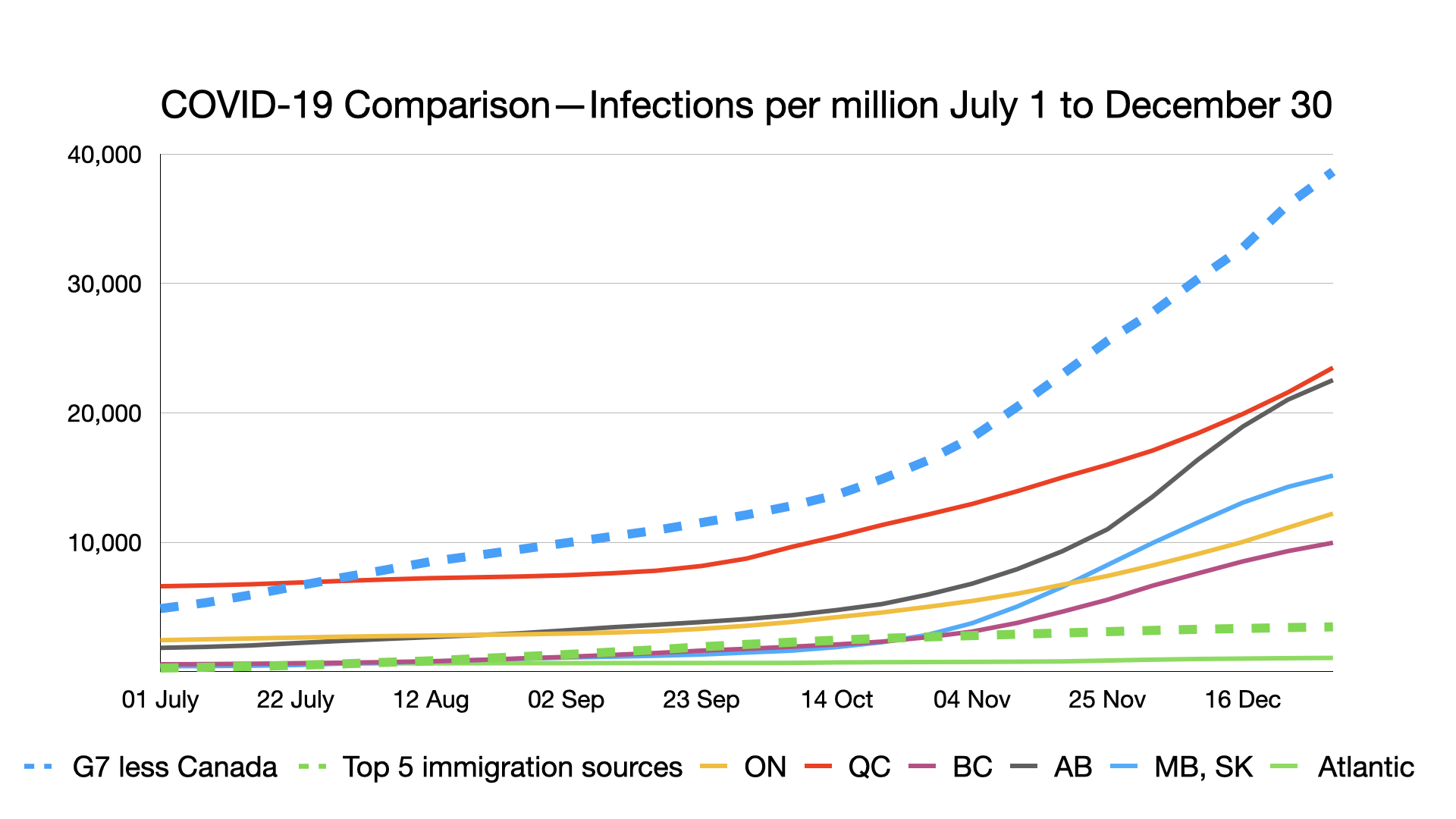
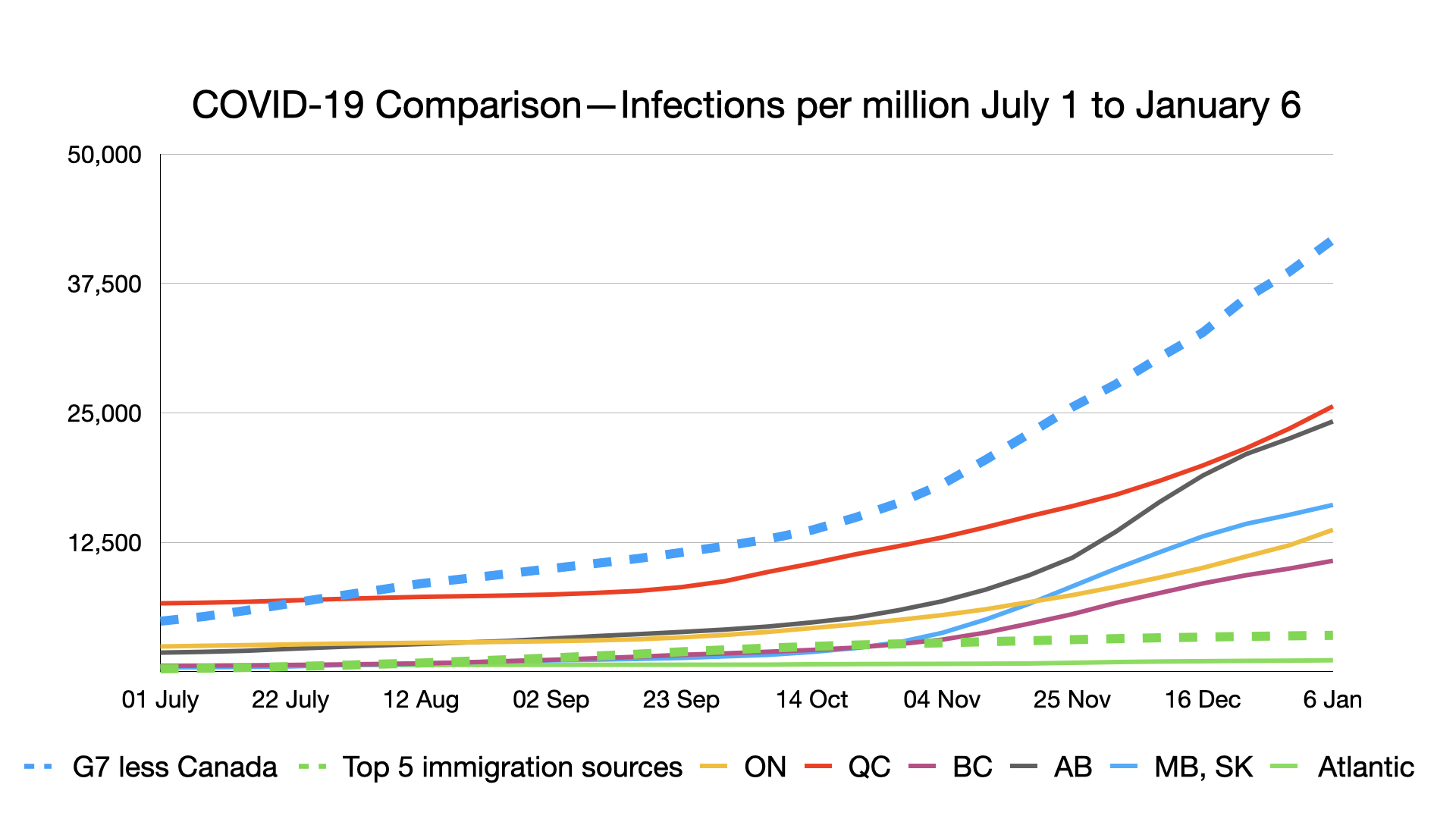
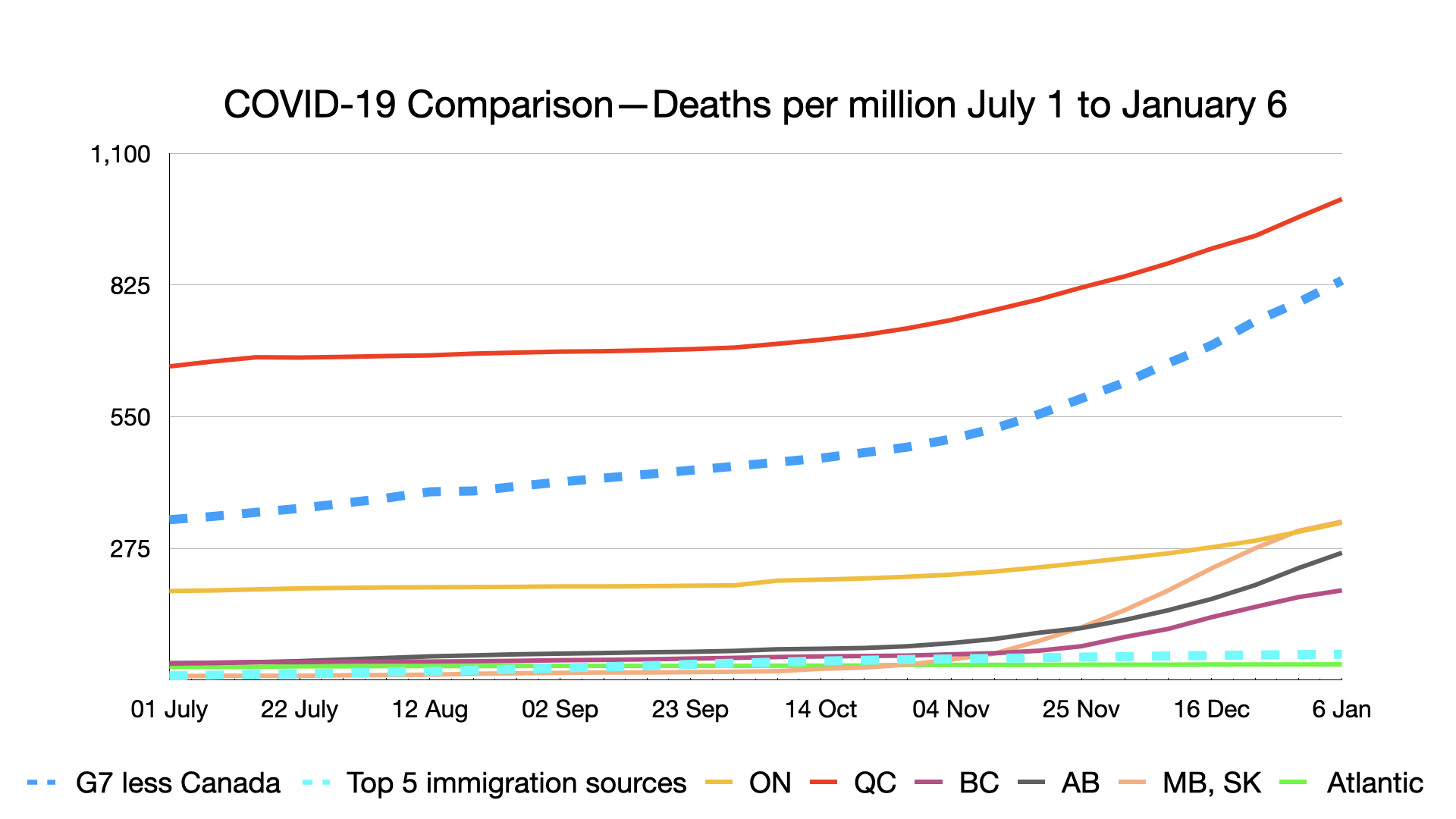
For a change and end 2020, I prepared these charts comparing infection and death rates per million for Canadian provinces with the G7 (less Canada) and top five immigration source countries (India, China, Philippines, Pakistan and Nigeria).

For the G7 average, only Japan is significantly lower. For immigration source countries, the large populations, lower infection and death rates except for India, and perhaps less comprehensive reporting, mean that rates are lower than all provinces save for Atlantic.

The charts compare the overall second-wave increase and particularly the relatively steeper increase in Western provinces for both infections and deaths.

While Canadian provincial infection rates are less than G7 (less Canada), Quebec’s death rate is higher than the G7.

And the standard weekly charts and table.

And in a rare public comment, Swedish King Carl XVI Gustaf “condemned political leaders for their experiment, branding the light-touch strategy a miserable and deadly failure.”

Remember in the early days of the pandemic, when people like Tucker Carlson and Sen. Rand Paul (R-KY) advocated that the U.S. follow the Swedish model of avoiding strict lockdowns and letting life carry on largely as normal amid the highly contagious virus?

Well, as the year ends, Sweden is coming to terms with a death toll that is approximately 10 times higher than neighboring Norway and Finland, and now its king has condemned political leaders for their experiment, branding the light-touch strategy a miserable and deadly failure.

“The people of Sweden have suffered tremendously in difficult conditions,” King Carl XVI Gustaf, who is traditionally tight-lipped on political matters, told the Swedish state broadcaster SVT. He added, “I think we have failed. We have a large number who have died, and that is terrible.”

Although it’s remarkable for a king to comment on policy, his actual comments were a statement of the obvious. Anders Tegnell, the country’s top epidemiologist who designed its anti-lockdown strategy, has himself admitted that too many people have died and the country should have done more to prevent the spread of the disease from the outset.

Throughout the pandemic, Swedes have been allowed to go to restaurants and bars with no social-distancing measures in place and, until recently, were allowed to hit the gym and send their kids to school. The country has also broken with the near-universal guidance of recommending that protective face masks be worn in public, except in hospitals.

The sight of Swedes packing restaurants and bars in the first wave of the pandemic led some commentators in the U.S. to urge their own leaders to follow Sweden’s example. That way, they said, the economy would be protected and the virus could make its way through the population and offer a good level of herd immunity to slow down its spread.

Since then, deaths in Sweden have soared well beyond similar-size neighboring countries, and Tegnell previously said there’s no sign that herd immunity is doing anything to slow down the rate of infection. And the Swedish economy still entered a harsh recession—although it was milder than those seen in most other European nations.

The rapid increase in new infections has even caused Sweden to partially abandon its anti-lockdown strategy, with the government imposing tougher rules to reduce the limit on public gatherings to eight people from 50, asking high schools to do their teaching remotely, and banning late alcohol sales. Finance Minister Magdalena Andersson warned last month that the measures will harm the economy but are necessary.

Speaking to Swedish network TV4 this week, Tegnell said he was shocked by the second wave of the pandemic, saying, “I think many, with me, are surprised that it has been able to come back so strongly.”

A poll published Thursday showed that support for Tegnell and his approach has collapsed over the past two months.

Source: Swedish King Carl XVI Gustaf Brands His Country’s Anti-Lockdown Strategy as a Deadly Failure

France Fast-Tracks Citizenship for Frontline Workers

Broader in scope than Canadian measures. Something for Canadian policy makers and politicians to consider:

Nine months after its president declared “war” against the coronavirus, France announced Tuesday that it has fast-tracked hundreds of citizenship applications from foreign frontline workers who have distinguished themselves in the battle.

“Foreign workers gave their time and swung into action for all of us during the Covid crisis,” said Marlène Schiappa, France’s junior minister for citizenship. “It is now up to the Republic to take a step toward them.”

The beneficiaries include not just health care workers but also garbage collectors, housekeepers and cashiers, Ms. Schiappa said.

The fast-tracking measure is a notable departure for a country that has adopted increasingly tight immigration rules. Caught in the clog of paperwork, citizenship applications can take years to complete, and the number of naturalizations has been decreasing over the years.

Some 48,000 people acquired French nationality through naturalization last year, or about 18 percent fewer than in 2015, according to statistics from the National Institute of Statistics and Economic Studies.

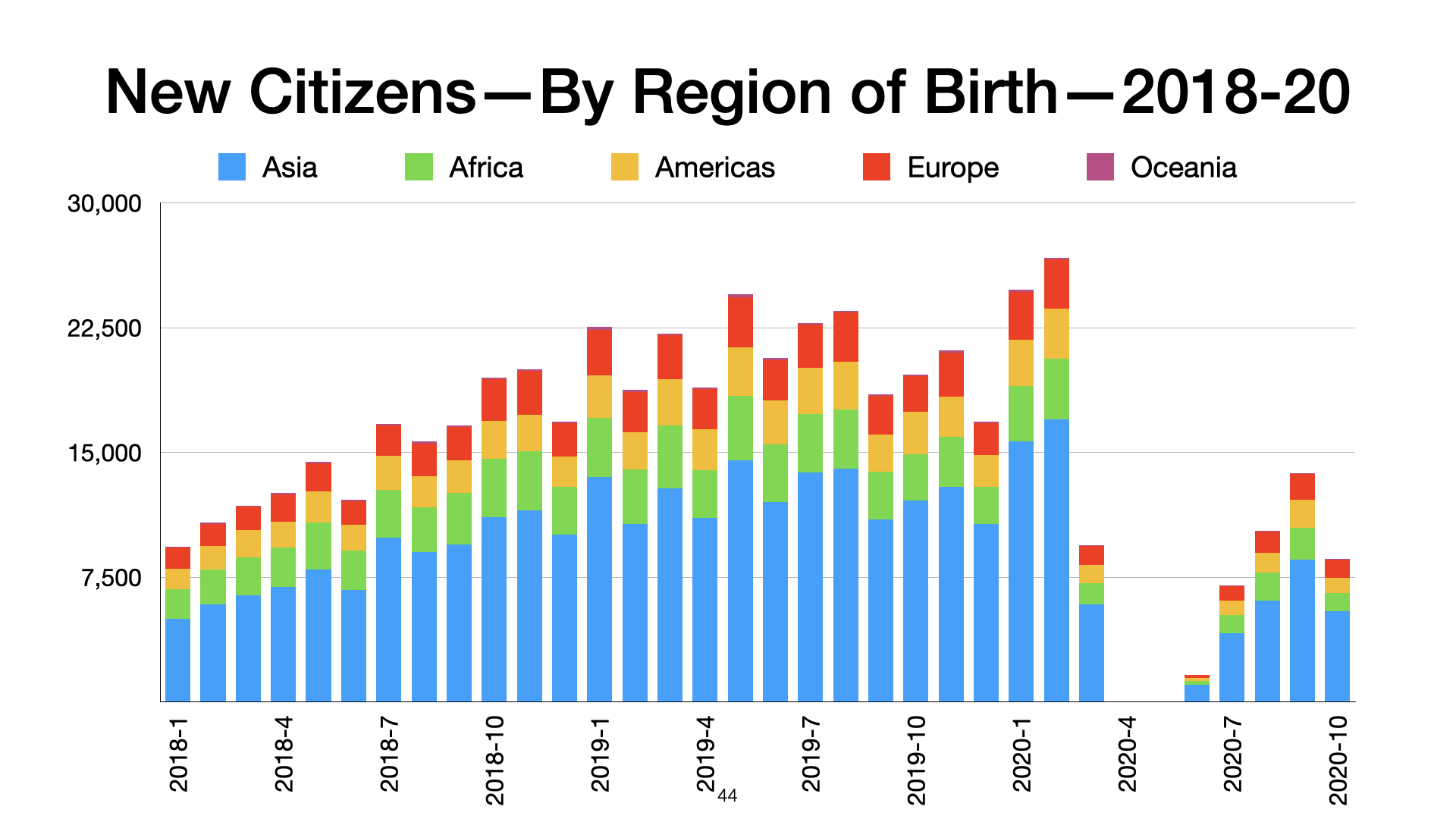
#Citizenship October numbers, year-to-date down 51.8 percent

The open data citizenship numbers, previously only up to June, have now been updated to October like most of the other datasets. No particular surprise, given media coverage, and it appears that IRCC has been working through existing applications given that testing was suspended until recently with only some piloting on online testing.

Country variations year-to-date are largely comparable whereas the October 2020 to 2019 variations are much greater, with France having the lowest impact, Iraq the highest.