#COVID-19: Comparing provinces with other countries 2 June Update

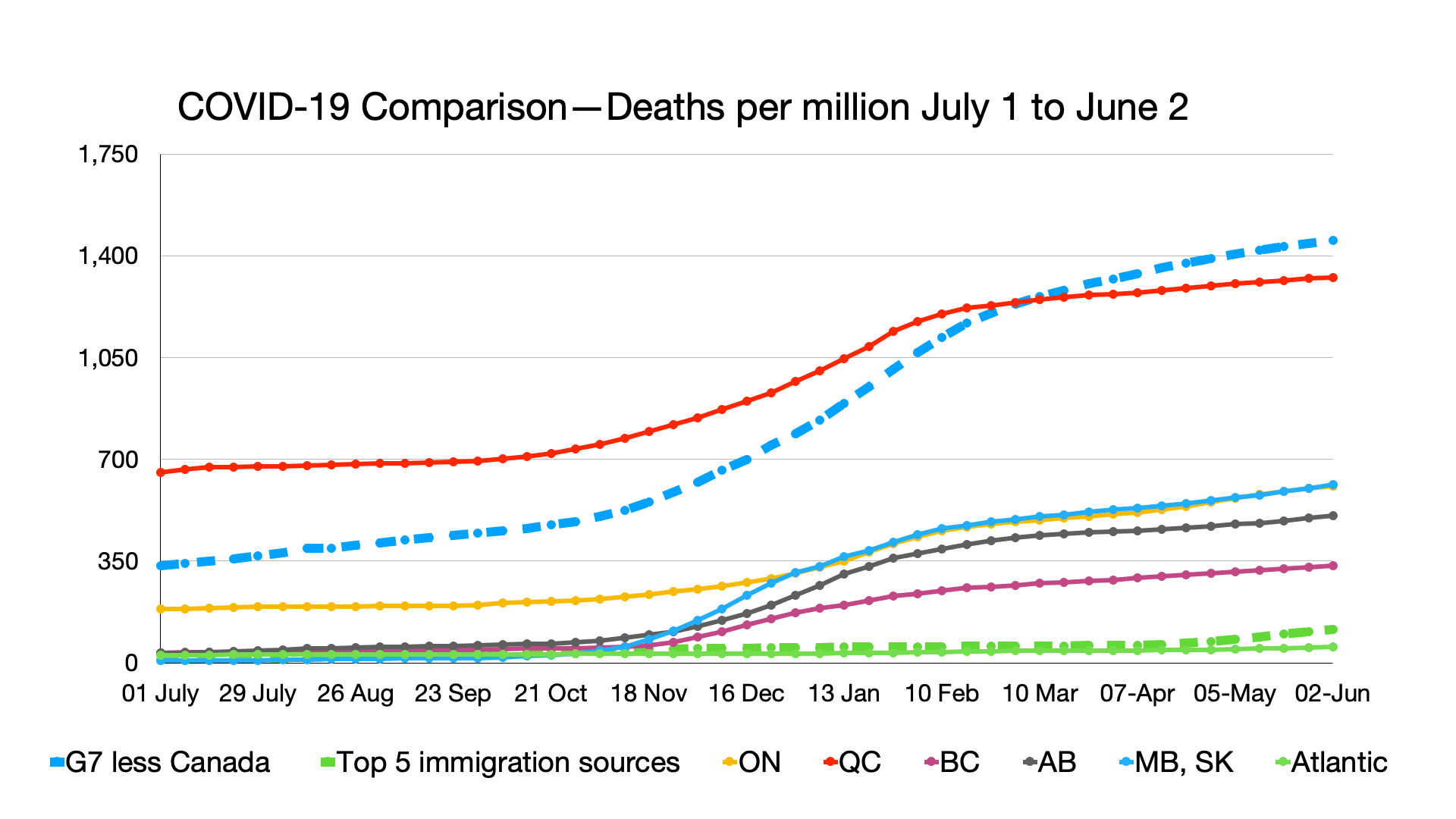
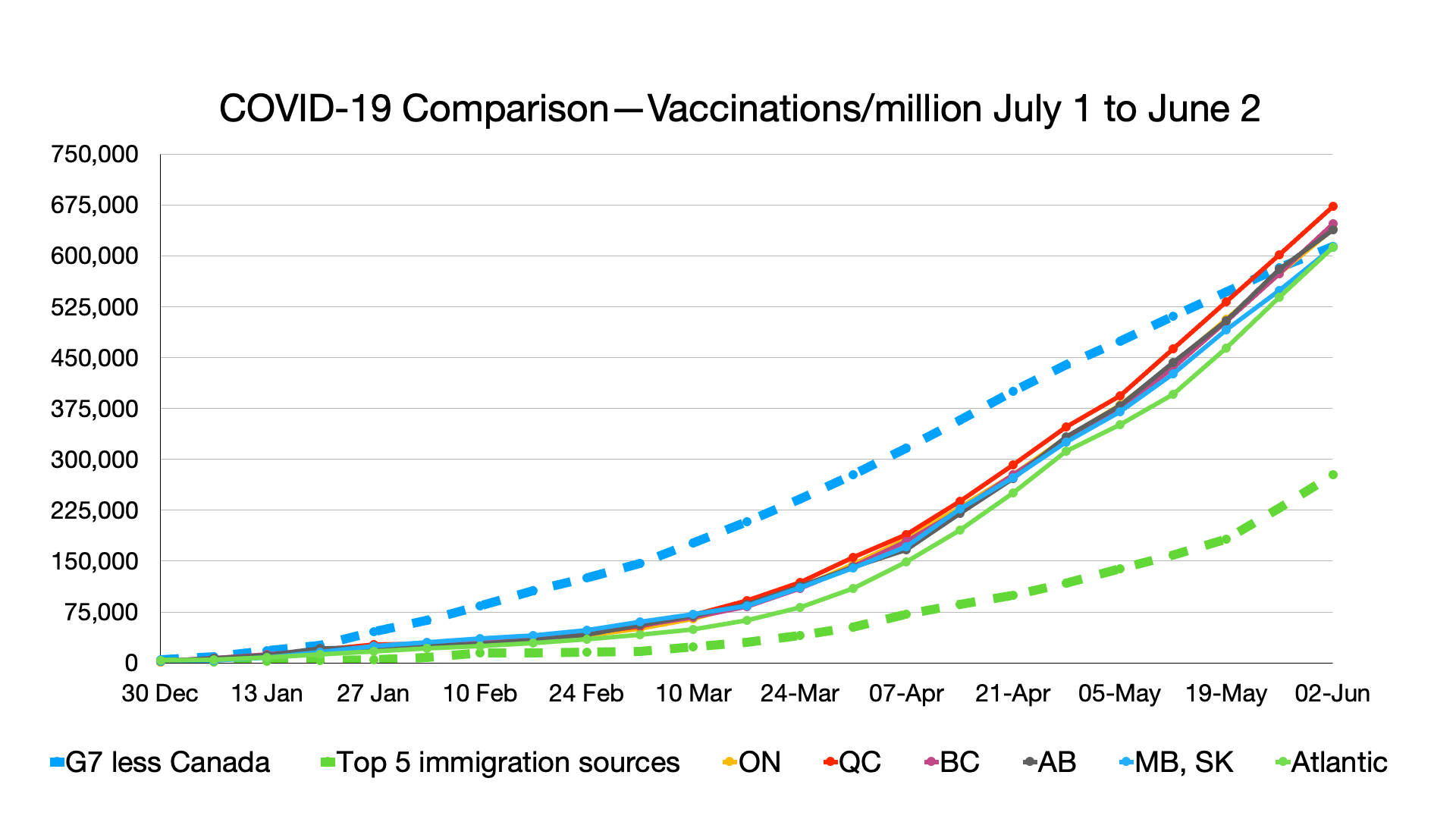
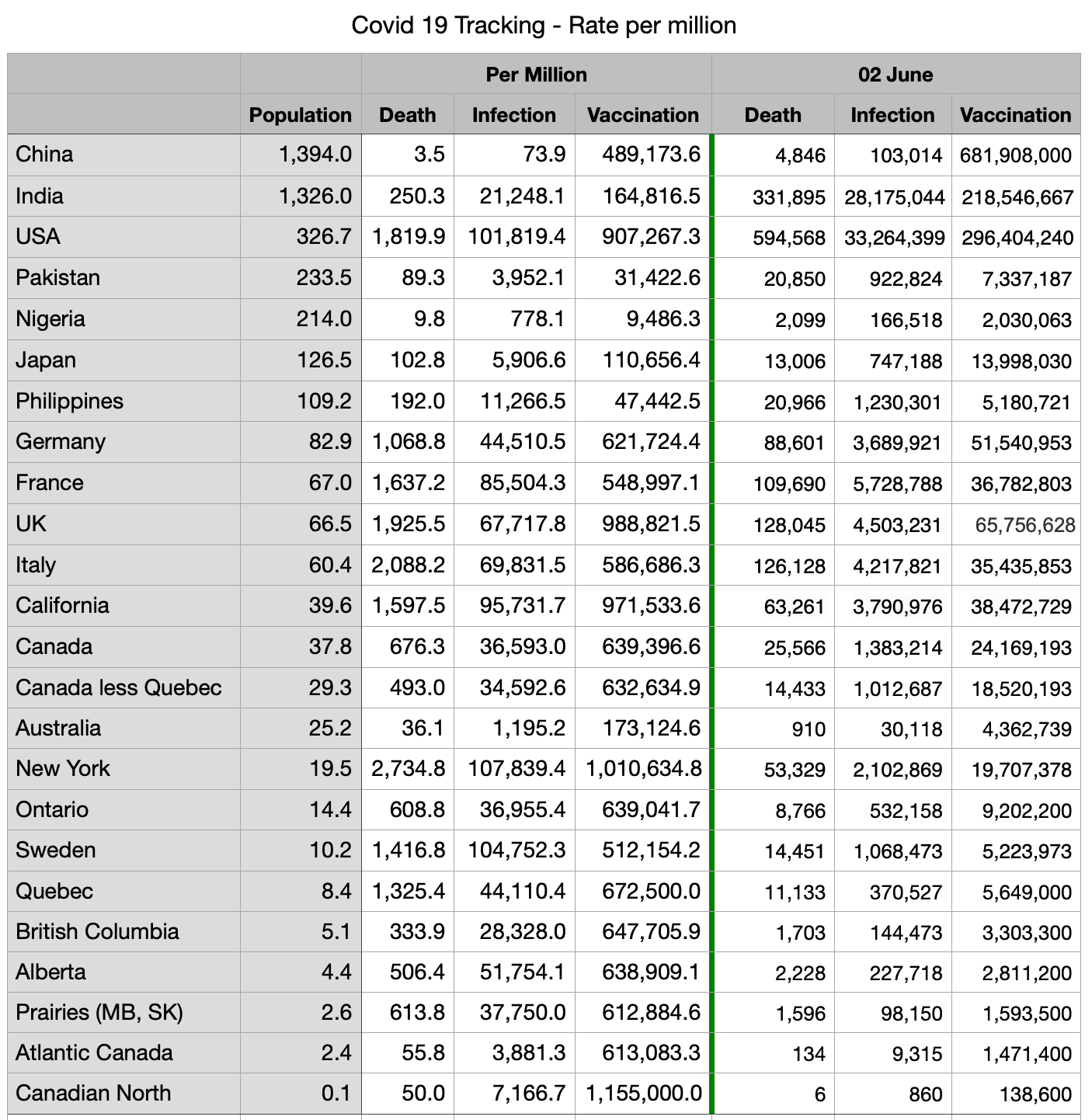
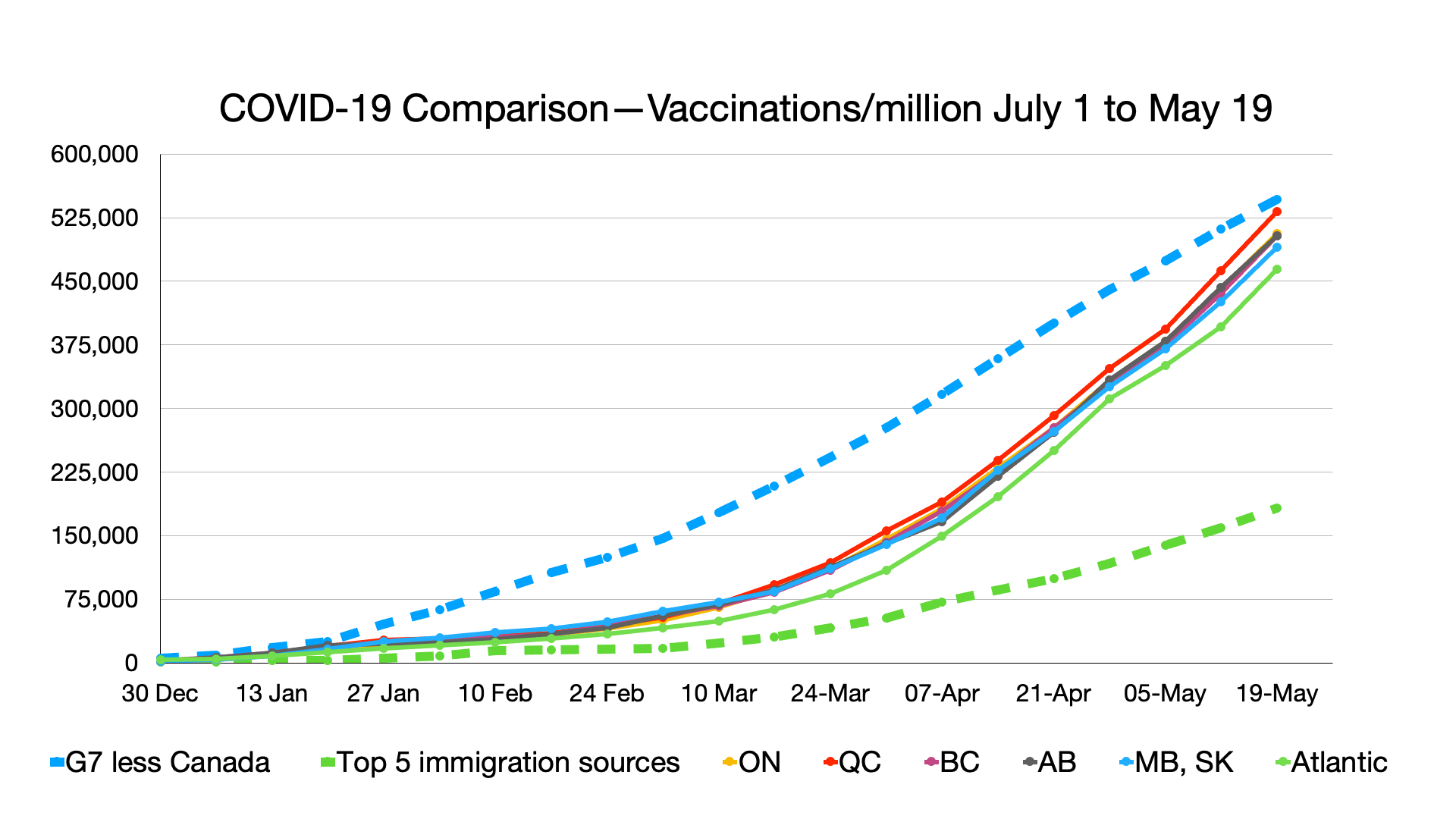
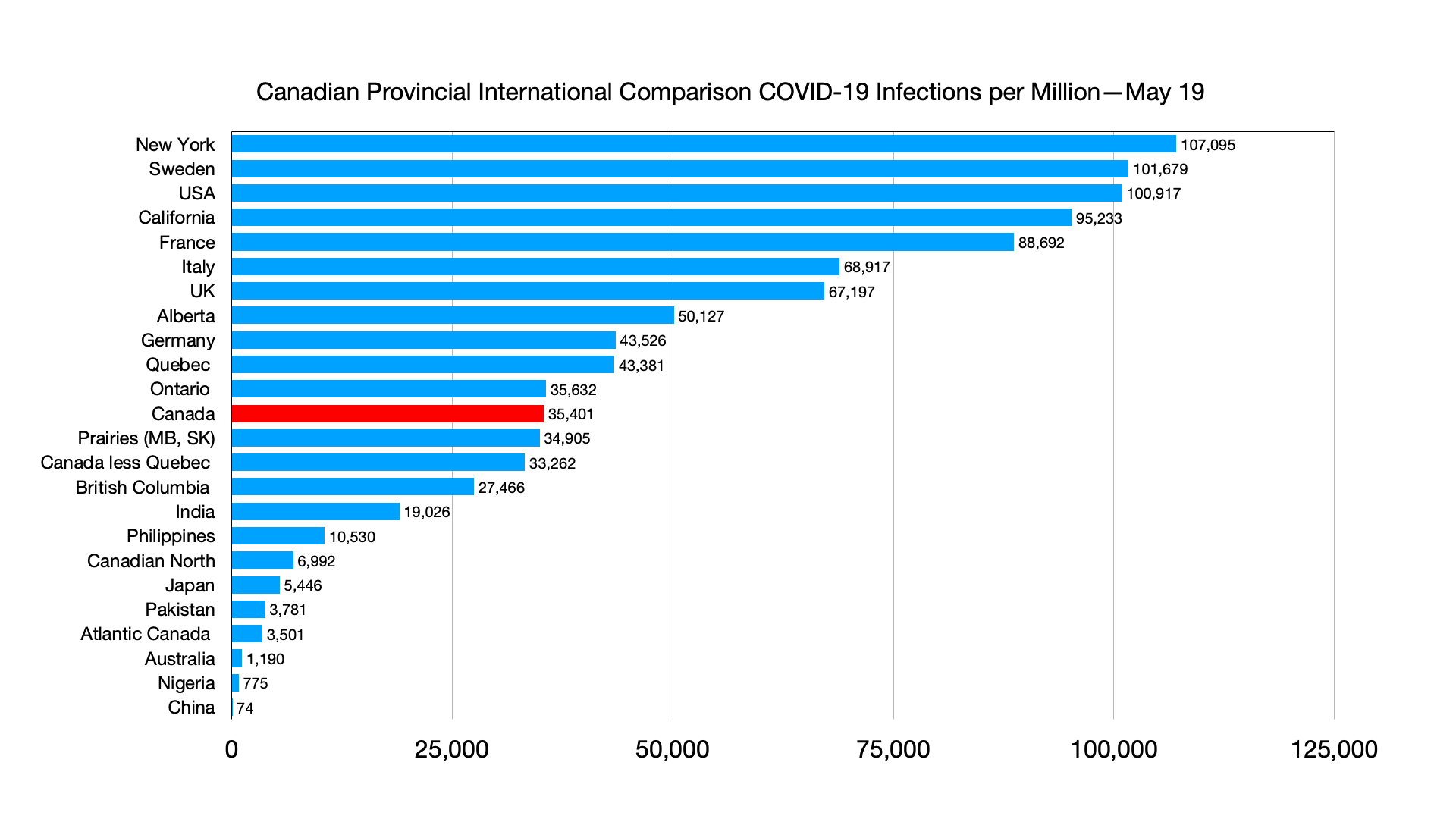
The latest charts, compiled 2 June as overall rates in Canada continue in all provinces save Manitoba to come down along with increased vaccinations.

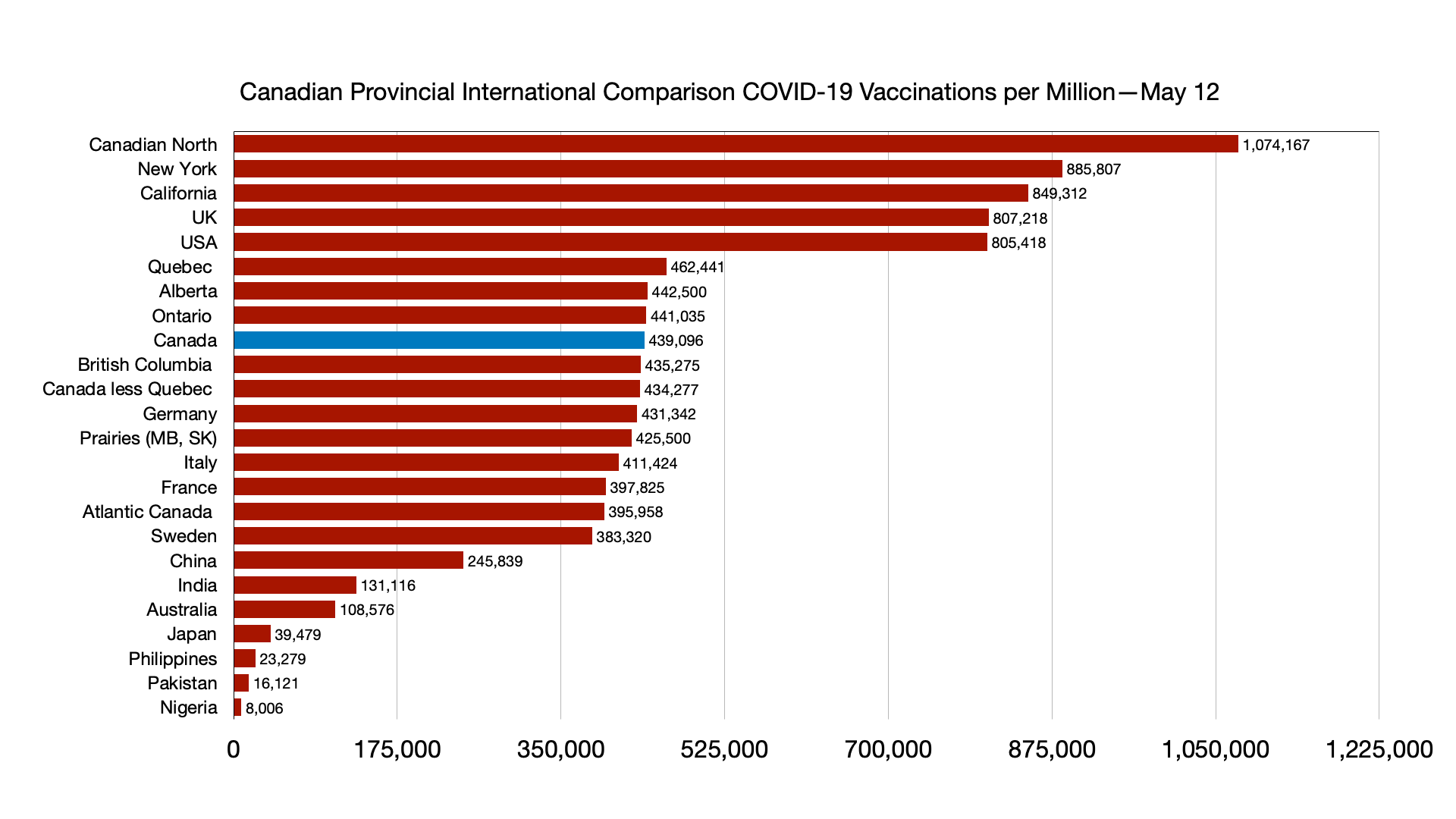
Vaccinations: Minor relative changes, Canadian provinces all ahead of EU countries save Germany.

Trendline charts

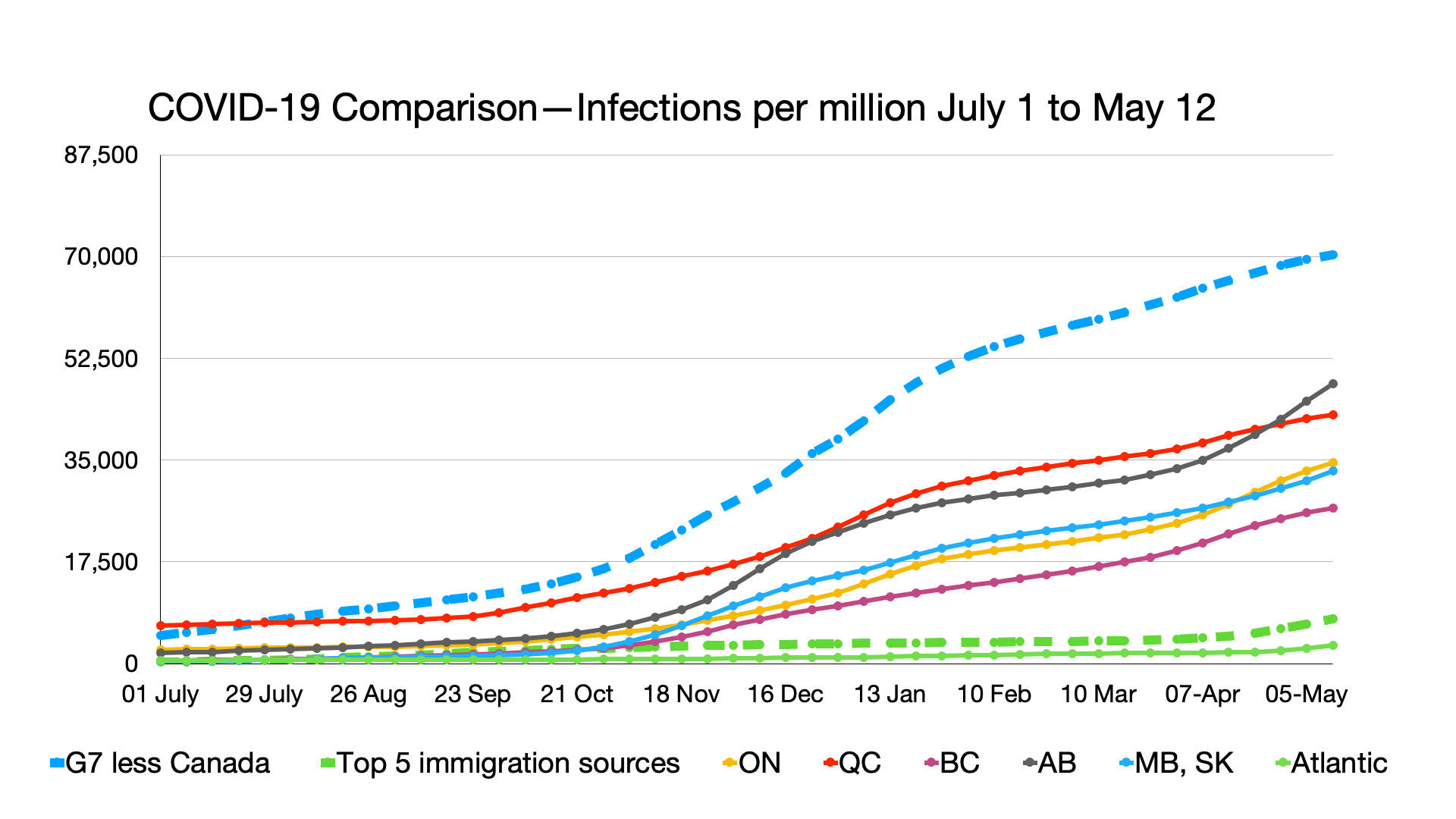
Infections per million: No major relative changes and recent surges appear to be levelling off save for the Prairies (mainly Manitoba).

Deaths per million: No significant change, Prairies slightly ahead of Ontario.

Vaccinations per million: Canadian vaccination rates have caught up to G7 less Canada with Quebec ahead as US vaccination rates are stalling.

Weekly

Infections per million: No relative change.

Deaths per million: Prairies ahead of Ontario, driven by Manitoba.

‘Fortress Australia’: Why calls to open up borders are meeting resistance

Of note and the challenge of reopening:

Australia has been one of the world’s Covid success stories, where infection rates are near zero and life mostly goes on as normal.

That’s in large part thanks to the early move to shut its borders – a policy that has consistently been supported by the public.

But after a year in the cocoon, there is growing unease in the country over the so-called “Fortress Australia” policy.

Recent announcements declaring that Australia won’t open up until mid-2022 – meaning a two year-plus isolation – have amplified concerns.

Critics argue the extension of closed borders will cause long-lasting damage to the economy, young people and separated families. It also tarnishes Australia’s character as open and free, they say.

Calls for a clear plan to pull Australia back into the world are growing, as the country wrestles with an uncomfortable tension – balancing the safety of closed borders against what is lost by living in isolation.

“A Fortress Australia with the drawbridge pulled up indefinitely is not where we want to be,” says former Race Discrimination Commissioner Dr Tim Soutphommasane.

“Australia is at its best when it’s open and confident – not fearful and insular.”

Locking the gate

In March 2020, the government closed the borders. It barred most foreigners from entering the country and put caps on total arrivals to combat Covid. Mandatory 14-day quarantine and snap lockdowns have also been used to control the virus spread.

The measures are extreme, and among the strictest in the world.

But they’ve worked. Australia regularly sees months without a single case in the community, and it has recorded fewer than 1,000 deaths in the pandemic.

Given that, the strict border controls have proven tremendously popular. Public polls regularly report 75-80% approval ratings for keeping the door shut.

Even higher numbers – around 90% – approve overall of the government’s pandemic handling, and trust in government has increased in contrast to views of voters in some Covid-ravaged nations.

Languishing behind

But the government now also faces mounting pressure over how it plans to handle the next phase of the pandemic.

Prime Minister Scott Morrison – who faces an election next year – has announced Australia won’t re-open borders until mid-2022. The exact timing and just how that will happen are unclear.

But the budget announcement was a shock extension to previous forecasts of an opening-up to occur slowly at the end of this year.

The main reason for the delay is vaccination.

Australia’s immunisation programme has been beset with delays, and lags well behind other developed nations such as the UK and US.

Critics say complacency over the low virus circulation delayed its kick-off. And now rising hesitancy – fuelled at least in part by Australia’s isolation – has also slowed the vaccine rollout.

Facing those failures, the government fell back on the border ban as a resort, critics say.

That’s dealing a heavy blow to sectors like tourism and higher education. Australia’s strong migration programme – relied on to address skills shortages and population growth – has also been cut almost completely.

Ernst and Young, an accounting firm, estimates that Australia’s economy is losing A$7.6bn (ยฃ4.18; $5.9bn) a month from the closed borders.

So a group of experts from the University of Sydney have called for an exit plan to be put in place. People need to know their options and prepare for the future, they say.

Their “roadmap to re-opening” focuses on prioritising vaccination, expanding quarantine and starting trials to bring in people for affected industries.

They point to successful examples like the New Zealand travel bubble, and the Australian Open tennis tournament.

“This is the case when measured in hard dollar terms, but also when measured against less tangible factors such as fuelling a negative and inwards-focused national psyche that threatens our global standing, as well as national unity and cohesion.”

‘Us and them’ mentality

Others have also voiced their concerns over how an extended retreat from the world could damage Australia’s character.

When Australia was parochial it had a White Australia policy (1900s-1970s), which restricted immigration from non-European nations. Multiculturalism has replaced that policy in recent decades, but the ideal is still fragile, experts warn.

Dr Liz Allen, a demographer at the Australian National University, contends that Covid has already made the nation more “protectionist and insular”.

Government policies have created an “us and them” division, she argues.

The hostile treatment of migrants is a clear example, she says. Australia’s conservative government of eight years has never advocated for immigration – the coalition won the 2019 election pledging to “slash” the migrant intake.

At the start of the pandemic, Mr Morrison told the nation’s two million migrants on temporary visas to “go home”.

Those visa holders – often doing the low-paid, essential jobs of cleaning and food delivery – were also ineligible for the government’s pandemic welfare support, leaving many facing destitution.

The border ban has also sown community division, seen in its most extreme form last month when Australia took the world-first step of threatening jail for citizens who returned home from Covid-ravaged India. The Indian-Australian community expressed outrage they were being treated like second-class citizens.

Multicultural roots

The issue of stranded Australians reflects Australia’s character as an intensely multicultural nation.

Nearly 30% of the population were born overseas, and another quarter have a parent who was. As a nation of migrants, so many Australians have deep personal ties to other parts of the world.

Prior to Covid, about one million Australians were estimated to be living and working overseas. A section of the population – often highly educated and skilled – was also very mobile.

But the closed-border policy doesn’t appear to recognise these global connections or the disproportionate impact on first and second-generation Australians, critics say.

In addition, the borders created a narrative where blame for a virus outbreak was often laid at the feet of returning individuals.

“We turned on ourselves, on our own people,” says Dr Allen.

Political leaders described the virus as “imported” by returning travellers, rather than escaping through failures in the hotel quarantine system. Such rhetoric egged on social media commentary blaming incoming Australians.

Just happy to be safe

But while there’s division aimed at Australians outside the country, within the borders people feel comfortable with their lot.

First and foremost, people say they feel relieved and grateful to be shielded from the virus.

“There’s a lot of sympathy and real feeling for people caught up outside, and for the people who can’t go to weddings and funerals overseas,” says Melissa Monteiro, head of a migrant resource community centre in western Sydney.

“But you know, everyone ends with ‘that’s just how it is’. People are firstly, just grateful to be in this country and to be safe.”

Race relations researcher Andrew Markus, an emeritus professor at the University of Monash, says most Australians also don’t view the closed borders as a cultural isolation, or a “shutting yourself off from the world”.

Instead it’s just seen as a necessary short-term health measure – an attitude adopted across the political and cultural spectrum, he says.

He notes too that polling throughout the pandemic showed Australians’ support for multiculturalism and globalisation remained strong – about 80% approval – despite concerns about social cohesion and a rise in hate crimes against Asian-Australians.

Dr Allen says that the strong support for the government’s Covid fight is understandable – particularly when it has worked.

But she also says that the Australian public has been presented with no other options. The prolonged border closure and city lockdowns on single infections have all been largely uncontested policies.

She says it’s time now for Australia to move past such policies which she feels are rooted in fear. The country continues to face calls to bring back its own citizens.

“I don’t think it’s bad that people are afraid of Covid – we should be afraid. But we require leadership going forwards that doesn’t leave people behind.”

Source: ‘Fortress Australia’: Why calls to open up borders are meeting resistance

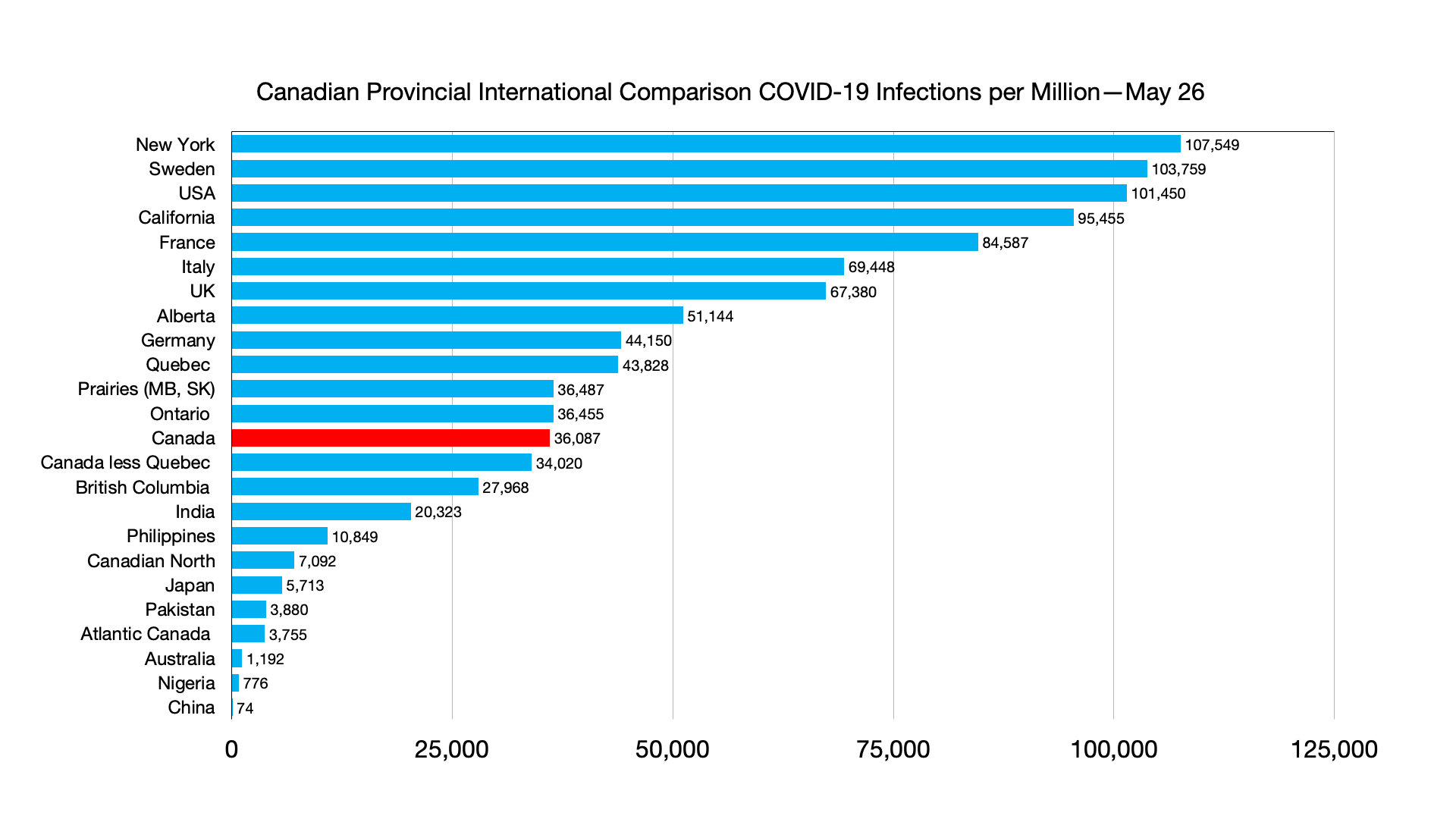
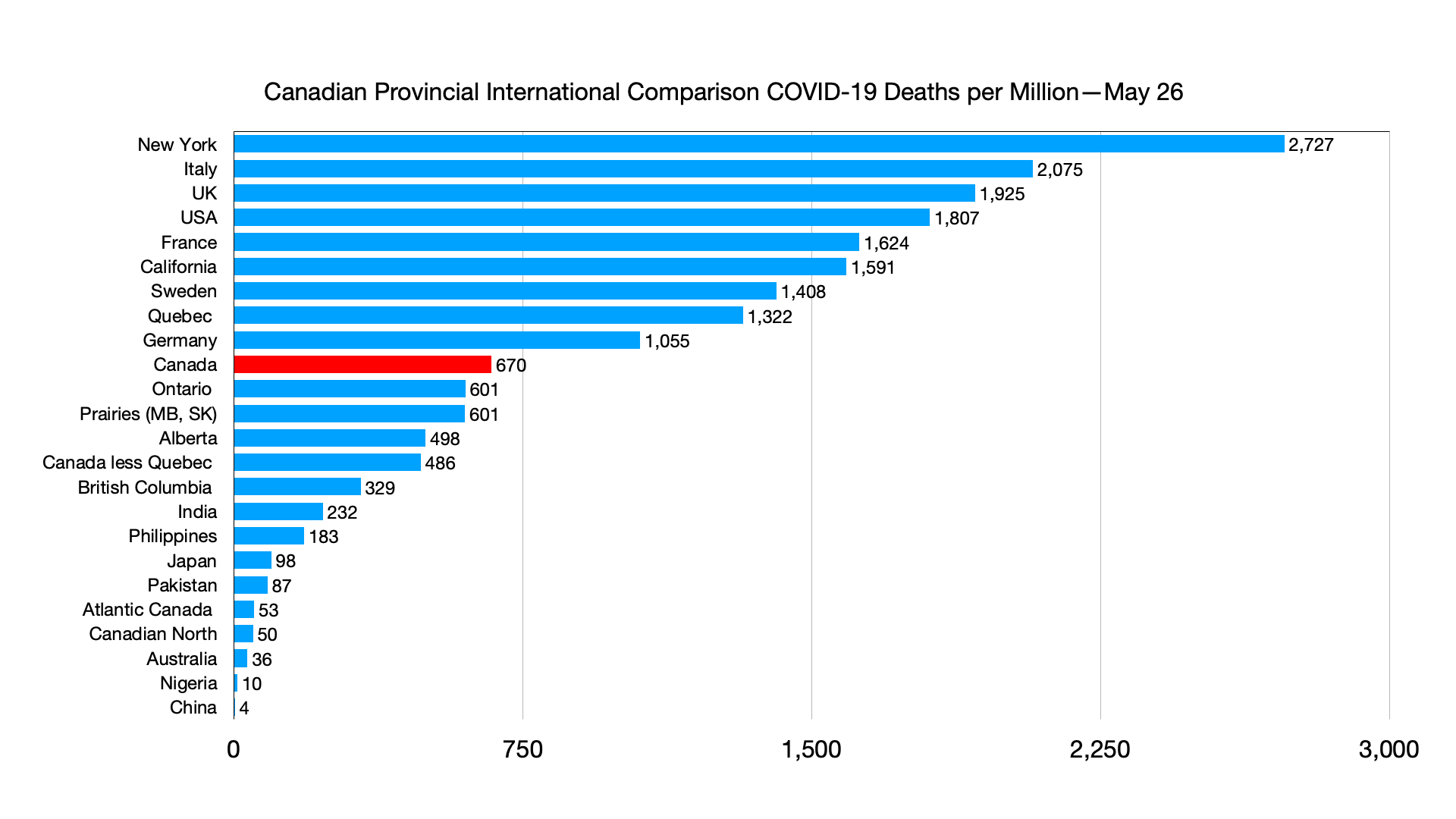
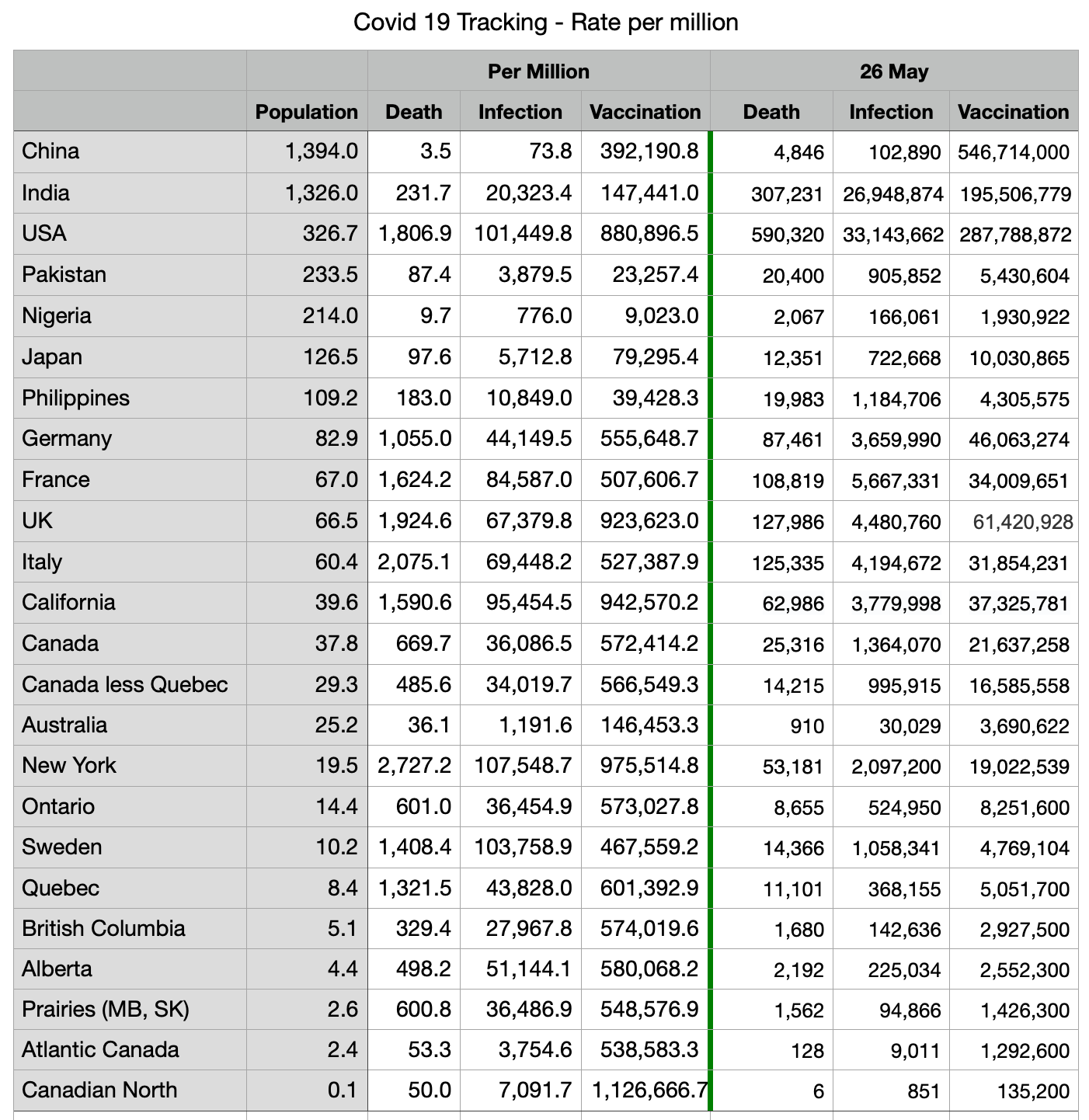
#COVID-19: Comparing provinces with other countries 26 May Update

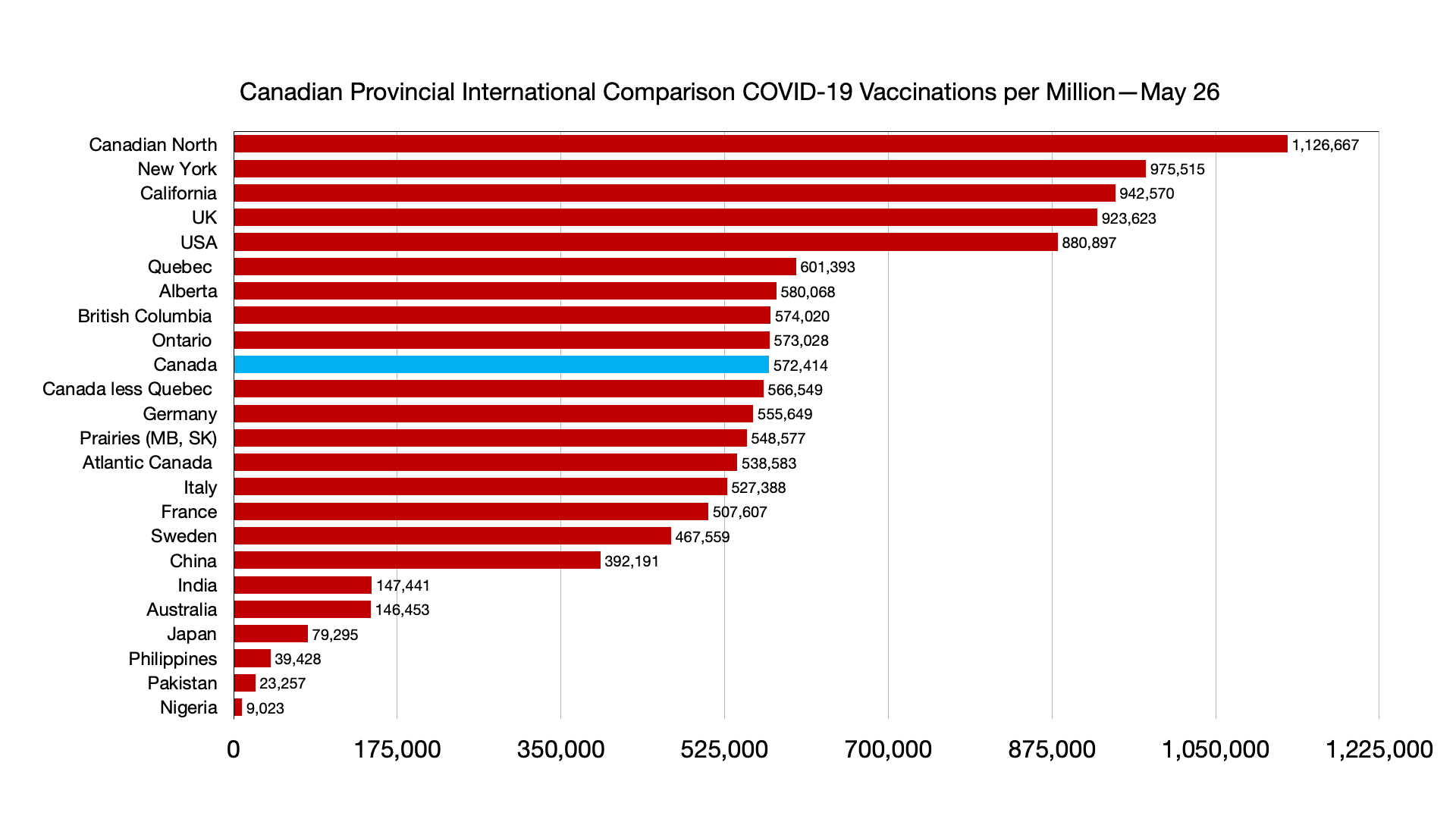
The latest charts, compiled 26 May as overall rates in Canada continue to come down along with increased vaccinations.

Vaccinations: Minor relative changes, with Alberta moving ahead of British Columbia and Ontario, Atlantic Canada ahead of Italy and France.

Trendline charts

Infections per million: Alberta levelling off and upsurge in Manitoba is resulted in Prairie rate marginally more than Ontario.

Deaths per million: No significant change.

Vaccinations per million: Canadian vaccination rates have largely caught up to G7 less Canada with Quebec ahead.

Weekly

Infections per million: Prairies ahead of Ontario, driven by Manitoba.

Deaths per million: No relative change.

India

While there is undercounting in all countries as analysis of above average deaths indicate (e.g., The Economist’s Tracking covid-19 excess deaths across countries), this article on India is of particular interest.

The official Covid-19 figures in India grossly understate the true scale ofย the pandemicย in the country. Last week, India recorded theย largest daily death tollย for any country during the pandemic โ€” a figure that is most likelyย still an undercount.

Even getting a clear picture of the total number of infections in India is hard because of poor record-keeping and a lack of widespread testing. Estimating the true number of deaths requires a second layer of extrapolation, depending on the share of those infected who end up dying.

In consultation with more than a dozen experts, The New York Timesย has analyzed case and death counts over time in India, along with the results of large-scale antibody tests, to arrive at several possible estimates for the true scale of devastation in the country.

Even in the least dire of these, estimated infections and deaths far exceed official figures. More pessimistic ones show a toll on the order of millions of deaths โ€” the most catastrophic loss anywhere in the world.

Indiaโ€™s official coronavirus statistics report about 27 million cases and over 300,000 deaths as of Tuesday. The countryโ€™s response to the pandemic has been further complicated this week by a cyclone that is battering Indiaโ€™s eastern coast, with winds of more than 95 miles per hour.

Even in countries with robust surveillance during the pandemic, the number of infections is probably much higher than the number of confirmed cases, because many people have contracted the virus but have not been tested for it. On Friday, a report by the World Health Organizationย estimatedย that the global death toll of Covid-19 may be two or three times higher than reported.

The undercount of cases and deaths in India is most likely even more pronounced, for technical, cultural and logistical reasons. Because hospitals are overwhelmed, many Covid deaths occur at home, especially in rural areas, and are omitted from the official count, said Kayoko Shioda, an epidemiologist at Emory University. Laboratories that could confirm the cause of death are equally swamped, she said.

Additionally, other researchers have found, there are few Covid tests available. Families are often unwilling to say that their loved ones have died of Covid. And the system for keeping vital records in India is shaky at best. Even before Covid-19, about four out of five deaths in India were not medically investigated.

Source: https://www.nytimes.com/live/2021/05/26/world/covid-vaccine-coronavirus-mask

The two pandemics of anti-Black racism and COVID-19 are tied together

Long, somewhat rambling read, stronger on the diagnostique than policy responses.

I would argue more inequality/inequity than anti-Black racism given the groups affected (see https://www.nytimes.com/2021/05/24/briefing/vaccination-class-gap-us.html with respect to vaccines but applies more generally):

It has been a year.

Almost one year ago, on May 25, 2020, Minneapolis police officer Derek Chauvin murdered George Floyd. Protests ignited in Minneapolis and then spread quickly to cities across the United States and around the world, withestimatesย indicating that these were the largest, most diverse and longest-lasting protests in North American history.

They heralded aย massive shiftย in public support for Black Lives Matter, bringing the pervasiveness of anti-Black racism and calls to defund the police into broader public consciousness. Although police officers areย rarely held to accountย for the deaths they cause while on duty, Mr. Chauvin was charged and convicted by a Minneapolis jury of second-degree murder, third-degree murder and manslaughter.

But without the viral video of Mr. Chauvinโ€™s public killing of Mr. Floyd,recorded by a 17-year-old childย who to this day has nightmares about being unable to help, the outcome would likely have been very different. The original statement by the Minneapolis police department indicated that Mr. Floyd resisted arrest and was handcuffed by officers, who then noted that he โ€œappeared to be suffering medical distress,โ€ without mentioning an inkling about Mr. Chauvinโ€™s deadly use of force.

The trial revealed thatย Genevieve Hanson, an off-duty firefighter trained in CPR, begged the officers on the scene to let her help and was rebuffed, as were other bystanders. Law enforcement professionals, including Minneapolis police chief Medaria Arradondo, broke the usual blue wall of silence to make the case that Mr. Chauvinโ€™s actions were excessive and unwarranted.

Throughout the trial, Mr. Chauvin was depicted as a rogue officer who disobeyed his training and disregarded established protocol. A bad apple who went too far.

It has been a year. More than a year, in fact, of living through, with, in fear of and in spite of COVID-19. The initial lockdown in March, 2020, was followed by a brief summer respite and then another, deadlier resurgence of the virus beginning in December, 2020, more contagious variants, and the imposition of stricter curfews and stay-at-home orders, depending on where in Canada you live.

The pandemic has revealed a national crisis in long-term care, initiatedย talk of vaccine passports, demonstrated the precarious labour conditions of low-wage, โ€œessentialโ€ workers, generated outbreaks among vulnerableย homelessandย incarceratedย populations, catalyzedย mass evictions, forced a mass exodus ofย more than 200,000 womenย from the Canadian labour force, brought working parents and other caregivers to the brink of exhaustion, and multiplied theย negative mental health effects of social isolation for school-age children.

Even as vaccinations finally roll out, we do not know what the long-term effects of this pandemic will be on our economy, our politics or our social fabric.

In all that weโ€™ve lived and lost this past year, we cannot think of these two phenomena โ€“ anti-Black racism and COVID-19 โ€“ as separate. Both are global, though nationally textured. Both had the potential to be mitigated by decisive government action or accelerated by epic government failure. Both are simultaneously individualistic and systemic. Both have exposed the cracks in our national moral consciousness about the definition of the common good. And both are existential threats that fuel death, degradation and destruction within our sociopolitical ecosystems.

But the two pandemics are not just similar, they are interlocking, and have wrought havoc on racialized communities across the continent.

Despite the assertions by some politicians that the virus โ€œdoes not discriminate,โ€ it is nowย settled scientific wisdomย that the burden of disease in the COVID-19 pandemic in North America disproportionately falls on racialized communities.

National dataย collected in the United States shows that Hispanic/Latino communities are overrepresented in COVID-19 case counts, and Black Americans are overrepresented in deaths because of the disease. It is a bitter irony that, upon his death, it was revealed that Mr. Floyd had tested positive forย COVID-19.

While similar national-level data does not exist in Canada, the patchwork of local health units and provinces that have decided to track racial disparities in COVID-19 rates tell a similar story.ย In Toronto, Black residents are 9 per cent of the population, yet represent 14 per cent of COVID-19 cases and 16 per cent of hospitalizations. The case rates for South Asian/Indo-Caribbean communities and Latin American communities are two to three times higher than the average rate across the city, respectively.

The virus is brutal in its efficiency โ€“ it feasts on the social fissures created by the mistreatment of, and divestment from, racialized communities

We now know far more about the mechanisms of this divestment than we did a year ago. The separation of our labour forces into those whose employers provide the flexibility to work from home, and those who are โ€œessential,โ€ demonstrate how intertwined race and class are in deciding who lives and who may die in this pandemic. To be an โ€œessentialโ€ worker in 2021 is counterintuitive: The products of oneโ€™s labour are invaluable, but employers and policy makers alike treat the workersย themselvesย as disposable.

The comforts that have made urban, middle-class life bearable during this upheaval โ€“ย two-day shipping from online retailers,ย curbside pickup from grocery stores, open daycares, andย take-out delivered hot and fresh via food delivery appsย โ€“ operate by exposing an underpaid and predominantly racialized work force to the virus, oftenย without proper protectionย orย additional compensation.

Canadaโ€™s caregiving professions are right at the heart of this distressing hierarchy. Personal support workers and nurses, many of whom are Filipino women and who are working under Canadaโ€™s Caregiver Program, have beenย blamed for infecting patientsย despite the harrowing working conditions caregivers experience on the front lines of the hardest-hit sector of our society: long-term and in-home care.

Once exposed to the virus, these workers are often forced to continue to work because most provincesย do not offer paid sick leave, and the Canada Recovery Sickness Benefit offered by the federal government createsย a series of barriers to accessing minimal financial support.

These contradictions and binds are evidence of what researchers have termedย Canadaโ€™s colour-coded labour marketย on red alert. Gaps in wealth, employment rates and average employment income between racialized and white Canadians areย persisting or deepening.

Beyond inaction, the two pandemics expose how politicians scapegoat certain communities to avoid taking responsibility for the social and political problems the lawmakersโ€™ incompetence has exacerbated.

From Ontario Premier Doug Ford blaming โ€œinternational studentsโ€ andย lax border controlsย for a third wave of COVID-19 that emerged, in large part, from industrial and manufacturing settings, to Alberta Premier Jason Kenney usingย assumptionsย of South Asians recklessly holding big family gatherings in Calgary to explain case bumps in the city, politicians across the country find it easier to blame the racialized โ€œotherโ€ than to reckon with their own policy decisions.

Even leaders of the Atlantic provinces,ย vaunted internationallyย for their management of the pandemic, have leapt at the opportunity toย harangue Black residentsย for alleged breaches in public health orders โ€“ even when they haveย no official basis to do so.

The rationale behind this discriminatory framing appears to be simple: It works. The public (or at least the portions of the public these leaders envision as their supporters) respond to the protective, coercive powers bestowed upon policy makers in a public-health crisis so long as there is an enemy toward whom they can direct frustration and blame for this chaos.

We see this trend taking hold in the rise ofย anti-Asian hateย in Canada, and especially in British Columbia, where nearlyย one out of every twoย people of Asian descent experienced at least one racist action in 2020.

By making the never-ending series of lockdowns a manifestation of the personal failings of a few interlopers, these leaders direct attention away from the social, medical and political institutions we have allowed to erode. The racialized other becomes the imagined vector of disease, masking compounding policy failures that have been decades in the making.

These stigmatizing narratives are also reflected in the ways Black and Indigenous patients, in particular, are treated in our health systems.ย Joyce Echaquan,ย an Atikamekw woman, suffered racist abuse from hospital staff in Saint-Charles-Borromรฉe, Que., as she lay dying. This atrocity emerges from the continuing violence of internal colonialism, which is premised on a racial calculus that considers the lives of Indigenous peoples to be less valuable than those of settlers.

Similarly, theย death of Mireille Ndjomouoย at the hands of attendants who disregarded her basic medical needs is indicative of a clinical context in which Black women areย ignored and mistreated. The message sent, implicitly or explicitly, is that Black and Indigenous people are unruly and in need of control in clinical settings, lest we cause havoc as we perish.

Adding to this messaging is the choiceย by some jurisdictionsย to avoid collecting race-based health data about COVID-19 to support targeted interventions and vaccination programs in the communities hardest hit by the virus. This occurs despiteย demonstrable evidenceย to suggest that collection of race-based data prompts equity-oriented decision-making at a local level.

Instead, support for racialized communities is often left to advocates, clinicians and other professionals on the front lines of battling the virus who haveย long recognizedย that a race-conscious approach to health promotion and vaccine distribution will be key to breaking the pandemicโ€™s hold on communities across the country.

The systematic neglect that afflicts Black communities in particular prompts a sense of distrust in public-health systems that is reflected in the much-debated โ€œvaccination hesitancyโ€ that Black Canadians show. One look at community-centred vaccination clinics inย Upper Hammonds Plains,ย Rexdaleย orย Montreal-Nordย shows that the work ofย dedicated doctors, nurses, social workers and community volunteers disrupts these facile narratives.

When people feel heard and cared for, they show up to get vaccinated in droves. Far too often, however, these community voices are disregarded to no oneโ€™s benefit.

The two pandemics have also exposed how quickly policymakers turn to policing and punitive measures as a response to any kind of challenge. Mr. Floydโ€™s murder, as well as the police-involved deaths of Regis Korchinski-Paquet, Rodney Levi and Chantel Moore that occurred in the subsequent months, are part of a perpetual backdrop of violence committed by police forces against Black and Indigenous people.

It is worth noting, as many have, the origins of the police in slave patrols of the 19th century and that the original purpose of the RCMP โ€“ then the North-West Mounted Police โ€“ was to remove Indigenous peoples from their traditional territories.

But the police are deadly to Black and Indigenous people in the here and now, and that alone is a solid foundation for recent calls to defund โ€“ and abolish โ€“ the police. These sustained and vigorousย organizing effortsย have made significant advancements across North America: from removingย resource officers from schoolsย in Peel Region and anย $11-million cut over two yearsย to the police budget in Edmonton, to aย 33-per-cent cut to police budgets in Austin, Tex.

Despite these important milestones, however, policy makers have tended toward either maintaining or increasing police budgets. In Minneapolis, talk of abolishing the police force hasย given way to modest cutsย and accusations of obstructionism by the mayor. Meanwhile, city councils inย Halifax,ย Saskatoonandย Winnipegย all increased police budgets, while Calgaryโ€™s council gave the policeย more moneyย than they were seeking.

That these budget increases emerged during COVID-19 despite unforeseen opposition indicates how much the pandemic has facilitated theย radical expansion of police surveillanceย across the country, complete with โ€œsnitch linesโ€ that encourage citizens to report their neighbours for protocol violations.

This shift toward โ€œpolicing the pandemic,โ€ as detailed by Alexander McClelland, an assistant professor of criminology at Carleton University, and Alex Luscombe, a PhD candidate at the University of Torontoโ€™s Centre for Criminology and Sociolegal Studies, illuminates the racialized framings that underpin the enforcement of public health emergency legislation. Using police officers to enact orders under the pretext of protecting public health has worked in Hamilton toย suppress dissent in tent citiesย against those very same forces, while enforced curfews in Montreal have led to fines for workers who are deemed to be flouting the rules โ€“ย even if they carried authorization letters with them.

This approach looks less like health promotionย as outlined in the Ottawa Charter for Health Promotion, signed at an international conference organized in collaboration with the World Health Organization in 1986, and more like the deepening of a web of carceral institutions that abolitionist activists have warned us about for years.

We see a similarly troubling expansion of these carceral powers under the pretext of public health within Canadaโ€™s prisons. While some provincesย wisely decidedย to release low-risk offenders at the behest of advocates to prevent devastating COVID-19 outbreaks in jails, prisoners in federal facilities have been subject to extended COVID-prompted โ€œisolationsโ€ that may breachย international standards for torture.

Not only have these cruelties proven ineffective to mitigate theย sweeping outbreaksย in many federal facilities, but they are also an outcome of theย insufficient preventative measuresย taken in federal institutions to prevent the spread of the virus in the first place.

In times of crisis, it is intuitive for the citizenry to tacitly assent to restrictions that might otherwise seem like government overstep. A year ago, the idea of mask mandates, group size restrictions or curfews seemed ludicrous. And yet, here we are; the legitimacy of these measures is contrived from their careful design and the democratic promise that they are to be universally applied, limited in scope and temporary in nature.

But there is an acute danger to the amplification of carceral logics, punitive measures and police authority: It is far easier to expand power than it is to contract it. Even if we are able to conquer COVID-19 in the foreseeable future, it is unlikely that newfound police powers will be readily or willingly relinquished. โ€œPower concedes nothing without a demand,โ€ Frederick Douglass said in 1857. โ€œIt never did and it never will.โ€


Finally, the two pandemics raise an unavoidable moral question of how we understand social solidarity and the common good. COVID-19 has exposed not just cracks in our social fabric, but chasms.

The policy decisions that have been made during this moment of crisis were about much more than public health. They were, at base, about how we see ourselves as a collective, what we think we owe each other, who deserves to be protected, who should be shown care and concern, who must repel state violence and economic exploitation at every turn, and who must try to fend for themselves.

From the earliest days of the first wave, governments asked us for individual sacrifice for the common good. We changed our lives to protect this imagined community of people we have never seen or met. Our children didnโ€™t go to school, we lost jobs, we didnโ€™t get to bury our loved ones โ€“ all in the name of the common good.

And then we watched the video of George Floyd being tortured for eight minutes and 46 seconds. We collectively bore witness to a public lynching in the year 2020, committed by those sworn to protect and serve the common good.

One year ago, cities erupted as ordinary people took to the streets, in protest of the revelation, new to some, familiar to others, that the โ€œcommon goodโ€ is commonly racist. For a moment, it seemed as though a racial reckoning, 400 years in the making, was at hand. For a moment, there was a spark of understanding that though public health and public safety are core functions of government, they frequently involve responses by the state that do more harm than good.

For a moment, there was wider recognition of the duplicitous treachery of a benign discourse of multicultural nationalism while vulnerable populations were immobilized or unable to shelter in place. For a moment, the reckoning seemed possible and then even likely, the publicโ€™s captivation genuine and sincere, as if the collateral damage of the pandemic wrought a collective aspiration that we might be able to substantiate a different kind of world on the other side of these entwined tragedies.

But it is now a year later, and weโ€™ve been here before. These moments nearly always prove to be temperamental and temporary.

White American support for Black Lives Matterย peaked at 43 per cent last June; that support has now dipped back down to around 37 per cent, the same level as when Mr. Floyd was still breathing. A full 50 per cent of white Americans currently oppose the movement altogether. The rebellions wrought by ordinary folks taking to the streets have beenย monetizedย andย commodified.

Hollow statements against some kind of amorphous conceptualization of systemic racism have become an effective marketing strategy. Our collective memory of the uprisings has been sanitized to be more palatable to moderates, profitable to the professional class, and sanctioned by the same levels and forms ofย state powerย that continue to simultaneously ravage and neglect Black lives and communities.

Sure, steps have been taken and declarations made. Last monthโ€™s federal budget announced the government would take steps toย fight systemic racism and empower communities. The same document provided an additionalย $75-million over the next five yearsย to the RCMP to combat systemic racism, even as many are coming around to the idea thatย the police cannot be reformed, and racism cannot be extracted from the protectorate of the social order.

This is the core tension between a year of tentative and cautious optimism and the well-earned pessimism borne from decades of disappointment with just how fleeting these moments can be.

The two pandemics are interlocking, existential crises, but only one has been treated with the level of urgency required to make a real difference. The onset of COVID-19 was met with the mobilization of the scientific community, accelerated vaccine development, the advent of complicated provincial response systems and on-the-ground co-ordination of entire communities to ensure accessible testing and orderly vaccine distribution. With a little more than a year of decisive action, unprecedented investment, and individual and community sacrifice, we are turning a corner.

The same is not true of the other pandemic, 400 years in the making and still a formidable, resilient and deadly force. Anti-Black racism, and the white supremacy that underpins it, is an existential threat to us all. It fosters social, economic and ecological ruin through division and exploitation. It requires as transformative and all-encompassing an effort to disrupt it as did COVID-19.

The two pandemics were not spontaneous, or even unprecedented, really. Anti-Black racism did not โ€œeruptโ€ in the past year and cannot be resolved by book clubs, equity, diversity, and inclusion trainings and task forces, or good intentions. White supremacy operates at the core of our society and has done so for centuries. Weโ€™re not out of the woods; not by a long shot.

When COVID-19 strikes, individuals do not recover easily. Some have damaged organs or permanent lung problems, while others have mental-health issues that arise from the grief, loss, isolation and fatigue. Even for those who have not been ill, our lives have been forever altered.

The new variants of COVID-19 continue to mutate, transform and defy our efforts to bring an end to the pandemic. The toll on human life in this country โ€“ 25,000 dead, 1.2 million recovered and 1.3 million currently sick โ€“ weighs heavily on our collective consciousness.

The durability and long-term effects of the disease, the way it exposes the precarity and vulnerability of human life, the way it seeps into your mind, body and soul and messes with how you live, breathe, walk, act and exist in the world โ€“ this is also the delirious trickery of racism.

There will be no return to normal, after this. Besides, as the incomparable poet Dionne Brandย wrote last summer, what kind of person would mourn the normalcy that killed Mr. Floyd? After a year, we are still in a moment of flux, but also a moment ripe with potential.

This is what the late sociologist Stuart Hall might have called a โ€œpolitics without guarantees.โ€ We cannot be certain that what will emerge in this reconfigured, postpandemic world will be any kinder or more egalitarian than any previous iterations.

There is nothing that guarantees the moral arc of the universe will ultimately bend toward justice. Overcoming the two pandemics will require struggle and vigilance; building the world we envision will take more than a year.

Tari Ajadi is a PhD candidate in political science at Dalhousie University.

Debra Thompson is an associate professor of political science and Canada Research Chair in Racial Inequality in Democratic Societies at McGill University and author of the forthcoming bookย The Long Road Home.
Source: https://www.theglobeandmail.com/opinion/article-the-two-pandemics-of-anti-black-racism-and-covid-19-are-tied-together/

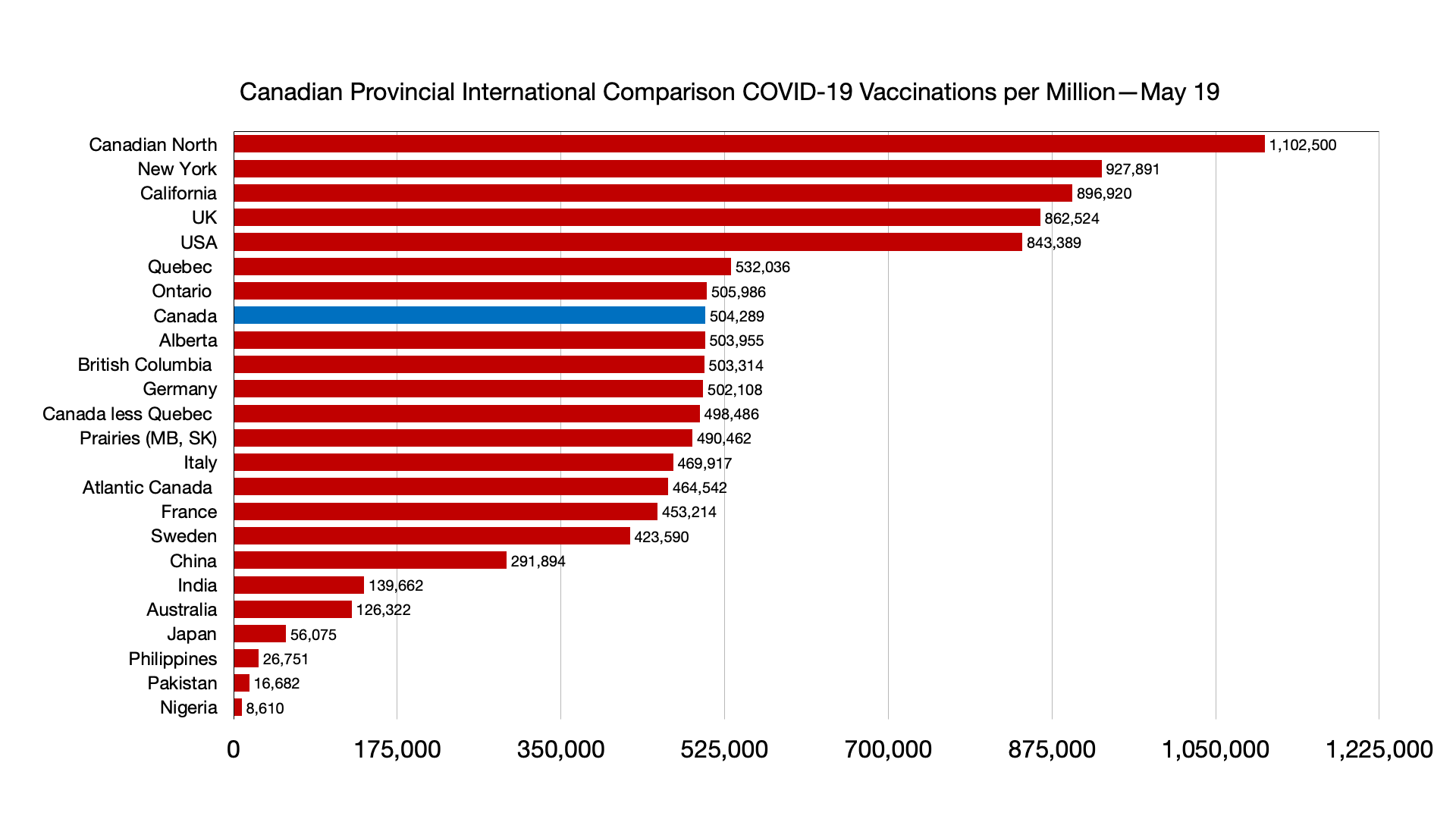
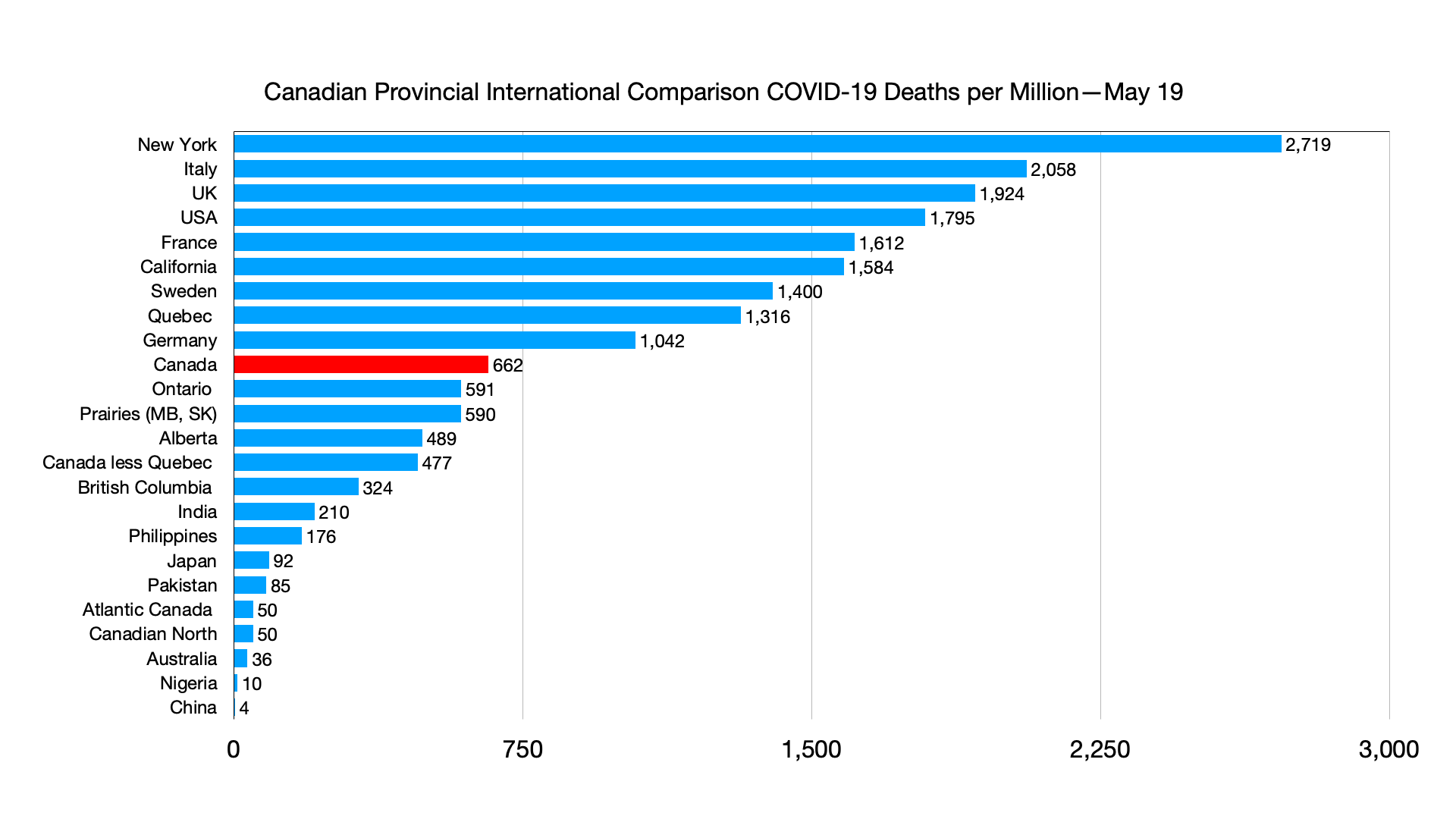
#COVID-19: Comparing provinces with other countries 19 May Update

The latest charts, compiled 19 May as the third wave continues.

Vaccinations: No significant relative changes

Trendline charts

Infections per million: Alberta spike continues and upsurge in Manitoba is driving Prairie rates closer to Ontario.

Deaths per million: Gap between G7 and Canadian provinces continues to grow.

Vaccinations per million: Canadian vaccination rates continue to catch up to G7 less Canada and are likely to exceed G7 shortly (at least in some provinces).

Weekly

Infections per million: Minor shifts between some EU countries and Canadian provinces.

Deaths per million: Atlantic Canada ahead of the North.

How Australia can benefit from low or no immigration

A critical look, one that the Australian government appears to have largely adopted, but not going so far as “no immigration”:

For years there has been an often heated debate about the impact of high immigration on the Australian economy.

It is clear that population growth driven by some of the highest immigration levels in the world have supported bottom line GDP growth โ€“ the new Australians work, eat, live and spend.

High immigration has also fuelled strong demand for housing and was, at least in part, one of the divers of the unrelenting rise in house prices for many decades.

At the same time, population growth outpaced infrastructure capacity, most notably the transport networks in the big cities where most immigrants settled. Congestion was also seen in productivity destroying traffic chaos, overcrowded schools, hospitals and other government services.

Immigration was also a source of labour for many businesses, which has seen the government slash trade training funding, made university costs oppressive and generally undermined the skills set of many Australians.

If workers were needed to pick fruit, work as highly skilled engineers in the mines or IT gurus for businesses, the government simply granted work visas and the problem was solved.

Resources to train and upskill the 2 million Australians unemployed and underemployed โ€“ many of who do not have the skills needed in todayโ€™s economy โ€“ were hopelessly inadequate which is why, with the borders closed, there is a widespread skills shortage.

The benefits of high immigration were being offset or at least diluted by the costs.

COVID-19 and the border closures

With the onset of the COVID-19 pandemic, the government effectively closed the international borders to immigrants.

Indeed, the latest figures from the Australian Bureau of Statistics show that more people are leaving Australia permanently than are arriving. This is the first time this has happened in 100 years.

A year after net immigration turned negative, there are some economic trends emerging that might give a few insights into the sort of immigration policy that is best for Australians after the COVID-19 pandemic is over or at least when we learn to live with the virus in an orderly way.

Perhaps the most obvious issue is a skills shortages among the current workforce which is sparking up opportunities for a long overdue acceleration in wages growth. Business are reporting it difficult to find suitable workers and for obvious reasons, this cannot be fixed by working visas and immigration.

A recent RBA survey of business shows expectations for wages growth is at its highest level in over a decade. Weak wages growth, for so long a problem for the Australian economy, is poised to turn with a substantial pick up in private sector wages unfolding.

It is well understood that rising wages growth will fuel household incomes and with that, consumer spending.

And the key thing about this wages growth is that firms are able to meet this higher wages bill given there has been solid growth in bottom line profits and margins as the economy expands.

Border closures are now linked to higher wages.

With the working from home phenomenon that has been experienced due to the COVID-19 restrictions, congestion in most CDBs and on public transport is less common. Again this is good news and if sustained, will ease the pressure on State budgets for future infrastructure spending. Fewer people are using existing public transport and roads.

While it is yet to be fully tested, there is tentative evidence that low immigration has reduced demand for residential property.

The mini-boom in house prices evident over the last 8 or 9 months has been driven by favourable affordability with first home buyers using stunningly low interest rates and a raft of financial incentives to get into the market and pay-up for their home.

New immigrants have, obviously, been absent from auctions of the queues for rental properties.

Immigration an election issue?

The next Federal election is less than a year away. It could even be in October as Prime Minister Morrison works to take advantage of the favourable economic news and as some of the measures in the budget start to impact on voters.

It is possible that immigration will be an election issue particularly if one side, or other, uses the good news from low immigration as part of a platform to improve the well being of Australians with strong per capita growth.

Of course, Australia needs to maintain its humanitarian immigration program, and when health conditions permit, this should resume.

But the bigger picture immigration program, which saw 1 million people arrive in the three years prior to COVID-19, needs to be scaled back even when the borders reopen.

If we go back to huge population growth in the years ahead, get set for weaker wages, further house price gains, pressure on infrastructure and higher unemployment.

Source: How Australia can benefit from low or no immigration

Hundreds of thousands of Canadian citizenship hopefuls waiting for applications to be processed

While immigration has started to recover from COVID lows, citizenship has largely not: less than 9,000 January-March 2021 compared to 61,000 for the same quarter in 2020:

In March 2020, Minakshi thought her journey to Canadian citizenship was coming to a close, asย Immigration, Refugees and Citizenship Canada set a date for her test.

Then the world changed before her eyes on March 11, exactly a week before her scheduled citizenship exam, as the World Health Organization declared COVID-19 a pandemic.

The IRCC cancelled all tests, including hers, exceptย for what it called a few “urgent” exams, held virtually.

“It does look like there’s some promising signs of spring ahead,” Sharma said, referring to the online testing process flowing more smoothly now.

But it is little comfort for Minakshi: “If I get the fourth fingerprint request next year, I’m going to withdraw my file,” she said.

Source: Hundreds of thousands of Canadian citizenship hopefuls waiting for applications to be processed

#COVID19 #Immigration effects: March 2021

My regular monthly update. A few changes from earlier versions. 

Slides now have one-year and two-year comparisons, highlighting change from 2019 pre-COVID baseline as well as well as post-COVID 2020. Citizenship application numbers include first quarter 2021. 

Slide 3 summarizes the changes by program. 

In terms of trends and observations, the overall picture is that of a return to the 2019 baseline, partially for Permanent Residents but close to normal for IMP, TFWP and study permits except where noted below. No significant recovery in citizenship numbers.ย 

  • While still lower than 2019 baseline, PR admissions are recovering from their 2020 low. First quarter numbers of 70,000 suggest 280,000 for 2021 but government changes (lowering of Express Entry minimum score, Temporary resident to permanent resident pathway program, likely others to come) will result in higher numbers.ย 
  • TR to Permanent Residents transition continues to remain at about half of total Permanent Residents numbers.ย 
  • TRs, both IMP and TFWP, have all increased compared to 2019 save for IMP/Agreements.and TFWP/Caregivers. Most dramatic increase is with respect to โ€œOther IMP Participantsโ€ which largely reflects open work permits for Hong Kong residents with HKSAR and BNO passports.ย 
  • Study permit holders have increased from the 2019 baseline.ย 
  • Asylum claimants remain significantly lower given border closures and travel restrictions.ย 
  • Citizenship numbers remain much lower than the 2019 baseline, reflecting the partial reopening and move to online testing and ceremonies.ย 
  • Visitor visas remain largely closedย 

Farber and Fisman: The overlap between lockdown agitators and hate groups is a threat to us all

Of note:

Theย pandemicย has been a major source of disruption in the lives of Canadians for more than a year, leaving many of us frightened. For some people, that fear means opportunity.

In 2008,ย epidemiologists developed models of the โ€œcoupledโ€ dynamics of epidemicsย and the fear generated by them, showing that behavioural changes engendered by fear can spread as a parallel epidemic, making the infectious disease worse. When two such epidemics interact, the process is referred to as a โ€œsyndemic.โ€

The pandemic, then, has undoubtedly been a syndemic of infection and fear, preyed upon by well-known internet influencers who sat at the core of hate networks that existed before the first outbreak. Now, we have to reckon with a syndemic of infection and hate in a system too vulnerable to both โ€“ or face very real consequences.

According to aย recent report in The New York Times, many experts now believe the United States may never reach herd immunity. This is largely due to hesitancy around safe and effective vaccines, which is being driven in part by anti-science and pro-conspiracy beliefs. These movements have only sown confusion as people navigate the informational minefield that is a public-health crisis, and they threaten to keep us all in pandemic limbo for the foreseeable future.

Indeed, since the beginning of the global outbreak, conspiratorial anti-establishment movements have only gained momentum, finding common cause in opposing mask mandates and lockdown measures and sucking up oxygen by undermining valid criticisms of government health orders. Rallies and protests have been organized almost every weekend across the country, and those who have found fame in the process bill themselves as defenders of our freedoms. They march with a list of grievances and conspiracy theories, but all believe they are standing up against their misguided idea of tyranny.

Outdoor rallies may not in and of themselves confer much risk on attendees; COVID-19 is some twentyfold less infectious outdoors than indoors as a result of dominant aerosol transmission. However, these gatherings undermine confidence in public-health guidance and promote messaging that is likely to further damage communities already hard-hit by this pandemic.

Ekos Research has found that 8 per cent to 20 per cent of Canadians have views that could be characterized as being distorted via disinformation, with men, minorities and lower-income individuals more likely to be disinformed. We know that minority and lower-income communities in Canada have already been the hardest-hit by COVID-19, and now weโ€™ve seen the promotion of disinformation deepening the problem. Vaccine hesitancy also tracks closely with being disinformed; the promotion of disinformation will continue to injure communities even if it becomes possible to move beyond the pandemic via vaccination.

The principal actors of the anti-lockdown movement have either been or rubbed elbows with some significant haters on the scene. Vancouver neo-Nazi Brian Ruhe, who at one pointย organized a mock book burning, was involved in its earliest iteration. Quebecโ€™s far-right conspiracy streamerย Alexis Cossette-Trudel, a big name among Franceโ€™s QAnon following, is an important mouthpiece of the francophone anti-lockdown movement. Neo-Nazi Paul Fromm is a fixture at rallies in both Ontario and inย Kelowna, B.C.ย Antimask activist Chris Saccocciaโ€™s social-media feeds featureย Holocaust denial and racist posts.

Perhaps one of Canadaโ€™s most persistent agitators is Kevin Johnston, who made national headlines in 2017 when he wasย charged with the willful promotion of hatredย against Muslims. In 2019, he lost aย $2.5-million judgmentfor his role in racially motivated defamation against Toronto philanthropist Mohamad Fakih in which he repeatedly accused him of being a terrorist; the judge called his comments about Mr. Fakih โ€œhate speech at its worst.โ€ Now, Mr. Johnston isย running for mayor of Calgaryย and has shifted gears by portraying himself as anย anti-lockdown and antimask influencer.

The fact that an anti-public health agenda aimed at undermining the Canadian economy and the health and well-being of Canadians has been taken up by a roguesโ€™ gallery with a long track record in disinformation and promotion of hatred should give us all pause. And with our country now approaching 25,000 dead due to COVID-19, Canadians should ask themselves whether the promotion of disinformation โ€“ and the undermining of the tools and measures that will permit a return to normalcy โ€“ has crossed the line from mere grotesque opportunism to active, malicious harm.

Source: https://www.theglobeandmail.com/opinion/article-the-overlap-between-lockdown-agitators-and-hate-groups-is-a-threat-to/

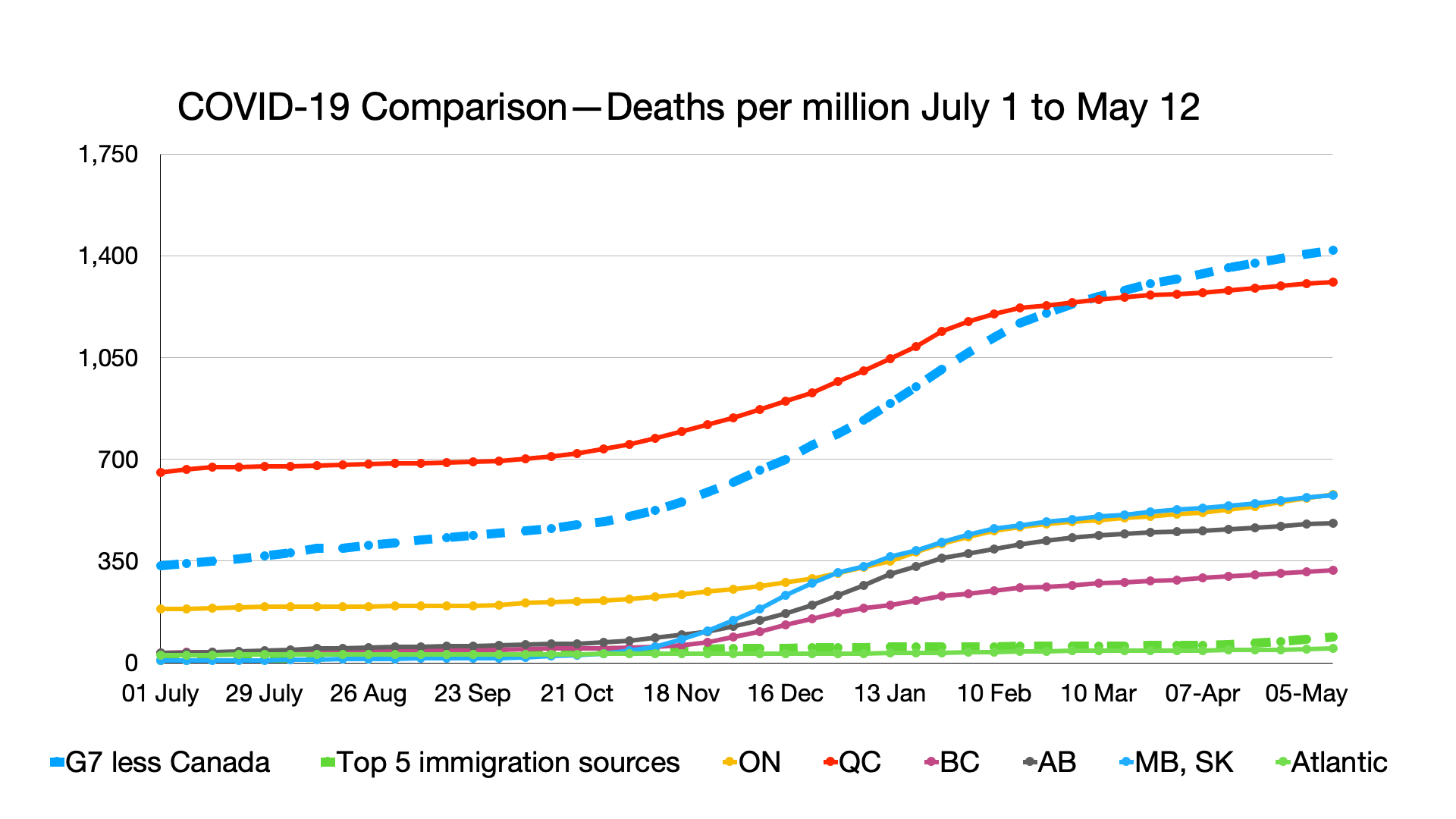
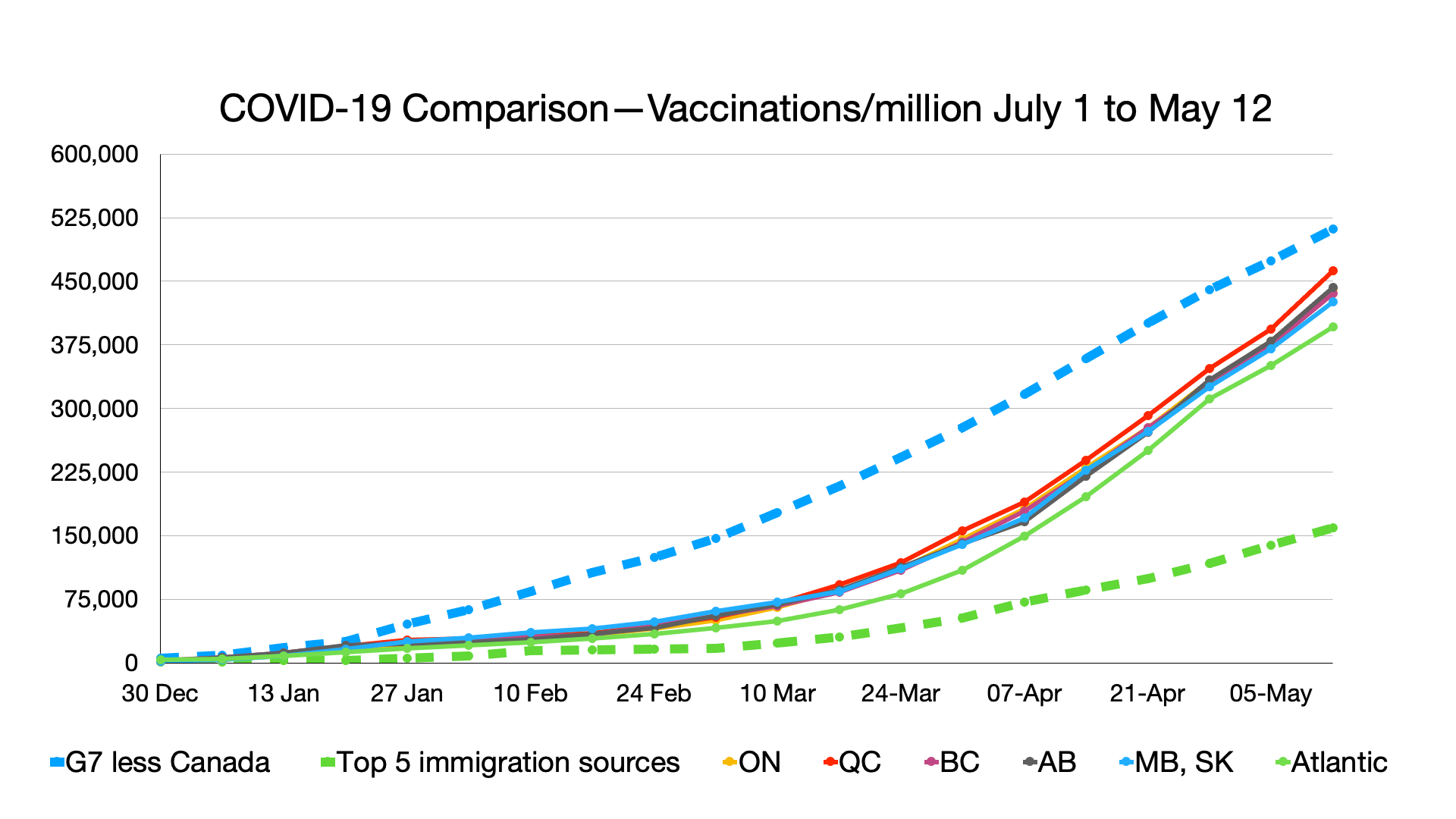
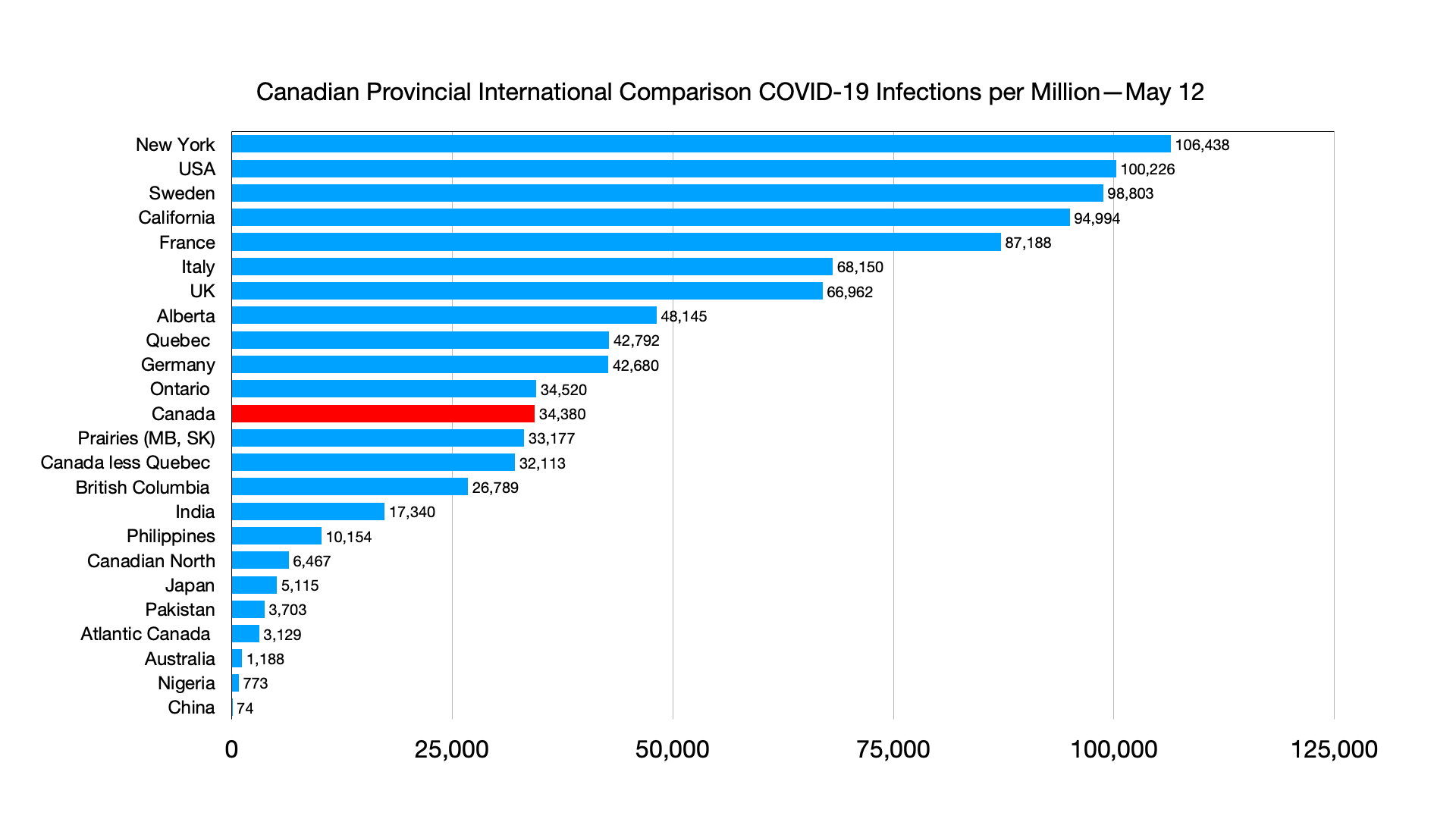
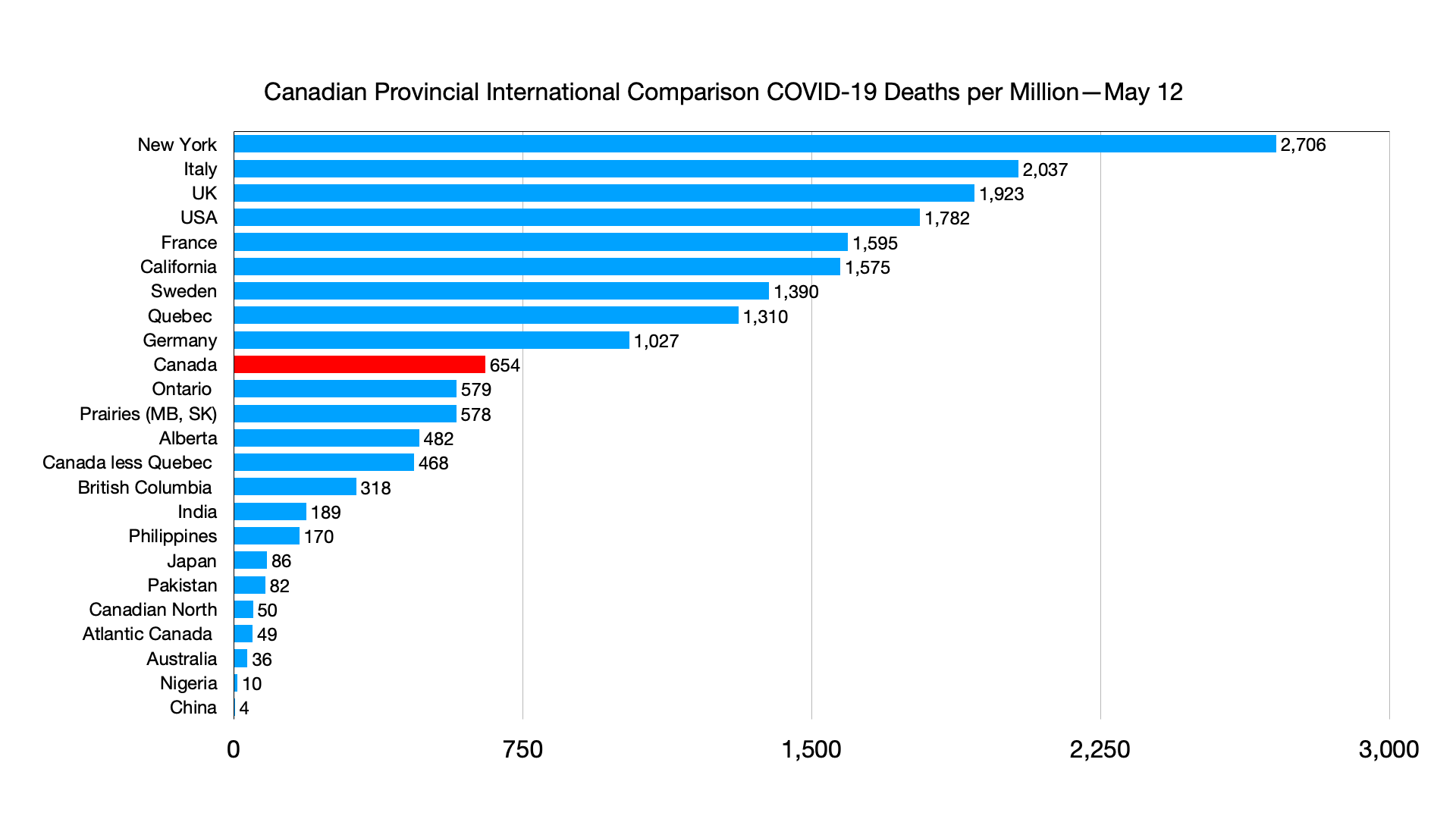
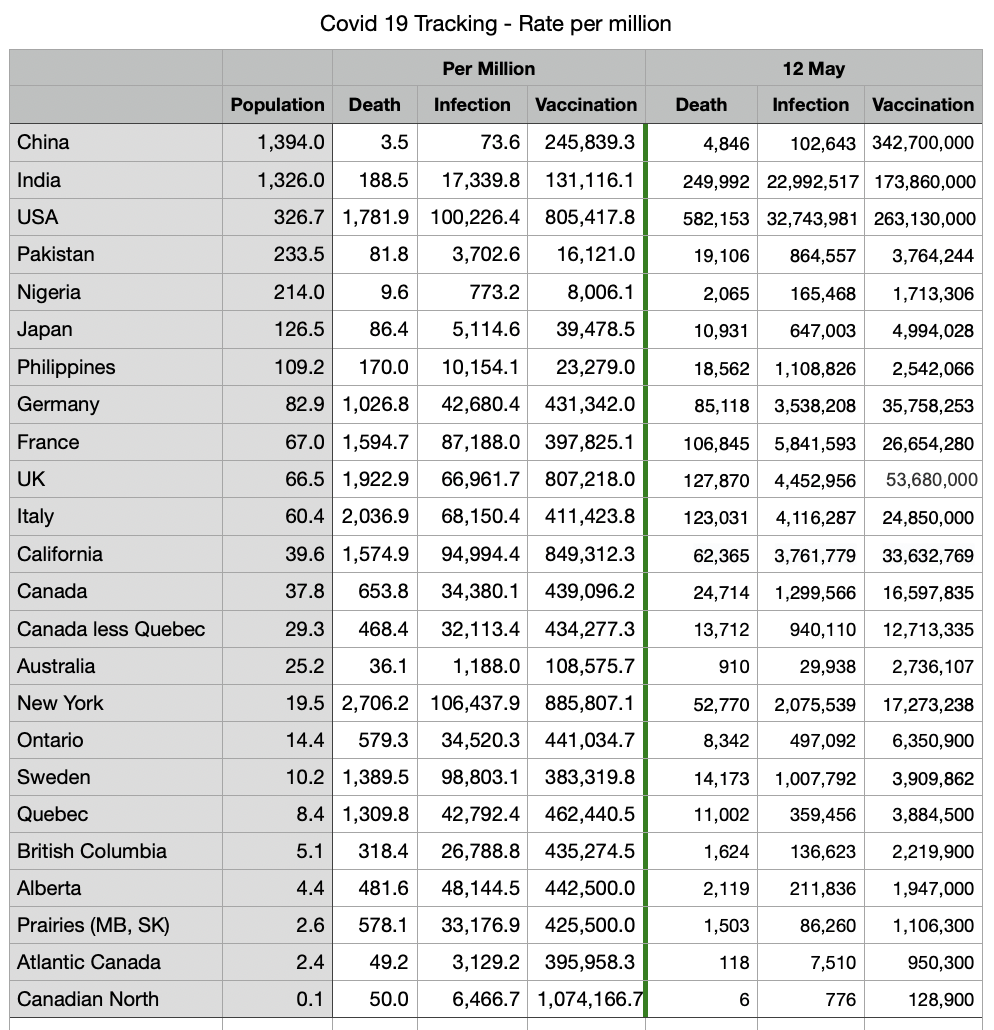
#COVID-19: Comparing provinces with other countries 12 May Update

The latest charts, compiled 12 May as the third wave continues. The ongoing spike of infections and deaths in India per million still has not resulted in a change in the relative ranking given the size of India’s population.

Vaccinations: Overall, vaccination rates in Canada and most provinces continue to be comparable or greater to those of EU countries.

Trendline charts

Infections per million: The ongoing spikes in Alberta and Ontario continue, with Alberta showing the highest growth rate.

Deaths per million: Gap between G7 and Canadian provinces continues to grow.

Vaccinations per million: Vaccination rates in Canadian provinces continue to increase more quickly than overall G7 less Canada countries. USA has moved ahead of the UK. Canada and the largest four provinces all ahead of Germany but Atlantic Canada behind France, while Australia and Japan have moved ahead of the Philippines. The Increases among immigration source country continue to reflect China and India mass vaccination roll-out, but at lower rates of increase compared to Canadian provinces and G7.

Weekly

Infections per million: Sweden moved ahead of California, Italy ahead of UK, and Ontario ahead of all Canada.

Deaths per million: Ontario ahead of Prairies.