Do more to help Yazidis, say Tories as audit of 546 refugees shows they only let in 3

Hard to believe, given all the previous and current rhetoric of the Conservatives. Kind of undermines their case even though I am sympathetic to giving priority to communities at greater risk, including the Yazidis:

As the Conservatives push for more help for Yazidis fleeing persecution at the hands of Islamic militants, new information suggests their efforts to do so while in government were minimal.

Data from a controversial audit of Syrian refugee cases ordered by former prime minister Stephen Harper late last spring reveals of 546 people reviewed, three identified as Yazidi, a Kurdish minority group which practices an ancient faith.

Immigration officials also told a House of Commons committee Monday that Yazidis were never highlighted specifically by the Conservatives as a group that should be prioritized for resettlement, even with their targeted approach to resettlement.

The data and the testimony Monday give both the Liberal and the Conservative arguments over Canada’s refugee policy some new energy after the file was a political flashpoint for most of 2015.

The Conservatives’ areas-of-focus policy drew heavy criticism, with many arguing it flew in the face of international obligations that see the UN choose who is resettled. The Tories argued that they were using the UN criteria, but were drilling down within them to ensure the most vulnerable were helped.

The Tories put religious minorities in that category, but the data obtained by The Canadian Press under access-to-information laws suggest the vast majority of landed Syrians whose files were audited were Sunni Muslim, as is the refugee population at large. About three dozen were Christian.

That few Yazidis arrived under their watch is a fact the Tories haven’t dwelled on as they have been pushing the Liberals for more action.

UN ignores ethnicity when prioritizing refugees

Since 2014, the Yazidis have been subject to forced conversions, murder, rape and enslavement at the hands of Islamic militants — actions recently declared a genocide by the UN.

The Tories now say that declaration should put them at the front of the line for resettlement to Canada.

There are, however, numerous policy roadblocks, especially the fact that most are in their home country of Iraq and as such aren’t eligible for resettlement.

Another challenge is that while a person’s faith or ethnicity might be the reason he or she became a refugee, it’s not something the UN looks at when selecting people for resettlement. In fact, the UN expressly asks states not to prioritize groups that way because the most important criteria must be vulnerability.

The Liberals repeatedly asked Immigration Department officials Monday about the policies of the previous government. While in opposition, they had argued that selecting refugees on the basis of religion — as the Tories were believed to be doing — was wrong. The Liberals have resisted calls to do so with the Yazidis.

But the Tories never gave specific instructions to track Yazidis, the officials said.

What about the Tories’ “areas of focus,” the officials were asked. Were Yazidis placed on that?

“There was no specific group put on the list,” Robert Orr, assistant deputy minister, said.
Source: Do more to help Yazidis, say Tories as audit of 546 refugees shows they only let in 3 – Politics – CBC News

Tories unfairly targeted Muslims during election, supporter tells convention

Jenni Byrne still in denial mode?

A Muslim Conservative supporter took to the floor of the federal Tory convention in Vancouver to accuse her party of unfairly targeting Muslims during the failed 2015 election campaign.

Urz Heer, who hails from the riding of Brampton South in the Toronto area, told Conservative Party executive director Dustin van Vugt that the party made her feel like an outsider.

The Tories came under fire during the 2015 campaign for vowing to ban people from wearing the niqab head covering during citizenship swearing-in ceremonies and for pledging to consider barring public servants from donning the same garb at work.

 “This party worked actively and aggressively against my people,” Ms. Heer said as some fellow Conservatives disputed what she was saying.

“It did,” she said. “It didn’t differentiate who Muslims were versus the enemy.”

She said Conservative tactics spurred Muslims to vote against the Tories in the election, Ms. Heer said.

“For the first time I felt like I didn’t belong here and this was my country,” the Conservative delegate said.

Former Conservative campaign manager Jenni Byrne, also attending the Vancouver party convention, defended the campaign’s conduct. The Tories also promised late in the campaign to set up a tip line so Canadians could report allegations of “barbaric cultural practices.”

Ms. Byrne noted that Mr. Harper’s announcement in early October last year that his government would consider a ban on niqabs in the public service followed a court decision on the headgear.

A day before the Conservative Leader’s statement, the Federal Court of Appeal had rejected the Tory government’s request that its ruling on the unlawfulness of barring the garb from citizenship ceremonies be put on hold while it sought leave to take the matter to the Supreme Court.

“In terms of the barbaric cultural practices or the niqab debate, the campaign had absolutely no choice but to speak on it, the [former] prime minister had choice but to speak because there was a court ruling midway through the campaign. It wasn’t that it was a campaign choice. It was: we had to react to a court case,” Ms. Byrne said.

Source: Tories unfairly targeted Muslims during election, supporter tells convention – The Globe and Mail

Conservative MP Deepak Obhrai: New Rules Turning Tories Into ‘Elitist And White-Only’ Club

Interesting – and a major risk for the party given the importance of new Canadian voters:

A longtime Conservative MP is blasting his own party for becoming an “elitist and white-only” club.

Calgary MP Deepak Obhrai, the dean of the Tory caucus, told The Huffington Post Canada he is deeply frustrated by new rules the party imposed earlier this year that raised the annual Conservative membership fee to $25 — “the highest of any party” — and set the entrance fees for leadership contestants at $100,000. 

deepak obhrai

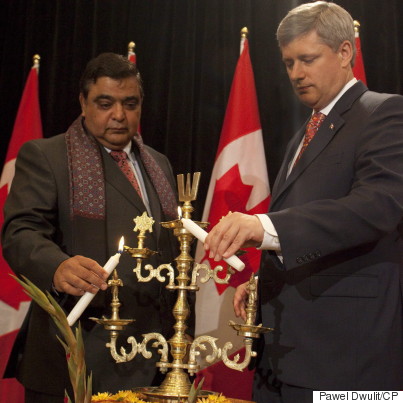
Deepak Obhrai and former prime minister Stephen Harper celebrate Diwali by lighting a candle on Parliament Hill on Oct. 8, 2009. (Photo: Pawel Dwulit/Canadian Press)

“Since we lost power in 2015, I have become very concerned about the direction my party has taken,” he told HuffPost over the phone on Thursday.

“These actions, in my view, have disenfranchised a vast majority of Canadians. Newcomers, immigrants, low-income Canadians, and those economically challenged will be turned off and walk away because they can’t afford these high fees…

“What is concerning me is that, unfortunately, [the Conservatives] will be seen as an elitist and white-only party,” he said.

Ethnic communities’ outreach

Since his election in 1997, Obhrai said he’s been working his “butt off” to bring immigrants to the party, a job that was subsequently taken on with great fanfare by former cabinet minister Jason Kenney. Success in connecting with ethnic communities culminated in the Tories’ majority election win in 2011, Obhrai said.

But that work has been dropped as a priority for the Conservatives under the leadership of party president John Walsh, Obhrai said. He added that the party has lost touch with grassroots members and pointed out that the caucus was not consulted.

“This party has become a party that is seen [to be only] for like rich people, I ask why? Why only for those who can afford it? Why the rich?

“For a family of four, it’s like asking them to give $100, and then also asking them to give through a credit card, which many don’t have. I have had these problems and my EDA [electoral district association] passed a motion telling the national council that we are unhappy with these rules,” the Calgary MP told HuffPost.

Source: Conservative MP Deepak Obhrai: New Rules Turning Tories Into ‘Elitist And White-Only’ Club

At the Manning conference, identity politics continue to torment the Conservatives

Interesting. Conservatives really need to come to terms with this given just how much their outreach strategy to ethnic voters collapsed in ridings with strong visible minority populations, as well, it appears, being offside mainstream Canadian values:

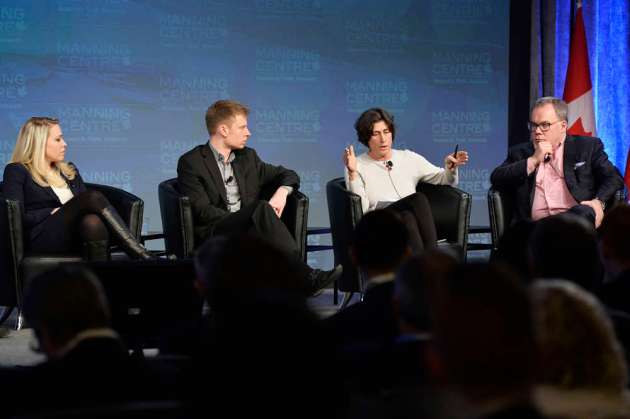
Toronto Star columnist Chantal Hébert was blunt about the mini existential crisis the conference was exposing.

CTV Journalist Mercedes Stephenson, Sun Media Journalist Anthony Furey, Journalist Chantal Hebert and MacleanÕs Journalist Paul Wells take part in a panel during the Manning Centre Conference in Ottawa on Friday, February 26, 2016. iPolitics/Matthew Usherwood

“Why did Justin Trudeau win the niqab debate on an issue he should’ve lost (according) to the polls? Because his stance on the niqab debate, which is a policy stance, goes to who the Liberals are. You could set your clock on Justin Trudeau saying what he said about the niqab,” she said.

“I look at your party and the niqab, and I don’t know who think you are. If you can, explain it….There are issues that brand a party beyond tone. And before you set out, you need to decide who you are.”

Back in the other room, where Scott-Marshall was explaining the results of their survey, she spoke of a type of free association exercise where participants were asked what words came to mind when they heard Conservative.

There were some positives, but also negative descriptors in line with what Weston had heard at peoples’ doors: “Old, outdated, and mean.”

When the survey drilled down further into how Canadians felt about common terms in the political vernacular — liberal, progressive, democrat, centre, independent, left-of-centre, socialist, conservative, libertarian, radical — they got a strong negative reaction to “conservative”.

“The most common negative reaction is to the word radical, not surprising probably. Although the second most common negative reaction is actually to the term conservative.” Scott-Marshall said.

“Just over a third of Canadians, 36 per cent, say they have a negative response to the term conservative when they hear it. And only 20 per cent say they have a positive response. Something to bare in mind just in terms of maybe negative…baggage that’s being associated with the term Conservative now.”

At the Manning conference, identity politics continue to torment the Conservatives

Canadians turned off by Donald Trump’s inflammatory policies: poll

Canadians_turned_off_by_Donald_Trump’s_inflammatory_policies__poll___National_PostInteresting but not terribly surprising result that largely correlates with the Conservative Party base, providing a possible explanation for the wedge politics of the previous Conservative government and its election strategy:

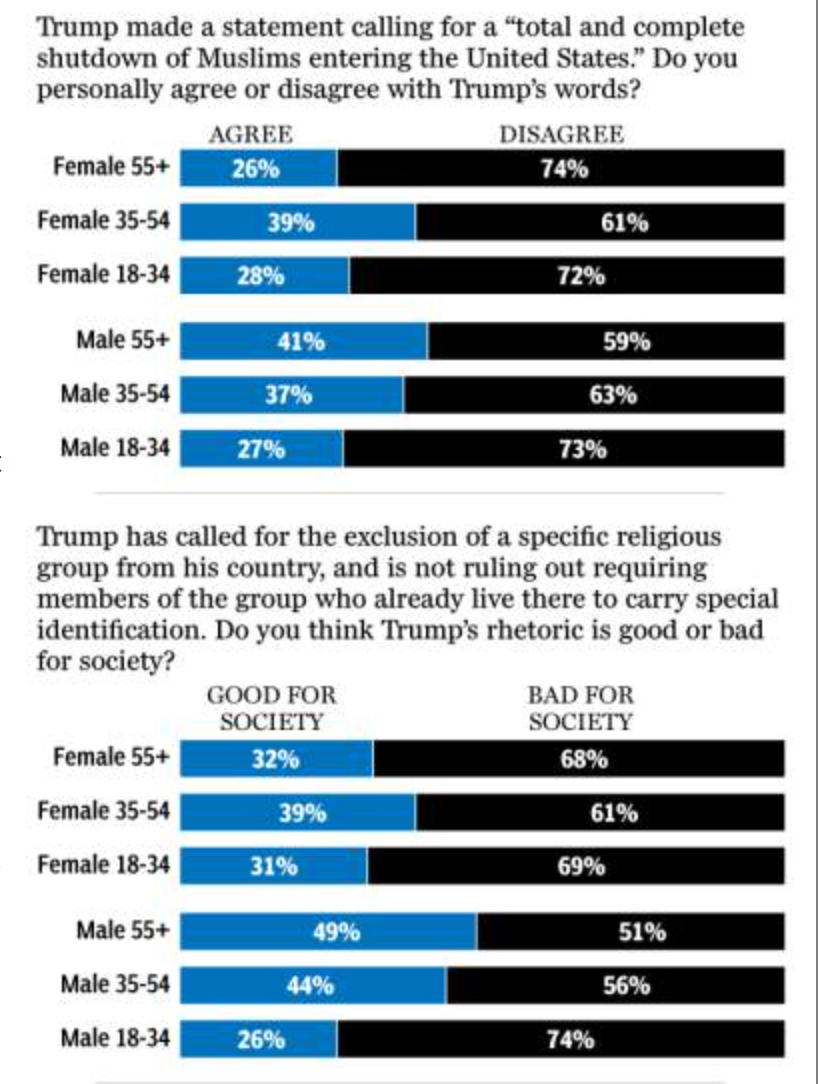
Respondents were also questioned about Trump’s call for a ban on all Muslims entering the United State: 67 per cent said they personally disagree, while about 50 per cent “strongly” disagree.

However, the poll notes that still leaves a sizeable minority — a full one in three — who agrees with Trump, 13 per cent “strongly” so.

Women aged 35-54 and men 55 or older were mostly likely to agree with Trump — by 39 per cent and 41 per cent respectively.

Responses varied across the country.

In every case, support for Trump was more apparent in rural settings, and at its lowest in urban centres like Toronto, Montreal and Vancouver.

Residents of central Canada and the west coast were most likely to dislike Trump, compared with 46 per cent of Saskatchewan residents who said they agreed with him.

Responses were also dictated by politics: people who voted Conservative in the last federal election were far more likely to support Trump, 55 per cent,

Respondents were also divided on whether or not Trump’s remarks are good or bad for society.

Unsurprisingly, the same minority that agrees with Trump’s police is also likely to say his rhetoric is good for society because it brings to light “timely issues without fear of political correctness, ” while 63 per cent disagreed, saying it “encourages fear and hatred towards Muslims.”

Kurl said that while the poll was clear a majority of Canadians do not support Trump, it is important to note the minority results, too.

“There is a significant number of Canadians who agree with Trump’s statements calling for a complete shutdown of Muslims entering the United States,” she said.

“Two in three disagree. The majority disagree. But one in three agree and that is a significant segment of Canadians.”

The poll has a margin of error of 2.5 percentage points, 19 times out of 20.

Source: Canadians turned off by Donald Trump’s inflammatory policies: poll | National Post

Why the Conservative ethnic outreach strategy fell apart: Cardozo

Andrew Cardozo on the reasons the Conservative ethnic outreach strategy failed:

It was that they assumed the ethnic voters were too stupid to hear the Liberal promise and could be easily scared by hot button words.

After years of visiting thousands of parades, temples, gurdwaras and the occasional mosque, and chasing around with foreign leaders like Indian Prime Minister Narendra Modi and Filipino President Benign Aquino and Israeli Prime Minister Benjamin Netanyahu, the 416, the 905, the 604—all those “heavily ethnic” ridings went Liberal.  How could they?

The first pillar of the Conservative ethnic policy was in part that they identified the more conservative elements within each of the communities, no matter how large or small, and in doing so not only expanded their base, but deepened the conservativism of the party.  They were able to attract the many traditional-minded Christians from various countries in addition to conservative elements of others from China, India and all the non-Christian religious groups.

The second pillar of the strategy was to play home-country politics.  All governments have done this, but the Conservatives took it to new heights—an extent to which it was becoming distasteful.  There will always be leaders in each community who will bask in the glow of a visiting head of state, but at a different level, members of the community are saying,  “No, Mr. Modi is not my Prime Minister, it’s you damn it.”

So on both these approaches, the Conservatives were smart enough to understand that they were not going to get the whole community but they could get the support of the more conservative segments of each community.  The sad part of it though was that they had no compunction about racing into a community and aggressively addressing issues on which there were divisions.  Unlike any other political party, they inserted their wedge politics that they use in the wider society, and have left those communities divided like never before. For example, you got a handful of demonstrators from the Jewish Defence League outside a fundraiser for a Jewish Liberal candidate in Toronto.

The third pillar of the strategy has been to play communities off each other, by resurrecting divisions from the old countries.  Taking a principled stand is what they said it was about.  They actively reached out to minority Christian communities from the South Indian and Middle East regions—people who left those countries to escape Islamic fundamentalism only to find that fundamentalism growing here, be they homegrown terrorist or the niqab and hijab.

But here is where the Liberals and New Democrats need to look deeply.  Just because the Conservatives were appearing to be overly bombastic, the other parties should not race to the complete opposite position.  There remains a need to counter radicalism within Canada and we do need to work towards gender equality in all communities.  While some women might cover by their own choice, others are certainly forced to.  So finding that balance should not be eschewed just because of the Conservative’s ugly approach.

In the end the Conservative approach was to focus on the conservative minded segments, cater to home-country politics, divide communities and scare them.  They will have earned the more hard-core conservative supporters for life, but by and large the strategy fell apart and even backfired, as they lost the vast majority in these communities to the Liberals’ positive campaign of hope and inclusiveness.

Source: Why the Conservative ethnic outreach strategy fell apart | hilltimes.com

Election 2015: Party Platforms Immigration, Citizenship and Multiculturalism

Now that all the political platforms are out, I prepared this comparative table of the three major parties and their commitments on immigration, citizenship, multiculturalism and related issues.

A number of aspects worthy of note with respect to the Liberals and NDP (Conservatives are largely reinforcing existing policies):

  • Neither party mention repealing C-24 (2014 Citizenship Act) either in whole or in part (e.g., revocation), despite having been clear on the campaign trail and in the debates to do so (save for the Liberals committing to restore pre-Permanent Resident time for international students for residency requirements);
  • The main focus is immigration, with the Liberals emphasizing rolling back some of the changes, the NDP foreign credential recognition;
  • General agreement on refugee policy with some nuances;
  • No real discussion of multiculturalism save for the need for community outreach and engagement as part of a counter extremism strategy, with the NDP also calling for non-discriminatory consular service; and,
  • Both calling for the restoration of the long-form Census.

The link to the pdf version of the table is below (doesn’t translate well into WordPress):

Liberal, NDP and Conservative Platforms

I have tried to summarize accurately the individual commitments. Needless to say, if any readers have any corrections, comments or suggestions, happy to revise this accordingly.

Political Parties Respond to OCASI Questions for General Election 2015

OCASI [Ontario Council of Agencies Serving Immigrants] surveyed the major parties regarding immigration-related issues. The following excerpts their responses to the question below on citizenship. The Conservative Party did not submit a response given that it has largely implemented its policies:

“3. Citizenship

Only 26 per cent of permanent residents who settled in Canada in 2008 acquired Canadian citizenship, compared with 44 per cent for immigrant who arrived in 2007 and 79 percent for those who arrived in 2000. These are the findings of research on citizenship acquisition released earlier this year. Access to citizenship has become more restricted, and naturalized citizens and those with dual citizenship are treated differently under the law.

Question: How will you ensure access to citizenship and exercise of citizenship is equitable?”

NDP:  Under Stephen Harper and the Conservatives, it has become harder and harder for immigrants to come to Canada and succeed. They’ve created huge backlogs, increased fees, politicized the citizenship test, made children and seniors pass language tests, and created new categories of citizenship rights. An NDP government will work with stakeholders to restore fairness and transparency to our citizenship and immigration system and to undo harmful Conservative changes. We will repeal Conservative legislation that treats naturalized and dual citizens differently from other citizens. We will review the citizenship test. And we will remove the requirement for 14-17 year olds and 55-64 year olds to pass a language test in order to receive citizenship.

Liberal:

Citizenship application wait times have ballooned during Mr. Harper’s time in office. Not content to quadruple fees and double processing times, the Conservatives have unnecessarily erected new barriers for aspiring citizens. We are witnessing ever more difficult language testing imposed on older potential Canadians, and the scrapping of the credit for time spent in Canada, which was previously extended to international students. In all of these areas, a combination of Conservative cynicism and budget cutbacks have abandoned those people who find themselves in the immigration system.

Over and over during the Harper decade we have heard how Canadians cannot get access to the services they need in a timely manner. A Liberal government will create new performance standards for services offered by the federal government, including streamlining applications, reducing wait times, and money- back guarantees. Performance will be independently assessed and publicly reported, including immigration processing. After years of cuts, all of these services take too long and do not provide the service that Canadians deserve.

Liberals believe that leading this country should mean bringing Canadians together, not dividing them against one another. We will repeal the parts of Bill C-24 that introduce unnecessary barriers and hardships for people to become Canadians. With C-24, the Conservative government has created a second class of citizen—dual nationals whose Canadian citizenship can revoked by the government without due process. Liberals believe in a Canada that is united and strong not in spite of its differences, but precisely because of them. These values have been abandoned under Stephen Harper, who wants us to believe that some of us are less Canadian than others.

Liberals believe that citizenship is a fundamental building block of Canada. No elected official should have the exclusive power to grant or revoke this most basic status. This bill devalues Canadians citizenship and undermines Canada’s economic well-being by making it harder to attract international talent and expertise to Canada.

Green:

The research clearly demonstrates that access to citizenship is rapidly becoming an unrealizable pursuit for many immigrants to Canada. Our immigration and refugee protection system is not prepared for 21st­century realities or challenges. A system with more than 50 entry streams that by 2010 had produced a backlog of one million applications ­ many of which languished in the queue for up to five or six years ­ is a dysfunctional nightmare at best. It is an embarrassment to a country like Canada that increasingly depends on interconnectedness with the rest of the world.

Immigration is first and foremost about citizenship. The Green Party is the only federal party to have concluded that the Temporary Foreign Worker Program (TFWP) is irredeemably flawed and must be scrapped. Weak mechanisms for assessing labour shortages have allowed the TFWP to undermine wage and labour standards. At the same time, the program exploits foreign workers.

Any reforms to Canada’s immigration system must strengthen our social fabric and be consistent with our fundamental values of the rule of law, equality, and fairness. The Green Party will initiate a comprehensive overhaul of Canada’s immigration and refugee protection system. Our reforms will ensure an efficient and predictable path to citizenship for all immigrants and their families. In addition to the policies discussed in depth here, we will establish pathways to citizenship for temporary foreign workers and the families of new Canadians. Greens will work with municipalities and provinces to improve the integration of new Canadians. We will also repeal Bill C­24 which allows the minister of citizenship to revoke citizenship. Citizenship is a category that cannot have classes.

New Democratic Party response to OCASI – Election 2015 [PDF]

Liberal Party response to OCASI – Election 2015 [PDF]

Green Party response to OCASI – Election 2015 [PDF]

Conservative ‘barbaric practices’ bill panders to fear of immigrants: Walkom

Tom Walkom on the Government’s pandering to its base:

As justification for his bill, Alexander cited the case of Mohammad Shafia, an Afghan immigrant who, along with his wife and son, killed three of his daughters and the girls’ stepmother.

What the minister didn’t point out is that all three killers received the maximum sentence — life in prison.

“The apparent reason behind these cold-blooded, shameful murders was that the four completely innocent victims offended your completely twisted concept of honour . . . that has absolutely no placed in any civilized society,” the judge said at sentencing.

Not much leniency there.

In another case cited by Alexander this week, it’s hard to know what the judge will say. The alleged wife-killer has not yet gone to trial.

This inconvenient fact didn’t stop the minister from publicly declaring the recent immigrant from Afghanistan guilty of an honour killing. It’s the second time this year that Alexander has preemptively convicted this particular man. The first was in a March speech for Toronto’s Canadian Club.

It is true that Canada does not tolerate practices more common in other countries. Americans who want to come to Canada must give up their handguns. Chinese billionaires, if they wish to settle here, may have only one spouse apiece. Murdering wives and daughters — for any reason — is just not on.

But laws in these areas already exist. With the exceptions noted above, Alexander’s bill does not add anything helpful. In the guise of protecting women it takes potshots at Muslim immigrants. Its motives are crassly political.

Perhaps the title of the bill could be changed from “Zero Tolerance for Barbaric Cultural Practices Act” to “Craven Pandering to the Conservative Base and anti-Muslim Sentiment.”

Conservative ‘barbaric practices’ bill panders to fear of immigrants: Walkom | Toronto Star.

Contrasting Party Statements on Multiculturalism Day

Worth reading all three messages as they all have a different take. Conservative stress common values and standing on guard, NDP focus on tolerance, compassion and equality, Liberal emphasis on equality and inclusion:

Ministers Jason Kenney, Chris Alexander and Tim Uppal issued the following statement on Canadian Multiculturalism Day:

“Canadian Multiculturalism Day is an opportunity to appreciate our country’s longstanding tradition of peaceful pluralism, and the constitutional protection of our liberties.

“Since before Confederation, immigration has helped shape our country into one of the most culturally diverse in the world, and Canada continues to have the highest per-capita level of immigration among developed countries.

“Canada’s approach to multiculturalism encourages all Canadians to celebrate their cultural heritage, while actively integrating into Canadian society and committing to our common values of freedom, democracy and the rule of law.

“Let us continue to celebrate our unity in diversity, while standing on guard for the freedoms so many have fought to protect, both at home and abroad.”

Ministers Jason Kenney, Chris Alexander and Tim Uppal issue statement to celebrate Canadian Multiculturalism Day – Canada News Centre.

The Official Opposition:

“Multiculturalism is a fundamental Canadian value and on this Canadian Multiculturalism Day, the New Democratic Party is proud to celebrate our nation’s rich diversity.

“The values of tolerance, compassion and commitment to equality are shared by all Canadians and allow everyone to realize their full potential. The NDP has always been a staunch supporter of these values.

“We are proud to acknowledge the important contributions of our society’s many groups and multicultural communities, and the NDP will continue its efforts to promote our multicultural heritage, so that Canada may remain a land of possibility for all those who call it home.”

Statement by the Official Opposition on Canadian Multiculturalism Day

And from the Leader of the Liberal Party:

“Today we celebrate the ethnic, religious, and cultural diversity that has come to define Canada’s national fabric.

“Canadians can be proud of the progress we have made in promoting inclusion and equality in this country – from adopting an official policy of multiculturalism in 1971, to including it as a fundamental principle in the Charter of Rights and Freedoms.

“Canadian multiculturalism embodies the freedom and democracy upon which our country was built. Today, the success of our diverse communities in fostering innovation and prosperity has proven that we are made strong not in spite of our differences, but because of them. We are reminded to neither take our diversity for granted nor become complacent. We must continue on a path where every citizen feels equal and embody a nation of citizens who respect one another.

“On behalf of the Liberal Party of Canada and our Parliamentary Caucus, I join with all Canadians in celebrating Multiculturalism Day.”

Statement by Liberal Party of Canada Leader Justin Trudeau on Multiculturalism Day