Why are so many new immigrants leaving Canada? – CTV News

Some of the personal stories behind those leaving:

Immigrants to Canada are increasingly leaving this country for opportunities elsewhere, according to a study conducted by the Institute for Canadian Citizenship and the Conference Board of Canada.

In fact, the number of immigrants who left Canada rose by 31 per cent above the national average in 2017 and 2019.

According to the study, factors that influence onward migration include economic integration, a sense of belonging, racism, homeownership, or a lack thereof, and economic opportunities in other countries, the report revealed.

Amid a crunch on affordable housing and other services, Immigration Minister Marc Miller announced on Nov. 1 that the federal government intends to maintain its target of admitting 500,000 new permanent residents in 2026.

In the days since the announcement, dozens of people who came to Canada as immigrants have reached out to CTVNews.ca to explain why they’ve abandoned their efforts to build a life here, or are close to doing so.

Most respondents said the high cost of living and competition for jobs and affordable housing have driven them to look beyond Canada’s borders for better prospects.

Julian Cristancho immigrated to Canada from Colombia in 2019, after briefly considering the U.S., and started an entry-level human resources job after completing a human resources degree in Ontario. The job paid $17 per hour – not a living wage in most Ontario cities at the time, according to the Ontario Living Wage Network – and he quit after two years to apply for something better.

“It took around 50 applications and countless hours tailoring resumes and cover letters just to get three initial interviews and not hearing back from those companies,” he wrote in an email to CTVNews.ca. In Cristancho’s experience, Canada’s immigration system works well at getting people into the country, but not at setting them up for success after they’ve invested some time here, he said.

Emilson Jose, from India, has lived in Canada for 10 years and has learned that many Canadians can’t afford to live close to where their jobs are located, meaning they spend dozens of hours commuting each month.

“So literally you will spend the majority of your time on roads which could be otherwise spent with your family,” he told CTVNews.ca in an email. From daycare to housing to daily household expenses, Jose has found that the cost of living in Canada can easily exceed a family’s income. He said he worries how much harder it will be for his children to attain homeownership decades from now.

“No matter how much you make, your take home pay is not even keeping up the expense. Families barely keep their head above water,” he said.

“After 10 years of hardship, I am now a proud Canadian citizen who doesn’t want to live in Canada anymore.”

Saikiran Yellavula came to Ontario with his family to study in 2019 after having practised dentistry in India for two years. Yellavula got a job in retail while studying health-care administration at Conestoga College, and in 2021, he and his family became permanent residents. For the past 16 months, Yellavula has worked fervently to land a job more suitable to his education and training, with no luck.

“I have applied for approximately 2,000 jobs in Toronto, but have received only one interview,” he told CTVNews.ca in an email. “The high cost of living, particularly the soaring grocery prices, combined with the current inflation…has made it incredibly difficult to make ends meet.”

On top of struggling to get by in a city known for having some of the highest living expenses in Canada, Yellavula and his family have found Canada’s cold climate hard on their physical and mental well-being.

“The combination of these factors has led to a deeply disheartening and depressing experience, not just for us but for many other immigrants facing similar circumstances,” Yellavula said. “Regrettably, these challenges have driven us, as well as several others we know, to contemplate leaving Canada for good. It pains us to consider leaving a country that we initially chose with hope and optimism for a better future.”

Shahrukh Al Islam, originally from Bangladesh, has been in Canada since 2011, when he moved here for school at 18 years old. He excelled at the University of Alberta and received several academic scholarships. Upon graduating, he landed a job with Amazon in Vancouver. However, Canada no longer holds the same appeal it once did for Al Islam, and he’s preparing to move south, where he believes he will earn more, and enjoy more spending power.

“(I) will be leaving Vancouver for Seattle soon,” he told CTVNews.ca in an email. “Tech salaries are higher, taxes are lower, houses are cheaper and USD is stronger.”

Bernard De Vaal and his wife moved to Canada from South Africa in 2018 and tried for five years to build a life here. De Vaal completed a post-graduate program in journalism and the couple had a baby. In 2019, the small family moved from Windsor, Ont. to Vancouver to try and settle into life in Canada.

For another four years, they struggled with social isolation, the high cost of living and the prospect of reaching old age without a sufficient retirement fund. They settled for an apartment that didn’t meet their needs, but which was all they could afford. Eventually, they gave up on Canada.

“My wife and daughter have since moved back to South Africa with me having to stay and work in Vancouver to pay off the debt we accumulated over the course of the last five years,” De Vaal told CTVNews.ca in an email.

“We feel extremely let down by the ‘Canadian’ dream. What we found is a withering, uncertain and anti-working class government, happy to sell promises it never intended on keeping.”

Other readers who contacted CTVNews.ca cited health-care woes and a hostile political landscape among their reasons for leaving Canada, though affordability was still a common thread.

Bianca Mtz and her partner moved to Canada from Europe when she was 29 and both secured well-paying jobs in Vancouver. Mtz came armed with a master’s degree and a PhD in engineering.

Despite their professional success, the two found it hard to cover the expenses of their small family.

“We found ourselves merely scraping by, unable to afford a home to raise our child,” Mtz said in an email to CTVNews.ca

Meanwhile, although they had chosen Canada over the United States for its health-care system, they were unable to secure a family doctor.

Compounding these issues, Mtz said, were daily headlines about political scandals, policy failures and pervasive social inequality. It was enough to convince Mtz and her partner to return to Europe.

“Confronted with a society where hard work did not seem to correlate with fair rewards, where health care and educational systems were compromised, and where government corruption was not an anomaly but a recurrent headline, our longing for Europe’s more accountable and equitable social systems intensified,” Mtz said.

“We are thus compelled to return to a society where taxes lead to tangible public services, healthcare is a given right, not a privilege and where schools are havens of learning, unmarred by the pervasive reach of politics.”

Source: Why are so many new immigrants leaving Canada? – CTV News
Canada’s ‘leaky bucket’ of immigration? More newcomers are choosing to leave Canada for greener pastures

Flip side of immigration levels, the number of immigrants leaving. Important new analysis:

More recent immigrants are leaving Canada for greener pastures, a new study says.

The findings suggest the phenomenon is especially prevalent between four and seven years after newcomers have received their permanent residence.

Although the number and ratio of people leaving each year varied, over the course of 25 years, accumulatively about 20 per cent of immigrants in each cohort ultimately left Canada, said the report, “The Leaky Bucket: A Study of Immigrant Retention Trends in Canada.”

However, the so-called onward migration rate spiked to 31 per cent in 2019 when 67,000 departures were reported.

“While the fairy tale of Canada as a land of opportunity still holds for many newcomers, this study points to burgeoning disillusionment,” said the report released Tuesday by the Institute for Canadian Citizenship (ICC) and the Conference Board of Canada.

“After giving Canada a try, growing numbers of immigrants are saying ‘no thanks,’ and moving on.”

As Canadians turn their attention to the number of immigrants welcomed to Canada amid worries over housing costs, access to health care and other government services, the report sheds light on what researchers call “onward migration,” where people leave their home country, settle in a second and then move again.

Based on the 2021 longitudinal immigration database, which links immigration data with tax data, the study tracks immigrants’ departures by using their lack of fiscal activity, such as income, as a proxy for an individual’s presence or absence in Canada.

Those included in the study were granted permanent residence between 1982 and 2018, and must have been at least 18 years of age when they came to Canada and filed income taxes here at least once since their arrival.

Averaging across each of the 1982-2018 cohorts, it found that onward migration in the first year sits just below the average annual rate of 0.9 per cent. However, the rate rises quickly and peaks around year five, with an average of 1.33 per cent of the arrival cohort leaving that year. It then declines steadily, falling back below 0.9 per cent by year 11.

However, the annual first-year onward migration rate spiked from 0.8 per cent in 2016 to 1.18 per cent in 2019, representing a significant surge compared to the average 0.9 per cent.

“The trend has been toward an increased onward migration rate,” said 18-page report. “More recent cohorts have sustained elevated onward migration rates for a greater number of years. This has led to higher cumulative onward migration for recently arrived cohorts.”

The extent of onward migration does ebb and flow. Over a 15-year period, those who arrived in the late 1980s and early 1990s, as well as the ones who came in 2004 — the last cohort where the 15-year post-arrival data was available — all had a higher rate of departures.

The average cumulative onward migration rate, for example, was 18 per cent for cohorts who arrived in the 1980s, compared to the 21 per cent among those who were granted permanent residence in the first half of the 1990s.

The report findings are in line with a conservative estimate by Statistics Canada that found 15 to 20 per cent of immigrants leave the country within 10 years after arrival and a recent Star story that found more recent immigrants are contemplating leaving.

Generally speaking, said the ICC and Conference Board report, the benefits of immigration can only be realized over time, when newcomers stay, thrive and contribute to the country.

“Retention should be a key performance indicator for Canada’s immigration strategy, given the central role that immigration is meant to play in supporting population and economic growth,” it said.

Researchers agreed the longitudinal immigration database is not perfect, because it wasn’t designed to measure onward migration and may not capture those who don’t file income taxes for whatever reason and who are not linked properly with the tax data.

There could be many reasons why newcomers choose to leave Canada, whether it’s due to challenges they face in their economic integration, their lack of sense of belonging, opportunities arising in other countries or even individual or family preferences.

“Many of these are beyond the control of Canadian policymakers,” the report said. “But policymakers can influence immigrants’ experiences in Canada.”

It recommends the federal government closely monitor onward migration among newcomers, invest in settlement services and programs to support immigrant integration, help employers hire and retain immigrant workers, and put money in infrastructure to meet population growth.

Source: Canada’s ‘leaky bucket’ of immigration? More newcomers are choosing to leave Canada for greener pastures

Amid growing dissent, will Canada change its immigration plans?

Good overview, largely from the more pro-current approach side, as we await the levels plan release:

Canada is set to unveil the latest targets for how many new residents it hopes to welcome in the coming years.

The annual announcement of permanent resident levels, something Immigration Minister Marc Miller must do in Parliament on or before Nov. 1, is the kind of dry fare that has traditionally drawn little attention, serving largely as a governmental formality amid high levels of public support for immigration.

But this year’s numbers are expected to face more scrutiny given a surging discussion of whether Canada has the capacity and the infrastructure it needs to accommodate the hundreds of thousands of newcomers it is bringing in.

{{tncms-inline displaytitle=”Immigration drives Canada’s population to 40M” embedid=”ba479a79-f163-4cc5-97a2-74273de44cbb” linktodownloadthumbnail=”https://oovvuu-thumbnails-prod.imgix.net/48/80128685-73f5-4883-bd94-3b3795f23f29.jpg?h=200&w=300″ playerscripturl=”https://playback.oovvuu.media/player/v2/index.js” type=”oovvuu”}}

And, as the government seeks to maintain public support for immigration, some say how Prime Minister Justin Trudeau’s Liberals approach immigration — and the messaging around it — will be key.

The government’s current immigration plan, unveiled in 2022, aimed to bring in 465,000 new permanent residents this year, 485,000 in 2024 and 500,000 in 2025. The immigration ministry is on track to meet the 2023 target.

The upcoming plan, however, will look at the numbers for the next three years.

Recent polls suggest that Canadians’ appetite for more immigration may be waning. A Nanos report in September showed 53 per cent of Canadians wanted Ottawa to accept fewer immigrants, up from 34 per cent in a similar poll in March. Then, an online survey by Research Co. in October found 38 per cent of Canadians said they believe immigration is having a mostly negative effect, up 12 percentage points from research conducted a year ago.

“Some people are feeling there’s too much immigration, when it comes to the fact that it’s driving up the housing cost, exacerbating the housing shortage, making the connection between immigration and health care and education,” says Toronto Metropolitan University professor Rupa Banerjee, whose research focuses on immigrant employment integration.

“Immigration is on people’s radar more and the plan will be scrutinized a lot more closely.”

So far, the government has seemed inclined to stay the course.

“I don’t see a world in which we lower it, the need is too great,” Miller told Bloomberg in August. “Whether we revise them upwards or not is something that I have to look at.”

Magdalene Cooman of the Conference Board of Canada said Canadians need to understand the immigration plan’s long-term objectives are to address the country’s aging population and boost economic growth.

While immigrants do need housing, health care and other government services, she said, people shouldn’t lose sight of the fact that newcomers are also part of the solutions to those challenges, and contribute to the workforce, whether it’s by building new homes or caring for those in hospitals.

“There is a reason why the federal government has moved in this direction,” said Cooman, the board’s interim associate director in charge of immigration research.

“Immigration is really the only way to increase population, to support population growth and to support the future of Canada.”

A recent report by Desjardins said the country’s working-age population (those 15 to 64) would need to grow by just over two per cent annually in order to offset the impacts of aging. That growth relies largely on immigration.

“What’s the optimal level of immigration to Canada? This can be a tough question to answer, as ‘optimal’ is in the eye of the beholder,” said the report. “It depends on the policy objective that immigration is meant to achieve.”

While the short-term strains of the population growth are already showing, the report suggested the federal government could restrict the admission of non-permanent residents such as international students and temporary foreign workers.

Despite the lagging infrastructure, the conference board’s Cooman warned that any pause to the long-term immigration strategy could create other unintended problems.

“I’m not opposed to increasing the levels because I understand the long-term growth strategy,” said Cooman. “But I am opposed to increasing the levels without a strategy to show us how all the infrastructure can be built to accommodate more people in the country. You can’t have one without the other.”

Whom Canada brings in matters, observers say.

Permanent residents come to Canada under the economic, family or humanitarian classes. In 2023, about 58 per cent of them will have been selected based on their education backgrounds and skills; 23 per cent through sponsorships by spouses or children and grandchildren; and the rest as resettled refugees and protected persons.

Using real wages as a proxy for relative productivity of different groups, the Desjardins report said economic immigrants in particular are outperforming the typical Canadian.

Several observers credit the immigration ministry with fine-tuning the way it selects economic immigrants by better matching the skills of candidates with the labour market needs, and targeting those with backgrounds in health care, transportation, trades, agriculture and STEM occupations. Officials, for instance, have relaxed some rules for immigrant physicians and created a special immigrant class to attract workers in construction-related trades.

To immigration lawyer Betsy Kane, the bigger challenge for Miller is to overcome the public backlash and explain his immigration strategy.

“Between the home construction effort and the easing of the doctor efforts, you’re potentially reducing the lag in public opinion,” said Kane, vice-president of the Canadian Immigration Lawyers Association.

Banerjee of TMU said the government has to be more specific in explaining the immigration plan than just floating the big numbers around.

“We are bringing in trades and transport workers and there’s a number of pilots now that are working to try and bring people into underserviced smaller and rural communities. Many of them are very small (scaled), but there’s been efforts,” said Banerjee.

“A lot of that is lost, because all we see in the headlines is ‘500,000 newcomers being admitted.’”

In August, a CIBC study found there were about one million more people living in Canada than official government estimates, including international students, foreign workers, asylum seekers and undocumented migrants. (Unlike permanent residents, temporary residents are uncapped and not included in the immigration plan.)

“We need to make sure these immigration targets also include temporary migration numbers. We cannot have uncapped temporary migration and then pretend that is all of the immigration,” said Banerjee.

In a letter to Miller this month, the Business Council of Canada urged the government to prioritize highly skilled economic-class immigrants to fill high-paying jobs, and raise the ratio of the economic immigrants in the mix from 60 per cent to 65 per cent by 2025.

While the number of job vacancies requiring lower levels of skill and education has declined significantly, the council said unfilled job openings for highly trained and educated professionals remain stubbornly high.

“Enhanced economic immigration is essential,” wrote Goldy Hyder, president and CEO of the council, whose member companies support more than six million jobs across Canada. “If we do not seek this skilled labour, our economic rivals will.”

But employers aren’t the only group that would like to get a bigger piece of the permanent-resident pie.

Advocates for refugees are urging Ottawa to raise the levels of resettled refugees up from about 10 per cent to 15 per cent to accommodate the growing number of displaced migrants around the world, which now stands at 108 million.

“If we are able to increase Canada’s resettlement targets, it would support the reduction of the backlog,” said Gauri Sreenivasan of the Canadian Council for Refugees, adding that a recent government audit showed 99,000 refugees were waiting in the queue by December 2022.

NDP immigration critic Jenny Kwan said she’s concerned about the backlash against the immigrant community.

“No good will come out of that because we have already lived through racism and discrimination in Canada’s history,” she said. “The government has to have a housing plan and an infrastructure plan for our community.”

Tom Kmiec, the Conservative immigration critic, did not respond to the Star’s requests for comment. This summer, his party leader, Pierre Poilievre, did say the immigration system is broken, but sidestepped reporters’ questions about whether he would change the current targets.

Source: Amid growing dissent, will Canada change its immigration plans?

Reeve: Canada’s new permanent-residency pathways are a half-measure

Interesting that an organization generally aligned with the government’s immigration priorities and plans makes this justified criticism of the government’s approach to TR2PR. More fundamental issues IMO to criticize as Don Wright did but welcome never the less.

The numbers of TR2PR continue to increase so despite the argued lack of pathways, many are making the transition, particularly economic class, although clearer and more transparent pathways are always desirable:

Earlier this year, Liberal MP Randeep Sarai put forward a private members’ motion in the House of Commons, calling for expanded immigration pathways for temporary residents to become permanent. Motion M-44 set out a timeline of 120 days for the federal government to respond, and in September, federal Immigration Minister Sean Fraser did so, tabling a strategy aimed at foreign workers and international students who have significant work experience in sectors with persistent labour shortages.

This is a step in the right direction. Research from the Conference Board of Canada shows that those with Canadian work experience that matches their skills and education are more likely to succeed economically. However, governments at both the federal and provincial levels must go further to create clear, predictable and stable pathways for temporary residents. Changing how we think about these transitions – and how the government defines a “Canadian work experience” – would improve outcomes for immigrants by expanding their economic opportunities and limiting their exposure to precarity and abuse.

Temporary residents currently fit into two broad categories: temporary workers and international students. A significant percentage of individuals in both groups want to stay in Canada and would benefit greatly from doing so. What’s more, both groups could deliver significant benefits to the country, particularly in achieving the objectives of Canada’s immigration levels plan, which aims to welcome 465,000 permanent residents in 2023; 485,000 in 2024 and 500,000 in 2025. But there is no clear pathway to permanent residency status for these individuals who, under existing skills requirements, don’t qualify. They need access to systems and better supports.

Temporary workers are those who often return to Canada on multiple visas and/or perform essential and in-demand roles. Canada is growing increasingly dependent on these workers, particularly in industries such as agricultural harvesting and manufacturing. Many businesses and services would benefit greatly from filling these essential roles with permanent employees.

International students, meanwhile, are often referred to in research and rhetoric as “ideal immigrants.” Once they graduate, they have Canadian credentials, networks and experience, and can potentially boast existing exposure to the labour market. They can overcome economic and social integration barriers at a young age, thus allowing them to enjoy more years of success while contributing even more to the economy.

Despite their clear potential, both groups face significant barriers to achieving permanent residency. Temporary workers usually have comparatively lower levels of education and a lack of professional experience, both of which prevent them from qualifying for standard economic immigration pathways. International students, particularly those who achieve credentials below the university degree level, face similar challenges.

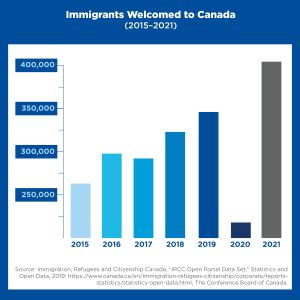
The government’s plan to increase immigration levels is laudable, and may mean that a greater number of temporary residents can transition to permanency. However, from 2015 to 2021, the number of permanent resident admissions grew by 49 per cent, to 406,025 from 271,840, while the number of temporary residents grew by 83 per cent, to 860,690 from 468,280. If current trends continue, a smaller percentage of temporary residents will make the transition, even as overall targets grow.

Improving processing capacity for both kinds of residents is essential, given the significant backlogs currently plaguing the system. Clearer pathways for permanent residency would in turn significantly reduce the processing load, because it would likely limit the tendency of workers and students to apply for multiple successive visas as they pursue permanency.

Part of Mr. Fraser’s plan is to expand eligibility for certain in-demand professions and review the points awarded for Canadian work experience, all with the aim of increasing candidates’ likelihood of success. This has potential, but also pitfalls. These criteria are inherently unpredictable and lack transparency, and the terms are subject to abrupt change. Immigrants, communities and employers need stable categories and rules to make decisions and develop strategies. Adding technicalities and volatility to a system as complex as Canada’s may only make it more challenging to navigate.

Altering the system to make pathways to permanent residency clearer and more predictable would maximize the benefits of immigration for immigrants and Canada alike. Temporary residency should be limited as much as possible to those who truly only want to be in Canada temporarily. For those who intend to stay, pathways to let them maximize their potential must be clear and effective. The government’s plan, as it stands, doesn’t achieve this objective.

Iain Reeve is the associate director of immigration at the Conference Board of Canada.

Source: Canada’s new permanent-residency pathways are a half-measure

Canadian Real Estate Fuelled or Cooled by Immigration Policy? 

From the recent report by Re/Max Canada, the Conference Board and CIBC, largely cheerleading the government’s increased immigration levels but emphasizing the need for more trades in the mix of immigrants to help address labour shortages in construction:

SCENARIO: Canada fulfils its commitment to welcome more than 400,000 immigrants per year to the country with a continued emphasis on integrating Economic Immigrants who generally have higher education, English and French skills, and prior Canadian work or study experience.

“Immigration produces significant benefits for the Canadian economy as a whole and helps meet the labour market needs of particular communities and sectors. Canada’s system excels at selecting immigrants who have a high likelihood of long-term economic success. However, the system could improve by selecting more immigrants to fit specific, chronic labour market needs. In particular, a focus on immigrants with skills in the trades and construction could help address severe labour shortages that limit housing supply,” says Iain Reeve, Associate Director, Immigration Research, Conference Board of Canada.

Canadian real estate and immigration_Immigrants welcomed to CanadaResearch by the Conference Board of Canada has shown that higher immigration levels can benefit the Canadian economy with greater GDP and public revenues [Note: Overall GDP not per capita GDP]. CIBC Capital Markets and The Conference Board of Canada agree that the Canadian economy needs a minimum of 400,000-plus new immigrants annually to sustain our economic vibrancy.

In fact, despite the pandemic, Canada accepted approximately 405,000 new Canadians in 2021. According to Benjamin Tal, Deputy Chief Economist at CIBC Capital Markets, what is not often reported is that 70 per cent of the 2021 cohort were already established in Canada and approximately 50 per cent of the 2022 immigrants will be in-country. The key insight here is that we are not looking at 400,000-plus net new individuals settling anew in Canada with housing needs, but approximately half that number. They have been students and non-permanent residents with employment, promising prospects for employment and all with housing. 

New immigrants are not the only factor to consider in determining housing demand. The formula is complicated and often does not look at things such as immigrants already living in Canada and Canadian students in temporary housing. To get an accurate measure of housing demand, further refinement is needed to housing data collection methods, according to both CIBC Capital Markets and The Conference Board of Canada.  

As Tal explains, the profile of new Canadians is quite distinct from historical immigrant cohorts. Many have higher educational credentials and Canadian work experience. For example, just 10,000 new immigrants in 2015 held a post-graduate work permit, versus more than 88,000 in 2021, according to data compiled by the Conference Board.

Canadian real estate and immigration_Immigrants who are homeownersIt takes 10 years for immigrants to have earnings that are commensurate with their skills, education, and experience when compared to similar Canadian-born workers. According to Tal, that time has decreased by approximately half. In part, this is a result of Ottawa’s emphasis on economic immigrants and better immigrant support systems. This means that new immigrants can land on their feet faster and participate in the Canadian economy in various ways, such as entering into Canadian real estate ownership. In 2021, 38 per cent of homeowners in Canada were immigrants.

However, as both CIBC Capital Markets and The Conference Board of Canada state, Canada’s immigration levels alone are not an issue. There is a missed opportunity by not selecting more immigrants who are trained in the trades, where all regions across Canada are experiencing a deep labour shortage. 

In reference to the construction sector alone, BuildForce Canada reported that 90,000 workers will be leaving the workforce in the next five to 10 years due to retirement. Yet, Canada has not accepted enough skilled trade immigrants in 2021 to fill these labour market gaps, according to the Conference Board of Canada. This will impact Canada’s ability to fulfill the new housing and affordable housing starts as predicted by the federal government.

“Currently, Canada’s federal immigration policy does not link with the country’s labour market needs and that will be a mounting problem in our capacity to build enough homes to meet the high demand over the next five years,” says Tal. “It’s all fine to table policy to improve our national housing affordability crisis by promising to build more homes and affordable housing — it’s critical — but it’s superfluous when you don’t have the skilled workers
to build it.”

“For several years now, RE/MAX Canada has been advocating for a coherent and achievable national housing strategy to calm red-hot price increases and more importantly, to improve affordability for a greater diversity of buyers and renters,” says Elton Ash, Executive Vice President, RE/MAX Canada. “Yet, as the experts at CIBC and The Conference Board show, our current immigration policy is lacking sufficient linkages with labour demands and as such is not set-up as successfully as it could be. Immigration policy should help support our labour demands.” 

Source: Canadian Real Estate Fuelled or Cooled by Immigration Policy?

Who is ‘essential’? Immigrants and foreign workers overrepresented in designated jobs during COVID-19, a new report finds

Interesting and informative report, quantifying some of the numbers:

The pandemic has shed light on how immigrants and foreign workers are the backbone of the essential workforce that keeps the flow of goods and services uninterrupted during the crisis.

Now, for the first time, a new study has looked at the data to back it up.

Based on custom government data, the Conference Board of Canadaexamined the representation of immigrants and temporary foreign workers in sectors and occupations identified by Ottawa as “essential” during the COVID-19 pandemic.

Although immigrants only account for 23.8 per cent of the Canadian workforce, they are “overrepresented” in major essential jobs: transit and passenger transportation (39.7 per cent); food manufacturing (34.85 per cent); administrative and support services (29.84 per cent); truck transportation (29.71 per cent); nursing and residential care facilities (29.21 per cent); personal and laundry services (28.1 per cent); and food services and restaurants (27.43 per cent).

Temporary foreign workers are also an increasing source of labour in the farm and food manufacturing subsectors.

Work permit holders — who make up around 1.4 per cent of the overall labour force — are overrepresented in food services (3.4 per cent); accommodation services (2.7 per cent); professional and technical services and food manufacturing, both at 2 per cent.

“Immigrants and temporary residents are critical in the essential sectors and occupations. That’s very clear,” said study author Yilmaz Dinc, senior research associate at the Conference Board specializing in immigration.

“As the pandemic has shown, we don’t only need people with bachelor’s, master’s and doctor’s degrees. We also need people with manual skills. We need truck drivers, nurse aides and workers in food manufacturing. It’s important to create an immigration pathway for people with those skills to arrive in Canada as permanent residents.”

The data also revealed a chronic problem within the country’s immigration system that rewards high education achievements and professional work experiences but fails to utilize those talent and match them with jobs that are commensurate with those qualifications.

The report found that overqualification is particularly common among newcomers working as nurse aides, orderlies, and patient service associates (45 per cent); transport truck drivers (28 per cent); and process control and machine operators in food and beverage processing (34 per cent). Similar trends are observed for temporary residents in these occupations.

Among truck drivers, for instance, more than 25 per cent of the immigrants and 16.8 per cent of foreign workers in the occupation have a bachelor’s degree even though their role doesn’t require one — an indication the study says that these workers’ skills and knowledge have been underutilized.

The study said immigrants who came under the economic class such as the federal skilled workers program — which often requires post-secondary education — constitute a significant proportion of the immigrant workforce in essential subsectors.

In 2015, 45.7 per cent of the 91,500 permanent residents working in food manufacturing and 52.6 per cent of the 89,000 permanent residents employed in nursing and residential care facilities came here as economic immigrants based on their skills and qualifications.

It’s not like migrants are drawn to essential jobs with low pay and little job mobility, said Dinc, but they have few options.

“These are hard jobs. Many of these sectors, again and again, face difficulties in attracting domestic labour. What happens is these sectors turn to newcomers and temporary residents to fill those vacancies,” he said.

“They are more readily available than some of the better-paying, better-quality jobs. And that’s how the overrepresentation of immigrants and foreign workers becomes stronger and stronger.”

To build a stable essential workforce resilient to disruptions such as a global pandemic, Dinc said policy-makers can’t just rely on the import of temporary foreign workers and on overqualified permanent residents, who would seek other opportunities that arise.

Over the longer term, governments and employers must address the precarious conditions faced by essential workers by improving the benefits and wages to recognize their contributions to the economy not just during pandemic times.

“You have to create pathways to permanent residency for these essential workers to fill essential job vacancies. On the other hand, there needs to be a fresh approach to compensation, career advancement and job mobility to make those jobs attractive not just to immigrants but also Canadians,” said Dinc.

Earlier this year, Ottawa rolled out a one-time special immigration program to grant permanent residence to 90,000 recent international graduates as well as temporary foreign workers with work experience in essential occupations.

Dinc said immigration officials must tweak their existing selection criteria to ensure regular permanent residence pathways are available for migrants to fill essential jobs.

Source: https://www.thestar.com/news/canada/2021/10/29/who-is-essential-immigrants-and-foreign-workers-overrepresented-in-designated-jobs-during-covid-19-a-new-report-finds.html

Ottawa is right to attract more immigrants

The Conference Board pro-immigration level opinion. Money quote: “It’s prioritizing its immigration targets and devaluing the very high social-capital standards that underpin Canada’s system of economic immigration.”

As I have indicated a few times, I disagree with this approach as I think it understates, if not ignores, some of the inequality aspects of this policy:

In the short term, spending by immigrants can help fuel economic recovery, while the availability of immigrant labour will be essential in restoring the restaurant and hospitality sectors.

The federal government’s latest efforts to make it easier for immigrants with Canadian work experience to become permanent residents is another sign it’s committed to attracting more immigrants. 

Clearly, federal officials are convinced of the social, economic, and labour-market benefits of high immigration levels.

But what does their approach mean for the immigrants who will arrive at this challenging time? And what might this period teach us about our immigration system?

Earlier this month, Immigration, Refugees and Citizenship Canada invited 27,322 people to apply for permanent residency as part of the Express Entry program’s “Canadian experience” class. This draw from the pool of registered candidates was five to 10 times greater than the usual number of invitations made in a single draw.

The increase was made possible by significantly lowering the points threshold to qualify for an invitation to become a permanent resident. These points are awarded for a variety of social and human-capital reasons that align with long-term integration and economic resiliency, such as: education, age, knowledge of an official language, and experience living in Canada as a temporary resident.

This is the second major step by the federal government to ensure we continue to attract immigrants in large numbers, despite the COVID-19 pandemic. Last October, Ottawa updated its three-year immigration planwith record targets culminating in 421,000 arrivals in 2023.

The new targets were warmly received by immigration advocates who hoped the federal government wouldn’t follow the lead of many other countries by restricting immigration because of the pandemic and the recessions caused by its associated public-health measures.

However, even advocates are skeptical that Ottawa can attract 401,000 immigrants in 2021 — not because of a lack of demand, as Canada’s appeal as a destination for emigrants has only increased during the pandemic. Rather, they fear that continued travel restrictions, and the news that mass vaccinations won’t arrive in Canada until this fall at the earliest, will have a dampening effect on immigration.

Even in 2020, the government relied heavily on those already in Canada to boost invitations for permanent residency. Research by the Conference Board of Canada shows that 60 per cent more permanent-resident “arrivals” were already in Canada than in the previous two years.

The latest move is a doubling-down on this strategy, and leans heavily on temporary workers and students who are already in the country.

In this way, Ottawa is making a clear trade-off. It’s prioritizing its immigration targets and devaluing the very high social-capital standards that underpin Canada’s system of economic immigration.
So how do we assess this trade-off?

The long- and short-term benefits of maintaining high immigration levels are clear. In the long term, immigration fuels economic growth, improves our ratio of working-age Canadians to retirees, creates more tax revenue, and supplies skilled labour to key sectors. Economic and population modelling by the Conference Board of Canada demonstrates that more immigration benefits the economy.

In the short term, spending by immigrants can help fuel economic recovery, while the availability of immigrant labour will be essential in restoring the restaurant and hospitality sectors, for instance.

Therefore, the government has good reasons to want to get as close to its immigration targets as possible, despite the challenges of COVID. The pattern of relying on immigrants who have Canadian experience, but lower social capital, might continue as long as significant travel restrictions remain.

But this doesn’t mean immigrants who arrive during this period won’t be successful or contribute as much to the Canadian economy. Our economic modelling indicates that even immigrants with comparatively lower social-capital attributes — for instance, refugee and family-class immigrants — still make significant contributions to the economy, especially over time.

Also, most newcomers with experience living in Canada will already have Canadian work experience. This helps with future job searches, as employers tend to assess Canadian experience more favourably than foreign work experience. They will also arrive at jobs with a better understanding of Canadian culture and workplace norms, and greater facility with our official languages, neither of which may be their first.

There is great short- and long-term economic value in trying to reach Canada’s immigration targets. In closely observing the progress of immigrants who arrive during and just after the pandemic, we can learn a lot about the value of Canadian experience, compared to other social-capital factors.

The key is not to let individual immigrants suffer for the sake of Canada’s economy and our understanding of the integration process. They should be monitored closely, and both government and the immigration sector should be prepared to offer additional support if they struggle.

Source: https://go.conferenceboard.ca/MDk0LUVHRi02MzkAAAF71qV7cSskUNcrhiS4-30l_NQZjeNl-F2yhUwu_YEwPrJPoUe8DYze02tYZtddvE27AJPjm1k=

Immigration levels plan: Reactions

Have been following the various reactions to date regarding the government’s (overly) ambitious targets for the next three years. Relatively few op-eds and commentary, possibly due to the focus on COVID and the US presidential election which are taking up most of the oxygen.

And much of the commentary focusses overly on the administrative issues, not the more substantive issues related to economic integration of immigrants during an economic recession, one that is likely to linger for a few years.

Have grouped these by constituency:

Business-oriented

The plan was welcomed by the business sector.

“There is widespread agreement across party lines that immigration is essential to long-term economic growth,” said Goldy Hyder, president and CEO of the Business Council of Canada, which represents some of the country’s largest businesses.

“Newcomers bring energy, skills, new ideas and entrepreneurial spirit. They start companies, fill skill shortages, buy houses and pay taxes, … The minister’s plan will allow Canada to make up lost ground as the pandemic eases. It will inject new dynamism into our economy.”

The Canadian Manufacturers and Exporters even went one step further, saying Ottawa’s objectives were too modest and will not allow the country to catch up quickly enough over the coming months to compensate for the reduced number of immigrant admissions this year.

“Manufacturers are increasingly using immigration to supplement their workforce but there are not enough immigrants to meet the demand,” said Dennis Danby, its president and CEO, who represents 2,500 leading manufacturers in the country.

“If manufacturing is to be at the core of the economic recovery following the COVID-19 crisis, we must do more in prioritizing immigration from the economic stream.” (Toronto Star)

As Canada’s leading voice on smart population growth, Century Initiative continues to advocate not just for increasing our population, but for policies to support that growth through investments in education and in the national and urban infrastructure that will allow our communities to grow in a sustainable manner. We also need to prioritize supporting parents with a national childcare strategy, and our children with early education programs.

Now is the right time to invest in growing our population. Environics Institute’s recent Focus Canada survey shows that a record two-thirds (66%) of Canadians reject the idea that immigration levels are too high, and that Canadians recognize the critical contribution immigrants make to our economy and our social fabric. We have a tremendous opportunity before us and welcome the opportunity to continue working with gover(nment to seize it in the interest of future generations of Canadians. (Century Initiative)

Opposition critics

Opposition MPs took aim at the way the government has handled immigration throughout the pandemic and questioned how the new targets would be achieved.

Conservative immigration critic Raquel Dancho said the government is announcing new levels without a plan for how they will be safely implemented.

Jenny Kwan, immigration critic for the NDP, said she believes the numbers are “a bit of a hoax” because the backlog to process applications is so great that the targets will be hard to meet.

Christine Normandin, the Bloc Québécois immigration critic, said in French that Ottawa is taking the opposite approach to the Quebec system. She said the province takes only as many immigrants as it can process in one year, while Ottawa sets goals without taking into account its capacity to do the paperwork. (Globe)

That lower-end target is actually below the low end of the number of immigrants, pre-pandemic, the Liberals had planned to admit in 2021, pointed out NDP immigration critic Jenny Kwan. 

“The Liberals demonstrate a lack of conviction in their targets and left the door wide open for immigration levels to decrease,” she said in a statement.

It’s also not clear how unused room is being carried over. 

For example: the Liberals had planned to admit 49,000 refugees this year. Next year, according to Friday’s plan, they are aiming for 59,500. 

While that looks like an increase of 10,000, the number of refugees who have actually arrived in the first eight months of this year was down nearly 60 per cent from 2019 arrivals. 

So it’s possible that the 2021 figures merely incorporate the shortfall from this year, as opposed to being an overall increase. Mendicino wasn’t clear when asked about that issue Friday.  (Canadian Press)

NDP immigration critic Jenny Kwan said the government must not overlook the compassionate aspects of the immigration system, such as removing travel restrictions for asylum seekers and ensuring permanent residence status for migrant workers in recognition of their contributions during the pandemic.

“The immigration department’s processing abilities is still spotty at best and serious investment in staffing, far beyond what we’ve seen so far, is needed,” said Kwan.

“Without these investments, applicants are to expect significant increases in processing times for years to come, which were already long before the pandemic.” (Toronto Star)

Tweets from CPC critic Dancho:

The Liberals have failed to layout a plan to  bring in newcomers to Canada safely. No widespread access to rapid tests and the 14 day quarantine is not a financial option for many people. #cdnpoli https://twitter.com/RaquelDancho/status/1322270115921055746?s=20

They have no plan to better resource immigration department to fulfil the levels promised.  Liberals are simply adding to their massive, years-long immigration backlogs that fail to provide potential newcomers with certainty, dignity or respect. #cdnpoli https://twitter.com/RaquelDancho/status/1322270117384851456?s=20

The ministers announcement did not acknowledge the economic devastation caused by COVID-19 or the hundreds of thousands of Canadians facing unemployment since the pandemic hit and how these new ambitious immigration numbers will impact them. #cdnpoli https://twitter.com/RaquelDancho/status/1322270118290903040?s=20

International organizations

Either way, that Canada even continues to open its arms is welcome, said Rema Jamous Imseis, the UN refugee agency’s Canadian representative. 

“In an era of travel restrictions and closed borders, refugees continue to be welcomed by Canadians,” she said in a statement.

“The significance of this lifeline and the deep generosity of Canadians cannot be overstated.” (Canadian Press)

Academics

While experts had expected Ottawa to stay the course with its immigration goals — given the government had publicly stated immigration would be key to restarting the post-COVID-19 economy, they were surprised the Liberals would decide to take it up a notch.

Although critics have raised concerns about high immigration given that the country’s jobless rate hovered at nine per cent in September — after peaking at 13.4 per cent in May — from 5.6 per cent before the pandemic, some experts say the government is on the right track.

“The timing for expanding the program now is good. But I’m surprised how high the targets are they have set. I don’t know how realistic it is from a bureaucratic administrative perspective,” said Carleton University economist Chris Worswick, who specializes in the economics of immigration.

“I commend the government for thinking about immigration again. I was worried that it wouldn’t happen. I wonder if they’re being too ambitious. I’m cautiously optimistic that we’ll end up at a good place.” (Toronto Star)

Immigration lawyers and advocates

Immigration and refugee experts welcomed the move to grant permanent residency to those already in the country.

“I’ve always thought, even before COVID, that it makes a lot more sense to target people who are already educated here, or have work experience here, or at least have lived here. … These are people who are already demonstrating their genuine interest in Canada,” immigration lawyer Chantal Desloges said.

Janet Dench, executive director of the Canadian Council for Refugees, said her organization has urged the government to give permanent residency to those in Canada.

“What we need to see is that realization actually reflected in actual operations, actual policies, because at this point, the way the Immigration Department is working is running in completely the opposite direction,” she said. (Globe)

We need #StatusforAll and Fairness.
Today’s Canada’s Immigration Plan does neither. pic.twitter.com/xhsJtrZBtj— Migrant Workers Alliance for Change (@MWACCanada) October 30, 2020

Contrary to what the government is saying, there is NO INCREASE in IMMIGRATION LEVELS. Instead, there was a 150,000 shortfall in immigrants in 2020, and the government is trying to catch up for it by increasing 50,000 each year for the next three years. But as COVID-19 continues, these promises are unlikely to be kept.+

The overall proportion of new immigrants remain the same, with the primary focus on “high waged” immigrants. However, to qualify for these immigration programs, migrants must show 12-24 months of high-waged work. With COVID-19-related job losses disproportionately impacting racialized people, many migrants don’t have access to these jobs and won’t qualify. No plan has been announced to ensure full and permanent immigration status for all migrant and undocumented people right now.+ Many migrants — including care workers and former international students — were not able to complete requirements for permanent residency in 2020 due to COVID-19. However, there is no meaningful increase in numbers on fixing of rules for these migrants in today’s announcement. (Migrant Workers Alliance)

On the right

Recent polls have shown that Canadians are weary about increasing immigration levels in the wake of the coronavirus pandemic. 

A poll commissioned by True North found that an overwhelming 76% of Canadians strongly agreed with the idea of a temporary pause until a coronavirus vaccine is developed and unemployment drops to pre-coronavirus levels. Note: Polling firm unknown and thus is not credible

The poll results show a surprising consensus among political parties as well with 67% of Liberals wanting to impose a temporary pause, 66% of NDP voters and 89% of Conservatives. 

“Given today’s global circumstances of a public health pandemic and severe economic crisis, now is the perfect opportunity to revert back to our successful historic immigration model, listen to the majority of Canadians, and take another pause,” True North’s founder Candice Malcolm wrote when the poll was released. 

“It’s time for our leaders to listen to the people and do what’s best for our country.” (“True” North)

While the government touted the need for migrants to strengthen the economy, the unemployment rate in Canada, the unemployment rate currently stands at 9%, from an all-time high of 14% in May. Over 8 million Canadians applied for emergency COVID relief benefits in the form of the CERB. Canada’s unemployment rate was around 5% prior the pandemic. (Rebel Media)

Links:

https://www.thestar.com/news/canada/2020/10/30/canada-raises-immigration-targets-to-record-level-eyeing-covid-19-recovery.html

https://www.theglobeandmail.com/politics/article-canada-aims-to-accept-far-more-immigrants-in-next-three-years/

https://www.nationalnewswatch.com/2020/10/30/open-arms-in-an-era-of-closed-borders-pandemic-era-immigration-plan-to-be-released/

https://www.centuryinitiative.ca/2020/10/30/statement-by-century-initiative-in-response-to-todays-announcement-on-canadas-new-immigration-levels-plan/

https://www.rebelnews.com/canada_to_increase_immigration_targets_after_covid_disruption

https://www.facebook.com/notes/migrant-workers-alliance-for-change/immigration-announcement-fails-to-ensure-fairness-status-for-all/10101179406532842/

Douglas Todd: Who cares about ‘winning’ the immigration debate?

Good for the Conference Board for inviting some more critical or sceptical voices like Todd (whose articles, as you know, I always find interesting).

On polling data, the picture is more complex than simply presenting one polling firm where the timing, question phrasing and methodology may somewhat skew results (e.g., Environics and Pew present a more positive portrait than IPSOS).

And not sure that immigration policy is developed in any less transparent manner than any other area of government policy, and where stakeholder groups, who follow the issues carefully, have more influence:

Politicians and corporations that want more immigrants in Canada are mounting marketing campaigns to “win the immigration conversation.”

At least the CEOs, think tanks and civil servants are upfront about aiming to promote higher immigration levels, which aligns them with Prime Minister Justin Trudeau and the Liberals.

Where, however, does this leave all the Canadians in the mushy middle? That’s where most Canadians are at, according to immigration department officials and other migration experts who spoke at a Conference Board of Canada event held last week in Vancouver. The gathering was titled, “Winning the Immigration Conversation.”

Not many Canadians are extremists, either for or against current immigration policy or rates, polls suggest. The bulk of the population seems hazy about Trudeau’s plan to continue to increase immigration levels to 350,000 people a year by 2021, up from 260,000 when he was elected in 2015.

My sense is most Canadians are not eager to either “win” or “lose” the immigration discussion. Most of us don’t think immigration boils down to an either/or option. Some of us mostly want to know what’s going on, so we can be informed at the ballot box.

But as some speakers at the Conference Board event noted, Canada’s politicians and mandarins are almost unique in the obscure way they dictate the country’s powerful immigration policies from behind closed doors.

Kareem El-Assal, the senior immigration director for the Conference Board, asked me to speak at the “Winning the Immigration Conservation” conference so participants would not end up in the usual echo chamber, in which everyone basically agrees with each other.

El-Assal had seen my 2017 story on the clubby atmosphere that reigned among the more than 1,000 Canadians who work with immigrants, refugees and international students and attended Montreal’s Metropolis Conference. My article on that gathering was headlined, “The narrow view from the migration sector bubble.”

So I give credit to the corporate-sponsored Conference Board, a booster of high immigration levels, for welcoming diversity of opinion. It turned out some scholars, and even some civil servants, had their own skepticism about Canada’s immigration levels, which are arguably the highest per capita in the world.

I told participants I’m intrigued by philosophy’s two foundational questions: What is real? And how then shall we live? And I bring those questions to immigration matters.

What I’ve discovered in recent years on the migration beat is the vast majority of native Canadians (and to a lesser extent immigrants) don’t have a grasp on what is real about the increasing global migration of people, particularly into Canada. And it’s understandable.

Even though the Conference Board has launched its own campaign for increased immigration, El-Assal revealed data showing most Canadians don’t have the foggiest idea about a basic issue: How many immigrants come into Canada each year.

Only nine per cent of Canadians knew correctly it is between 150,000 and 300,000 annually. What’s worse, El-Assal said, when Canadians learn how many immigrants are actually entering the country, their support goes down.

“The populists may have a point,” Antje Ellerman, a political scientist at UBC, told the Conference Board gathering.

“Canada has a high degree of (immigration) policy-making behind closed doors.” The immigration agenda has “traditionally been dominated by the government and civil servants, and rarely engaged the public in meaningful ways.”

In addition, the complexities of immigration rules are not often covered by the media. That is the unfortunate case even though, for instance, almost half the populations of Toronto and Vancouver are foreign-born.

One concern is that if Canadians are purposely being kept in the dark about immigration developments, and even opposition politicians are afraid of raising the subject for fear of being labelled xenophobic or racist, how can the host society make wise choices about an issue that has defined the country?

Turns out many Canadians are concerned. Only 45 per cent believe immigration is “good for the economy,” according to a new Ipsos poll. Another 57 per cent believe “immigrants place too much pressure on public services,” be that health or transit systems. And almost 60 per cent say government is “hiding the true costs to taxpayers and society.”

Immigration officials are not alone in finding in the past couple of years that there has been a shift among Canadians about immigration. That is part of the reason Ottawa has launched a promotional campaign called #immigrationmatters.

Its public relations effort is getting out stories about immigration successes, especially at the neighbourhood level. Not a discouraging word will be heard from #immigrationmatters, of course, since it will support a major plank in this year’s Liberal campaign.

However, Ellerman is among those who think it unwise for governments in Canada, Europe or elsewhere to ignore the populist voices that worry about immigration. To do so, she said, could feed anti-immigration radicalism.

UBC economics professor David Green offered the audience some data-based realities about immigration.

One finding takes issue with frequent claims by Immigration Minister Ahmed Hussen that high immigration is the key to economic prosperity. Green highlighted how immigration has an almost imperceptible effect on long-term Canadian wages, not doing anything at all for per-capita income.

And although boosters of strong immigration frequently maintain it is absolutely necessary to counteract an aging Canadian labour force, Green’s studies show its effect is minimal, almost non-existent.

Immigration numbers would have to jump multiple times over to make even a small dent in the growing portion of seniors in Canada, Green said. In addition, most people who obtain citizenship status in Canada soon try to sponsor older family members to join them.

But immigration is not all about economics. Many of the speakers recognized reliable new opinion surveys show much of the public resistance to high immigration has mostly to do with culture.

Roughly one in two Canadians fear too many immigrants “do not adopt Canadian values.” Many in the host society feel they are losing command of their own cultural identities. Some migration specialists said such feelings should not necessarily be dismissed as xenophobic.

Give the swirl of powerful factors at play, what are we to make of efforts by Ottawa and its supporters to “win the immigration conversation”? Even though organizers of the Conference Board event said they came up with the title to be provocative, I’d say immigration policy needs more balanced attention than that found in win-lose campaigns.

In a democracy, the public could use as much information as possible about migration policy and trends. Who knows what would happen if Ottawa became more transparent? Reality has a funny way of surprising all of us.

Source: Douglas Todd: Who cares about ‘winning’ the immigration debate?

2018 Immigration Plan: Higher Levels and a Multi-Year Plan Will Benefit Canada’s Economy

Conference Board reaction to the Government announcement with a good summary. :

On the heels of the Government of Canada’s announcement that it will welcome some 310,000 immigrants in 2018 and is introducing a multi-year levels plan for just the second time in history, the Conference Board’s Craig Alexander offers the following insights:

“Canada’s decision to increase immigration will help sustain long-term economic growth in light of its rapidly aging population and low birth rate. Introducing a multi-year levels plan will improve the ability of governments, employers, immigrant-serving organizations, and other important stakeholders to successfully integrate newcomers into Canada’s economy and society.”
—Craig Alexander, Senior Vice-President and Chief Economist, The Conference Board of Canada.

Insights

  • Canada’s 2018 immigration target of 310,000 represents a 19 per cent increase compared with its newcomer intake between 2006-2015.
  • The immigration target will be 330,000 in 2019, and 340,000 in 2020.
  • Canada’s intake is the highest since 1913 and will represent about 0.90 per cent of the population by 2020 which is also high by historical standards. Unlike the past, however, Canada can no longer count on natural increase (births minus deaths) to grow its labour force.
  • Population aging is one of the biggest economic and fiscal challenges facing Canada.
  • An October 2017 report by the Conference Board shows that immigration is a strong driver of Canada’s economy. Today, 75 per cent of population growth is due to immigration. Canada’s population growth will come entirely from immigration as the number of deaths is forecast to outpace births by the early 2030s.
  • In the absence of immigration, economic growth and government revenues would slow, and Canada would struggle to fund vital social programs. Health care, for example, will only become more expensive to deliver as an older population requires more services.
  • Canada is introducing a multi-year levels plan for just the second time in its history. The plan will allow stakeholders to make informed decisions as they seek to integrate newcomers into the economy and society. For instance, city planners can more accurately project how many newcomers will be arriving over multiple years and what sorts of infrastructure investments are required to successfully absorb a larger population.
  • Canada first introduced a multi-year levels plan for the period between 1982-1984 but the onset of a recession effected the federal government’s ability to continue with the plan.
  • Opinion polls show that public support for immigration remains high. To maintain this support, it is essential that newcomers are equipped with the tools that they need to benefit the Canadian economy and complement domestic workers.

Source: 2018 Immigration Plan: Higher Levels and a Multi-Year Plan Will Benefit Canada’s Economy