Chris Selley: Latest outrages over Muslims give a preview of Quebec’s next referendum

Sigh:

…One might ask him the same about all manner of other religious rites parents impose upon their children, and one might even get a consistent answer. Quebec feminist icon Louise Mailloux once equated baptism and circumcision with rape. When Mailloux ran for the PQ in 2014, then leader Pauline Marois said she “respect(ed) the fact that she has that point of view.”

St-Pierre Plamondon complained, too, about a sign welcoming people to Montreal’s City Hall that features a woman wearing the hijab. “Clearly the issue of religious invasion of public space does not stop at Bedford School,” he wrote.

So, yet again, the goalposts have shifted. The old deal was if you speak French and integrate into society, you’re welcome to practice any religion you like. The more recent deal, under 2019’s Bill 21, is that if you want to wield state power for a living — as a police officer, Crown prosecutor, prison guard or teacher — then you also have to remove any religious symbols while you’re on the job.

Now the mere presence of a hijab on a little girl in a library, or anywhere in public, is problematic in Quebec.

Those who’ve always believed Bill 21 wasn’t punitive enough, including St-Pierre Plamondon, have concluded that Bill 21 must be toughened in response to the scandal at the Bedford elementary school. And it all could have been avoided if the school board had just done its bloody job.

Expect a third referendum to boil down to this: linguistic and religious freedom versus restrictions thereof. That can’t not be ugly — and it won’t work for the Yes side. The referendum would fail, and Canada would still include an even-more-divided Quebec that’s even more out of step with the rest of Canada’s concepts of linguistic and religious freedom.

Source: Chris Selley: Latest outrages over Muslims give a preview of Quebec’s next referendum
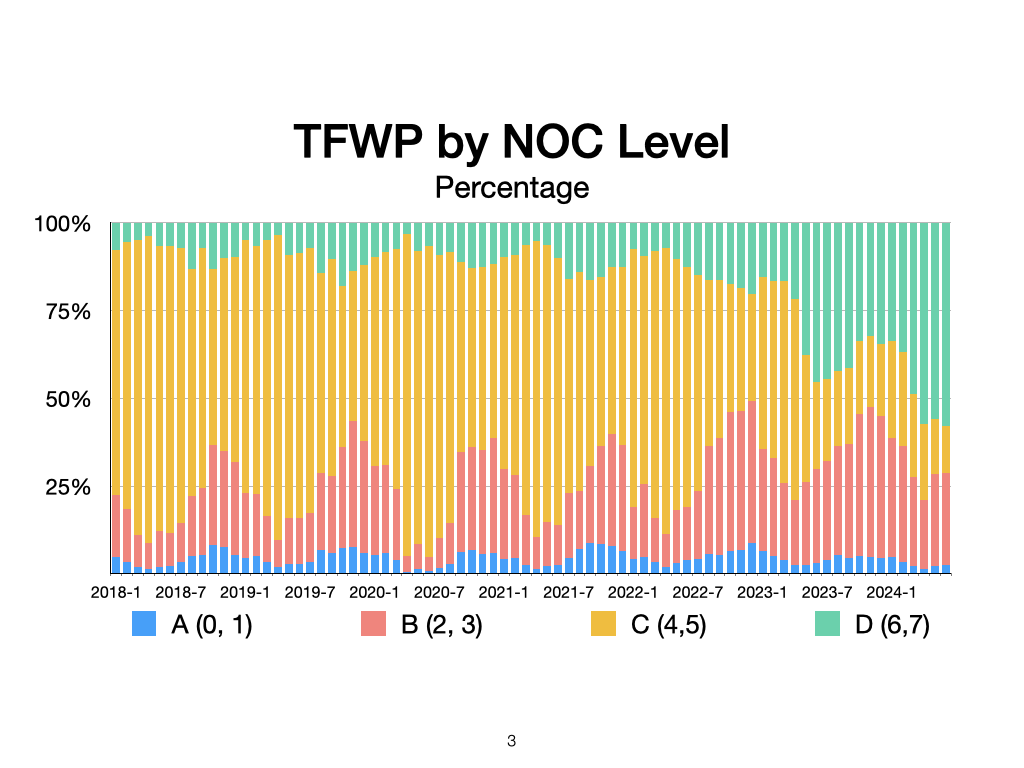
Colby Cosh: Lululemon’s sweetheart deal for temporary foreign workers

Of note. The vast majority of those hired under the TFWP are low-wage workers:

…It is easy to imagine that the decision to approve the permits was a no-brainer for B.C., Ottawa, and the federal ministers who quarterbacked the exemption. And, yes, Lululemon is a brand Canadians surely feel positive about, leaving aside that little blip with the terrible Olympics outfits.

But, you know, those positive feelings are surely strained just a tad when you hear about those jobs Lululemon couldn’t fill from the vast reservoir of educated and enterprising humanity that is the Lower Mainland of B.C. The company’s TFW exemption is allowing it to hire people for positions that no Canadian could conceivably fill, to wit: “graphic designers, advertising and marketing managers, computer systems managers, retail wholesale buyers, pattern-makers and industrial engineers.” This list includes some jobs I’ve seen friends move to Vancouver to do! Either things have changed a lot human-capital-wise out on the coast, or Lululemon just wanted a backdoor subsidy in exchange for maintaining its visible connection with Canada.

To be sure, companies have to fight their corner ferociously against the perpetual efforts of governments to drink their blood, but Vescera’s story observes that Lululemon also battled his team’s efforts to obtain documents about the exemption through the province’s freedom of information law. The company half-successfully tried to invoke the “harmful to third-party business interests” provision that is present in B.C.’s FOI law, along with those of most provinces. This, to me, is genuinely irksome practice—made worse because, although the Investigative Journalism Foundation received redacted documents, nobody will explain what third party’s interests are being protected, or why.

Indeed, I cannot fathom a reason for any “business interests” provision in any FOI law at all. The inherent danger in all dealings between businesses and governments are an overwhelmingly important reason for freedom of information law to exist. Allowing suppression of information on the grounds that some teat-sucking client of the state might be embarrassed or compromised is simply a license for the concept of FOI to be nerfed to death

Source: Colby Cosh: Lululemon’s sweetheart deal for temporary foreign workers

Chris Selley: Canada’s ‘immigration consensus’ endures, despite Ottawa’s worst efforts

Correct interpretation IMO. However, the current government’s approach undermines public trust in government competence in immigration and other areas, even as some corrective action is taking place:

….Environics also inquired as to why the shift occurred. And it’s very obviously for one major reason: The housing crisis. In 2022, 15 per cent of respondents agreed that “immigrants drive up housing prices (and lead to) less housing for other Canadians”; in 2023, 38 per cent agreed.

And they’re right. Add demand for a scarce product and prices go up. Canada absolutely should be able to cope with current or higher levels of immigration, and indeed thrive off of it. We’re not exactly short on land or high on population density. But our politicians have never been more motivated to address housing scarcity, and the results have been utterly dismal. For heaven’s sake there were fewer home starts in June 2024 than in June 2022, according to CMHC data.

On the issues more typically associated with anti-immigration sentiment per se, the Environics data show no alarming spikes at all. Only four per cent of respondents cited “security risk” as a factor influencing their desire for less immigration. One-quarter said “immigrants are a drain on public finances (or) cost too much,” or are “bad for (the) economy (and) take jobs from other Canadians” — up from 23 per cent and 21 per cent, respectively, which is hardly any change at all in the polling world.

In 2022 and 2023 alike, just 19 per cent of respondents told Environics there were “already too many people in Canada” — the strongest suggestion, I submit, that what we’re seeing here isn’t a backlash against immigration, let alone against individual immigrants and immigrant populations, but a call for some restraint until we get our crap together. Just nine per cent of respondents told Environics they thought immigrants make their community worse; 42 per cent said they make it better.

For 30 years, Environics has asked Canadians whether they think “there are too many immigrants coming into this country who are not adopting Canadian values” — something you hear often from people who could fairly be called anti-immigration. In 1993, 72 per cent of Canadians agreed with that proposition. Three decades later, amid this so-called “backlash,” the figure was 48 per cent.

Especially at a time when Canadians seem more angst-ridden about the country’s economic future than I can ever remember — potentially fertile soil for xenophobic sentiments, as history shows — these don’t strike me as alarming numbers at all. That’s especially true considering we’ve been admitting more immigrants per capita than at any time since the Hungarian Revolution in 1956, and watching tens of thousands of people traipse illegally across the Canada-U.S. border claiming asylum, and been lectured about racism and intolerance by a government that has basically conceded all of its opponents’ points on the immigration file.

Wanting less immigration isn’t inherently a “backlash” unless the optimal number of immigrants is infinite, which it obviously is not. We have enough problems to deal with without inventing new ones. The immigration consensus lives, despite the federal government’s worst efforts.

Source: Chris Selley: Canada’s ‘immigration consensus’ endures, despite Ottawa’s worst efforts

Chris Selley: Gaza makes strange bedfellows — and maybe that’s a good thing

Of interest. Interesting type of intersectionality:

…Barely veiled threats aside, there’s nothing surprising about any of the foregoing. Few religions are bullish on things like homosexuality and gender fluidity, and Islam is no exception. When the Environics Institute last surveyed Canadian Muslims’ attitudes about the country, in 2016, it found just 36 per cent of Muslims felt “homosexuality should be accepted by society,” versus 80 per cent of Canadians overall. Just 26 per cent of Muslims felt it “should … be possible to be both an observant Muslim and live openly in a … same-sex relationship.”

And they’re allowed to think that. We put freedom of religion in the Charter and everything.

In some ways this just highlights the absurdity of left-versus-right thinking. Your opinions on the Israeli-Palestinian conflict really should have no bearing on your opinions about same-sex marriage or the appropriate age, if any, for gender-reassignment surgery — or indeed vice versa. They are entirely unrelated issues.

I don’t consider myself especially conservative or right wing, so I’m not here to rep “my side” or score any points. But I will note that people on the left are often obsessed with bedfellows: If someone nasty agrees with you on something, that’s somehow a reflection on you. It’s a reason to reconsider your position.

It’s not a judgment progressives would want to invite on themselves, in this case. But if they’re capable of locking arms with social-conservatives to advance a common cause, I’m tempted to see it as a good thing more than a bad thing. We should all be able to look past our differences, even visceral ones, to make a better country.

Source: Chris Selley: Gaza makes strange bedfellows — and maybe that’s a good thing

Chris Selley: Can Quebec’s language vultures not leave hospitals alone, at least? ATIP translation

On ATIP, the government should just move to automated translation as it is getting good enough to be used for ATIP. From a client service perspective, would address timeliness, from a government perspective, would address costs:

…In other bilingualism news, journalist Dean Beeby reports that federal official languages commissioner Raymond Théberge has launched an investigation into the CBC proactively posting online its responses to journalists’ access-to-information requests.

That’s an undisputed best practice in the world of access-to-information, a field in which Canada (and the CBC in particular) ranks somewhere below South Sudan and Myanmar: If you’ve released information to one journalist, there’s no earthly reason to make other journalists request it again and go through the whole rigmarole. Just send them a link to the response, or they can find it themselves.

But federal government institutions are required to publish everything in French and English; the CBC’s responses are in English. So now we have a federal appointee considering whether this rare attempt at transparency must be published in both official languages.

That would amount to thousands upon thousands of pages of documents. They absolutely will not be translated. The only practical outcome is not to publish the documents at all. I’m quite sure CBC would be happy with that.

And without getting too melodramatic about it — official bilingualism is totally sustainable, in a rational form — I feel like we’re at a crossroads here. There was a time when Canada was fat and happy enough that doing arguably weird and excessive things in the name of official bilingualism didn’t seem like too much of a burden or a hassle. We had plenty of money, debt-to-GDP was fine, pretty much everyone with a decent job had a decent place to live.

That time is not now. This is a broke and broken country, requiring generations of punishingly expensive fixing — not least on the most basic issue of housing — that actually made a controversy out of children’s medicine delivered to Quebec, during a children’s medicine shortage, on grounds the labels weren’t bilingual.

It’s enough, already. Someone just has to say it: “enough.” But no one with the power to change anything ever, ever will.

Source: Chris Selley: Can Quebec’s language vultures not leave hospitals alone, at least?

Chris Selley: Putting activists on the federal government payroll won’t fix intolerance

Tend to agree. More virtue signalling to individual communities rather than fostering integration and reducing intolerance:

…All of this is pretty much beside the point, however, as far as Housefather’s new position is concerned. You can’t fight antisemitism in Canada without engaging the most passionate Palestinian supporters, a good few of whom clearly do mean “Jew” when they say “Zionist,” at least to my and many other Canadians’ eyes and ears. If Palestinian supporters can’t stand the sight of Housefather, surely he’s just wasting his time, preaching to a choir that’s already perfectly cognizant of the problem.

It’s precisely the situation that Amira Elghawaby has faced since her appointment in 2022 as our first “special representative on combatting Islamophobia.”

You can’t fight Islamophobia in Canada without engaging Quebec nationalists, many of whom make no bones about being fearful of Islam and what pious Muslims might do to Quebec society. You can’t fight Islamophobia without talking to the only province that bans teachers and Crown attorneys and police officers from wearing a hijab.

But Elghawaby can’t talk to Quebec, and never will be able to talk to Quebec, because in the past she had disrespected Quebec’s all-consuming victimhood complex. “I want to puke,” she wrote on Twitter in response to a historian’s proposition that French Canadians were “the largest group of people in this country … victimized by British colonialism.”…

Source: Chris Selley: Putting activists on the federal government payroll won’t fix intolerance

Chris Selley: Toronto’s Dundas debacle proves education matters, even in a pandemic

Valid points:

…On the latter point, especially with a world of information a mouse click away, I am very sympathetic. You can know history’s names and dates and understand nothing about it, for example, or you can draw a blank on the names and dates but have a very firm grasp of history’s overall arc and its relevance for today.

And on that point, this week, Ontario offered up a case study to show where crappy education, especially in history, can lead us. Toronto Mayor Olivia Chow’s executive committee, the last step before city council, approved plans to rename the city’s Yonge-Dundas Square — think Times Square but even more antiseptic and soulless — as Sankofa Square.

Sankofa is a Ghanaian term referring “to the act of reflecting on and reclaiming teachings from the past, enabling us to move forward together,” CBC reports. The rebranding is framed as a sort of recompense for the city having named it previously after Henry Dundas, an 18th-century abolitionist politician who, among other feats, managed to invalidate all slave contracts on Scottish soil.

But Dundas disagreed with other abolitionists on whether it was best as a practical, political matter to try to abolish slavery immediately or incrementally. And that was enough to get him cancelled in Toronto, just as Egerton Ryerson was cancelled before him on the spurious charge that he helped design an abusive residential-school system for Indigenous children.

Councillors exhibited sub-zero levels of Sankofa in debating the matter, it must be said. Coun. Chris Moisie accused one anti-renaming deputant of being a racist. Non-Black councillor Gord Perks complained that the opponents just don’t understand anti-Black racism.

Well nor does Toronto City Council, if it’s stripping an abolitionist’s name from a public square as an apology for slavery.

Education matters. It separates us from the apes and grounds us in a basic shared understanding of how the world works, and worked in the past, and it informs debate on how it should work in the future. By rights, the COVID nightmare should have produced a call to arms: Let’s get serious about education again. Some, however, seem prepared to use it to speed up a race to the bottom.

Source: Chris Selley: Toronto’s Dundas debacle proves education matters, even in a pandemic

Chris Selley: TMU’s anti-Israel meltdown is a warning sign for Canada’s legal community

Cutting but all too accurate. Thanks agin to Robyn Doolittle and the Globe for the in-depth article:

….The “wording that questioned Israel’s legitimacy” was expressed in the letter as follows: “‘Israel’ is not a country.”

But … it is, though. That’s precisely what the signatories are angry about, isn’t it? This is the sort of non-argument you make through a megaphone out front of the student union when you’re, say, 19, not once you’ve invested tens of thousands of dollars in a legal education.

Some in the legal community worry about the free-speech implications of this metropolitan meltdown. On the bright side, these students have helpfully taken that concern out of play by indicating they’re happy to sign very sensitive documents that they haven’t read. There might be a place for them in future on Donald Trump’s legal team, but probably not at one of Canada’s top firms.

And hang on, what the hell is the point of a petition that isn’t public?

It’s as if these people thought they had enrolled in some kind of activist-lawyer fantasy camp, rather than an actual law school. Tough error to make, one would have thought, as it’s a bloody expensive fantasy camp: Upwards of $22,000 per annum; upwards of $25,000 if you’re from outside Ontario. How do you make it to law school not knowing actions have consequences?

Source: Chris Selley: TMU’s anti-Israel meltdown is a warning sign for Canada’s legal community

Ottawa veut étendre la citoyenneté aux enfants nés à l’étranger de Canadiens, Chris Selley: Finally, an easy fix to the Citizenship Act, 18 years in the making

Limited commentary to date:

…Professeur en droit de l’immigration, des réfugiés et de la citoyenneté à l’Université d’Ottawa, Yves Le Bouthillier accueille favorablement le nouveau projet de loi, affirmant que les nouveaux changements pourront encourager la mobilité internationale des Canadiens.

« Pour les femmes, si elles voulaient vraiment préserver le droit de leurs enfants de transmettre leur citoyenneté, il fallait rester au Canada pour accoucher », donne-t-il comme exemple.

Les parents nés à l’extérieur du pays devront avoir passé au moins 1095 jours cumulatifs (trois ans) au Canada avant la naissance ou l’adoption de leur enfant pour lui transmettre leur citoyenneté canadienne.

« Je pense que c’est une limite raisonnable à ce qui constitue un lien substantiel avec le Canada », a expliqué le ministre.

Le professeur Le Bouthillier indique que le seuil de 1095 jours est assez souple comparativement aux critères d’autres pays. Aux États-Unis, par exemple, un parent doit être un citoyen américain et avoir passé au moins cinq ans physiquement aux États-Unis avant la naissance de l’enfant pour lui transmettre la citoyenneté. Au moins deux ans de cette présence physique doivent être après le 14e anniversaire du parent.

Le projet de loi canadien favorise ainsi la rétention et l’acquisition de la citoyenneté à travers le parent, analyse le professeur.

Un nouveau test pour les enfants nés après l’entrée en vigueur de la réforme sera aussi mis en oeuvre pour « évaluer les liens manifestes » avec le Canada….

Source: Ottawa veut étendre la citoyenneté aux enfants nés à l’étranger de Canadiens

Chris Selley in the NP has a valid point regarding exercising ministerial discretion, rather than arguably broader measures than needed to address particular cases:

….If citizenship ministers had been willing to exercise their broad discretion and grant citizenship to people like the infant Burgess son, it might not have been a problem. There aren’t thousands of these cases, though there are more than a few. I know two Canadian children who (as it stands) won’t be able to pass on Canadian citizenship to their children, should their children be born abroad. One of them has a brother who will be able to pass on Canadian citizenship to his children, should they be born abroad, because he happened to be born after his parents moved back to Canada.

This is not coherent. Bill C-71 offers the promise of coherency.

Source: Chris Selley: Finally, an easy fix to the Citizenship Act, 18 years in the making

Chris Selley: Backing the Houthis exposes the raw Jew-hatred of the pro-Palestinian protesters

Such extremism has little place in Canada and those publicly supporting such extremism need to reflect more on the impact of their actions:

Canada is broken in many ways, but the ability of different people from very different backgrounds to get along has not thus far been one of them. That’s very much at risk. Obviously many Jewish Canadians arrived many weeks ago at where I now find myself: Overt public support for Hamas, which is only slightly more subtle about its genocidal aims than the Houthis, has destroyed friendships and professional relationships, and weakened confidence in Canada as a safe place for Jews to live.

I abhor the idea of asking any individual Muslim (or any other Canadian) to explain and justify his position on the Israeli-Palestinian conflict. We’re allowed to think whatever we want about geopolitics inside our own heads, so long as we can be civil to each other out in the real world. But more and more, these protests are becoming an overt rejection of that latter.

Calling for an end to Israel’s war against Hamas is fair enough. The death toll is appalling, the prospects of a lasting victory uncertain. But if they’re as worried about Islamophobia as they claim to be, Muslim organizations and advocates desperately need to repudiate the naked extremism that now seems to have free run within the cause.

Source: Chris Selley: Backing the Houthis exposes the raw Jew-hatred of the pro-Palestinian protesters