Why Legal Immigration Is Impossible for Nearly Everyone

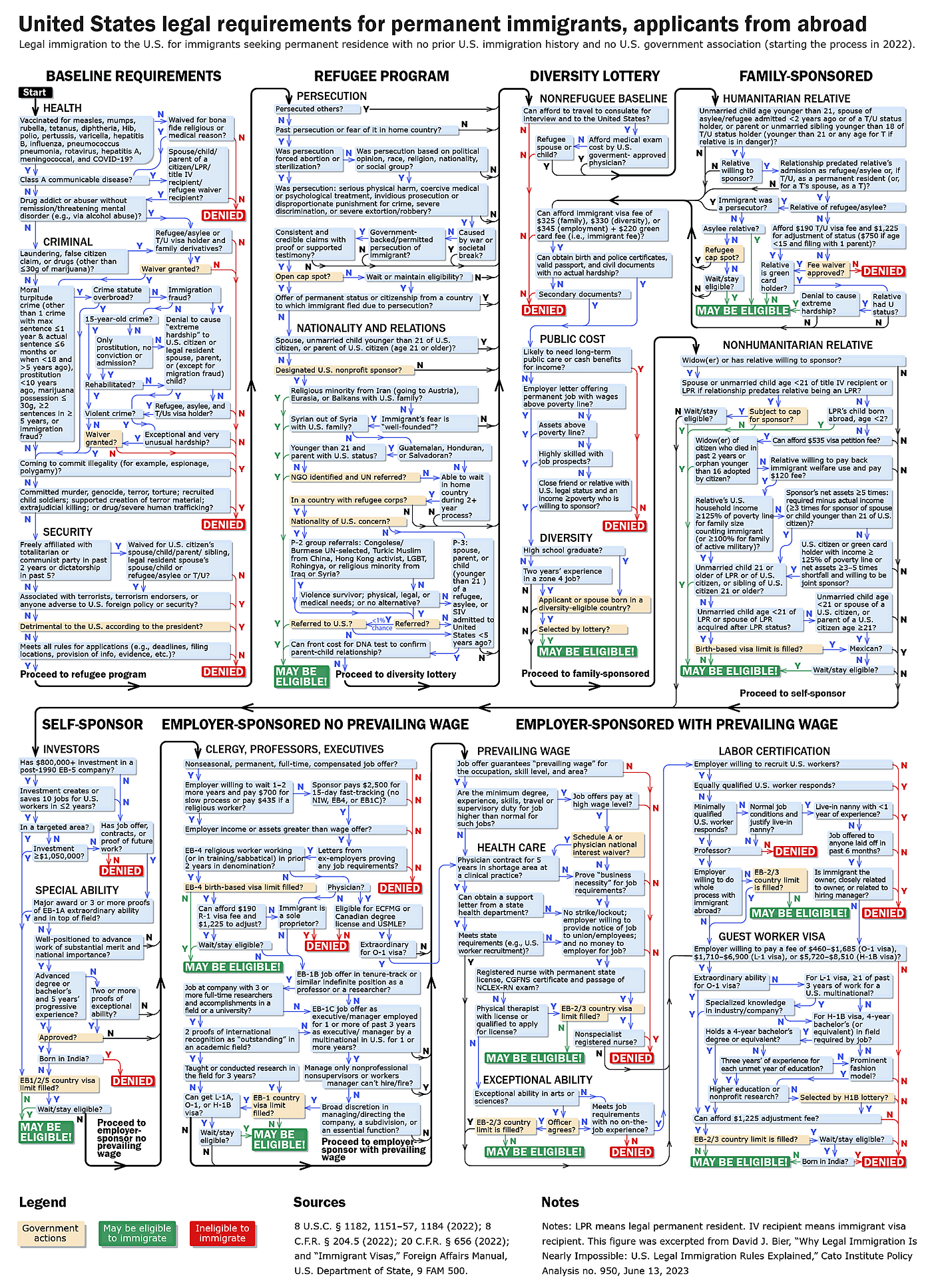
Wonderful graphic illustrating the complexity of immigration to the USA. Canadian system if anything is more complex, given Provincial Nominee Program and the various “boutique” or targeted programs. Would be nice if IRCC could prepare such a chart as part of the briefing package for the expected incoming Conservative government as a basis for streamlining, simplification and automation:

My latest policy analysis published today explains why it is impossible for nearly all immigrants seeking to come permanently to the United States to do so legally. The report is a uniquely comprehensive and jargon-free (to the extent possible) explanation of U.S. legal immigration. Contrary to public perception, immigrants cannot simply wait and get a green card (permanent residence) after a few years. Legal immigration is less like waiting in line and more like winning the lottery: it happens, but it is so rare that it is irrational to expect it in any individual case.

The figure below shows the U.S. legal immigration system for people who are abroad who presently intend to immigrate permanently to the United States. Below I briefly describe the main problems and choke points in this labyrinth.

Flow chart of the entire legal immigration system

Guilty Until Proven Innocent

Until the Immigration Act of 1924, everyone in the world was eligible to immigrate to the United States unless the government proved they fell into an ineligible category. In other words, innocent until proven guilty. Since then, the foundational principle of U.S. immigration law is that everyone in the world is ineligible to immigrate unless they prove to the government they fit into an eligible category. The result is that over 99 percent of all those wanting to immigrate to the United States cannot do so legally.

Source: Why Legal Immigration Is Impossible for Nearly Everyone

Immigrants Didn’t Steal the Election After All

Yet another myth questioned:

Among the rampant absurdities about immigration that spread from both the obscure and prominent corners of the Internet, the idea that the Biden administration was “importing” voters from abroad to help Kamala Harris win was simultaneously the silliest and the most common. Setting aside the conspiracy theories, the 2024 election provides the best evidence to date that Republicans can compete when immigration is high.

For reasons I can’t appreciate, many Republicans act as if they cannot do well if there are many immigrants in the electorate. Vice President-elect JD Vance saidrecently that immigration would permanently tilt the balance of power in favor of the Democrats. He said this even as his running mate was poised to make historic gains among Hispanic voters, many of whom are immigrants or children of immigrants. Regardless, the historical evidence shows that GOP performance improves with more immigration, so there are no data behind Vance’s fears.

The immigrant share isn’t associated with a stronger performance of either party in presidential elections. But there is a relationship between stronger Republican performance and a larger immigrant share of the US population. The Democrats controlled both houses of Congress for 83 percent of the years from 1935 to 1994 when the immigrant share of the US population was below 10 percent. Since 1995, Democrats have not controlled either house of Congress 53 percent of the time.

Republicans have performed much better during the high immigration periods of US history. Why? Not only do new populations assimilate, but the more Democrats compete and cater to the votes of naturalized citizens, the more US-born voters drift toward Republicans. An additional factor is that the immigrant share has been high when the unionized share of the labor force has been low, possibly because immigrants undermine unionization

Unions were historically the base of the Democratic Party until recently. Any benefit from naturalized citizens did not outweigh losses among the unionized population.

Does this mean that Democrats needed to be even more anti-immigrant to win? That was Kamala Harris’s assessment of the situation. But my view is that her (and Biden’s) immigration gambit backfired. Polls show that from 2019 to 2023 the share of voters saying immigration should be decreased grew just 6 points. Even though illegal immigration fell sharply in 2024, the share of Americans saying that immigration should be restricted suddenly jumped 14 points in June 2024.

Here’s what happened: Harris and Biden endorsed a bill to “shut the border” in 2024, which they reiterated as their position repeatedly before finally acting unilaterally to ban asylum in June 2024. It’s no surprise that when the heads of both parties endorse immigration restrictions, more people move toward that position. We have seen similar swings on other issues, like trade, when the head of a party (Trump) suddenly endorses a different view. Rather than neutralizing Trump’s immigration attacks, Harris’s flip validated them.

Source: Immigrants Didn’t Steal the Election After All

Trump’s Immigration Policies Made America Less Safe. Here’s the Data.

Yet another example:

Listen to just about any of former president Donald Trump’s rallies, and you’ll hear claims that President Joe Biden’s border policies have made the country less safe. At a recent town hall, Trump said Biden is releasing murderers, “drug dealers, drug addicts, everybody” into the country.

But new data reveal that Trump was the one whose immigration policies damaged the country’s security. In fact, he released more convicted criminals into the United States than his successor.

This is not to lend credence to Trump’s efforts to demonize immigrants as dangerous or violent. Data from the Census Bureau shows that immigrants — both legal and illegal — are at least half as likely as citizens to be incarcerated for crimes committed in the United States. (This is why deporting everyone living here illegally would increase crime rates.)

But when it comes to the small percentage of noncitizens who do commit crimes, Trump did not prioritize removing them during his term in office. In fact, he explicitly deprioritized them.

Trump released more criminals into the United States than Biden.

In his first week in office, Trump signed an executive order rescinding Obama-era orders that directed the Department of Homeland Security to focus its resources on detaining and removing noncitizens who committed serious crimes. Trump said he would not “exempt classes or categories of removable aliens.” His goal, he said, was enforcement “against all removable aliens.”

What did that mean in practice? Immigration and Customs Enforcement agents were no longer required to focus on felons. They could arrest anyone caught here illegally, and they did — from pizza delivery drivers to domestic-violence victimsto spouses of U.S. citizens with no criminal records.

New government data obtained by the Cato Institute highlight what happened next: Immigrants with serious criminal records were frequently released into the country instead of being detained for deportation. This included individuals who were transferred to the custody of ICE after serving their sentences and those who were previously deported and encountered ICE after crossing into the country again.

From January 2017 to February 2020, the Trump administration released more than 58,000 convicted criminals into the United States, including more than 8,600 violent criminals and 306 murderers. Contrast that with the Biden administration, which reinstated enforcement priorities: Overall, the average month under Trump saw twice as many releases as under Biden.

Bier WaPo1

Source: Trump’s Immigration Policies Made America Less Safe. Here’s the Data.

Immigration Cannot Significantly Reduce Inflation

Of note. Many of the arguments also apply to the Canadian context:

Many immigration advocates have recently called for increasing the number of immigrants allowed into the country to fill lower-wage jobs in order to decrease wages by increasing the supply of workers, thereby lessening inflation. In this post, we attempt to roughly estimate the possible impact of immigration-induced reductions in wages on consumer prices. We focus our analysis on the lower-wage sectors of the economy that primarily employ workers without a bachelor’s degree (the less-educated) because many of those advocating for more immigration have specifically called for more workers in these sectors. Our analysis shows that reducing wages for the less-educated is not an effective means of controlling inflation because such workers earn relatively little and as a result account for only a modest share of economic output. There is also the equally important question of whether reducing the wages of workers who are the lowest-paid is sound public policy.

Among our findings:

  • Reflecting their relatively modest average compensation, workers without a bachelor’s degree account for an estimated 25 percent of GDP. This means that even a substantial reduction of 10 percent in their wages could likely reduce consumer prices by only an estimated 2.5 percent. More educated workers and capital account for most of the economy.
  • If we look at just lower-wage occupations done primarily by those without a bachelor’s degree, we find that they account for only 22 percent of GDP. As a result, a 10 percent reduction in wages in these occupations could reduce prices by only an estimated 2.2 percent.1
  • It might be possible to reduce wages in specific occupations by dramatically increasing the number of workers in relatively few occupations. But since individual lower-paid occupations account for only a tiny share of the economy, the impact on overall consumer prices would be correspondently tiny. For example, the compensation earned by construction and extraction workers is only 2.2 percent of GDP, for cleaning and maintenance it is 1 percent, for food preparation and serving it is 1.1 percent, and for healthcare support it is 0.9 percent.
  • Prior to Covid, workers, including those without a bachelor’s degree, have generally seen their wages decline or grow very little for more than two decades, so reducing their wages by admitting more immigrants can be seen as unfair and unwise.
  • More than one in seven of these less-educated workers are currently eligible to receive cash payments from the Earned Income Tax Credit and Additional Child tax Credit — the nation’s largest cash assistance programs for low-wage workers. Reducing the wages of such workers could undo some of these important efforts to help low-income workers.
  • Nearly two-thirds of all children in poverty in America are dependent on a worker who does not have a bachelor’s degree. Using immigration to reduce wages for less-educated workers has significant negative implications for American’s low-income children.

Source: Immigration Cannot Significantly Reduce Inflation

Canada Admits 3 Times More Non-College Immigrants per Capita than the U.S.

Useful comparative data:

Many Americans want a more “merit‐​based” legal immigration system, and the country most commonly associated with this framework is Canada. Former‐​Attorney General Jeff Sessions, for example, characterized U.S. immigrants as largely “illiterate”, with “no skills”, and argued that America “should be like Canada” on immigration, evaluating them on their skills. But while Canada does favor economic‐​based paths to residence, it still admits far more non‐​college educated immigrant workers than the United States does as a proportion of its population—and it is planning to let in even more in the coming years.

According to Canada’s statistics, 244,800 non‐​college‐​educated immigrants over the age of 25 in the labor force entered Canada from 2015 to 2019, 0.65 percent of the Canadian population. During the same period, 729,797 immigrants with the same characteristics entered the United States, 0.22 percent of the U.S. population (Figure 1). In other words, Canada saw nearly three times more entries into its labor force from lower‐​skilled workers than the United States did in recent years on a per capita basis. This disparity would be greater if illegal immigrants were excluded from the calculation.

Despite admitting far more non‐​college‐​educated immigrant workers, Canada also admitted nearly 5 times as many immigrant workers with bachelor’s degrees and 4 times as many immigrant workers with advanced degrees as the United States did from 2015 to 2019 on a per capita basis. This means that overall, Canada admitted nearly 4 times more immigrant workers into its labor force than the United States did from 2015 to 2019. Note that the Canadian share of lesser‐​educated workers would be even higher if they were not also admitting so many higher skilled immigrants.

While it is true that Canada admits a much larger share of immigrants through economic channels than the United States does, it also makes it easier for them to qualify based on jobs where a college education is not required. It also admits as a share of its population more immigrants based on family ties and humanitarian grounds than the United States. Canada has just announced its largest ever legal immigration targets for the next several years, which will increase the rate of admission for both skilled and lesser‐​skilled workers.

While college‐​educated immigrants offer the United States the greatest productivity boost, the fact that a majority of job growth will come from jobs not requiring a bachelor’s degree provides a strong basis for the United States to increase both skilled and lesser‐​skilled immigration in tandem.

Source: Canada Admits 3 Times More Non-College Immigrants per Capita than the U.S.

The Decline of Legal Immigration | Cato at Liberty Blog

Useful stats. MPI had a very good webinar assessing the Biden administration immigration policy and program changes. Lot more happening through executive orders (close to 300 in the past year, about 100 related to reversing Trump administration measures) than the high level debates would indicate:

Legal immigration collapsed in the last year of the Trump administration. The number of green cards issued abroad were declining prior to the pandemic, partly for policy and other reasons, but the American government’s overreaction to COVID-19 caused immigration to collapse as we’ve detailed here, here, here, here, and here.

Since President Biden took office in January 2021, the recovery of legal immigration has been much slower than we anticipated. The new vaccine mandate for immigrants (as we’re seeing in other countries with the Novak Djokovic scandal), the remaining closure of many embassies and consulates that reduce interviews for visas and their subsequent issuance, the delayed release of extra visas approved by Congress, and additional haphazardly imposed travel restrictions have greatly reduced the scope of legal immigration.

Despite those restrictions, the number of legal immigrant visas issued abroad has partly recovered from a low of 697 (that’s not a typo) in May 2020 to 35,647 in November 2021 (Figure 1). That’s 16 percent below the average of 42,390 immigrant visas issued monthly from January 2017 through February 2020, during Trump’s presidency but prior to COVID-19. December 2021 and January 2022 will likely show lower numbers.

As bad as the numbers for immigrant visas are, the number of non‐​immigrant visas issued abroad every month is even worse. Non‐​immigrant visas are for students, temporary workers, tourists, and others who can temporarily travel to the United States or reside here for a specific time and purpose. Figure 2 shows that 40,939 were issued in May 2020, the low point of the series, down from a monthly average of 738,642 from January 2017 through February 2020 – a 95 percent decline. The numbers have since climbed to a paltry 391,022 in November 2021 – far shy of their pre‐​pandemic numbers.

The Biden administration needs to rapidly reverse this situation, recover the lost visas through legislation, and go even further or the U.S. economy will suffer long run drags on its growth.

Source: The Decline of Legal Immigration | Cato at Liberty Blog

Share of World Population Allowed to Immigrate Legally to U.S. 85% Below Its Peak

Canada’s peak year for immigration in relation to its population was 1913, when over 400,000 arrived, or 5.2 percent of our total population of 7,632,000. In world population terms, that would be 22 per 100,000; today’s 400,000 is about 5 per 100,000. So not sure how meaningful this argument is but fun to work the numbers:

In fiscal year 2021, the share of the world population that the U.S. government permitted to immigrate legally to the United States was about 85 percent below its peak year of 1907 when 74 in 100,000 people became legal permanent residents of the United States. By 2021, that number had fallen to about 11 in 100,000—slightly lower than the 13 in 100,000 in 2019 or 16 in 100,000 in 2016.

Unlike those with various temporary statuses or no status, legal permanent residents are the only non‑U.S. citizens who may naturalize to become U.S. citizens. Measuring legal immigration as a share of the world’s population contextualizes potential immigrants’ actual opportunity to immigrate to the United States better than the absolute number of immigrants. No year has seen more than a fraction of a percent of the world’s population become U.S. legal permanent residents, but the share has declined, even as the desire to immigrate has increased.

Figure 1 shows the number of new legal permanent residents to the United States as a share of the non‑U.S. world population from 1840 to 2021. The lines after 1952 reflect the fact that some immigrants could adjust to legal permanent residence while already the United States. The share of “new arrivals” who enter from abroad as permanent residents fell even more dramatically from its high—nearly 95 percent below its peak in 1907.

During the era of mostly free immigration prior to 1925, legal immigration fluctuated wildly based on world events and the U.S. economy. But after visas were capped, an unnatural consistency developed at a low level. The one anomaly is in the period of 1989 to 1991 when the immigrants legalized by the 1986 amnesty adjusted to legal permanent residence. This experience was a small window into the demand that would exist if the United States had retained free immigration.

Table 1 ranks the years based on the share of the world population immigrating to the United States. Out of the 182 years, fiscal year 2021 ranks 122nd in terms of total new legal permanent residents as a share of the world population and 167th in terms of newly arriving legal permanent residents from abroad—which means only 15 years saw fewer new arrivals as a share of the world population than 2021.

If the United States had retained the same level of new legal permanent residents as a percentage of the world population as it saw during 1900 to 1924—the 25 years before the borders were closed—from 1925 to 2021, 160 million immigrants would have received permanent residence, compared to the 51 million who did. The level of legal immigration for 2000 to 2021 would be about 2.7 times the rate it actually was, permitting about 62 million immigrants as opposed to 22 million.

It’s reasonable to suppose that the actual rate would be higher than this, had the United States maintained its earlier policies. It certainly looks like the trend before World War I was upward from peak to peak. Transportation has also decreased significantly in price as well. The upshot is that the United States has extremely closed borders relative to what a reasonable person would expect under an even relatively open immigration system. This fact also explains why the country is experiencing so much more illegal immigration than in the past. When legal immigration is closed off, illegal immigration becomes most people’s only option.

Source: Share of World Population Allowed to Immigrate Legally to U.S. 85% Below Its Peak

USA: Criminal Illegal Immigration Rates Fall Along the Border

Of note:

Customs and Border Protection (CBP) just announced that they have encountered 1,431,179 people out of 1,960,519 total enforcement actions in FY2021 along the borders of the United States. When it comes to immigration enforcement, the two components of CBP are the Office of Field Operations and the Border Patrol. Relative to the 478,648 individuals encountered by CBP in FY2020, the number of individuals encountered is up by a factor of three in FY2021. Although the number of individuals encounters by CBP rose enormously in FY2021, the rate of criminals among them dropped to new lows.

CBP defines criminal noncitizens (they used to be called criminal aliens) as individuals who are not U.S. citizens and who have been convicted of crimes here or abroad if the conviction is for conduct which is also a crime in the United States. The CBP data also include noncitizens and U.S. citizens who are arrested as a result of being wanted by other law enforcement agencies. So as to not exclude any criminal illegal immigrants through unintentional omission, this blog post counts all apprehensions of criminals by CBP as noncitizen illegal immigrants. This results in an overcount of illegal immigrant criminals, but it’s better to make errors that overcount illegal immigrant criminality rather than errors that undercount it. In 2016, about 6.4 percent of all illegal immigrant individuals encountered by CBP were criminals. In FY2021, only about 1.9 percent of illegal immigrants apprehended by CBP were criminals (Figure 1).

The absolute number of criminal illegal immigrants encountered by CBP also fell from FY2016 to FY2021, but not in every year. In FY2016, CBP encountered 38,758 criminals out of approximately 607,761 individuals encountered. In FY 2021, CBP encountered 28,213 criminals out of 1,431,179 total illegal immigrants encountered. During that time, the number of illegal immigrants encountered by CBP increased by 236 percent and the number of criminals encountered fell by over 27 percent. In some of the intervening years, the absolute number of criminal illegal immigrants rose, but it generally trended downward.

It’s remarkable that such a vast increase in the number of illegal immigrants apprehended in FY2021 included a lower percentage of criminals than earlier years. Perhaps the supply of criminal illegal immigrants seeking to enter the United States is relatively inelastic and massive changes in the number of individuals seeking to enter unlawfully or ask for asylum are non‐​criminals. In other words, reforms in U.S. immigrant policy that could attract more illegal immigrants or changes in foreign conditions that prompt mass migration do not seem to much affect the flow of criminals.

Many Americans want to keep the border closed, increase harsh border security methods, or restrict asylum because they fear that those encountered are criminals. Based on data supplied by CBP, the criminal illegal immigrant proportion of all encounters along the border are lower in FY2021 than in previous years despite the large increase in the number of encounters. Illegal immigration is a serious problem that imposes high costs on Americans and migrants, but it does not pose a serious criminal threat.

Source: Criminal Illegal Immigration Rates Fall Along the Border

Americans Conflate Border Chaos and Legal Immigration | Cato at Liberty Blog

Of note (irregular crossings at Roxham Road in Canada provoke similar reactions):

A new poll released by Quinnipiac shows strong disapproval of President Biden’s immigration and border policies. According to the poll, 25 percent of respondents approve and 67 percent disapprove of Biden’s handling of immigration issues. Similarly, 23 percent approve and 67 percent disapprove of his handling of the situation on the Mexican border. This poll offers deep insights into how Americans think about immigration and ways for the Biden administration to get out of its chaotic immigration and border mess.

First, the similarity between the polling numbers suggests that Americans conflate what happens on the border with all of immigration policy. Of course, immigration policy is more than just border security. Legal immigration, such as allowing immigrants and migrants to legally come here from abroad, is the most important portion of immigration policy. Second, Americans are deeply concerned about border security issues. Apprehensions of immigrants along the border are up substantially over earlier years. The recent debacle over Haitian arrivals, the government’s heavy‐​handed response, and the certainty of future border arrivals from around the world feed the justified public perception of chaos along the border.

Border chaos makes Americans more opposed to immigration, both legal and illegal. As I’ve written before, there is a convincing academic literature on how public perceptions of chaos and illegal immigration reduce support for legal immigration around the world. When people feel like their government has lost control of immigration, voters are more likely to oppose legal immigration. That’s why the public’s opinion of immigration and the Mexican border are virtually identical in the Quinnipiac poll.

Smart commentators have noticed that the Quinnipiac questions do not indicate precisely what people disapprove of in Biden’s immigration policies. They’ve pointed out that Biden has pursued Trump’s immigration policies with some minor changes, many of which are more restrictive than Trump’s. There is evidence for this in other polls where a trend has emerged that those who are dissatisfied with immigration levels are increasingly dissatisfied because the numbers are too low – although more who are dissatisfied still want less immigration. Perhaps, these commentators claim, people are upset at Biden’s restrictive policies and harsh enforcement along the border? Unfortunately, that interpretation is too clever by half.

The Quinnipiac poll breaks down responses by political party. Democrats, who are more pro‐​immigration, support Biden’s policies while more immigration‐​skeptical Republicans oppose it. We’d see the opposite if the disapproval registered in the Quinnipiac poll were about Biden’s anti‐​immigration policies. The only confounding poll result is that 51 percent of respondents disapproved of deporting some Haitians without allowing them to apply for asylum, with 49 percent of Republicans and 30 percent of Democrats approving. This result is evidence that people are more supportive of immigration when people know how the immigration and enforcement systems actually operate.

Decoupling the immigration issue from the U.S.-Mexico border is key to liberalizing immigration. Candidate Biden ran on the most pro‐​immigration platform since Lincoln’s platform in 1864. If he wants to pursue those policies, his administration will have to reduce perceptions of chaos along the border.

How can he do that?

The first step is to recognize that more enforcement won’t reduce the perceptions of chaos. Even if 100 percent of illegal border crossers are returned or removed from the United States, the images of people crossing will continue to fuel the perceptions of chaos. With more enforcement, we’d even have more images and stories of chaos. The second step is realizing that few people are animated by opposition to legal immigration numbers. Sure, there are some organizations run by population control radicals like NumbersUSA that wants to reduce legal immigration, but they are not the norm. The third step is finding ways for these border crossers to enter legally and in an orderly fashion through ports of entry. By doing so, the scary images appearing in the media will disappear and the public will correctly perceive a vast reduction in chaos. Border Patrol agents can then focus their limited resources on intercepting actual security threats rather than asylum seekers and otherwise law‐​abiding illegal border crossers.

A streamlined parole process run at U.S. embassies and consulates far away from the border, expanded guest worker visa programs, and more green cards would channel many of the would‐​be border crossers into the legal immigration system and away from crossing between ports of entry. More importantly, such systems would allow vetting of migrants.

Opposition to immigration and the border chaos is mostly not a reflexive nativist reaction to immigrants. Americans like immigrants and are generally very welcoming, but Americans are rightly alarmed by chaos. For libertarians and many others, chaos is a sign of government failure and an indication that liberalization will reduce illegal immigration and chaos as it has in the past. For most Americans, their reaction to chaos is to be opposed to anything related to the cause of that chaos. This is the immigration Catch‐​22: Liberalization is required to get control over the border but border chaos politically prevents liberalization. The Biden administration can break that Catch‐​22 only by liberalizing first and incurring that political cost upfront. The political benefits for the Biden administration as well as the economic, social, and security benefits to U.S. society of a bold pro‐​immigration policy would be delayed but also much larger. As the Quinnipiac numbers show, Biden doesn’t have much to lose by following this approach.
Source: Americans Conflate Border Chaos and Legal Immigration | Cato at Liberty Blog

USA: Public Opinion Shifts in a Pro-Immigration Direction

Of note. Dysfunctional US political system does not translate shift into political action:

Since 1965, Gallup has been polling Americans about whether they want immigration levels to decrease, increase, or remain the same. Last year, the percentage of Americans who want to increase immigration rose above the percentage who want to decrease it for the first time. In 2021, that shift held with more respondents again supporting increasing immigration than decreasing it (Figure 1). The support for increasing legal immigration may have narrowed in 2021 to 33 percent from 35 percent in 2020, but the changes are so small that they are likely statistically insignificant.

Consistent with the general rise in support for increasing immigration, a large majority of Americans still believe that immigration is a good thing for the United States (Figure 2). Just like in Figure 1, the percentage saying it’s a good thing has declined by 2 percentage points but that is a small shift a statistically insignificant shift. Although this is consistent with pro‐​immigration policy views, it also includes those who like the current level of immigration.

However, an even more important shift has continued in U.S. opinion about immigration. Since 2001, Gallup has asked this question: “(Asked of those dissatisfied with level of immigration into U.S.) Would you like to see the level of immigration in this country increased, decreased or remain about the same?” Respondents who are dissatisfied with the level of immigration are increasingly likely to be dissatisfied because they think that there is too little immigration. I wrote about this last year but the trend has grown in 2021 (Figure 3). In 2020, 26 percent of respondents were dissatisfied with the level of immigration and they wanted to decrease immigration. By 2021, that percentage had fallen to 19 percent. The percent of those who were dissatisfied and wanted an increase stayed about the same and the percent of those satisfied climbed slightly.

That’s a tectonic shift. From 2001–2016, an average of 63 percent of respondents were dissatisfied with the level of immigration. Only about 5 percent of respondents were dissatisfied and wanted to increase immigration levels and a whopping 44 percent of the dissatisfied wanted to decrease them (Figure 3). This began to change shortly after President Trump took office. From 2017–2020, an average of about 11 percent of respondents wanted to increase immigration levels while 28 percent were dissatisfied and wanted to decrease them. By the end of the Trump administration, there was still quite a gap among those dissatisfied with immigration, but it had narrowed.

We’re clearly seeing a shift in public opinion where those who dislike the current system are beginning to dislike it because it’s too restrictive. To the extent that we can believe surveys that measure opinions unexpressed through concrete actions like voting, this is a big shift. So far, virtually all of the political energy and enthusiasm has been for immigration restriction. Anti‐​immigration voters cared a lot more about this issue than pro‐​immigration voters. Now, the decline in the percent of respondents who are dissatisfied and who want less immigration is beginning to look like the collapse in anti‐​immigration sentiment that began in the mid‐​1990s (Figure 1).

One doubt I had about this change in behavior last year was that this increased pro‐​immigration opinion was just a reaction to President Trump and that it would fade out after he left office. In other words, I was worried that this was just an ephemeral liberal reaction of President Trump rather than a real and sustained change in opinion. But since the 2021 survey results show that only 19 percent of respondents are dissatisfied and want less immigration, a number 7 percentage points below the previous response in 2020, that is an indication that the pro‐​immigration sentiment of the American public is continuing to increase in the Biden administration. That improvement is especially surprising considering the rise in apprehensions along the border.

This appears to be a positive and sustainable change in American public opinion.

Source: Public Opinion Shifts in a Pro-Immigration Direction | Cato at …https://www.cato.org › blog › public-opinion-shifts-pro…