‘We need to be at the table’: nominated Indigenous candidates near 2015’s record high

Of note (have added Indigenous percentage of riding populations):

With at least 43 Indigenous candidates running for federal office in 2019, the number is nearing the record-breaking 54 contenders in 2015, and almost doubling those nominated in 2011.

Most are running under a red banner, with 13 Indigenous people confirmed as Liberal candidates, followed by 11 for the NDP, eight for the Conservatives, seven for the Green Party, and three with the People’s Party, according to party-submitted numbers and a Hill Times analysis of public information. The PPC said it doesn’t have the resources to track demographics for its candidates.

That total is likely to increase, given the NDP and Liberals represented the bulk of nominations in 2015, for a combined 39 of the 54, and both have yet to nominate their full complement of candidates. The Liberals had named 231 out of 338 candidates as of July 29, and the NDP has less than half, with 130 names posted to its website as of Aug. 2.

The 2015 federal election saw a historic 10 Indigenous MPs elected and a historic number of Indigenous voters who cast ballots, with 61.5 per cent turnout on reserves, up from 47.4 per cent in 2011.

Liberal candidate Michelle Corfield, who is running in Nanaimo-Ladysmith, B.C., [8.3 percent Indigenous] said she’s excited by the numbers, thinking about the opportunities that are available now to her 20-year-old daughter and the voice historically marginalized First Nations people can have in government.

First Nations people were denied the right to vote until 1960, and long after that children were taken from their homes and put into residential schools. Up to 2015, there had only been 34 Indigenous MPs elected since Confederation, and 15 Indigenous Senators appointed to the Red Chamber.

“All of these things compounded how people perceived the relationship with the Crown” and affected the perception of participation in politics among Indigenous people, said Ms. Corfield, a former chair of the Nanaimo Port Authority and the Ucluelet First Nation legislative council.

“For decades, people have been making legislation for them but without them, so in order for us to have a voice in significantly designing how legislation informs and impacts Indigenous people, we need to be at the table,” said Ms. Corfield, who’s been a Liberal since she could vote and is one of two Indigenous candidates running in the riding where Green MP Paul Manly won a byelection earlier this year.

‘My whole life is political’

While it’s difficult to pinpoint why record levels of Indigenous people have run for office over the last decade, Liberal candidate Trisha Cowie said she doesn’t have the option not to be political.

“My whole life is political,” she said, pointing to the Indian Act, which determines who has official First Nations status, and historically stripped it from those who fought in wars, pursued post-secondary education, or women who married non-First Nations men.

“It governs my identity to an extent, whether you’re on reserve or off reserve, when there’s a settlement. Everything is political. You could sit back and watch it unfold, but it’s all very personal, so it’s very difficult to do,” said Ms. Cowie who ran in the previous election in Parry Sound-Muskoka, Ont., [5 percent Indigenous] coming less than five points behind Conservative-turned-Indpendent MP Tony Clement, who won’t run again.

“You can actually affect change from the inside instead of always fighting from the outside,” she said.

For the last two years NDP Winnipeg Centre, Man., [18.1 percent Indigenous] candidate Leah Gazan tried to work from outside Parliament, lobbying MPs and Senators to pass Bill C-262, enshrining the United Nations Declaration on the Rights Of Indigenous Peoples into law. Ms. Gazan said it was “horrific” to watch the Senate effectively kill the bill in the waning days of the session, by not moving to put outgoing NDP MP Romeo Saganash’s (Abitibi–Baie-James–Nunavik–Eeyou, Que.) private member’s bill to a vote.

A few hundred kilometres away on the East Coast, Liberal candidate Jaime Battiste [Sydney-Victoria, 10.4 percent Indigenous] was equally frustrated by the outcome, following the weekly developments and delays with his father James Youngblood Henderson, who helped draft the 2006 declaration.

If the Liberals take a second mandate, Mr. Battiste, who is the first Mi’kmaq person to be on a federal ballot and would be Nova Scotia’s first-ever Indigenous member of Parliament, said he’s heartened by the party’s promise to make it a government bill—and therefore more likely to pass —while Ms. Gazan recalled the “years of stalling” by the Liberals before it moved forward.

When looking at the increasing number of Indigenous candidates running, she said it’s important to avoid drawing broad conclusions, because Indigenous people are often “lumped into one group with the same values,” said Ms. Gazan, who’s been fighting for human rights and on the front lines of climate justice for three decades.

The best match for her values, she said, was the NDP, which has several high-profile leaders on its ballot, including former vice-president of the Union of B.C. Indian Chiefs Bob Chamberlin, and Grassy Narrows First Nation chief Rudy Turtle, who has said the Liberals haven’t done enough to help his community with the impacts of mercury poisoning.

Over the last decade, Ms. Gazan said political parties have approached her to run, but this time she said she felt the country is at “a critical juncture” and needed strong voices like hers, willing to speak truth to power.

Voting Liberal this election is “not the strategic vote,” a tactic she said helped take Winnipeg Centre from the NDP in 2015, because of the strong desire to boot former prime minister Stephen Harper. Liberal MP Robert-Falcon Ouellette beat out six-term New Democrat Pat Martin by a margin 26.5 percentage points in the previous election.

“This is one of the few ridings in the country that you can vote your conscience,” she said, and that’s the message her “community-based, community-led campaign” is giving. “I feel like our campaign is starting a movement and we are planning on getting this riding back.”

Lydia Hwitsum, who is running in Cowichan–Malahat–Langford, B.C., [9.4 percent Indigenous] for the Greens, also said without the strategic anti-Harper vote in play, her chances are better. One-term NDP MP Alistair MacGregor is running again after taking it in 2015 with 35.9 per cent of the vote, while the Greens came in fourth, with 16.9 per cent.

Born in 1964, Ms. Hwitsum is acutely aware that the right to vote came shortly before her lifetime. Cultural leaders like her “bright and brilliant” mother would never have had the chance to put their name on the ballot.

“The door’s open now and it wasn’t for them.”

So far, B.C. has the most Indigenous candidates running, with 10, followed by nine in Manitoba, and eight in Ontario. B.C.’s only Indigenous incumbent is Jody Wilson-Raybould, the former Liberal cabinet minister who will run as an Independent this time around in Vancouver Granville.

The Liberal candidates said they were saddened to see a powerful First Nations woman no longer with the party. In the midst of the SNC-Lavalin scandal and allegations the Prime Minister’s Office pressured her as attorney general, Ms. Wilson-Raybould resigned from cabinet and later was booted from caucus.

Ms. Corfield said Ms. Wilson-Raybould made her choice and “knew the consequences of those choices,” while Mr. Battiste said “this election isn’t about Jody and Justin,” but the Conservative policies that had him protesting in the streets four years before.

At the December 2018 Assembly of First Nations national conference, Mr. Battiste said he stood up and asked Conservative Party Leader Andrew Scheer (Regina-Qu’Appelle, Sask.) for one policy that made him different from Mr. Harper.

“And he couldn’t,” said Mr. Battiste, recalling how hundreds of chiefs booed his response that they’d have to wait until the party’s platform was released.

The “big move” by the Liberal party to open membership up made a difference during membership drives signing up supporters who helped him win the Sydney-Victoria, N.S., contested nomination a few weeks ago, said Mr. Battiste, showing the party is “taking strides to make sure Indigenous people are now more involved than ever in the political process.”

Indigenous voters “can be a swing vote in a riding,” said Mr. Battiste, a point the Assembly of First Nations has made to parties and politiciansthrough the 51 ridings it will target this election, 13 of which have Indigenous candidates running.

The Liberals will face their record on reconciliation, which Ms. Gazan said falls far short of Prime Minister Justin Trudeau’s (Papineau, Que.) promise as Canada’s most important relationship.

Four years can’t change 150 years of colonization, said Ms. Corfield.

“Maybe the expectations were set too high,” of the Liberals, but like Mr. Battiste she said this government has done more than any previous. Legislation addressing Indigenous languages and child welfare, and progress on boil water advisories are all signs of progress, they said.

In early March, before Mr. Battiste decided to run for the party, he captured some of that frustration in a Chronicle Herald op-ed, coming to the same conclusion he offers today: more Indigenous candidates must get politically involved.

“The only way to decolonize some of the processes of government is by having more Indigenous voices,” he said.

Source: ‘We need to be at the table’: nominated Indigenous candidates near 2015’s record high
Want more diversity in politics? Start by looking at political parties: Tolley

Good piece by Tolley. The only other point I would add is that visible minority candidates tend to run in ridings with significant numbers of visible minorities and immigrants, where likely the local riding party memberships reflect that diversity:

The 2015 federal election saw a record number of women, Indigenous peoples, and racialized Canadians elected to the House of Commons. When he selected his ministry, Justin Trudeau lauded it as “a cabinet that looks like Canada.” These gains are notable, but they should not be taken for granted. There are still representational gaps: women, Indigenous peoples, and racialized Canadians all occupy proportionately fewer seats in the House of Commons than their share of the Canadian population.

To get at the root of electoral under-representation, forget the electoral system. You need to look no further than Canada’s political parties. Parties control access to the House of Commons because they select nearly all of the candidates who appear on the ballot. Even so, the processes that parties use to recruit and select candidates are so opaque that the nomination stage has been referred to as the “black box” of Canadian politics. One thing is clear: if there is a representational deficit in the House of Commons, it’s because when parties nominate candidates, the ones they choose are still disproportionately white and male.

The problem isn’t voter bias. Of course voters harbour prejudice, but on election day, their preference for a particular party or leader tends to override whatever reservations they might have about a candidate’s race, gender, or demographic background. As a result, researchers have largely concluded that when women and minorities run, they win. What this means is that if parties nominated more diverse candidate slates, there would be more diversity in Parliament. The representational gap begins with parties, and the demographic mismatch between Parliament and the population only widens as prospective candidates move through each stage of recruitment, beginning with the decision to run for office and continuing until the ballots are counted.

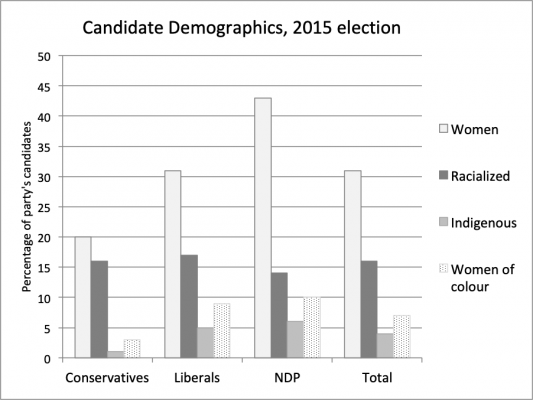
Parties are not obligated to release data on the diversity of their candidate slates, so researchers and journalists are left to tally the statistics. They do this by consulting candidate biographies and other publicly available information, but even then, it’s hard to compile a full picture beyond the three main parties. In 2015, our best estimates suggest that at least 80 per cent of candidates were white, and 70 per cent were men.

Data compiled by the author, using candidate biographies and other publicly available sources. Women of colour includes both Indigenous and racialized women.

So, why don’t parties nominate more women and minorities? In some cases, political parties underestimate the electoral prospects of candidates who don’t fit the profile of the prototypical politician. There is also evidence that they filter women into unwinnable ridings and pigeonhole racialized candidates into only the most diverse districts. Gatekeeping matters.

My research shows that racialized candidates are more likely to emerge when the party’s riding association president is also racialized; otherstudies confirm that women riding association presidents are positively related to the selection of women candidates. Perhaps it’s because women and racialized gatekeepers have more diverse networks and can draw on these resources when identifying potential candidates, but it also appears that under-represented groups respond more positively to recruitment from gatekeepers with backgrounds like their own. Diverse local party leadership might also signal the party’s openness to a variety of candidates.

Despite this, my own research suggests that at least three-quarters of riding association presidents—the most prominent local party gatekeepers—are white and male. Candidate search committees typically assist riding association presidents, but the face of local recruitment efforts is still relatively homogenous. Parties might have more success in their efforts to recruit candidates with a wider range of characteristics and life experiences if the executives of their local riding associations were themselves more diverse.

The NDP has tried to tackle the challenge through an equity policy that commits to running women candidates in at least 50 per cent of all districts, and members of other equity groups in a further 30 per cent; “equity groups” is a catch-all for racialized minorities, Indigenous peoples, persons with disabilities, individuals who are LGBTQ, and youth. Although in 2015, the party nominated more women candidates than either the Liberals or the Conservatives, they nominated the fewest racialized minorities. This suggests that even an explicit commitment to more diversity is not enough. In 2017, the Liberals and Conservatives defeated a private member’s bill that would financially penalize parties for not running more women candidates

Other less formal means have also been tried. For example, prior to the last election, the federal Liberals launched an initiative called #AskHer. The idea was simple and grounded in research that shows women candidates need far more encouragement to run for office than men do. The Liberal Party asked Canadians to identify qualified women candidates whom they thought the party should approach to run. From these submitted names, just one woman—Celina Caesar-Chavannes— was ultimately elected as a Member of Parliament.

Parties have long been the gatekeepers to elected office, but apart from requiring them to disclose the names of their donors and abide by some basic electoral rules, there is little—aside from public pressure—to hold them to account. The 2019 election is an opportunity to do so. How many candidates from equity-seeking groups did parties approach and encourage to run for office? What measures are they putting in place to recruit diverse candidates to office? And how are parties supporting new candidates, whether that’s through training, a financial contribution, or volunteers? Last election, parties told voters to #AskHer. This time, we need to ask more of parties.

Source: Want more diversity in politics? Start by looking at political parties

Maxime Bernier présente ses candidats québécois

Four women out of 31 (13 percent). Haven’t had time to look at immigrant and visible minority numbers:

Maxime Bernier a présenté vendredi à Montréal 31 candidats qui brigueront les suffrages pour le Parti populaire du Canada au Québec. Parmi eux, aucune figure connue, peu d’expérience politique et seulement quatre femmes.

«Le plus important pour nous ce n’est pas le sexe (des candidats): c’est que les gens partagent la plateforme et les valeurs du parti», s’est défendu le chef du Parti populaire du Canada (PPC), Maxime Bernier. Il présentait les candidats des circonscriptions de Montréal, Montérégie Ouest, Laval, Laurentides, et de l’Outaouais.

Les candidats sont issus des milieux des affaires ou des relations publiques, certains sont étudiants, ostéopathes, pasteurs, militaires, promoteurs immobiliers, avocats, etc. Ce panel hétéroclite a tout de même un point en commun: une vision d’un État aux pouvoirs restreints pour davantage de libertés individuelles.

Fort de ces candidatures, Maxime Bernier espère toujours participer au débat des chefs. Pour être éligible, puisque le PPC a été créé il y a neuf mois, le chef doit présenter des candidats dans au moins 304 des 388 circonscriptions. Ces candidats doivent aussi avoir «une véritable possibilité» d’être élus. Pour l’instant, il en a présenté 260. Selon le chef du PPC, il devrait de toute façon avoir sa place au débat, car il participe déjà chaque mardi aux côtés de représentants des autres partis politiques à l’émission Power Play, animée par Don Martin à CTV News.

Les «bons» changements climatiques

Maxime Bernier a réitéré l’opposition de son parti aux objectifs de l’accord Paris, puisqu’il croit «que c’est normal que le climat change» et «qu’il y a plus de 12 000 ans le Canada était sous la glace et que c’est grâce aux changements climatiques si le Canada est ce qu’il est aujourd’hui», ce qui a bien fait rire ses candidats. Il a ensuite affirmé vouloir dépolluer les lacs et les rivières pour qu’il soit possible d’y pêcher et de s’y baigner.

Maxime Bernier avait assuré que ses candidats pourraient prendre la position qu’ils désiraient dans le débat sur l’avortement. La candidate dans la circonscription de Shefford, Marriam Sabbagh, est pro-vie, tout comme celle dans Saint-Léonard-Saint-Michel, Tina Di Serio. «Je suis pro-vie, mais je respecte le choix des autres», a expliqué Mme Di Serio.

Pour le chef populiste, la catastrophe de Lac-Mégantic prouve par ailleurs qu’un oléoduc transnational est la solution la plus sécuritaire pour le transport du pétrole au pays. Si son parti remporte les élections, même en l’absence d’acceptabilité sociale, il imposerait ce pipeline.

Maxime Bernier a rappelé d’autres grandes lignes de son programme: fin de la gestion de l’offre en agriculture, réduction des seuils d’immigration, réforme du financement de Radio-Canada et de CBC, réduction de l’aide financière internationale et, entre autres, abolition du Conseil de la radiodiffusion et des télécommunications canadiennes (CRTC).

Source: Maxime Bernier présente ses candidats québécois

Why Canada’s political pipeline leaves little room for anyone but white men

Good study by Erin Tolley (disclosure: know Erin from our time together at CIC/IRCC and we remain in contact):

For women, the toughest hurdle is at the nomination level, the first checkpoint into the political realm.

Racialized minorities come up against barriers further along, beginning at the candidate selection stage.

That’s according to Erin Tolley, who teaches political science at the University of Toronto.

Tolley is among the first to map the race and gender of more than 800 people vying for a political party’s nomination ahead of the 2015 vote in 136 of the country’s most diverse ridings, where racialized minorities make up at least 15 per cent of the population, half of which are in Ontario. (Her tally uses Statistics Canada’s definition of “visible minority” and therefore does not include Indigenous nomination contestants or candidates.)

Wannabe politicians must first successfully compete for their choice party’s nomination in order to become the candidate in an election.

Though Tolley’s project is still in the works, early findings suggest political parties aren’t doing enough to diversify the pool of candidates.

“The dynamics for women and racialized minorities are different,” she said. “That’s important for parties to know because they therefore need to have different strategies if they want to attract and want to run women or racialized minority candidates.”

Women make up 52 per cent of the population, but only accounted for 33 per cent of nomination contestants across those 136 ridings. The proportion of female election candidates ticked up slightly, to 36 per cent, and 31 per cent of elected MPs in those districts were women.

That suggests women are less likely to throw their hat in the ring, but once they do, they fare well.

“Maybe women don’t want to run, they don’t want to be called ‘Barbies,’ for example,” Tolley said, citing veteran MP Gerry Ritz’s now-deleted and apologized-for recent tweet that referred to Environment Minister Catherine McKenna as “climate Barbie.”

Tolley put the onus on political parties.

“Political parties don’t do sufficient work to identify women candidates and encourage them to run,” she said. “Frankly, not enough fingers are pointed at political parties. We don’t need to change the electoral system to get women into politics. All parties need to do is nominate more women. It’s actually pretty simple.”

Racialized minorities don’t experience the same obstacle.

According to the data, minorities declare their candidacy in proportions that match their presence in the population. However, by the time Canadians go to the polls the share of MPs of colour is far below that.

“They want to be nomination contestants, but then the party is less likely to select them, and voters are even less likely to select them,” Tolley said.

Across the 136 ridings, racialized minorities comprised 38 per cent of the population and 37 per cent of nomination contestants. That dwindled to 33 per cent of election candidates, and to 29 per cent of MPs — an eight-point gap between the number of hopeful nominees and those who won a seat on the Hill.

A contributing factor is one Tolley has previously explored — that minority candidates tend to compete against each other in battleground districts.

That’s because racialized minorities are more likely to run, and win, in more diverse ridings, Tolley said. For instance, three candidates of colour may vie for their party’s nomination in an ethnically-rich district, and split the ballot.

“So, you have this big pool of people who are interested, but they’re competing against each other, essentially cancelling each other out — and that’s happening at each level,” she explained.

As for white men, their political possibilities widen.

Thirty-nine per cent of nomination contestants in those diverse ridings were white men, and they comprised 40 per cent of candidates on the ticket. Nearly half, 48.5 per cent, of those who won a seat were white males.

Source: Why Canada’s political pipeline leaves little room for anyone but white men | Toronto Star

Study says Canada’s three major parties are fielding more visible minority candidates | National Post

My short study quoted in the National Post, along with Chris Cochrane’s analysis (I will do a piece tomorrow analyzing the results and how many visible minority candidates were elected):

Fourteen per cent of the 1014 candidates – or 143 possible Members of Parliament – running for the Conservative, Liberal and NDP parties are members of visible minorities, according to an analysis by Andrew Griffith, former director general for citizenship and multiculturalism at Citizenship and Immigration Canada.

The proportion of visible minority candidates is roughly on par with the electorate, 15 per cent of which consists of visible minority voters.

“All parties are trying to compete for this (visible minority) vote,” says Griffith, who has written a book on multiculturalism in Canada.

Griffith’s study found the Liberals were leading with sixteen per cent of Liberal candidates – or 55 candidates – from visible minorities. The Conservatives and the NDP were lagging behind with 44 visible minority candidates each, amounting to 13 per cent of their total candidates. The Bloc Quebecois fare the worst, with only two visible minority candidates.

The Liberal lead is unsurprising given that “multiculturalism is part of their DNA,” says Griffith.

Visible minority representation is even higher in the 33 ridings in which more than half of the residents are from visible minorities. In these areas, 68 of the 99 major party candidates, including 19 women, are from visible minorities. All of the major parties are represented by a minority candidate in 15 of these ridings.

“These are all battleground ridings where all three parties, at least at the beginning of the campaign, were reasonably competitive,” says Griffith.

Twenty-three of these 33 ridings are in the Greater Toronto Area, a key battleground for the major parties. In these ridings, the Conservatives are fielding the most visible minority candidates, with 25 in the race, but are closely followed by the Liberals, who are running 24 candidates. The NDP lag behind with 19 candidates.

“You really have to hand it to (Conservative) Jason Kenny and the people who have made that outreach in those communities,” says Griffith.

But Chris Cochrane, a political science professor at the University of Toronto, says it’s important to distinguish between immigrants and visible minorities, some of whom may have lived in Canada for generations and make up a Liberal stronghold.

“Conservatives increased their vote share spectacularly among immigrants going into the last election but they didn’t do nearly so well among visible minorities,” he says.

Source: Study says Canada’s three major parties are fielding more visible minority candidates | National Post

Visible Minority Candidates in the 2015 Election: Making Progress

Is the increased number of visible minorities being reflected in party candidates? Which ridings are these candidates running in? And do these candidates reflect the largest groups in their ridings?

Now that we know the names of all candidates, we can answer these and related questions.

But first, as a basis for comparison, how has women’s representation increased in 2015 candidates? The analysis by Equal Voice shows that overall representation from the 2011 election has slightly increased from 31 to 33 percent (still far away from equality), with the relative ranking of parties below.

Women Candidates 2015 Election

To assess visible minority representation I have used candidate names, photos and biographies to identify visible minority candidates. Although not as exact as identifying women candidates (e.g., subjectivity in analyzing photos), it nevertheless provides a reasonably accurate indication of how well Canadian political party candidates represent the population of visible minorities who are also Canadian citizens (15 percent).

Building on an earlier study by Jerome Black (“Racial Diversity in the 2011 Federal Election: Visible Minority Candidates and MPs”) showing the diversity in earlier elections, I went through the candidate lists using the criteria above, concentrating on the more diverse ridings.

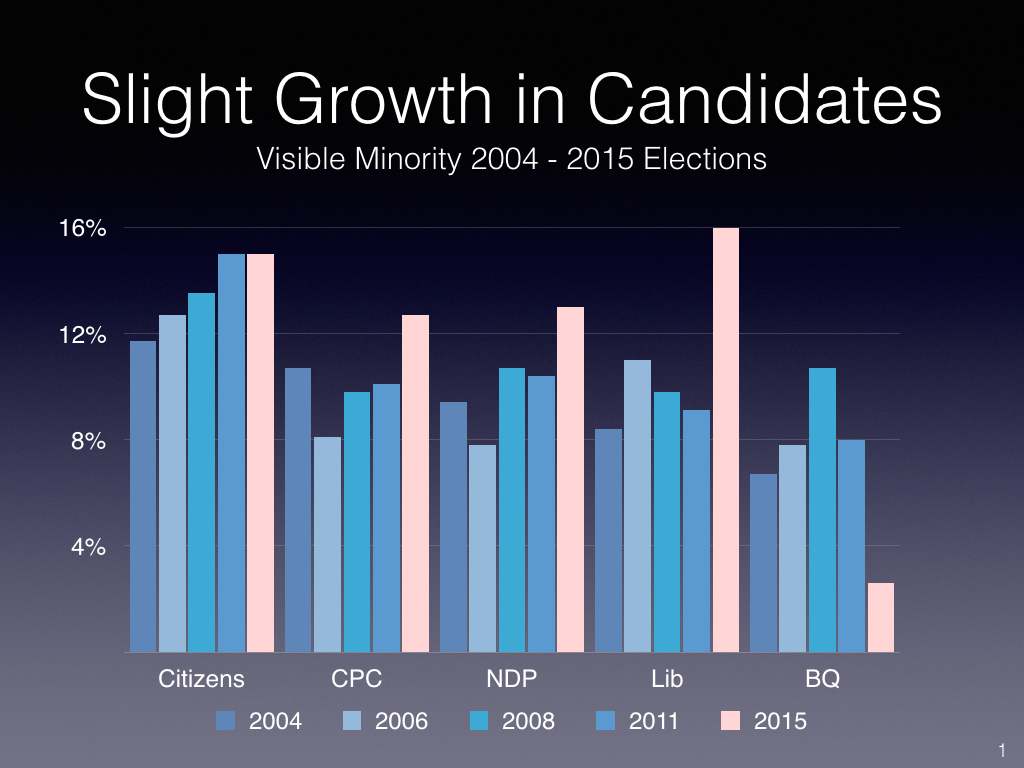
Out of a total of 1014 candidates for the three major parties, 142 or 13.9 percent were visible minorities. The chart below shows a growth in visible minority candidates for the three major parties plus the Bloc.

VisMin Candidates 2004-2015.001

For the 2015 election, the Liberal party has the most visible minority candidates, slightly greater at 16 percent than the number of visible minority voters who are citizens. The Conservative party and the NDP have slight under-representation (13 percent) while the Green party has greater under-representation (11 percent). The Bloc québécois only appears to have a two visible minority candidates (under three percent of Quebec’s 78 seats).

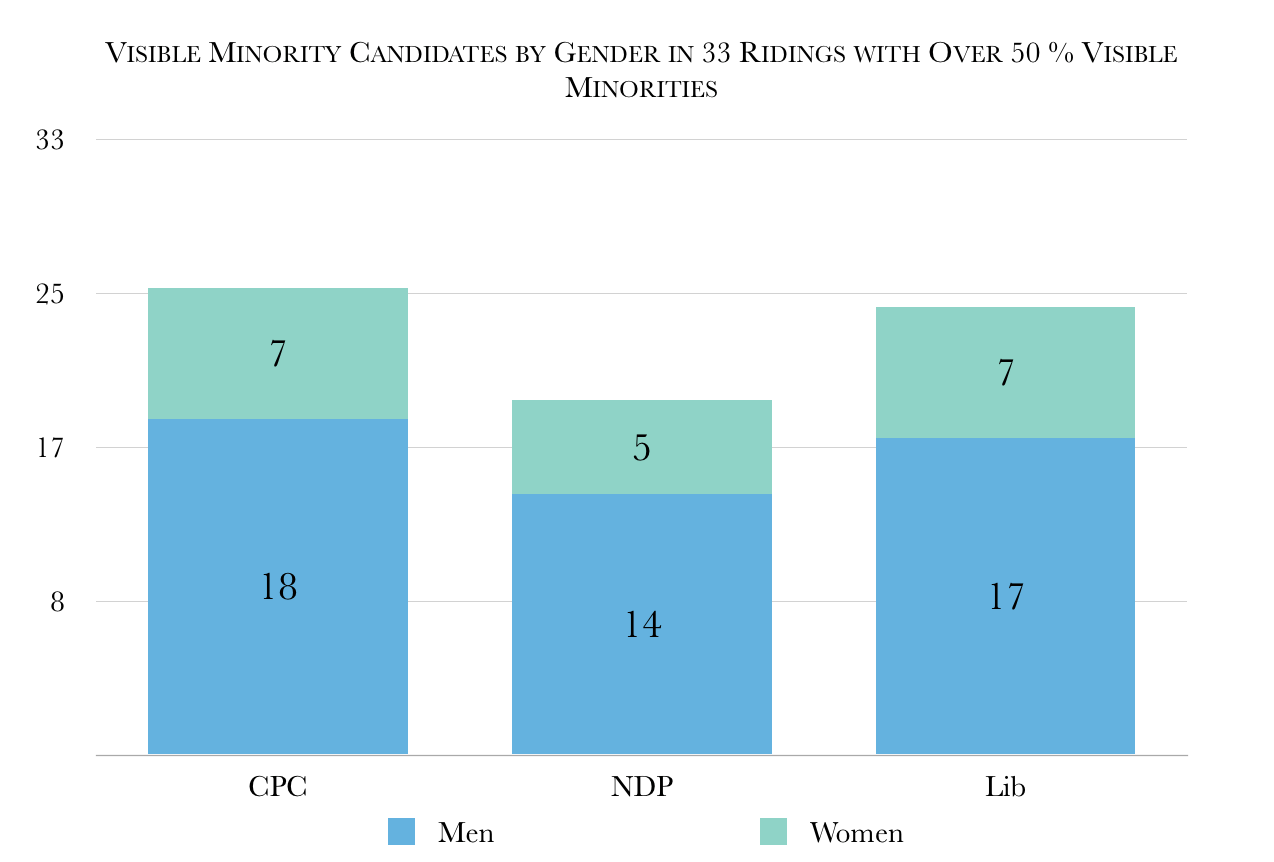
The chart below provides the comparative numbers for each party in the 33 ridings that are more than 50 percent visible minority, broken down by gender.

VisMin Candidates Top 33 RidingsAdditional characteristics of these ridings, in terms of the candidates, include:

  • Out of the 99 candidates from the three major parties, 68 are visible minorities (over two-thirds). These account for just under half of the 142 visible minority candidates in all ridings.
  • 19 candidates are women (19.2 percent)
  • In 15 of these ridings, all major party candidates are visible minorities;
  • Only one riding, Scarborough Guildwood, has no visible minority candidates;
  • The Conservative Party has the most visible minority candidates (25), followed by the Liberal Party (24) and the NDP (19); and,
  • In general but by no means universally, many candidates come from the larger communities in these ridings, particularly South Asian ridings as this table 2015 Ridings with More than 50% Visible Minorities and Their Candidates shows.

Happy election viewing and seeing how these (and other) ridings go.

Race Affects How Media Cover Canadian Political Candidates – New Canadian Media

Some good research and insights (disclosure: I know Erin from our time at CIC):

Where Tolley also finds stark differences in coverage is in the types of issues visible minorities seem to be most connected to. While they are often quoted in stories on immigration policy, multiculturalism or poverty – all “so-called minority issues,” as Tolley refers to them – their voices are often absent from stories about more “pressing” issues like the economy and the environment.

“Some people said to me, ‘Well, that makes sense because probably visible minorities don’t care as much about those issues,’” recalls Tolley. “[But] when I talked to visible-minority candidates about their issue priorities, many of them talked about the economy – things like taxes, finding good jobs, having credentials recognized, that sort of thing – and that doesn’t come out in their media coverage.”

Tolley finds the notions of visible-minority candidates only being able to serve people from their own ethnic group and unable to understand the issues of other Canadians concerning. White candidates, she says, don’t face this challenge, as they are often positioned as having broad reach and the ability to “woo” or “court” the ethnic vote.

“No one ever talks about the fact that white candidates also appeal to white voters. I mean, no one would write that,” Tolley says. “No one even describes white candidates as ‘white candidates’ or really talks about where they were born. Whiteness is basically put forward as the default and therefore not worthy of being mentioned, whereas minority or immigrant background is something that is covered because it is seen to be outside the norm or atypical, and therefore newsworthy.”

With the upcoming elections, there is still time for media outlets to consider Tolley’s research in their approach to the stories that they run. Everything from picture and headline choice to inclusion of socio-demographic background and whether a “diversity” angle is relevant to a story or not should be considered, she advises.

But most importantly, Tolley says, people – not just the media, but all Canadians – need to be open to the idea of talking about race, a subject she found during her research many are still uncomfortable with.

“Some of my interviewees talked about the fact that they are colour-blind – they don’t see colour,” she explains. “I said instead of talking about ‘colour-blindness,’ we should think more about the fact that we’ve been mute in conversations about race. We haven’t had mature discussions about it.”

Race Affects How Media Cover Canadian Political Candidates – New Canadian Media.