Liberals won over Muslims by huge margin in 2015, poll suggests

No surprise, given the Conservative party’s use of identity politics in the election and explicit anti-Muslim messaging.

Chris Cochrane’s (UofT Scarborough) exit poll analysis of the election results, presented at Metropolis this spring, shows even stronger support among Canadian Muslims, close to 80 percent:

Muslim Canadians voted overwhelmingly for the Liberal Party in last year’s election, helping Justin Trudeau secure the majority government that nine out of 10 of Muslims believe will help improve relations between themselves and other Canadians, according to a new survey.

The poll of Muslim Canadians also found widespread support for the right to wear a niqab during a citizenship ceremony and a large degree of opposition to the anti-terrorism legislation known as Bill C-51, two hot-button issues that may have cost the Conservatives dearly in the last federal election.

The Environics Institute polled 600 Muslim Canadians between November 2015 and January 2016, asking a number of questions related to identity and religious issues, in addition to more politically themed questions.

Of those who said they had voted in the 2015 federal election, 65 per cent reported voting for the Liberals, with 10 per cent saying they voted for the New Democrats and just two per cent for the Conservatives.

Another 19 per cent of Muslim respondents refused to say how they had voted.

How Muslims voted in the last federal election

The Liberals did particularly well among Muslims in Quebec and those who are Canadian born. The NDP did slightly better among younger Muslims than it did among older Muslims.

These numbers mark a shift away from the NDP and Conservatives compared with 2011. An Ipsos Reid exit poll of voters in 2011 found that 46 per cent of Muslim Canadians had voted for the Liberals, with 38 per cent having cast a ballot for the NDP and 12 per cent for the Conservatives.

Source: Liberals won over Muslims by huge margin in 2015, poll suggests – Politics – CBC News
Muslim Canadians increasingly proud of and attached to Canada, survey suggests

Noteworthy that increased religiosity seems compatible with attachment to Canada, just as it is with other religions:

An overwhelming majority of Muslim Canadians have a strong attachment to their country and feel that Canada is heading in the right direction, according to a new survey.

But the survey also finds that young Muslims, a cohort that is increasingly devout, have more attachment to their religious identity than older Muslims and are more likely to be concerned and pessimistic about discrimination.

These are the findings of a survey of 600 Canadian Muslims conducted by the Environics Institute between November 2015 and January 2016. It follows up on a survey conducted 10 years ago and suggests that Muslim Canadians are becoming increasingly integrated into the broader Canadian society.

The survey began in the weeks following last fall’s federal election. A good chunk of that election’s campaign was dominated by the debate about Muslim women’s right to wear the niqab, a religious face covering, as well the Conservative proposal to establish a tip-line to report “barbaric cultural practices” that was widely seen as aimed at Muslims.

Strong sense of belonging

The survey found that 83 per cent of Muslims reported being “very proud” to be Canadian, an increase of 10 points since 2006. This was in contrast to non-Muslim Canadians — only 73 per cent of whom said they were “very proud” to be Canadian.

Fully 94 per cent of respondents said their sense of belonging to Canada was very or generally strong, and 58 per cent said their sense of belonging had become stronger over the last five years. Just five per cent said it was getting weaker.

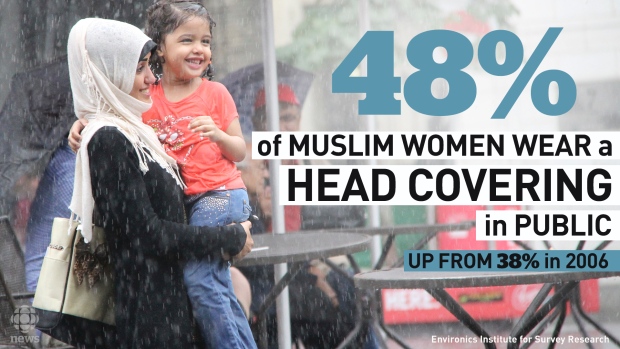
Muslim survey graphic 4

An Environics survey says nearly half of Muslim Canadian women report wearing a head covering in public. (CBC)

Muslims reported that Canada’s freedom and democracy was their greatest source of pride (24 per cent), followed by the country’s multiculturalism and diversity (22 per cent). Younger and Canadian-born Muslims were much more likely to choose multiculturalism and diversity, compared to foreign-born Muslims, who valued freedom and democracy.

The biggest knock against Canada was the weather. Just under one-third of Muslims said that was what they liked least about Canada. Another nine per cent highlighted discrimination and the treatment of Muslims. One-in-five could not name anything they disliked about Canada.

Source: Muslim Canadians increasingly proud of and attached to Canada, survey suggests – Politics – CBC News

Muslim men must learn to treat women as equals: Sheema Khan

One of the more interesting sessions we held on multiculturalism and faith was a small multi-faith roundtable, with the most interesting exchange being between Sheema Khan and Alia Hogben (Canadian Council of Muslim Women) who challenged some of the more conservative or traditional male Imams present on gender issues.

Both have continued to be outspoken as seen in this latest piece by Sheema:

From 2000 to 2005, I served as the chair of CAIR-CAN, a grassroots advocacy organization that fought discrimination against Muslims. Whether it was a Muslim woman denied employment because of her hijab, or the rendition of Maher Arar, we fought for basic human rights based on the Canadian Charter of Rights and Freedoms. This journey opened my eyes to my own double standards: I fought for Muslims to be treated with basic human dignity by the wider society, yet looked the other way when such treatment was denied to women within my own community.

Toward the end of my CAIR-CAN tenure, I could no longer stand the hypocrisy, and decided to tackle a fundamental problem that our community has been content to ignore: the treatment of women as second-class human beings. As chair, I came across incidents against Muslim women that would never have been tolerated had these been perpetrated by a non-Muslim. But if a Muslim did it, well, we would let it go, hoping that attitudes would one day change.

It was, and continues to be, the denial of the fact that many Muslim cultures have a bias against women. Consider the past few years of the Gender Gap Index, published by the World Economic Forum. It continually lists predominantly Muslim countries in the bottom rung of societies that equitably distribute resources between men and women. From the super rich (such as Saudi Arabia and other Gulf States) to the impoverished, a large chunk of Muslims live in societies where women are shortchanged in terms of development, opportunity and participation.

The bulk of Muslims in Canada are immigrants who naturally bring to this country the attitudes and norms shaped by their culture of birth. These will be transformed by Canadian norms; the transformation varies from person to person. Suffice it to say that many traditional Muslim institutions continue to operate on a patriarchal model, in which women are either unwelcomed or merely tolerated, but are always expected to keep the status quo. Those who demand basic rights are labelled with the “f” word – feminist.

….Some will be critical of the airing of “dirty laundry” during difficult times for Muslims. Yet meaningful discussions about the treatment of women have been avoided for far too long. To what end? What we don’t need is another lecture about the dress and behaviour of the “ideal” Muslim woman. Instead, we need to hear more about men taking responsibility for their actions, and treating women as equal human beings.

Source: Muslim men must learn to treat women as equals – The Globe and Mail

Young Muslim voters matter more than ever

Interesting contrast between the first generation and the second generation in terms of political engagement.

Canadian Muslims form between 15 and 20 percent in six ridings (Toronto’s Mississauga-Erin Mills, Mississauga Centre and Don Valley East; Montreal’s Saint-Laurent and Saint-Léonard-Saint-Michel; and, Ottawa South):

Yet for many Canadian Muslim youth, this country is the only home they have ever known.

Unlike many of their parents, who migrated to the country in the ’70s and ’80s, more than one in four Muslims in Canada were born here, according to a report published earlier this year by Ottawa-based researcher Daood Hamdani for The Canadian Dawn Foundation.

“Both my feet are planted here. There is no ‘back home’ for me,” says 37-year-old Mohammed Hashim of Mississauga, Ont.

‘I want Canada to go back to what it was.’— Sanaa Ali-Mohammed, 26

That’s a sentiment that the older generation doesn’t always share, Ali-Mohammed says. “For my parents, I think it’s more of a transactional relationship. They’ll be good citizens but there’s always this undertone of ‘we don’t really belong here.'”

Islamic Institute of Toronto president Fareed Amin is a first-generation immigrant to Canada and has seen this sentiment among his age group first-hand. “Many of them come from countries where whether you participate or not doesn’t make a difference, so sometimes there’s that skepticism to participate in the political process .”

Some new Canadians also carry with them the view that political involvement is potentially dangerous because of the tenuous political climates they left behind.

“I don’t think our young people have the same baggage that some of the first-generation immigrants have,” Amin says. “They’re born-and-bred Canadians.”

Back in Brampton, Ali says part of being Canadian is the freedom to be whoever you are. “My parents chose to come here because you can’t always be that in Pakistan.”

His hope for the election? “I want Canada to go back to what it was; the country my parents came to.”

The Conservatives’ veiled pitch for the anti-Muslim vote: Delacourt

Delacourt has it right, both in terms of substance and politics:

What we have here is a textbook case of saying one thing and doing another in politics. The ‘saying’ part is for all the wrong reasons — the ‘doing’ part is for the right ones.

I suspect the Conservative government realized several years ago that it was legally impossible to ban veiled voting. Two attempts were made between 2007 and 2011. Both quietly died on the order paper.

Here’s why: It would amount to singling out certain members of the population for restricted rights. We do allow people to vote in Canada without showing their face at the ballot box — through proxies, or mail-in special ballots. How do you write a law that says some people don’t need to show their faces, but others do?

Moreover, a special law to prohibit the niqab would stomp all over Canadians’ rights to religious expression. That’s probably why the Justice Department lawyer felt he had to point out the non-mandatory aspect of the legislation in Federal Court.

Rather than explain this to Canadians, though, the Conservatives took the path of blustering about niqabs and sending dog-whistle signals to people uncomfortable or fearful about Muslims. Bad statesmanship. Easy politics, though.

We saw that earlier this year, as well, when the Conservatives sent out a fundraising email asking supporters to sign up if they agreed that it was “offensive” to wear a niqab or a hijab at citizenship ceremonies. The email left little doubt that the Conservatives were whipping up these sentiments for reasons of purest electoral politics.

The note was signed by Immigration Minister Chris Alexander and stirred up some controversy with his interchangeable use of ‘niqab’ and ‘hijab’; one is generally associated with full-face coverings, while the other, the hijab, is commonly used to describe a head covering.

To make things even more confusing, not all Conservatives have been using the word “offensive” when it comes to garments of religious expression. Kenney, for instance, said on Twitter in 2013: “A child is no less Canadian because she or he wears a kippa, turban, cross, or hijab to school.” Kenney sent out that missive in the midst of the Quebec debate over the wearing of religious symbols in public.

There’s still a month left in this election and it’s entirely possible that one of the eleventh-hour Conservative campaign promises will revolve around banning veiled voting — again. It would fit well with this week’s bluster on citizenship ceremonies.

This time we might ask them: Why did the last two attempts quietly die? Are they serious this time, or is this just another attempt to whip up some good old-fashioned intolerance?

What’s really being veiled here by all this talk about the niqab?

Source: The Conservatives’ veiled pitch for the anti-Muslim vote

Overcoming Islamophobia: Fear is never the best basis for action – William Macdonald

Good essay on the need for perspective and mutual accommodation by William A. Macdonald in the context of Canadian Muslims but applicable more broadly:

The numbers tell their own story. There are about a million Muslims in Canada, and 1.6 billion around the world, one-quarter of whom reside in India and Indonesia. Despite the current problems particular to Islam, there is no irresistible link between Islam itself and terrorism. No Muslim country is in the world’s top 20 in terms of homicides per capita, nor is Islam associated with any of the 10 largest genocides in history.

The only long-run solution to the relationship between Islam and the rest of the world is rooted in mutual accommodation. Whatever is being done to fight terrorism must always keep that reality in mind. Words matter, and we should avoid to the extent possible including the terms Islamic or Muslim in our descriptions of extremism or terrorism, even if the violence is being done in the name of Islam. Readers already know that’s what al-Qaeda and Islamic State claim.

Islam is no different from any other religion in its need to examine itself critically. The thinking mostly has to come from within, while the challenges will often come from outside events. The recent U.S. Supreme Court decision upholding gay marriage is a good example: Religion not only challenges the world; the world challenges religion. Institutional religions, if they are to survive and thrive, need to communicate with their adherents, and everyone else. For example, the Pope challenges the world to do better at the very moment when the acceptance of gay marriage challenges his church (and not very long after it was challenged by the adverse reaction to its reluctance to respond to the sexual abuse of young people in its care).

David Brooks, the insightful conservative columnist for The New York Times, described the current post-gay-marriage situation in the United States very well. True believers – mostly of a religious persuasion – have a choice, he says; one way is to keep fighting for what they believe by seeking to change laws so that they can impose their views on society. The other, as Mr. Brooks and I both believe, is for these groups to accept that they are special communities of individual believers who can make their best contribution to their members and to society, not by trying to impose their views on others, but by the strength of their own communities of faith.

In recent weeks, the racist massacre in Charleston, S.C., has provided yet another example to our world, desperately in need of more compassion and a larger purpose than individuals themselves. It is difficult to imagine anything more powerful than the personal, face-to-face forgiveness of the deeply mourning relatives to the murderer of their loved ones. The authenticity of this forgiveness could come only from the force of their deep faith.

There is an urgent need to find the best strategy to address the double challenge presented by terrorist acts in Canada and terrorist recruits from Canada. Aside from that issue, how big a problem are Muslims? Or, from another perspective, is Canada a problem for Muslims? Canada’s history is all about a growing capacity for the inclusion of more and more differences in our society. Covering a woman’s face with a niqab is certainly incompatible with the openness that has become part of the Canadian way. Yet it represents no threat to anyone except on those occasions when there is a clear need to see someone’s face, such as for identification purposes or during testimony in court.

Overcoming Islamophobia: Fear is never the best basis for action – The Globe and Mail.

For those interested in his website and more of his views, his framing piece can be found at CANADA: STILL THE UNKNOWN COUNTRY along with other commentary at Canadian Difference.

Khadr’s release is bittersweet for Canada’s Muslims: Sheema Khan

Sheema Khan, in an uncharacteristically harsh judgement of the Government, makes the point about the need for a more inclusive approach:

The release of Mr. Khadr is bittersweet for Canadian Muslims. Many were touched by the young man’s modesty and warmth. His words were genuine – much like his smile. He seemed truly grateful for the freedom so long denied, for the support of so many, for the chance to start his life anew. He expressed remorse for the pain he caused. No hint of bitterness. Only the desire to complete his education, with hopes of entering health care – a field, he noted, rooted in compassion for those in pain. We should all be cautiously optimistic for Mr. Khadr’s reintegration into society.

However, Canadian Muslims have seen this scenario before in the post 9/11 era: A Muslim swept up in the “war on terror,” denied basic rights, tortured and left to rot in legal limbo to be saved only by the noble efforts of human rights activists, ordinary Canadians and our justice system. Canadian citizens Maher Arar, Abdullah Almalki, Ahmad El-Maati, Muayyed Nureddin and Abousfian Abdelrazik were all detained abroad with the aid of our security agencies. Mr. Abdelrazik’s case was particularly vexing. The Harper government repeatedly blocked his return from Sudan (citing him as a “threat”), even after the Canadian Security Intelligence Service and the RCMP cleared his name. A federal judge finally ordered Mr. Abdelrazik’s return. Meanwhile, Canadian Muslims saw the Harper government’s deferential treatment of convicted felons Brenda Martin and Conrad Black. Or, as Mr. Abdelrazik said: “The Canadian government has a racist mind. It is because I am black and Muslim.”

These words were echoed by Mr. Khadr’s lawyer, Dennis Edney, when asked why Mr. Khadr was left to languish in Guantanamo: “Mr. Harper is a bigot” and “doesn’t like Muslims.” These words were cathartic. We are the low-hanging fruit in the politics of fear. Omar Khadr is exhibit A; Zunera Ishaq is exhibit B. With an October election, it won’t be surprising to see political machinations at our expense – such as sweeping arrests of suspected terrorists and disparaging remarks against niqabs at voting booths.

Mr. Khadr asked Canadians to “see who I am as a person, not as a name.” It is a wish Canadian Muslims have for their themselves and their children: “Please see me for who I am, not as an object of fear.” An inclusive future lies in the fairness and compassion of Canadians.

Khadr’s release is bittersweet for Canada’s Muslims – The Globe and Mail.

ICYMI: Ontario imams to urge Muslims vote in federal election

Good article on Canadian Muslim voting and the ridings in which it can make a difference:

Of course, Canadian Muslims don’t vote as a united front.

According to an Ipsos Reid exit poll from the 2011 election, 12 per cent of Muslims who voted supported the Conservative party, while 46 per cent voted Liberal, and another 38 per cent voted NDP.

That doesn’t bother Sajan. “Our goal is that all eligible Canadian Muslims vote, period,” she says.

Nevertheless, higher Muslim voter turnout could make a significant difference not only in ridings with high Muslim populations such as Don Valley East and Mississauga Centre, but also in key ridings in Calgary and Edmonton, according to former Liberal MP Omar Alghabra.

“I lost an election by 300 votes,” says Alghabra, who represented the federal riding of Mississauga-Erindale from 2006-08.  “I know from experience that every vote counts.”

According to Statistics Canada, Muslims comprise between 12 and 19 per cent of the populations in 19 federal ridings, 11 in Ontario, six in Quebec and two in Alberta.

Mohammed Ayub Khan, a political science researcher at McMaster University, says one of the reasons that Muslims haven’t been very active at the polls historically is that they haven’t felt especially connected with the issues highlighted by parties.

Another reason may be the apparent rise in Islamophobia in recent years, which has left many Muslim Canadians feeling alienated and unengaged in the political process, says University of Toronto political science professor Katherine Bullock.

For his part, Khan says this year may be different. “2015 may well serve as the watershed event in Canadian Muslim political history” because of the intense focus surrounding Bill C-51 and things like the niqab debate, he says.

“It has really galvanized the various Muslim communities to start a conversation around the issue and consider their options.”

Bullock agrees, and Canadian Muslim Vote hopes to seize on that interest and expand its presence in other cities after this year’s election, translating its campaign materials into different languages to reach as wide a group as possible.

Friday’s launch will see imams from Ajax all the way to Kitchener touting the importance of civic engagement and calling Canada home.

Ontario imams to urge Muslims vote in federal election – Politics – CBC News.

PM Harper’s ‘dangerous’ comments on Muslims show lack of understanding on culture, says Taylor

Hard to disagree with Charles Taylor’s assessment:

Prime Minister Stephen Harper’s comments on the niqab are “very dangerous” and could lead to stigmatization and even radicalization, one of Canada’s most renowned political thinkers said Saturday.

Speaking to a packed room at the Broadbent Institute’s Progress Summit in Ottawa Saturday morning, McGill University philosopher Charles Taylor said the prime minister’s comments on the niqab as coming from an anti-feminist culture conflates Muslim dress with the threat of terrorism and jihadism, which stigmatizes the entire Muslim population and creates a rupture in Canadian society.

“This kind of stigmatization is exactly what we have to avoid,” Prof. Taylor told reporters following his address.

The Prime Minister has been “tone deaf” in his comments about Muslims, he said, which demonstrates a lack of understanding of the culture he’s discussing, though he also said electoral considerations likely figure in the approach.

“Ask yourself what are the recruiters of Islamic State saying? They’re saying, ‘Look, they despise you. They think that you’re foreign, you’re dangerous, you’re not accepted here so why don’t you come to them?’” he told reporters.

“The more you make it sound like that, the more you’re helping them. It’s strange that people don’t see that.”

PM Harper’s ‘dangerous’ comments on Muslims show lack of understanding on culture, says Taylor | hilltimes.com.

Harper’s silence on anti-Muslim backlash disheartens Muslim groups

They have a point. Silence from the top speaks:

Muslim groups have condemned the killings and the extremist beliefs which apparently motivated them. But they say their efforts to demonstrate that most Muslims do not share those beliefs and to show solidarity with non-Muslim Canadians need to be reinforced by political leaders, particularly the prime minister.

“We are trying to work together with our law enforcement and our authorities to end this what is called radicalization of youth. We are trying to do our utmost to help,” said Mostefa.

But when political leaders denounce Muslim extremists but don’t come to the defence of moderate Muslims, Mostefa said young Muslims will think: “This is my country and you don’t come to my support to stand by my side.”

And that sends “the wrong message.”

….. “Our leaders have a very important role to play,” concurred Amira Elghawaby, human rights co-ordinator for the National Council of Canadian Muslims.

“It’s the leaders who have to set the positive tone.”

Immediately following the 9-11 terrorist attacks in New York and Washington, Elghawaby noted that then-prime minister Jean Chretien visited a mosque “just to show Canadians that there’s no such thing as collective guilt.”

She said her group expects Harper, “as leader of our country, to speak up for the minorities that live here.”

“He has a responsibility to represent everyone and certainly Canadian Muslim communities are extremely worried about a backlash and I think that needs to be spoken to.”

Alia Hogben, executive director of the Canadian Council of Muslim Women, said it’s “very disheartening” that Harper has not bothered to speak out against the anti-Muslim backlash. But it’s not surprising to her.

“I don’t think he much likes Muslims,” Hogben said.

Canada is a multicultural country with over 1 million Muslims, most of whom are Canadian citizens whose religion is only part of their identity, she pointed out.

“I think it’s absolutely vital that the head of the country, like the prime minister, would accept that and also somehow reinforce it and reassure people.”

Asked why Harper has not specifically denounced any of the recent anti-Muslim incidents, the prime minister’s spokesman Jason MacDonald said: “These acts are obviously unacceptable.

Contrast this to any number of statements and the like on antisemitic incidents.

Harpers silence on anti-Muslim backlash disheartens Muslim groups.