Cabinet diversity 2025

While media coverage and commentary has understandably focused on gender parity, regional representation and the balance between old and new faces, the table below broadens this analysis to include visible and religious minorities, immigrants, Indigenous and LGTBQ.

In terms of visible minorities, there are 6 South Asians, one Black, one West Asian/Arab and one Filipino. Religious minorities or background include three Sikhs, two Jews, one Muslim and one Hindu.

Mike Moffatt: My remarks to the federal cabinet on housing, immigration, and the temporary foreign worker program 

Really quite striking how academics like Moffatt, Skuterud, Worswick and other have changed the discourse around immigration, focussing on selection criteria, productivity and impact on housing, healthcare and infrastructure.

Another further indication that immigration is not a third rail issue, and Moffatt speaking to Cabinet and sharing his remarks on the conservative outlet The Hub is a further illustration:

..On population growth, yesterday’s temporary foreign worker reforms are welcome news, but Canada must go much further. The TFW program, particularly the low-wage non-agricultural stream, suppresses wage growth, increases youth unemployment, creates the conditions for the exploitation of foreign workers, and reduces productivity, as it disincentivizes companies from investing in productivity-enhancing equipment. The low-wage stream should be entirely abolished, and the other streams should be substantially reformed, including creating a system of open permits.

Population growth targets, including both permanent and non-permanent residents, and housing growth targets, should all be incorporated into the annual release of the Immigration Levels Plan. The targets must be aligned, to ensure population growth does not outpace homebuilding, which will require substantial reductions in the permanent resident target over the next few years.

Like most economists, I support a robust immigration system and believe the current targets are achievable in the long run. In the meantime, however, we need to give ourselves time to allow homebuilding to catch up to past population growth, requiring a substantial reduction in the permanent resident target back to the levels of a decade ago.

We should be clear that this is not about blaming immigrants for Canada’s issues. Rather we must recognize that when we invite people to our country, we need to ensure that we have in place the conditions for them to succeed. We do them no favours, and us no favours, by setting them up to fail.

And we should be clear that we are setting people up to fail, particularly Millennials and Gen Z. Rents on new leases in Halifax are up 75 percent in the past five years. It should come as no surprise that the 2024 World Happiness Report found that Canadians under the age of 30 are the 58th happiest in the world. They are being denied a path to middle-class prosperity.

We can and must do better. Thank you for having me here today.

Source: Mike Moffatt: My remarks to the federal cabinet on housing, immigration, and the temporary foreign worker program

Concrete actions must accompany diverse cabinet, Canada Research Chair says

Hard not to agree with Erin Tolley but some perspective on what the government haas done – increased diversity in GiC, judicial, senate appointments, improved representation and data on public service diversity, refunding of the multiculturalism program and explicit anti-racism initiatives, special attention to Black Canadians along with the various historical recognition initiatives – would be helpful. Further action of course possible:

Prime Minister Justin Trudeau moved last month to introduce more diversity into his cabinet but some political experts said the additions won’t have much effect unless they go beyond surface-level representation.

Trudeau added seven new faces to his governing team on July 26 including Mississauga MP Rechie Valdez, the first Filipina Canadian woman MP, and Toronto MP Gary Anandasangaree, who is the first Sri Lankan Tamil to serve in cabinet.

Trudeau said in July that the new cabinet is a reflection of Canada’s diversity and would bring new voices, skills and experiences to the table.

Many saw the changes as part of an effort by the Liberals to shore up support in tight ridings and among specific ethnic communities.

But Erin Tolley, the Canada Research Chair on gender, race and inclusive politics at Carleton University in Ottawa, said a seat at the table is only one part of true representation – both for the ministers themselves and for the people they represent.

“I think in these particular cases, appointing somebody from those communities does act as a signal that the Liberals are listening, that they value input from that community,” said Tolley.

At the same time, it’s reductive to speak of changes to cabinet in terms of racial impact, she said. Focusing solely on race instead of policy is a disservice to both diaspora communities and the ministers themselves because it assumes diaspora communities vote primarily on the basis of the racial background, she said.

There’s little evidence to suggest voters can be motivated solely on racial grounds, said Tolley, which means a more diverse cabinet isn’t likely to dramatically shift voting behaviour among the people they represent come election time.

“You can’t simply put diverse faces around a table without also changing the way you do policy and the kinds of policy choices you’re making,” said Tolley.

Without this, communities could shift their alliances if they feel their support is being taken advantage of and if they’re not seeing responsiveness from a government, she said.

Sabreena Delhon, executive director of the Samara Centre for Democracy, said politicians can also feel taken advantage of if they don’t receive the supports they need in their new roles.

“If you’re going to have someone in a space where they have traditionally been under-represented or have had limited decision-making power, you need to think about what it will take to retain them,” Delhon said. “And that relates to creating working conditions that are sustainable and supportive.”

Delhon said Samara’s podcast, “Humans of the House”, which interviews former members of Parliament about their experiences in politics, has helped showcasewhat it means to work on the Hill. The candid conversations have talked about mental health struggles, the gruelling schedules and the steep learning curve MPs face when they receive a promotion.

When diverse MPs are given those promotions, there needs to be mechanisms in place to support their success and retention in the roles, said Delhon.

“If we don’t find ways for the House of Commons and the broader workplace culture of politics in Canada to hold on to the best and brightest problem solvers, then the leaders that we need will stop stepping forward altogether.”

And, she added, it’s not uncommon for racialized politicians to be the subject to threats online which add more stress and mental health struggles to their long list of challenges.

Samara analyzed more than 2.5-million posts on X, formerly known as Twitter, directed toward candidates in the 2021 federal election. About 20 per cent of those tweets were “toxic or abusive,” Delhon said, including sexually explicit content and attacks on their identities.

Cabinet shuffle day can be “an exciting day,” said Delhon, “but it’s important to understand how challenging the path to that position might have been for some,” especially those who are racialized.

When Charmaine Williams, a member of provincial parliament in Ontario, was named to Premier Doug Ford’s cabinet last year she became the first Black person in cabinet for the conservatives in that province.

She said she’s felt supported “every step of the way,” both from her colleagues and her constituents – “all those who’ve been impacted by the various barriers that so many Canadians (and) Ontarians face.”

This makes the feelings of support and inclusion even stronger, she said, because she knows folks “understand what it’s like to be the first.”

Williams was speaking in Ottawa at the end of a summit of the Canadian Congress of Black Parliamentarians. She said collaborating with other Black politicians reminds her that even though they may be the only ones in the room, you’re still there with the mandate to fight for all Canadians.

“It’s such a great feeling,” she said.

Source: Concrete actions must accompany diverse cabinet, Canada Research Chair says

Castel: La dimension géopolitique du cabinet Trudeau

Reasonable analysis:

Les observateurs s’entendent pour dire que le remaniement du Conseil des ministres fédéral par Justin Trudeau a occasionné un bouleversement majeur, l’ensemble de l’opération devant lancer un message économique. Or le plus extraordinaire, c’est de constater que le découpage de la représentativité sociale et géographique des nominations est resté quasi identique.

Nonobstant l’importance des portefeuilles, la question de la parité femmes/hommes ne se pose plus depuis 2015. Avec le remaniement de janvier 2021, on compte désormais cinq femmes parmi les dix ministres au sommet de l’ordre de préséance.

Ledit découpage fait aussi référence à la préoccupation qu’il y a, autant du côté du premier ministre que du côté des premiers intéressés, à ce que les régions se sentent adéquatement représentées. Certains choix comportent une forme de remerciement régional en même temps que des arrière-pensées électorales.

Le nombre de ministres par province est resté inchangé : l’Ontario en a 16 (41 %) ; le Québec, 11 (28 %), les provinces de l’Atlantique, 6 (15 %), la Colombie-Britannique, 4 (10 %) et les provinces des Prairies, 2 (5 %). Ces proportions, les mêmes que celles ayant suivi les élections de 2021, sont d’abord le reflet du poids démographique des provinces, mais elles sont aussi motivées par la préoccupation de solidifier les bases libérales locales dans des régions fragilisées depuis 2019 (Atlantique, Québec rural) tout en envoyant un message attractif aux régions historiquement rébarbatives, comme les Prairies ou le sud de l’Ontario rural.

La force du Parti libéral du Canada (PLC) réside dans les régions urbaines. C’est aussi sa faiblesse, puisque l’accès au gouvernement se gagne moins avec des votes qu’avec des sièges. Treize ministres proviennent de la grande région de Toronto, six de la région de Montréal et quatre de la région de Vancouver. Hormis un ministère torontois supplémentaire, le premier ministre garde le même nombre de ministres urbains, avec trois nominations pouvant être motivées par un souci de solidifier un siège menacé : Arif Virani à Toronto, Soraya Martinez Ferrada à Montréal et Jenna Sudds à Ottawa.

Suivant les élections de 2019, le PLC s’appuie sur une chaîne de quelques petits blocs ruraux et une série de zones urbaines isolées. Plusieurs ministres (Patty Hajdu, Marie-Claude Bibeau, Pascale St-Onge, François-Philippe Champagne) viennent de ces espaces stratégiques.

Depuis lors, une douzaine de francophones font partie du Conseil des ministres. Au Québec, la progression du Bloc québécois renforce l’importance de chaque poste ministériel en dehors de Montréal. Hors Québec, le jeu de chaise musicale est délicat, car chaque perte est souvent mal ressentie. C’était le cas pour Ginette Petitpas Taylor en novembre 2019 et c’est maintenant le cas pour Mona Fortier à Ottawa.

Cela dit, certains coups comptent double, car l’Ouest est représenté, depuis 2021, par Randy Boissonnault, un francophone militant d’Edmonton, et Dan Vandal, un Métis de Winnipeg, appelé au cabinet en 2019.

Sous les gouvernements Trudeau, trois Autochtones ont fait partie du Conseil des ministres. Si 10 des 18 députés autochtones ont été élus sous la bannière libérale, les élections de 2019 on fait du Nouveau Parti démocratique la force montante dans les régions boréales et nordiques ainsi que dans les régions de Winnipeg, d’Edmonton et de Vancouver, où des candidats autochtones se présentent.

La question de la diversité ethnique et religieuse est devenue incontournable, notamment à Toronto. À commencer par la vice-première ministre, on peut avancer qu’une quinzaine de ministres ont une origine ethnique autre que britannique ou française. Onze ministres (28 %) correspondent à l’un des groupes que Statistique Canada associe aux minorités visibles.

L’entrée ou la sortie de chaque personne au cabinet affecte l’ensemble d’un édifice déjà compliqué. Le premier ministre s’est sans doute rendu compte que, vu le nombre de paramètres à considérer, la seule façon de sortir de la quadrature du cercle passait par une augmentation du nombre de ministres. Ainsi les cabinets sont-ils passés de 31 à 37, puis à 39 membres, à chaque lendemain d’élections (2015, 2019, 2021). C’est le remaniement de juillet 2018 qui inaugure cette tendance, avec 35 membres.

De plus, à la fin du premier mandat de Justin Trudeau, le Québec et surtout l’Ontario ont gagné en influence, alors que les Prairies ont perdu des plumes, ce qui ne fut pas favorable aux élections de 2019. En n’allant pas chercher de ministre supplémentaire dans l’Ouest pour plutôt ajouter un ministre de Toronto, tout en faisant des changements stratégiques à Montréal et à Ottawa, le chef du Parti libéral du Canada donne l’impression qu’il pense aux prochaines élections, où il jouera défensif, pour recourir au langage sportif.

Source: La dimension géopolitique du cabinet Trudeau

Yakabuski: The renewal theme rings hollow even as Justin Trudeau names seven new faces to cabinet

Pointed comments on Ministers Fraser and Miller, likely understate the challenges. And of course, turning up the dial on the number of permanent and temporary residents much easier than new housing:

Conveying renewal and stability at the same time is a neat trick, if you can manage it.

Prime Minister Justin Trudeau tried to do both with a cabinet shufflethat featured a slew of new faces on Wednesday, all while relying even more heavily on a quartet of tested ministers – and likely future leadership contenders – to carry the load of a government living on borrowed time.

Source: The renewal theme rings hollow even as Justin Trudeau names seven new faces to cabinet

To blunt Poilievre’s outreach in cultural communities, Trudeau gives high-profile cabinet roles to MPs with diverse backgrounds, say some senior Liberals 

Of note. Of course, implementation and results count more than new faces around the table. But 29 percent of ministers are visible minority, a new high, and slightly higher than their share of the population:

In a major shuffle that is expected to set the stage as the prime minister’s election cabinet, Prime Minister Justin Trudeau promoted seven MPs to the front bench on Wednesday morning. He also shuffled some senior cabinet members with visible minority backgrounds, who were holding internationally focused portfolios to new portfolios with a domestic focus.

“This will help us re-solidify support within the visible minority communities,” said one Liberal MP who spoke with The Hill Times on a not-for-attribution basis to offer their candid views.

One of the biggest winners of the shuffle is three-term Liberal MP Arif Virani (Parkdale-High Park, Ont.) who joins the cabinet as the minister of justice and attorney general.

Liberal MP Gary Anandasangaree (Scarborough-Rouge Park, Ont.) also received a big promotion, moving into cabinet as the minister of Crown-Indigenous Relations. Rookie Liberal MP Rechie Valdez (Mississauga-Streetsville, Ont.) joins cabinet as minister of small business. Soraya Martinez Ferrada (Hochelaga, Que.) picks up the portfolios of tourism and the Economic Development Agency of Canada for the region of Quebec. Ya’ara Saks (York Centre, Ont.) is the new minister of mental health and addictions and associate minister of health.

Virani is an Ismaili Muslim Canadian, Anandasangaree is Tamil Canadian, Valdez is Filipino Canadian, Ferrada is Chilean-Canadian, and Saks is Jewish Canadian. 

As for senior ministers who have been shuffled within cabinet, Anita Anand (Oakville, Ont.) leaves defence to become the Treasury Board president. Former international trade minister Harjit Sajjan takes on emergency preparedness, as well as responsibilities for the King’s Privy Council for Canada and the Pacific Economic Development Agency of Canada. Kamal Khera, the former minister for seniors, is now minister of diversity, inclusion, and persons with disabilities.

Sajjan and Khera are Sikh-Canadians, and Anand is Hindu.  

Traditionally, visible minority Canadians have been a strong base of support for the Liberal Party.

When Pierre Poilievre became Conservative leader last year, he quickly appointed Tim Uppal (Edmonton Millwoods, Alta.), a Sikh-Canadian, and Melissa Lantsman (Thornhill, Ont.), a Jewish Canadian, as his deputy leaders. He also appointed Jasraj Singh Hallan (Calgary Forest Lawn, Altal), a Skih Canadian, as his finance critic. Recently, Arpan Khanna (Oxford, Ont.) and Shuvaloy Majumdar (Calgary Heritage, Alta,), both Hindu-Canadians, were elected as MPs in byelections. Khanna had previously served as the party’s outreach chair.

“That’s the main thing,” said the Liberal MP who spoke on a not-for-attribution basis. “To confront Poilievre and to break into new territory. Tamils are very enthusiastic about us, but Gary [Anandasangaree] will help us in maintaining that enthusiasm. Filipinos like us, but there’s no anchoring, and Veldez will do that.”

Visible minority communities play a key role in the outcome of swing ridings in major urban centres like the GTA, Vancouver, Calgary, and Montreal. Conservatives believe that the next election is theirs to lose and are going all-in to secure support from visible minorities—an important part of the Liberal voter coalition.

“We need to go back to domestic local messaging. Bringing Sajjan, Anand back [to portfolios with domestic focus] is a good step,” said a senior Liberal. “They can be assets in the South Asian community. Arif [Virani] will be very helpful in the Muslim community.” 

Source: To blunt Poilievre’s outreach in cultural communities, Trudeau gives high-profile cabinet roles to MPs with diverse backgrounds, say some senior Liberals 

‘It’s really unconscionable’: Here are the cabinet contenders Justin Trudeau snubbed

The reality of cabinet-making and the various factors – regional, gender, ethnic/racial etc – and how that invariably leads some to not make it.

Visible minority representation in Cabinet was 16.1 percent in 2015, rising to 21.6 percent in 2019 and falling slightly to 20.5 percent in 2021:

While the shuffling of key ministers and the ousting of others dominated cabinet chatter on Tuesday, there were also questions about MPs thought to be cabinet shoo-ins who were nowhere to be seen.

Prime Minister Justin Trudeau’s front bench shakeup saw the creation of a slightly expanded cabinet, with seven ministers remaining in their old posts, nine newcomers, and three members shown the door.

As for those left without a seat at the table, Quebec MP Greg Fergus is one of the names topping that list.

Fergus is set to start his third term representing the riding of Hull-Aylmer, and most recently served as parliamentary secretary to the prime minister, the president of the Treasury Board and the minister of digital government, among other positions.

“You get a guy like Greg who’s done everything right within his party, serving the country — and he gets overlooked,” said NDP MP Matthew Green, a member of the Parliamentary Black Caucus alongside Fergus.

“I just don’t understand it. It’s really unconscionable.”

Fergus, who declined to comment on this story, has done much more than partaking in a never-ending list of parliamentary roles, committees and associations: he also stood by the prime minister’s side during the 2019 election campaign after old photos emerged of Trudeau in blackface.

And even as Trudeau’s past actions loomed over his commitment to combating anti-Black racism the following summer, Fergus took a knee alongside the prime minister during a Black Lives Matter protest on Parliament Hill.

Fergus is one of several MPs from across the National Capital Region who were left without cabinet gigs on Tuesday.

Gatineau MP Steven MacKinnon, also a former Liberal party national director, was another contender who missed out on a spot. In Ottawa, former Ontario ministers Marie-France Lalonde and Yasir Naqvi, who each fit in Trudeau’s vision of a diverse cabinet, also failed to level up.

The region might have done with one more minister, said one government source who spoke on the condition they not be named, given that Catherine McKenna’s departure left only Ottawa-Vanier’s Mona Fortier representing the area.

Fergus and others might have filled that void, the source said, but Trudeau’s commitment to gender parity made that difficult.

The NDP’s Green, meanwhile, says the Liberal government will need to move past “this notion that they can only have a handful of Black people in cabinet.”

Ahmed Hussen was returned to cabinet Tuesday, while Toronto Centre’s Marci Ien became the first Black woman on the front bench in nearly two decades.

But Bardish Chagger’s ejection from cabinet left a potential opening for other picks from southwestern Ontario, like London West’s Arielle Kayabaga, the source said.

And while Atlantic Canada was well-represented among the 38 faces sent to cabinet this week, there are still those who were bypassed, said Lori Turnbull, director of the school of public administration at Dalhousie University.

Halifax MP Andy Fillmore was one of those options, Turnbull said, although one of the top contenders was Halifax West’s Lena Metlege Diab, a former Nova Scotia minister long speculated to fill the void left by former fisheries minister Bernadette Jordan.

Jordan’s Nova Scotia spot on the front bench was instead plugged by Central Nova’s Sean Fraser, a longtime MP who was handed the immigration file Tuesday.

“Every prime minister will have their own math … around how they’re going to put the pieces together and who they want to bring in,” Turnbull said.

“And one thing is that (Diab) represents Halifax West, which is a very safe Liberal riding. So it’s possible that if (Trudeau) is … sort of trying to solidify a seat, he doesn’t need to solidify that one with a cabinet post.”

Source: ‘It’s really unconscionable’: Here are the cabinet contenders Justin Trudeau snubbed

And this piece by Erica Ifill complaining about Greg Fergus’ absence from cabinet is silent about how Black representation in Cabinet has increased from 0 in 2015 to 2 out of 39 in 2021 (Ministers Hussen and Ien):

Fergus’ snub shows that for Black faces, the work is never enough

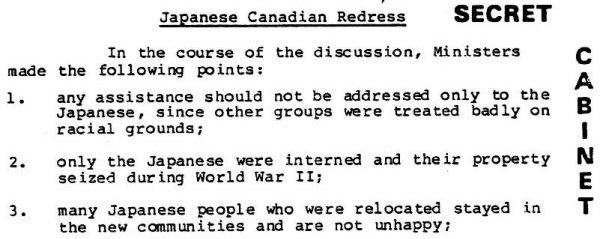
Trudeau Sr. cabinet opposed payments to interned Japanese-Canadians

Not much new here in terms of the substance of former PM Trudeau and his Cabinet’s position but nevertheless of interest:

The cabinet of then-Prime Minister Pierre Trudeau opposed compensation for interned Japanese-Canadians because they didn’t seem unhappy, say secret documents.

The declassified documents, obtained by Blacklock’s Reporter, said the cabinet was concerned about the precedent it would set to give cash to people whose property was seized.

“Any assistance should not be addressed only to the Japanese since other groups were treated badly on racial grounds,” cabinet agreed at a confidential April 18, 1984 meeting.

The National Association of Japanese Canadians had sought for years settlement of claims over the seizure and forced sale of property in 1942.

About 22,000 Japanese, including Canadian citizens, were removed from the BC coast after the Pearl Harbour attack and taken to the interior, Alberta, Manitoba and northern Ontario.

The wartime cabinet invoked the War Measures Act and seizing more than $152.4 million worth of fishing boats, real estate and automobiles owned by Japanese-Canadians.

Then-Multiculturalism Minister David Collenette in a censored 1984 report to cabinet proposed a settlement of claims.

“Many Japanese people who were relocated stayed in the new communities and were not unhappy,” said Cabinet Minutes.

“A nation cannot go back and wipe out the past, it should look forward. A more general approach should be taken, if anything is to be done.”

“All minorities will feel they should have a right to redress. Any resolution in the House of Commons should not be related to a single group.”

Cabinet said instead of compensating Japanese-Canadians, “other ways should be looked at, for example endowing chairs at universities,” said Minutes.

“In concluding, Ministers expressed the wish that the Minister (of Multiculturalism) look at the issue again and have it discussed in the cabinet committee on social development.”

Trudeau, Sr. at the time also publicly opposed any apology or compensation for the wartime internment.

“I’m not inclined to envisage questions of compensation about acts which have maybe discoloured our history in the past,” Trudeau told the Commons.

“I’m not sure where we would stop in compensating.”

The Liberal cabinet lost re-election five months later without settling the issue.

When Prime Minister Brian Mulroney was elected, in 1he 988 formally apologized for the wartime internment and approved $21,000 in compensation to some 6,000 surviving internees.

“All Canadians know apologies are inadequate,” Mulroney said at the time.

Japanese were interned under a 1942 order that demanded “all property situated in any protected area of British Columbia belonging to any person of the Japanese race be delivered up” for sale by federal agents.

Japanese-Canadians did not regain the right to vote until 1949.

Source: Trudeau Sr. cabinet opposed payments to interned Japanese-Canadians

Cabinet, Parliamentary Secretary and CPC critic comparison

Now that the parliamentary secretaries have been announced, I prepared this chart that compares representation of women, visible minorities and Indigenous peoples in cabinet, parliamentary secretary appointments and Conservative critic roles. Given the relatively small size of the Bloc and NDP caucuses, have not bothered to do the same as virtually every member of those two parties plays a critic role.

The Liberal commitment to a gender-balanced cabinet means that women are comparatively over-represented compared to their share of caucus. Conversely, and likely to balance caucus representation, women parliamentary secretaries are comparatively under-represented. The Conservatives, on the other hand, have compensated for their relative lack of women MPs by ensure that one-quarter have the higher profile critic roles.

For visible minorities, with the reference population adjusted to visible minorities who are citizens, the Liberals not only elected more visible minority MPs but have ensured that cabinet and parliamentary secretary representation is comparable to their caucus representation. The Conservatives have also chosen to highlight their visible minority MPs in their critic appointments.

For Indigenous peoples, the Liberals have slight under-representation in cabinet and parliamentary secretary appointments compared to the population and caucus.

In wake of blackface scandal, actual Black Canadians left in out-of-cabinet cold

Along the lines of the previous post, just phrased more sharply but more rhetorical and easier than reviewing the record and making specific criticisms or proposals:

Justin Trudeau doesn’t care about Black people.

In a post-blackface Canada, with a post-blackface prime minister, Black representation in the House of Commons, the Senate, and the judiciary—much less cabinet—remains abysmal, with only a smattering of chocolate in a sea of mayonnaise. After all of the ostensibly remorse-filled, Lena Dunham-esque apologies, peppered with activist language such as “intersectionality” and “privilege,” one would think Justin Trudeau would’ve learned something. He did not. It was all a ruse to get Black votes, only to shut them out of the important decision-making positions.

He continues to perform in blackface.

The 2015 election seated the most ethnically diverse House of Commons in Canada’s history: five Black MPs were elected, all Liberals, three of whom were newly elected. This election held the total steady, but with four Liberals and one New Democrat. Given that the Liberals usually elect the most Black candidates, and they were the ones caught in blackface, it is more incumbent upon them to practice what they preach. And preach they do. Like Kanye at Joel Osteen’s bible study.

After Time Magazine revealed who our prime minister was, the need to put this behind them was paramount. So what does one do when faced with the revelation of such racially heinous act? You call your Black friend. Enter Greg Fergus.

In the last Parliament, MP Fergus twice held the position of parliamentary secretary, first to the to the innovation minister and then to the Treasury Board president. In the wake of the blackface scandal, Fergus was called upon to do his duty and he did so with alacrity; his was the most prominent Black face imploring Canadians to forgive and move on. He even had the support of prominent cabinet minister Catherine McKenna, who stood by his side, nodding, at a press conference. It was a grotesque display of whiteness, to have a Black man tell other Black people how they should feel about the PM committing such a racist act, flanked by a white woman.

In that moment Greg Fergus made himself an agent of colonialism and allowed himself to be used as window-dressing, or the Black face of a scandal involving blackface.

And what did he get for it? Why wasn’t Fergus awarded a cabinet position like his white counterparts for his unwavering loyalty, especially as someone who has been in the Liberal trenches since he was a tyke (he was president of the Young Liberals of Canada from 1994 to1996)? Tap dancing for whiteness never brings prosperity, especially in the ignominious position Fergus put himself in.

But here is where Black people must take some responsibility.

After Trudeau was caught with his face singed, a private meeting was held between the PM and a myriad of “Black leaders” (whoever they are) to enact Part 2 of the apology tour. While it is not known all of what happened at this meeting, what we do know is that apologies were given, Trudeau was forgiven (by them), and Black people in the 905 and 416 subsequently came out to vote Liberal. Like Greg Fergus, these “leaders” allowed themselves to be used. And that is the problem with Black leadership in this day and age: they are too happy with the crumbs from Massa’s table and are too quick to give up the currency of political power—the vote. And what did these old wise men (and I do mean men) negotiate for the Black community in exchange for their continued votes? Not a damn thing.

And this is where Black people are: no currency, no power, no payoff. We sold out our negotiating power—along with our souls—by keeping that meeting private. The lack of transparency gave Trudeau an out. Since he didn’t have to be accountable to anyone, they got played, meaning the entire community got played.

However, all is not lost. Many of the strides made by the Liberal government came about due to an extraordinary amount of advocacy work done by Black organizations, and not because Trudeau cares about the plight of Black people. Within a minority Parliament situation, Black Canadians have more power and it’s time to toss out these old dudes who can’t figure out the cloud and add younger, more diverse leadership in the Black community—including women, LGBTQ, disabled, poor, and working-class people. We can lift others up instead of the few in Black “leadership” who only act as gatekeepers to power, while rewarding themselves.

Black organizations need to start seeing other people. Every party should be lobbied by Black advocates (except the PPC, because screw them) because loyalty to the Liberal Party has just gotten Black people to the back of the bus.

There needs to be a targeted lobbying plan to address the ministries who have a hand in policies that primarily affect Black people. These ministries need to be diversified and adjusted to benefit Black needs, Black aspirations, and Black dreams. And once these dusty Black leaders finally find the exit, the community may get somewhere because not all skinfolk is kinfolk.

Source: In wake of blackface scandal, actual Black Canadians left in out-of-cabinet cold