Not convinced that having separate envoys for antisemitism and islamophobia improves understanding and integration. Former envoy Deborah Lyons was candid about her experience and frustrations:
Jewish advocacy group B’nai Brith is calling on Ottawa to launch a commission on antisemitism and appoint someone to the envoy role that has been left vacant since July.
The group is holding a midday press conference on Parliament Hill today, a day before the annual remembrance ceremony at the National Holocaust Monument.
It’s asking Ottawa to fill the role of special envoy for combating antisemitism that has been vacant since Deborah Lyons resigned in July, three months before her term was set to expire….
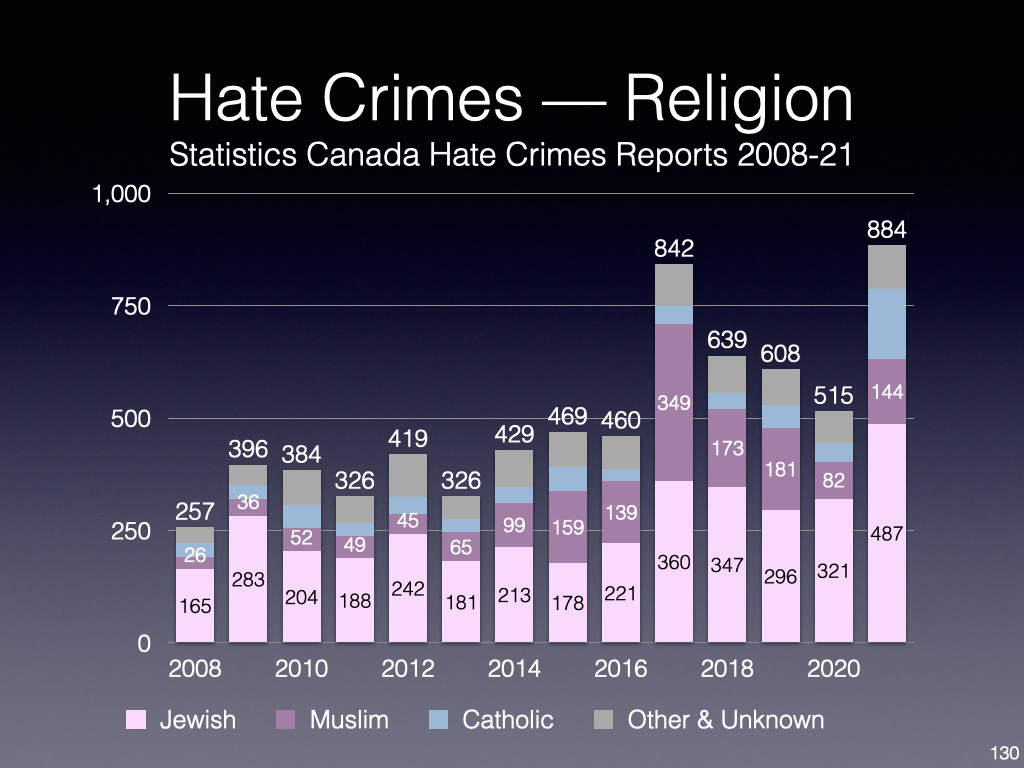
Latest numbers by StatsCan, showing particularly high increase in 2021 of religiously motivated hate crimes, with biggest relative increase for Catholics, likely due to the discovery of unmarked graves. In terms of ethnicity motivated, the rise of anti East and SE Asian hate crimes during pandemic stands out:
The number of police-reported hate-motivated crimes in Canada increased by 27%, up from 2,646 incidents in 2020 to 3,360 in 2021. This follows a 36% increase in 2020. In total, the number of police-reported hate crimes rose 72% from 2019 to 2021. Higher numbers of hate-motivated crimes targeting religion (+67%; 884 incidents), sexual orientation (+64%; 423 incidents) and race or ethnicity (+6%; 1,723 incidents) accounted for the majority of the increase. All provinces and territories reported increases in the number of hate crimes in 2021, except for Yukon, where it remained the same.
Police data on hate crimes reflect only those incidents that come to the attention of police and that are subsequently classified as hate crimes. As a result, fluctuations in the number of reported incidents may be attributable to a true change in the volume of hate crimes, but they might also reflect changes in reporting by the public because of increased community outreach by police or heightened sensitivity after high-profile events. Reporting may also be influenced by language barriers, issues of trust or confidence in the police, or fear of further victimization or stigma.
The head of the Canadian Race Relations Foundation is calling for action to combat hate and more federal help for victims, as new statistics show that hate crimes in Canada rose by 27 per cent last year.
Executive director Mohammed Hashim warned that unless action is taken to combat hate-motivated abuse, including online, it will continue to spread.
He said the “slew of hate” online is so prevalent it risks becoming normalized and those affected are changing their behaviour to deal with it, including by not reading social media comments.
“It is a firehose of hate that is growing, honestly, like a wildfire,” he said. “And unmitigated it will grow even further to a point where we will normalize being in a wildfire.
“That is because we have left this environment unchecked.”
Statistics Canada reported a dramatic increase in hate crimes in 2021. Last year, the number of hate-motivated crimes reported to the police rose to 3,360 incidents from 2,646 in 2020. This followed a 36 per cent rise in 2020.
In total, the number of hate-motivated crimes recorded by the police has gone up 72 per cent since 2019, according to the agency.
Four Muslim Canadians from the same family were killed in June last year when a man rammed a truck into them in London, Ont. Police have said the attack was motivated by Islamophobia.
Public Safety Minister Marco Mendicino said the figures are “further evidence of the alarming and unacceptable rise of hate that marginalized communities have experienced in recent years.”
Mendicino said the federal government is taking action on a variety of fronts, led by new legislation to tackle the rise of hate speech and hate crimes.
“We will not rest until all Canadians feel safe in their communities,” he added.
A report by the race relations foundation, published Tuesday, calls for greater federal help for victims of hate, many of whom do not qualify for financial compensation because their abuse does not count as a crime.
Hashim warned that “not supporting victims and leaving hate to proliferate freely disintegrates Canadian multiculturalism as a whole and a sense of collective belonging to this nation.”
Hate-motivated crimes targeting a person’s religious affiliation were up 67 per cent last year, according to Statistics Canada. Crimes based on a victim’s sexual orientation were up 64 per cent year over year. Another 1,723 recorded incidents targeted a person’s race or ethnicity, a six per cent increase, and together these categories made up the majority of the overall rise.
Marvin Rotrand of B’nai Brith Canada said Jews were the No. 1 target of hate crimes aimed at religious minorities.
“All Canadians should be worried about the alarming explosion of hate crimes witnessed in 2021,” Rotrand said. “Our community comprises 1.25 per cent of the Canadian population but were the victims of 56 per cent of hate crimes aimed at religious minorities. That is more than all other religious groups combined.”
Shimon Koffler Fogel, president and CEO of the Centre for Israel and Jewish Affairs, said incidents targeting the Jewish community have risen by 47 per cent since 2020.
“Statistically, Canadian Jews were more than 10 times more likely than any other Canadian religious minority to report being the target of a hate crime,” he said.
All provinces and territories reported increases in the number of hate crimes in 2021, except for Yukon, where the numbers remained the same.
Hashim, who regularly tours the country speaking to victims of hate as well as community groups and police forces, said more focus must be put on victims. He said young women are facing huge amounts of abuse online, particularly young Black women.
“Right now we talk a lot about hate crime statistics, how police are dealing with it or not dealing with it, being reported or not being reported,” he said. “What we are constantly missing is what is the effect on victims.”
The Department of Canadian Heritage is working on drafting an online hate bill to set up a framework to combat abuse online.
A previous anti-hate bill, introduced at the tail end of the last Parliament, died when the election was called.
Heritage Minister Pablo Rodriguez appointed an expert panel to make suggestions for a future bill, including faster takedown obligations on platforms, in particular over child pornography.
During a consultation by the federal government last year, some minority groups raised concerns about directly involving the police to combat hate speech online.
Hashim warned against “digital carding” and a mass trawl of content online. He acknowledged there is concern about whether police should be able to access all takedown materials for investigative purposes.
“I don’t think that is the proper way of doing online safety. There need to be checks and balances between how much information is accessible to the police. That is why we have warrants,” he said.
“Just creating open access for all police, for all takedown data, for all social media platforms is overkill in my opinion.”
The report commissioned by the Canadian Race Relations Foundation, and written by PricewaterhouseCoopers, said 80 per cent of hate crimes go unreported each year.
The report recommends Canada mirror Germany’s model for supporting victims of hate with millions of dollars of funding for community groups, which people who encounter hate “instinctively” reach out to, as well as a further victims fund.
It says the government’s current compensation schemes exclude many victims of hate because few hate-motivated acts are designated as criminal.
The report also suggests the government establish an emergency response fund for communities hit by hate attacks on a large scale, as well as a central national support hub for victims.
Agree with B’nai Brith that enforcement is the bigger issue, along with the discomfort or reluctance of some to report incidents to the police:
Ottawa says existing Criminal Code offences are adequate to confront a recent surge in hate-fuelled incidents, but the federal government has recommitted to passing a law aimed at improving hate crime prosecutions.
After recent online summits on antisemitism and Islamophobia, the Department of Justice said this week that it wants to ensure hatred is better defined but otherwise has no plans to overhaul the way hate crimes are dealt with in the courts. Suspects are most often charged for a core crime and then prosecutors may argue hate motivation at the end of a trial to secure a heavier sentence.
The National Council of Canadian Muslims (NCCM) released a list of 35 federal recommendations including a call for Ottawa to introduce new provisions in the code to single out hate-motivated assault, murder, threats, and mischief that would include specific new penalties for each infraction. The existing code only singles out three hate propaganda offences and mischief relating to religious or cultural sites.
Nadia Hasan, chief operating officer of the NCCM, said doing this would create a much stronger deterrent for potential criminals as hate crimes have risen in recent years.
“I’m not saying by any means that this alone would eradicate hate crimes for Canada, but it would send a strong message” that hate crimes deserve their own penalties, said Dr. Hasan. Her group also wants the code changed to offer restorative justice measures.
Dr. Hassan said creating a new class of hate crimes would also help victims get better service from front line investigators, some of whom are unfamiliar with Canada’s laws around hate-motivated attacks. The NCCM helped more than 70 hate crimes victims across the country seek justice last year and some of those victims have told her group that police in some jurisdictions routinely discouraged them from filing a hate-related complaint by telling them “it’s not worth it.”
“It happens often enough where we have to fight back and make sure the police are listening and really advocate for the victim,” said Dr. Hasan.
But Ian McLeod, a spokesman for the Department of Justice, said in an e-mailed statement that Canadians are well served by a justice system that prosecutes the existing hate crime offences and then, with other hate-related crimes, has penalties amplified when motivation is factored in at sentencing. However, he said Ottawa is committed to updating the Criminal Code throughBill C-36 to define hate speech as “content that expresses detestation or vilification of a person or group,” including over the Internet, where these comments are common.
Bill C-36, which targeted public hate speech by individuals, did not pass into law after being introduced by the Liberal government at the end of the parliamentary session. If an election is called this summer, as is widely expected, the legislation will no longer move forward.
Mr. McLeod’s statement said Ottawa is also tackling online hate through a proposal to create a new regime to police hateful content on social media sites.
In June, MPs unanimously voted to call the emergency Islamophobia conference following the murder of three generations of a London, Ont., Muslim family by a driver now facing terrorism charges, with the government also announcing the summit on antisemitism.
Statistics Canada also recently released its annual report on crime data showing 2020 brought a 10 per cent overall decrease in cases reported by police across the country, but departments reported a record 2,669 hate crimes cases – a 37 per cent spike from the year prior. Police and criminologists acknowledge hate crimes in general go vastly unreported.
Michael Mostyn, chief executive officer of B’nai Brith Canada, said his organization would rather see the current laws enforced “more diligently” before any new amendments are legislated.
“One of the serious frustrations from a group like B’nai Brith, which is dealing with the victims of hate crimes on a daily basis, is that we don’t see so many of these prosecutions across the country,” he said.
Mohammed Hashim, executive director of the Canadian Race Relations Foundation, a Crown corporation, said many different solutions are needed as Canada’s entire criminal justice system is ill-suited to address the scourge of hate crimes.
“It starts from underreporting; to not having confidence in the police dealing with hate crimes adequately; to the number of charges that are laid, or the lack thereof; and the level of seriousness that both attorney generals and prosecutors treat hate-motivated crimes,” he said.
Certainly hate speech, and interesting point about the impact of the Harper government’s repeal of provisions allowing citizens to launch civil actions against online hate speech:
A militant imam in Victoria who openly calls Jews, Christians, atheists and free-speech advocates “filthy” and “evil” is causing distress among Canadian Muslims, and there are calls for him to be prosecuted for hate speech.
“Younus Kathrada is not taken seriously in our community. Somebody making those claims is not part of Islam. But I guess there is a fringe element that follows him,” says Haroon Khan, a trustee at Vancouver’s Al-Jamia mosque, which belongs to the B.C. Muslim Association and often holds interfaith events.
Kathrada — who leads an organization called Muslim Youth of Victoria that has more than 15,000 Facebook followers — recently referred to the French teacher who was beheaded near Paris for showing cartoons of Muhammad as “a cursed, evil-spirited filthy excuse for a human being.”The hard-line imam has also appealed to his followers in Victoria and beyond to “destroy the enemies of Islam, and annihilate the heretics and the atheists.” He has told members to not vote for “filthy” and “evil” political candidates who support homosexuality or “Zionism.”
Kathrada first made international headlines last year when he called Christmas a “false festival” and said it is worse for a Muslim to wish someone “Merry Christmas” than it is to engage in adultery or murder.And he is continuing with his online denunciations.
A Canadian human rights organization that has been tracking Kathrada’s online sermons for years has been pressing for him to be prosecuted for hate speech.
“There must be consequences for years of relentless hate and incitement against Jews and others,” said Michael Mostyn, chief executive of B’nai Brith Canada, a Jewish service and advocacy group.
This fall, Mostyn said, Kathrada delivered an online sermon that referred to Jews as “brothers of monkeys and khanzeer(pigs in Arabic).” He asked God to “tear them apart.”
B’nai Brith, which has warned the RCMP’s hate crimes unit about Kathrada’s video sermons, says Canada’s law-enforcement system has shown in the past few years that it is capable of prosecuting people who advocate hate.
In November, B.C. resident Arthur Topham was sentenced to a 30-day conditional sentence plus three years probation after failing to comply with the terms of his previous conviction in 2015, when a jury concluded he had wilfully promoted hatred against Jews, Mostyn said. Topham had described Jewish places of worship as “synagogues of Satan” and advocated forcibly sterilizing Jews.
The Victoria police department could not be reached for comment about whether Kathrada has been under investigation.
Vancouver human rights lawyer Aleem Harmal, however, said it’s become difficult to take legal action in Canada for hate speech made on the internet.The Conservative government of Stephen Harper repealed the part of the Human Rights Code that had allowed citizens to launch civil actions against online hate speech, said Harmal. As a result, hate speech on the Web is now treated as a criminal offence, which is much harder to prosecute.
A hate crime is generally defined as speech, writing or behaviour that uses pejorative or discriminatory language about a person or group on the basis of such things as their religion, ethnicity or nationality, Harmal said, adding he didn’t have the expertise to judge whether Kathrada’s actions amount to hate crimes.
Three leaders of the B.C. Muslim Association, which represents most Sunni Muslims, either did not return messages or declined to comment.
However, Khan, noting Kathrada’s group does not belong to the B.C. Muslim Association, said it makes some sense for people to push for the Victoria imam to be charged with a hate crime.
“He seems to be running amok. If he is defaming Christians and Jews, we strongly condemn that kind of language. We’re all brothers and sisters,” said Khan, who is in the pharmacy business when not overseeing the Al Jamia mosque.
Khan will be the MC of a Jan. 29, 2021, Zoom forum against Islamophobia, which will include Liberal Defence Minister Harjit Sajjan, federal Diversity Minister Bardish Chagger, Vancouver councillor Christine Boyle, and RCMP hate crimes officer Anthony Statham.
Maintaining that Kathrada is “sidelined” among B.C.’s roughly 70,000 Sunni and Shia Muslims, Khan said he and other mainstream adherents will look further into what the sharp-tongued imam has been doing. “We’re very open-hearted and open-minded. He’s more of a fringe group.”
Kathrada’s Facebook page, which can be viewed by the public, has long featured running commentary in which he denounces perceived enemies of his intractable form of Islam, while his online followers, apparently using their real names, support and encourage him.
In recent weeks, France has been a key target of Kathrada’s attacks. He has joined calls by some Muslim leaders in the Middle East for a boycott of all French products in protest of President Emmanuel Macron’s defence of beheaded teacher Samuel Paty.
Paty was targeted close to his school near Paris for showing cartoons of the Prophet Muhammad in class. His killer, 18-year-old Abdullakh Anzorov, was shot dead by police. Macron said Paty was killed by an “Islamic terrorist” for standing up for free speech.
Top Muslim leaders in Egypt, Malaysia, Morocco and Pakistan have said freedom of expression does not apply to insulting Islam or Muslims — and they argued Macron, who has launched a major crackdown on Islamic fundamentalism in his country, is promoting Islamophobia.
Widely covered and unclear exactly how his comments made it through the vetting process given that they were likely to be uncovered by B’nai Brith and others. And intriguing if Liberals were working on defensive media lines (which could be developed):
Ousted Liberal candidate Hassan Guillet admits to posting online about a Hamas-aligned activist, but says the party was well aware of his comments and were even working on a public relations plan before they withdrew his nomination.
Last week, the Liberal Party dumped Guillet as a candidate in Quebec after a Jewish human rights group accused him of making a number of anti-Semitic and anti-Israel statements.
In a statement posted to its website Friday, B’nai Brith Canada alleges Guillett congratulated a Hamas-aligned activist, Raed Salah, upon his release from a “prison of occupied Palestine” and prayed that he would one day succeed in liberating “all of Palestine.” The group said he described Salah as “frontier-fighter.”
The group also said it found a since-deleted Facebook post from 2016 in which Guillet allegedly wrote “the Zionists control American politics.”
The group said it reached out to the Liberal Party more than a week ago to make it aware of their allegations against him. The Conservative Party also called for his withdrawal.
Later that day, the Liberal Party said Guillet’s “insensitive comments” don’t align with the party’s values and revoked his candidacy in the riding of Saint-Léonard—Saint-Michel.
Guillet held a press conference in the riding on Wednesday, sitting shoulder-to-shoulder with supporters. He said the party was aware of the contents of his Facebook page since at least Aug. 8 and already had discussed an action plan that involved reaching out to the Jewish community.
Guillet, a member of the Council of Quebec Imams who gained national attention after delivering a speech in Quebec City honouring victims of the Quebec mosque shooting, said he did congratulate Salah after he was released from prison because he had protested the closure of a Jerusalem mosque, but insisted he wasn’t aware of his background.
Liberals say decision is final
“The party either knew or should have known what it contained. Why, then, if these words were so problematic, why was my candidacy … accepted?” he said. “One is entitled to ask the question, was it incompetence or bad faith?
“I am not anti-Semitic. On the contrary, I campaigned and I will always campaign against all forms of racism, including Islamophobia and anti-Semitism.”
Guillet said a member of the Liberal Party approached him Friday and said he could resign for personal reasons — or the party would withdraw its support.
The Liberal Party isn’t changing its mind.
“Following an internal review, the Liberal Party of Canada took the appropriate steps to remove Mr. Guillet as the Liberal candidate for the riding of Saint-Léonard—Saint-Michel. That decision is final,” said party spokesperson Parker Lund in an email Wednesday.
Neither is B’nai Brith Canada.
“Today’s press conference only confirms our position that Hassan Guillet is not fit to carry the Liberal Party banner,” said Michael Mostyn, the group’s chief executive officer.
“We are satisfied with our role in exposing his anti-Semitic statements, and disappointed that he spurned an opportunity to retract them.”
Police in Peel Region have confirmed they are investigating a local Polish-language news outlet following a complaint from B’nai Brith Canada about anti-Semitic content.
The force’s Equity and Inclusion Bureau is “also aware” of the complaint, said spokesperson Const. Heather Cannon.
B’nai Brith laid the complaint after discovering “frequent anti-Semitic and hateful material” in Goniec, a news outlet based in Mississauga, Ont., that publishes a weekly newspaper with a circulation of about 1,000, and maintains a website and YouTube channel.
According to B’nai Brith, the paper has accused “Jews and Zionists” of having “terrorism in their blood,” and has urged readers to “stand up to the Jews,” in response to their attempts to “destroy” Poland.
In a series of “incendiary” articles, the outlet “warns repeatedly of Jewish control over the Polish government through ‘puppet politicians’ in the United States who favour ‘rewriting history’ in the interest of the Israeli government,” B’nai Brith said in an Aug. 15 statement.
Authors on the website have also stated that Jews are “playing their old game” of trying to interfere in various governments, while calling the actions of Jewish organizations “racist” and “satanic,” the Jewish advocacy group alleged.
“We are appalled by the blatant Jew-hatred peddled by this publication,” said Michael Mostyn, B’nai Brith’s CEO. “While there is room for disagreement over policies in modern Polish-Jewish relations, the anti-Semitic content that we are seeing is truly beyond the pale.”
Among other examples B’nai Brith cited was a photograph of Hasidic Jews juxtaposed with the U.S. Capitol building, followed by allegations that Congress is controlled by Jewish forces, as well as a headline saying, You Use WhatsApp – Jews Are Spying on You.
Goniec has also described a film documenting the 1941 anti-Jewish massacre in the Polish town of Jedwabne as “false propaganda of the ‘Holocaust enterprise’ in a plot to initiate reparations for Jewish property that was lost or stolen during the Second World War,” B’nai Brith charged.
Andrzej Kumor, the paper’s editor-in-chief and sole employee, called B’nai Brith’s accusations “unfounded” and said he will co-operate with police.
“I have nothing to hide,” Kumor told The CJN via email. “I was never hateful towards Jews or any other community. I see politics as a power play of different interests. I love the debate and I think that the debate is a cornerstone of (a) free, democratic society.”
He defended the material cited by B’nai Brith.
The headline about Jews spying, for example, “is about the security hole found in WhatsApp, which was exploited by (an) Israeli group with connections to … state security services,” Kumor explained, asking, “Is the headline, ‘The Russians are spying on us’ anti-Russian?”
He said the commentary titled Zionists Have Terrorism in Their Blood (not “Jews,” he noted) is about paramilitary groups in pre-state Israel – the Irgun, Haganah and the so-called Stern Gang – and “the smart political use of terrorism by Jews fighting for their country after the Second World War.”
As for the July 1941 pogrom in Jedwabne, “this crime should be investigated to the very end … to find out how many people died, and other circumstances,” Kumor said.
Several sources agree that at least 340 Jews were murdered in the pogrom, 300 of whom were locked in a barn that was set on fire.
Peter Jassem, past chair of the Polish-Jewish Heritage Foundation of Canada’s Toronto chapter, said it was brought to his attention “on numerous occasions” that Kumor was publishing “anti-Semitic content for years, sometimes explicitly, sometimes as innuendo regularly present in numerous articles written by him and his contributors.”
As for B’nai Brith’s translations, “everything seems to be accurate,” said Jassem. However, the title of one video cited by B’nai Brith “does not mean that Zionists have terrorism in their blood, but rather that they are guilty of terrorism,” Jassem explained. “But when you listen to the video, (Kumor) does say this: ‘Jews or Zionists have terrorism in their blood.’ ” Later in the same video, Kumor says, “It is said that Jews simply invented modern terrorism,” according to Jassem.
He added that both in this article and in an interview Kumor gave to an online Polish television station that Jassem views as anti-Semitic,” Kumor “seems to showhimself as a martyr and a freedom fighter whose mission is to uncover the truth and to defend freedom of speech. He blames Jewish conspiracy for this action against him.”
Of note, both the initial offence and the Muslim community response:
A community centre in Edmonton has banned a local imam from holding services there because he allegedly used anti-Semitic tropes in his services and online.
The Killarney Community League Hall banned Sheikh Shaban Sherif Mady from using their space to hold services after B’nai Brith alerted the community centre to Imam Mady’s rhetoric, including claims that international Zionism is behind all global terrorism, including ISIS and the New Zealand shooter, and that the Muslims will kill the Jews on Judgment Day.
Aidan Fishman of B’nai Brith said the police are “dutifully investigating” the matter. He also said B’nai Brith has been in contact with the Alberta Muslim Public Affairs Council (AMPAC).
“They’re aware of this and they, like I’m sure the vast majority of Muslims in Alberta and in Edmonton, have communicated to us that they totally disagree with what this guy said and they condemn it as well,” he said.
Faisal Suri of AMPAC confirmed that AMPAC condemned Shekih Mady’s speeches and online posts. He said AMPAC recognizes both anti-Semitism and Islamaphobia, as they affect two of the biggest communities most harmed by hatred and discrimination.
“We definitely condemn the words of this one individual. One individual’s actions and words do not reflect upon the Muslim community,” Suri said.
He also added that AMPAC is investigating Sheikh Mady, and whether other individuals hold similar views. He said the counci is working to prevent the imam from having any public platforms to advance his views.
Good serious comparison of the various datasets available. The observations regarding the limitations of ADL statistics also apply to B’nai Brith as to those on FBI data also apply to StatsCan complication of police reported hate crimes.
With respect to the National Crime Victimization Survey, the closest Canadian equivalent is the currently underway General Social Survey – Canadians’ Safety (GSS) which includes self-reported victimization, to be released winter 2020-21:
On Sunday, a Jewish man standing outside a synagogue was shot in the leg in what police are investigating as a possible hate crime. It was only the latest in a string of anti-Semitic attacks this year.
These attacks have brought in their wake headlines declaring “a spike in hate crimes” and “increased anti-Semitic attacks all across this country,” based on episodes like Sunday’s as well as data. Earlier this year, the FBI reported the largest increase in hate crimes since 2001, and the Anti-Defamation League reported that anti-semitic incidents rose by 57% in 2017.
As a result, a consensus has developed around the idea that hate crime and anti-Semitism are rising, and that Jews are no longer safe in the U.S. Leaders across the political divide agree.
But I’ve found myself skeptical of these claims of rising hate. Partly, this is because of a rather personal reason: Since moving to the US over a decade ago, I have never personally experienced hate or a hate crime.
But I was skeptical for a professional reason too. As a mathematician by training, I spent my PhD years working with messy crime data. And the truth is, it cannot be trusted at face value.
I couldn’t help but wonder if the data on hate crimes, especially those pertaining to the Jewish community, might have similar problems.
And it does. Big time.
To dig deeper, I looked at all the available data on hate crimes, which included incidents of hate by year, surveys, and reports. I sought out datasets, what are in their ideal form collected methodically year after year by faceless government statisticians. I also downloaded spreadsheets and mined the numbers myself.
What I found will probably surprise you: We have a real anti-Semitism problem in this country. But it’s not getting worse.
But you can’t compare hate crimes to road accidents; with a hate crime, like with terrorism, the victim is targeted because of their group identity, and the entire group feels threatened. Hate crimes select symbolic targets, such as community buildings, whose significance far exceeds their property value.
And research indicates that being in a targeted group is not just discomforting but can have a tangible effect how people behave. We know from Europe that attacks on Jews can trigger a wave of immigration to Israel, and it should not be assumed that the same cannot happen to American Jews.
Even more disturbingly, research on fertility data from 170 countries found that during waves of terrorism there is a decline in births.
All of this made me even more anxious to find out if there was actually a wave of anti-Semitism sweeping through America. So I sought out the two most frequently-cited sources of hate crime data: reports from the ADL and the FBI.
Let’s start with baselines. According to the FBI’s most recent data, 2017 saw 7,175 hate crimes nationwide, including 15 hate murders. Anti-Jewish hate crime incidents represented 13% of all incidents – 923 – coming in second only to Anti-Black hate crimes, which numbered 2,013 incidents.
There were also more anti-Semitic incidents than “anti-gay” crimes, for example. Most importantly for our purposes, because Jews make up just 1-2%of the US population, these numbers mean that the Jewish community is targeted by hate crimes disproportionately to its numbers by a factor of ten.
The ADL has been tabulating data on anti-Semitic hate crime for an impressive 40 years, and it receives data both from the police and the public. The ADL has built out a modern data center and has interactive online visualizations.
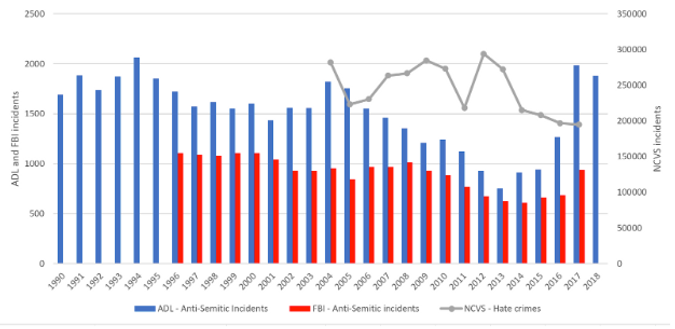
In its most recent audit, the ADL reported that 2018 had the third-highest number of incidents of the past four decades, with 1,879 incidents. The 2018 total is 48% higher than the number of incidents in 2016, and 99% higher than in 2015. Both 2017 and 2018 had far more incidents than typical for the previous eight years. This is, indeed, alarming.
However, these numbers should be taken with a mild dose of the proverbial salt. The problem with hate data is that only 20% of hate crimes are reported to the police, and, one suspects, even fewer to the ADL. So the statistics give just the tip of an iceberg; the majority of hate times are not included in this count.
This makes them somewhat unreliable. To rely on 20% of the data to determine if there is a wave of anti-Semitic hate crimes would be like looking at the top shelf of your fridge, and finding it overflowing, deciding that you need to buy a larger fridge (I would suggest looking at the other four shelves first).
And you can’t just compare the 20% of reported crimes each year to the 20% from last for the simple fact that the reporting rate is not a constant 20% of all crimes. Reporting goes up and down along with public concern. An increase in concern about hate crimes can increase the number of reports by the public, and even the number of police investigations, making more of the “iceberg” (or fridge) visible and inflating the numbers.
To put it plainly, if many people started to believe, fairly or not, that we are in the midst of a wave of hate, they would also start to report more hate crimes, making the data inconsistent with the past.
This is not to say that the jump in anti-Semitic hate crimes reported by sources like the ADL is a statistical mirage. But the reality is probably different from what the numbers suggest.
Independently of the ADL, the FBI has been reporting hate crime data since the 1990s through its Hate Crime database. It has developed impressive guidelinesto judge if a crime incident is indeed a hate crime, and its reports are available online. Surely, here we can expect to finally find deep databases processed by standard and reliable statistical methods!
But alas, the FBI’s numbers also need to be taken with a little grain of kosher salt. The problem is that crimes are generally reported to the local police department and not to the FBI directly, so the FBI’s data is only as good as the reports it receives.
In some states, less than 10% of the police agencies bother to report to the FBI at all, and likely only report the more severe crimes. As a credit to the system, the FBI provides consistent data that goes back to the 1990s, and thus is well-suited to recording if there are any national trends.
But charting the FBI data from 1996 to 2017 suggests that we are far from having achieved new heights of anti-Semitism. Rather, anti-Semitic incidents peaked in 1999 at 1,109 per year, then declined from 2008 to 2014, and have been trending up since then, reaching 976 in 2017.
As with the ADL numbers, the data quality is not great, thanks to under-reporting. But even taking that into account, we appear to still be well below the numbers of the 1990s.
Alex GutfrainStatistics of Anti-Semitism
Fortunately, there is another government crime tracking program that has been all but forgotten by the press: the National Crime Victimization Survey. Unlike the ADL and the FBI, who collect reports, the NCVS goes out to the communities and interviews some 160,000 people every year, asking them if they were victims of various crimes.
Because the NCVS uses a representative sample, it can reliably estimate the number of crimes in the entire country, including hate crimes. If there is a wave of hate in America, the NCVS would detect it in its survey.
In its most recent report, NCVS estimated that 204,000 hate crimes occur in the US annually, of which just 15,000 are confirmed by the police.
There is no data specifically on anti-Semitism in NCVS, but if we assume per the FBI’s estimate that about 13% of hate crimes are anti-Semitic, then there are a staggering 26,000 anti-Semitic crimes every year in the US — 30 times more than reported by the FBI and 14 times more than the ADL.
What we can learn from these statistics is both good and bad. For all the problems of the last few years, there is no reason to fear a wave of hate, because the wave, if it exists, is a small one.
Today’s Jewish America has probably the safest existence of any Jewish community in history. In this generation, a Jew is much more likely to suffer a car accident than a hate crime.
But to believe naively in the American utopia is to ignore the truth: Hate is alive and well in America, and Jews are often the target of it.
The lated B’nai Brith report. Waiting for the 2018 police-reported hate crimes report (Statistics Canada re-released the 2017 report www150.statcan.gc.ca/…ticle/00008-eng.htm):
Online hatred is fuelling a rise in anti-Semitism that saw a record-breaking number of Jewish Canadians harassed and assaulted in 2018, according to a new report from B’nai Brith Canada.
Western Canada, in particular, saw anti-Semitic incidents skyrocket last year. The number of incidents in British Columbia more than doubled to 374 from 165 in 2017, just behind Saskatchewan and Manitoba, which together had a 142.6 per cent increase in anti-Semitic incidents in 2018 compared to 2017, to 131 from 54.
“We are experiencing a disturbing new normal when it comes to anti-Semitism in this country, with expressions of anti-Jewish hatred surfacing in regions that are typically less prone to such prejudices,” said Michael Mostyn, chief executive officer of B’nai Brith Canada.
British Columbia had the third highest total number of anti-Semitic incidents behind Quebec, with 709, and Ontario, at 481.
The countrywide total topped 2,000 incidents of hatred toward Jews in 2018 for the first time in more than 35 years, marking the fifth straight annual increase and the highest number of incidents the organization has recorded since it began tracking such data in 1982. The report suggests the federal government needs to address legislative gaps that allow hateful rhetoric to flourish and spread.
The report comes just two days after a gunman opened fire on Jewish worshippers at the Chabad of Poway synagogue in Southern California on Saturday — an attack that was prefigured by a threatening social media post, according to the FBI. The online screed said the alleged attacker was inspired by the Tree of Life massacre in Pittsburgh in October, a tragedy that was preceded by virulent anti-Jewish comments posted online by the suspected shooter.
During the Poway attack, one woman was killed and three others were wounded, among them a child and the synagogue’s rabbi.
“Anti-Semitism has real-world consequences,” Ran Ukashi, the national director of B’nai Brith Canada’s League for Human Rights, writes in the report’s introduction. Pointing to the murder of 11 Jewish worshippers at the Tree of Life synagogue, Ukashi suggests anti-Jewish harassment is not only deeply troubling; its sharp rise in Canada fuels the fear here of violence of the kind seen internationally in the past year.
According to the report, online harassment on social-media platforms including Facebook and Twitter — or through electronic communications such as email — accounted for 80 per cent of total incidents.
“Of particular concern is the rise of anti-Semitic harassment on social media, including death threats, threats of violence and malicious anti-Jewish comments and rhetoric,” Mostyn said, echoing Ukashi’s warning.
Steven Slimovitch, the national legal counsel for B’nai Brith Canada, said online hate has a much larger reach and can have a bigger impact than direct, one-on-one incidents.
“Now what’s happening is you can easily reach thousands, if not hundreds of thousands, of people via the internet,” he said. “You can do it quietly, you can do it in your basement and that’s a very, very serious problem.”
The report defines harassment as “verbal or written actions that do not include the use of physical force against a person or property,” including: promotion of hate propaganda via social media, the internet, telephone or in print; verbal slurs, hate speech or harassment, or systematic discrimination in public spaces; and verbal threats of violence in cases where “the application of force does not appear imminent, or no weapon or bomb is involved.”
And while physical violence represents only 0.5 per cent of the incidents cited in B’nai Brith’s Monday report, Canada is no stranger to real-world intimidation, violence or threats of violence against Jews. (B’nai Brith only includes incidents in the report where a victim’s Jewish religion was the explicit reason for the attack).
On Monday, the York Region police hate-crime unit reported investigating an incidentinvolving the spray-painting of anti-Semitic graffiti on the front of the garage of a Vaughan home on Friday.
In November, four 17-year-old Jewish boys wearing religious garments were assaulted in north Toronto by another group of teenagers, who prefaced their attack by making derogatory comments about the boys’ religion. In February, two Saskatchewan schoolchildren were beaten by their classmates for being Jewish.
And a Montreal man was charged with inciting hatred toward Jewish people and threatening to cause death and bodily harm to Jews after allegedly writing online posts in October in which he threatened to kill “an entire school full of Jewish girls,” according to the Montreal Gazette.
Mostyn said there is no reason to believe there is an elevated threat of an attack in Canada, but the amount of online hatred targeting Jews is having an impact. This, he said, is why B’nai Brith is pushing for protections that go beyond adding more security officers outside synagogues and Jewish schools.
“We have to start at the start, and the start is incitement,” Mostyn said. “And too often nowadays this incitement is taking place on the internet and it is influencing others that unfortunately take violent and drastic actions, and that’s what really needs to stop.”
B’nai Brith’s recommendations include instituting a dedicated hate-crime police unit in every major city and providing enhanced training for hate-crime officers, and co-ordinating between the federal government and social media platforms to develop a plan to counter online hate.
Facebook recently began deleting pages belonging to white supremacist individuals and groups, but has faced significant backlash for not doing more to stop hatred advanced on its platform.
A reminder that it is not just Muslims that will be affected by Bill 62:
Interdire à certains fonctionnaires de porter la kippa ou d’exhiber une étoile de David représenterait une grave atteinte aux droits garantis par les chartes et serait contesté devant les tribunaux, préviennent d’importantes organisations juives.
B’nai Brith et le Centre consultatif des relations juives et israéliennes (CCJI) s’inquiètent du dépôt imminent par le gouvernement Legault du projet de loi sur la laïcité.
Selon La Presse et Radio-Canada, Québec va interdire le port de signes religieux aux fonctionnaires en position d’autorité, y compris les enseignants, les directions d’école et ceux qui portent une arme.
« Ce qu’on entend du projet de loi est contraire aux valeurs canadiennes et québécoises. La CAQ doit éviter la pente glissante qui consiste à réduire les droits fondamentaux », prévient Harvey Levine, directeur du bureau québécois de B’nai Brith.
Le débat public sur les signes religieux au travail s’est surtout centré sur le hidjab. Mais les organismes juifs canadiens rappellent que la kippa serait aussi visée, tout comme le turban sikh ou la croix chrétienne.
« Il s’agit selon nous d’une menace pour les libertés religieuses des juifs, des musulmans, des sikhs, et tous les autres groupes religieux visibles dans cette province », indique M. Levine.
La laïcité de l’État peut être atteinte sans que l’on s’attaque aux droits religieux, estime le Centre consultatif des relations juives et israéliennes (CIJA).
« Bien qu’il existe un fort sentiment en faveur de la réaffirmation de la laïcité au Québec, notre communauté estime que la laïcité de l’État est un devoir institutionnel et non personnel. L’attachement à la laïcité ne repose pas sur l’apparence des individus », indique Reuben Poupko, coprésident du CIJA-Québec.
Pour le chef de l’opposition à l’hôtel de ville de Montréal, qui porte la kippa, l’idée d’interdire les signes religieux à certains fonctionnaires est basée sur une mauvaise prémisse : celle selon laquelle un employé de l’État qui porte un signe religieux ne peut être neutre.
« Il est difficile pour moi de croire qu’en 2019, on remette en question les motivations des gens selon leur manière de s’habiller, a récemment écrit Lionel Perez dans Montreal Gazette. Retirer les signes religieux n’éradique en rien les préjugés. »
Jusque devant l’ONU
Le B’nai Brith et le CIJA craignent que le projet de loi sur la laïcité n’enfreigne des droits garantis par les chartes. La Charte canadienne des droits et libertés protège certaines libertés fondamentales, parmi lesquelles les libertés de religion et d’expression.
Le premier ministre François Legault se dit prêt à utiliser la disposition de dérogation (communément appelée clause nonobstant) pour soustraire sa future loi aux tribunaux. Pour lui, il s’agit de « protéger notre identité ».
Selon l’avocat montréalais Julius Grey, la disposition de dérogation ne peut toutefois protéger le Québec et le Canada contre un camouflet devant le Comité des droits de l’homme de l’Organisation des Nations unies (ONU).
« Si le gouvernement espère éviter le débat judiciaire en invoquant la clause nonobstant, il doit se rappeler qu’il existe un forum international où ce genre de chose peut être débattu », souligne Me Grey.
« Il est téméraire de préjuger de ce qui sera dans le projet de loi, dit-il. Mais il me semble que la confrontation judiciaire est plus ou moins inévitable. »
Ce comité de l’ONU a par exemple épinglé la France à au moins deux reprises sur la question des signes religieux. Dans un cas, l’ONU a donné raison à une employée d’une garderie congédiée car elle portait le voile islamique. Les décisions de ce comité ne sont toutefois pas contraignantes.
« Bien sûr, la décision du Comité des droits de l’homme des Nations unies n’est pas contraignante comme le jugement d’une cour québécoise ou de la Cour suprême », explique Julius Grey.
« Mais je vois mal comment le Québec, malgré un jugement de cette nature, justifierait de maintenir sa position. »


 Multicultural Meanderings