Immigrants’ Sense of Belonging to Canada: The Role of Source-Country Gender Inequality

Interesting findings:

“A growing body of literature uses country-level indicators to examine the impact of immigrants’ source-country conditions on the home and work lives of immigrants after arrival. One measure that has attracted increased attention is gender inequality in immigrants’ countries of origin. However, little is known about the degree to which the transition from high to low gender inequality countries affects the development of connections with the receiving country and whether immigrant women and men are impacted differently. This article examines the association between source-country gender inequality and immigrants’ sense of belonging to Canada. Our regression analysis of data from the 2013 and 2020 General Social Surveys suggests a higher level of source-country gender inequality is associated with a stronger sense of belonging to Canada for both immigrant men and women. Despite concerns from some conservative critics that gender inequality in source countries hinders immigrant integration, the results show that immigrants from cultures different from Canada develop a strong sense of belonging to Canada. Our findings suggest that cultural distance does not necessarily have a negative impact on immigrant men’s and women’s self-perceived integration into their host country.”

Source: Immigrants’ Sense of Belonging to Canada: The Role of Source-Country Gender Inequality

Yakabuski: Bill 21 has made immigrants in Quebec grow even more attached to Canada 

Good commentary on a significant study (Le sentiment d’appartenance des immigrants au Québec s’effrite par rapport au Canada):

When then-premier Pauline Marois unveiled her sovereigntist Parti Québécois government’s proposed Charter of Quebec Values in 2013, she got an earful from an unlikely critic.

Source: Bill 21 has made immigrants in Quebec grow even more attached to Canada

Le sentiment d’appartenance des immigrants au Québec s’effrite par rapport au Canada

Not surprising given Loi 21 and other initiatives:

Les débats sur la laïcité ont permis au Canada de marquer des points dans la guerre d’usure avec le Québec pour la loyauté des immigrants racisés. Le sentiment d’appartenir à la communauté québécoise n’a pas décliné entre 2012 et 2019, mais cet « élan » s’est néanmoins affaibli par rapport à la volonté d’être canadien, indique une nouvelle étude.

Ce déficit d’appartenance à la province s’est aussi étendu aux minorités non religieuses et à celles qui sont francophones durant cette période. Elles étaient pourtant moins susceptibles d’être touchées par les deux « événements focalisateurs » sous la loupe de cet article publié récemment dans la Revue canadienne de science politique que sont le projet de charte des valeurs et le projet de loi 21 sur la laïcité de l’État.

Les chercheurs ont mesuré l’évolution de l’appartenance à travers trois enquêtes qui coïncident dans le temps avec ces grands débats de société, soit en 2012, 2014 et 2019. « Au début de la période étudiée, on voit que, chez les immigrants non religieux ou francophones, il n’y a pas de préférence marquée entre le Québec ou le Canada. L’appartenance à l’un ou l’autre est aussi forte », explique Antoine Bilodeau, professeur de science politique à l’Université Concordia et coauteur de l’étude avec Luc Turgeon.

Ces perceptions évoluent, avec un creux en 2014, pour ensuite stagner envers le Québec. Mais pendant ce temps, le sentiment d’appartenance envers le Canada grandit, et cet effet est généralisé à tous les immigrants racisés, pas seulement ceux qui sont religieux ou qui ne sont pas francophones.

« Cela indique que les groupes minoritaires ont perçu ces débats comme une remise en question plus large de la relation avec la majorité. Ce qui est en trame de fond de tout ça, chez certains partisans [de la laïcité], mais beaucoup chez ses détracteurs, c’est que ces politiques reflètent le malaise du Québec avec la diversité grandissante », détaille-t-il.

Mais ce lien n’est pas causal avec une certitude absolue. Les chercheurs constatent plutôt que l’aiguille a bougé en faveur du fédéral sur le cadran de l’appartenance et attribuent cette modification à des facteurs déjà bien démontrés. Même si la transformation n’est pas totale, elle correspond dans le temps avec ces moments clés et elle est cohérente avec la littérature scientifique.

Un certain nombre d’études au Québec laissaient déjà entendre que les débats sur les symboles religieux avaient nourri un sentiment d’exclusion, mais elles ne permettaient pas de faire cette comparaison avant et après les propositions législatives.

Les deux auteurs, cette fois, ne peuvent « que conclure que les débats sur l’interdiction des symboles religieux à travers les propositions législatives qui ont pris place en 2014 et en 2019 ont contribué à détériorer la relation des immigrants racisés avec la communauté politique québécoise ou, plus précisément, ont contribué à creuser l’écart dans le sentiment d’appartenance à l’avantage du Canada », écrivent-ils dans l’étude.

Deux modèles

« Au fond, la perception est que le modèle fédéral est plus flexible dans sa définition de qui il reconnaît comme citoyen à part entière », résume le professeur, qui étudie ces aspects depuis nombre d’années. Et les débats sur la laïcité sont « venus consolider ou accentuer cette perception ».

Les deux coauteurs citent d’ailleurs l’ancien premier ministre Jacques Parizeau, qui s’inquiétait en 2013 que le projet de charte des valeurs du Parti québécois fasse la part belle au fédéralisme, qui allait pouvoir ainsi se présenter comme le véritable défenseur des minorités.

« Il [Jacques Parizeau] disait “vous allez perdre de vue la dynamique de compétition”. L’étude lui donne raison », explique M. Bilodeau.

Encore plus frappant aux yeux du coauteur de l’étude, la perte du sentiment d’appartenance vis-à-vis du gouvernement québécois « est causée par ses propres actions », plutôt que, par exemple, la passivité ou l’incapacité à rattraper le fédéral.

Autre fait intéressant, le sentiment d’appartenance des immigrants racisés a été mesuré par deux aspects : l’attachement et le sentiment d’être accepté. Le concept d’appartenance est ainsi mieux compris dans sa dimension relationnelle, une relation à deux sens.

« C’est un peu comme demander “est-ce que je veux faire partie du groupe ? [attachement] Puis, est-ce que j’ai la perception que le groupe veut que j’en fasse partie ? [sentiment d’acceptation]” », détaille M. Bilodeau.

On pourrait penser que c’est surtout le sentiment d’acceptation qui a été touché : « Intuitivement, on dirait, ce geste me montre qu’ils ne veulent pas de moi. » Mais il y a, selon le professeur, un effet boomerang sur le désir de faire partie de la communauté, sur le sentiment d’attachement. « Non seulement c’est que je sens, qu’ils ne veulent pas [que j’appartienne au groupe], mais ça me fait remettre en question ma propre volonté d’être Québécois par rapport à “je veux être Canadien”. »

Des expériences vécues

« J’aimerais beaucoup me tourner vers le sentiment d’appartenance envers le Québec, mais on nous fait sentir qu’on n’y appartient pas. Alors, il faut se tourner ailleurs », explique d’ailleurs en entrevue Jana, une jeune musulmane. Le Devoir a choisi de ne pas publier son nom de famille, car la Montréalaise est encore mineure.

Pour elle, ce sont assurément les débats sur la laïcité qui ont entamé son sentiment d’appartenance : « Avant, je m’identifiais comme Québécoise, mais, avec les nouvelles lois, j’ai senti que ça a créé deux classes différentes : ceux qui peuvent réaliser leurs rêves et les autres, qui ne le peuvent pas. »

« Moi, je voulais devenir avocate pour défendre l’équité sociale, mais j’ai l’impression que je ne peux pas choisir cette carrière sans sacrifier ma religion », dit la jeune femme, qui porte le hidjab.

La Loi sur la laïcité de l’État, connue d’abord comme projet de loi 21, interdit le port de signes religieux chez les agents qui incarnent l’autorité de l’État, y compris les juges et les procureurs de la Couronne.

Jana pourrait exercer à titre d’avocate en pratique privée, reconnaît-elle, mais elle a l’impression que certaines portes lui sont déjà fermées avant même qu’elle entame des études de droit.

Pour Garine Papazian-Zohrabian, professeure de psychopédagogie à l’Université de Montréal et psychologue clinicienne, cette étude va dans le même sens que ce que d’autres travaux ont démontré : « les approches coercitives freinent le sentiment d’appartenance », a-t-elle déjà écrit sur plusieurs tribunes.

« Je vois aujourd’hui les conséquences de la loi 21 [Loi sur la laïcité de l’État] dans le milieu enseignant », dit Mme Papazian-Zohrabian. Elle voit avec grande déception les embauches de personnel non légalement qualifié dans les écoles, « alors qu’on prive nos élèves de bonnes enseignantes » parce qu’elles portent le voile.

« On pousse les gens à se recroqueviller sur eux-mêmes et à trouver une place uniquement dans leur communauté. Symboliquement, on ne peut plus parler d’intégration », dit-elle.

Mme Papazian-Zohrabian a émigré du Liban et elle est d’origine arménienne, « petite-fille de rescapés d’un génocide », donc à même de comprendre l’importance de l’identité, remarque-t-elle.

Les politiques et le discours sur l’immigration ont créé « une dynamique de plus en plus polarisée », selon la spécialiste. Beaucoup d’immigrants ont pourtant « choisi le Québec ou le Canada parce que c’est une société progressiste et une société de droit. Quand ils se sentent attaqués ici, ça crée de la détresse chez eux ».
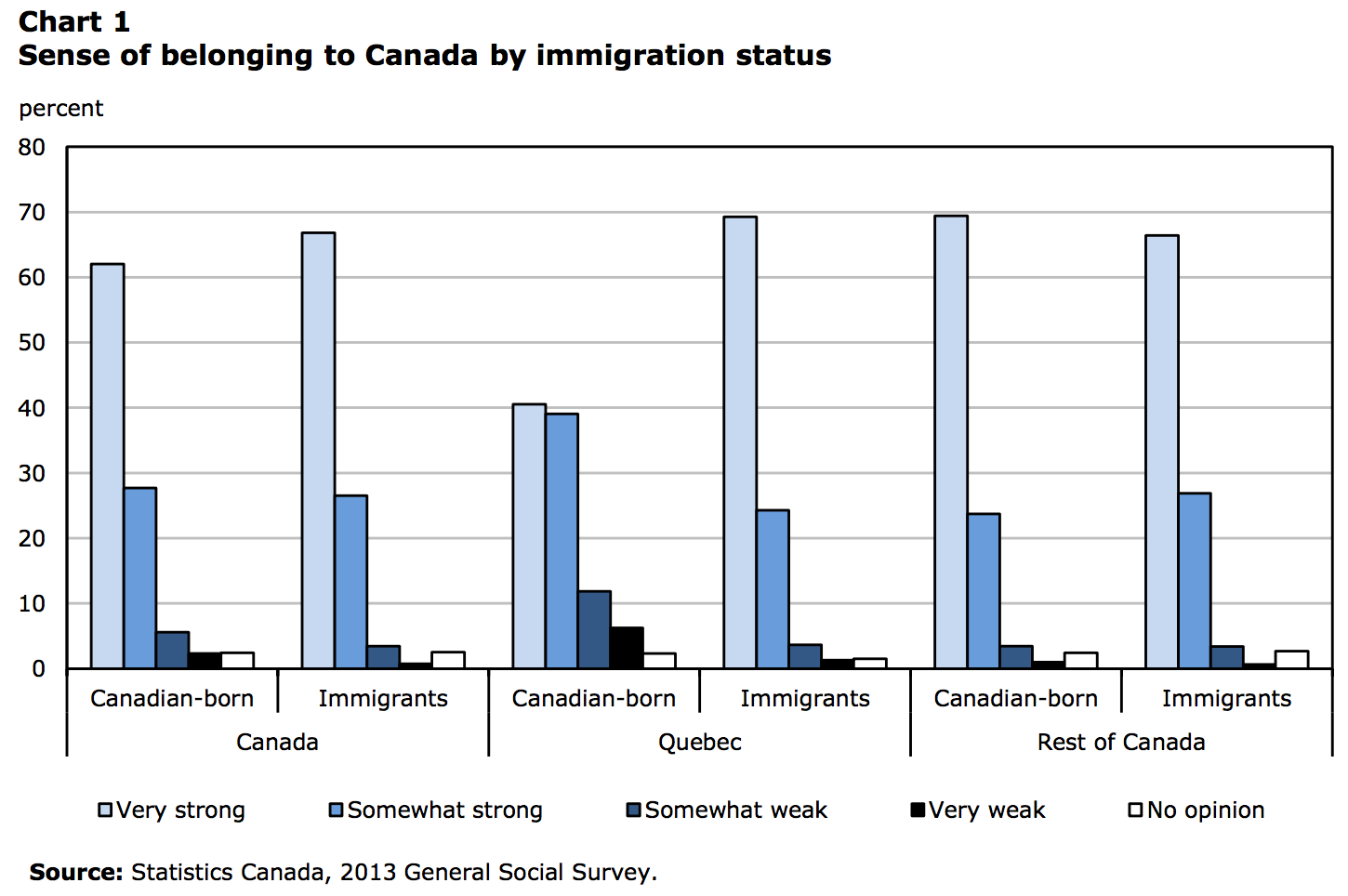
Source: Le sentiment d’appartenance des immigrants au Québec s’effrite par rapport au Canada

Débats sur la laïcité et sentiment d’appartenance chez les immigrants racisés au Québec : Mieux comprendre l’impact des « événements focalisateurs»

Of note. The laïcité ironically have reduced the “belonging deficit” of Quebec compared to other provinces among non-religious minorities and Francophones

Résumé

« Certaines études suggèrent que le projet de Charte des valeurs du PQ et la loi 21 ont nourri un sentiment d’exclusion chez les membres des religions minoritaires. Cependant, aucune étude ne permet à ce jour de comparer le sentiment d’appartenance des minorités religieuses avant et après la mise à l’agenda de ces projets législatifs. Ancrée dans la recherche sur les « événements focalisateurs » et reposant sur des données de trois sondages réalisés en 2012, 2014 et 2019, notre étude examine l’impact des débats sur laïcité sur le sentiment d’appartenance des immigrants racisés au Québec. Nos résultats démontrent qu’un déficit d’appartenance au Québec par rapport au Canada existait déjà en 2012, mais qu’il était circonscrit à certains groupes, notamment ceux de dénominations non chrétiennes et les non francophones. Nos analyses montrent aussi qu’avec les débats sur la laïcité, le déficit d’appartenance au Québec s’est étendu aux minorités non religieuses et aux francophones. »

Abstract 

“Some studies suggest that the PQ’s proposed Charter of Values and Bill 21 have fostered a sense of exclusion among members of religious minorities. However, there is no study to date that compares the sense of belonging of religious minorities before and after these legislative projects were put on the agenda. Grounded in research on “focusing events” and drawing on data from three surveys conducted in 2012, 2014 and 2019, our study examines the impact of the secularism debates on racialized immigrants’ sense of belonging in Quebec. Our results show that a deficit of belonging to Quebec relative to Canada already existed in 2012, but that it was circumscribed to certain groups, notably those of non-Christian denominations and non-French speakers. Our analyses also show that with debates on secularism, the Quebec belonging deficit has extended to non-religious minorities and Francophones.”

Read or download the full article (in French) | Consulter ou télécharger l’article complet : 

Débats sur la laïcité et sentiment d’appartenance chez les immigrants racisés au Québec : Mieux comprendre l’impact des « événements focalisateurs » | Canadian Journal of Political Science/Revue canadienne de science politique | Cambridge Core

Almost half of Canadians report a strong sense of belonging to their local community: GSS results for visible minorities and immigrants

Summaries I found more interesting, with overall sense of belonging stronger than not visible minority or Indigenous for most groups, as is the case for immigrants.

Further analysis needed why some groups have a stronger sense of belonging than Korean, Chinese and Southeast Asians and look forward to future work by StatsCan and others:

Sense of belonging to a local community varies among racialized groups

The proportion of people reporting a strong sense of belonging to a local community differed across racialized groups. For example, South Asian (59%), Filipino (57%), Arab (54%), and Black (51%) Canadians were more likely to have a strong sense of belonging to their local community, compared with those who did not belong to a racialized group and were not Indigenous (46%). 

On the other hand, Korean (24%), Chinese (36%), and Southeast Asian (38%) Canadians were less likely to have a strong sense of belonging to their local community. This finding is consistent with previous research, suggesting that some racialized groups are more likely to have a strong sense of belonging to their local community. More in-depth analyses are necessary to further understand this variation.

Immigrants are more likely to have a strong sense of belonging to their local community

Compared with those born in Canada (46%), recent immigrants—i.e., immigrants who arrived in the past five years (50%)—and those who arrived in Canada more than five years ago (48%) were more likely to have a strong sense of belonging to their local community. Despite the unique economic and social challenges they experienced during the pandemic, immigrants may nonetheless settle in regions where they receive support from immigrant settlement organizations or cultural community groups. 

This report found that social, economic, and demographic factors were associated with having a strong sense of belonging to a local community. Future research using the Canadian Social Survey will track this and other indicators in the Quality of Life Framework through the pandemic recovery period and examine how these factors and others relate to each other.

Source: Almost half of Canadians report a strong sense of belonging to their local community

Immigrants are most excited about Canada 150 celebrations; Quebecers — not so much

Not surprising that new Canadians, those who chose to come here, are more enthusiastic. Other polling on belonging and attachment to Canada generally shows comparable attachment to Canada between ‘old-stock’ and new Canadians:

The newest Canadians are the ones most pumped up to celebrate the country’s sesquicentennial in 2017 according to a survey on Canada 150 events and attitudes posted online this week by the Department of Canadian Heritage.

Among people who weren’t born in Canada, 51.6 per cent said they strongly agreed with the statement they were looking forward to celebrating Canada 150 compared to 29.5 per cent of those who were born in Canada.

“This survey shows immigrants are very enthusiastic about Canada and they are looking to take leadership of the commemorations of our 150th,” said Jack Jedwab of the Association for Canadian Studies in Montreal. “That’s paradoxical when you think about it, because that anniversary is not part of their heritage.”

The difference between native Canadians and immigrants is greatest in Quebec, where many of the Canadian-born respondents were francophones who have the lowest interest in the celebration. But even in Ontario, there was a 20 percentage point difference between native Canadians and immigrants.

“I was expecting some difference, but 20 points is surprising,” Jedwab said.

The Leger survey was commissioned by Canadian Heritage and surveyed 2,191 Canadians aged 18 and over from all regions of the country. The purpose was to find a baseline of Canadians’ attitudes toward their country and the 150th anniversary of Confederation celebrations in 2017.

A majority of Canadians are proud of their country, plan to take part in Canada 150 events and approve of the government spending money on the party, according to a survey, which was conducted last June.

The exception, unsurprisingly, are francophone Quebecers whose strongest affinity is to their home province and who are the least likely to approve spending money on the Canada 150 celebrations, as well as least likely to volunteer or take part in events. The Quebec factor, though not unexpected, poses a problem for the federal government in promoting Canada 150 events in the province, Jedwab said.

“One of the big stories in this is the level of interest among francophones. There’s a risk here that you’re going to have a different level of celebration in Ottawa than you do in Gatineau. The government has got a challenge. On the one hand, if it wants to maximize involvement among francophones, there will be a pushback to manage as well. That pushback in Quebec risks undercutting the degree of interest among non-francophones.”

The survey found 95 per cent of Canadians say they feel attached to the country and that they identify as Canadians first, over their individual provinces or communities. Two-thirds of the respondents said they intended to participate in Canada 150 events and about one-third said they had seen or heard advertising related to the 2017 celebrations.

Affinity for Canada and support for a Canada 150 party was strongest among women and those aged 65 and older.

Source: Immigrants are most excited about Canada 150 celebrations; Quebecers — not so much | Ottawa Citizen

Statistics Canada: Patterns and Determinants of Immigrants’ Sense of Belonging to Canada and Their Source Country

statscan-gss-belongingImportant study by Statistics Canada and John Berry from the General Social Survey confirming high levels of belonging to Canada:

The results show that 93% of immigrants had a very strong or a strong sense of belonging to Canada. Furthermore, a strong sense of belonging to the receiving country is not necessarily incompatible with a sense of belonging to the source country. About 69% of all immigrants had strong sense of belonging to both Canada and their source country (the integrated belonging profile). Another 24% of immigrants had a strong sense of belonging to Canada and a weak sense of belonging to their source country (the national belonging profile). In comparison, very few (3%) had a strong sense of belonging to their source country but a weak sense of belonging to Canada (the source-country belonging profile); and very few (4%) had a weak sense of belonging to both Canada and their source country (the weak belonging profile).

Compared with immigrants in the integrated belonging profile, those in the national belonging profile were characterized by lower levels of civil liberty and life satisfaction in their source countries and by more exposure to Canadian society. Younger age at immigration, more years of residence in Canada, and speaking English or French at home are all significant predictors of the national belonging profile.

The source-country belonging profile was characterized by a high average level of life satisfaction in the source country, older age at immigration, shorter stay in Canada, and perceived discrimination. The weak belonging profile was relatively more prevalent among spouses and dependants of economic principal applicants, or immigrants who came to join their relatives in Canada, and among those who were unemployed, never married, or had very low income.

Overall, this study finds that the overwhelming majority of immigrants had a strong sense of belonging to Canada, with or without a strong sense of belonging to their source country. Source-country attributes were as important as immigration entry status and post-migration experience in affecting immigrants’ sense of belonging to Canada and their source country.

Source: Analytical Studies Branch Research Paper Series: Patterns and Determinants of Immigrants’ Sense of Belonging to Canada and Their Source Country

UK: How I Passed the English Cricket Test – Kenan Malik

Kenan Malik on Britishness and belonging:

Craft a statement. Teach a lesson. Politicians may be the only people in the world who imagine that the creation of identities, or the forging of a sense of belonging, can be reduced to such simple formulas.

What most public debates ignore is the complexity, elasticity and sheer contrariness of identity. Whether personal or national, identities can never be singular or fixed because they are rooted largely in people’s relationships with one another — not merely personal but social relationships, too — and such connections are always mutating.

…. My parents were of a generation that accepted racism as part of life. I was of a generation that challenged it, politically and physically. We confronted far-right thugs, organized street patrols to protect black and Asian families, and stood up to police harassment. And this inevitably shaped our sense of who we were.

My generation did not think of itself as “Muslim” or “Hindu” or “Sikh.” We wanted to be seen as British. When Britain told us, “You don’t belong,” we responded both by insisting on our Britishness and by identifying with those who challenged British identity. Such is the contradictory character of belonging.

… Today, things are different. Neither racism nor racial violence has disappeared, and hostility to immigration has become a defining feature of British politics. Yet the savage, in-your-face racism that marked Britain a generation ago is, thankfully, relatively rare. The nature of Britishness has changed, too. No longer rooted in ideas of race and empire, it is defined as much by diversity as by jingoism. National identity is being recast in a host of new debates, from the fractious question of Scottish independence to the fraught relationship with the European Union.

Blacks and Asians have long since become an accepted part of Britain’s identity, as well as its sporting tapestry. And I have dropped my “anyone but England” attitude. I, too, now feel the pain of penalty shootout defeats and the rare joy of cricket match victories. Yet, if I am now willing to wave the flag at a cricket field or in a soccer stadium, I will not necessarily do so in all contexts. I may be tribal about sports, but I am not patriotic about Britain.

Unthinking, irrational support for one team over another is an essential part of the experience of sports. Patriots wish us to be equally unthinking in our attachment to the nation in every arena, from culture to war. The myth of nationalism is that “Britishness,” just like “Frenchness” or “Americanness,” comes as a single package. But identity does not work like that.

There are many aspects of British life that I admire, and many that I despise. I only have to visit a London street market to be reminded how open Britain is to foods and goods and influences from all over the world; I only have to stand in line in passport control at Heathrow Airport to remember how deep the suspicion of foreigners runs. Many British traditions resonate with me; many I find abhorrent. This is the nation that produced the Levellers and the Suffragettes, radical movements that helped shape the world; it is also a nation that still clings to a monarchy and the unelected, feudal House of Lords.

Many non-British traditions, too, have helped shape my views, values and ideals. To erase this complexity with the myths of patriotism is to diminish the very meaning of belonging.

How I Passed the English Cricket Test – NYTimes.com.