Have seen some of these initiatives in the Canadian context for language (second language fluency can decline), community and food choice reasons:
Indian community members joined local politicians and aged care providers recently at the launch of Planning Permits for an ethno specific, Indian aged care facility in Melbourne. The Australian Federal Government has approved a $1 million dollar grant towards the 108-bed facility in the south-eastern suburb of Noble Park.
According to Petra Neelman, Executive Director of MiCare (Formerly Dutch Care), the facility will ensure availability and access to linguistic and cultural needs, social activities and food choices for the residents. The plans include four prayer rooms, a vegetarian kitchen and a 300-seat capacity community hall among other culturally sensitive features.
Years of persistence in attempts to provision aged care services from an ethno specific Indian perspective finally saw some promising development with this launch. As all the dignitaries that attended the event pointed out, the credit for this exciting development goes to community leader and Multicultural Ambassador Vasan Srinivasan, who worked persistently to bring the plans to fruition.
Alan Tudge MP, Minister for Cities, Urban Infrastructure and Population, commended Vasan for his persistence in spearheading projects that included the development of the Museum India in Dandenong, where the aged care facility launch was held.
‘Energiser Bunny’ and ‘Organiser Extraordinaire’ were the terms used to describe Vasan as the Minister acknowledged his hard work in negotiating with both the Federal and State Governments in relation to the proposed facility.
According to the Minister, ethno specific services provide enhanced connectedness and mental wellbeing for older people from diverse backgrounds. He thanked everyone involved for getting this up and running and officially declared the planning approvals as completed.
Roz Blades, Mayor, City of Dandenong, joined the Minister in launching the plans along with Neil Angus, Shadow Minister for Citizenship and Multicultural Affairs and Matt Fregon, Member for Mount Waverley.
Despite the melting heat, the event was well attended by multicultural leaders, community representatives and local media. MC Aneka and Swati admirably kept their cool through the entire event as they invited the dignitaries to say a few words.
Rakesh Malhotra (Consul General of India in Melbourne), Dr Dinesh Parekh (Artistic Director of Museum India) and Dr Sharad Gupta (President of FIAV) also addressed the audience briefly. A traditional Indian wrap and flowers were presented to all the dignitaries.
A light vegetarian meal was served after the event.
Speaking to the guests post event, Vasan Srinivasan shared his experience of the challenges that were faced and the multiple attempts made before reaching this stage of approval.
He is optimistic that the combination of MiCare’s experience of working with ethnic backgrounds, Federal and State Government funding and community support will ensure the realisation of this project. “As the population of Indians in Melbourne continues to grow it is imperative that the community has access to ethno specific aged care in order to age and live well,” said Vasan.
According to him, availability of an ethno-specific and multicultural aged care, bilingual workforce and health educators will play a pivotal role in promoting healthy ageing and community capacity building.
Speaks for itself and the perseverance to be heard:
Back in August, when Behrouz Boochani was speaking with NPR over the phone, the Kurdish-Iranian journalist said his debut book, written mostly with texts he sent from an Australian detention center, was meant “to make a challenge against this system, to tell the truth to people.” He wasn’t motivated by money.
On Thursday, his work earned him some money anyway.
The Victorian Premier’s Literary Awards, which are among Australia’s most prestigious literary prizes, singled out Boochani’s No Friend But the Mountains: Writing from Manus Prison for their highest honor: the Victorian Prize for Literature. His book also won in the nonfiction category.
The Victorian Prize carries a purse of 100,000 Australian dollars, while the nonfiction award brings 25,000 on top of that — or about $90,000 in USD, all told.
But because Boochani remains detained on Manus Island, part of Papua New Guinea, at the same offshore facility where he’s been held since 2013, his translator, Omid Tofighian, picked the awards up at the ceremony in his stead. And Boochani had to deliver his remarks through a recorded video message.
“I have always said I believe in words and literature. I believe that literature has the potential to make change and challenge structures of power,” he said. “Literature has the power to give us freedom.”
Boochani himself has not enjoyed physical freedom for more than five years now. He has lived in a kind of legal purgatory since he fled from Iran to Indonesia and then tried to travel to Australia, where he had hoped to obtain asylum after his pro-Kurdish publication attracted the scrutiny of Iranian security forces.
Instead, the boat he’d been riding was intercepted by the Australian authorities, who eventually transferred him to Manus Island. It is there, at what the Australian government calls an “offshore processing centre” — and what what he calls a “prison” — that Boochani has lived for years.
Australia first reached an agreement with Papua New Guinea, back in 2013, to hold some asylum-seekers on its small northern neighbor. Since then the practice has received vehement pushback — including from Papua New Guinea’s Supreme Court, which ruled it illegal in 2016, and from multiple international aid organizations.
In a report issued late last year, Doctors Without Borders, or Médecins Sans Frontières, said dozens of the detainees had attempted suicide and still more had considered it.
“While many of our patients had experienced trauma,” said MSF’s Christine Rufener,“it was the Australian policy of indefinite processing that destroyed all their hope for the future and devastated their mental health.”
Despite the ruling of Papua New Guinea’s high court, and despite the Manus Island camp’s formal closure later, hundreds of asylum-seekers continue to languish on the island without much idea of what may come next.
During Boochani’s years-long detention, he wrote his book in Farsi, in dispatch after dispatch sent via WhatsApp, which Tofighian then translated into English and organized. The result is a hybrid text that eschews easy classification, combining journalism, poetry and critical theory to craft what the prize’s judges called “a new understanding both of Australia’s actions and of Australia itself.”
“Altogether, this is a demanding work of significant achievement,” they explained in their citation. “No Friend But the Mountains is a literary triumph, devastating and transcendent.”
In the end, Boochani told NPR, his work in some way is also a gesture of hope: “We all hope that finally, after five years, we get freedom in a place like America or other countries.”
Australia failed to make basic checks before stripping a suspected Islamic State fighter of his citizenship, a senior official said Wednesday, an admission likely to call into question the legality of the move.
The country last month striped Neil Prakash of citizenship after claiming he was Fijian — prompting strenuous denials from the authorities in Suva and an embarrassing diplomatic rift.
Prakash is accused of being a member of the IS jihadist group, and identified as the 12th Australian dual-national to lose their passport over terrorism links.
He is currently in Turkey facing charges of joining the organisation.
A parliamentary intelligence committee on Wednesday grilled Home Affairs officials on the issue, asking whether they verified his status with Fiji or consulted experts in Fijian law before revoking Prakash’s citizenship.
“No, we did not” admitted senior department official Linda Geddes.
If Prakash is neither Fijian nor Australian he would now be stateless in contravention of decades old UN accords and Australian law.
A Special Counsel advising the government told the parliamentary committee he offered “strong advice” on the case, but would not go into detail.
The move against Prakash was touted at the time by hardline Home Affairs minister Peter Dutton as the ruling Liberal Party eyed its base supporters and May elections.
But it created an awkward backdrop for a recent landmark Pacific visit by Australian Prime Minister Scott Morrison.
And in related news, lawyers express concern over expansion of Australian citizenship revocation policy towards those convicted of minor crimes:
Australian lawyers are afraid petty criminals and people participating in religious festivals could be rendered stateless under citizenship law changes aimed at homegrown terrorists.
Constitutional and human rights experts have also expressed grave concerns about the “irredeemable” bill being put forward by the federal government.
The Morrison government wants to be able to deport Australian-born extremists who are entitled to citizenship in another country.
But the Law Council of Australia fears the proposed powers would be disproportionately harsh and could breach international law.
Dual nationals sentenced to at least six years jail for terror offences can already be stripped of their Australian citizenship.
The coalition wants to scrap the six-year threshold and expand the range of offences it can rely upon.
The Law Council’s David Neal is urging the federal parliamentary intelligence committee to keep the existing triggers in place.
“Low-level offending, which is dealt with to finality in a local court, could be captured by laws that lead to citizenship cessation,” he told committee members in Canberra on Wednesday.
Dr Neal is also concerned the offence of “associating with a terrorist organisation” could capture people participating in legitimate social gatherings and religious festivals.
Constitutional expert George Williams believes tinkering with the bill could also capture religious pilgrims and business people who venture into politically-sensitive areas.
“There is no actual involvement in terrorism, there is no suggestion of disloyalty, but that would trigger under this legislation the possibility of revocation,” he told the committee.
Professor Williams said the bill would have a range of “extreme and unjustified” consequences and could make the community less safe.
“In fact, it may do some harm, particularly in the broader agenda of building social cohesion.”
The laws would also significantly lower the threshold around proving a person’s citizenship of another country.
Under the changes, the minister would only need to be “reasonably satisfied” a person may be entitled to citizenship elsewhere.
“As recent history demonstrates – in both the cases of members of parliament and the (Neil) Prakash case – determining existing foreign citizenship can be difficult,” Dr Neal said.
“Determinations based on predictions about future foreign citizenship – which may include decisions by foreign governments – are obviously fraught.”
The Morrison government sparked a diplomatic fight with Fiji over the summer break after stripping Prakash of his Australian citizenship.
The Islamic terrorist was born in Melbourne to a Fijian father but Fiji says he is not a citizen.
The federal government has indicated dual nationals who are stripped of their citizenship could languish indefinitely in immigration detention if other countries refuse to take them.
The annual Scanlon Mapping Social Cohesion Surveys provides a more nuanced of immigration related public opinion, but still showing 43 percent believing the number of immigrants is too high:
Support among Australians for a growing population is crumbling amid fears of overcrowded cities and homes priced out of the reach of ordinary people, a new survey by the Australian National University has revealed.
As both the Morrison government and Shorten opposition consider their own approaches to population policy in the run-up to this year’s election, the ANU poll found just three out of 10 Australians believe the nation needs more people.
A similar poll conducted in 2010 found support for a growing population at 45 per cent.
The 15 percentage point fall was driven by a huge drop in support among male voters who in 2010 showed majority support for a bigger Australia. Male support has now fallen to 38.4 per cent.
In 2010, 38.5 per cent of female voters backed a growing population but this has now fallen to 28.2 per cent.
Over the past year, the nation’s population has grown by 390,500 of which 61 per cent was from net overseas migration.
But with growing public concern about Australia’s immigration intake, the government is considering a reduction in the current cap of 190,000. The planned intake for the 2019-20 financial year, to be set in the April budget, is expected to be closer to 160,000.
Already, Prime Minister Scott Morrison has signalled a reduction in the number of migrants brought into the country, saying he had heard “loud and clear” that city roads were clogged, “the buses and trains are full”.
It appears much of the drop in support for more Australians has been driven by issues in our major cities which have largely absorbed the 2.5 million increase in the nation’s population since 2010.
Almost nine out of 10 surveyed agreed that the high cost of housing was a reason to limit Australia’s population growth. Eighty-five per cent also believed the nation’s cities were over-crowded and there was too much traffic.
Another concern among those surveyed was around labour shortages.
About 90 per cent of those quizzed agreed that Australia should “train our own skilled people, not take them from other countries”.
Lead researcher Nicholas Biddle said with two-thirds of Australians believing the country has enough residents, the lived experience of many people was influencing their view towards immigration.
“Australians are more likely to support population growth if it increases our skills base, mitigates the impacts of an ageing population and increase our economic prosperity,” Associate Professor Biddle said.
“But they do not want population growth to cause crowding, affordability or job security issues nor at the expense of our natural environment.”
The poll was conducted late last year, just as house prices were falling in most major capital cities with Sydney property down by more than 11 per cent.
The poll is at odds with an Ipsos poll taken in October last year for the Sydney Morning Herald and The Age which showed 52 per cent of respondents backing the idea of keeping or increasing the number of immigrants. Forty-five per cent supported a reduction in the nation’s migrant intake.
Responding to the ANU poll, Coalition voters were the least likely to support a higher population while Greens voters were the most open to the idea, but even amongst them support was less than 50 per cent.
People aged between 25 and 34 showed the highest support for more Australians, at more than 41 per cent. The lowest support was among people aged between 45 and 54, at less than 25 per cent.
The survey also found large differences based on ethnic background.
Just a quarter of Australian-born people supported a larger population, almost half the rate of those born in a non-English speaking country. Just under 40 per cent of those from an English-speaking nation backed a larger population.
The government is considering a way to encourage immigrants to live in rural and regional areas, with some country towns crying out for skilled workers. The poll showed this was more popular among urban Australians than those living in areas that would be home to new residents.
Support among Coalition and Greens voters for the policy was about 75 per cent but among Labor voters it was 10 percentage points lower.
Professor Biddle said while the survey showed growing opposition to migration, those quizzed were not driven by cultural issues.
He said there was substantially more support for migration on the grounds of broadening Australia’s cultural diversity, almost double the rate for those who believed the nation was already too culturally diverse.
According to Professor Biddle, Australians had a series of serious concerns about a growing population.
“Australians need to be convinced that traffic and house prices won’t increase unduly, that there will be limited effects on the environment, and that Australia’s existing workforce will still receive adequate training,” he said.
The federal government has revised the citizenship code to make it compulsory for all councils to hold citizenship ceremonies on Australia Day – but some councils say the Morrison government should have consulted rather than applying a “heavy-handed and odd” approach.
Under changes to the Australian Citizenship Ceremonies Code to be introduced in 2020, councils will also have to hold a second citizenship ceremony on September 17 – Australian Citizenship Day – and new citizens will have to abide by a strict dress code that bans boardshorts and thongs.
The revised code will be sent to councils this week, Immigration, Citizenship and Multicultural Affairs Minister David Coleman announced.
“Australian citizenship is an immense privilege and fundamental to our national identity,” Mr Coleman said.
“As part of this update, the government will require that citizenship ceremonies be held on Australia Day across the nation.
“New citizens should be given the opportunity to become an Australian on our national day – Australia Day is an incredibly important part of our national calendar.”
On Sunday, Prime Minister Scott Morrison said the government will “protect our national day and ensure it is respected”.
“We believe all councils who are granted the privilege of conducting citizenship ceremonies should be required to conduct a ceremony on Australia Day,” he told the Sunday Telegraph newspaper.
In 2017, two Melbourne councils were stripped of the right to hold citizenship ceremonies after scrapping all Australia Day celebrations to recognise Indigenous sensitivities. Yarra City Council and neighbouring Darebin Council cited a groundswell of popular support for the move but were slapped down by the government.
Amid a growing push from some corners to change Australia’s national from January 26, several councils have already made plans to move or cancel traditional celebrations this year.
Victoria’s Darebin, Yarra and Moreland, Western Australia’s Fremantle and NSW’s Byron have already flagged a change of date, because January 26 is considered a day of mourning by many Indigenous and non-Indigenous people.
City of Sydney Labor Councillor Linda Scott said councils had an obligation to listen to community sentiment.
“The job of local governments is to listen to their communities and represent their views,” she told SBS News.
“Councils should be able to set the day of their citizenship ceremonies in line with the views of their community.”
She said other councils had shifted citizenship ceremonies from January 26 because of extreme heat, a lack of new citizenship applications or because of cultural sensitivity.
Australian Local Government Association president Mayor David O’Loughlin said most councils likely won’t be opposed to the government’s proposed changes to the Australian Citizenship Ceremonies Code but councils will have valid concerns.
“Most councils hold more than one citizenship ceremony a year, some as often as monthly – the Federal Government’s strong focus on drawing a link between Australia Day and citizenship ceremonies is bizarre,” he said.
“We do acknowledge that a small number of councils are in discussions with their communities about whether the 26th of January is the appropriate day to celebrate Australia Day.
“However, councils cannot move Australia Day – this is ultimately up to the Federal government – but it is our job to be responsive to our communities, including to their calls for prudence and advocacy.”
He said if the Morrison government had “bothered to consult” with council it would have found many Local Government Areas forgo citizenship ceremonies on Australia Day because of the heat.
“In some locations, it’s simply too hot for councils to hold ceremonies during the day, so they do it the evening before, just as the Federal Government does with its Australian of the Year Ceremony,” he said.
“Interestingly, the federal government has made no mention of any financial contribution towards the additional costs involved in running these ceremonies.”
More than 73,000 people have become Australian citizens on Australia Day in the past five years, according to government figures – despite there being no specific requirement for councils to hold ceremonies on January 26.
City of Darebin’s Mayor Susan Rennie told SBS News her council “will not be marking January 26 by holding any events on that day or surrounding days” for a second year running.
Ms Rennie said Darebin is “opposed to Australia’s national celebration being held on January 26 out of respect for local Aboriginal and Torres Strait Islander peoples, who have told us that they experience a day of sadness, pain and disconnection”.
A reminder of the contribution some lower skilled immigrants can make to rural communities and a caution regarding the limits of encouraging more high skilled immigrants to settle there:
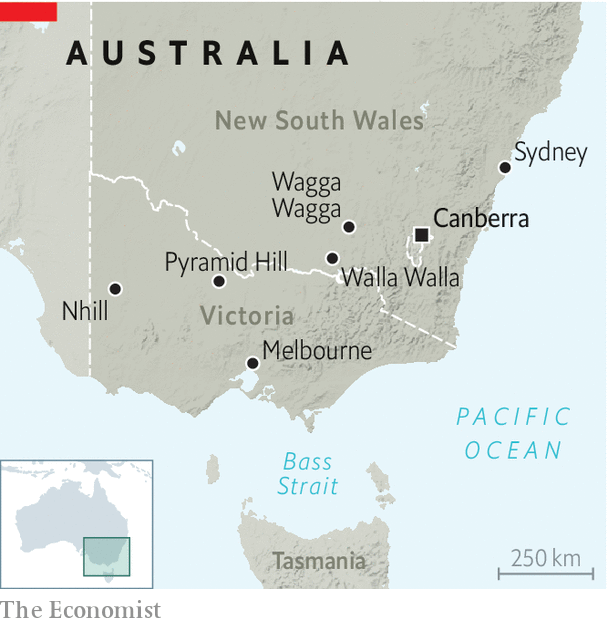
First came the Burmese, then the Afghans and the Africans. Since 2016, 400-odd Yazidis have washed up in Wagga Wagga, a regional centre south-west of Sydney. Its primary school has had to hire interpreters to communicate with families (fully a fifth of its students are refugees). The local college teems with parents learning English and new trades. Doctors have had to brush up on illnesses rarely found in the area. Few locals seem fussed about the changes. And to those fresh out of war zones, “Wagga” is an idyll. “My children are safe,” says Ismail Darwesh, a Yazidi who fled Islamic State’s attempt to wipe out his people, a religious minority in Iraq and Syria. “Everything you want you can get here.”
The refugees have been sent to Wagga Wagga under a scheme which brings beneficiaries from foreign camps to rural Australia (most settle in urban areas). The hope is that they can offset the population decline that threatens many outback settlements with extinction, as birth rates fall and youngsters head for cities. Wagga Wagga’s Multicultural Council says the population is only growing thanks to the new arrivals. Immigrants are helping to stem shrinkage in another 150 localities.
The scheme helps big cities, too, by easing the pressure on roads, schools and hospitals there. Thousands of Iraqis and Syrians descended on Sydney’s western suburbs after extra visas were dished out to them in 2016 and 2017. Many have struggled to find work, and conservatives grumble about ghettoisation. A recent report from the Centre for Policy Development, a think-tank, found that just 17% of “humanitarian entrants” have jobs after 18 months in Australia. Yet remote towns are crying out for people to fill vacancies on farms, in abattoirs and to look after the elderly. The cost of living is lower than in Sydney or Melbourne and, for farmers like Mr Darwesh, a quiet life is appealing anyway.
To stay afloat, some outback towns have taken to recruiting migrants for themselves. A piggery in Pyramid Hill, in northern Victoria, started sponsoring workers from the Philippines a decade ago. They now make up a fifth of its 500-odd population, keeping not just the business afloat, but also the local school. Another town in the same state, Nhill, lured 160 Burmese refugees from Melbourne with jobs at a food company, adding perhaps A$40m ($28m) to its economy. A group of residents in Walla Walla, a dot in New South Wales, is now scouting for refugees from Sydney. “We have jobs, we have housing and we have education,” says Andrew Kotzur, who runs the local steelworks. “We just need more people to sustain them.”
Asylum-seekers and farm labourers make up a tiny portion of the immigrants pouring into Australia. The conservative coalition government is keen to rusticate others, too. Scott Morrison, the prime minister, has suggested that some of Australia’s 500,000 foreign students could be sent to regional universities. The population minister, Alan Tudge, added that visa restrictions and incentives could be used to push skilled migrants out of Melbourne and Sydney. Almost all the best-qualified arrivals settle in those two cities, but luring them out will not be easy. It is partly owing to migration that Sydney and Melbourne are thriving. Foreign accountants and it geeks choose them for well-paid work and swanky suburbs. Rob them of both, and far fewer would come to Oz at all.
Almost comical in the Australian government’s ineptitude. A reminder of the challenges in determining whether or not someone slated for revocation is actually a citizen, or entitled to the citizenship, of another country:
Fijian officials have rejected claims Australian-born terrorist Neil Prakash is a citizen of their country, leading the Federal Opposition to label Home Affairs Minister Peter Dutton as an embarrassment to the country.
Last month Mr Dutton revealed the Federal Government had revoked Prakash’s rights as an Australian citizen because of his affiliation with the Islamic State (IS) terrorist group.
The Federal Government argued it could strip his citizenship because it had “clear advice” he had, or was entitled to, Fijian citizenship.
Prakash was born in Melbourne to a Fijian father and Cambodian mother. He is currently in jail in Turkey, awaiting trial on multiple terror charges.
Now Fiji’s Immigration Director Nemani Vuniwaqa has told the ABC there is no evidence of Prakash or his parents ever being Fijian citizens.
“[There are] no records of Mr Prakash being a Fiji citizen,” he said.
“We do not have any records of his immediate family either, unless if it was provided to the Department.”
Fijian law states the children of a former citizen can apply for citizenship, provided that one of their parents was still a citizen at the time of their birth.
In an indication of how Canberra has handled the matter, Mr Vuniwaqa said he had not received any communication from the Australian Government about Prakash’s case.
“I first received info from a local media source who quoted that Mr Prakash had been stripped off his Australian citizenship,” he said.
“There was no formal communication with regards to the plans by the Australian Government.”
The ABC understands the Federal Government communicated with the Fijian Foreign Ministry about the case.
Prime Minister Scott Morrison is making an official visit to Fiji next week, where the matter will likely be discussed.
Shadow Immigration Minister Shayne Neumann said Mr Dutton had badly mishandled the situation.
“Peter Dutton didn’t consult, or have his department consult with the Fijian Government before he announced that he was stripping this terrorist of citizenship.
“Peter Dutton is a shameless, self-serving media tart on this issue and what he’s done is embarrassed himself, has embarrassed the Prime Minister, embarrassed our country, and in a week’s time Prime Minister Morrison has to go to Fiji to sort out Peter Dutton’s mess.”
The Federal Government is standing by its decision.
“Home Affairs Minister Peter Dutton has been very clear in his comments about Neil Prakash, he’s made it clear what the Government’s position is,” cabinet minister Paul Fletcher said.
“He’s also made it clear he’s not going to be providing a running commentary on this matter.”
Legal experts said if Prakash was not Fijian, the Australian government’s decision would be invalid.
“If he isn’t a citizen or a national of another country other than Australia then it’s beyond statutory authority,” Rayner Thwaites, a senior law lecturer from the University of Sydney said.
“It’s as if the citizenship deprivation hadn’t happened, it would not have effect.”
Always interesting to see how previous governments grappled with issues, in this case the Australian government under PM Howard, and how officials provided significant advice that for some reason was ignored, resulting in the recent crisis regarding parliamentarians who were dual citizens:
Creating dual citizenship
In April 1996, then-Immigration Minister Philip Ruddock said it was “urgent” to move ahead with reforms that would allow Australian citizens to pick up a second citizenship for the first time.
Mr Ruddock said this was inconsistent. Migrants to Australia were often allowed to keep their home citizenships, but dual-citizenship was off-limits to natural-born Australians.
It would be another six years before the Howard government changed the law in 2002 — but the 1996 submission got the ball rolling.
The minister was concerned about some backlash from RSL groups, but said the prohibition was a matter of “great concern” to those affected.
He compared Australia with the countries that allowed dual citizenship at the time — like France, New Zealand, the USA, Israel and Syria — and those that did not, like Indonesia, Iran, Norway and Austria.
If only they knew
Right at the end of the submission, officials from the Department of Prime Minister and Cabinet make a prescient warning.
“Acceptance of the proposals would increase the disparity between the qualifications for citizenship and those for elected office,” the department wrote.
The children of Manus Island refugees and local women are being denied birth certificates, according to their families, potentially leaving up to 39 of them stateless.
A number of refugee men detained in the Australian-run Manus Island regional processing centre and Papua New Guinean women started relationships as early as 2015, with some children born shortly after. The regional processing centre was shut down in 2017 but at least 750 refugee and asylum seeker men remain in the country, with 580 of those on Manus Island, according to UN high commissioner for refugees estimates from July.
“I just want a marriage certificate for my wife and I, birth certificates for our two babies, citizenship and an area where we can live,” Haroon Rashid, a 27-year-old Rohingyan refugee, says.
Rashid fled Myanmar because of ethnic cleansing by government forces and arrived in PNG in 2013. The following year he was found to be a refugee and married a 22-year-old Manusian woman, Molly Noan.
The couple says provincial authorities have refused to issue birth certificates for their two-year-old son, Mohammed, and 17-month-old daughter, Almeera.
In 2016, after their eldest child was born, they asked the Manus Island provincial administrator for documents but were told to get confirmation from the PNG Immigration and Citizenship Authority.
But the authority told the couple it was not its responsibility and referred the matter back to the Manus Island provincial government.
Rashid and Noan have given up trying to get these documents owing to what they say are continual delays and refusals. “Our marriage and life is aimless and our destiny is uncertain without him being a citizen,” Noan says.
The future remains unknown for these refugee and asylum seeker men without PNG citizenship, while others face a long wait for resettlement in third countries. Now their children face a risk of statelessness too, as they lack birth certificates to prove they were born and registered in PNG.
Experts warn that the denial of birth certificates violates the children’s international legal right to be registered immediately after birth.
“Denial of birth certificates is the first step to statelessness,” says Prof Hélène Lambert, an expert in international refugee law at the University of Wollongong.
She warns that the children could become exposed to further human rights violations that flow on from a lack of proper documentation: “This could result in a whole range of social, economic, civil and political rights being denied.”
….
“Lack of birth registration can create a risk of statelessness, which is heightened in certain circumstances where a child is born to migrant or refugee parents, or belongs to a minority community that struggles to have its ties to the state recognised,” she says.
….
The Australian government has refused to confirm reports that the children of refugee men and local woman have been denied birth certificates. “This is a matter for the government of PNG,” a spokesperson for Australia’s Department of Home Affairs said in a one-sentence statement.
Good summary of the latest Scanlon Foundation report and the point about how important perceptions are regarding how well immigration is managed particularly relevant to Canada:
Australia has not lost faith in immigration. The political narrative has darkened but not the fundamental view of ourselves as an immigrant nation. Most of us remain convinced that we are in so many ways better off for newcomers of all races and creeds who have come in large numbers to our shores.
That is the verdict of the Scanlon Foundation’s 2018 Mapping Social Cohesion Report published on Tuesday. The mission of the foundation is to measure how this migrant nation hangs together. Over the last decade 48,000 of us have been polled to fathom the panics that sweep this country and the steady underlying views Australians have of immigration.
“Immigration is a growing concern,” says the author of the report Professor Andrew Markus of Monash University. “But for media commentators and some politicians it has become an obsession. They are in the business of creating heightened concern, of crisis. But what the survey shows is rather a picture of stability.”
Markus is one of Australia’s leading authorities on the politics of race. This is the 11th report he has written for the Scanlon Foundation. Year in year out his reports show about 80% of us believe immigrants are “generally good” for Australia’s economy and that ours is a better society for the “new ideas and cultures” that immigrants bring to this country. Support for multiculturalism in 2018 stands almost as high as ever at 85%.
“A number of international surveys that look at Australia, America, Canada, a range of European countries from eastern Europe to western Europe, and also countries in other parts of the world, have a consistent finding that on attitudes to immigration and cultural diversity, Australia is within the top 10% of countries which are open to and welcoming of immigration,” says Markus
A glance at the Scanlan report 2018
Putting into perspective the renewed political contest over immigration is the underlying purpose of the latest Scanlon report. This year Fraser Anning called for a return to White Australia; the notion of exiling new migrantsfrom Sydney and Melbourne was seriously debated; and political leaders in all parties called for cuts – sometimes savage – to immigration numbers.
“Politicians present their views on immigration as if they are speaking for the nation,” cautions Markus. “The reality is that their words are directed to that segment of voters in marginal electorates that supports their party, or that may be attracted to their party, or may be lost to their party.”
Rising concern about numbers was a particular focus of this year’s report. This has kicked up significantly in the last few years. In 2016 only a third of Australians believed the migrant intake was too high. Now 43% of us are worried.
In the past, concern about numbers has moved up and down in lockstep with employment figures. Not this time. And the Scanlon pollsters set out to identify what was driving fresh fears in 2018.
“The program itself is something that’s marketable, something that finds a receptive audience,” says Markus. “But there’s a growing concern – still a minority position, but growing concern – that the immigration program is not being well managed.
“This is linked to people’s perceptions of overcrowding, public transport, housing costs, and so on. These issues are much more complex than just immigration intake. That’s what we’re picking up. That’s a risk for Australia going forward.”
Our rising national anxiety about numbers has been measured by a number of pollsters. Lowy, Essential and Newspoll all found a majority wish for the intake to be cut. Ipsos and Scanlon reckon the balance is slightly the other way with 52% of us for keeping – or even increasing – the number of migrants we take.
This picture of a country divided but still open to mass immigration comes with a fundamental caveat: the boats have stopped.
“I think that John Howard was very successful in that mantra of ‘we control who comes into this country’,” says Markus. “That clearly resonates very strongly. Australia maintained its White Australia policy – very strictly controlled – for decades beyond other countries who abandoned theirs quite quickly after the second world war. Australia has stuck to that very religiously.
“I think it’s been established that the policy of stopping the boats, whatever people will understand by that, is a very strong buy-in. People in Australia in large numbers will turn their gaze away from what happens at offshore detention.”
Not published in this year’s Scanlon report but made available to Guardian Australia are figures obtained for the first time showing what the nation thinks of penning refugees on Manus and Nauru. They demolish the idea that Australia has fundamentally changed its mind about the Pacific solution. The best that can be said is that we’re split on the issue.
From the start in 2007, the Scanlon reports have been mapping the dark side of this story. The constituency of those worried about immigration is not small but Markus puts the number of us markedly hostile at only about 10% – though a noisy 10%.
“They paint immigration as somehow transforming Australia, making Australia unrecognisable,” he says. “They see multiculturalism as a threat. Within some of these groups, it gets to the level that they see these activities as treasonous.
“One of the stories that goes around within these circles is that somehow the Australian people were never given a choice. Dangers have been foisted upon the Australian people. Australian people never approved of any of the White Australia policy. You need to have a referendum on that.
“It’s Pauline Hanson’s line, but also far-right groups and it’s been there for decades. What these learned commentators on Australian society seem to miss is that we actually have elections in this country every three years. If people were so upset then they would vote the government out of power and they would vote in One Nation or whoever. We would have Fraser Anning as our minister of immigration if people were so upset.”
Markus found that worries about immigration are uppermost in few of our minds. We are far more worried about the economy, the environment and the poor quality of government. Asked to name the most important problem facing the country today, only 7% of respondents in 2018 picked immigration.
But the figure for One Nation voters was 25%.
Longing for a White Australia has died down over the years but has never died out. Once again the Scanlon report reveals a considerable constituency for keeping new arrivals white and Christian – or at least, not Muslim.
In face-to-face interviews in 2018, 15% of Scanlon respondents agreed it should be possible for immigrants to be rejected simply on the basis of their race or ethnicity. And 18% agreed they could be sorted solely by religion.
As well as conducting 1,500 face-to-face interviews, the teams engaged by the Scanlon Foundation quizzed 2,260 people online, respondents who tend, sitting on their own, to be a little more frank about their negative views.
Online, 22% of us supported sorting immigrants by race and 29% of us for sorting them by religion. These figures mark clear minority positions in modern Australia but they are not insignificant, as the report shows by showing support for the Keep Australia Christian brigade within political parties:
It speaks quite well for religion. But the latest Scanlon Report offers not much evidence that the nation is warming to Islam. The online survey reveals only a tiny fall from 41% of us last year to 39% of us this year who admit to very or somewhat negative attitudes to Muslims.
“It is a notable finding that across the two modes of surveying, and with a different range of questions, discriminatory immigration policy fails to gain support from more than 30% of respondents,” writes Markus. “Nonetheless, the level of negative sentiment towards those of the Muslim faith, and by extension to immigrants from Muslim countries, is a factor of significance in contemporary Australian society.”
Year after year the Scanlon reports have mapped national divisions over race and immigration. The pattern is clear. Whether the issue is the sheer numbers coming to our shores or their colour and creed, much the same rifts appear between young and old, city and country, prosperous and struggling, those with higher education and those who never finished school.
Typical is the breakdown for the Keep Australia White brigade.
“That divide between people who have had the opportunity to go on with their education in a formal way at universities and so on, and those who don’t is a very strong divide,” says Markus. “It’s not something unique to Australia. It would be true certainly of western countries that I’ve looked at.”
Markus admits being stumped by the marked – but still minority – hostility to race and immigration shown by people working in trades. And he is not advancing any easy explanation for the relaxed attitudes of graduates. He believes life on multiracial campuses may have a good deal to do with it. But he places greater weight on study itself.
“Respect for reason is at the heart of a university education,” says Markus. “It’s not what you hear down the pub that goes down. You learn there is a discipline. We arrive at conclusions within a discipline whatever you study. Respect for knowledge and respect for reason is perhaps what drives people away from the camp which embraces delusions and xenophobia.”
Markus is heartened by the victory of Daniel Andrews in Victoria. Commentators and politicians were obsessed throughout the campaign with black crime. The fear is there in the Scanlon figures – a third of Australians generally but 41% of Victorians are afraid of becoming victims of crime – but these fears could not be marshalled to deny Andrews victory.
Though Melbourne is the fastest-growing city in the land with immense pressures on infrastructure, Melburnians aren’t calling for cuts to immigration. “And despite the opposition running hard on black gangs etc, the issue didn’t decide the election,” notes Markus.
More than ever, Melbourne looks like the future of this immigration nation.

 Multicultural Meanderings