While Australian approach to immigration is more restrictive than Canada’s, Canada’s economic and immigration recovery may also be longer than expected. But like all projections and estimates, time will tell.
Australia has been one of the more successful countries in addressing COVID-19, with only 311 infections and 4 deaths per million (July 1):
Australia’s second-most populous state was poised to take the biggest economic hit from the COVID-19 pandemic even before a dramatic spike in cases over the past fortnight forced renewed shutdowns in large parts of Melbourne.
Key points:
Victoria’s gross state product is expected to fall 1.6pc in 2020-21
The state is vulnerable due to its reliance on immigration from overseas and interstate
Many of the smaller states are expected to see higher peak unemployment rates, despite comparatively better economic performance
The latest business outlook from consultancy Deloitte Access Economics tips Victoria to suffer the biggest fall in gross state product in the 2020-21 financial year, which just began.
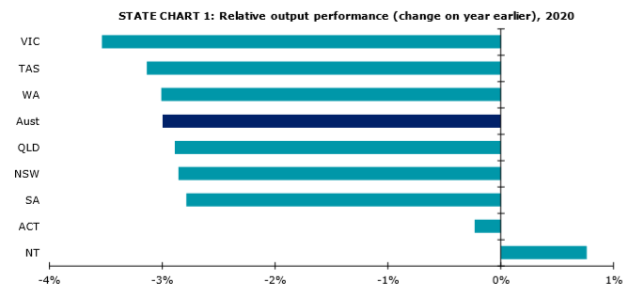
Deloitte predicts Victoria’s domestic economy will shrink 1.6 per cent this financial year, also leaving it with the worst economic performance in the nation this calendar year.
“The largest downturn is likely to be felt in Victoria given its current spike in cases, as well as that state’s dependence on migration and on foreign students in an age of lockdowns and closed borders,” Deloitte’s Chris Richardson said in the report.
Most state economies are expected to shrink around 3 per cent this year due to the pandemic.(Supplied: Deloitte)
Mr Richardson said Victoria’s economy was particularly vulnerable due to the latest wave of coronavirus cases, which would see the state cut off from the rest of the country, once the border with New South Wales closed from Wednesday.
“Victoria has had the strongest COVID restrictions across the country and now, with the prospect of a second wave returning and the reintroduction of restrictions, the state is likely to see some prolonged misery in particularly hard-hit sectors,” he noted.
Melbourne’s construction sector facing ‘severe setback’
While travel-related sectors, such as tourism and education, and hospitality will be the most immediate casualties, Mr Richardson says the medium-term effects will be felt acutely in the state’s previously booming construction sector.
“Victoria’s construction sector was already showing signs of weakness before COVID hit,” he wrote.
“With high levels of uncertainty, and an unexpected drop in population growth, construction is likely to suffer a severe setback over the coming year.
“Demand for office and apartments in Melbourne, including those projects that are halfway through, are being reconsidered as the density of Melbourne’s CBD is now less attractive across people’s daily lives.”
Mr Richardson added that one silver lining for Victoria’s construction sector was that there was a lot of planned infrastructure investment, something which would also be seen in the second-most pandemic-affected state, New South Wales.
It will particularly target transport projects in Melbourne and Sydney.
However, that investment is not expected to wholly make up for the loss of overseas arrivals.
“Other things equal, keeping tourists, students and migrants away for longer means that Australia’s economy will be some 4 to 5 per cent smaller than it could otherwise be,” Mr Richardson said.
Deloitte observed that New South Wales was similarly affected by the closure of international borders, with the state usually receiving more than a third of migrants who arrive in Australia from overseas.
However, in recent years, New South Wales has been losing existing residents to other Australian states, notably Victoria, a trend which Deloitte expects to have paused during the crisis, especially due to hard border closures.
The state’s comparatively better success in containing the virus so far has Deloitte tipping just a 0.1 per cent fall in New South Wales gross state product this financial year, as domestic activities continue to return to normal.
Some other states are expected to see a rise in their domestic activity — again excluding the large drop in exports, which includes foreign tourism and education — while the two territories are tipped to perform best.
“The lift in LNG-related exports from the Ichthys project will protect the Northern Territory, while its strong public sector base is a very welcome anchor in the storm for the ACT,” Mr Richardson explained.
Even though their domestic economies are expected to take a smaller hit than the bigger states, Deloitte is warning South Australia and Queensland will suffer the nation’s highest unemployment rates, above 9 per cent, while Western Australia and Tasmania will also have a weaker jobs market than Victoria.
Deloitte tips unemployment to be at its lowest in the ACT (5.7 per cent) and New South Wales (7.5 per cent).
COVID-19 infections ‘best’ economic indicator
Overall, Deloitte is forecasting a relatively fast recovery from the pandemic, tipping only a 0.4 per cent decline in GDP nationwide this financial year, following on from a 0.1 per cent fall in 2019-20.
It is predicting robust national economic growth of 5.3 per cent the following financial year, 2021-22.
However, this forecast is based on Australia keeping COVID-19 cases suppressed, a vaccine or good anti-viral treatments being widely available by the middle of next year, and international travel gradually recommencing, starting with trips to New Zealand at the end of this year and expanding to a general reopening of Australia’s borders by the end of next year.
Mr Richardson said a continued and widespread spike in cases would lead to much worse economic outcomes.
“That’s why opening up if virus numbers aren’t under control is risky.
“And, in a volatile environment, it is also why the best leading indicator of how an economy will perform is how that nation is going in its fight against the virus.”
Will continue to watch how this plays out and whether it influences Canadian debates and discussion (not seeing many signs it is to date). Canada has also largely been dependent on immigration for economic growth and the drop this year will have a comparable impact:
Australia’s immigration program, a key factor in the economy’s record stretch without recession, is under threat amid calls for the nation to turn inward while it recovers from the coronavirus pandemic.
Skills-based immigration has helped fill roles in industries experiencing high demand, slowing the aging of the country’s workforce. Crucially, the swelling population has delivered about 1.5 percentage points to annual GDP growth, allowing the economy to defy the business cycle.
Harry Triguboff personifies the program. The billionaire octogenarian fled to Sydney from China in 1948 ahead of Mao Zedong’s takeover, eventually becoming Australia’s fifth-richest man. His wealth was generated by building apartments to house the multitudes who followed in his footsteps.
“Australia was always built on migrants. We are the most successful with it,” Triguboff said in an interview with Bloomberg News. “Migrants are important because they work and build, and migrants of course need housing.”
Yet Australia’s bipartisan openness toward immigration is fraying amid a pandemic-induced recession. With the virus forcing the closing of borders, Prime Minister Scott Morrison anticipates an 85% drop in permanent arrivals this fiscal year.
Bill Evans, chief economist at Westpac Banking Corp., estimates that such a reduction could limit overall population growth to about 0.75%. The population could even contract if the number of Australians leaving the country doesn’t change, he said.
This has “profound implications for the nature of the job market, from the perspective of supply, the future and structure of the dwelling construction cycle and Australia’s potential growth rate,” Evans said. “Supporting Australia’s population growth is paramount. Australia should not accept the prospect of a collapse in net migration.”
Australia has been hailed for running the world’s best immigration program. In 2016, just under half of all Australians were either born overseas or had a parent who was. It ranks highly even among developed-world counterparts: 29% of Australians were born overseas, compared with 23% in New Zealand, 21% in Canada and around 14% in the U.S.
Immigration played a central role in helping Australia avoid recession for 28 years — until coronavirus hit. In per capita terms, however, the expansion halted temporarily in 2013 following the mining investment boom, and again in late 2018 as residential dwelling construction slowed.
“The post-COVID-19 question we must ask now is this: when we restart our migration program, do we want migrants to return to Australia in the same numbers and in the same composition as before the crisis?” said Kristina Kenneally, the opposition Labor party spokesperson for immigration.
“Our answer should be no,” she wrote in a May opinion article. “Our economic recovery must help all Australians get back on their feet, and to do that we need a migration program that puts Australian workers first.”
What Bloomberg’s Economists Say
“Migration has been a key driver of Australia’s growth story over the past decade, bolstering demand – particularly for housing – and easing labor market and demographic pressures through a strong supply of younger skilled workers. A migration-led slowdown in population growth risks exposing several underlying weaknesses in the economy, dampening demand, and revealing shortcomings in the training of skilled workers.”
James McIntyre, economist
Australia’s Treasury department said in a 2018 research report that migration is typically attacked because it adds to existing problems. The department noted that from 1996 to 2016 Australia’s population rose by more than 6 million people, with 75% of the growth in the states’ capital cities.
“Issues such as congestion and pollution are not new. These issues have concerned policy makers for decades and are the result of a range of legacy issues, such as environmental practices or town planning decisions, in addition to population growth,” the Treasury report said. “However, population growth tends to heighten existing challenges.”
Veronica Sparagis, business manager and co-owner of Ultima Building Group in Sydney’s western suburbs, warned that scaling back migration would hurt home building. It could erode demand for new homes and deprive the industry of specialist knowledge from offshore, she said.
Net immigration creates demand for an additional 80,000-100,000 homes per year, responsible for around two-thirds of underlying property demand, based on a calculation of net arrivals and average persons per household. Almost 10% of Australians work in construction, which accounts for about 9% of GDP.
“The industry most impacted by a cut in immigration is construction,” Sparagis said. “The building industry may be forced into a standstill.”
Of note. Bernier tried (and continues to try) to play a similar game:
Pauline Hanson and her party have only achieved modest electoral successes. Yet, she is undoubtedly Australia’s most successful populist politician and has had a profound impact on the way the country talks about issues like multiculturalism and immigration.
Hanson’s entire political career can be seen as a denial and rejection of the realities of whiteness in Australia – that is, the unearned benefits and privileges afforded to white people in settler-colonial countries.
Hanson has benefited from – and helped to shape – the normalisation of racism and xenophobia in Australia. She has pushed the boundaries of what can be “acceptably said” in public discourse and has had a disproportionate influence on the national debate.
In doing so, she has also created the political space for other far-right figures like Fraser Anning to emerge and become more a part of the political mainstream.
The birth of One Nation
Hanson first emerged on the political landscape in 1996 when she was disendorsed as the Liberal Party candidate for Oxley following racist comments she made about Indigenous people in a letter to the Queensland Times.
She contested the election anyway, running as an independent on a self-described nationalist, populist and protectionist platform, and won the seat with a large swing against the Labor incumbent.
In her maiden speech to the House of Representatives, Hanson claimed to speak on behalf of “mainstream Australians” and promised a “common sense” approach to politics.
Most controversially, Hanson warned Australia was “in danger of being swamped by Asians”, called for the abolition of multiculturalism and railed against Indigenous rights, so-called “political correctness” and “reverse-racism”.
The times suited Hanson. After 13 years of Labor government, John Howard and the Liberal Party looked to exploit a sense of resentment and grievance on the issues of multiculturalism and immigration, which arguably opened up the space for Hanson and helped to legitimise her views.
Indeed, in a 1996 speech delivered to the Queensland Liberal Party, Howard celebrated the idea people felt able to speak a little more freely and could do so without living in fear of being branded as a bigot or racist.
This represented a high point for the party at the federal level and gave it considerable influence over government policy.
Hanson’s populist, nativist beliefs
Hanson can best be described as a populist radical right politician, alongside such figures as Donald Trump, Nigel Farage, Marine Le Pen and Viktor Orbán.
But more importantly, the populist radical right also uses the language of “us-versus-them” and portrays immigrants and refugees as existential threats to the safety, security and “culture” of a particular society.
In Hanson’s view, non-natives must either assimilate and embrace “Australian culture and values” or “go back to where they came from”.
Hanson has consistently drawn on a sense of grievance and victimhood – in particular, white victimhood. She has espoused a belief in the existence of so-called “reverse-racism” or “anti-white” racism since the outset of her political career.
Hanson has even gone so far as to claim the most downtrodden person in this country is the white Anglo-Saxon male.
The mainstreaming of the far-right
Hanson’s resurgence in 2016 occurred in a very different political climate than her first stint in parliament in the late 1990s.
Emboldened by years of normalised Islamophobia in Australia and the electoral successes of far-right parties globally, Hanson’s maiden Senate speech warned Australia was now in danger of being swamped by Muslims, who bear a culture and ideology that is incompatible with our own.
Hanson’s resurgence has clearly cemented Muslims as the new “dangerous other”, though her racist attitudes towards First Nations people and Asian immigrants have also remained a constant.
It was only later, after a vocal outcry, that the Coalition backed down and claimed the votes were made in error.
The media have played a key role in the mainstreaming of Hanson and One Nation by consistently giving them a platform to voice far-right ideas.
Hanson’s legacy and impact on society
There are a couple of ways to think about Hanson’s legacy and impact on society.
The first is to gauge her direct influence on government policy through her role as a parliamentarian. There’s no doubt she has wielded considerable influence as one of a number of senators to hold the balance of power in recent years.
Yet, despite some success in influencing legislation and her recent appointment as deputy chair of the family law inquiry, Hanson has been largely unsuccessful in seeing her signature policies realised.
And while acknowledging Hanson’s role in mainstreaming far-right ideas, it’s important to note these ideas have existed before her maiden speeches and will exist well beyond her time in politics.
Exclusively focusing on Hanson’s individual acts ignores the systemic nature of racism and the role of the mainstream political class in reproducing and upholding these racist structures.
When assessing Hanson’s legacy, it may be comforting to view her as an aberration and reflection of a bygone era, but she remains very much a product of the Australian settler-colonial story.
It’s perhaps more accurate to think of Hanson as a symptom of racism and xenophobia in Australia, rather than its cause.
Choosing to study abroad is as much a leap of faith as it is a financial commitment. The decision to uproot one’s life from the comforts of home is always made with the belief that the new place we have chosen to stake a formative portion of our lives will ultimately value our presence.
For many Chinese international students enduring the pandemic on Australian shores, that belief has been shaken. In the latest round of political sparring between China and Australia, the Chinese government has advised its citizens and students to reassess travel plans to Australia, citing a rise in racial discrimination and incidents of abuse towards people of Asian descent. Australia was quick to categorically reject the assertions as “disinformation”and “demonstrably untrue”. But political posturing rarely provides clarity on issues, and more often exposes the insecurities of the players rather than the intended show of strength.
Whether China’s caveat stems from a genuine concern for the wellbeing of its citizens or is part of a broader punitive strategy to condemn Australia’s push for an independent review into Covid-19’s origins will be dissected ad nauseam in the coming weeks. But instead of the preoccupation with how foreign powers choose to define Australian society, perhaps the more deserving and pressing matter for the government is to listen to the voices of those who live under its care.
Indictments don’t have weight without context, and whether or not it’s convenient for those in power to acknowledge, the pandemic has unearthed the reality of strained race relations that permeate Australian society. The Australian Human Rights Commission and Anti-Discrimination NSW have documented a surge in anti-Asian racism, while the Asian Australian Alliance has reported almost 400 racist incidents since April. Behind the dispassionate statistics is a traumatic inventory of lived experiences by the Asian Australian community: a bus driver verbally assaulted, two sisters spat at while crossing the street, a family’s home vandalised with hateful graffiti, an international student punched for wearing a face mask.
These racist sentiments were not spawned by Covid-19 – the virus merely amplified their potency and provided an unabashed avenue for their release. And yet, when China’s travel warnings were issued, Chinese international students quickly came to Australia’s defence, rebuking the notion that studying here was dangerous and expressing dismay that they were being used as bargaining chips in the escalating economic tug-of-war between China and Australia.
Having completed a postgraduate degree where the majority of my fellow colleagues were Chinese international students, I spoke to several of them in light of China’s recent statements. Why did they choose Australia? Do their experiences affirm Australia’s self-projected global image as a nation that embraces multiculturalism? Overwhelmingly, they said choosing to invest in an Australian education was because they believed it was safer here compared with other western countries and wouldn’t discourage others with similar personal aspirations. At the same time, all of them shared more than a few stories of racist encounters they endured, ranging from verbal slurs to physical intimidation.
As a Chinese Australian who grew up in Sydney, I have the luxury of saying that I have never had to fear for my safety while calling Australia home. But I also can’t deny the twisted sense of relief I felt when lockdown began, as it meant I wouldn’t have to leave the house as often and mentally prepare for whatever Covid-related ignorance might befall me, or see my immunocompromised mother ridiculed for wearing her face mask. For much of the Asian Australian community, these two realities are not mutually exclusive.
In recent weeks, federal ministers have repeatedly plugged the soundbite that Australia is a harmonious and multicultural society, reducing racism to the “actions of a tiny minority of cowardly idiots”. Given the suite of stories being shared about anti-Asian discrimination and the growing momentum of Australia’s Black Live Matters protests, the halcyon story of racial harmony being peddled by the government rings disingenuously hollow. The glaring injustices faced by Indigenous Australians and the racism faced by the Asian community are distinct and nuanced issues the government needs to seize without diluting the concerns of its citizens with the “a few bad apples” line.
After initially choosing to complete my academic studies in the United States, I decided to return to Australia midway – because it was home. I missed the familiarity of a childhood where a little Chinese girl used to frolic across playgrounds with little black, brown and white kids without a care in the world. That is what I have told friends and family envisioning a future for themselves here, that despite its faults, Australia could offer them the same. But we need to ensure the story of Australia’s aspirational diversity is not a myth. It’s not enough to be a multicultural society on paper. The powers that be need to translate those ideals into actions that effect meaningful change.
If Australia is to welcome international students and the world back to its shores, there needs to be some self-awareness and reflection on the climate into which they are bringing them. The question this government and its institutions need to ask themselves is: are we going to invest in the people who are choosing to invest in us?
Expect the same with respect to Canada if not already in place given the importance of Chinese tourism and standard Chinese regime pressure tactics:
Trade and Tourism Minister Simon Birmingham has labelled China’s warning against its citizens visiting Australia “unhelpful”, as Chinese state media said the warning was issued in response to Australia’s “anti-China” policies.
Key points:
There have been a number of high-profile racist incidents in Australia targeting Asians during the coronavirus pandemic
Nevertheless, analysts say that China’s travel warning is the latest attempt to pressure Australia into cooperation
Incidents of xenophobia and harassment of foreigners have also been recorded in China during COVID-19
Senator Birmingham told RN this morning that he accepted Asian-Australians had faced incidents of racism since the COVID-19 pandemic began, but rejected the idea that Australia was unsafe for foreign tourists.
“Australia’s a country where our leaders and our communities condemn racism and where we have very clear processes in place if violent attacks occur for people to report them,” Senator Birmingham said.
“But I think the idea that Australia, in any way, is an unsafe destination for visitors to come to is one that just does not stand up to scrutiny.”
Australia accused of ‘anti-China’ strategy
An editorial published by the Global Times, a Communist Party mouthpiece, warned the travel ban “may just be the tip of the iceberg”.
“If Australia wants to retain the gain from its economic ties with China, it must make a real change to its current stance on China, or it will completely lose the benefits of Chinese consumers,” it wrote.
“The tourism loss may be just a tip of iceberg in its loss of Chinese interest.”
Another article attributed the travel warning to “Australian animosity” and “rocky bilateral ties”, quoting analysts as saying that the official warning was “reasonable” given “abundant evidence” of racist acts.
“Australia has become a close collaborator of the US in its anti-China strategy at the expense of China-Australia relations,” the Global Times paraphrased Chen Hong, director of the Australian Studies Centre at East China Normal University in Shanghai, as saying.
Delia Lin, a senior lecturer from the Asia Institute at the University of Melbourne, told the ABC the travel warning was “not about genuine concern over racist attacks or genuine concern over the safety of Chinese citizens”.
“If you look at it from a practical perspective, this travel warning is pretty meaningless because nobody can really travel at the moment,” she said.
Jane Golley, director of the Australian Centre on China in the World at The Australian National University, said that Australia’s relations with China had been deteriorating since at least 2017.
“I think we’ve started treating them as an adversary in general, while still trying to maintain that they’re an important trading and investment partner for us,” she told the ABC.
Federal Government defends Australian multiculturalism
Asked by RN whether he believed China was attempting to do diplomatic damage to Australia with the travel warning, Senator Birmingham said it was unclear.
“It’s difficult for me to try to ascribe motivations to other countries; this is an unhelpful statement, no doubt about that,” he said.
“This is a bullying tactic,” said Dr Lin of the Asia Institute. “China doesn’t see it as bullying, they say it as a way of showing strength.”
Senator Birmingham says Australia’s embrace of multiculturalism stood out in the world.
“That’s what frustrates me and disappoints me in relation to China’s statement,” he said.
Mr Birmingham has tried to speak about ongoing diplomatic tensions with his Chinese counterpart over recent weeks, but he said he was yet to hear back from Commerce Minister Zhong Shan.
China has “become very adept at using economic tools to send geopolitical messages,” Professor Golley said.
‘Convenient’ criticism of Australia amid reports of racism
Deputy Prime Minister Michael McCormack earlier rejected the suggestion there had been an increase in racist attacks in Australia.
“I don’t know why this has been stated, I don’t know what was in the thinking of the organisation or the person who made the statement, all I can say is the statement is not true,” he said.
In April, two Melbourne University students were allegedly verbally abused and physically assaulted after a pair of women screamed “coronavirus” at them and told them to get out of the country.
In March, a Bundaberg teenager was charged for assaulting a 27-year-old South Korean backpacker and accusing her of bringing the coronavirus to Australia.
The 15-year-old was charged with assault occasioning bodily harm while armed, assault occasioning bodily harm, common assault and stealing. The matter has been finalised.
Although there are important differences between the two countries there are also some uncomfortable similarities with Canada, as we have also relied on immigration for continued economic growth, overall GDP not necessarily GDP per capita;
Australia’s three decades of uninterrupted prosperity are coming to an abrupt end as the global coronavirus pandemic crashes one of its most lucrative sources of income – immigration.
The country has been successful in managing the outbreak and reopening its A$2 trillion (US$1.33 trillion) economy, thanks in part to an early closure of its borders.
But the policy has led to a halt in mass immigration – a key source of consumer demand, labour and growth – in an economy which is facing its first recession since the early 1990s.
Net immigration, including international students and those on skilled worker visas, is expected to fall 85 per cent in the fiscal year to June 2021, curbing demand for everything from cars and property to education and wedding rings.
Gurmeet Tuli, who owns a jewellery store in the Sydney suburb of Parramatta, said his business is already hurting in a neighbourhood which is home to tens of thousands of migrants.
“My main clientele is young people who come here to study, they find work here and settle down, fall in love and want to get married,” Tuli said.
“I have not sold a single diamond ring in the past two months,” he added, noting business is down about 40 per cent so far this year.
So critical is migration to Australia that analysts reckon the economy would have slipped into a recession last year without new arrivals to boost population growth.
AMP Capital Chief Economist Shane Oliver estimates that population growth in recent years has boosted the economy by about one percentage point per year.
But as migration stalls, education, housing and tourism sectors are seen among the worst hit.
The drought in international student arrivals, who in recent years made up about 40 per cent of the migrant intake, is expected to hit the A$37 billion education sector, Australia’s second largest services export after tourism.
A fall in new arrivals could also dampen the construction boom in Australia’s all important housing sector, which has been fuelled by migrants in big cities like Sydney and Melbourne.
“REAL IMPACT”
Even though immigration is a politically divisive topic in Australia, there is a broad recognition that the country needs its 200,000 to 300,000 annual intake to grow consumption demand and fill skills shortages in various sectors.
While a large share of these migrants arrive on what are considered “temporary” visas, many later gain permanent residency and employment, adding to long-term population growth.
Australia’s population would grow an average 1.6 per cent annually over the decade to 2027, according to the latest official projections from 2018. Without immigration, it was forecast to grow only 0.5 per cent.
“During a slowdown and when the unemployment rate is high there is popular pressure to slow down migration,” said AMP Capital’s Oliver. “But if we want the economy working back again, we need migration to return.”
Concerns over immigration range from sustainability and housing affordability to more populist complaints about social integration and foreigners taking local jobs.
Prime Minister Scott Morrison said last week Australia needed 160,000 to 210,000 arrivals to sustain GDP per capita growth, and acknowledged the great uncertainty current restrictions cast over the outlook.
“It’s going to be one of the real impacts of this crisis because our borders aren’t opening anytime soon,” he said.
SAFE BUBBLE
That has prompted urgent calls for solutions from some businesses and political leaders.
The premier of New South Wales, Gladys Berejiklian, is lobbying her federal counterparts to allow international students in to rescue universities, which contribute A$13 billion to the economy of the country’s most populous state.
Australia’s government is also working with New Zealand to establish a “Trans-Tasman bubble” that would re-open the movement of people between the two closely integrated economies.
New Zealand is a large source of labour for Australia, home to about 600,000 kiwi expatriates.
To be sure, Australia still enjoys its “lucky country” status, benefiting from resilient global demand for some commodities and having been able to re-open large parts of the economy sooner than many other advanced economies..
But even though Australia’s central bank expects the economy to expand 6 per cent next year after a projected 6 per cent contraction in 2020, analysts and businesses warn a sustained recovery is unlikely without the full resumption of immigration.
Over the years, immigration has helped transform Australia’s retail and urban landscape, reviving down-at-heel suburban high streets, spurring swanky commercial property development and creating new consumer markets.
Gotcha Fresh Tea is one of a host of bubble tea franchises that has expanded rapidly in Australia, with demand fuelled in large part by international students but also by growing interest for the Asian tapioca beverage from the wider community.
Orlando Sanpo, business development manager at EFC Group Australia, the chain’s franchisor, said the student freeze has hit sales by up to 80 per cent in some downtown stores and even closed an outlet at a Sydney campus.
“We need people to come back to the country,” Sanpo said.
We have an understandable tendency to compare Canada with Australia.
Yet the Australian political culture is different in terms of language and tone, with its conservatives being more to the right in general than Canadian conservatives.
Moreover, Australia, unlike Canada, was forced to develop an (imperfect) culture of accommodation, given the large French speaking minority. Both countries, of course, share a common and difficult history with their Indigenous populations.
But under both Liberal and Conservative governments, Canada has generally favoured higher levels of immigration and greater openness to minority accommodation.
So while I expect the economic fallout will force the Liberal government to reduce immigration levels somewhat, I would expect this to be more modest than in Australia. And it is noteworthy that the Conservatives are not (yet) calling for any major pause or reduction. But we shall see how this plays out::
I’m not alone in attending social events in this country where the conversation turns much more easily to American politics than Canadian.
Donald Trump. Nancy Pelosi. Mike Pompeo. Joe Biden. Alexandria Ocasio-Cortez. Anne Coulter. Bernie Sanders. The list of strong personalities goes on. It’s not surprising subdued Canadians become fixated on the take-no-prisoners politics of the U.S.
But it could be more relevant for Canadians to compare and contrast how leaders are responding to COVID-19 and its implications in a more similar English-language country, despite it being geographically farther away than the world’s largest economic power.
Like Canada, Australia is a middle power with a reasonably healthy parliamentary democracy, as well as shared British roots (French in Canada as well) and a significant Indigenous presence. Multiculturalism flourishes in both countries, where more than one in five residents are foreign-born. We have similar populations: Australia contains 25 million people, Canada 35 million.
Canada and Australia — more than the U.S., which takes in one-third the number of immigrants per capita — have relied on large numbers of immigrants as well as foreign students and workers on visas to expand their economies, educational systems and housing markets.
Australia lost 594,300 jobs in April, its largest fall on record, and now has an unemployment rate of seven per cent. Canada lost almost two million jobs and has seen unemployment balloon to 13 per cent. The economies and housing markets of both countries are shaking.
Yet Australia’s elected leaders are sharply diverging from those in Canada in how they’re responding to the pandemic at a policy level, especially regarding migration.
The Australian PM went on to forecast immigration levels would plunge by a breath-taking 85 per cent in the fiscal year ending in the summer of 2021.
Morrison acknowledged the decline will be a shock to his traditionally immigration-friendly country. But he suggested Australians ought to get used to lower levels.
In the last two years Australia accepted 470,000 new immigrants, while Canada welcomed 616,000. The two countries’ multi-ethnic populations have in the past roughly agreed on immigration policy.
A YouGov poll found Canadians and Australians have been more open to high in-migration rates than citizens of most nations. Even though 38 per cent of Canadians and 46 per cent of Australians said last year they want to reduce the number of incoming migrants, roughly a quarter wanted the rate to stay the same and another quarter hoped levels would be hiked.
Yet the two countries are now talking and acting much differently in regards to the future of migration. Unlike Australia’s prime minister, Canada’s Justin Trudeau has not speculated about possible intake levels. His immigration minister, Marco Mendicino, simply said this month that robust in-migration must continue in the aftermath of COVID-19 travel bans.
But questions are arising about whether the higher immigration targets the Liberals released in early March — of 341,000 new permanent residents in 2020, 351,000 in 2021 and 361,000 in 2022 — are sustainable, taking into account sweeping unemployment.
“Given that the economic crisis will linger long after the health crisis has passed, can Canada accommodate an additional one per cent of immigrants and refugees added to our population in the foreseeable future,” asked Conservative immigration critic Peter Kent. Mendicino promised only that he would provide an update on migration targets in the fall.
The two countries are also diverging on non-permanent residents. Australia’s acting immigration minister said 300,000 people on study visas and work visas have already departed the country and another one-quarter are expected to go. They are leaving in part because Morrison, who leads the centre-right Liberal-National Coalition government, told non-Australians, including a record 720,000 international students, to return to their home countries if they could not financially support themselves during the coronavirus crisis.
Across party lines Australian politicians are expressing worries about how future immigrants, foreign students and guest workers will compete for jobs with the upwards of a million Australians who have been frozen out of work, at least temporarily, due to COVID-19.
Senator Kristina Keneally, a spokeswoman for the opposition Labor party, recently called for a reduction in migrant numbers after the pandemic, saying the country’s historic reliance on immigration to boost growth has hurt some workers and inflated housing prices.
“When we restart our migration program, do we want migrants to return to Australia in the same numbers and in the same composition as before the crisis? Our answer should be no,” Keneally wrote in a much-discussed May 3 opinion piece in the Sydney Morning Herald .
“Our economic recovery must help all Australians get back on their feet, and to do that we need a migration program that puts Australian workers first,” said Keneally, adding that Morrison’s government had “cynically” created one of the largest migrant labour forces in the world, of 2.1 million temporary workers.
In contrast to Australia’s politicians, Ottawa is hoping to keep immigration levels high and retain as many international students and guest workers as possible.
To convince tens of thousands of temporary foreign workers to continue assisting Canadian farms and long-term care facilities, the Liberal government recently began making it easier for them to get permanent resident status.
Worried about a drastic drop in the country’s record 645,000 fee-paying international students, Ottawa removed the cap on how many hours most can work each month. It also made it possible for foreign students to keep their study visas even if they are not in the country.
Last week, in addition, the Liberals changed policy so that up to a million foreign students, refugees and guest workers could apply for the government’s Canada Emergency Response Benefit (CERB) of $2,000 a month without providing proof of a work permit .
Despite so many longstanding similarities between the two countries in regards to the complexities of migration policy, the leaders of Australia and Canada are now taking opposite approaches in the devastating wake of COVID-19.
In effect, Canada and Australia have turned themselves into living laboratories, engaging in different social experiments. We will be better able to evaluate their theories once the test results come in.
Looks like Australia has been able to ramp up virtual citizenship ceremonies dramatically to about 750 per day, showing it can be done although less meaningful than in person:
More than 16,800 people have received Australian citizenship via virtual ceremonies during the pandemic but many more are still waiting.
The migration sector has voiced concern as the processing times for Australian citizenship applications have blown out amid the COVID-19 pandemic.
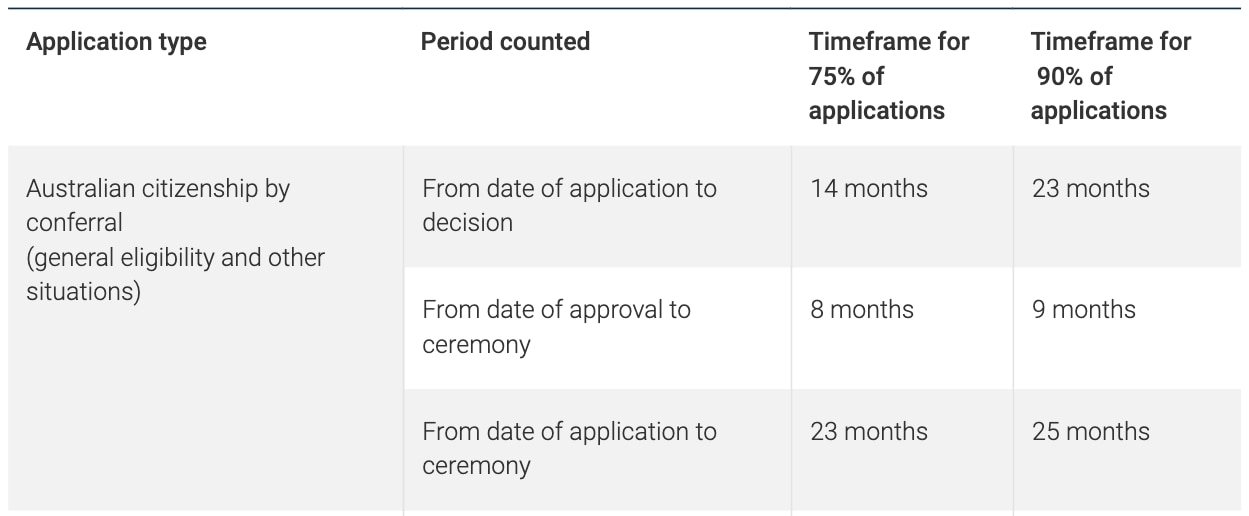
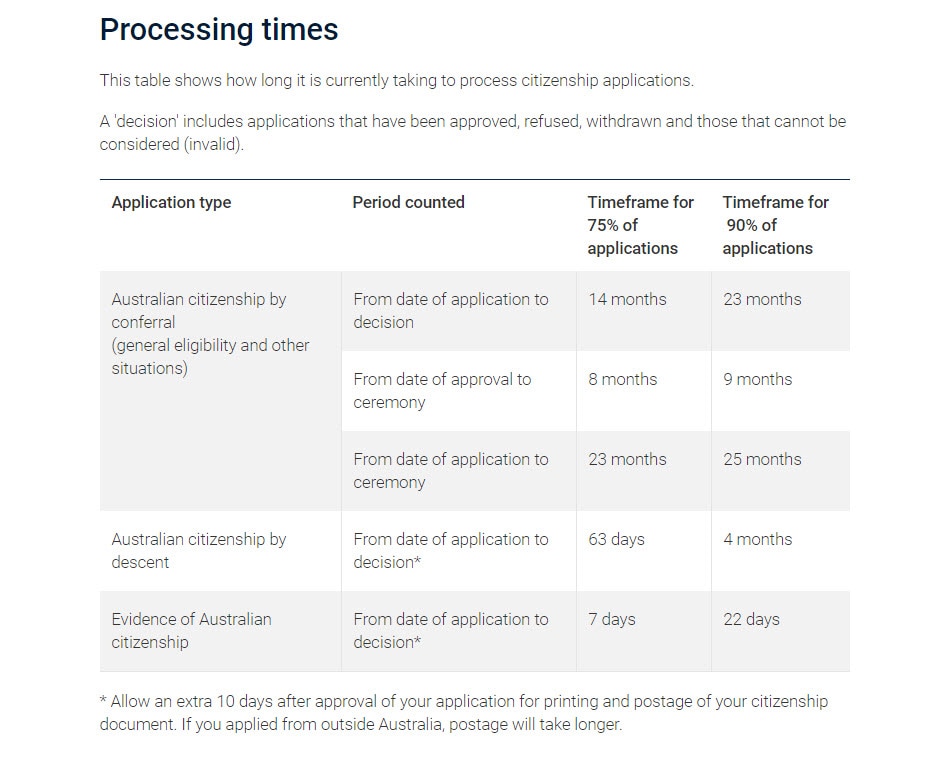
Figures from the Department of Home Affairs show 75 per cent of applications for citizenship by conferral now take 23 months – up from 16 months last June.
Ninety per cent of these applications are completed in 25 months compared to 20 months a year ago.
A department spokesperson told SBS News the pandemic had affected processing.
“Due to the COVID-19 pandemic, all face-to-face citizenship appointments, such as interviews and citizenship tests, have been placed on hold. This has meant an increase in overall processing times,” the spokesperson said.
“The department will recommence in-person interviews and citizenship tests when it is safe to do so,” they said, adding that new applications are still being accepted.
How long it is currently taking to process Australian citizenship by conferral.
The Department of Home Affairs
But Carla Wilshire, CEO of the Migration Council Australia, said these numbers needed to be addressed.
“Once people go down the pathway of citizenship, a lot of decisions are put on hold until that citizenship comes through … It’s important we give them certainty as quickly as possible,” she said.
“Getting those waiting times down is critical in terms of really managing people’s sense that their lives are progressing and they are able to make decisions going forward around their commitment towards Australia.”
“Particularly during COVID, where people have a lot of generalised anxiety and feel a sense of insecurity, I think it’s really important that we take measures to … ensure resources are put to use to give citizenship as quickly as possible.”
It is a point echoed by Melbourne-based migration agent Kirk Yan.
“I haven’t seen the government offer a reasonable or acceptable explanation for the long processing times … They can’t explain why it takes two years,” he said.
“For citizenship, as long as you meet the requirements of a permanent resident, you are supposed to get it granted if you pass the citizenship test and the character or identity checks … I don’t know why it takes such a long time for the department.”
He said the latest rise in wait times left many of his clients anxious.
“The current situation has meant lots of people are waiting, just to get information or a response,” he said.
But even as wait times have gone up, the government has managed to address the backlog of citizenship applications this financial year.
The department spokesperson said during the year 2019-20, up to 22 May this year, 175,304 people were granted Australian citizenship – up 56 per cent on the same period last year.
Over recent months, it has been done via virtual citizenship ceremonies.
More than 750 people have received citizenship through online ceremonies each day since they began, and up to 22 May, more than 16,800 people received citizenship this way.
The latest backlog figure is now 123,727 applications, compared to 221,695 a year ago.
But Migration Council Australia’s Ms Wilshire said this number was “still significant by historical standards”.
“During COVID, there is so much insecurity as people are losing that sense of being able to visit their country of origin and connect with family as global movement is decreasing,” she said.
“I think that affirmation of being part of the Australian community is psychologically quite important for our migrant communities.”
More on Australian citizenship numbers and processing delays:
Highlights:
170,819 people have been conferred Australian citizenship in 2019-20
15,000 people have received citizenship online during the pandemic
117,958 applicants still in the queue for citizenship
“The Government has moved to online citizenship ceremonies during the COVID-19 pandemic. More than 750 online ceremonies are being conducted each day, and to 20 May 2020, more than 15,000 people have received citizenship this way during the pandemic,” a spokesperson from the Department of Home Affairs told SBS Hindi.
“In 2019-20 to 15 May 2020, 170,819 people have been conferred Australian citizenship. This is up 56 per cent on the same period last year,” the spokesperson said.
However, those who have applied for citizenship and are awaiting the outcome of their Australian citizenship application will have to wait longer.
The latest processing times released by the Department of Home Affairs indicates the waiting period for Australian citizenship has shot up.
Compared to waiting period of 16 months, from date of application to ceremony, in June 2019, the average waiting period for 75 per cent of applicants has shot up to 23 months from date of application to ceremony in April 2020.
The latest processing times released by the Department of Home Affairs indicates the waiting period for Australian citizenship has shot up.
Department of Home Affairs
“Due to the health risks, all face-to-face citizenship appointments, such as interviews and citizenship tests, have been placed on hold. This has meant an increase in overall processing times,” the spokesperson said.
“The Department will recommence in-person interviews and citizenship tests when it is safe to do so.
“New applications for Australian citizenship are still able to be accepted during this period.
“Processing continues for applications that do not require a face-to-face appointment. Processing also continues for lodged applications up to the point where an appointment is required so that the applicant will be able to undertake an appointment when it is safe to do so.”
Last month, as COVID-19 pandemic forced citizenship ceremonies to move online, Acting Minister for Immigration, Citizenship, Migrant Services and Multicultural Affairs, Alan Tudge said additional resources will be deployed once it is possible to resume tests and interviews.
‘Additional resources will be deployed to conduct testing and interviews as soon as social distancing measures to prevent the spread of COVID-19 ease,’ he said.
As of April 30, 2020, 117,958* applicants were still awaiting the outcome of their citizenship application.
India top source of Australian citizenship
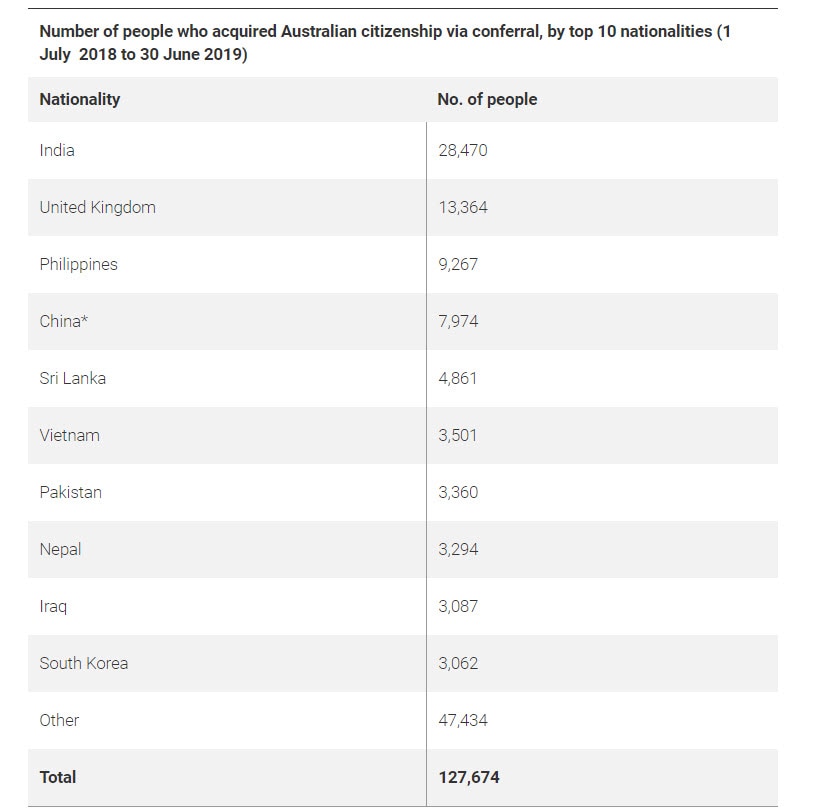
India has been the top source of Australian citizenship for the last two years, with over 28,000 Indian nationals becoming Australian citizens in 2018-19.
Source of Australian Citizenship 2018-19
Department of Home Affairs
Indian-born applicants also top the list of visa recipients by country under Australia’s annual permanent immigration program.
Hard to understand the rationale for appealing the particular case unless there is a general point they wishy to make:
The federal government has lodged an appeal to overturn a Federal Court decision recognising the Australian citizenship of a man born in pre-independence Papua New Guinea (PNG).
Mr Lee, who has lived in Brisbane since the early 1980s, was born in May 1975 in Port Moresby in the Australian external territory of Papua – four months before PNG became an independent country.
In his April judgment, Federal Court judge Darryl Rangiah ruled that at the time PNG became independent, Mr Lee fell within s65(4)(a) of the PNG Constitution “as a person who had the right to permanent residence in Australia and that therefore did not make him a PNG citizen”.
“I make the declaration that the applicant is an ‘Australian citizen’.”
Court documents filed on Friday show the Department of Home Affairs is appealing on the grounds that Justice Rangiah erred in finding Mr Lee was not an “immigrant” under the then Australian Migration Act after PNG independence in September 1975.
The appeal rejects the Federal Court ruling that Mr Lee had the right to Australian permanent residence, did not become a PNG citizen, and had never ceased to be an Australian citizen after independence, and remains an Australian citizen.
Both Mr Lee’s parents are Australian citizens, as are his father’s parents and his younger siblings, who were born in post-independence PNG and obtained Australian citizenship by descent.
“I am indeed deeply disappointed that Home Affairs has decided to make an appeal, but we will keep motoring on until this is finished,” Mr Lee told SBS News.
“Having done nothing wrong and confirmed in the Federal Court that I am an Australia citizen, it would seem there is no error with my status under the Australian Citizenship Act, yet Home Affairs continue to be unfair in dragging out this issue.”
Many PNG-born Australians have been caught out by Australian legislative changes that have resulted in the cancellation of their passports and citizenship certificates, rendering some technically stateless.
The federal government has argued the documents had been incorrectly issued for up to four decades and told those affected to apply for Australian citizenship.
Mr Lee travelled with his mother repeatedly to Australia after PNG independence on her passport and was issued with an Australian passport in 1979 before the family settled permanently in Brisbane in 1982.
Four years ago when he tried to renew his passport, his application was refused.
In the Federal Court hearing, a submission by the acting immigration minister Alan Tudge argued Mr Lee lost his Australian citizenship when PNG became independent in 1975.
“As the matter is before the court it would be inappropriate to comment,” the Department of Home Affairs said in a statement to SBS News on Tuesday.

 Multicultural Meanderings