‘Why not us?’: Asylum seekers on COVID-19 front lines demand permanent residency

All too predictable, the understandable debates over who’s in and who’s out, which happens with respect to most government programs, whether immigration or other:

Doll Jean Frejus Nguessan Bi says he couldn’t sleep at all last night.

The asylum seeker from Ivory Coast works as a security guard in hospitals and long-term care homes in the Montreal area, where he watched many of his colleagues stop coming in as deaths linked to COVID-19 began to mount this spring.

But while Nguessan Bi kept working, he said he found out Friday that he would be excluded from a new government program to fast-track the permanent residency applications of some asylum seekers working on the front lines during the pandemic.

“Why (not) us? We who gave our hearts and our love… Why are we abandoned?” he said in an interview at a protest camp across the street from Prime Minister Justin Trudeau’s Montreal riding office Saturday. “What did we do to deserve this?”

Ottawa announced Friday that asylum seekers working in specific jobs in the health-care sector would be eligible for permanent residency without first having to wait for their asylum claims to be accepted, as is typically the process.

Immigration Minister Marco Mendicino said the move came in response to public demand for so-called “Guardian Angels” — many in Quebec — to be recognized for their work.

“They demonstrated a uniquely Canadian quality in that they were looking out for others and so that is why is today is so special,” Mendicino said in an interview Friday afternoon.

But asylum seekers and their supporters say Ottawa’s plan excludes thousands of workers without permanent status in Canada who have laboured on the front lines during the pandemic, often at great personal risk to themselves and their families.

That includes security guards and janitorial staff, factory workers, and farm labourers, among others.

“I have friends who worked with me in security that abandoned (their posts) because they were afraid of getting infected. But I stayed,” said Nguessan Bi.

He said he wants Trudeau and Quebec Premier Francois Legault to do something to help asylum seekers who are not eligible for the new program.

Several dozen people rallied in front of Trudeau’s office on Saturday to demand permanent residency for all asylum seekers.

“It’s an act of recognition. They deserve status,” Joseph Clormeus, a member of Debout pour la dignite, a Montreal advocacy group that organized the rally, told the crowd.

Anite Presume, a Haitian asylum seeker who came to Quebec in August 2017 from the United States, was among the protesters.

She works in a medication factory, and said she kept working during the pandemic despite the risks.

“To take the bus, we were all stressed, but we still went to work because it was essential. They needed medication for the hospitals,” she said in an interview.

She said she has not received a response yet to her application for asylum in Canada, and lives under a cloud of uncertainty and stress about her future.

“It’s a feeling of rejection,” Presume said, about not being included in Ottawa’s regularization program. “They rejected us as if we did nothing.”

To apply for residency under the new program, applicants must have claimed asylum in Canada prior to March 13 and have spent no less than 120 hours working as an orderly, nurse or another designated occupation between the date of their claim and Aug. 14.

They must also demonstrate they have six months of experience in the profession before they can receive permanent residency and have until the end of August 2021 to meet that requirement.

The program was the result of negotiations between the federal government and Quebec, who have had a strained relationship on the question of immigration, and in particular the asylum claimants, in recent years.

Public support has been building for asylum seekers’ demand for permanent residency after it was revealed that refugee claimants were among those toiling in Quebec’s long-term care facilities, which were hard-hit by COVID-19.

Source: ‘Why not us?’: Asylum seekers on COVID-19 front lines demand permanent residency

Canadian court correctly finds the U.S. is unsafe for refugees

Sean Rehaag and Sharry Aiken on the court decision. To date, haven’t seen any media commentary from those more to the right on the court decision and the CPC Immigration Critic Peter Kent has also been silent. Sharp contrast to all the earlier commentary and criticism:

This week, Canada’s Federal Court ruled that the Canada-U.S. Safe Third Country Agreement (STCA) is unconstitutional.

Under the agreement, refugee claimants entering Canada at land ports-of-entry can be returned directly to the United States without being allowed to make a refugee claim in Canada. The agreement was a quid pro quo for concessions offered to the U.S. after 9/11, including a “smart border” accord, enhanced information-sharing and joint border enforcement.

Advocates for refugees have long argued that the STCA violates international refugee law and Canadian constitutional law. Differences between the refugee determination systems in Canada and the U.S., as well as differences in the rights enjoyed by refugee claimants in both countries, mean that some people who would be recognized as refugees in Canada would be denied protection south of the border.

In other words, the U.S. is not “safe” for at least some refugees.

Trump’s election worsened situation

These arguments took on an especially urgent tone after Donald Trump’s election as American president in November 2016.

The Trump administration has implemented many racist, xenophobic and anti-refugee policies to dissuade people from seeking asylum in the U.S. For example: Harsh detention practices (including detention of young children), family separation, restrictions on the refugee definition (such as excluding people facing gender-based violence), militarization of the border and of course attempting to build a wall along the U.S.-Mexico border.

This prompted a growing chorus of voices — from law professors to human rights organizations and political parties — to call on Canada to suspend or withdraw from the STCA.

Their arguments are persuasive. How can a country be considered safe for refugees if it locks up refugee kids in cages or refuses refugee protection to women facing gender-based violence?

Closing the loophole

Unfortunately, these voices have been ignored. Instead, worried about critiques from the right about weakness on border control, the federal government under Prime Minister Justin Trudeau contemplated trying to get the U.S. to extend the agreement to the entire border — not just official land ports of entry.

The U.S., however, has little incentive to expand the agreement, which would block even more asylum-seekers from leaving the United States for Canada, and there has been little movement on this front.

This inaction left the matter to the courts. Lawyers for refugee and human rights organizations, as well as refugee claimants, went to Federal Court, arguing that the STCA is unconstitutional.

Federal Court Justice Ann Marie McDonald agreed with them.

Her decision focused narrowly on what happens to refugee claimants who are turned away under the STCA.

And what happens is atrocious. Refugee claimants are handed over to American officials who detain them for weeks. Conditions of detention are inhumane. Solitary confinement is common. Access to lawyers is restricted, which makes it harder to secure refugee protection.

Worse still, these are intentional policies aimed at making the experience of seeking asylum in the U.S. so traumatic that others will be discouraged from making the same journey.

As Justice McDonald held:

“The evidence clearly demonstrates that those returned to the U.S. by Canadian officials are detained as a penalty …. penalization of the simple act of making a refugee claim is not in keeping with the spirit or the intention of the STCA or the foundational conventions upon which it was built.”

No safety for refugees

In other words, U.S. immigration detention practices violate international refugee law and undermine the basic premise of the STCA that both countries are safe for refugees.

So there we have it. A Canadian court has determined that American detention practices are “grossly disproportionate” and “shock the conscience,” and that Canada cannot be complicit by sending refugee claimants to the U.S. to face these practices without violating constitutional rights to life, liberty and security of the person.

The question now is what comes next.

The Federal Court suspended its declaration of constitutional invalidity for six months to allow Canadian Parliament to respond.

The government could appeal the decision. If that happens, the STCA will be tangled up in the courts for years — during which time more asylum-seekers like Nedira Mustefa, one of the applicants in the case, will find themselves in solitary confinement in U.S. detention centres. Mustefa told the court she felt “scared, alone and confused,” with no sense of when she would be released, during her time in American detention.

Alternatively, the Canadian government can send a clear signal that it cares about constitutional and international law, heed Justice McDonald’s findings and take steps to immediately suspend the STCA.

The detention practices that she focuses on in her decision are only one among many ways in which the U.S. has attacked refugee rights. These attacks are mounting. The Trump administration recently proposed reforms that would gut what remains of the American asylum system. Every day that the STCA remains in effect, Canada continues to be complicit in these attacks.

Enough is enough. The STCA must be suspended.

Source: Canadian court correctly finds the U.S. is unsafe for refugees

Coyne: If the United States was ever a ‘Safe Third Country,’ it is no longer

Likely the best commentary to date on the Federal Court decision.

Will be interesting to see the commentaries and reactions by those who have roundly criticized the STCA loophole, the Roxham Road asylum seekers and the government’s handling over the next few days:

One of the things on which Canadians like to congratulate themselves is our generous treatment of refugees. And it’s true, up to a point. The protections afforded asylum applicants in Canada not only meet the standards set by the 1951 United Nations Convention Relating to the Status of Refugees, but also exceed them.

Certainly if you compare Canadian refugee policy with that of the United States, it looks considerably more liberal. But here’s the thing: For particular types of refugee claimants, Canadian refugee policy is U.S. policy. For the better part of two decades, since the 2004 Safe Third Country Agreement between the two countries went into effect, asylum seekers arriving at land-based ports of entry on the border have been routinely turned back, without a hearing.

The premise: As each country deems the other to be “safe” in terms of its treatment of refugees (defined, under the UN convention, as those with a “well-founded fear of persecution” in their country of origin), so asylum seekers may be obliged to apply in whichever of the two they first arrive in. In practice, this means the U.S. agrees to take back those applicants Canada refuses to admit; the flow is almost never in the other direction.

That, indeed, was the point. The agreement was struck at Canada’s request in the aftermath of the Sept. 11, 2001, attacks, when it was feared a flood of applicants, fleeing north from the suddenly less hospitable U.S., would overwhelm the Canadian refugee system. It was vintage Canadian hypocrisy: We would preserve our more generous system by offloading much of its work onto their less generous system.

Well, now our bluff has been called. A Federal Court judge has ruled the legislation implementing the treaty is a violation of the Charter of Rights and Freedoms, specifically its guarantees of the right to “life, liberty and security of the person.” The unspoken premise of the agreement, that the Americans’ treatment of refugee claimants may be a little rough and ready, but not so bad as to be intolerable – at least to those not forced to endure it – has been held up to the light of actual experience, and found bogus.

The histories of those who brought the case make harrowing reading: a woman from El Salvador who was raped by gang members, who threatened to kill her and her daughters if she went to the police; a Muslim woman from Ethiopia, a member of its Oromo minority, who had come to the United States as a child but now faced deportation; a family from Syria, also Muslims, fleeing that country’s civil war, only to find themselves in the America of President Donald Trump’s “Muslim ban.”

Yet in all three cases, Canadian border authorities were prepared to hand them back to their U.S. counterparts. Two of the three were spared this fate only because they were able to find a lawyer in time to file emergency stays of removal. The experience of the third, Ethiopian national Nedira Mustefa, is instructive. She was thrown in prison, held in solitary confinement for a week, and detained for a month in appalling conditions: without proper food, in freezing cold, in the same cells as criminals. She told the court she “did not know when [she] would be released, if at all.”

This is not unusual. Evidence before the court showed that those turned back at the border are “immediately and automatically imprisoned” by U.S. authorities, for weeks or even months – as an explicit penalty for having applied for refugee status. They may often find themselves without lawyers, without translators, even without access to a phone. And awaiting them at the end of their ordeal is the very real prospect of deportation, with far fewer legal safeguards than the Canadian refugee determination system provides.

There is no use pretending Canada is not responsible for their treatment, though government lawyers tried. In many cases, they are physically handed over to the Americans by the Canadian authorities whose protection they had sought. Yet there can be little doubt what awaits them on the other side, and little doubt that Canadian authorities know it. It is not the right to live in Canada they are thereby denied. It is the right not to be arbitrarily detained, or to be deported to face death or persecution in their countries of origin. It is, at the very least, the right to have their cases heard fairly, which one part of our laws loudly proclaims while another quietly denies.

As a practical matter, the Safe Third Country Agreement was already imploding under the weight of its many loopholes and anomalies: Applicants who arrived “irregularly,” between ports of entry, were not turned back, even as those who entered by the normal channels were. But now its very premise has been exposed as a lie. Whatever case there may have been for designating the United States as a safe third country while George W. Bush or Barack Obama were president, it no longer exists. Outsourcing Canadian refugee policy was always a morally dicey proposition. In present circumstances, it is untenable.

That isn’t to say that the concerns that gave rise to it are entirely unfounded. The differences between U.S. and Canadian refugee policies are bound to encourage claimants to head from one to the other. Once it is known that Canadian authorities no longer have the legal power to reject their claims out of hand, they may arrive in numbers that our offices are not equipped to handle. But the alternative can no longer be just to turn them back and hope for the best – even assuming we could. Not if we wish to live up to our own lofty ideals.

This was a decision of the Federal Court, not the Supreme Court. The judge has suspended its application by six months. The government may appeal. Or it can use the time to try to come up with a solution. Six months from now there may well be a new administration in Washington. Perhaps it may adopt a less draconian position toward refugee claimants. Perhaps the agreement might even be renegotiated, in a way that gave claimants more incentive to work within the system, because they were less fearful of the result.

But whatever happens, there can be no more pretense. The United States is not a safe third country, and we know it. We have no blind eye left to turn.

Source: If the United States was ever a ‘Safe Third Country,’ it is no longer

Also, a good history and analysis by Richard Warnica:

Lise Thibault slept in the front room, with the window open, so the winter air could slip in and keep her cool. And as she slept, she dreamed. In the distance, outside the field of her sleeping sight, a baby cried. It wasn’t her baby. She knew that, even in her dreams. She was 80 years old then. Her children were grown. They had grown children of their own.

On the baby cried, and Thibault stirred, but she didn’t wake. It was the kind of cry you hear through walls — thin and high and hiccupping. The kind of cry that perks a parent’s ears, no matter how old their children are — the kind of cry you wouldn’t normally hear on a wide, wooded lot in the Quebec countryside, just over the border from Roxham Road.

Thibault opened her eyes and her dream cut short. But the crying didn’t end. It was the middle of the night in late February. Her nearest neighbours were out of earshot. But still the cries carried on. So Thibault rose from her bed. She walked to the window. She looked out into the dark road.

It was late February 2017. Donald Trump had just become president and Justin Trudeau had just told the world, via Twitter, that Canada still welcomed the persecuted and afraid. On Chemin Roxham, where Thibault has lived with her husband since 1968, the border seemed to be fading away. People were walking across — in ones and twos and 10s. They came in families and alone. They walked up a dead-end road in nowhere New York. They crossed a deep ditch and entered Canada, where for a time they became the biggest political story in the country — a lightning rod for debates over border control, loopholes, populism, racism and who is and isn’t a legitimate refugee.

Standing in the snow that night, beneath the amber streetlight, dressed for a different, much warmer world, Thibault saw a young woman holding a baby. A second child, a toddler, stood by her side. “She was so obviously cold,” Thibault said, “and so were the children.” Soon a border control official drove by. He phoned the police, and an officer followed. The mother tried to give him some money, Thibault said, but he refused. Instead, he put the children in the car. “Don’t cry,” he told them. And he drove them all away.

On Wednesday, a federal court judge in Toronto declared that the Safe Third Country Agreement, the border pact that made Roxham Road a thing, violates the Canadian Charter of Rights and Freedoms. The ruling validated decades of arguments made by refugee groups, lawyers and advocates for the displaced and stateless. At the most basic level, it also affirmed what activists on both sides of the border have been saying for almost four years, that the United States, under Donald Trump, is not a safe place for asylum seekers and refugees.

As is often the case with legal rulings of sweeping effect, Wednesday’s judgement actually turned on something quite human and narrow. The case was brought by a coalition of advocacy groups, including the Canadian Council for Refugees and Amnesty International, on behalf of several test plaintiffs. Among those was Nedira Jemal Mustefa, an Ethiopian woman who had lived in the United States since she was 11 years old.

In April 2017, Mustefa tried to cross the border at Saint-Bernard-de-Lacolle, a few kilometres from Roxham Road. After she told border guards she intended to apply for asylum, she was questioned for 30 hours, denied entry then delivered back into the hands of U.S. authorities. She spent the next 30 days in a maximum-security prison in upstate New York sometimes known as “Little Siberia” for its freezing conditions.

For the first seven days in Little Siberia, Mustefa was locked in solitary confinement, an experience she described as “terrifying, isolating and psychologically traumatic.” It was that experience that Federal Court Justice Ann Marie McDonald leaned on in her ruling. The Canadian officials, she wrote, had handed Mustefa over to the U.S. knowing she would be imprisoned, knowing, in other words, that she would be deprived of her fundamental rights under Canadian law.

“The evidence clearly demonstrates that those returned to the U.S. by Canadian officials are detained as a penalty,” she wrote. “The penalization of the simple act of making a refugee claim is not in keeping with the spirit or the intention of the (Safe Third Country Agreement) or the foundational Conventions upon which it was built. … For these reasons, I conclude that the Applicants have established a breach of section 7 of the Charter.”

Ironically, had Mustefa tried to cross the Canadian border a few kilometres away, at Roxham Rd., she would have been allowed in, permitted to make her claim and never would have become a test case. That’s what has long driven critics of the Safe Third Country Agreement, on the left and the right, mad.

The deal, hatched in the aftermath of September 11, 2001, was both incredibly broad and extremely porous. With few exceptions, it meant that anyone crossing into Canada from the U.S., by land, was prevented from making a refugee claim. It worked the other way too. The idea was that both Canada and the U.S. were supposed to be safe, and that would-be refugees should be making their claims in whichever “safe” country they arrived in first.

But it never totally worked that way. Critics on the left argued that the United States was not, in fact, safe. Critics on the right, meanwhile, hammered on the fact that the deal only ever applied at official border crossings. For a long time, those arguments weren’t academic. But they weren’t totally mainstream, either. People crossed irregularly. But never in great numbers. When Donald Trump was elected, the levees broke and the floods began.

Beginning almost immediately after Trump’s election, people starting walking over the border in serious numbers. They crossed in the winter, at great peril, into Manitoba and Saskatchewan. They crossed outside Vancouver and near Niagara Falls. But most of them, tens of thousands of them, crossed at Roxham Road, a dead-end street in upstate New York that ended in a tiny ditch in the Canadian woods.

So many of them crossed, so regularly, that Canadian officials eventually filled in a path over the creek so asylum seekers could roll their luggage across. They hauled in trailers and port-o-potties and built a semi-permanent reception centre on the other side of the border. Mounties would stand and sternly warn asylum seekers they’d be arrested if they crossed, then, once they crossed, help them with their bags.

It was a strange and contradictory thing to witness. And it represented, with each crossing, the strange and contradictory nature of asylum policy under Justin Trudeau. He wanted Canada to look welcoming. It was good for the brand. But he didn’t love dealing with what it meant to welcome so many, so fast.

For months, Roxham Road was the biggest story in Canada. It carried on as a political lightning rod for more than a year. And then, the issue just faded away. The traffic at the border never really stopped. People kept on crossing. But Canadians and Canadian politicians mostly stopped talking about it. The Liberals didn’t love getting painted as soft on border security. The Conservatives weren’t fond of getting lumped in with the angry, anti-outsider right. In any case, when the election came last year, Safe Third Country, asylum seekers, and Roxham Road barely made a ripple.

All the while, in the background, lawyers kept working away at the case that ended Wednesday. And that case means that now, whether they like it or not, the Liberals have to deal with the issues underlying Roxham Road. It is patently clear that the United States under Donald Trump is not a safe country for asylum seekers. Indeed, the Trump administration doesn’t want it to be. That’s their border plan: Make things so inhospitable in the U.S. that asylum seekers never even bother to try. That the Liberal government went to court to argue otherwise was absurd. That they lost was something of a surprise.

What happens next though, isn’t clear. Justice McDonald gave the government a six-month grace period before her ruling comes into effect. In six months, the world could be a different place. Joe Biden could be the U.S. president. The conditions for asylum seekers in the U.S. could be different than they are today. The government could amend the law, appeal the ruling or find another way to punt the issue down the road. Until then, in theory, asylum seekers could still get turned away at a border crossing and welcomed at a border ditch. A system that never totally made sense, one that is now officially, legally, in violation of the Charter, could remain in place.

Whatever comes next, the government should be careful. This country has an obligation to treat people who come here, by any route, as human beings. That obligation doesn’t go away just because our closest neighbour has decided it doesn’t apply to them anymore.
Source: Canadian federal court ruling could mean the end of Roxham Road border crossings

Asylum claims being filed in Canada continue to rise slightly despite pandemic

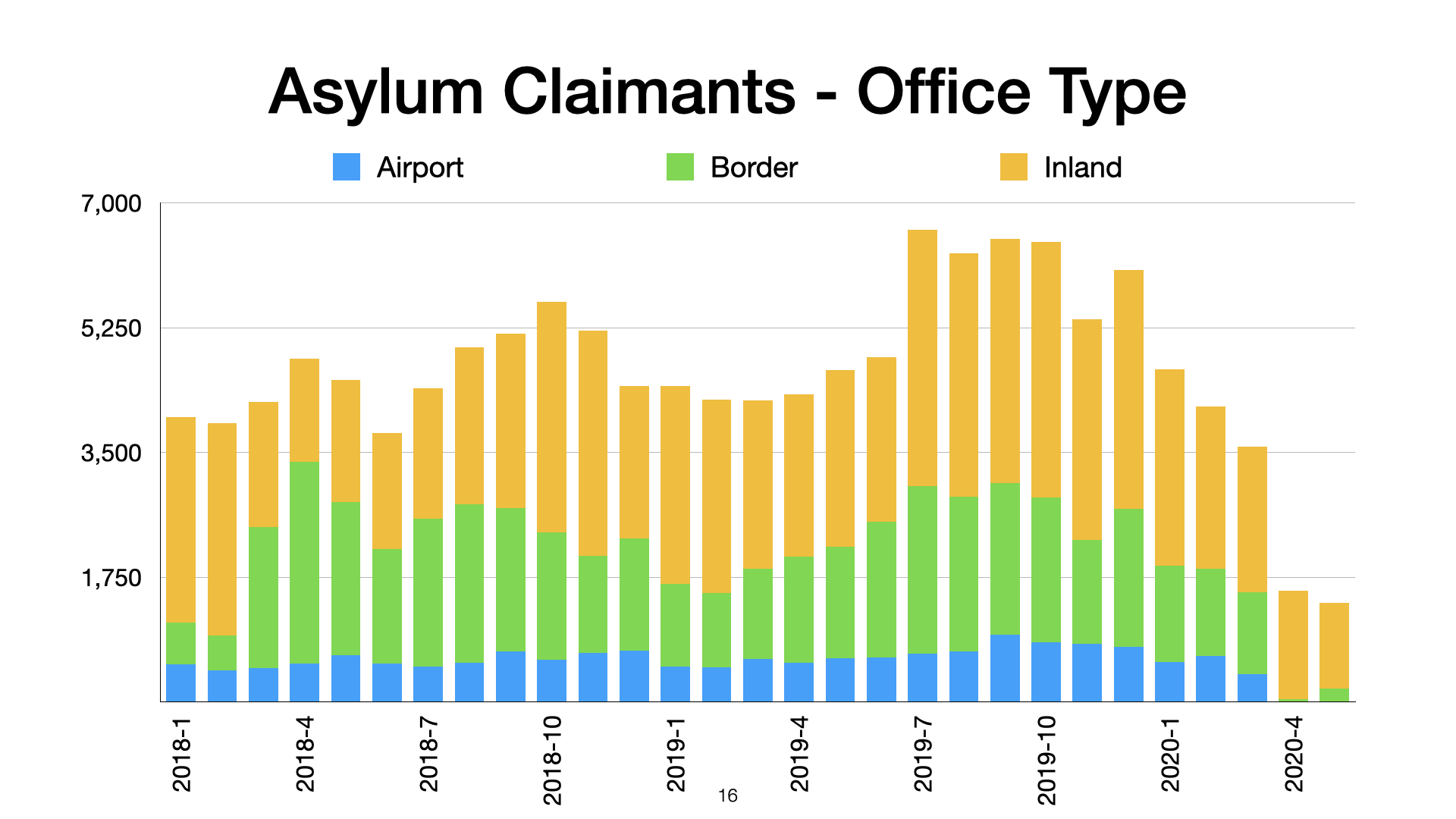
The overall trend, however, is overwhelming lower than pre-COVID as shown in the chart above (June data to be added):

The number of asylum claims being filed in Canada continues to rise slightly despite ongoing global travel restrictions.

The latest figures from the Immigration Department show 1,500 claims for refugee status were filed in Canada in June, up from 1,400 in May.

For the first time since April — the first full month of major travel restrictions designed to slow the spread of COVID-19 —  refugee claims were filed at airports. There were also multiple claims at marine ports.

Also slightly on the rise were the number of people stopped by the RCMP trying to cross irregularly into Canada: 32 in June, up from 21 in May.

Currently, Canada is turning back those who show up at unmarked border crossings, one of several measures being taken at the border in response to the pandemic.

How many people will continue to attempt to enter Canada irregularly may change in the coming months, in the wake of a Federal Court decision Wednesday that the Safe Third Country Agreement between Canada and the U.S. violates the charter.

The agreement is the reason just over 3,000 people this year have tried to cross irregularly into Canada in order to file for asylum. Under the deal, they would be turned away at formal border points.

They can still, however, lodge a claim once they are inside Canada.

But Federal Court Justice Ann Marie McDonald said Wednesday that elements of the law underpinning the agreement violate the constitutional guarantee of life, liberty and security.

Under the agreement, which took effect in 2004, Canada and the U.S. recognize each other as safe places to seek protection.

That means Canada can turn away those who arrive at land ports of entry along the Canada-U.S. border on the basis they must pursue asylum in the U.S., the country where they first arrived.

In the long-running court case, the applicants, who are citizens of El Salvador, Ethiopia and Syria, arrived at a Canadian land entry port from the U.S. and sought refugee protection but were refused.

They had argued in court that when returning ineligible refugee claimants to the U.S., Canada exposes them to risks in the form of detention and other rights violations.

In her decision, McDonald concluded the consequences ineligible claimants may face upon return to the U.S. are “inconsistent with the spirit and objective” of the refugee agreement and amount to a violation of the rights guaranteed by Section 7 of the charter.

The judgement, however, was suspended for six months to allow the government to find a solution.

Talks between Canada and the U.S. to update the Safe Third Country Agreement have been underway for a while, and rights advocates in both countries have urged Canada to use the ruling as opportunity to push them forward.

“Human Rights First notes that the Trump administration’s treatment of asylum seekers is now even worse than it was at the time evidence was submitted in this case,” the non-partisan American group said in a statement.

“In light of the court’s decision and this ongoing deterioration, Human Rights First urges the Canadian government to take this opportunity to withdraw from the ‘safe third country’ agreement.'”

The government can’t sit on its hands and do nothing, said Queen’s University professor and immigration law expert Sharry Aiken.

She said the agreement should be suspended immediately, as the while the court was only dealing with the legality of the deal, it continues to impact refugee claims.

“In my view the Canadian government has a responsibility to act immediately to prevent further violations of our constitution and the international human rights commitments to which Canada has agreed to be bound,” she said.

“It also means that it would be unconscionable for the government to appeal this ruling and seek a stay of the ruling.”

Current travel restrictions in place to slow the spread of COVID-19 appear to have placed downward pressure overall on asylum claims.

By the end of June 2019, 26,725 claims were filed, compared with 16,865 asylum claims filed so far this year.

The rise in June of this year was due to an increase in people already in Canada making claims at government offices, as opposed to those requesting asylum immediately upon arrival in Canada.

Source: Asylum claims being filed in Canada continue to rise slightly despite pandemic

‘Canada cannot turn a blind eye’: Federal court says Safe Third Country Agreement with U.S. violates charter

The big news this week, with the question will the government accept or appeal this decision given that defending the STCA with the Trump administration would be different under a possible Biden administration:

In a ruling that lambastes the American government’s detention of asylum-seekers and chastises Canadian officials as complicit, this country’s Federal Court has ruled the so-called Safe Third Country Agreement is unconstitutional.

The ruling is being hailed as a major victory for refugee rights — and drawing calls from advocates for Ottawa to immediately and unilaterally suspend the agreement with the United States.

“Security of the person encompasses freedom from the threat of physical punishment or suffering,” Justice Ann Marie McDonald wrote in her 62-page decision, which was released Wednesday.

“The accounts of the detainees (in the U.S.) demonstrate both physical and psychological suffering because of detention, and a real risk that they will not be able to assert asylum claims.”

Under the bilateral pact, Canada and the U.S. each recognize the other country as a safe place to seek protection.

That means Canada can turn back potential refugees who arrive at land ports of entry along the Canada-U.S. border on the basis they should pursue their claims in the States, the country where they first arrived.

The agreement, which took effect in 2004, was originally touted by officials in both countries as a way to curb “asylum shopping.” However, critics have long argued that the U.S. asylum system is cruel and inhumane — critiques that have grown louder and more pronounced during the Trump administration.

In its judgment, the court found it unconstitutional to ban would-be claimants from attempting to enter either country at official border crossings. The court gave Ottawa six months to respond and fix the policy to make sure it complies with the Canadian charter before declaring the accord invalid.

“The evidence demonstrates that the immediate consequence to ineligible STCA claimants is that they will be imprisoned solely for having attempted to make a refugee claim in Canada,” McDonald said. “The ‘sharing of responsibility’ objective of the STCA should entail some guarantee of access to a fair refugee process.”

Refugee advocates urged the Liberal government to move quickly to suspend the agreement, which the terms allow.

“Refugee claimants turned away at the Canada-U.S. border face grave human rights violations in the United States, notably atrocious conditions in immigration detention,” said Alex Neve, Secretary General of Amnesty International Canada, one of the parties.

“Under no circumstances should the government consider appealing this ruling. It is time to stop pretending that all is right when it comes to protecting the rights of refugees in the U.S. Not one more refugee claimant should be turned away at the Canada-U.S. border.”

Mary-Liz Power, spokesperson for Public Safety Minister Bill Blair, would not say whether the government planned to appeal the court decision.

“We are aware of the Federal Court’s decision and are currently reviewing it. Although the Federal Court has made its ruling, that decision does not come in effect until January 22, 2021. The Safe Third Country Agreement remains in effect,” Power said in an email.

U.S. President Donald Trump’s anti-migrant policies have spurred an influx of so-called irregular migrants skirting asylum restrictions by crossing outside of Canada’s official ports of entry, where restrictions have applied.

More than 50,000 asylum seekers have come here that way via the U.S. over the past two years. Once here, after passing initial medical and security screenings, refugees can work and access health-care pending a decision on their asylum claims.

“When the Trump administration attempted to impose their travel ban in January 2017, it was obvious that the Liberal government could no longer count on the United States to live up to its international and humanitarian obligations,” said NDP immigration critic Jenny Kwan.

“Contrary to what Minister Blair has said in the past, this (ruling) proves that refugees are not simply ‘asylum shopping.’”

After Trump’s election in November 2016 with an anti-immigration agenda, Canadian and U.S. non-governmental organizations and refugee lawyers started their effort to challenge the legality of the asylum restrictions.

In 2017, they connected with a Salvadoran woman in the U.S. who sought asylum after she was raped and threatened by the notorious Mara Salvatrucha gang in El Salvador, and agreed to be the lead litigant. The other litigants included a Syrian family of four and a young Ethiopian woman, all of whom were denied access to asylum in Canada. The three Canadian rights groups, including the Canadian Council for Refugees and the Canadian Council of Churches, also enlisted nine other witnesses

During the hearing in November, the court reviewed evidence that showed detainees in the U.S. had no access to phone calls and legal counsel or translators; have been lost due to transfers between detention centres; and sometimes were held in solitary confinement.

“The court could hardly fail to be moved by the testimonies of the appalling experiences of people in the U.S. immigration detention system, after Canada closed the doors on them,” said Dorota Blumczynska, president of the Canadian Council for Refugees.

“Their experiences show us and convinced the court that the U.S. cannot be considered a safe country for refugees.”

The court decision also called out Canadian officials’ responsibility.

“Canada cannot turn a blind eye to the consequences … in its efforts to adhere to the STCA. The evidence clearly demonstrates that those returned to the U.S. by Canadian officials are detained as a penalty,” Justice McDonald wrote.

Queen’s University immigration law professor Sharry Aiken said it’s “reasonable” to expect an influx of refugee claimants at official ports of entry from south of border in light of the ruling, though it may not happen immediately due to the COVID-19 border restrictions.

“The court ruling itself does not address the current (pandemic) context but the implications of the ruling signal that Canada should step up immediately to protect the rights of claimants approaching Canada for asylum,” Aiken said.

“Canada has proven itself more than capable of adequately addressing spikes in the numbers of asylum seekers. Constitutional rights are not about the numbers, in any event.”

Source: https://www.thestar.com/news/canada/2020/07/22/canadian-court-says-safe-third-country-agreement-with-us-violates-charter.html

Trump administration extends work visa ban, creating uncertainty for Canadians

The Canadian angle (applies more broadly of course, with India likely being the country most affected):

The Trump administration said Monday that it is extending a ban on green cards issued outside the United States until the end of the year and adding many temporary work visas to the freeze — including those used heavily by technology companies and multinational corporations — tossing a cloud of uncertainty over thousands of Canadians, including cross-border workers and their families.

The administration cast the effort as a way to free up jobs in an economy reeling from the coronavirus. A senior official who spoke to reporters on condition of anonymity estimated the restrictions will free up to 525,000 jobs for Americans.

The ban, while temporary, would amount to major restructuring of legal immigration if made permanent, a goal that had eluded the administration before the pandemic. Long-term changes targeting asylum seekers and high-tech workers are also being sought.

Business groups pressed hard to limit the changes, but got little of what they wanted, marking a victory for immigration hardliners as Trump seeks to further solidify their support ahead of the November election.

The ban on new visas applies to H-1B visas, which are widely used by major American and Indian technology company workers and their families, H-2B visas for nonagricultural seasonal workers, J-1 visas for cultural exchanges and L-1 visas for managers and other key employees of multinational corporations.

There will be exemptions for food processing workers, which make up about 15 per cent of H-2B visas, the official said. Health care workers assisting with the coronavirus fight will continue to be spared from the green-card freeze, though their exemption will be narrower.

“In the administration of our nation’s immigration system, we must remain mindful of the impact of foreign workers on the United States labour market, particularly in the current extraordinary environment of high domestic unemployment and depressed demand for labour,” Trump wrote in his presidential proclamation.

Potential effect on Canadians

These moves could affect thousands of Canadians. They are far more severe than an earlier immigration announcement from Trump in April, which affected only applications for permanent immigration visas.

The new provisions touch work visas used by many Canadians. Canadians filed more than 4,000 H-1B applications in each of the last two years, and numerous others would get L1 business visas in a normal year, including executives working for cross-border companies.

Source: Trump administration extends work visa ban, creating uncertainty for Canadians

@Picardonhealth How should we thank our guardian angels? Certainly not with deportation

Petty not to do so:

They call them the “guardian angels,” the thousands of personal-support workers (PSWs), orderlies, cooks and janitors who have been toiling for months in Quebec’s beleaguered and often overwhelmed long-term care homes during the COVID-19 pandemic.

Almost all of them are women, many from racialized communities, including a disproportionately large number from Quebec’s Haitian community.

In recent days, one subset of this overworked, underpaid work force has received a lot of attention – asylum seekers.

Why?

Because, despite doing essential work that no one else would and literally putting their lives at risk, juggling multiple part-time gigs for as little as $13 an hour, many of these front-line workers could face deportation.

That’s disgraceful, and un-Canadian.

Lawyer and social entrepreneur Fabrice Vil has been leading the social-media campaign #JeMeSouviendrai (I will remember) to get the provincial and federal governments to “regularize” the immigration status of asylum seekers working as essential workers.

“This pandemic has shown us the human face and the real sacrifices of essential workers,” Mr. Vil said on the popular Radio-Canada talk show Tout le monde en parle. “When people make a contribution to society, we need to recognize that contribution.”

Quebec Premier François Legault has been cool to the idea, but in recent days, in response to growing public pressure, he has softened his position a bit.

A little recent history helps explain the political volatility of this issue.

In 2017 and 2018, more than 37,000 people made an “irregular” border crossing and requested asylum in Canada. Most of them simply trudged up Roxham Road in Saint-Bernard-de-Lacolle, Que., exploiting a loophole in the Canada-U.S. Safe Third Country Agreement, which said they could only be turned back at official border crossings.

Before he was Premier, Mr. Legault took a hard line on the asylum seekers, saying Quebec could not welcome “all the world’s misery” and demanding the Roxham Road crossing be shut down. It has been. Since March, there have been only 14 “irregular” crossings and all have been sent back to the United States. Yet, “Roxham Road” remains a dog-whistle term for anti-immigration proponents.

Let’s not forget that most of the asylum seekers have been working while waiting for their cases to be processed. Many have been working in long-term care for two or three years, invisible until the pandemic hit.

When the idea of granting residency to asylum seekers was first floated, the now-Premier rejected it out of hand, saying: “We can’t open the door and say, ‘If you come here illegally, if you find a job, we’ll accept you as an immigrant.’ That’s not how it works.”

His critics responded by saying that, first of all, asylum seekers are not illegals. Further, they stressed that what is wanted is a special dispensation for those who work in health care facilities in these extraordinarily difficult times. The precise number is unclear, but believed to be at least 2,000.

Mr. Legault responded by promising to review their requests on a case-by-case basis, potentially accepting them as economic immigrants. (While immigration is a federal jurisdiction, this is a provincial program.) Federal Immigration Minister Marco Mendicino has tried to stay out of the fray, saying “all asylum claimants will receive a fair and full hearing on the individual merits of their claim.”

Quebec’s Immigration Minister, Simon Jolin-Barrette, has also announced a plan to recruit 550 temporary workers as PSWs and fast-track their permanent residency applications.

Around the same time, Quebec also announced a bold plan to hire 10,000 PSWs by offering a paid three-month training course and full-time jobs at $26 an hour. (About a $50,000 annual salary.)

The catch is that the program is only for Canadian citizens, so asylum seekers, refugees and migrant workers are shut out again.

This sparked another wave of outrage.

Wilner Cayo of the advocacy group Debout pour la dignité says the exclusion adds insult to injury.

“These women were good when it came to working for a miserable salary,” he told CBC News. “But now that this work is going to be well paid, the thank-you they get is ‘You can’t be part of the program.’”

At a demonstration last week, the sentiment was well summarized on a protester’s sign, written in Haitian Créole: “Nou pap mouri pou gran mèsi!”

Translation: “We will not die for a ‘thank you’ and we will not die in vain.”

Indeed, a proper thank-you must begin with granting permanent residency. Then full-time jobs. And speeding up family reunifications.

It’s the least we can do for these guardian angels, for services rendered selflessly.

Source: How should we thank our guardian angels? Certainly not with deportation

Legault promises to give asylum seekers working in CHSLDs a chance to apply as immigrants

Reality intrudes:

Quebec Premier François Legault says he will consider giving asylum seekers who work in long-term care homes a chance to stay in the province by applying as immigrants.

Legault opened Monday’s briefing by saying he has asked Immigration Minister Simon-Jolin Barrette to look at the situation, on a case-by-case basis, as a way of saying “thank you.”

The co​​​​mments represent a departure for Legault. The Coalition Avenir Québec premier has previously rejected the idea of giving any kind of preference for asylum seekers and others without status working in essential jobs during the pandemic.

But there have been growing calls for him to recognize their contribution.

On Saturday, supporters held a rally in Montreal and on Sunday, Fabrice Vil, a Montrealer of Haitian background, was critical of the premier on the popular French-language talk show Tout le monde en parle.

Legault, whose government has cut immigration levels, said Monday he would try to strike a balance between giving thanks to those working in the residences, known by their French initials CHSLDs, while at the same time not setting a precedent.

“We have to be careful. I don’t want to send the message that in the future we will accept everybody if they find a job in Quebec,” he said.

“But we also have another situation where it’s really critical to get more people working in our CHSLD. So those people, they are already working in CHSLDs. So how can we bring them via the normal immigration process? That’s what I’m looking at.”

Legault added his government would also have discussions with the federal government, which is responsible for refugee applications.

While the province says it has no record of the total number of asylum seekers doing work in CHSLDs, advocates say hundreds of people, many of them originally from Haiti, have been working as patient attendants.

Some have already had their refugee claim rejected, and may not be able to stay in Canada when deportations resume.

Protest at PM’s office

Protestors rallied outside Prime Minister Justin Trudeau’s Montreal office on Saturday, demanding he do more for asylum seekers who have been risking their lives by working in long-term care homes with COVID-19 outbreaks.

Frantz André, a member of the Action Committee for People without Status in Montreal, the group behind the demonstration, said Legault should be taking a stronger stand on the issue.

While the federal government makes the final decision when it comes to the immigration status of asylum seekers, provincial leaders are able to influence those decisions, he said.

“I think all the parties, including the CAQ, should have said in one voice, ‘Mr. Trudeau, you need to make a decision,'” André told CBC News on Monday.

“We as Quebecers, we are willing to give people an opportunity to be accepted, to be equally Canadian as anybody else.”

Source: Legault promises to give asylum seekers working in CHSLDs a chance to apply as immigrants

Fewer than 10 asylum seekers sent back to U.S. since Canadian border shutdown: Blair

As expected. Full April stats, when available in about a month, will show a dramatic decline in overall numbers:

The federal public safety minister says fewer than 10 asylum seekers have been turned back to the U.S. since the historic shutdown of the border.

Bill Blair provided the figure to the House of Commons today, noting it has been almost a month since the Canada-U.S. border closed to all but non-essential travel to help curb the spread of COVID-19.

The deal struck by the two countries included a provision that those crossing between formal border points in order to seek asylum would also be turned back.

Figures published today by the Immigration Department suggest, however, that the flow of people prior to that remained relatively steady.

The RCMP intercepted 930 people crossing irregularly in Canada in March, down from 1,002 the same month last year.

So far this year, 3,035 people have been intercepted crossing between formal border points, up from 2,698 in the first three months of 2019.

Source:  Less than 10 asylum seekers sent back to U.S. since Canadian border shutdown: Blair – National

With COVID-19 clampdown, number of asylum seekers at Canada-U.S. border slows to a trickle

As expected. Full March numbers not out yet so these interim numbers highlight the impact from March 21:

Sweeping changes at Canada’s borders under emergency pandemic restrictions have slowed cross-border traffic to an unparalleled trickle, including people claiming persecution abroad.

Six asylum seekers were turned back at Canada’s border with the United States under recent COVID-19 restrictions, four of them irregular border crossers, from March 21 to April 2, according to data from Canada Border Services Agency (CBSA).

March 21 was the day the highly unusual emergency order under the Quarantine Act prohibited entry into Canada by people claiming refugee protection.

Only one asylum seeker has been allowed to proceed into Canada under exemptions to the closed border rule, which could mean the person was an American citizen.

Of the four irregular crossers, which are sometimes referred to as illegal border crossers, two were stopped after crossing into Quebec and two into British Columbia.

The remaining two asylum seekers arrived from the United States at a border entry point in southern Ontario and were also turned back, CBSA said. The agency refused to say what country any of these people were seeking protection from.

“Failure to comply with a direct back order could result in the foreign national to become inadmissible to Canada,” said Jacqueline Callin, a spokeswoman for CBSA. “This regulation will be applied to all foreign nationals seeking to enter Canada if their entry is prohibited — regardless if they enter irregularly or at a designated land port of entry.

“Asylum claimants will be asked to provide basic identifying information and requested to return to make their asylum claim after the temporary prohibition has been lifted.”

That stands in sharp contrast to what is typical border activity.

CBSA would not provide the numbers of asylum claims for the same period last year. However, as a point of contrast, in all of March 2019, the RCMP made 1,001 interceptions of asylum seekers who did not cross at a formal border checkpoint: 967 in Quebec, 22 in B.C., and 13 in Manitoba.

That same month there were a total of 1,870 asylum claims made at formal border crossing points, which was itself one of the lowest monthly totals for the year.

There are far fewer new cases of refugee claimants at the Immigration and Refugee Board (IRB).

The Refugee Protection Division of the IRB received 304 refugee protection claims nationally from March 21 and April 5, according to IRB data. While a specific comparison to the same period last year was not available, in 2019, the IRB had an overall average of 2,245 referrals in a two-week period.

This does not mean all 304 claimants crossed the border since the COVID-19 travel restrictions, however. There may be delays between a claimant’s arrival in Canada and a referral to the IRB, said Anna Pape, a spokeswoman for the IRB.

The steep drop in asylum seekers in Canada mirrors the unparalleled drop in all border traffic under COVID-19.

From March 23 to March 29, there were almost 82 per cent fewer land crossings into Canada compared with the same period last year, and an almost 85 per cent drop in people arriving by air.

On March 16, in an abrupt about-face, Prime Minister Justin Trudeau said foreign travellers were prevented from entering Canada, except for U.S. citizens, to curtail the spread of the novel coronavirus.

Despite that, the next day, Minister of Public Safety Bill Blair said irregular border crossers would undergo medical screening but still be allowed to proceed for assessment of their immigration claims in Canada.

The following day,  borders were clamped down even tighter with the Canada-U.S. border closed to all non-essential travel, regardless of citizenship.

On March 20, in a further change, the government announced that asylum seekers will also be rejected at the border for the time being.

All travellers arriving in Canada — including Canadian citizens — are being met with increased intervention and screening in light of COVID-19.

Temperatures, however, are not taken by CBSA at borders or airports.

During a similar but less severe pandemic, the Severe Acute Respiratory Syndrome (SARS) outbreak in 2003, temperature testing was found to be an ineffective control, CBSA said. During SARS, 2.3 million travellers had temperatures taken at Canada’s airports.

“Despite this intensive screening effort, no cases of SARS were detected using these methods,” said Callin.

Source: With COVID-19 clampdown, number of asylum seekers at Canada-U.S. border slows to a trickle