Mexico Deports Most of Its Detained Migrant Population

Of note, reflecting in part the effect of the Trump administration cutting off Central American access to the American asylum system:

On Sunday, Mexico’s National Institute of Migration (INM) announced the repatriation of 3,653 Central American migrants. The measure comes after growing concern over Covid-19 spreading in INM detention facilities throughout Mexico.

Mexico recently has faced issues attempting to deport Central American citizens back to their home countries. Guatemala, Honduras, and El Salvador closed their borders to citizens and aliens.

The INM said: “In the face of the health emergency caused by Covid-19, the Ministry of the Interior, the National Institute of Migration (INM), acts responsibly and safeguards the integrity of the population in the context of migration by seeking to fully guarantee their human rights.”

Guatemalan nationals were sent back by bus and Honduran and Salvadoran migrants were transported by aircraft to their countries of origin. The International Organization for Migrants administered the flight arrangements to Central America.

In March, the INM had 3,579 foreign nationals housed throughout its 65 detention facilities and shelters. As of Sunday, the number had decreased to 106 migrants — a 97 percent reduction in the detained migrant population.

The remaining aliens gave their consent to stay in Mexican custody. Religious organizations have assisted with shelter accommodations for migrants choosing to stay in Mexico.

The United Nations, the National Human Rights Commission of Mexico, and dozens of other activist organizations supported the mass release of foreign nationals from INM custody.

Additionally, the INM expressed its support of Mexican nationals being repatriated from the United States to prevent the spread of Covid-19 amongst their countrymen.

And Mexico’s Ministry of Foreign Relations announced that it had been able to repatriate more than 129 Mexican people from Honduras and 30 from El Salvador.

Source: Mexico Deports Most of Its Detained Migrant Population

More resources needed for federal agencies processing refugee claims: AG

No surprise here, reflecting some long-term and ongoing issues:

Canada’s refugee and asylum system will continue to be overwhelmed if additional resources are not committed to the three federal agencies responsible for processing refugee claims, the country’s auditor general said Tuesday.

“We project that if the number of asylum claimants remains steady at around 50,000 per year, the wait time for protection decisions will increase to five years by 2024 — more than double the current wait time,” interim Auditor General Sylvain Ricard said in his spring report.

The current backlog, the auditor general said, is “worse than in 2012,” when a mountain of unresolved claims led the Harper government to reform the system.

The federal watchdog said in December last year that some 71,380 people were waiting for their claims to be heard. In March 2010, that number was 59,000.

Canada was the ninth-largest recipient of refugee and asylum claimants in 2017, with some 50,400 claims filed, a number that jumped to 55,000 in 2018.

About 40,000 of those asylum claimants came via the United States, with most crossing into Quebec.

The surge of claimants has put additional pressure on a system that has long grappled with processing delays, the auditor general’s office said — a crunch that is expected to continue if funding levels and processing capacity remains the same.

“Overall we found Canada’s refugee determination system was not equipped to process claims according to the required timelines,” the report notes.

Long wait times

At the end of December 2018, the auditor general’s office said the average wait time for a decision in Canada was two years. As of 2012, refugee claimants are supposed to have a hearing scheduled within 60 days of their arrival in Canada. 

In the March 2019 budget, the Trudeau government pledged $1.18 billion over five years for Canada’s strained refugee claimant system.

“Budget 2019 did provide additional resources to enhance the capacity of the system but it was not clear exactly how it’s going to deal with the backlog and reduce the wait times for claimants,” said Carol McCalla, the principal director of the auditor general’s report on processing asylum claims.

About 65 per cent of claimants have seen their hearings delayed at least once, the auditor general said — an action that led to an additional five-month delay, on average. 

About 25 per cent of claims made saw multiple delays, the auditor general said, noting most of the holdups were “due to administrative issues within the government’s control.” 

In almost half of the cases, hearings were delayed because a member of the Immigration and Refugee Board of Canada was unavailable. 

Another 10 per cent of cases were stalled because security screens were still being processed, even though the necessary paperwork had already been filed in one in five of the cases delayed for security reasons.

CBSA has since reallocated resources to “significantly improve the timeliness of security screening,” the auditor general’s report noted.

Canada’s refugee processing system isn’t utilizing available fast-tracks, either — processes that allow the Immigration and Refugee Board of Canada to decide certain claims by simply reviewing a file rather than hold a hearing. 

The auditor general found the board only expedited about 25 per cent of eligible cases, even though 87 per cent of the remaining eligible cases eventually received a positive outcome. 

“Moreover, we found the Board did not process expedited claims more quickly,” the report said. “On average decisions for expedited claims took about the same amount of time as regular claims.” 

The board, the auditor general noted, announced changes to its expediting processing system in January.

Missing security checks

Processing delays weren’t the only issue flagged by Canada’s auditor general Tuesday. 

Canada’s federal watchdog also found poor quality assurance checks between Canada Border Services Agency and the federal immigration department meant about 400 applicants (or 0.5 per cent) were not subjected to the necessary criminal or identity checks because of system errors or failure to take claimants’ fingerprints. 

“Neither organization systematically tracked whether a criminal records check was always completed because of poor data quality,” the report reads, adding those records are “important for public safety and the integrity of the refugee determination system.”

In a statement Tuesday afternoon, Public Safety Minister Ralph Goodale’s office said initial screening by CBSA of individuals arriving in Canada include biometric and biographic screening.

“This layer of screening screens out individuals with serious criminality. No individuals with serious criminality or security concerns were allowed into admitted to Canada,” Goodale’s office said.

“With respect to the layer of biometric screening examined by the Auditor General, the only new piece of information captured by this layer of screening is whether or not an individual had previously claimed asylum in another country.”

Poor data quality wasn’t the only concern flagged by the auditor general’s office.

Canada’s federal watchdog said poor communication between the three organizations responsible for Canada’s asylum claim system was made worse by the fact the CBSA, the federal immigration department and the Immigration and Refugee Board of Canada use “different information technology systems, with limited interoperability.” 

As a result, the auditor general said it found “important gaps in which information was not shared, such as changes to hearing dates.”

“The system needs to be more flexible to be able to be scalable to increases in demand. As well, improvements are needed in how it uses its resources to share the information and processes the claims more efficiently,” McCalla said.

All three organizations also remain heavily dependent on paper and faxes to share specific claim information, the auditor general said, with the Immigration and Refugee Board of Canada relying “almost exclusively on paper files in its work.” 

“Collecting and sharing information securely and efficiently are critical to the proper processing of asylum claims, especially when claim volumes are high,” the report noted.

In response to the auditor general’s report, all three organizations pledged to improve their quality assurance programs. “Through regular monitoring, issues such as missing, delayed, incomplete, or ineligible claimant information will be identified and addressed in a timely manner by the responsible organization,” reads a statement attributed to the organizations in the report.

Additional work will also be done to improve the department and agency’s technological capabilities, they said, including an eventual shift to digital processing.

Source: More resources needed for federal agencies processing refugee claims: AG

Mexican Asylum Claims Skyrocket Since the Trudeau Government Eliminated Visa for Mexican Nationals

The numbers have increased dramatically although without the IRCC background documents, we do not know whether this extent was predicted or not. But there was a clear trade-off between economic and political considerations and maintaining the visa requirement.

The previous Conservative government faced similar pressures from the EU with respect to the visa requirements then in place for Bulgaria and Romania but were defeated before they had to make a similar decision (EU visa standoff strains allies Canada needs to pass trade deal. The Conservative government did drop the visa requirement for Czech nationals facing this pressure. The Liberal government dropped the visa requirement for Bulgaria and Romania (only Romania figures in the top 25 asylum claimant countries):

After the Trudeau government changed Canada’s visa rules, the number of Mexican refugee claimants in Canada skyrocketed.

2,445 Mexican visitors to Canada failed to leave and instead applied for refugee status in Canada during the first ten months of 2018, according to new data from Immigration Refugee Citizenship Canada (IRCC) .

The number of Mexican asylum claimants to Canada in on track to rise almost 75% above the previous year’s total, or an 840% increase from 2016’s total.

In July 2016, the Trudeau government removed the visitor visa for Mexicans travelling to Canada —  a visa imposed by the Harper government back in 2009 to end a surge of Mexicans claiming refugee status — despite the fact that the visa significantly reduced the number of asylum claims.

In 2016, the number of Mexican asylum seekers jumped to 260 from 111 the previous year, then surged to 1,515 in 2017, and continued to climb dramatically in 2018, rising to 2,445 claims in the first 10 months.

Number of Annual Asylum Claims from Mexican Nationals

2007 2008 2009 2010 2011 2012 2013 2014 2015 2016 2017 2018
7,153 9,454 7,581 1,197 649 321 84 80 111 260 1,515 2,445

Source: Department of Citizenship and Immigration Canada

“Our Government took a pivotal step towards rebuilding and strengthening our relationship with Mexico, which was damaged considerably under the previous government,” said Immigration Minister Ahmed Hussen’s spokesperson Mathieu Genest in an email.

“The visa lift has helped expand trade and business opportunities, increase investment and tourism, and strengthen people-to-people ties that benefit both countries. In 2017 alone, the increase in business travellers and tourists generated more than $600 million in economic benefits for Canada.”

Not everyone shares the Trudeau government’s optimism.

Toronto Immigration lawyer Guidy Mamann pointed out that, “the decision was definitely not consistent with traditional immigration policy.”

“This was completely anticipated by anyone who knows anything about it. It was done for purely political reasons. Mexico is a full participant in NAFTA and didn’t want to feel like the poor cousin of the trio. The cost was anticipated and was undertaken as the ‘cost of doing (international) business,’” said Mamann in an email.

“I would bet that any report by the CBSA (Canadian Border Services Agency) or CIC (the Department of Citizenship and Immigration Canada, now know as Immigration Refugee Citizenship Canada or IRCC) that was requested by the government at that time would have warned of a significant increase in refugees claims,” he said.

Prior to the Harper government’s policy that made it mandatory for Mexicans travelling to Canada to get a travel visa, only a small fraction of the thousands of Mexicans asking for refugee status were deemed by the Immigration and Refugee Board of Canada to be legitimate claimants. In 2008, for instance, Mexico comprised 26% of all asylum claims in Canada.

About 90% of those claims were eventually either rejected or abandoned.

“It would be inappropriate to speculate on asylum claims before the IRB,” said Genest about the low success rate of past Mexican refugee claimants being a concern with the latest spike in claims.

“The IRB is an independent, quasi-judicial tribunal that operates at arms-length from the government to assess and make decisions on all refugee claims. Each case is evaluated on its own merits, and those with a well-founded fear of persecution are permitted to stay and those who are found to not have a legitimate claim are removed.”

Canada’s asylum system costs taxpayers billions of dollars every year.

Trump Claims There Is a Crisis at the Border. What’s the Reality?

Good analysis of the numbers:

President Trump has frequently called the situation at the southern border with Mexico a crisis and insists that building his long-promised border wall will fix it. Here are some of Mr. Trump’s most common assertions of a crisis, and the reality of what we know about immigrants and the border.

“We can’t have people pouring into our country like they have over the last 10 years.”

THE REALITY Illegal border crossings have been declining for nearly two decades. In 2017, border-crossing apprehensions were at their lowest point since 1971.

Total number of arrests for illegally crossing the Mexican border

Undetected illegal border crossings have dropped at an even faster rate, from 851,000 in 2006 to approximately 62,000 in 2016, according to estimates by the Department of Homeland Security.

However, there is one group of migrants that is on the rise: families. A record number of families have tried to cross the border in recent months, overwhelming officials at the border and creating a new kind of humanitarian crisis.

Number of arrests for illegally crossing the Mexican border

Asylum claims have also jumped, with many migrant families telling officials that they fear returning to their home countries. Seeking asylum is one way to legally migrate to the United States, but only 21 percent of asylum claims were granted in 2018, and many cases can take years to be resolved.

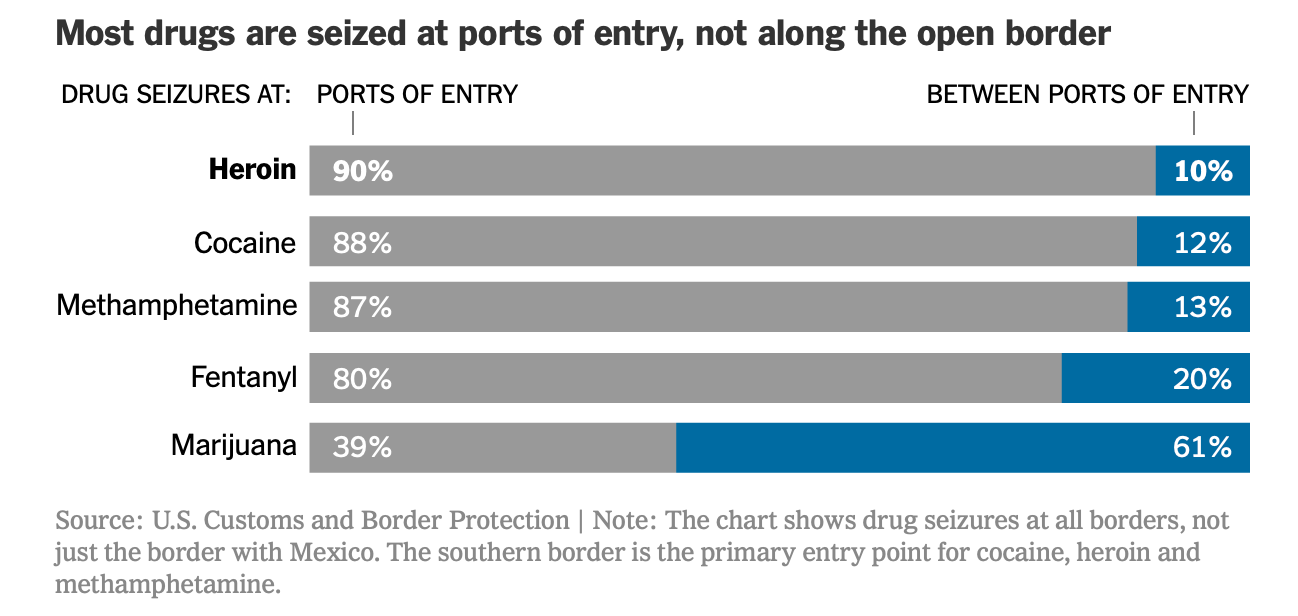
“Every week, 300 of our citizens are killed by heroin alone, 90 percent of which floods across from our southern border.”

THE REALITY It is true that the majority of heroin enters the United States through the southern border, according to the Drug Enforcement Administration. But the D.E.A. also saysthat most heroin is brought into the country in vehicles entering through legal border crossings, not through the areas where walls are proposed or already exist.

Most drugs are seized at ports of entry, not along the open border

There are more than two dozen ports of entry along the southern border. Barriers are already present in Border Patrol sectors with the highest volumes of heroin seizures.

“Over the years, thousands of Americans have been brutally killed by those who illegally entered our country, and thousands more lives will be lost if we don’t act right now.”

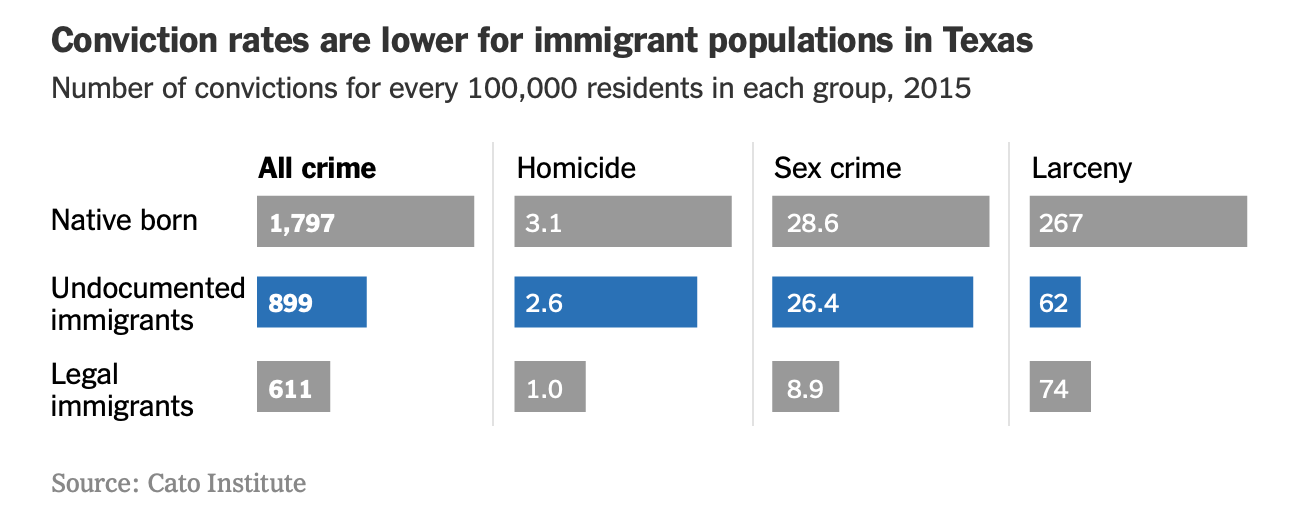
THE REALITY It is difficult to assess the president’s claims that illegal immigration leads to more crime because few law enforcement agencies release crime data that includes immigration status. However, several studies have found no link between immigration and crime, and some have found lower crime rates among immigrants.

Texas, which has the longest border with Mexico and has one of the largest populations of undocumented immigrants of any state, keeps track of immigration status as part of its crime data. The Cato Institute, a libertarian research center, analyzed the Texas data in a 2015 study and found that the rate of crime among undocumented immigrants was generally lower than among native-born Americans.

Conviction rates are lower for immigrant populations in Texas

Some critics of the study argued that the reason undocumented immigrant conviction rates were low was because immigrants were deported after they served their sentences, which prevented them from committing another crime in the United States, reducing their rate of crime relative to native-born Americans.

Alex Nowrasteh, senior immigration policy analyst at the institute, addressed the complaint by comparing first-time criminal conviction rates among undocumented immigrants in Texas and native-born Americans in Texas. He found that undocumented immigrants still committed crimes at a rate “32 percent below that of native-born Americans.”

President Trump frequently tells the stories of Americans who have been killed by undocumented immigrants as examples of criminal behavior. These terrible crimes have happened, but there is no comprehensive data that shows whether these killings are happening at crisis levels.