John Ivison: Ottawa’s tech-talent drive finally puts some economic elbows up

Positive commentary on the new streams:

It’s been said that moving to the U.S. is part of Canada’s culture.

But times change. Social media was humming this week with reaction in the U.S. to a new immigration policy launched by the Canadian government. American high-tech entrepreneur Srinivasan Balaji tweeted to his nearly one million followers that work visa holders in the U.S. who are “stuck in an endless green card line” should be aware of a new program in Canada that is attempting to lure engineers that the U.S. is “repelling.”

Another user said: “Canada is eating our lunch. This is bad news for America.” The policy in question was unveiled by Immigration Minister Sean Fraser, at the Collision tech conference in Toronto on Tuesday.

As part of a new Tech Talent Strategy, Canada will open a work permit stream for holders of the H1B visa, which allows U.S. employers to employ foreign workers in specialty occupations.

Other strands include bringing in employer-specific work permits for up to five years in companies the government deems “innovative”; a digital nomad strategy to allow people working for foreign companies to stay in Canada for six months; and the option for people waiting for permanent-resident status to apply for a work permit while their application is processed.

“There is no question that we are in a global race for the same pool of talent with competitors around the entire world,” Fraser said.

The Trudeau government has been loath to view the world in competitive terms, preferring to hand out participation medals. The consequences of de-prioritizing competitiveness and productivity are apparent in this country’s GDP-per-capita numbers, which are sliding — as is, consequently, our relative standard of living.

But Fraser was speaking in terms that will encourage those who despair about the country’s economic future. He said he is enthusiastic about the “ambitious goals” being set “because they are not just about numbers, they are strategic.”

The news was greeted with enthusiasm by Mikal Skuterud, economics professor at the University of Waterloo, who hailed the policy as one that is “at long last, aimed at leveraging immigration to boost real economic growth.”

The Liberal government has been enthusiastic about raising immigration rates for a number of reasons, ranging from the popularity of its family reunification policies in politically important seats around our big cities, to the impact on economic growth of bringing in a million people a year, as happened last year.

But while GDP rises almost in lockstep with population growth, such a dramatic influx puts strains on services like health and on the housing market. Critics of unplanned immigration, like Andrew Griffith, a former director general at Immigration, Refugee and Citizenship Canada, have long argued that the country should “bring in fewer people and treat them better.” But he said the new tech strategy is a good initiative to tap into the available talent pool and into frustration with the U.S. immigration system.

“It should bring in immigrants that boosts productivity, rather than drains it,” Griffith said. He pointed out that this is a government that has found it much easier to make announcements than manage complex systems.

Fraser talked of streamlining and fast-tracking the International Mobility Program for talented individuals, but this is still an immigration system with an 800,000-case backlog across all lines of business. Frustration with the U.S. immigration system could very quickly become exasperation with Canada.

But the intentions are good. Twenty years ago, the numbers of permanent residents coming to Canada outnumbered the temporary residents, according to numbers compiled by Griffith. Last year, the 437,000 new permanent residents were a fraction of the 1.6 million temporary residents, half of whom were covered by the International Mobility program or the Temporary Foreign Workers program; half of whom were students. It is open to debate whether it is responsible for the government to bring in so many low-skilled people when the impact on health and housing systems is so clearly deleterious.

That discussion is likely to get more pointed if, as the OECD suggested this week, unemployment starts to rise. But it is long overdue that Canada gets its elbows up in the global battle for talent.

Source: Ottawa’s tech-talent drive finally puts some economic elbows up

Canada should deny care to pregnant ‘birth tourists,’ doctor argues

Good article based upon the opinion piece by Dr. Barrett shared yesterday:

Should Canada deny care to ”birth tourists,” pregnant women who visit Canada with the sole purpose of delivering their babies here, thereby obtaining automatic Canadian citizenship for their newborns?

It’s a provocative, and, some say, dangerous suggestion. However, a leading expert in preterm and multiple births is arguing that Canadian hospitals and doctors should have “absolutely zero tolerance” for birth tourism, a phenomenon that is rising once again now that COVID travel restrictions have been dropped.

It’s a “sorry state of affairs” that women in Canada face wait times of 18 months or longer for treatment for pelvic pain, uncontrolled bleeding and other women’s health issues, Dr. Jon Barrett, professor and chief of the department of obstetrics and gynaecology at McMaster University wrote in an editorial in the Journal of Obstetrics and Gynaecology Canada.

“The thought that even ONE patient seeking birth tourism would potentially take either an obstetrical spot out of our allocated hospital quota, or even worse, a spot on the gynaecologic waiting list, should be enough to unite all in a position that anything that in any way facilitates this practice should be frowned upon,” Barrett wrote.

“These are non-Canadians getting access to health care, which we haven’t got enough of for our own Canadians,” he said in an interview.

When planned low-risk births go wrong, and babies end up spending weeks in intensive care, hospitals can be left with hundreds of thousands in unpaid bills. One Calgary study found that almost $700,000 was owed to Alberta Health Services over the 16-month study period.

The women themselves are also at risk, Barrett said, of being  “fleeced” by unscrupulous brokers and agencies charging hefty sums upfront for birth tourism packages that include help arranging tourist visas, flights, “maternity” or “baby hotels” and pre-and post-partum care.

And, while he declined to provide specific examples, “Tempted by large sums of money, even the best of us can be tempted into poor practice,” Barrett wrote.

The issue has triggered high emotions and debate among Canada’s baby doctors. Under Canada’s rule of jus soli, Latin for “right of soil,” citizenship is automatically conferred to those born on Canadian soil.

Birthright citizenship gives the child access to a Canadian education and health care. They can also sponsor their parents to immigrate when they turn 18.

Other developed nations require at least one parent to be a citizen, or permanent resident.

According to data collected by Andrew Griffith, a former senior federal bureaucrat in Immigration, Refugees and Citizenship Canada, “tourism” births account for about one per cent, give or take a bit, of total births in Canada. Data from the Canadian Institute for Health Information show Canada hosted 4,400 foreign births in 2019.

At a national level, the numbers aren’t huge, however they can become significant at the local level, Griffith said: In pre-COVID years, non-resident births accounted for up to 25 per cent of all births at a single hospital in Richmond, B.C., while the numbers at a handful of other popular destination hospitals in Ontario and Quebec approached five to 10 per cent of all births.

“In a system that is tight and stretched, it does become an issue at the hospital level,” Griffith said.

But birth tourism also undermines the integrity and confidence in Canada’s citizenship process, he said, “It appears like a short cut, a loophole that people are abusing in order to obtain longer-term benefit for their offspring.”

“It sends the wrong message that basically we’re not very serious in terms of how we consider citizenship and its meaningfulness and its importance to Canada,” Griffith said.

Barrett is careful to stress that birth tourism absolutely doesn’t apply to women who happen to be in Canada because of work, or study programs, or as refugees. “We must declare that people who are here for a genuine reason should have seamless access to health care,” he said.

What he opposes are the “non-urgent planned and deliberate birth tourists in our hospitals.”

Doctors can’t deny care to a woman in labour. Emergency care would always be given, he said. “Obviously you’re never going to turn somebody away.”

But doctors and hospitals could decline to provide pregnancy care before birth. “Eventually, if you create this unfriendly environment,” Barrett said, “if everybody said we are not looking after you and not facilitating this, eventually people will not come. They would realize they are not getting what they are seeking, which is optimal care.”

Some women step off the plane 37 weeks pregnant, three weeks from their due date. “That’s why my colleagues say, ‘You can’t do that. People are going to suffer,’” Barrett said. “Yes, unfortunately, people are going to suffer, because they won’t get pregnancy care, and they’ll show up at the hospital without antenatal care.”

While some women do come to Canada seeking superior medical care, “let’s be frank,” said Calgary obstetrician and gynecologist Dr. Colin Birch. “The principal motivator is jus soli.

“Sometimes its veiled under, ‘I want to get better medical care,’ but, interestingly, they fly over several countries that can give them the equivalent care to Canada to get here,” said Birch, countries that don’t offer jus soli.

Birch is co-author of the Calgary study, the first in-depth look at birth tourism in Canada. Their retrospective analysis, a look back over the data, involved 102 women who gave birth in Calgary between July 2019 and November 2020. A deposit of $15,000 was collected from each birth tourist, and held in trust by a central “triage” office to cover the cost of doctors’ fees. A deposit wasn’t collected to cover fees for hospital stays for the mom or baby; women were made aware they would be billed directly.

The average age of the woman was 32. Most came to Canada with a visitor visa, arriving, on average, 87 days before their due date. Birth tourists were most commonly from Nigeria, followed by the Middle East, China, India and Mexico. Overall, 77 per cent stated that the reason for coming to Canada was to give birth to a “Canadian baby.”

Almost a third of the women had a pre-existing medical condition. One woman needed to be admitted to the ICU after delivery for cardiac reasons, another was admitted for a high blood pressure disorder and stroke. Nine babies required a stay in the neonatal intensive care unit, including one set of twins that stayed several months. Some women skip their bills without paying.

“Every conversation about heath care is that we haven’t got money for health care,” Birch said. “Yet you’ve got unpaid bills of three-quarters of a million. It’s not chump change.”

But denying care is a dangerous and unrealistic “gut reaction” that some hospitals have already taken, Birch wrote in his counter editorial for the Journal of Obstetrics and Gynaecology Canada. “Let’s be very clear: They won’t let them through the front door, or they send them on to another hospital.”

“You cannot have zero tolerance for patients,” Birch said. “You can’t do that because that leads to maternal and fetal complications.”

The federal government could tweak the rule of “jus soli,” excluding people who just come to Canada on a temporary visitor visa to give birth, and then leave, he and others said. “You do the Australian approach, that one of the parents has to be a citizen of the country,” said Griffith, a fellow of the Environics Institute and Canadian Global Affairs Institute.

Three years ago, the United States announced it would start denying visitor visas to pregnant foreign nationals if officials believe the sole purpose was to gain American citizenship for their babies.

While some have said birth tourists are being demonized as “queue jumpers and citizenship fraudsters,” Griffith isn’t convinced birth tourism is a politically divisive issue.

“I don’t think there are very many people that really would get upset if the government sort of said, ‘We’re going to crack down on birth tourists, women who come here specifically to give birth to a child and who have no connection to Canada.’”

Source: Canada should deny care to pregnant ‘birth tourists,’ doctor argues

Citizenship oath at the click of a mouse would cheapen tradition, Tory critic

Nice to see the opposition raising the issue as this change requires a political discussion. Sent my Canada Gazette submission to both the Conservatives and NDP, with no reaction from the NDP to date.

Hard to take Minister Fraser’s assertion that “they will still have an opportunity to participate in an IRCC-organized citizenship ceremony shortly after they complete their citizenship” seriously when the main rationale is to reduce the number of ceremonies to save a minuscule portion of the cost of the citizenship program. The inclusion arguments are more of a smokescreen than substantive.

Clearly Minister Fraser doesn’t understand and appreciate how powerful the ceremonies are to new Canadians (and many existing Canadians) in terms of meaningfulness and sense of belongin:

The Conservative immigration critic says a proposal to allow people to become a Canadian citizen with the click of a mouse “cheapens” an otherwise special moment for newcomers.

Citizenship by click is not citizenship,” said Calgary MP Tom Kmiec.

They’re really cheapening citizenship purely for political motivation, to reduce their backlogs.”

The federal government is seeking feedback on a plan to let people take the Oath of Citizenship online, rather than attend an officiated ceremony.

Immigration Minister Sean Fraser first floated the idea in January 2022 as a way to speed up processing times, which would have someone “self-administer a digital oath by signed attestation, and celebrate their citizenship at a later date.”

Yet the proposal published in the Canada Gazette late last month would instead allow someone to skip the ceremony entirely.

Fraser did not specify why the proposal had changed, nor who came up with the idea. But he said COVID-19 created a backlog that even virtual ceremonies can’t quickly clear.

“For those people who choose to do an online self-attestation, they will still have an opportunity to participate in an IRCC-organized citizenship ceremony shortly after they complete their citizenship,” Fraser said on Friday, in his first public comments on the proposed regulatory change.

Fraser added that those who have waited years for citizenship would be able to take their oath faster under that process, and he rejected claims it would cheapen the moment.

Kmiec said the ceremonies are a big deal for people like him who were not born Canadian. Kmiec, who immigrated from Poland, still recalls taking his oath in 1989, and said the tradition shouldn’t be diminished as a way to deal with an administrative backlog.

“These are very low-cost events; these are mostly retired civil servants, serving judges and ex-judges who do the actual ceremony,” he said.

“The way they’ve done this tells me that they’re embarrassed by it, because I’d be embarrassed by it too.”

Kmiec argued the backlog stems from Liberal incompetence in administering programs, rather than the pandemic. He is also critical of the lag after newcomers they take the oath, at which point they relinquish their permanent-residence card and await their citizenship certificate in the mail, which can be used to apply for a passport.

“There are some process changes they could do to actually make people’s lives easier,” he said.

In any case, Canada’s former director-general of citizenship and multiculturalism, Andrew Griffith, said the department should have issued a press release about the proposed change instead of “trying to slip it by.”

Griffith retired after a career with Immigration, Refugees and Citizenship and Canada’s foreign service, and said the phrasing in the regulatory proposal and the lack of public-opinion research suggests it’s aimed at reducing costs rather than making things more convenient for applicants.

“It’s driven by the desire to reduce, if not eliminate, ceremonies, virtual or physical. And it’s pretty explicit,” he said.

“One gets the impression as a former bureaucrat that maybe the officials who had to draft the stuff weren’t really that keen.”

Griffith noted that the 1946 Citizenship Act explicitly called for ceremonies that instil the responsibilities and privileges of citizenship, as Canada carved out an identity separate from Britain following the Second World War.

“It’s really an abuse of the process, because it goes against the grain of what the Citizenship Act was designed to do,” he argued. “It really goes against one of the fundamental objectives of citizenship.”

The comment period on the proposed change closes on March 27.

If approved, the changes to the citizenship regulations would come into effect at early as June, at a cost of about $5 million.

Source: Citizenship oath at the click of a mouse would cheapen tradition …,

Un serment de citoyenneté en ligne déprécierait le rituel, soutient l’opposition

Citizenship Oath on a Click: My Submission

My submission in response to Canada Gazette, Part I, Volume 157, Number 8: Regulations Amending the Citizenship Regulations (Oath of Citizenship)

General 

The planned change risks weakening the meaningfulness of Canadian citizenship by allowing the oath to be administered by a “non-authorized person” and thus citizenship ceremonies to be reduced if not eliminated in number.

The notice is lacking in any serious analysis apart from some generalities around potential cost and time savings. 

Given that the proposal focuses on cost savings due to a reduced number of ceremonies, one would expect, at a minimum, estimates of the number of applicants who would avail themselves of “ceremonies on a click” and the consequent number of reduced ceremonies. 

There is no analysis on the impact on the sense of belonging and attachment that moving to “ceremonies on a click” will have on new Canadians, nor is their any consideration of the historical context or the will of Parliament. It appears that no public opinion research was conducted regarding this proposed change as none is mentioned in the notice. 

This proposal has been widely criticized in commentary by myself and Senator Omidvar, former Governor General Clarkson, former Immigration Minister Marchi among others. These public commentaries, and the comments they have generated, need to be included along with formal comments like this one.

Issues

While IRCC has correctly focussed on modernization of the process such as e-applications, e-tests and an on-line application tracker in order to facilitate the process for applicants, in other areas it has weakened the meaningfulness, integration and sense belonging of becoming a citizen. The move to virtual citizenship ceremonies, needed during the pandemic, has less power and significance than in-person ceremonies, as anyone who has attended both can attest.

The proposed change would further weaken the act of becoming a citizen by eliminating or at least reducing the need for citizenship ceremonies, an objective explicitly stated in the “benefits and costs” section.

It is also against the wishes of Parliament, expressed as early as the first reading of the original Citizenship Act on October 22, 1945, when the then Secretary of State, Paul Martin Sr. spoke of the importance of citizenship ceremonies, stating that the legislation would:

“by appropriate ceremonies, impress upon applicants the responsibilities and privileges of Canadian citizenship” (House of Commons Debates, October 25, 1945, p. 1337 and s.38, Citizenship Act, 1946.)

Mr. Martin went on to state that new Canadians must:

“be made to feel that they, like the rest of us, are Canadians, citizens of a great country, guardians of proud traditions and trustees of all that is best in life for generations of Canadians yet to be … [and] have a consciousness of a common purpose and common interest as Canadians; that all of us be able to say with pride and say with meaning: “I am a Canadian.”” (House of Commons Debates, October 25, 1945, p. 1337)

At second reading, Mr. Martin reiterated that where ceremonies were taking place for Canadian ‘naturalization’ (which occurred prior to 1947), these ceremonies “have made a deep impression upon every new Canadian who has obtained Canadian naturalization.” He added that is was the Government’s “determination under the statutory provisions of this bill to frame regulations that will make these ceremonies more than ordinary procedure, and one of a memorable character.” (House of Commons Debates, April 2, 1946, p. 505)

Mr. Martin understood the importance of a ceremony to welcome new Canadians into the Canadian family and our practice of public ceremonies has been emulated by other countries who emulate the benefits of what we have been doing. It would be a betrayal of those who preceded us to do away with citizenship ceremonies.

Background

The section focusses on the oath and ceremony as meeting the formal legal requirement and is silent on the broader implications on welcoming and belonging that citizenship ceremonies provide. There is no mention of public opinion research on attitudes towards citizenship ceremonies. 

Internal research and evaluations are similarly not mentioned. The 2013 IRCC Evaluation of the Citizenship Awareness Program noted: 

“Although newcomers have various reasons for getting their Canadian citizenship, the evaluation found that practical reasons, such as getting passports, ranked below more intangible reasons linked to their social integration, highlighting a role that promotion can have in creating a sense of belonging and permanency for newcomers to further encourage uptake.”

The 2020 Evaluation of the Citizenship Program also indicated that the “evidence suggested that wanting to feel fully Canadian and to make Canada their permanent home are primary motivators,” along with the need to “implement a new approach for the knowledge requirement, which could include a revised study guide and additional tools.” 

Public commentary in the media and social media indicate significant attachment to public ceremonies, whether in-person or virtual.  Again, there is no reference to the original will of Parliament that ceremonies take place and that:

“Since the passage of the Citizenship Act in 1947, Canadian citizenship policy has embodied two distinct objectives: i) to encourage and facilitate naturalization by permanent residents; and ii) to enhance the meaning of citizenship as a unifying bond for Canadians.” (2013 Evaluation)

Description

IRCC is essentially arguing that becoming a citizen in front of an authorized person along with other to be Canadians is not worth a few hours of their time? Seriously? 

The experience that I and others have while attending citizenship ceremonies is that the ceremony is a very significant moment in the immigration and citizenship journey for them, their families and friends. This more than compensates for a few more months of processing time.

Again, the lack of public opinion research on this proposed change is telling, as this is one of the few public moments in the immigration, integration and citizenship journey, and one of the few positive experiences with the process.

Regulatory analysis—Benefits and costs

The aim is clearly cost reduction through the holding of fewer citizenship ceremonies:

“Consequently, it is expected that participation in ceremonies would be lower than it is currently, and there would likely be fewer ceremonies overall. Therefore, the Government of Canada would save costs, as the proposal would likely reduce the number of ceremonies the Department would be required to arrange.”

Tellingly, there is no data on the recent average costs of holding citizenship ceremonies, both in-person and virtual. And there are no estimated numbers of the reduction of citizenship ceremonies that would be needed to cover the ongoing costs of $5 million over 10 years. This amount is negligible in relation to the overall budget of the Citizenship Program.

Similarly, there are no  estimates on the number of persons who would likely choose this option and the consequently reduced number of ceremonies. This information, and the underlying assumptions, should be stated in the notice (the government of the day did so with respect to the 2014-15 increase in citizenship fees).

But more than the financial benefits and costs, this change fundamentally diminishes the symbolic and celebratory aspects of citizenship by eliminating the most significant part of the process of becoming a citizen, being among others from around the world who are taking the next step in their immigration and integration journey.  As Paul Martin Sr. said in 1946, we need ceremonies and they must be these “more than ordinary procedure, and one of a memorable character.”

There is no discussion on this most fundamental aspect of this change, nor acknowledgement of how this shift will affect applicants and their sense of participation and belonging. Citizenship is not a drivers license or health card; it is the means of having a secure home, of have the right to vote and participate in decisions regarding the present and future of Canada. 

Trying to justify these changes on inclusion grounds, given processing and ceremony time savings, misses the most important and fundamental inclusion which is the ceremony itself, with all its rituals and symbolism and welcome it provides.

With no public opinion research or consultations cited in the notice, likely that none was carried out, yet we know from commentary to date that this change is highly controversial.

Implementation, compliance and enforcement, and service standards

Will IRCC report on the expected up to three months processing time separately? Unlikely, so we will never know whether these savings were realized.

Will IRCC publicly report on the number of persons self-administering the oath and those in ceremonies on an annual basis as part of the department’s annual departmental plan and results report? Given the weakness of IRCC’s current reporting on the citizenship, and given no commitment is made in the Gazette, unlikely. 

Recommendation

IRCC should abandon these proposals and maintain Canada’s proud tradition of meaningful public citizenship ceremonies.

However, should IRCC proceed in this ill-advised change, several commitments need to be made:

  1. IRCC needs to include breakdowns between the number of new Canadians self-administering the oath and those participating in public ceremonies in its annual departmental plans and result reports;
  2. IRCC needs to share publicly any internal targets in terms of ceremony reductions in order to assess the impact of the change; and,
  3. IRCC needs to commit to public opinion research on the experience of new Canadians who self-administer the oath and those who participate in ceremonies, an interim public report two-years after the change comes into effect (June 2025) and a further public report five-years later (June 2028)

Finally, as it was Parliament that originally directed formal ceremonies to take place, Parliament ought to review any actions by IRCC that undermine the will of Parliament.

Please consider providing your views to the Government through the Gazette process: https://canadagazette.gc.ca/rp-pr/p1/2023/2023-02-25/html/reg1-eng.html

Griffith and Omidvar: Canadian citizenship by individual click? That’s not a good idea

Written jointly with Senator Omidvar:

The federal government’s recent proposal to allow applicants to self-administer the citizenship oath instead of being required to do so before a citizenship judge or equivalent undermines the meaningfulness and significance of becoming a Canadian citizen with fellow new Canadians.

Citizenship ceremonies are one of the few special moments in which the federal government can connect with new Canadians and celebrate their becoming Canadian and furthering their integration journey.

From experience attending ceremonies and taking the oath, we know the impact on new Canadians is real and meaningful, as it is on existing Canadians in attendance. Having citizenship conferred is not transactional, unlike obtaining drivers’ licences, health cards or passports. Citizenship allows for political participation through voting and being able to run for office and thus directly influence the future direction of Canada.

The proposed change continues a trend of diminishing the value of Canadian citizenship in practical aspects. There has been the ongoing massive shift to virtual citizenship ceremonies, prompted by the pandemic but expanded (99 per cent since April 2020). As well, there is no updated citizenship study guide despite plans for one more than three immigration ministers ago.

The government justifies the proposed change on operational and financial grounds and is silent on the policy implications regarding integration of new Canadians. The previous government was similarly silent on the implications of its quintupling of adult citizenship fees in 2014-15, which we now know has resulted, along with other factors, in a significant drop in naturalization rates.

The current government is explicit that cost savings will come primarily from reduced citizenship ceremonies, both physical and virtual.

It is striking that a government so attuned to the importance of reconciliation and recognition of past and current injustices and the concerns of particular groups, can be so blind to the power of citizenship ceremonies to bring people of diverse origins together to celebrate them becoming part of Canadian society with all the rights and responsibilities that entails. And arguing, on inclusion grounds, that the change will save applicants two hours of ceremony time misses this broader aspect of inclusion.

Arguably, with pandemic measures largely over, the government should revert to in-person ceremonies as the default option, as these provide a greater sense of community and connection than virtual ceremonies.

The government, early in its mandate, made significant changes to residency and language requirements to improve inclusion, and more recently, changes to the oath of citizenship to recognize Indigenous and treaty rights. Reducing processing and ceremony time are insignificant in comparison.

We know from the recent Statistics Canada and the Institute for Canadian Citizenship analysis that naturalization has declined dramatically from 60.4 per cent in 2016 to 45.7 per cent in 2021, five to nine years after landing, reflecting a combination of factors, including the pandemic and high citizenship fees. A substantive inclusion measure would require the government to implement, at least partially, its platform commitment in the 2019 and 2021 election platforms to eliminate citizenship fees.

Citizenship provides a mix of personal and public benefits.

Applicants personally benefit from the security citizenship provides in terms of mobility and voting rights and the ability to run for office. Canadian society benefits from the “common bond for Canadian-born individuals and naturalized Canadians alike, signifying full membership in Canadian society.”

The proposed change highlights how the government treats citizenship as a service transaction rather than a substantive unifying and integrating process to help new Canadians feel fully part of Canadian society.

Andrew Griffith is the former director general for Citizenship and Multiculturalism and is a fellow of the Environics Institute and of the Canadian Global Affairs Institute. Sen. Ratna Omidvar is an independent senator from Ontario.

Source: Griffith and Omidvar: Canadian citizenship by individual click? That’s not a good idea

Soon a Canadian citizenship oath could be just a scroll and click away: But should it be?

The Canada Gazette notification of plans to further water down citizenship by allowing the oath to be administered by a “non-authorized person” risks further weakening the meaningfulness of Canadian citizenship.

IRCC justifies the proposal solely on operational and financial grounds, without any serious discussion of policy considerations. In a sense, this repeats the process of the previous government’s quintupling of adult citizenship fees in 2014-15, with a Gazette notice that discounted any impact from fee increases on naturalization rates. As we know from the recent Statistics Canada analysis and the Institute for Canadian Citizenship, that was likely one of the factors, along with the impact of the pandemic, on the drastic decline in naturalization from 60.4 percent in 2016 to 45.7 percent in 2021, five to nine years after landing.

More worrying is some of the rationale for this change. Upfront costs of some $5 million over 10 years are expected to be recouped though reduced ceremonies as the Gazette notice states: 

“Consequently, it is expected that participation in ceremonies would be lower than it is currently, and there would likely be fewer ceremonies overall. Therefore, the Government of Canada would save costs, as the proposal would likely reduce the number of ceremonies the Department would be required to arrange.”

In a nod to inclusion, the notice mentions that applicants will save “up to three months processing time.” Furthermore, “swearing or affirming in this manner via the secure online solution is expected to take significantly less time” than the 90 minutes the current ceremonies take. 

These are insignificant compared to changes made early in the government’s mandate that eased residency and language requirements, or the more recent change to the Oath to recognize Indigenous and treaty rights.

But to make citizenship more inclusive, the government would need to implement, at least partially, its platform commitment in the 2019 and 2021 election platforms to eliminate citizenship fees, a much more substantive measure.

Citizenship, as I have argued in the past, provides a mix of personal and public benefits. 

Applicants personally benefit from the security citizenship provides in terms of mobility and voting rights and the ability to run for office. Canadian society benefits from the “common bond for Canadian-born individuals and naturalized Canadians alike, signifying full membership in Canadian society.” 

This proposed change highlights how the government treats citizenship as a service transaction rather than a substantive unifying and integrating process to help new Canadians feel fully part of Canadian society. That the government has not issued the revised citizenship study guide, announced three ministers ago, is but a further example. 

Canadians, newcomers and old-timers, should raise their concerns with their MPs, regarding this diminishment of citizenship and the integration of new Canadians:

Starting as soon as June, new Canadian citizens could take the oath on their own — without the need for a citizenship judge.

The proposed change is an attempt by immigration officials to reduce processing time and backlogs.

However, critics warn the move would drastically change the decades-old ritual for generations of newcomers and with a click on the keyboard, further dilute the meaning of Canadian citizenship.

“This just further cheapens the significance of becoming a Canadian citizen. It’s just as easy to click terms and conditions to become a citizen as it is to create a Facebook or a TikTok account,” said Daniel Bernhard, CEO of the Institute for Canadian Citizenship.

“That’s really a shame.”

The change, as part of the modernization and digitalization of immigration processing, is expected to reduce the current citizenship processing time by three months to 21 months, according to the plan published in the Canada Gazette over the weekend.

Swearing an oath has been a legal requirement of becoming a citizen in this country since 1947. It’s a solemn vow taken by citizenship applicants to follow the laws of Canada and fulfil their duties as citizens.

Citizenship is not only a milestone for new immigrants toward their belonging and commitment to Canada, it also comes with the benefits of a passport, voting rights and the ability to run for elected office.

Under the proposed change, the immigration minister would have broad discretion to allow citizenship applicants to take the oath by other means and not necessarily before an authorized individual. 

Currently, new citizens swear or affirm the oath before a citizenship judge at virtual or in-person ceremonies, which are mainly scheduled on weekdays, during working hours, although ceremonies are occasionally scheduled on Saturdays. 

“Many clients have to take time off work to attend citizenship ceremonies, and this time off is not necessarily paid by employers,” the immigration department said in the Gazette.

“The flexibility would allow the Department to implement options aimed at improving client service and reducing processing times of citizenship applications.”

The proposed change came in the wake of new data indicating a nosedive in citizenship uptake over 20 years.

The 2021 census found that just 45.7 per cent of permanent residents became citizens within 10 years, down from 60 per cent in 2016 and 75.1 per cent in 2001.

“Citizenship does take a long time, and they’re working on the process,” said Bernhard, whose organization obtained the data. “But the actual problem is not how long it takes to get the citizenship. The actual problem is the desirability of Canadian citizenship itself.”

During the pandemic, citizenship processing time has doubled from the prior 12-month service standard, even though the number of citizenship applications granted annually has risen significantly to 243,000 from 113,000 over the last five years. 

With Canada moving toward bringing in half a million new permanent residents a year by 2025, the inventory of citizenship applications — standing at 358,000 — is expected to grow.

Citizenship applicants must go through a stringent screening process to ensure they meet all requirements, including three out of five years of physical presence in Canada at the time of applying. Those between ages 18 and 54 must also show proficiency in either official language and pass a citizenship exam before they are scheduled for a citizenship ceremony.

Due to COVID, officials have brought in virtual citizenship ceremonies as of April 2020. Since then, 15,290 of the 15,457 ceremonies have been held online in front of an authorized official, generally a citizenship judge.

The “self-administration” of the oath-taking would now allow new citizens to sign a written attestation online without a witness to complete the obligations of citizenship, and applicants would still have the option to do it before a citizenship judge, the immigration department told the Star in an email Monday.

Officials said the measure could result in savings as fewer ceremonies are expected to be hosted.

For Andrew Griffith, a former director general at the immigration department, the change marks another diversion of the federal government in its approach to immigration and citizenship.

“I just look at all of our immigration policies,” said Griffith, now an Environics Institute fellow. “It’s basically the more, the merrier. It’s not about the ability to integrate. It’s just increasing numbersI can see the logic in terms of you just want to push people through but I always thought that immigration and citizenship was more than that.

“We’re just really further diminishing the value of citizenship.”

The public has 30 days to comment and provide feedback to the proposed regulatory change.

Source: Soon a Canadian citizenship oath could be just a scroll and click away

The Political Impact of Increased Diversity: What the Census Shows

The 2021 census highlights the growth in immigrants, visible and religious minorities. The political impact will continue to play out at the riding level, further reinforcing political party efforts to attract voters from these groups. This article provides a detailed analysis of diversity at the riding level, with the percentage of visible minorities and key demographic and socio-economic characteristics of these ridings.

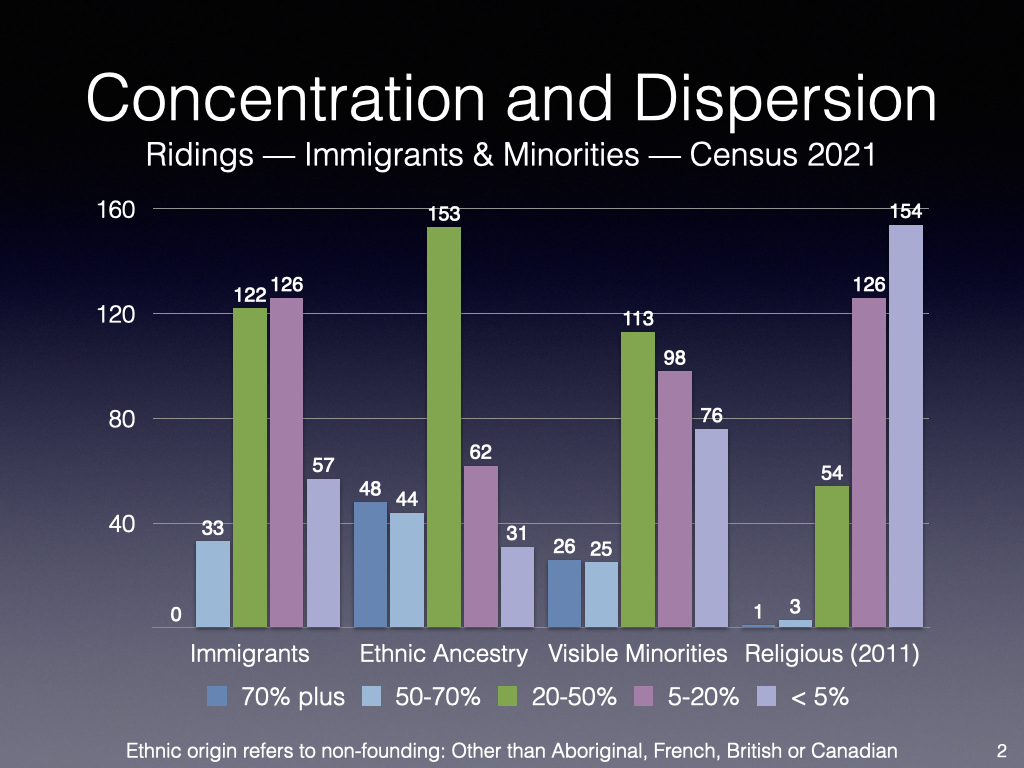
Figure 1 contrasts immigrants, non-founding ethnic ancestry or origin, visible and religious minorities by their percentage in ridings, highlighting the large number of ridings with significant population shares of each group.

Figure 2 highlights the growth of ridings where visible minorities form a significant share of the population. The number of ridings in which visible minorities form a majority of the population has increased from one in ten (33) in 2011 to close to one in six (51), reflecting high and increasing levels of immigration. Moreover, the number of ridings with significant numbers of visible minorities (20 to 50 percent) has also increased significantly, reflecting ongoing immigration to smaller urban and suburban centres.

While the number of ridings with between five and 20 percent visible minorities has stayed relatively constant, the percentage of visible minorities has increased by five percent or more in about half of these ridings.

In contrast, there are only four ridings in which religious minorities form the majority, an increase of two compared to 2011, with 54 ridings in which religious minorities are between 20 and 50 percent, an increase of 12 compared to 2011.

Figure 3 shows ridings with a majority of visible minorities by province, with Ontario, British Columbia and Alberta having the greatest share and increase compared to the 2016 census. These are all ridings where one can expect all parties to run visible minority candidates, most likely from the largest visible minority group in the riding.

However, virtually all provinces have an increased number of ridings with between 20 and 50 percent visible minorities, and thus ridings where visible minorities are a significant constituency.

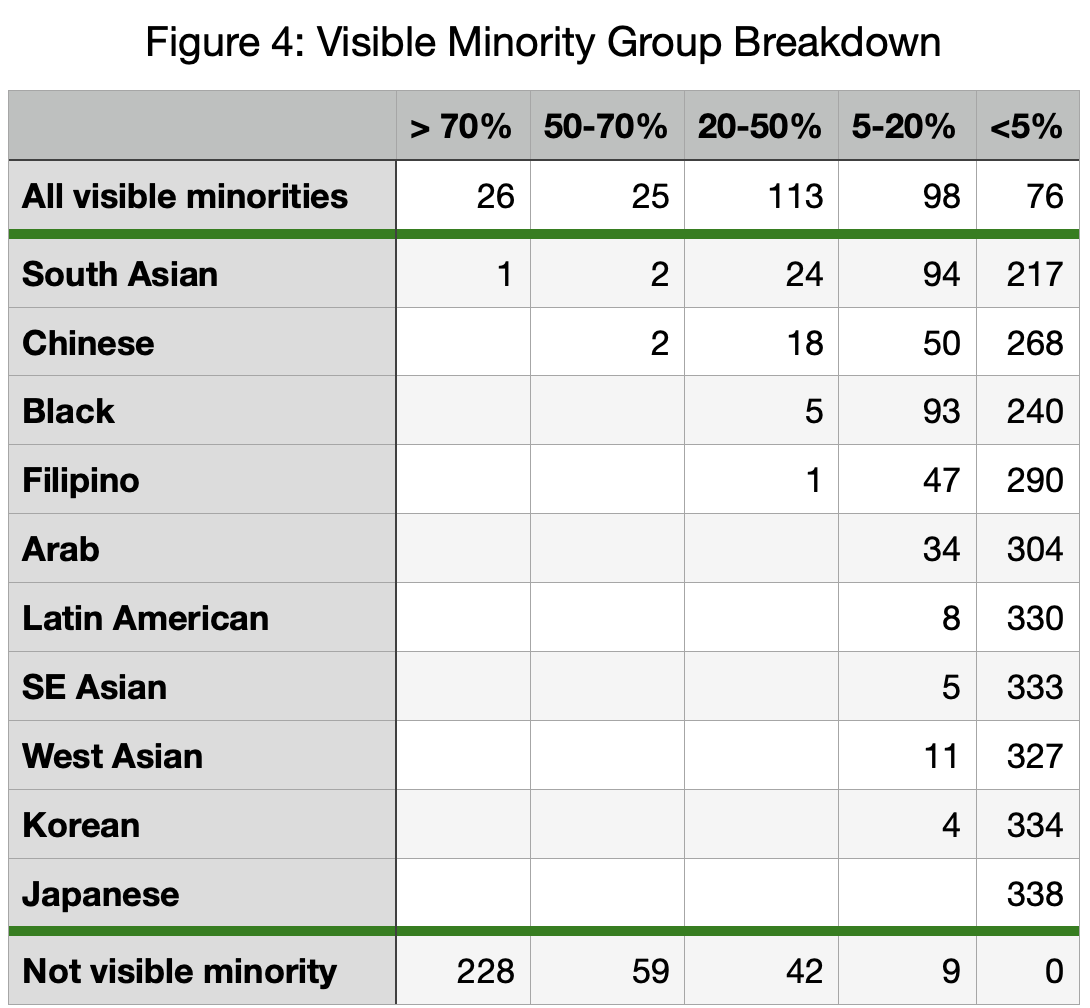
Figure 4 provides the breakdown by visible minority group, with only South Asians and Chinese being a majority of the population (five ridings out of 51 – Brampton East and West, Surrey-Newton for South Asians, Markham-Unionville and Richmond Centre for Chinese), highlighting that most visible minority majority ridings have a mix of visible minority groups. All visible minority groups are present in ridings with between 5 and 20 percent, save Japanese.

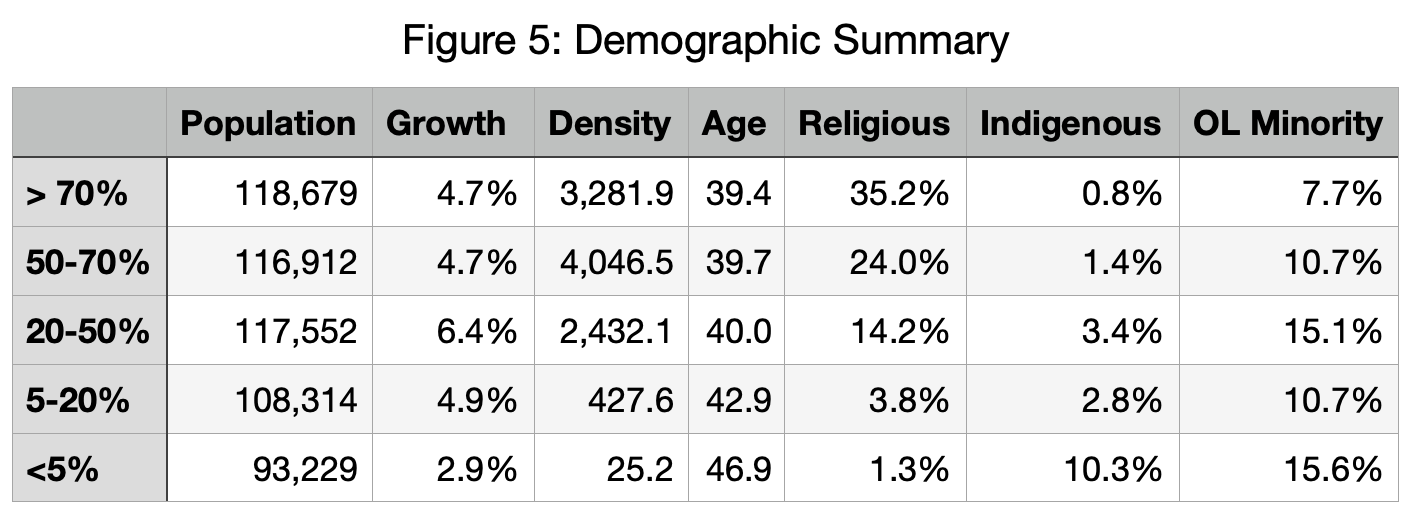
Demographic and socioeconomic characteristics vary by percentage of visible minorities as shown in Figure 5.

Visible minority majority ridings are characterized by larger populations, moderate growth, high densities, a younger population, a higher percentage of religious minorities and a low percentage of Indigenous peoples, with the reverse generally being the case for ridings with less than 20 percent visible minorities, highlighting the differences between rural and urban Canada. The highest growth occurs in ridings with 20 to 50 percent visible minorities, ridings that are increasingly diverse. The percentage of religious minorities correlates with the percentage of visible minorities. There is no overall pattern with respect to official language (OL) minorities.

As one would expect, the higher the percentage of visible minorities, the higher the percentage of immigrants and conversely, the lower the percentage of citizens given residency and other requirements as shown in Figure 6. The period of immigration highlights the contrast between earlier waves of immigration, largely European in origin and in low visible minority ridings, and later waves, largely visible minority, with an impact across all ridings, particularly in the last five years and in ridings with lower overall percentage of visible minorities.

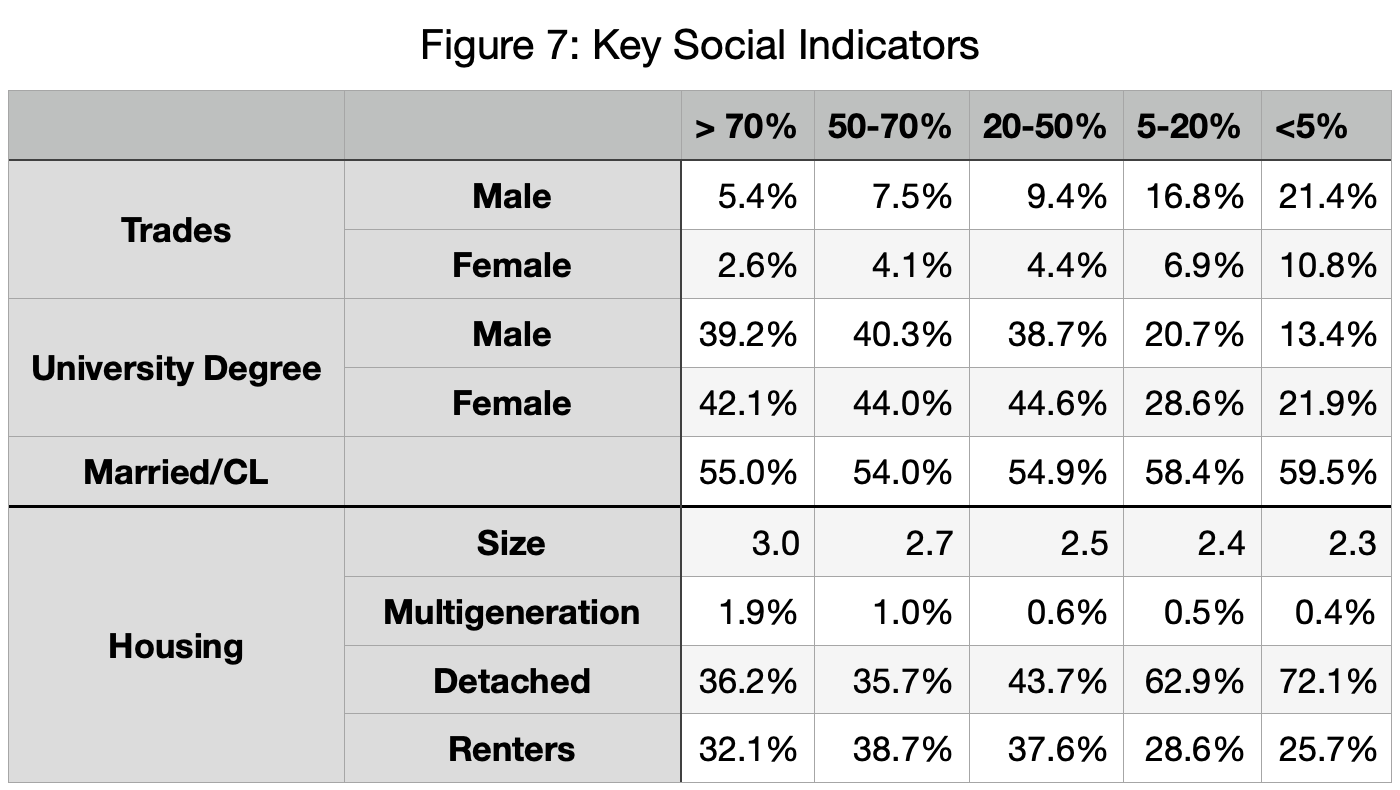
Figure 7 highlights educational attainment (trades and university degree, the percentage of married or common-law couples, household size, and whether residents form part of  multigenerational households, are in single-detached housing and the percentage of renters. Trades are more prevalent in ridings with fewer visible minorities and university diplomas more prevalent in ridings with more visible minorities. Women have higher rates of university degrees across all ridings.

Variations on marriage or common law between ridings are small. Household size directly relates to the percentage of visible minorities whereas the prevalence of single detached homes is inversely proportional. Renting is more prevalent in ridings with between 20 and 70 percent visible minorities.

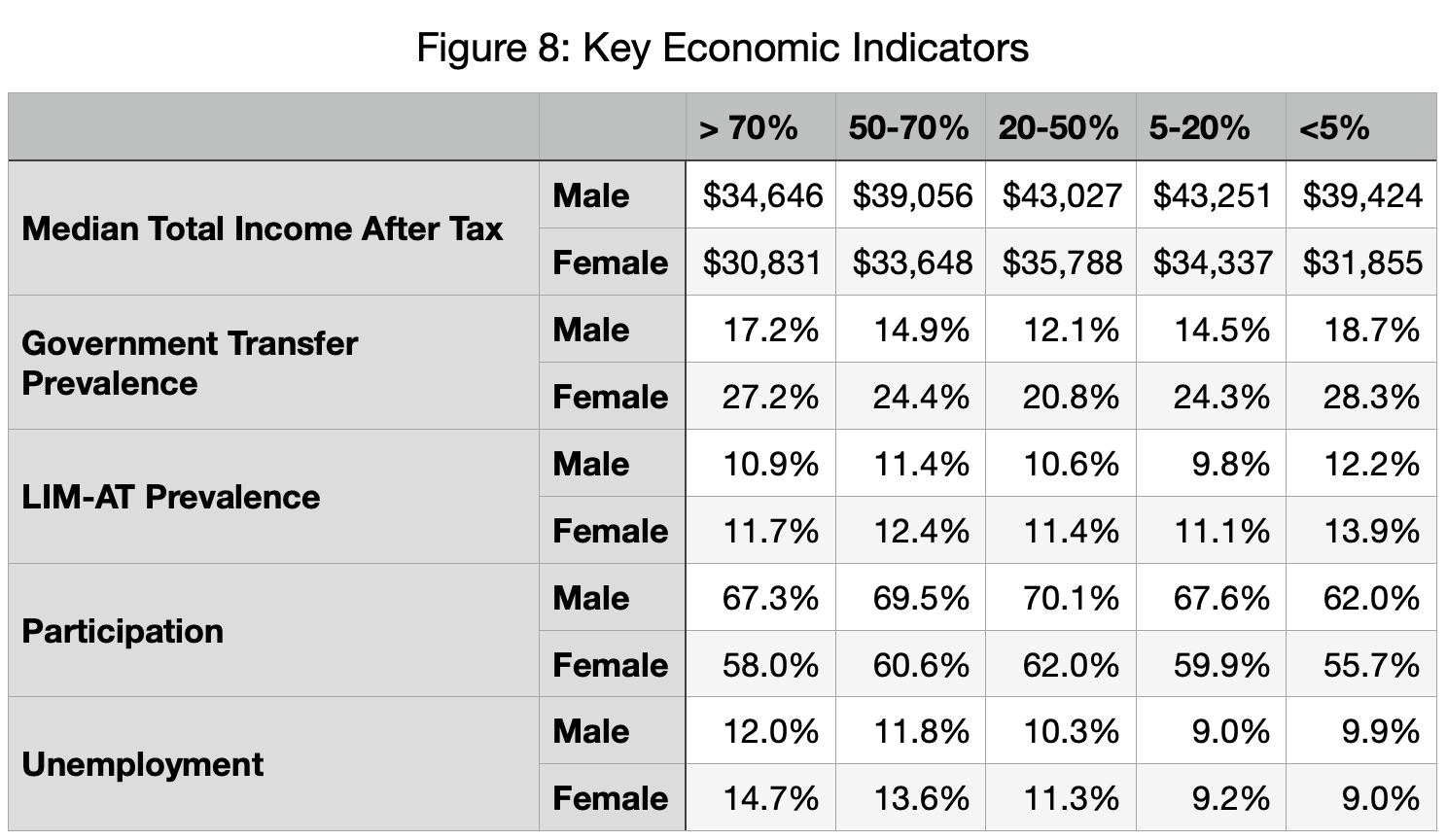
Figure 8 highlights median total after tax income, the percentage of government transfers and income along with participation and unemployment rates. In general, ridings with between 20 and 50 percent have the strongest economic outcomes save for unemployment rates which are lowest in ridings with fewer visible minorities. Outcomes for women are worse overall except with respect to unemployment in ridings with less than 20 percent visible minorities.

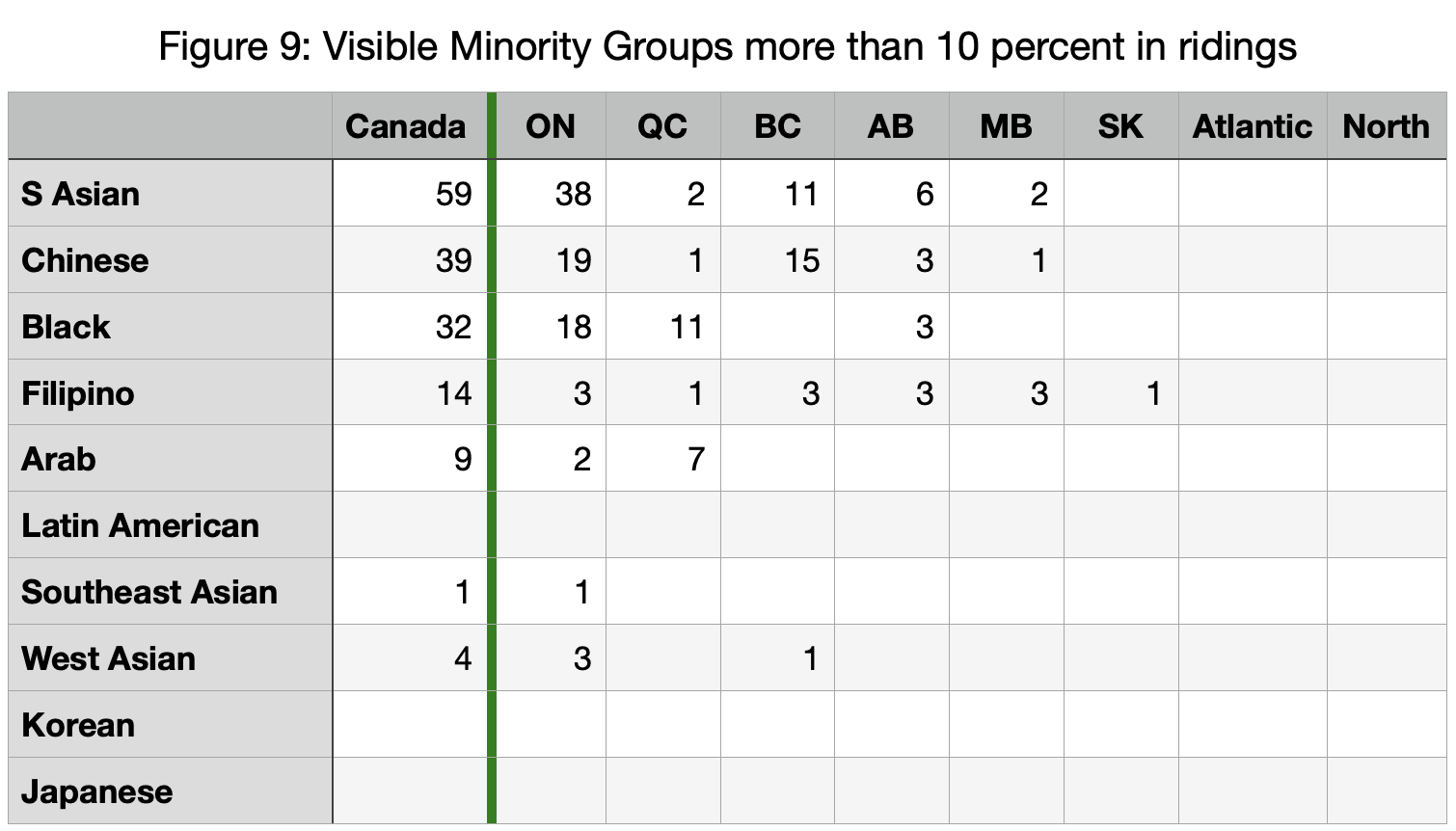
Turning to the political aspect and voter targeting, Figure 9 highlights the number of ridings where a visible minority group forms more than 10 percent of the population, broken down by province, again demonstrating the extent to which political parties need to address specific group concerns. Only Latin American, Korean and Japanese have no ridings with ten percent or more of the population; however, with a threshold of five percent, only Japanese have no ridings of significant concentration. Regionally, there are no ridings in Atlantic Canada and the North with one visible minority group forming 10 percent of the population but six ridings where one group forms more than five percent: three South Asian, two Black and one Chinese.

Figure 10 highlights the 190 ridings where a religious minority forms more than five percent of the population as a threshold of ten percent would exclude Buddhist and Indigenous spirituality. Most groups are concentrated in a number of ridings, with Muslims dispersed across the greatest number of ridings.

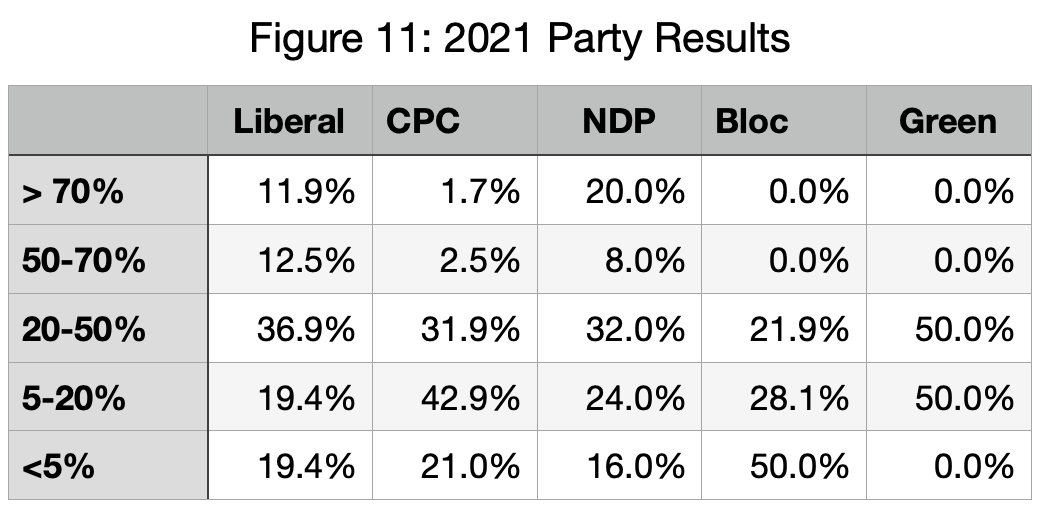
Figure 11 breaks down the 2021 election results, highlighting the relative strength of the Liberals and NDP in visible minority majority urban ridings and the relative strength of the Conservatives in ridings with between five and twenty percent visible minorities. Compared to the 2015 election, the biggest change was the increase in the relative share of NDP MPs in visible minority majority ridings and the Conservative and Bloc relative share increase in ridings with between 20 to 50 percent visible minorities. These ridings can flip; in 2011, the Conservatives won a majority of ridings with more than 50 percent visible minorities.

Concluding observations

All parties have candidate selection, policy and other electoral strategies to engage these communities and the ongoing increase in the number of visible minority candidates and MPs reflects these strategies. Substantively, there are no major differences in attitudes between immigrants and non-immigrants across a range of immigration-related issues.

While some visible minority groups have a tendency to vote for a particular political party, there is political diversity in all groups resulting in no party ignoring any group. Earlier waves of immigrants, mainly European origin, tend to lean Conservative compared to more recent waves, mainly visible minority, tend to lean Liberal.

Visible minority and immigrant groups are affected by perceived singling out or dog whistles, as the Conservatives learned to their cost in 2015, with the “barbaric cultural practices” tip line and the strength of the Liberal language “a Canadian is a Canadian is a Canadian” in response to the Conservative government’s citizenship revocation provision of C-24. Immigration-specific issues such as the ease of family reunification also play a role.

But in general, visible minority voters are more affected by overall campaign themes and issues, whether these be with respect to campaign tone, general concerns regarding the economy, housing, and healthcare, and largely follow the overall electoral trend at national and regional levels.

Riding characteristics impact upon voting patterns. Visible minority majority ridings have lower incomes and higher unemployment which generally play to left and left-of-centre parties. Similarly, larger family size and more multigenerational households in these ridings suggest that political parties target their messaging accordingly.

No major party is arguing against increased immigration, nor is any province except for Quebec. Public support is strong. Apart from administrative issues like backlogs and poor Immigration, Refugees and Citizenship Canada service, debates and discussion focus more on the practicalities and impact of immigration on housing affordability, healthcare stresses and infrastructure gaps. More recent commentaries are focussing on these negative impacts but in a non-xenophobic manner. After all, these issues affect immigrants and non-immigrants alike, helping to reduce polarization.

Methodology:

All data is from the Census profile given that it provides riding-level data. Indicators were chosen based on their pertinence. Non-founding ethnic ancestry includes all groups save for English, Scottish, Irish, Welsh, Canadian, French and Indigenous (Census allows for multiple responses). Electoral results data is from Elections Canada.

Andrew Griffith is the author of “Because it’s 2015…” Implementing Diversity and InclusionMulticulturalism in Canada: Evidence and Anecdote and Policy Arrogance or Innocent Bias: Resetting Citizenship and Multiculturalism and is a regular media commentator and blogger (Multiculturalism Meanderings). He is the former Director General for Citizenship and Multiculturalism and has worked for a variety of government departments in Canada and abroad and is a fellow of the Canadian Global Affairs Institute and Environics Institute. 

Source: The Political Impact of Increased Diversity: What the Census Shows

Liberal minister says Canada needs more immigration as targets get mixed reviews

Mixed reviews are from me and Ted McDonald of UNB:

As Canada plans to significantly ramp up its immigration levels in the coming years, some policy experts are worried about potential effects on health care, housing and the labour market.

But Immigration Minister Sean Fraser insists that Canada needs more newcomers to address labour shortages and demographic changes that threaten the country’s future.

“If we don’t continue to increase our immigration ambition and bring more working-age population and young families into this country, our questions will not be about labour shortages, generations from now,” Fraser said in an interview with The Canadian Press.

“They’re going to be about whether we can afford schools and hospitals.”

In November, the federal Liberal government announced a new immigration plan that would see Canada welcome 500,000 immigrants per year by 2025.

A record-breaking 431,645 people became permanent residents in 2022.

The new immigration rates will be substantially higher than rates in similar countries, such as Australia, said University of New Brunswick political science professor Ted McDonald.

That’s not a bad thing in itself, he said. But in his view, raising immigration levels isn’t the right way to address current labour shortages.

“I think the policy would make more sense if it’s aligned with what are seen as underlying structural labour market shortages that are going to persist,” McDonald said.

At the same, he said one justification for immigration is clear: Canada has a declining birthrate.

According to Statistics Canada, the country’s birthrate fell to a record low of an average of 1.4 children per woman in 2020. That’s well below the 2.1 rate needed to maintain a population without immigration.

That doesn’t stop others from worrying about how more newcomers could put a strain on other perennial issues such as housing affordability and health care.

“There’s no assessment that I have seen of the impact of these targets on housing affordability and availability, no assessment of these targets in terms of additional pressures on health care,” said Andrew Griffith, a former high-ranking official at Immigration and Citizenship Canada.

But Fraser said that many of the new permanent residents already live in Canada. For example, 157,000 international students became permanent residents in 2021.

“It’s not as though there are half a million people coming to Canada who are not already here,” the minister said.

He said changes are also coming to the Express Entry system in the spring so that immigrants can be selected based on the sector and region in Canada they’re heading to.

That will help alleviate some of the strain on things like health care and housing, he said.

The ongoing debate on whether the new targets are too ambitious is also coinciding with heightened scrutiny regarding what — or who — is influencing government policy.

Radio-Canada reported last week that two sources within Immigration, Refugees and Citizenship Canada said McKinsey & Company’s influence on immigration policy has grown in recent years.

A government response to a Conservative MP’s written question, which was tabled in the House of Commons in December, says the department has not recently awarded any contracts to the consulting firm — at least, not during the timeframe the MP asked about, which was from March 2021 until October 2022.

And during the interview Thursday, Fraser said McKinsey has had no role to play in the new immigration levels plan.

“I’m not being influenced by them,” Fraser said.

“This is something that I’ve arrived at independently.”

The minister said he came to the decision regarding the immigration plan on the advice of department officials. He said he also took into consideration what he’s heard from different organizations, stakeholders, and provincial and territorial leaders.

Policy experts often worry about the outsized influence stakeholders can have on government policies, since interest groups lobby the government to implement policies that are in line with their priorities, and some are more powerful than others.

Business groups in Canada have seen ongoing labour shortages as a major concern, and they have called on the government to help fill vacancies.

Following the announcement of the new plan, the Business Council of Canada applauded the targets in a press release, saying that “an economy that is chronically short of workers cannot achieve its potential.”

Griffith said that in his opinion, the current government is “fairly responsive to the pressures of stakeholders,” whether they are business groups or organizations that work with immigrants.

While the interests of stakeholders can sometimes align with what is actually good policy, McDonald said stakeholder groups have “vested interests.”

“We have to be aware of where the advocacy is coming from, and not being naïve about it,” he said.

Source: Liberal minister says Canada needs more immigration as targets get mixed reviews

2022 in review and looking ahead: immigration and related issues

2022 was characterized, in many ways, by the failure of governments to anticipate and respond to changed circumstances. Whether it be backlogs in immigration, citizenship and passports, or the overall failure of governments to address pressures on housing, healthcare and infrastructure, virtually every level of government failed to some extent.

What has been encouraging has been greater public commentary on the need for governments to address these pressures (externalities) even if the most governments remain in denial or at least silent, with the current approach, across all governments save Quebec, being the “more the merrier,” both permanent and temporary residents.

As I recently argued, the government’s Annual Report on Immigration needs to include a discussion of these externalities as well as including temporary residents in its planning and targets.

I have continued my monthly updates of immigration-related programs and have been pleased to work with the Institute for Canadian Citizenship in making some of this data more easily accessible. Summary of the recovery across programs below, comparing January-October 2022 with full year 2018, showing already well ahead of 2018 in most programs.

Issues I expect to continue following are foreign interference by governments like China, Iran and Russia, exploitation of international students and ill-guided policies that make this more-and-more a lower-skilled immigration stream, the contrast between Ukrainian refugees and others, the ongoing federal-provincial immigration arguments over relative shares, and, of course, the evolution of public opinion on immigration-related issues.

It will also be interesting to see whether or not the the proposed class action lawsuit by Black public servants is allowed to proceed along with the complaint to the United Nations Commission for Human Rights. Whenever I look at the numbers (and will do so again in 2023), Black representation is relatively better than South Asian, Chinese, and Filipino for the EX category, and better than all other groups overall, although there are significant differences among the different occupations. 

The other broader development to watch will be the expected revision of the Employment Equity Act, an act that has, IMO, facilitated and resulted in increased diversity among designated groups.

Citizenship will remain a focus and I am still waiting for the revised citizenship study guide to be released (under the fourth immigration minister!). It will also be interesting to see if the government fulfills its campaign commitment in both the 2019 and 2021 elections to eliminate citizenship fees (that were increased 5 fold by the previous government). Given the current financial pressures, will be interesting to see if the government walks that commitment back, implement it in the forthcoming budget, or do nothing and assume no one will notice (not placing any bets but inaction is the most likely outcome).

I have requested a number of citizenship Census specialized data sets to allow me to update and track change compared to 2016, looking at variety of socioeconomic factors and outcomes.

Lastly, some good news, the complete switch of attitude among political leaders in Hérouxville, the small town that convulsed Quebec with its 2007 xenophobic code of conduct for immigrants, to welcoming immigrants given demographics. Overtime, will likely have broader reverberations and somewhat weaken the differences between Montreal and the regions.

Lastly, on a personal note, we became grandparents for the first time, welcoming a new life into our family.

Best wishes for the holidays and will restart up in January.

Article roundup

Citizenship 

Is birth tourism about to return now that travel restrictions have been lifted (Policy Options, 2022), my annual update, showing a further decline compared to pre-pandemic numbers, given the legacy of Canadian travel and Chinese government restrictions.

Disconnect between political priorities and service delivery (The Hill Times, 2022), commentary on a “missing link” between policy and service delivery/implementation.

Passport delays risk undermining our trust in government (The Star, 2022), op-ed on the passport delivery fiasco.

Immigration 

Has immigration become a third rail in Canadian politics? (Policy Options, 2022), my latest, arguing for improvements in the annual levels plan to incorporate temporary workers and include considerations of the externalities of housing, healthcare and infrastructure impacts.

Public opinion on migration could sour amid food insecurity and climate change (Policy Options, 2022), This commentary was developed in the context of a Ditchley conference on food insecurity.

How the government used the pandemic to sharply increase immigration (Policy Options, 2022) My analysis of the government’s actions.

Diversity and Employment Equity

Do MPs represent Canada’s diversity? (Policy Options, 2022) Written jointly with Jerome Black, this analysis confirmed ongoing increases in political representation.

Forthcoming articles early in the new year will look at the political impact of increased diversity at the federal riding level and a comparison of provincial government political representation for the last two provincial elections.

Is birth tourism about to return now that travel restrictions have been lifted?

My annual update:

COVID-19 continues to provide the perfect natural experiment to assess the extent of “birth tourism” – when women visit Canada for the purpose of giving birth here and thus obtaining Canadian citizenship for their child. Two years in, the data shows a decrease of almost eight per cent, compared to 2020-21 and almost 52 per cent compared to the pre-pandemic 2016-20 average, in the number of “non-resident self-pay” births in Canada.

As Figure 1 indicates, there was a steady increase of non-resident births prior to the pandemic. But after COVID-related travel restrictions were implemented in 2020, there was a sharp drop, with no recovery in 2021. This provides a very good indication of the extent of birth tourism in Canada. Now that the restrictions are loosening and travel is once again opening up, it’s time for the federal government to revisit its policy on non-resident births and Canadian citizenship.

https://e.infogram.com/1bffaa89-7b27-4768-acdd-860d46ab420b?parent_url=https%3A%2F%2Fpolicyoptions.irpp.org%2Fmagazines%2Fdecember-2022%2Fbirth-tourism-may-rise-again%2F%3Futm_source%3DPolicy%2BOptions%2BNewsletter%26utm_campaign%3D87f90b7127-EMAIL_CAMPAIGN_2022_02_14_05_26_COPY_01%26utm_medium%3Demail%26utm_term%3D0_26f66e24ce-87f90b7127-104024581%26mc_cid%3D87f90b7127%26mc_eid%3D86cabdc518&src=embed#async_embed

The decline to 2,245 in 2021 from 2,433 in 2020 occurred in all provinces save Quebec, which remained relatively stable (Table 1). The decline was particularly notable in British Columbia, where most birth tourists pre-pandemic were from China – a country most affected by travel restrictions. The drop is in stark contrast to steady increases over the previous five-year period.

https://e.infogram.com/c85b1f61-f842-4a62-adbb-c69b1c8964af?parent_url=https%3A%2F%2Fpolicyoptions.irpp.org%2Fmagazines%2Fdecember-2022%2Fbirth-tourism-may-rise-again%2F%3Futm_source%3DPolicy%2BOptions%2BNewsletter%26utm_campaign%3D87f90b7127-EMAIL_CAMPAIGN_2022_02_14_05_26_COPY_01%26utm_medium%3Demail%26utm_term%3D0_26f66e24ce-87f90b7127-104024581%26mc_cid%3D87f90b7127%26mc_eid%3D86cabdc518&src=embed#async_embed

A similar decline in visitor visas and birth tourists has been noted in the United States.

The percentage of non-resident births in Canada fell from slightly less than two per cent of total births in 2019 to 0.7 per cent in 2020 and has remained at that level. Given increased immigration, the percentage of non-resident births also fell during the same period.

As noted in previous articles, the non-resident self-pay code that is the basis for the analysis is broader than that of women who arrive on visitor visas. It includes international students, about half of whom are covered by provincial health plans, and other temporary residents. Visitor visas recovered to only 57 per cent of pre-pandemic levels in 2021-22 while visas for temporary workers have more than recovered from pre-pandemic levels. Visitor visas for Chinese nationals, one of the major groups, have recovered to only 21 per cent of former levels compared to 57 per cent of previous levels for all visitor visas. Chinese government travel-related restrictions are likely a significant factor in the reduced number.

Table 2 provides a hospital-level view of the impact of COVID, contrasting pre- and post-pandemic years in terms of non-resident and total births for the 10 hospitals with the largest percentage of non-resident births. Non-resident births continued to decline in most hospitals. British Columbia’s Richmond Hospital – the epicentre of birth tourism with its supportive “cottage industry” of “birth hotels” – has been the hardest hit. There was a decrease of 95.6 per cent compared to pre-pandemic levels.

https://e.infogram.com/d4121dd0-70ad-48bc-ba08-1b02f02ecbe6?parent_url=https%3A%2F%2Fpolicyoptions.irpp.org%2Fmagazines%2Fdecember-2022%2Fbirth-tourism-may-rise-again%2F%3Futm_source%3DPolicy%2BOptions%2BNewsletter%26utm_campaign%3D87f90b7127-EMAIL_CAMPAIGN_2022_02_14_05_26_COPY_01%26utm_medium%3Demail%26utm_term%3D0_26f66e24ce-87f90b7127-104024581%26mc_cid%3D87f90b7127%26mc_eid%3D86cabdc518&src=embed#async_embed

This suggests that my initial estimate from 2018 that about 50 per cent of non-resident births were due to birth tourism was conservative, and that the percentage of “tourism births” is about one per cent of all births (or about 0.4 per cent of current immigration levels).

Three federal immigration ministers later, the government has not have followed up on its 2018 commitment to “better understand the extent of this practice as well as its impacts” following the first release of the Canadian Institute for Health Information numbers and related media attention. The 2021-22 decline understandably reduces political interest and pressure in addressing the issue, particularly at a time of government and stakeholder support of increased immigration, as the proportion on “non-resident” self-pay is only about 0.5 per cent of permanent resident admissions, having fallen from 1.7 per cent pre-pandemic.

Given the current focus on increased immigration, it is highly unlikely that the government will take action. The numbers are very small compared to the planned level of 500,000 immigrants to Canada in 2025 and Immigration, Refugees and Citizenship Canada’s current policy and operational challenges. However, given that visitor visas have largely reverted to pre-pandemic levels in 2022, growth in birth tourism can be expected in future years.

The government should address the policy deficit in this area. There appears to be public support for some action. A 2019 Angus Reid survey indicated that the vast majority of Canadians would support removing birthright citizenship for children born to women on visitor visas.

The use of CIHI data to quantify the extent of birth tourism, albeit approximately, highlights the potential in greater linkages between immigration and health data. With respect to birth tourism, the ability to distinguish between non-resident births for visitors, international students and temporary workers would provide greater precision on the extent of the practice.

It would also allow for more informed analysis and understanding of the health outcomes of immigrants and would identify opportunities for improvement.

The policy and operational questions remain as to whether the extent of birth tourism warrants an amendment to the Citizenship Act, visa restrictions on women intending to give birth in Canada, or other administrative and regulatory measures to curtail the practice. Because visa restrictions would be difficult to administer, and because regional administrative and regulatory measures may well encourage hospital and jurisdiction “shopping,” the “cleanest” approach would be an amendment to the Citizenship Act that would make Canadian citizenship dependent on one parent being a citizen or permanent resident, comparable to the situation in Australia.

A note on methodology 

The data is from the CIHIs Discharge Abstract Database, more specifically the responsible for funding program (RRFP) non-resident self-pay” category, as well as totals for hospital deliveries. The RRFP data include temporary residents on visitor visas, international students, foreign workers and visiting Canadian citizens, and permanent residents. While Quebec has a slightly different coding system, CIHI ensures its data is comparable. 

Health coverage for international students varies by provinces, but most are covered by provincial health plans. This is not the case in Manitoba and Ontario, and for some students in Quebec whose country of origin does not have a social security agreement with Quebec. The pre-pandemic baseline is the five-year average 2016-20.

Mackenzie Health’s Woman and Child program moved from Mackenzie Richmond Hill Hospital to Cortellucci Vaughan Hospital when it opened to the community in June 2021.

Source: Is birth tourism about to return now that travel restrictions have been lifted?