Canada must look beyond STEM and diversify its AI workforce

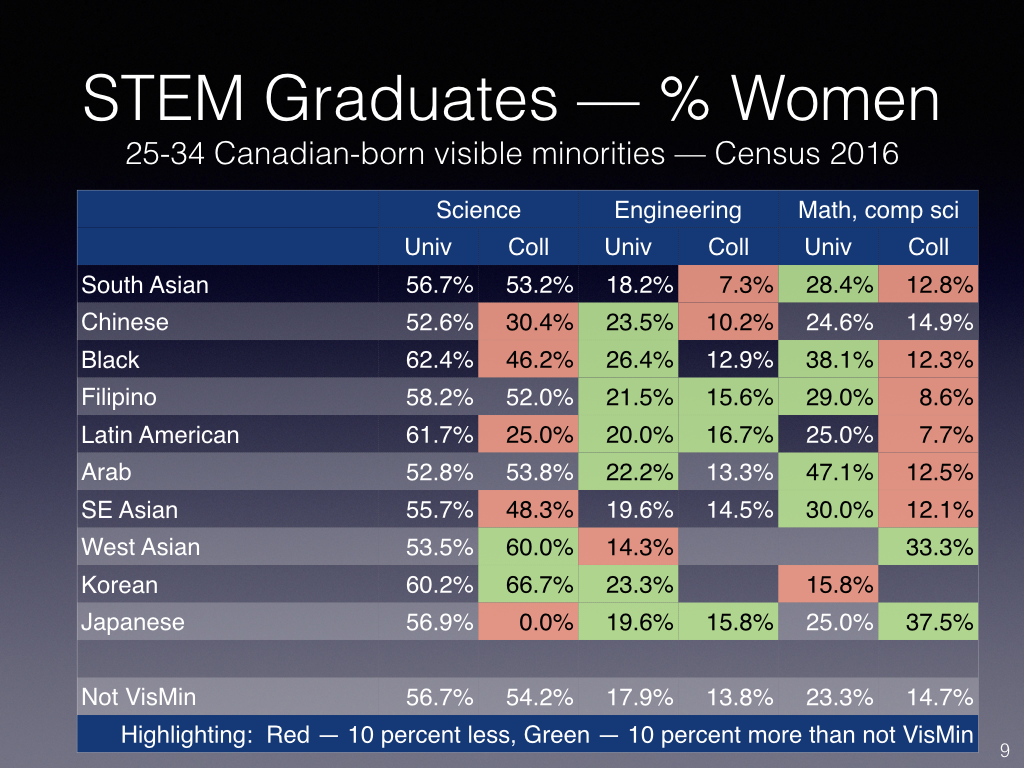
From a visible minority perspective, based on STEM graduates, representation reasonably good as per the chart above except for engineering and particularly strong in math and computer sciences, the closest fields of study to AI.

With respect to gender, the percentage of visible minority women is generally equivalent to that on non-visible minority women or stronger (but women are under-represented in engineering and math/computer sciences):

Artificial intelligence (AI) is expected to add US$15.7 trillion to the global economy by 2030, according to a recent report from PwC, representing a 14 percent boost to global GDP. Countries around the world are scrambling for a piece of the pie, as evidenced by the proliferation of national and regional AI strategies aimed at capturing the promise of AI for future value generation.

Canada has benefited from an early lead in AI, which is often attributed to the Canadian Institute for Advanced Research (CIFAR) having had the foresight to invest in Geoffrey Hinton’s research on deep learning shortly after the turn of the century. As a result, Canada can now tout Montreal as having the highest concentration of researchers and students of deep learning in the world and Toronto as being home to the highest concentration of AI start-ups in the world.

But the market for AI is approaching maturity. A report from McKinsey & Co. suggests that the public and private sectors together have captured only between 10 and 40 percent of the potential value of advances in machine learning. If Canada hopes to maintain a competitive advantage, it must both broaden the range of disciplines and diversify the workforce in the AI sector.

Looking beyond STEM

Strategies aimed at capturing the expected future value of AI have been concentrated on innovation in fundamental research, which is conducted largely in the STEM disciplines: science, technology, engineering and mathematics. But it is the application of this research that will grow market share and multiply value. In order to capitalize on what fundamental research discovers, the AI sector must deepen its ties with the social sciences.

To date the role of social scientists in Canada’s strategy on AI has been largely limited to areas of ethics and public policy. While these are endeavours to which social scientists are particularly well suited, they could be engaged much more broadly with AI. Social scientists are well positioned to identify and exploit potential applications of this research that will generate both social and economic returns on Canada’s investment in AI.

Social scientists take a unique approach to data analysis by drawing on social theory to critically interpret both the inputs and outputs of a given model. They ask what a given model is really telling us about the world and how it arrived at that result. They see potential opportunities in data and digital technology that STEM researchers are not trained to look for.

A recent OECD report looks at the skills that most distinguish innovative from non-innovative workers; chief among them are creativity, critical thinking and communication skills. While these skills are by no means exclusively the domain of the social sciences, they are perhaps more central to social scientific training than to any other discipline.

The social science perspective can serve as a defence mechanism against the potential folly of certain applications of AI. If social scientists had been more involved in early adaptations of computer vision, for example, Google might have been spared the shame of image recognition algorithms that classify people of colour as animals (they certainly would have come up with a better solution). In the same vein, Microsoft’s AI chatbots would have been less likely to spew racist slurs shortly after launch.

Social scientists can also help meet a labour shortage: there are not enough STEM graduatesto meet future demand for AI talent. Meanwhile, social science graduates are often underemployed, in part because they do not have the skills necessary to participate in a future of work that privileges expertise in AI. As a consequence, many of the opportunities associated with AI are passing Canada’s social science graduates by. Excluding social science students from Canada’s AI strategy not only reduces their career paths but restricts their opportunities to contribute to fulfilling the societal and economic promise of AI.

Realizing the potential of the social sciences within Canada’s AI ecosystem requires innovative thinking by both governments and universities. Federal and provincial governments should relax restrictions on funding for AI-related research that prohibit applications from social scientists or make them eligible only within interdisciplinary teams that include STEM researchers. This policy has the effect of subordinating social scientific approaches to AI to those of STEM disciplines. In fact, social scientists are just as capable of independent research, and a growing number are already engaged in sophisticated applications of machine learning to address some of the most pressing societal challenges of our time.

Governments must also invest in the development of undergraduate and graduate training opportunities that are specific to the application of AI in the social sciences, using pedagogical approaches that are appropriate for them.

Social science faculties in universities across Canada can also play a crucial role by supporting the development of AI-related skills within their undergraduate and graduate curriculums. At McMaster University, for example, the Faculty of Social Sciences is developing a new degree: master of public policy in digital society. Alongside graduate training in the fundamentals of public policy, the 12-month program will include rigorous training in data science as well as technical training in key digital technologies that are revolutionizing contemporary society. The program, which is expected to launch in 2021, is intended to provide students with a command of digital technologies such as AI necessary to enable them to think creatively and critically about its application to the social world. In addition to the obvious benefit of producing a new generation of policy leadership in AI, the training provided by this program will ensure that its graduates are well positioned for a broader range of leadership opportunities across the public and private sectors.

Increasing workplace diversity

A report released in 2019 by New York University’s AI Now Institute declared that there is a diversity crisis in the AI workforce. This has implications for the sector itself but also for society more broadly, in that the systemic biases within the AI sector are being perpetuated via the myriad touch points that AI has with our everyday lives: it is organizing our online search results and social media news feeds and supporting hiring decisions, and it may even render decisions in some court cases in future.

One of the main findings of the AI Now report was that the widespread strategy of focusing on “women in tech” is too narrow to counter the diversity crisis. In Canada, efforts to diversify AI generally translate to providing advancement opportunities for women in the STEM disciplines. Although the focus of policy-makers on STEM is critical and necessary, it is short-sighted. Disciplinary diversity in AI research not only broadens the horizons for research and commercialization; it also creates opportunities for groups who are underrepresented in STEM to benefit from and contribute to innovations in AI.

As it happens, equity-seeking groups are better represented in the social sciences. According to Statistics Canada, the social sciences and adjacent fields have the highest enrolment of visible minorities. And as of 2017, only 23.7 percent of those enrolled in STEM programs at Canadian universities were women, whereas women were 69.1 percent of participants in the social sciences.

So, engaging the social sciences more substantively in research and training related to AI will itself lead to greater diversity. While advancing this engagement, universities should be careful not to import training approaches directly from statistics or computer science, as these will bring with them some of the cultural context and biases that have resulted in a lack of diversity in those fields to begin with.

Bringing the social sciences into Canada’s AI strategy is a concrete way to demonstrate the strength of diversity, in disciplines as well as demographics. Not only would many social science students benefit from training in AI, but so too would Canada’s competitive advantage in AI benefit from enabling social scientists to effectively translate research into action.

Source: Canada must look beyond STEM and diversify its AI workforce

Douglas Todd: Robots replacing Canadian visa officers, Ottawa report says

Ongoing story, raising legitimate questions regarding the quality and possible bias of the algorithms used. That being said, human decision making is not bias free and using AI, at least in the more straightforward cases, makes sense from an efficiency and timeliness of service response.

Will be important to ensure appropriate oversight and there may be a need from an external body to review the algorithms to reduce risks if not already in place:

Tens of thousands of would-be guest workers and international students from China and India are having their fates determined by Canadian computers that are making visa decisions using artificial intelligence.

Even though Immigration Department officials recognize the public is wary about substituting robotic algorithms for human visa officers, the Liberal government plans to greatly expand “automated decision-making” in April of this year, according to an internal report.

“There is significant public anxiety over fairness and privacy associated with Big Data and Artificial Intelligence,” said the 2019 Immigration Department report, obtained under an access to information request. Nevertheless, Ottawa still plans to broaden the automated approval system far beyond the pilot programs it began operating in 2018 to process applicants from India and China.

At a time when Canada is approving more guest workers and foreign students than ever before, immigration lawyers have expressed worry about a lack of transparency in having machines make life-changing decisions about many of the more than 200,000 temporary visas that Canada issues each year.

The internal report reveals its departmental reservations about shifting more fully to an automated system — in particular wondering if machines could be “gamed” by high-risk applicants making false claims about their banking, job, marriage, educational or travel history.

“A system that approves applications without sufficient vetting would raise risks to Canadians, and it is understandable for Canadians to be more concerned about mistakenly approving risky individuals than about mistakenly refusing bona fide candidates,” says the document.

The 25-page report also flags how having robots stand in for humans will have an impact on thousands of visa officers. The new system “will fundamentally change the day-to-day work of decision-makers.”

Immigration Department officials did not respond to questions about the automated visa program.

Vancouver immigration lawyer Richard Kurland says Ottawa’s sweeping plan “to process huge numbers of visas fast and cheap” raises questions about whether an automated “Big Brother” system will be open to scrutiny, or whether it will lead to “Wizard of Oz” decision-making, in which it will be hard to determine who is accountable.

The publisher of the Lexbase immigration newsletter, which uncovered the internal document, was especially concerned that a single official has already “falsely” signed his or her name to countless visa decisions affecting migrants from India and China, without ever having reviewed their specific applications.

“The internal memo shows tens of thousands of visa decisions were signed-off under the name of one employee. If someone pulled that stunt on a visa application, they would be banned from Canada for five years for misrepresentation. It hides the fact it was really a machine that made the call,” said Kurland.

The policy report itself acknowledges that the upcoming shift to “hard-wiring” the visa decision-making process “at a tremendous scale” significantly raises legal risks for the Immigration Department, which it says is already “one of the most heavily litigated in the government of Canada.”

The population of Canada jumped by 560,000 people last year, or 1.5 per cent, the fastest rate of increase in three decades. About 470,000 of that total was made up of immigrants or newcomers arriving on 10-year multiple-entry visas, work visas or study visas.

The senior immigration officials who wrote the internal report repeatedly warn departmental staff that Canadians will be suspicious when they learn about the increasingly automated visa system.

“Keeping a human in the loop is important for public confidence. While human decision making may not be superior to algorithmic systems,” the report said, “human in-the-loop systems currently represent a form of transparency and personal accountability that is more familiar to the public than automated processes.”

In an effort to sell the automated system to a wary populace, the report emphasizes making people aware that the logarithm that decides whether an applicant receives a visa is not random. It’s a computer program governed by certain rules regarding what constitutes a valid visa application.

“A system that provides no real opportunity for officers to reflect is a de facto automated decision-making system, even when officers click the last button,” says the report, which states that flesh-and-blood women and men should still make the rulings on complex or difficult cases — and will also be able to review appeals.

“When a client challenges a decision that was made in full or in part by an automated system, a human officer will review the application. However, the (department) should not proactively offer clients the choice to have a human officer review and decide on their case at the beginning of the application process.”

George Lee, a veteran immigration lawyer in Burnaby, said he had not heard that machines are increasingly taking over from humans in deciding Canadian visa cases. He doesn’t think the public will like it when they learn it.

“People will say, ‘What are we doing here? Where are the human beings? You can’t do this. People are afraid of change. We want to keep the status quo.”

However, Lee said society’s transition towards replacing human workers with robots is “unstoppable. We’re seeing it everywhere.”

Lee believes people will eventually get used to the idea that machines are making vitally important decisions about human lives, including about people’s dreams of migrating to a new country.

“I think the use of robots will become more acceptable down the road,” he said. “Until the robots screw up.”

Source: Douglas Todd: Robots replacing Canadian visa officers, Ottawa report says

A.I. Systems Echo Biases They’re Fed, Putting Scientists on Guard

Yet another article emphasizing the risks:

Last fall, Google unveiled a breakthrough artificial intelligence technology called BERT that changed the way scientists build systems that learn how people write and talk.

But BERT, which is now being deployed in services like Google’s internet search engine, has a problem: It could be picking up on biases in the way a child mimics the bad behavior of his parents.

BERT is one of a number of A.I. systems that learn from lots and lots of digitized information, as varied as old books, Wikipedia entries and news articles. Decades and even centuries of biases — along with a few new ones — are probably baked into all that material.

BERT and its peers are more likely to associate men with computer programming, for example, and generally don’t give women enough credit. One program decided almost everything written about President Trump was negative, even if the actual content was flattering.

AI system for granting UK visas is biased, rights groups claim

Always a challenge with AI, ensuring that the algorithms do not replicate or create bias:

Immigrant rights campaigners have begun a ground-breaking legal case to establish how a Home Office algorithm that filters UK visa applications actually works.

The challenge is the first court bid to expose how an artificial intelligence program affects immigration policy decisions over who is allowed to enter the country.

Foxglove, a new advocacy group promoting justice in the new technology sector, is supporting the case brought by the Joint Council for the Welfare of Immigrants (JCWI) to legally force the Home Office to explain on what basis the algorithm “streams” visa applicants.

The two groups both said they feared the AI “streaming tool” created three channels for applicants including a “fast lane” that would lead to “speedy boarding for white people”.

The Home Office has insisted that the algorithm is used only to allocate applications and does not ultimately rule on them. The final decision remains in the hands of human caseworkers and not machines, it said.

A spokesperson for the Home Office said: “We have always used processes that enable UK Visas and Immigration to allocate cases in an efficient way.

“The streaming tool is only used to allocate applications, not to decide them. It uses data to indicate whether an application might require more or less scrutiny and it complies fully with the relevant legislation under the Equalities Act 2010.”

Cori Crider, a director at Foxglove, rejected the Home Office’s defence of the AI system.

Source: AI system for granting UK visas is biased, rights groups claim

Beware of Automated Hiring It won’t end employment discrimination. In fact, it could make it worse.

Some interesting ideas to reduce the risks of bias and discrimination:

Algorithms make many important decisions for us, like our creditworthiness, best romantic prospects and whether we are qualified for a job. Employers are increasingly turning to automated hiring platforms, believing they’re both more convenient and less biased than humans. However, as I describe in a new paper, this is misguided.

In the past, a job applicant could walk into a clothing store, fill out an application, and even hand it straight to the hiring manager. Nowadays, her application must make it through an obstacle course of online hiring algorithms before it might be considered. This is especially true for low-wage and hourly workers.

The situation applies to white-collar jobs too. People applying to be summer interns and first-year analysts at Goldman Sachs have their résumés digitally scanned for keywords that can predict success at the company. And the company has now embracedautomated interviewing.

Automated hiring can create a closed loop system. Advertisements created by algorithms encourage certain people to send in their résumés. After the résumés have undergone automated culling, a lucky few are hired and then subjected to automated evaluation, the results of which are looped back to establish criteria for future job advertisements and selections. This system operates with no transparency or accountability built in to check that the criteria are fair to all job applicants.

The language gives it away: How an algorithm can help us detect fake news

Interesting:

Have you ever read something online and shared it among your networks, only to find out it was false?

As a software engineer and computational linguist who spends most of her work and even leisure hours in front of a computer screen, I am concerned about what I read online. In the age of social media, many of us consume unreliable news sources. We’re exposed to a wild flow of information in our social networks — especially if we spend a lot of time scanning our friends’ random posts on Twitter and Facebook.

My colleagues and I at the Discourse Processing Lab at Simon Fraser University have conducted research on the linguistic characteristics of fake news.

The effects of fake news

A study in the United Kingdom found that about two-thirds of the adults surveyed regularly read news on Facebook, and that half of those had the experience of initially believing a fake news story. Another study, conducted by researchers at the Massachusetts Institute of Technology, focused on the cognitive aspects of exposure to fake news and found that, on average, newsreaders believe a false news headline at least 20 percent of the time.

False stories are now spreading 10 times faster than real news and the problem of fake news seriously threatens our society.

For example, during the 2016 election in the United States, an astounding number of U.S. citizens believed and shared a patently false conspiracy claiming that Hilary Clinton was connected to a human trafficking ring run out of a pizza restaurant. The owner of the restaurant received death threats, and one believer showed up in the restaurant with a gun. This — and a number of other fake news stories distributed during the election season — had an undeniable impact on people’s votes.


It’s often difficult to find the origin of a story after partisan groups, social media bots and friends of friends have shared it thousands of times. Fact-checking websites such as Snopes and Buzzfeed can only address a small portion of the most popular rumors.

The technology behind the internet and social media has enabled this spread of misinformation; maybe it’s time to ask what this technology has to offer in addressing the problem.

In an interview, Hilary Clinton discusses ‘Pizzagate’ and the problem of fake news online.

Giveaways in writing style

Recent advances in machine learning have made it possible for computers to instantaneously complete tasks that would have taken humans much longer. For example, there are computer programs that help police identify criminal faces in a matter of seconds. This kind of artificial intelligence trains algorithms to classify, detect and make decisions.

When machine learning is applied to natural language processing, it is possible to build text classification systems that recognize one type of text from another.

During the past few years, natural language processing scientists have become more active in building algorithms to detect misinformation; this helps us to understand the characteristics of fake news and develop technology to help readers.

One approach finds relevant sources of information, assigns each source a credibility score and then integrates them to confirm or debunk a given claim. This approach is heavily dependent on tracking down the original source of news and scoring its credibility based on a variety of factors.

A second approach examines the writing style of a news article rather than its origin. The linguistic characteristics of a written piece can tell us a lot about the authors and their motives. For example, specific words and phrases tend to occur more frequently in a deceptive text compared to one written honestly.

Spotting fake news

Our research identifies linguistic characteristics to detect fake news using machine learning and natural language processing technology. Our analysis of a large collection of fact-checked news articles on a variety of topics shows that, on average, fake news articles use more expressions that are common in hate speech, as well as words related to sex, death and anxiety. Genuine news, on the other hand, contains a larger proportion of words related to work (business) and money (economy).

This suggests that a stylistic approach combined with machine learning might be useful in detecting suspicious news.

Our fake news detector is built based on linguistic characteristics extracted from a large body of news articles. It takes a piece of text and shows how similar it is to the fake news and real news items that it has seen before. (Try it out!)

The main challenge, however, is to build a system that can handle the vast variety of news topics and the quick change of headlines online, because computer algorithms learn from samples and if these samples are not sufficiently representative of online news, the model’s predictions would not be reliable.

One option is to have human experts collect and label a large quantity of fake and real news articles. This data enables a machine-learning algorithm to find common features that keep occurring in each collection regardless of other varieties. Ultimately, the algorithm will be able to distinguish with confidence between previously unseen real or fake news articles.

Source: The language gives it away: How an algorithm can help us detect fake news

Will Your Job Still Exist In 2030?

More on the expected impact of automation and AI:

Automation is already here. Robots helped build your car and pack your latest online shopping order. A chatbot might help you figure out your credit card balance. A computer program might scan and process your résumé when you apply for work.

What will work in America look like a decade from now? A team of economists at the McKinsey Global Institute set out to figure it out in a new report out Thursday.

The research finds automation widening the gap between urban and rural areas and dramatically affecting people who didn’t go to college or didn’t finish high school. It also projects some occupations poised for massive growth or growing enough to offset displaced jobs.

Below are some of the key takeaways from McKinsey’s forecast.

Most jobs will change; some will decline“Intelligent machines are going to become more prevalent in every business. All of our jobs are going to change,” said Susan Lund, co-author of the report. Almost 40% of U.S. jobs are in occupations that are likely to shrink — though not necessarily disappear — by 2030, the researchers found.

Employing almost 21 million Americans, office support is by far the most common U.S. occupation that’s most at risk of losing jobs to digital services, according to McKinsey. Food service is another heavily affected category, as hotel, fast-food and other kitchens automate the work of cooks, dishwashers and others.

At the same time, “the economy is adding jobs that make use of new technologies,” McKinsey economists wrote. Those jobs include software developers and information security specialists — who are constantly in short supply — but also solar panel installers and wind turbine technicians.

Health care jobs, including hearing aid specialists and home health aides, will stay in high demand for the next decade, as baby boomers age. McKinsey also forecast growth for jobs that tap into human creativity or “socioemotional skills” or provide personal service for the wealthy, like interior designers, psychologists, massage therapists, dietitians and landscape architects.

In some occupations, even as jobs disappear, new ones might offset the losses. For example, digital assistants might replace counter attendants and clerks who help with rentals, but more workers might be needed to help shoppers in stores or staff distribution centers, McKinsey economists wrote.

Similarly, enough new jobs will be created in transportation or customer service and sales to offset ones lost by 2030.

Employers and communities could do more to match workers in waning fields to other compatible jobs with less risk of automation. For instance, 900,000 bookkeepers, accountants and auditing clerks nationwide might see their jobs phased out but could be retrained to become loan officers, claims adjusters or insurance underwriters, the McKinsey report said.

Automation is likely to continue widening the gap between job growth in urban and rural areas

By 2030, the majority of job growth may be concentrated in just 25 megacities and their peripheries, while large swaths of the country see slower job creation and even lose jobs, the researchers found. This gap has already widened in the past decade, as Federal Reserve Chairman Jerome Powell noted in his remarks on Wednesday.

Source: Will Your Job Still Exist In 2030?

Facial Expression Analysis Can Help Overcome Racial Bias In The Assessment Of Advertising Effectiveness

Interesting. The advertisers are always ahead of the rest of us….:

There has been significant coverage of bias problems in the use of machine learning in the analysis of people. There has also been pushback against the use of facial recognition because of both bias and inaccuracy. However, a more narrow approach to recognition, one focused on recognition emotions rather than identification, can address marketing challenges. Sentiment analysis by survey is one thing, but tracking human facial responses can significantly improve accuracy of the analysis.

The Brookings Institute points to a projection that the US will become a majority-minority nation by 2045. That means that the non-white population will be over 50% of the population. Even before then, the growing demographic shift means that the non-white population has become a significant part of the consumer market. In this multicultural society, it’s important to know if messages work across those cultures. Today’s marketing needs are much more detailed and subtle than the famous example of the Chevy Nova not selling in Latin America because “no va” means “no go” in Spanish.

It’s also important to understand not only the growth of the multicultural markets, but also what they mean in pure dollars. The following chart from the Collage Group shows that the 2017 revenues from the three largest minority segments are similar to the revenues of entire nations.

It would be foolish for companies to ignore these already large and continually growing segments. While there’s the obvious need to be more inclusive in the images, in particular the people, appearing in ads, the picture is only part of the equation. The right words must also be used to interest different demographics. Of course, that a marketing team thinks it has been more inclusive doesn’t make it so. Just as with other aspects of marketing, these messages must be tested.

Companies have begun to look at vision AI for more than the much reported on facial recognition, that of identifying people. While social media and surveys can catch some sentiment, analysis of facial features is even more detailed. That identification is also an easier AI problem than that of full facial identification. Identifying basic facial features such as the mouth and the eyes, then tracking changes based on watching or reading an advertisement can catch not only a smile, but the “strength” of that smile. Other types of sentiment capture can also be scaled.

Then, without having to identify the individual people, information about their demographics can build a picture of how sentiment varies between groups of people. For instance, the same ad can easily get a different typical reaction from white, middle aged women, then from older black men, and from that of East Asian teenagers. With social media polarizing and fragmenting many attitudes, it’s important to understand how marketing messages are received through the target audiences.

The use of AI to rapidly provide feedback on sentiment analysis will help advertisers to better tune messages, whether aiming at a general message that attracts an audience across the US marketing landscape, or finding appropriate focused messages to attract specific demographics. One example of marketers leveraging AI in this arena is Collage Group. They are a market research firm which has helped companies to better understand and improve messaging to minority communities. Collage Group has recently rolled out AdRate, a process for evaluating ads that integrates AI vision to analysis sentiment of the viewers.

“Companies have come to understand the growing multicultural nature of the US consumer market,” said David Wellisch, CEO, Collage Group. “Artificial intelligence is improving Collage Group’s ability to help B2C companies understand the different reactions in varied communities and then adapt their to the best effect.”

While questions of accuracy and ethics in the use of facial recognition will continue in many areas of business, the opportunity to better message to the diversity of the market is a clear benefit. Visual AI to enhance the accuracy of sentiment analysis is clearly a segment that will grow.

Source: Facial Expression Analysis Can Help Overcome Racial Bias In The Assessment Of Advertising Effectiveness

San Francisco Is Right: Facial Recognition Must Be Put On Hold

Good analysis by Manjoo:

What are we going to do about all the cameras? The question keeps me up at night, in something like terror.

Cameras are the defining technological advance of our age. They are the keys to our smartphones, the eyes of tomorrow’s autonomous drones and the FOMO engines that drive Facebook, Instagram, TikTok, Snapchat and Pornhub. Cheap, ubiquitous, viral photography has fed social movements like Black Lives Matter, but cameras are already prompting more problems than we know what to do with — revenge porn, live-streamed terrorism, YouTube reactionaries and other photographic ills.

And cameras aren’t done. They keep getting cheaper and — in ways both amazing and alarming — they are getting smarter. Advances in computer vision are giving machines the ability to distinguish and track faces, to make guesses about people’s behaviors and intentions, and to comprehend and navigate threats in the physical environment. In China, smart cameras sit at the foundation of an all-encompassing surveillance totalitarianism unprecedented in human history. In the West, intelligent cameras are now being sold as cheap solutions to nearly every private and public woe, from catching cheating spouses and package thieves to preventing school shootings and immigration violations. I suspect these and more uses will take off, because in my years of covering tech, I’ve gleaned one ironclad axiom about society: If you put a camera in it, it will sell.

That’s why I worry that we’re stumbling dumbly into a surveillance state. And it’s why I think the only reasonable thing to do about smart cameras now is to put a stop to them.

This week, San Francisco’s board of supervisors voted to ban the use of facial-recognition technology by the city’s police and other agencies. Oakland and Berkeley are also considering bans, as is the city of Somerville, Mass. I’m hoping for a cascade. States, cities and the federal government should impose an immediate moratorium on facial recognition, especially its use by law-enforcement agencies. We might still decide, at a later time, to give ourselves over to cameras everywhere. But let’s not jump into an all-seeing future without understanding the risks at hand.

What are the risks? Two new reports by Clare Garvie, a researcher who studies facial recognition at Georgetown Law, brought the dangers home for me. In one report — written with Laura Moy, executive director of Georgetown Law’s Center on Privacy & Technology — Ms. Garvie uncovered municipal contracts indicating that law enforcement agencies in Chicago, Detroit and several other cities are moving quickly, and with little public notice, to install Chinese-style “real time” facial recognition systems.

In Detroit, the researchers discovered that the city signed a $1 million deal with DataWorks Plus, a facial recognition vendor, for software that allows for continuous screening of hundreds of private and public cameras set up around the city — in gas stations, fast-food restaurants, churches, hotels, clinics, addiction treatment centers, affordable-housing apartments and schools. Faces caught by the cameras can be searched against Michigan’s driver’s license photo database. Researchers also obtained the Detroit Police Department’s rules governing how officers can use the system. The rules are broad, allowing police to scan faces “on live or recorded video” for a wide variety of reasons, including to “investigate and/or corroborate tips and leads.” In a letter to Ms. Garvie, James E. Craig, Detroit’s police chief, disputed any “Orwellian activities,” adding that he took “great umbrage” at the suggestion that the police would “violate the rights of law-abiding citizens.”

I’m less optimistic, and so is Ms. Garvie. “Face recognition gives law enforcement a unique ability that they’ve never had before,” Ms. Garvie told me. “That’s the ability to conduct biometric surveillance — the ability to see not just what is happening on the ground but who is doing it. This has never been possible before. We’ve never been able to take mass fingerprint scans of a group of people in secret. We’ve never been able to do that with DNA. Now we can with face scans.”

That ability alters how we should think about privacy in public spaces. It has chilling implications for speech and assembly protected by the First Amendment; it means that the police can watch who participates in protests against the police and keep tabs on them afterward.

In fact, this is already happening. In 2015, when protests erupted in Baltimore over the death of Freddie Gray while in police custody, the Baltimore County Police Department used facial recognition softwareto find people in the crowd who had outstanding warrants — arresting them immediately, in the name of public safety.

Eyes On Detroit

Detroit’s facial recognition operation taps into high-definition cameras set up around the city under a program called Project Green Light Detroit. Participating businesses send the Detroit Police Department a live feed from their indoor and outdoor cameras. In exchange, they receive “special police attention,” according to the initiative’s website.

Source: Detroit Police Department; Open Street Map | By The New York Times

But there’s another wrinkle in the debate over facial recognition. In a second report, Ms. Garvie found that for all their alleged power, face-scanning systems are being used by the police in a rushed, sloppy way that should call into question their results.

Here’s one of the many crazy stories in Ms. Garvie’s report: In the spring of 2017, a man was caught on a security camera stealing beer from a CVS store in New York. But the camera didn’t get a good shot of the man, and the city’s face-scanning system returned no match.

The police, however, were undeterred. A detective in the New York Police Department’s facial recognition department thought the man in the pixelated CVS video looked like the actor Woody Harrelson. So the detective went to Google Images, got a picture of the actor and ran hisface through the face scanner. That produced a match, and the law made its move. A man was arrested for the crime not because he looked like the guy caught on tape but because Woody Harrelson did.

The robot revolution will be worse for men

Interesting long read and analysis:

Demographics will determine who gets hit worst by automation. Policy will help curb the damage.

The robots will someday take our jobs. But not all our jobs, and we don’t really know how many. Nor do we understand which jobs will be eliminated and which will be transitioned into what some say will be better, less tedious work.

What we do know is that automation and artificial intelligence will affect Americans unevenly, according to data from McKinsey and the 2016 US Census that was analyzed by the Brookings think tank.

Young people — especially those in rural areas or who are underrepresented minorities — will have a greater likelihood of having their jobs replaced by automation. Meanwhile, older, more educated white people living in big cities are more likely to maintain their coveted positions, either because their jobs are irreplaceable or because they’re needed in new jobs alongside our robot overlords.

The Brookings study also warns that automation will exacerbate existing social inequalities along certain geographic and demographic lines, because it will likely eliminate many lower- and middle-skill jobs considered stepping stones to more advanced careers. These jobs losses will be in concentrated in rural areas, particularly the swath of America between the coasts.

However, at least in the case of gender, it’s the men, for once, who will be getting the short end of the stick. Jobs traditionally held by men have a higher “average automation potential” than those held by women, meaning that a greater share of those tasks could be automated with current technology, according to Brookings. That’s because the occupations men are more likely to hold tend to be more manual and more easily replaced by machines and artificial intelligence.

Of course, the real point here is that people of all stripes face employment disruption as new technologies are able to do many of our tasks faster, more efficiently, and more precisely than mere mortals. The implications of this unemployment upheaval are far-reaching and raise many questions: How will people transition to the jobs of the future? What will those jobs be? Is it possible to mitigate the polarizing effects automation will have on our already-stratified society of haves and have-nots?

A recent McKinsey report estimated that by 2030, up to one-third of work activities could be displaced by automation, meaning a large portion of the populace will have to make changes in how they work and support themselves.

“This anger we see among many people across our country feeling like they’re being left behind from the American dream, this report highlights that many of these same people are in the crosshairs of the impact of automation,” said Alastair Fitzpayne, executive director of the Future of Work Initiative at the Aspen Institute.

“Without policy intervention, the problems we see in our economy in terms of wage stagnation, labor participation, alarming levels of growth in low-wage jobs — those problems are likely to get worse, not better,” Fitzpayne told Recode. “Tech has a history that isn’t only negative if you look over the last 150 years. It can improve economic growth, it can create new jobs, it can boost people’s incomes, but you have to make sure the mechanisms are in place for that growth to be inclusive.”

Before we look at potential solutions, here are six charts that break down which groups are going to be affected most by the oncoming automation — and which have a better chance of surviving the robot apocalypse:

Occupation

The type of job you have largely affects your likelihood of being replaced by a machine. Jobs that require precision and repetition — food prep and manufacturing, for example — can be automated much more easily. Jobs that require creativity and critical thinking, like analysts and teachers, can’t as easily be recreated by machines. You can drill down further into which jobs fall under each job type here.

Education

People’s level of education greatly affects the types of work they are eligible for, so education and occupation are closely linked. Less education will more likely land a person in a more automatable job, while more education means more job options.

Age

Younger people are less likely to have attained higher degrees than older people; they’re also more likely to be in entry-level jobs that don’t require as much variation or decision-making as they might have later in life. Therefore, young people are more likely to be employed in occupations that are at risk of automation.

Race

The robot revolution will also increase racial inequality, as underrepresented minorities are more likely to hold jobs with tasks that could be automated — like food service, office administration, and agriculture.

Gender

Men, who have always been more likely to have better jobs and pay than women, also might be the first to have their jobs usurped. That’s because men tend to over-index in production, transportation, and construction jobs — all occupational groups that have tasks with above-average automation exposure. Women, meanwhile, are overrepresented in occupations related to human interaction, like health care and education — jobs that largely require human labor. Women are also now more likely to attain higher education degrees than men, meaning their jobs could be somewhat safer from being usurped by automation.

Location

Heartland states and rural areas — places that have large shares of employment in routine-intensive occupations like those found in the manufacturing, transportation, and extraction industries — contain a disproportionate share of occupations whose tasks are highly automatable. Small metro areas are also highly susceptible to job automation, though places with universities tend to be an exception. Cities — especially ones that are tech-focused and contain a highly educated populace, like New York; San Jose, California; and Chapel Hill, North Carolina — have the lowest automation potential of all.

See how your county could fare on the map below — the darker purple colors represent higher potential for automation:

Note that in none of the charts above are the percentages of tasks that could be automated very small — in most cases, the Brookings study estimates, at least 20 percent of any given demographic will see changes to their tasks due to automation. Of course, none of this means the end of work for any one group, but rather a transition in the way we work that won’t be felt equally.

“The fact that some of the groups struggling most now are among the groups that may face most challenges is a sobering thought,” said Mark Muro, a senior fellow at Brookings’s Metropolitan Policy Program.

In the worst-case scenario, automation will cause unemployment in the US to soar and exacerbate existing social divides. Depending on the estimate, anywhere from 3 million to 80 million people in the US could lose their jobs, so the implications could be dire.

“The Mad Max thing is possible, maybe not here but the impact on developing countries could be a lot worse as there was less stability to begin with,” said Martin Ford, author of Rise of the Robots and Architects of Intelligence. “Ultimately, it depends on the choices we make, what we do, how we can adapt.”

Fortunately, there are a number of potential solutions. The Brookings study and others lay out ways to mitigate job loss, and maybe even make the jobs of the future better and more attainable. The hardest part will be getting the government and private sector to agree on and pay for them. The Brookings policy recommendations include:

  • Create a universal adjustment benefit to laid-off workers. This involves offering career counseling, education, and training in new, relevant skills, and giving displaced workers financial support while they work on getting a new job. But as we know from the first manufacturing revolution, it’s difficult if not impossible to get government and corporations on board with aiding and reeducating displaced low-skilled workers. Indeed, many cities across the Rust Belt have yet to recover from the automation of car and steel plants in the last century. Government universal adjustment programs, which vary in cost based on their size and scope, provide a template but have had their own failings. Some suggest a carbon taxcould be a way to create billions of dollars in revenue for universal benefits or even universal basic income. Additionally, taxing income as opposed to labor — which could become scarcer with automation — provides other ways to fund universal benefits.
  • Maintain a full-employment economy. A focus on creating new jobs through subsidized employment programs will help create jobs for all who want them. Being employed will cushion some of the blow associated with transitioning jobs. Progressive Democrats’ proposed Green New Deal, which would create jobs geared toward lessening the United States’ dependence on fossil fuels, could be one way of getting to full employment. Brookings also recommends a federal monetary policy that prioritizes full employment over fighting inflation — a feasible action, but one that would require a meaningful change to the fed’s longstanding priorities.
  • Introduce portable benefits programs. This would give workers access to traditional employment benefits like health care, regardless of if or where they’re employed. If people are taken care of in the meantime, some of the stress of transitioning to new jobs would be lessened. These benefits also allow the possibility of part-time jobs or gig work — something that has lately become more of a necessity for many Americans. Currently, half of Americans get their health care through their jobs, and doctors and politicians have historically fought against government-run systems. The concept of portable benefits has recently been popular among freelance unions as well as among contract workers employed in gig economy jobs like Uber.
  • Pay special attention to communities that are hardest-hit. As we know from the charts above, some parts of America will have it way worse than others. But there are already a number of programs in place that provide regional protection for at-risk communities that could be expanded upon to deal with disruption from automation. The Department of Defense already does this on a smaller scale, with programs to help communities adjust after base closures or other program cancellations. Automation aid efforts would provide a variety of support, including grants and project management, as well as funding to convert facilities into new uses. Additionally, “Opportunity Zones” in the tax code — popular among the tech set — give companies tax breaks for investing in low-income areas. These investments in turn create jobs and stimulate spending in areas where it’s most needed.
  • Increased investment in AI, automation, and related technology. This may seem counterintuitive, seeing as automation is causing many of these problems in the first place, but Brookings believes that embracing this new tech — not erecting barriers to the inevitable — will generate the economic productivity needed to increase both standards of living and jobs outside of those that will be automated. “We are not vilifying these technologies; we are calling attention to positive side effects,” Brookings’s Muro said. “These technologies will be integral in boosting American productivity, which is dragging.”

None of these solutions, of course, is a silver bullet, but in conjunction, they could help mitigate some of the pain Americans will face from increased automation — if we act soon. Additionally, many of these ideas currently seem rather progressive, so they could be difficult to implement in a Republican-led government.

“I’m a long-run optimist. I think we will work it out. We have to — we have no choice,” Ford told Recode, emphasizing that humanity also stands to gain huge benefits from using AI and robotics to solve our biggest problems, like climate change and disease.

“The short term, though, could be tough — I worry about our ability to react in that time frame,” Ford said, especial given the current political climate. “But there comes a point when the cost of not adapting exceeds the cost of change.”

Source: The robot revolution will be worse for men